
A Citizen’s Testimony on Institutional Betrayal, Manufactured Wars, and the Ethics of Conscience in Uniform
Posted on 26th August, 2026 (GMT 07:45 hrs)
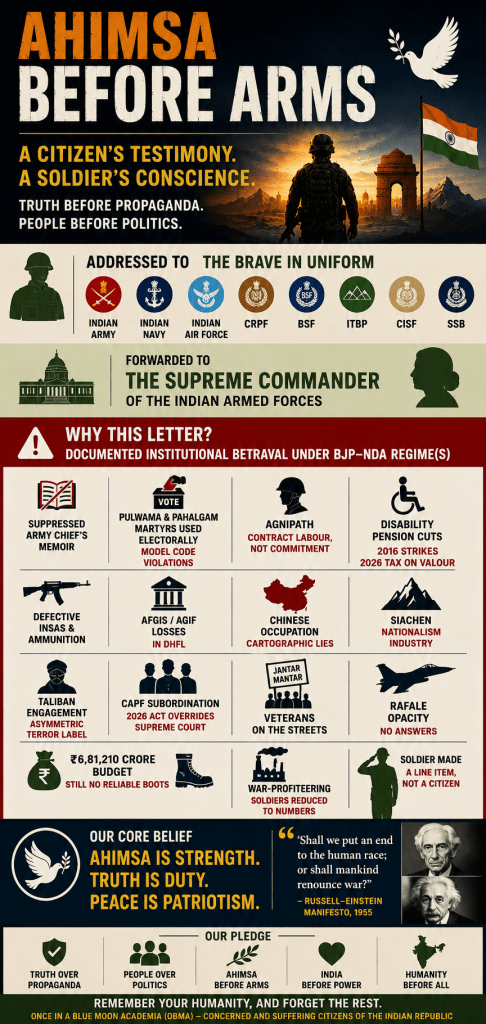
Addressed to the personnel of the Indian Army, Indian Navy, Indian Air Force, and the Central Armed Police Forces — CRPF, BSF, ITBP, CISF, SSB — and forwarded to the Supreme Commander of the Armed Forces.
Authors: Concerned and Suffering Citizens of the Indian Republic
ABSTRACT
Addressed to the men and women in the uniform of the Indian Republic — not to generals, procurement officers, or politicians, but to the person with the rifle, the aircraft, the border watch, and the internal-security beat — this open letter and dossier is written from ahimsa: hard, active non-violence that refuses the destruction of truth. From parliamentary records, CAG reports, RTIs, courts, former Governors and Army Chiefs, the National War Memorial, investigative and strategic sources, SIPRI and budget data, and OBMA’s research, it maps institutional betrayal under the BJP–NDA regime(s): a suppressed Army Chief’s memoir; electoral use of Pulwama and Pahalgam martyrs; Model Code violations; Agnipath’s contract labour; disability-pension cuts after the 2016 strikes and the 2026 tax on valour; AFGIS/AGIF losses in DHFL; defective INSAS and ammunition; Chinese occupation and cartographic lies; Operation Sindoor’s fog and later war-memorial names; Siachen’s nationalism industry; Taliban engagement and the asymmetric terror label; CAPF subordination and the 2026 Act overriding the Supreme Court; veterans at Jantar Mantar; Rafale opacity; a ₹6,81,210-crore budget that still cannot issue reliable boots; and war-profiteering that turns the soldier into a line item. Linked to Prahar, Rang De Basanti, War Chhod Na Yaar, and Jai Ho, and closed by the Russell–Einstein question, it asks the citizen in uniform for viveka — not rebellion, but truth known, paid forward, and refused as the next campaign poster’s raw material.
Keywords: Ahimsa; Indian Armed Forces; CAPF; Civil–Military Relations; Operation Sindoor; Agnipath; OROP; Disability Pension; INSAS; Siachen; DHFL–AFGIS; Taliban; Rafale; Cartographic Massacre; Anyonya Pratibimba; Russell–Einstein Manifesto; BJP–NDA
“I do believe that, where there is only a choice between cowardice and violence, I would advise violence… I would rather have India resort to arms in order to defend her honour than that she should, in a cowardly manner, become or remain a helpless witness to her own dishonor.” — Mohandas Karamchand Gandhi
0. Open Letter Before Documentation
From: Once in a Blue Moon Academia (OBMA)
Email: contactus@onceinabluemoon2021.in, onceinabluemoonacademia@gmail.com
To:
- Smt. Droupadi Murmu, The Hon’ble President of India and Supreme Commander of the Indian Armed Forces, Rashtrapati Bhavan, New Delhi — 110 004
- The Chief of Army Staff, Integrated HQ of MoD (Army), South Block, New Delhi — 110 011
- The Chief of Naval Staff, Integrated HQ of MoD (Navy), South Block, New Delhi — 110 011
- The Chief of Air Staff, Integrated HQ of MoD (Air Force), Vayu Bhavan, New Delhi — 110 011
- The Director General, Central Reserve Police Force (CRPF), CGO Complex, Lodhi Road, New Delhi — 110 003
- The Director General, Border Security Force (BSF), Block No. 10, CGO Complex, Lodhi Road, New Delhi — 110 003
- The Directors General, ITBP, CISF, and SSB
Subject: Transmittal of the consolidated open letter and dossier — “Ahimsa Before Arms” — with a plea for widest possible dissemination to all ranks
Honoured Chiefs, Directors General, and Your Excellency the Supreme Commander,
We write as citizens of the Indian Republic — not as leisure-class politicians, not as military strategists, not as partisans of any electoral formation — but as people who cannot sleep while the world, and our own nation within it, moves steadily toward the condition that Bertrand Russell and Albert Einstein named in 1955 with a precision that has not been improved upon:
Here, then, is the problem which we present to you, stark and dreadful and inescapable: Shall we put an end to the human race; or shall mankind renounce war? — The Russell–Einstein Manifesto, London, 9 July 1955
They did not speak as members of any nation, continent, or creed. They spoke “as human beings, members of the species Man, whose continued existence is in doubt.” They concluded: “Remember your humanity, and forget the rest.”
It is in that spirit — and in the spirit of ahimsa, the active, demanding non-violence that this subcontinent gave the world — that we transmit this document. It is addressed not to institutions as abstractions but to people with bodies: the person carrying the rifle, flying the aircraft, standing watch at the border, sailing in the Indian Ocean, walking a disputed track in Chhattisgarh, freezing on a glacier that kills by weather rather than by fire. The person who, before they were a soldier, was a son or daughter, a brother or sister, a citizen of a republic that made promises it has not kept.
In 1940, at the height of the most devastating war the world had yet seen, Charles Chaplin — playing a humble barber mistaken for a dictator — stepped before a microphone and addressed the soldiers of the world. The passage this letter treats as moral foundation is taken from that speech:
Soldiers! Don’t give yourselves to brutes — men who despise you — enslave you — who regiment your lives — tell you what to do — what to think and what to feel! Who drill you — diet you — treat you like cattle, use you as cannon fodder. Don’t give yourselves to these unnatural men — machine men with machine minds and machine hearts! You are not machines! You are not cattle! You are men! You have the love of humanity in your hearts! You don’t hate! Only the unloved hate — the unloved and the unnatural! Soldiers! Don’t fight for slavery! Fight for liberty!
We do not transmit these words to incite disobedience. We transmit them because the attached record demonstrates, across more than twenty documented dimensions, that the Indian soldier has been systematically treated as an instrument while being publicly celebrated as a hero.
His disability pension was slashed the morning after his sacrifice was used as a campaign backdrop. His savings, invested through service welfare societies, were exposed to a financial fraud whose resolution benefited a conglomerate that donated crores to the ruling party through Electoral Bonds. His standard-issue rifle’s cartridge case bursts in the chamber at a rate documented by the Comptroller and Auditor General. He has been asked to freeze at Siachen at a cost measured in thousands of rupees per second, where the overwhelming majority of casualties come from the mountain itself. He has been sent to patrol a border whose precise location his government will not publicly reconcile with the maps of its closest partners. His predecessor’s memoir — written by a former Chief of Army Staff — has been kept in bureaucratic suspension because it asks questions the political leadership cannot answer. When he is killed, his death is placed as a backdrop on a campaign poster. When he is a CAPF jawan rather than an Army jawan, his widow receives a lump sum and civil-service pension rules. When he is an Agniveer, the contract itself is the abandonment, signed in advance.
Two nuclear-armed states — India and Pakistan — exchanged missiles, drones, and aircraft fire over four days in May 2025. The weapons are more sophisticated than any Russell or Einstein imagined in 1955. The question they posed is more urgent than it has ever been. The soldiers on both sides of that exchange are human beings.
What we ask
- That this covering letter and the attached dossier be received and read by the Chiefs of Service and Directors General to whom it is addressed, and by the Supreme Commander to whom a copy is forwarded.
- That it be disseminated, in whatever manner each service’s commanding officers judge appropriate, to personnel at all ranks — because the documented evidence concerns their welfare, dignity, and institutional treatment, and they have the right to know it.
- That it be treated not as a challenge to military discipline or national security but as the legitimate exercise of Article 19(1)(a) — a right the soldier’s own oath is ultimately taken to protect.
- That it be answered in writing on the documented points: the suppression of General Naravane’s memoir; the eleven pre-Pulwama intelligence warnings and the denied CRPF airlift; the 30 September 2016 disability-pension notification and the 2026 “tax on valour”; AFGIS and AGIF exposure to DHFL; Agnipath’s implementation without adequate institutional consultation; the CAPF (General Administration) Act, 2026, and the Supreme Court judgment it was written to override; the six names inscribed on the National War Memorial after a parliamentary denial of Operation Sindoor deaths; and the unanswered cartographic questions addressed to the National Security Adviser.
We do not expect every reader to accept every conclusion. We do expect every reader to recognise that the evidence is drawn from parliamentary records, CAG audits, RTI papers, judicial proceedings, the National War Memorial Roll of Honour, the testimony of a former Governor of Jammu and Kashmir, leaked but widely reported excerpts of a former Army Chief’s unpublished memoir, and the government’s own budget documents. No institutional reply can dismiss that record without engaging its substance.
We release this document in open solidarity with the men and women who have already walked the path of peaceful, constitutional protest — and with those who will again take their place at Jantar Mantar. In August 2026 the Alliance of All Ex-Paramilitary Forces Welfare Association announced a hunger strike at Jantar Mantar beginning 12 November 2026 (with related notices to the PMO and the Ministry of Home Affairs), demanding withdrawal of the Central Armed Police Forces (General Administration) Act, 2026, and restoration of the Old Pension Scheme. Earlier in the same year, retired Army personnel gathered at the same site over the failures of the Ex-Servicemen Contributory Health Scheme, the tax on disability pensions, and the Agnipath model. We do not claim their seats. We do not speak in their name. We stand with them as citizens who recognise that the demands they carry — dignity of service, honest pension, cadre fairness, an end to the conversion of the uniformed body into temporary labour — are the same demands this letter documents. Their presence at Jantar Mantar is not a threat to the Republic. It is the Republic’s unfinished business made visible. As this dossier enters circulation, we place it beside their banners, their notices, and their quiet, non-violent resolve.
In ahimsa, in grief, and in enduring hope —
The Founder-Members of ONCE IN A BLUE MOON ACADEMIA (OBMA)
How to read the following dossier
Kindly read it as a letter first: it is addressed to a person, not to a ministry. Then read it as a file: every major claim is tied to a date, a document, a testimony, a CAG paragraph, a budget line, a wall of names, or a statute. Where the public record is incomplete — aircraft hull-loss inventory, the full Naravane manuscript, the closed rooms in which Agnipath was decided — the incompleteness is named as incompleteness, not filled with invention. The BJP–NDA information order depends on that filling: rumours where facts would suffice, and slogans where numbers would indict. This text refuses both.
The following sections are not necessarily twenty-one scandals. They are one structure: extract the body, decorate the funeral, litigate the pension, postpone the book, rename the map, short the contract, issue the rifle the auditor has already failed, stage the four-day war and carve the names a year late, freeze the glacier into a billing cycle, host the convenient enemy, override the court, push the veteran off the pavement, seal the aircraft file, spend ₹6.81 lakh crore and still wreck a foot, convert the soldier into a line item, police his speech, and call the cinema that stops at the salute a history. Once that structure is visible, “national security” as currently practised is no longer an argument. It is a method.
Findings at a Glance
- Civil–military truth is managed by delay: a former Army Chief’s memoir remains unpublished years after announcement; Russell’s 1963 book was banned; the method is older than the present government and more efficient under it.
- Pulwama is not a closed file: eleven warnings, a denied airlift, a Governor told to keep quiet, forty dead, an election. No minister resigned.
- The soldier is an electoral asset and a fiscal liability in the same week: posters, helicopters, “Modi ki Sena,” then Agnipath, disability cuts, 16,000 tribunal appeals.
- Service welfare money — AFGIS, AGIF, a Navy school — sat inside DHFL; the resolution favoured a politically donated-to acquirer; a SLAPP followed the speech of victims.
- The kit still fails the CAG test: INSAS metallurgy, ammunition holes, glacier clothing. Time magazine’s 1962 sentence has not been retired.
- Maps and speeches diverge: 38,000 sq km, buffers on India’s own claim, Depsang unsaid, an unanswered letter to the NSA.
- Operation Sindoor produced a Lok Sabha sentence (“none of our soldiers were harmed”) and, thirteen months later, six names on the National War Memorial.
- CAPF dead are statistically real and institutionally lesser; the 2026 Act cancelled a Supreme Court repair job and reserved the summit of those forces for IPS deputation.
- Veterans already practised ahimsa for 320 days. The state called them a gun and tore a shirt.
- A ₹6.81 lakh-crore budget and a fifth-place global ranking have not produced a boot that does not wreck a foot. They have produced a private offset and a public haircut.
DEDICATION
This document is dedicated—
to the forty CRPF personnel who died at Pulwama;
to the twenty soldiers who died at Galwan;
to the six whose names were cut into the National War Memorial after a minister told Parliament that no soldier had been harmed;
to Lance Naik Hanumanthappa, who survived six days beneath twenty-five feet of Siachen snow before the mountain finished what the avalanche began;
to the widows of the Indian Air Force, whose savings stopped the day DHFL stopped;
to Danish Siddiqui, who documented a war and was killed in it, and whose government later rolled out the carpet for the force that held the ground where he fell;
to the 4,942 CAPF personnel killed in action since their forces were raised;
to the eighty-two-year-old veteran whose shirt was torn by the police on the eve of Independence Day;
and to every soldier who carried a rifle whose magazine cracked in the cold—
in the name of a nation that owed them better.
In Akira Kurosawa’s Dreams (1990), in the the sequence often referred to as “The Tunnel,” a demobilised company commander walks a lonely road at dusk. An anti-tank dog — explosives strapped to its back — snarls out of the darkness and will not let the war end. From the black throat of the tunnel Private Noguchi steps forward, his face painted the blue of the drowned, and asks the only question that still matters: “Sir, did I really die in action?” He cannot believe it; the light of his parents’ house still burns on the mountainside and they are still waiting. The commander, who held him as he died, can only answer that the homecoming was a dream he had while dying.
Then… the whole Third Platoon marches out at attention, blue-faced, boot-perfect, still reporting “all present and accounted for” to a country that has already spent them. The officer breaks and orders them back into the dark: the war was absurd, the responsibility is his, go back and rest in peace. This is the only true monument the war industry ever builds — a tunnel, a mad dog, and a column of boys who do not yet know that the flag they died under has already forgotten their names, that their “supreme sacrifice” was a line in a budget, a poster behind a podium, a sentence in Parliament that said none of our soldiers were harmed. They come back to ask one thing of the living: not for medals, not for memorials, but to be told the truth — that the war was manufactured, that they were never machines and never cattle, and that someone, at last, is awake enough to say turn back, rest, it should never have been you. Are we/they really dead…or living?
I. Introduction — The Sleepless Citizen And The Hard Question
This letter-and-dossier is written at midnight by someone who cannot sleep.
Not because of hatred. Not because of maitri — that benevolent goodwill which asks nothing of anyone and demands nothing of the world. But because of ahimsa: the active, unrelenting refusal to participate in the logic of destruction, including the destruction of the truth that the people in uniform most deserve to know.
On 9 July 1955, Bertrand Russell stood before the world and read aloud a document co-authored with Albert Einstein — signed four days before Einstein’s death — and nine of the greatest scientific minds then living. They were not speaking in metaphor. They were physicists who understood precisely what they had helped create. They appealed not to governments but to individuals: scientists, citizens, soldiers.
This letter-and-dossier is written in that tradition. It is addressed to you — the person who wears the uniform — because every section that follows documents not the failure of soldiers but the failure of the system that claims to honour them.
You are asked to die for a nation that cuts your disability pension. You are asked to freeze at Siachen for thousands of rupees per second of taxpayer expenditure and then receive boots that damage your feet. You are asked to fly aircraft whose spare parts were procured under a cloud and then told — when you crash — that it was pilot error. You are asked to patrol a border whose precise location your government will not publicly disclose, guarding a map whose “not an inch of land lost” notation contradicts the buffer zones established inside your own claim lines.
— This letter, to the person in uniform
You deserve the truth. This dossier is an attempt to give it to you. It asks, at the end, not for your rebellion but for your viveka — the discriminative wisdom that can see through the distorted mirror of manufactured theocratic nationalism to the institutional architecture constructed, in your name and at your expense, for purposes that have served the political leadership far more reliably than they have served you.
The BJP–NDA years have perfected a double movement. In public: the soldier as the highest symbol of the nation, the martyr as campaign décor, the operation-name as sacred vocabulary, the slogan that not an inch has been lost. In private and in the Gazette: the contract that abolishes the pension, the notification that slashes disability benefit, the court filing in which the Ministry of Defence is the adversary of the wounded, the Act that reserves the top of the CAPF for IPS deputation, the memoir that cannot be read, the names that appear on the National War Memorial a year after the Minister told the Lok Sabha that no soldier was harmed. The two movements are not a contradiction in the regime’s own logic. They are the logic. Extraction in the name of honour. Management in the name of fiscal prudence. Silence in the name of national security.
The pages that follow are therefore not a catalogue of grievances. They are a map of a single structure, viewed from more angles. Read any one section in isolation and it can be dismissed as an anomaly, a leak, a disgruntled veteran, a CAG paragraph. Read them together and the pattern is no longer deniable.
II. The Suppressed Voice — General Naravane’s Memoir And The Architecture Of Silence
A former Chief of Army Staff wrote a book. It was announced, listed, pre-ordered, and then disappeared into an indefinite Ministry of Defence review that has no published rejection, no timeline, and no appeal. Leaked passages record a request for political orders at Galwan and a reply that was not an order. This section holds that silence open: the manuscript that cannot be read, the three words that indict, and the older Indian tradition of keeping inconvenient military truth in bureaucratic purgatory.
II.1 The memoir that cannot be read
General Manoj Mukund Naravane (retd.), Chief of Army Staff from 2019 to 2022, wrote Four Stars of Destiny: An Autobiography. It traces a journey from a middle-class childhood to the apex of India’s military hierarchy, interweaving personal milestones with sustained reflections on leadership, institutional ethos, and the fraught dynamics of civil–military relations. It was announced in 2023. It was offered for sale. It has never been formally published. As of mid-February 2026 it remained trapped in the Ministry of Defence review process — years without resolution — while numerous other military publications sailed through.
Penguin Random House India holds exclusive rights. There has been no production or authorised distribution. Listings disappeared from major platforms; pre-orders were cancelled; circulating copies are unauthorised. General Naravane himself marked the status of the book on social media. A Delhi Police FIR followed the illegal distribution, with questioning of publishing personnel. Rahul Gandhi cited the book in Parliament in early February 2026, referring back to Naravane’s 2023 announcement that it was “available now.” The House saw adjournments. The state answered with procedure.
This is not routine vetting. It is the state’s preferred instrument of silencing: not a ban, which would invite a court; not a rebuttal, which would concede the terrain of argument; but bureaucratic purgatory. No written rejection. No timeline. No appeal. Indefinite review. The government cannot formally reject the manuscript without scrutiny. It cannot permit release without legitimising an insider narrative that contradicts the constructed image of decisive, unflinching national-security leadership.
II.2 Galwan and the three words that indict
The memoir’s political danger lies in its account of the Ladakh standoff of 2020. Leaked excerpts, reported across independent media and cited in Parliament, describe repeated requests from Army leadership for explicit political guidance during the Galwan confrontation — requests met with vague or non-committal replies. The phrase attributed to the political leadership has been widely reported: “Jo uchit lage woh karo” — do what you think is fit.
A serving Army Chief, commanding Indian troops in an active confrontation with the People’s Liberation Army on the Himalayan border, asks the civilian political leadership for orders. He is told, in effect, to use his own judgement. That is not delegation of operational detail. It is abdication of political responsibility at the precise moment the Constitution assigns that responsibility to the civilian executive. And then, when the confrontation produces twenty deaths — seventeen of them completed by exposure after the melee — the same political leadership claims decisive credit for a response it apparently declined to clearly authorise.
Twenty Indian soldiers were killed on the night of 15–16 June 2020 in hand-to-hand combat with improvised weapons at approximately 17,000 feet. Colonel Santosh Babu was among the dead. The Shyok — the river whose name means death — claimed men by hypothermia after they fell from the ledge. China later acknowledged four deaths of its own. The official Indian line remained “not an inch of land lost,” even as buffer zones subsequently established at Pangong Tso took Indian troops off a stretch of their own claim line from Finger-2 to Finger-8, and even as Depsang and Demchok continued to register the loss of earlier patrolling access.
II.3 The mechanism of suppression
The rule is simple: the closer the speaker is to the state’s core legitimacy, the subtler the suppression. A BBC documentary can be dismissed as colonial bias and throttled at the gateway. A former Governor can be raided by the CBI. A memoir by a former Army Chief cannot be easily discredited without destabilising civil–military trust. So the state chooses delay. The silence around Four Stars of Destiny is itself the most damning argument the text is not allowed to make. By keeping the book inaccessible, the government ensures that its most serious accusation — about the management of inconvenient truth — is made not only by the pages that cannot speak, but by the years of non-publication that surround them.
This is not new. In 1963 Bertrand Russell published Unarmed Victory, documenting his correspondence with the governments of India and China during the 1962 war, and arguing that Nehru’s Forward Policy had been a provocation and that ceasefire proposals had been rejected. The Indian government banned the book. Sixty-three years later the 2020 version of the same pattern — political ambiguity, military exposure, subsequent myth-making — is in the same purgatory. The suppression of honest military accounts is among the republic’s oldest geopolitical traditions. The BJP–NDA years have not invented it. They have professionalised it.
The memoir also, according to leaked indications, records professional concern inside the Army high command about Agnipath — readiness, cohesion, long-term institutional health — and the political constraint on saying so openly. The Army did not design the scheme. It was told to implement it. That fact belongs in Section V. It is named here because the same document that cannot be published is the document that would have let the institution speak in its own voice about both the border and the contract.
Compare the handling. A coffee-table book that flatters a leader clears. A unit history that flatters a battle clears. A Chief’s book that records a request for orders and a reply that was not an order does not clear. The Ministry will say security. Security is the word a bureaucracy uses when the danger is to a narrative rather than to a post. If Galwan’s political management cannot survive a retired Chief’s prose, the problem is not the prose.
Rahul Gandhi’s citation in the Lok Sabha in February 2026 did what the review process was designed to prevent: it moved the unpublished book from a private humiliation into a public fact. The FIR on unauthorised copies then performed the second half of the manoeuvre — criminalise circulation rather than authorise publication. A state that cannot bear a book will always prefer a police station to a printing press.
III. Pulwama — The Uncontested Testimony Of Satyapal Malik
On 14 February 2019, forty CRPF personnel died at Lethpora. Eleven intelligence warnings had already been issued. An airlift request had been denied. The Governor of Jammu and Kashmir — the government’s own appointee — later stated on record that he was told to keep quiet (allegedly by the Prime Minister’s Office itself!). No minister resigned. The bodies entered the election. This section holds the sequence open: the warnings, the denial, the silence order, and the testimony that has never been factually rebutted.
III.1 Who Satyapal Malik is, and why it matters
Satyapal Malik was appointed by Prime Minister Narendra Modi as Governor of Jammu and Kashmir. He was the constitutional head of the state on 14 February 2019, when 40 CRPF personnel of the 76th Battalion were killed at Lethpora, Awantipora, Pulwama district, by a vehicle-borne suicide bomber using approximately 300 kilograms of RDX. He was not an opposition politician. He was the government’s own representative, with access to intelligence briefings and a line to the Prime Minister’s Office.
In a one-hour interview with Karan Thapar in April 2023, Malik made allegations that have not been refuted on the facts. They have been deflected, dismissed, and followed by CBI raids on his premises. Former Army Chief General Shankar Roychowdhury subsequently confirmed the substance of Malik’s revelations in an interview with Telegraph India. The testimony stands. The raid is the reply.
III.2 Eleven warnings, one denied aircraft request, three hundred kilograms of RDX
A year-long investigation by Frontline established eleven intelligence warnings issued between 2 January and 13 February 2019. The last of them, dated the day before the attack, specifically flagged the routes of security forces in the Pulwama–Awantipora area. At least six inputs named Awantipora.
The CRPF asked the Home Ministry for aircraft to move approximately 2,500 personnel from Jammu to Srinagar. The request was denied. A convoy of 78 vehicles went by road. The route was not sanitised. Eight to ten link roads meeting the highway at the attack zone were left unmanned. A vehicle carrying 300 kilograms of explosive travelled through one of the most heavily surveilled territories on earth for ten to fifteen days without interception.
Malik’s account: he called the Prime Minister the day after the attack to report the lapses. He was told “Chup raho” — keep quiet. The National Security Adviser, Ajit Doval, separately told him to stay silent. Rajnath Singh was Union Home Minister at the time. No minister resigned. The attack was folded into the election.
III.3 The electoral arithmetic
The Pulwama attack occurred on 14 February 2019. Lok Sabha polling began on 11 April 2019. The Balakot airstrike followed on 26 February. At a Latur rally the Prime Minister asked voters to dedicate their first votes to the soldiers of Pulwama and Balakot — in explicit tension with the Election Commission’s own directive not to invoke the armed forces in campaigns. Field officers of the Commission confirmed the violation in writing. The commissioners overruled their own officers and issued a clean chit. Ten complaints filed by the Congress produced no action.
Malik’s conclusion, on the record: he understood that the government acted with the thought of benefiting electorally from the attack. That sentence does not require a conspiracy theory about who built the bomb. It requires only the documented sequence: warnings unused, airlift denied, silence ordered, bodies converted into a campaign vocabulary, accountability refused. The same sequence is the analytical template this dossier applies, without hysteria and without exemption, to Pahalgam and Operation Sindoor in 2025.
| Date | Fact on record | Political sequel |
| 2 Jan–13 Feb 2019 | Eleven intelligence inputs; six naming Awantipora | No visible route sanitisation of the 14 Feb convoy |
| Pre-14 Feb 2019 | CRPF airlift request for ~2,500 personnel denied | 78-vehicle road convoy; unmanned link roads |
| 14 Feb 2019 | 40 CRPF personnel killed; ~300 kg RDX | No ministerial resignation |
| 15 Feb 2019 | Governor Malik reports lapses; told to keep quiet | CBI attention arrives years later — for Malik |
| 26 Feb 2019 | Balakot airstrike | Folded into campaign oratory |
| Mar–Apr 2019 | Latur “first vote” appeal; “Modi ki Sena”; Pulwama poster as backdrop | EC field officers overruled; clean chit |
| Apr 2023 | Malik–Thapar interview; Roychowdhury confirmation | Raid, deflection, no factual rebuttal |
IV. The Soldier As Electoral Prop — Model Code Violations
The conversion of the soldier from a citizen in uniform into a political asset is not a slip of the tongue. It is a practice with dates, venues, and a paper trail of notices that went nowhere.
IV.1 “Modi ki Sena”
On 31 March 2019, during the campaign for the general election, Uttar Pradesh Chief Minister Yogi Adityanath publicly described India’s armed forces as “Modi ki Sena” — Modi’s Army. The Election Commission of India issued a notice for violation of the Model Code of Conduct. There was no retraction of substance. The phrase was not withdrawn. The matter was allowed to dissolve into the noise of the campaign. The constitutional point did not dissolve with it.
The armed forces of India are not the private property of any political leader, party, or government of the day. They belong to the Republic and to the Constitution. The soldier’s oath is taken to the Constitution of India, not to a surname, not to an election symbol, not to a campaign slogan. To call the Army, the Navy, the Air Force, or the CAPF “Modi’s Army” is not a slip of the tongue. It is an ideological claim of ownership by design. It converts the uniformed body into a political commodity — an asset to be brandished on posters, invoked in rallies, and spent for electoral return. The same formation that cuts disability pensions, shortens service into Agnipath contracts, litigates the wounded in sixteen thousand tribunal files, and keeps a former Army Chief’s memoir in bureaucratic purgatory simultaneously asserts proprietary rights over the very men and women it treats as expendable. The phrase does not honour the soldier. It annexes him. That is the false claim this dossier records and refuses.
IV.2 The dead as backdrop
At a Churu, Rajasthan campaign rally, a poster of the Pulwama dead was positioned behind the Prime Minister so that television cameras would frame the dead as his backdrop. Their names became votes. Their families’ grief became electoral arithmetic. The Model Code exists precisely to prevent this alchemy. It was not applied.
IV.3 The IAF helicopter at Chilakaluripet
In 2024 the Prime Minister arrived at a campaign rally in Andhra Pradesh in an Indian Air Force helicopter — a government asset, crewed by Air Force personnel — for a party campaign event. A complaint was filed. No action followed. Indira Gandhi was disqualified by the Allahabad High Court in 1975 for a lesser misuse of official machinery. The precedent exists. The will to apply it to the present incumbent did not.
IV.4 Religion, enmity, and the broadcast consecration
Section 123(3) of the Representation of the People Act, 1951, prohibits appeals on grounds of religion. Section 123(3A) prohibits promoting enmity between classes of citizens for electoral purposes. The Ram Mandir consecration in January 2024 — three months before the general election, attended by the Prime Minister in his official capacity, without the President of India, with Vedic ritual nationally broadcast — tested both provisions. No electoral consequence followed. The pattern is the point: the soldier, the martyr, the temple, the aircraft, the slogan. Each is available. None is restrained.
V. The Agnipath Betrayal — Soldiers As Temporary Labour
Launched on 14 June 2022, Agnipath turned a four-year contract into the new foundation of recruitment: up to 25 percent retained, 75 percent discharged with a severance packet and no pension. The government called it modernisation. The Parliamentary Standing Committee had already projected the pension bill toward ₹2.5 lakh crore. This section holds the scheme to that arithmetic — and to the professional warnings that were overridden, the readiness that was traded for a spreadsheet, and the young soldier who signs the abandonment in advance.
V.1 The scheme and its real motive
Launched on 14 June 2022, Agnipath recruits Indians aged 17.5 to 21 for a fixed four-year term. At the end of that term, up to 25 percent may be retained. The remaining 75 percent are discharged with a Seva Nidhi of approximately ₹11.71 lakh assembled from matched contributions plus interest. No pension. No gratuity. No lifelong entitlement. Starting pay is in the region of ₹30,000 a month, rising toward ₹40,000 by year four. Life cover during the contract is non-contributory and finite.
The government presented the scheme as modernisation: a younger force, a leaner pension bill, a tech-ready profile. The Parliamentary Standing Committee on Defence had already projected the pension bill toward ₹2.5 lakh crore. The scheme is the pension bill’s solution, transferred onto the youngest and least protected recruits. The institution that trains a soldier for perfection and then returns him at twenty-two with a severance packet and no institutional belonging has not reformed itself. It has exported its fiscal problem onto the person least able to bear it.
By 2026 the original 25 percent retention was already under strain. The Navy sought 70–75 percent retention for technical trades; Army and Air Force discussions moved toward approximately 50 percent. The numbers are an admission. A scheme sold as design is being patched as damage.
V.2 The consultation gap
Leaked indications from the unpublished Naravane memoir describe the Army high command voicing professional concerns about readiness, cohesion, and long-term institutional health, and facing political constraint on open expression. The Army did not design Agnipath. A transformation in the foundational basis of recruitment — from career service to temporary contract — was decided above the institution and issued to it as policy. Civilian supremacy is a constitutional good. Civilian supremacy used to silence professional warning is not statesmanship. It is the militarisation of a spreadsheet.
V.3 Nine structural lacunae
- Combat readiness: four-year rotations corrode the regimental cohesion that Indian infantry doctrine still treats as a fighting system, not a slogan.
- The 75 percent problem: trained twenty-two-year-olds released into a job market that was already failing them; youth unemployment in official series has been grim enough without adding a cohort taught to kill and then told to find a private job.
- Death-in-service disparity: Agniveer families do not receive the pension and lifelong architecture that regular soldiers’ families receive. Agniveer Mood Muralinaik is among the six Operation Sindoor dead later inscribed on the National War Memorial — a contract soldier entered on the wall of honour under a scheme that denied him the ordinary entitlements of honour.
- Seva Nidhi’s actual worth: less than two years of metropolitan rent in many cities; a severance, not a pension.
- The Nepal–Gorkha diplomatic rupture: a recruitment tradition older than the republic, treated as an accounting residual.
- Pandemic-era age injustice: aspirants over-aged by the years in which recruitment was frozen.
- Nashik training deaths: the human cost of compressing formation into a disposable cycle.
- Compensation scandals around individual Agniveer deaths, including the Ajay Kumar case as reported in the public record.
- The suicide of an Agniveer on sentry duty in Agra — the endpoint of a design that isolates a very young person inside an old institution and then reminds him he does not fully belong to it.
Behind all nine is a single principle: the reduction of the soldier from a citizen in uniform to temporary contract labour in the gig economy of national defence. The BJP–NDA government did not stumble into this. It chose it, against professional warning, as a method of shrinking a future fiscal obligation while expanding a present nationalist spectacle.
Youth protests against Agnipath were treated as a law-and-order event rather than as a recruitment event. The scheme arrived after years in which ordinary recruitment had itself been frozen, so that the first offer many aspirants met after the pandemic was not a career but a contract. The political language was “tour of duty,” borrowed from armies that do not ask a twenty-year-old to hold Siachen on a four-year clock and then return him to a district with no industry. India’s force structure is still built on long socialisation inside a regiment. Agnipath keeps the regiment’s name and deletes the time that makes the name mean something.
There is a further cruelty hidden in the 25 percent retention. The three men in four who leave are not merely unemployed. They are trained, young, armed-service-socialised, and told that the institution which took their best years has no further use for them. Any honest internal-security planner would treat that cohort as a social fact. This government treated it as a saving.
VI. The Pension Betrayal — Honouring Sacrifice In Public, Litigating Against It In Private
On 28 September 2016, India celebrated surgical strikes. On 30 September the Ministry of Defence issued a notification that cut disability pensions for soldiers injured in the line of duty. The same pattern returned in 2026 as a tax on full-tenure disability pension, while more than 16,000 cases stood pending in which the government litigated against its own wounded. This section holds the double movement open: public honour, private reduction — cut, partial retreat, reimpose.
VI.1 30 September 2016 — the morning after the celebration
On 28 September 2016, Indian Army para-commandos crossed the Line of Control on what the government named surgical strikes. On 29 September, India celebrated. On 30 September — the day after the celebration — the Ministry of Defence, through the Department of Ex-Servicemen Welfare, issued a notification dramatically reducing disability pensions for soldiers injured in the line of duty.
| Category (illustrative, as then reported) | Effect of the 30 Sep 2016 notification |
| Young soldier, 100% disability, invalided out | Monthly pension cut from ₹45,200 to ₹27,200 — ₹18,000 a month gone |
| Major, ten years’ service | Disability pension slashed by over ₹70,000 a month |
| Naib Subedar, 26 years’ service | Disability pension slashed by ₹40,000 a month |
| Serving general, on record | “Shocked is an understatement. Instead of joining us in celebrating the strikes, the MoD has stabbed us in the back.” |
VI.2 The 2026 “tax on valour”
The 2026 Union Budget removed income-tax exemptions for disability pensions of soldiers who retire after completing full tenure, even where they carry a service-related disability. The encoded message is brutal in its clarity: it is fiscally smarter to leave early than to complete the service while injured. A republic that taxes the wounded for staying is a republic that has converted valour into a taxable event.
VI.3 Sixteen thousand cases — the Ministry against its own
Over 16,000 cases have stood pending in various courts in which the government challenges disability-pension awards granted by the Armed Forces Tribunal. Sixteen thousand wounded or disabled former soldiers in legal battle with the state they served. In many files the cost of government lawyers, across years and hearings, exceeds the cumulative pension differential in dispute. This is not thrift. It is punitive bureaucracy. The state spends money to ensure that soldiers receive less.
VI.4 Cut, retreat, reimpose
The 2016 cuts were partially withdrawn after public outcry. The PMO intervened for damage limitation. Reporting in February 2026 confirmed that the most damaging cuts had returned. The government, headed in finance by Nirmala Sitharaman — who had herself served as Defence Minister and cannot plead ignorance of what the reductions mean for battle casualties — again cut soldiers’ disability benefits. The pattern is: cut; face outrage; partially retreat; wait; reimpose. The soldier exhausts. The file does not.
One Rank One Pension belongs in the same pattern and is treated at length in Section XIII. The words are simple. Implementation has been partial, contested, and timed to protest and to elections rather than to the contract the republic claimed to have made.
VII. The DHFL Scandal — When The Airman’s Widow’s Savings Funded Crony Capital
The savings of airmen, soldiers and their widows sat inside Dewan Housing Finance when the company defaulted (2019), the RBI superseded its board (20 November 2019), and the NCLT opened the CIRP (moratorium from 29 November 2019). Three service-welfare pockets were on the books as admitted claims: Army Group Insurance Fund ~₹39.24 crore (NCDs), Air Force Group Insurance Society ~₹72.93 crore (fixed deposits), Navy Children School ~₹2.54 crore (FDs) — about ₹114.7 crore in all. On 7 June 2021 the NCLT approved Piramal Capital’s resolution plan (implemented 30 September 2021) and, in the same order, asked the Committee of Creditors to reconsider paying the Army group in full, given the nature of the duties those funds were meant to protect. On 17 June 2021, at its 20th meeting, the CoC put that suggestion to a vote: 100 percent cash for AGIF, AFGIS and the Navy school. The banks rejected it — 89.19 percent against. AFGIS appealed. Retail depositors as a class were left with a fraction (a mere 23% for dissenting FD Holders of the DHFL) of admitted dues; the politically connected acquirer, Ajay Piramal, took the company. Electoral-bond disclosures later showed the Piramal group among the largest financial-sector purchasers of bonds (group entities totalling on the order of ₹85 crore+, including Piramal Capital and Housing Finance).
At that fork the service-welfare depositors and the wider victim body refused a carve-out that would have paid the uniform’s savings in full while leaving other fixed-deposit holders to the haircut. They declined preferential exit and stood with the rest. We salute that refusal. This section holds the sequence open: whose money it was, the dates on which the CoC and the NCLT spoke, where the resolution went, and what solidarity cost.
VII.1 Whose money it was
The Air Force Group Insurance Society mobilises the savings of Air Force personnel — past, present, and dependants. Its social-security deposit schemes are designed for retired airmen and widows of air warriors, who place terminal benefits — gratuity, commuted pension, leave encashment — as the primary source of ongoing income. AFGIS invests the pool in instruments it deems safe. One such instrument was DHFL, then AAA-rated by Indian credit agencies.
| Institution | Reported exposure / admitted claim |
| Air Force Group Insurance Society | ₹72.93 crore admitted in insolvency (earlier public report of ~₹84 crore FD exposure, Nov 2019) |
| Army Group Insurance Fund | ₹39 crore |
| Navy Children’s School | ₹2.54 crore |
| Approximate armed-forces financial exposure | ₹114.47 crore of terminal benefits and welfare funds |
VII.2 What DHFL did, and what the resolution did
DHFL’s promoters stand accused of diverting tens of thousands of crores — figures in the public forensic discussion run above ₹30,000 crore and, in some reconstructions, higher — through shell companies, with alleged links in investigative reporting to criminal networks. When DHFL collapsed in 2019, payments froze. Widows whose monthly income came from AFGIS interest on DHFL deposits did not see that income reduced. They saw it stop.
The resolution plan ultimately approved — over the higher bid associated with Oaktree and over promoter Kapil Wadhawan’s offer of full repayment to creditors — was the Piramal plan. Small FD holders received in the region of 23 percent of claims at the first distribution. Ajay Piramal’s political donations to the BJP through Electoral Bonds have been reported at ₹85 crore; DHFL itself donated ₹27.5 crore to the BJP before collapse. Section 32A of the Insolvency and Bankruptcy Code, conferring clean-slate immunity on the acquirer, was inserted into law 25 days after DHFL’s insolvency proceedings began. The coincidence is not an argument all by itself. Combined with the bond donations, the rejected 100-percent offer, and the privileging of a politically connected bidder, it is an argument the state has never honestly answered.
On 17 June 2021 the NCLT suggested treating the “ARMY Group” as a separate class and repaying admitted claims without haircut. The Committee of Creditors did not take that road. Ordinary depositors wrote to the IAF command and the Defence Minister on 18 May 2021. Public messaging in June 2021 thanked service-linked creditors who voted against a modified plan that would have isolated full repayment for themselves alone. Article 14 was invoked to justify treating widows and tycoons inside the same haircut. Equality before the law, in that usage, meant equalising the airman’s widow with the resolution applicant’s convenience.
Chronology matters because memory is what the resolution process is designed to exhaust. November 2019: AFGIS exposure in DHFL FDs is already in the public domain, then reported near ₹84 crore. 2019–20: ratings that had been AAA stand exposed as theatre. 2021: NCLT speaks; CoC does not take the full-repay road for the Army group; small holders learn the percentage that “resolution” would mean. Thereafter: Piramal control, Section 32A shelter, Electoral Bond numbers in the public conversation, and, in 2025–26, a defamation suit against the people who kept the chronology on the page. The widows did not move. The file did.
VII.3 The SLAPP
Piramal Finance filed a defamation suit — Bombay High Court Suit S/42/2025 — against DHFL victims and activists including the OBMA founder-member, listed as Defendant No. 6, his name misspelled. A timely written statement filed by email was ignored; he was classified under “Undefended Suits.” The plaintiff continued to file in a defunct pre-name-change corporate identity; the registry stamped papers “CANCELLED.” RTIs from OBMA to the CAG, the IBC architecture, and the Ministry of Home Affairs produced evasion, misdirection, and disposal. The state’s information system protected the system that harmed the Indian armed personnel’s widows. The courtroom was then used to punish the people who said so.
VIII. Defective Weapons And The Manufactured Soldier
The Comptroller and Auditor General has already written the indictment in percentages. Between 2015 and 2020, 13 to 17 percent of INSAS rifles issued for field use were returned with metallurgical and functional failure; certain ammunition fuzes recorded deficiency rates approaching 94 percent; seven ammunition types sat in shortfall of 32 to 74 percent of authorised holdings; Siachen winter clothing and high-altitude gear were found deficient across consecutive audited years (2015–18). Boots still wreck feet. The same political order that names operations after valour and places the soldier on campaign posters continues to issue kit the auditor has already declared unfit. This section holds that gap open: the manufactured hero, the defective rifle, and the file that never closed.
VIII.1 INSAS
Between 2015–16 and 2019–20, 13 to 17 percent of INSAS rifles were returned for rectification. A CAG audit of 26 defect-investigation cases found 14 from the INSAS: cartridge cases bursting in the chamber, bulging of the housing body, cracks in the breech block. Rifles were declared unserviceable. The CAG’s conclusion was metallurgical: pre-existing deficiencies, improper heat treatment, manufacturing failure.
At Kargil in 1999 — the rifle’s first major combat deployment — magazines cracked in the cold. In Nepal in 2005, 43 soldiers died when INSAS rifles overheated in sustained fire. An injured soldier, from a hospital bed after a Maoist attack, said on national television: “Government doesn’t give us anything. How do we fight Maoists with INSAS and without bulletproof vests?” The Army stopped buying INSAS by 2014. The Ordnance Factory Board asked the Army to buy more.
VIII.2 Ammunition
A CAG report identified critical deficiencies across 30mm, 40mm, 51mm, 81mm, 84mm, 105mm, 120mm, 125mm and 130mm — the ammunition of infantry combat vehicles, anti-aircraft guns, mortars, rocket launchers, field guns, T-72s and T-90s. Seven types showed deficiencies of 32 to 74 percent. Five types of spare fuzes showed deficiencies of 41 to 94 percent. The Army has been stocking ammunition it had itself declared obsolete in 2009. Accidents from faulty ammunition have been raised by the service as an operational alarm, not a tabloid complaint.
VIII.3 Boots, jackets, sleeping bags, face masks
CAG reporting confirmed that between 2015–16 and 2017–18, troops at Siachen lacked basic winter gear: boots, jackets, sleeping bags, face masks. Officers and soldiers buy their own boots because OFB boots damage their feet. This is the material condition of a force maintained by what the government calls the world’s fifth-largest defence budget.
VIII.4 A sentence from 1962 that has not expired
Time magazine, on Rezang La, 1962, where a company armed with bolt-action rifles died almost to the last man: “The Indian Army soldier lacks almost everything but courage.” Written in 1962. Structurally accurate in 2026, if the measure is CAG paper, parliamentary committee paper, and the man on the hospital bed. Courage is not a procurement policy. Treating it as one is how governments convert a virtue into an alibi.
IX. The Cartographic Massacre — Chinese Occupation And The Unanswered Letter
For more than six decades, maps have been redrawn while official speech has denied the redrawing. Chinese control over roughly 38,000 square kilometres of Aksai Chin, the 2020 Galwan clash, subsequent buffer zones that moved the Line of Actual Control westward, and the unanswered letter of a former Army Chief to the political leadership form one continuous record. In 2025–26 the same pattern reappeared in Arunachal’s Upper Subansiri: local communities and fact-finding teams reported PLA pressure on traditional grazing lands and denial of access to designated Indian patrolling points such as Shera 5; the Army and the political leadership denied formal “encroachment,” even as a minister acknowledged heightened Chinese activity on the high ridges and said villagers’ concerns were justified. At the same time the Siliguri Corridor — the narrow “Chicken’s Neck” that links the Northeast to the rest of India — was placed under a new triangular security grid of garrisons and land transfers, an admission that geography itself remains a strategic liability. Territory contested, language managed, the soldier left to hold a line the map no longer fully matches. This section holds that record open.
IX.1 The letter that received no answer
On 1 January 2025, our OBMA addressed the National Security Adviser, Ajit Doval, seeking clarification on the discrepancies between India’s official maps — showing Aksai Chin, all of Arunachal Pradesh, and undivided Jammu and Kashmir as Indian territory — and maps served from the United States, the United Kingdom, Canada, China and Vietnam, which do not ratify those lines. The letter asked: who is to be trusted? What are the actual borders? How are citizens to understand the sovereignty the Constitution names when partner-states’ maps do not reflect it? No reply came. The silence of the man who negotiated the post-Galwan arrangements is itself a reply.
IX.2 Territorial arithmetic
| Claim / fact | Approximate magnitude | Official posture |
| Aksai Chin under Chinese control since the 1950s | ~38,000 sq km (larger than Kerala) | Shown as India on official Indian maps |
| Arunachal Pradesh claimed by China as “South Tibet” | ~83,000 sq km | Renaming campaigns 2023–24; claim rejected, infrastructure race unfinished |
| Combined disputed / claimed theatre | ~121,000 sq km | Nationalist oratory; maps unchanged |
| Territory Pakistan ceded to China, 1963 | ~5,180 sq km | Acknowledged in Parliament by the Defence Minister, Sep 2020 |
| Pangong buffer after 2020 | Indian patrols off Finger-2 to Finger-8 stretch (~10 km) | Maps still print the LAC at Finger-8 |
| Reported loss of Indian-patrolled ground, May–Jun 2020 | ~60 sq km (Daily Telegraph and later analyses) | “Not an inch of land lost” |
| Depsang, Demchok patrolling access | Restricted / contested after 2020 | Omitted from key ministerial statements |
The philosopher Ludwig Wittgenstein, in the Blue Book, mentioned: a man who wishes to redraw Devonshire has not changed the hills; he has proposed a new notation. “By a new notation no facts of geography are changed.” “Not an inch of land lost” is a new notation. The buffer zones, the lost patrols, the villages China built, the roads China poured, the fingers Indian troops no longer walk — those are the hills.
Even Rajnath Singh’s 17 September 2020 Rajya Sabha statement did acknowledge Chinese occupation of approximately 38,000 square kilometres in Ladakh and the 5,180 square kilometres Pakistan ceded in 1963, and China’s claim on a further vast tract, including Arunachal Pradesh. What it did not do was name the lost patrolling access in Depsang. Opposition members did. Analysts did. The ministerial sentence did not.
IX.3 Galwan, again, as geography rather than anniversary
Post-2020 China consolidated in eastern Ladakh — permanent villages, roads, bases in the Depsang–Pangong–Demchok arc — while disengagement produced buffers that fell predominantly on ground India had patrolled. Beijing continues to reject the McMahon Line and to pace infrastructure faster than India’s belated BRO surge. The 2025–26 BRO capital allocation of ₹7,146.50 crore is not nothing. It is also not an answer to a decade of political insistence that nothing required an answer.
X. Operation Sindoor — Theatre, Truth, And The Names On The Wall
In May 2025 a four-day crisis was named, televised, and declared a victory before the full human ledger was allowed to appear. What the government sold as decisive theatre left behind fogged aircraft losses, a parliamentary sentence that no soldier had been harmed, and — thirteen months later — six names cut into the National War Memorial. This section holds the gap between those two records open.
X.1 Pahalgam — five questions that are not a conspiracy theory
On 22 April 2025 an attack on tourists at Pahalgam killed 26 civilians, predominantly Hindu men, targeted on a religious identification. Grief is not in dispute. The following questions are also not in dispute as questions, because Pulwama made them structurally necessary:
- Why was a prominent pilgrimage-tourist hub so thinly protected?
- How did attackers traverse on the order of 300 kilometres through one of the most militarised corridors on earth — Pahalgam toward Muzaffarabad via the Srinagar–Baramulla–Uri chain — without interception?
- Who produced the photographs of suspects that circulated on news platforms before body counts were complete?
- Was actionable intelligence received and shelved?
- Why did the attack arrive at a moment of domestic strain — Waqf disputes, caste-census demand, inflation, a weakened 2024 mandate — when a security shock has, in this political culture, reliably reordered the news?
These are not proof of orchestration. They are the questions a serious republic asks after Pulwama, after Malik, after eleven unused warnings. A government that treats the questions themselves as treason has already answered them in the only way it knows: by changing the subject to vengeance.
X.2 What is established, and what was withheld
On 7 May 2025 India launched missile and air strikes on nine alleged militant targets in Pakistan and Pakistan-administered Kashmir, executed in approximately 25 minutes, with reported use of standoff weapons. A four-day crisis followed — drones, artillery, aerial engagement. A ceasefire was reached on 10 May 2025. Open-source reconstructions put the economic disruption of those days in the billions of dollars; that figure is a reminder that “theatre” is not a metaphor when markets, aviation and livelihoods move with the aircraft.
What remained officially fogged: Indian aircraft losses. The IAF’s early formulation — losses are part of combat but pilots are back home — acknowledged loss without specifying it. Chief of Defence Staff Gen. Anil Chauhan, at the Shangri-La Dialogue in May 2025, admitted fighter losses and spoke of early tactical mistakes and later adaptation. An Indian naval defence attaché, Captain Shiv Kumar, speaking at a seminar in Indonesia, acknowledged jet losses and attributed them to political constraints on the military; the government said he was quoted out of context, while confirming that the armed forces operate under civilian political leadership. Pakistan claimed five Indian jets, including Rafales. Visual analysis in the international press identified debris consistent with Indian aircraft on the Indian side of the line. Dassault rejected the higher Pakistani Rafale tally. India neither confirmed nor denied a complete inventory. Audits that would have settled the matter were not invited.
X.3 The Minister said no one was harmed…the wall said otherwise!
On 28 July 2025, Defence Minister Rajnath Singh told the Lok Sabha that if the question was whether any Indian soldier had been killed in the operation, the answer was no — none of our soldiers were harmed. On 26 June 2026, six names were inscribed on the National War Memorial (Wall 3D, Tyag Chakra) and the Roll of Honour, identified as deaths during Operation Sindoor:
| Rank and name | Unit |
| Subedar Major Pawan Kumar | Headquarters 10 Infantry Brigade |
| Rifleman Sunil Kumar, Vir Chakra | 4 Jammu and Kashmir Light Infantry |
| Lance Naik Dinesh Kumar | 5 Field Regiment |
| Agniveer Mood Muralinaik | 851 Light Regiment |
| Havildar Sunil Kumar Singh | 237 Field Workshop Company |
| Sergeant Surendra Kumar, Vayu Sena Medal | 39 Wing, Indian Air Force |
Two received gallantry awards. The deaths were publicly identified on the wall thirteen months after the ministerial sentence. Congress MP K. C. Venugopal filed a breach-of-privilege notice on 30 June 2026. The Ministry’s subsequent clarification narrowed the July 2025 sentence into a rebuttal of a “false narrative” about captured pilots and aircraft, rather than a total denial of death. Funerals, it then said, had been held; the DGMO had paid tribute on 11 May 2025. The narrowing is the method. A sentence that sounded like “no one died” becomes, after the stone is carved, a sentence about a different question. Hansard and the Roll of Honour were left to stare at each other.
X.4 The name
Sindoor — the vermillion of a married Hindu woman — was chosen to signify vengeance for the widowing at Pahalgam. The name is not a clerical label. It declares a religious frame for a state operation. Muslim soldiers of the Indian Army have served and died on every border in every conflict this republic has fought. The name of the operation that required their service did not include them. That is not administration. It is communal signalling in military dress. Neutral operational names exist for a reason. This government chose not to use one.
The media sequence after Pahalgam repeated Pulwama’s grammar with better graphics. Blame hardened before forensics. Suspect photographs arrived with the speed of a product launch. Television converted mourning into a demand for aircraft. None of that proves a stage-play. All of it proves a political culture that cannot sit with grief for a single news cycle without converting it into a doctrine. A serious general staff can plan a strike without naming it after a mark on a Hindu bride. This political order cannot, because the audience for the name is not the target set. It is the voter.
Captain Shiv Kumar’s Indonesia remarks — jet losses attributed to political constraints — were officially waved away as context-free. The waving is itself evidence. If civilian control meant only the lawful supremacy of the elected executive, no one would fear the sentence. What was feared was the implication that constraints were political in the narrow sense: limits set not by law or by prudence but by the needs of a narrative. Combined with Chauhan’s Shangri-La admission of early tactical error, the public is left with a war that was real, a victory that was declared, an inventory that was withheld, and a wall of names that arrived a year later. That is not fog of war. That is fog of government.
XI. The No-Man’s-Land Economy — Siachen, Kargil, And ₹18,000 A Second
The Siachen Glacier sits between 18,000 and 23,000 feet. Temperatures fall toward minus 60 degrees Celsius. Oxygen is about a tenth of what the lungs expect at sea level. A bare hand on a rifle barrel for fifteen seconds can mean frostbite severe enough for amputation. India spends on the order of ₹5 to 7 crore a day to remain there — ₹18,000 a second by one widely cited arithmetic, in the region of ₹1,825 crore a year, with an accumulated cost since 1984 exceeding $5 billion. A roti that costs ₹2 to bake can cost ₹200 to deliver. A packet of Frooti that costs ₹10 below can cost ₹85 on the ice.
Approximately 97 percent of Siachen casualties come from weather and altitude, not from enemy fire. More than 1,000 Indian soldiers have died there since 1984 — avalanches, frostbite, hypothermia, high-altitude sickness. Lance Naik Hanumanthappa survived six days under 25 feet of snow and then the mountain finished what the avalanche began. The CAG’s winter-gear findings for 2015–18 belong next to these sentences, not in another chapter of a different book.
The territory is geologically magnificent and humanly uninhabitable. No village. No farm. No civilian street. No life without specialised support. Yet Kargil Vijay Diwas is produced every 26 July as national liturgy. Films monetise the peaks. Speeches invoke Tiger Hill. The glacier is converted, by the alchemy of manufactured nationalism, from frozen wasteland into soil soaked in martyr’s blood — simultaneously manufacturing the hero, the anniversary, and the electoral dividend.
Whenever people seek clothing and food, the sound of war drums rises at the border. — Poet Saibal Mitra
The taxpayer funds the second. The soldier provides the body. The politician takes the dividend. That is the no-man’s-land economy.
XII. The Distorted Mirror — India, The Taliban, And The Asymmetric Terrorism Label
In October 2025 the same political order that brands domestic Muslim citizens as a security category rolled out a red carpet for the Taliban’s foreign minister in New Delhi, while women journalists were kept outside the door. This section holds that contradiction up to the light: the terrorism label applied asymmetrically, the external partner welcomed, the internal suspect surveilled — and the mirror in which power refuses to recognise its own face.
XII.1 The red carpet
On 10 October 2025 the BJP government hosted Taliban Foreign Minister Amir Khan Muttaqi in New Delhi for a week — the first official Taliban delegation of this kind since 2021. India announced that its technical mission in Kabul would become a full embassy. The government that bans girls from school, erases women from public space, and executes opponents received the republic’s diplomatic welcome.
At Muttaqi’s first press conference at the Afghan embassy in New Delhi, women journalists were excluded on the basis of gender. The same political formation that uses the hijab debate to assert the institution over the Muslim girl said nothing when Taliban gender apartheid was practised on Indian soil. The government that sells itself as the defender of Hindu women against Muslim patriarchy permitted the most severe available version of that patriarchy to set the door policy of a press conference in the capital.
XII.2 Anyonya pratibimba
Sāṃkhya’s anyonya pratibimba — distorted mutual mirroring — names the move by which a power projects its own predation onto the other and then refuses to recognise its own face. India accuses Pakistan of sponsoring Jaish-e-Mohammed and Lashkar-e-Taiba. Pakistan accuses India of playing in Afghanistan and of sponsoring its preferred “fitna.” Both accusations live in the documented record. Neither state has clean hands. Each is partly right about the other and wholly unwilling to see itself.
Meanwhile the same formation that brands Indian Muslim clerics and Tablighi Jamaat members as a security category celebrates engagement with the actual Taliban as statecraft. The operational distinction is not Islam as theology. It is Islam as an instrument: Pakistani-aligned, minority-domestic, useful for manufacturing the internal enemy that nationalist politics requires. The external Taliban, sitting on lithium, can be a partner. The internal Muslim remains a suspect. Danish Siddiqui, Pulitzer-winning Indian photojournalist, was killed in July 2021 in Taliban-controlled territory while working for Reuters. Four years later his government rolled out the carpet for the Taliban’s foreign minister. No official sentence connected the two facts. That silence is the citizen’s position in the hierarchy: surveilled at home, absorbed as a cost abroad.
XII.3 Minerals, not sermons
Afghanistan’s mineral endowment is estimated in the range of $1 trillion to $3 trillion, including major lithium. Engagement with the Taliban is, among other things, a contest with China and Pakistan for access, conducted in the language of aid and normalisation. The same pattern is visible wherever conflict and extraction share a map: lithium, coltan, Adivasi belts. The terrorism label is not independent of that map. It follows it.
Afghanistan’s mineral endowment is estimated in the range of $1 trillion to $3 trillion, including major lithium. Engagement with the Taliban is, among other things, a contest with China and Pakistan for access, conducted in the language of aid and normalisation. The same pattern is visible wherever conflict and extraction share a map: lithium, coltan, Adivasi belts. The terrorism label is not independent of that map. It follows it.
So does the Union Budget. After the Taliban’s return in 2021, India’s formal development posture shifted from the multi-billion-dollar reconstruction era to a narrower “Aid to Afghanistan” head. Budget Estimates for that head stood at approximately ₹200 crore for FY 2022–23, FY 2023–24 and FY 2024–25 (with the 2023–24 Revised Estimate reported higher, near ₹220 crore, to cover wheat, medical support and scholarships). The allocation was then cut: ₹100 crore in BE 2025–26 (after a lower Revised Estimate for the prior year in some parliamentary reporting), then raised again to ₹150 crore in the Union Budget 2026–27 — a deliberate step-up after the October 2025 Muttaqi visit and the upgrade of India’s presence in Kabul. Parallel to the budget line ran the physical consignments: on the order of 50,000 metric tonnes of wheat, hundreds of tonnes of medicines and vaccines, pesticides, earthquake and flood relief, scholarships, and later hospital and clinic projects framed as assistance to the “Afghan people.”
The official vocabulary insists the money is humanitarian, not recognition. The political fact remains: the same regime that bans girls from secondary school and keeps women journalists out of a press conference in New Delhi is the regime through whose territory, ports and ministries that aid must pass, and with whose foreign minister the republic now sits at the table. The internal Muslim is still a security category. The external Taliban, sitting on lithium and on the budget’s “Aid to Afghanistan” line — approximately ₹200 crore in the Budget Estimates for FY 2022–23, 2023–24 and 2024–25, then ₹100 crore in BE 2025–26, then ₹150 crore in the Union Budget 2026–27 — is a partner in the making. That is not a sermon. It is a ranking.
XIII. The Forgotten Army — CAPF Betrayal And The Act That Overrode The Court
Nearly ten lakh personnel serve in the Central Armed Police Forces — CRPF, BSF, ITBP, CISF, SSB and their siblings. Between 2021 and 2023 alone, 2,463 of them died on duty (112 in action, 2,351 otherwise); since the forces were raised, 4,942 have been killed in action. A CRPF martyr’s family typically receives ₹35 lakh ex-gratia and civil-service pension rules; an Army equivalent receives liberalised pensionary awards, lifelong widow’s pension, and a welfare architecture the CAPF still lacks. In May 2025 the Supreme Court, in Sanjay Prakash v. Union of India, directed progressive reduction of IPS deputation up to Inspector General and recognised Organised Group A status for CAPF cadre. On the last day of April 2026 Parliament answered with the Central Armed Police Forces (General Administration) Act, 2026: at least 50 percent of IG posts, 67 percent of ADG posts, and 100 percent of SDG and DG posts reserved for IPS officers on deputation. Around 13,000 Group A officers face promotion delays of 15 to 18 years. This section holds that arithmetic open — bodies used, cadre blocked, a court order overridden by statute.
XIII.1 Identity as an administrative wound
Approximately ten lakh personnel serve in the Central Armed Police Forces — CRPF, BSF, ITBP, CISF, SSB, and their siblings. They are addressed in the covering letter with the three services because they share terrain, enemies, and bodily risk, and because they receive, systemically, less of everything else. Their parliamentary acts and a line of court judgments treat them as armed forces of the Union. Pay commissions, on government recommendation, have clubbed them with civilians and police. They were denied the Old Pension Scheme and placed under the New Pension System as if they were desk employees who happen to carry rifles.
The CAPF soldier deploys into the same Naxalite forests where the INSAS overheats. He patrols the same high-altitude ground where winter gear was deficient for consecutive years. He mans the same international borders that generate the imagery of campaign films. Between 2021 and 2023, 2,463 CAPF and Assam Rifles personnel died on duty — 112 in action, 2,351 on duty otherwise. Since the forces were raised, 4,942 CAPF personnel have been killed in action. Nearly five thousand dead. The physical finality is identical to an Army death. The institutional sequel is not.
XIII.2 What a CAPF martyr’s family receives
| If the dead is… | The family receives… |
| Army soldier, killed in action | Liberalised pensionary award at last pay; widow’s pension for life; canteen, hospital, welfare, regimental net, social standing in martial communities |
| CRPF jawan, killed by terrorists / enemy action | ₹35 lakh ex-gratia (as publicly stated for this category) plus civil-service pension rules |
| CRPF jawan, accidental death on duty | ₹25 lakh ex-gratia plus civil-service pension rules |
The Delhi High Court has held that the CAPFs are armed forces of the Union and therefore entitled to the Old Pension Scheme as granted to the Army, Navy and Air Force. The court has spoken. The government has not acted. Asked in Parliament whether it differentiates among the sacrifices of the Union’s armed forces, the government said it does not. It then proceeded, through pay-commission design, pension architecture, promotion rules, and the 2026 Act, to institutionalise exactly that differentiation.
XIII.3 The CAPF (General Administration) Act, 2026
On the last day of April 2026, Parliament passed the Central Armed Police Forces (General Administration) Act, 2026. The trigger was not a security emergency. It was a Supreme Court judgment. In May 2025, in Sanjay Prakash v. Union of India, the Court directed the Centre to progressively reduce IPS deputation to CAPF up to Inspector General within two years, and recognised Organised Group A status for CAPF officers — a victory for 12,000 to 13,000 cadre officers who had litigated for decades against IPS “outsiders” blocking their promotions.
The government’s reply to the Supreme Court was not compliance. It was a statute. The Act writes into law the hierarchy the Court had begun to dismantle: at least 50 percent of IG posts, at least 67 percent of ADG posts, and 100 percent of SDG and DG posts to be filled by IPS officers on deputation. A BSF officer who has spent thirty years on the Bangladesh border cannot become DG of the BSF. That post is reserved for an IPS officer whose last decade may have been a state capital and a desk.
Around 13,000 Group A officers face promotion delays of 15 to 18 years. A CRPF Assistant Commandant who joined at 23 and served in anti-Naxal, counter-insurgency, border and election duties may wait until 41 for a first serious rise, watching an IPS officer travel the equivalent distance in a fraction of the time. In forces whose bodies age under combat load, those years are not paperwork. They are the difference between command by a person who has led a company into contact at 0300 hours and command by a person for whom the force is a posting.
XIII.4 Raj Ghat, 9 April 2026
On CRPF Valour Day — commemorating the 1965 battle in the Rann of Kutch, where CRPF held Pakistani forces for three days without the Army’s air and armour — personnel demonstrated at Raj Ghat for the Old Pension Scheme, time-bound promotion, and dignified career progression. They chose Gandhi’s memorial. They did not ask for a heavier rifle. They asked for the dignity that ahimsa, in its full sense, treats as a birthright: that a life of service will not be ranked by the accident of cadre.
XIV. The Jantar Mantar Republic — Veterans At The Margins Of The System They Built
The CAPF protest at Raj Ghat is the latest form of a spectacle visible at Jantar Mantar since at least 2014: men who served the country in uniform, having survived the mountain and the mine, returning to the capital to ask for what the service was supposed to guarantee.
The OROP agitation was not an afternoon. It lasted 320 days — nearly a year of organised presence within sight of Parliament. When the relay fast was suspended, it was because a senior lawyer offered to carry the matter to the Court, not because the file had been honestly closed. The Defence Minister of the day, Manohar Parrikar, described the veterans’ presence as a proverbial gun held to the government’s head. Unarmed elderly men at a designated protest site, described as a gun. The metaphor is a confession. A government that uses the soldier as its most potent electoral symbol experienced the same soldier’s peaceful demand as coercion.
Delhi Police and the municipal authority moved to clear the site before Independence Day. An 82-year-old veteran said he was pushed and that his shirt was torn. Group Captain (retd.) V. K. Gandhi called it a Black Independence Day. The state that asks soldiers to defend Article 19(1)(b) sent police against the peaceful assembly of those soldiers on the eve of the anniversary of the freedom they had been employed to guard.
Veterans signed a petition in their own blood for the President, the Supreme Commander. They gathered medals to return — 1,500 in one accounting of a single effort; around 22,000 returned over the longer protest, by the veterans’ own count. The President would not accept them. Two men tried to burn medals before cameras and were stopped by their own. A section tried to march to Raisina Hill and was stopped by police.
Major General Satbir Singh (retd.), who led the hunger strike, said the government had not implemented the Koshiyari Committee’s demand and that what had been announced was diluted. A retired colonel said the Prime Minister gave speeches on peace and ignored the Army. The government that ran campaigns on “not an inch” and on Pulwama’s dead announced a version of OROP designed to reduce the fiscal obligation without closing the moral one. Veterans from 22 states and five Union Territories had already built the network Jai Ho imagines. The government did not engage it. It outlasted it. Bureaucratic patience is cheaper than an 82-year-old man in the Delhi sun.
Soldiers! Don’t give yourselves to brutes — men who despise you — use you as cannon fodder. — Chaplin’s barber, paraphrased as theme; the veterans at Jantar Mantar already knew the line
XV. The Raksha Mantri Record — Accountability, Contradiction, Resignation Demand
Rajnath Singh taught physics and, as Uttar Pradesh Education Minister in 1991–92, gave the state an Anti-Copying Act aimed at false certification. The dossier of his years as Home Minister (2014–19) and Defence Minister (2019– ) is a study in the opposite craft: the management of official sentences so that they survive contact with the dead.
On 24 June 2015 he said that “our ministers do not have to resign. This is not their (Congress) government, this is the NDA government.” The sentence is the doctrine. Pulwama happened on his Home Ministry watch. Galwan happened on his Defence Ministry watch. Pahalgam and Operation Sindoor happened on his Defence Ministry watch. Agnipath was implemented on his Defence Ministry watch. The 2016 disability notification sat inside the same ministerial universe. The Rafale political defence was his to deliver. No resignation followed any of it.
XV.1 The method
- Reclassification: “no losses” narrows, after the wall is carved, into “no captured pilots.”
- Consent manufacture: “victory has become a habit,” said to veterans in September 2025.
- Expert-circuit capture: clarifications, refused audits, the Dassault question left in Paris.
- Cost displacement: onto families, onto Agniveer contracts, onto CAPF widows, onto AFGIS depositors.
- Stay-and-resume: contradictions left idle until the news cycle moves.
The structure is older than this particular regime, and it has already worn both party colours. On 24 March 1986 the Government of India signed with AB Bofors of Sweden for 410 FH-77B 155 mm howitzers at SEK 8,410.66 million — ₹1,437.72 crore. Swedish Radio named the commissions on 16 April 1987. The trail ran through AE Services Ltd (a 3 per cent consultancy that would vest only if the contract landed before 1 April 1986; it was signed a week earlier), through Ottavio Quattrocchi, and through Panama fronts including McIntyre Corp, timed to India’s own disbursements after the 20 per cent advance of 2 May 1986. The publicly cited commission envelope was of the order of ₹64 crore. Thirteen years later those same guns, in the direct-fire role from Drass and Mashkoh, did the work at Tololing and Tiger Hill. The howitzer performed. The file did not. Congress ran that deal. The republic kept the barrel and lost the audit.
The Kargil caskets were NDA. After the 1999 war, under Prime Minister Atal Bihari Vajpayee and Defence Minister George Fernandes, the Ministry signed a single-vendor contract in August 1999 with the US firm Buitron and Baiza for 500 aluminium transfer cases and 3,000 body bags at $1.5 million — $2,500 a casket. CAG Report No. 7A of 2001 recorded that a 16 December 1994 letter from 66 Infantry Brigade had already put the same class of case at $172; that the supplier’s own claim of 75 per cent aluminium cost worked out to ₹45.31 lakh a tonne against a London Metal Exchange high-grade price of ₹63,360; that 150 cases arrived on or about 6 March 2000, months after hostilities ended; and that the Director-General of Quality Assurance rejected them — specified 18 kg, delivered nearer 55 kg, welded not die-pressed — after 90 per cent ($337,500) had already been paid. Of the wider Operation Vijay emergency purchases of ₹2,175.40 crore, the CAG found that nearly all supplies were contracted or received after the fighting stopped. A CBI court discharged the accused in December 2013; the Supreme Court in October 2015 declined to pin personal criminality on Fernandes or Vajpayee. The audit was not discharged. The soldier died on the ridgeline. The NDA state then overpaid for a box that would not hold him.
That is the lineage this dossier inherits. Congress ran Bofors. The NDA of 1999 ran the caskets. The BJP–NDA of 2014–26 runs Rafale’s sealed cover, INSAS metallurgy the CAG already failed, a disability cut the morning after a celebration, six Sindoor names cut a year after “no soldier was harmed,” and a glacier billed by the second. Different decades. Same method: decorate the funeral, litigate or postpone the file, leave the body to the family and the invoice to the taxpayer. The jawan does not need a new court case from 1986 or 1999. He needs to recognise the pattern when the next envelope is called security.
XV.2 The Rafale Scandal— A Chapter Of Opacity, Not Of Aviation
The 36-aircraft Rafale purchase is not a story about a fighter jet. It is a story about how a competitive tender for 126 aircraft was killed, how price was declared a state secret, how the public yard was pushed aside, how a private house with almost no aerospace depth entered the offset stream, and how Indian courts closed a file that French investigators have kept open into 2026.
The abandoned architecture. Under the Medium Multi-Role Combat Aircraft (MMRCA) process, Rafale was declared L1 in January 2012. The architecture was 18 flyaway aircraft plus 108 to be built in India with Hindustan Aeronautics Limited as the manufacturing heart and a work-share already signed in March 2014 (HAL 70 percent, Dassault 30 percent). That was the transfer-of-technology path. On 10 April 2015, in Paris, the Prime Minister announced a different deal: 36 aircraft in flyaway condition. The 126-aircraft tender was withdrawn. HAL was no longer the heart of the build.
The envelope. The Inter-Governmental Agreement was signed on 23 September 2016 for about €7.87 billion — commonly cited in India as roughly ₹59,000 crore. Officials later told the Lok Sabha a “per aircraft” figure near ₹670 crore by stripping out weapons, India-specific enhancements, spares and logistics. Independent reconstructions put the fully loaded average nearer €200–217 million per jet when the whole package is divided by 36 — a jump of about 40 percent against Dassault’s earlier per-unit quote on the 126-aircraft bid, depending on what is counted as comparable. The CAG, using an “aligned cost,” later said the 2016 package was 2.86 percent cheaper than its reconstructed equivalent — and immediately noted that bank-guarantee costs embedded in the older offer complicated the comparison. Parliament was given one number. Dassault’s own annual report spoke another. The gap was not closed. It was classified.
The offset and the private house. The deal carried a 50 percent offset — on the order of €3.9 billion / ₹30,000 crore — to be discharged in India. On 3 October 2016 Dassault and Anil Ambani’s Reliance Group announced Dassault Reliance Aerospace Limited (DRAL). Reliance Defence had negligible fighter-assembly history. The joint venture was presented as industrial deepening. Critics called it the substitution of a public yard with a politically connected private name. Dassault later took majority control of DRAL. The offset pie was split among Dassault, Thales, Safran and MBDA. The public was not given a line-by-line map of who received what, when, and against which delivered capability.
The anti-corruption clause. Reporting by Mediapart and related investigations documented that anti-corruption clauses that had been standard in Indian defence procurement since 2002 were stripped from the inter-governmental instrument. Separate reporting alleged secret commissions and inflated “consulting” invoices routed through intermediaries, including payments associated with Sushen Gupta / Interstellar Technologies in the years leading to the sale. Those allegations are the subject of French judicial process, not of an Indian conviction. That distinction matters. So does the fact that the clause which would have made such questions contractual was removed.
Two jurisdictions, two endings. Petitions reached the Supreme Court of India. On 14 December 2018 the Court declined to order a probe; review petitions were dismissed on 14 November 2019. Pricing details were shown to the bench in a sealed cover. The Defence Minister demanded an opposition apology and treated the first aircraft’s arrival as vindication. Vindication is not an audit. In France, after Mediapart and NGO complaints, the Parquet National Financier opened a judicial investigation for corruption, influence-peddling and related financial offences around the 2016 sale. Investigating judges (including Virginie Tilmont) were still working the file in 2026. Julie Gayet, wife of former President François Hollande, was questioned over contacts with Anil Ambani. Indian courts finished. French courts did not.
The sequel that repeats the form. In April 2025 India signed for 26 Rafale-M naval jets. In 2026 Dassault bid for 114 more IAF Rafales, with talk of a Nagpur assembly line at the old DRAL site and a package spoken of near ₹3.25 lakh crore. France has not handed over the source-code architecture of SPECTRA, the RBE2 radar and the mission computer; India is offered controlled interfaces. The first deal’s unresolved questions — price opacity, offset politics, dropped integrity clauses, a live foreign investigation — sit under the second deal like an unclosed annex.
This dossier does not pretend that a sealed-cover judgment is a forensic clearance, or that a French investigation is a conviction. It records the structure: a 126-aircraft Make-in-India path reduced to 36 flyaways; a public manufacturer displaced; a private offset partner installed; a price treated as a secret; an integrity clause removed; an Indian court that stopped; a French file that did not. The pilot who flies the aircraft is not the scandal. The architecture that bought it is.
XV.3 Dynasty, as a footnote that is not a footnote
A party that campaigns against dynasty advanced, under this minister’s public life, an elder son as MLA and party office-bearer and a younger son into state party office, with further electoral discussion attached. The point is not unique sin. The point is the gap between the sermon and the household.
The resignation demand that follows from this record is not a slogan borrowed from television. It is the ordinary rule of parliamentary government: the minister answers for the portfolio. If 40 dead at Pulwama, 20 dead at Galwan, six names on the Sindoor wall after a denial, an Agniveer among them, a memoir in purgatory, a pension slashed after a celebration, and a Rafale file that only one country’s investigators still treat as alive — if all of that does not reach the threshold, the threshold is decorative.
The 2015 sentence — NDA ministers do not have to resign — was offered as a contrast with Congress. It is in fact a theory of power: accountability is what the other side does when weak. When an Education Minister finally resigned in July 2026 over a paper-leak storm, the exception identified the rule. Twelve years, two Home-and-Defence portfolios, a border war of stones and exposure, a four-day air and missile crisis, a recruitment revolution imposed on the services, and the chair remains occupied. The physics teacher who once wrote a law against false certificates now presides over a ministry whose most important certificates — no land lost, no soldier harmed, no memoir ready, no kit short — do not survive the annexes of this dossier.
A Right to Recall and a genuine None-of-the-Above (Right to Reject) are the institutional answers this record points toward, because ministerial shame has been abolished as a practice. Until those instruments exist, the only available instrument is the sentence, public and persistent, that names the gap between Hansard and the wall.
XVI. The Fiscal Anatomy Of Militarisation — Budget 2025–26
The Union’s defence allocation for FY 2025–26 is ₹6,81,210 crore — on the order of $77–79 billion, 9.53 percent above the previous year, 13.45 percent of the Union Budget, 1.9 percent of GDP. That last number is the one the modernisers cite as inadequate against a 2.5–3 percent aspiration. It is also the number that sits beside a winter-gear audit, an INSAS metallurgy finding, and a disability-pension lawyer’s bill. The republic is not too poor to keep a promise to a wounded Naib Subedar. It is too committed to a different set of promises.
| Head, FY 2025–26 | Amount (₹ crore) | Note |
| Total defence | 6,81,210 | 13.45% of Union Budget; 1.9% of GDP |
| Capital outlay on defence services | 1,80,000 | 26.43% of defence; +4.65% |
| Capital acquisition / modernisation | 1,48,722.80 | Includes R&D and infrastructure |
| Domestic procurement share of modernisation | 1,11,544.83 | Claimed 75%; private slice ₹27,886.21 cr |
| Revenue — pay, sustenance, operations | 3,11,732.30 | 45.76%; +10.24% |
| Defence pension | 1,60,795 | 23.60%; +13.87%; OROP for ~34 lakh pensioners |
| ECHS | 8,317 | +19.38% |
| DRDO | 26,816.82 | 3.94% of defence |
| iDEX | 449.62 | Nearly tripled in two years |
| Coast Guard total | 9,676.70 | Capital ₹5,000 cr (+43%) |
| BRO capital | 7,146.50 | +9.74%; border roads |
| “Other” (incl. Rashtriya Rifles, Agnipath, transport) | 59,181 | 8.69% |
Manpower costs — pay plus pension — consume on the order of 70 percent of the defence budget. That fact is used as the argument for Agnipath. It is not used as an argument for stopping the Ministry from litigating 16,000 disability files, or for paying CAPF widows as if their dead had been soldiers, or for buying boots that do not destroy feet. The spreadsheet is selective.
India remains among the world’s largest arms importers — 11 percent of global imports in 2018–22, 8.3 percent in 2020–24 on SIPRI’s later window — with Russia, France and the United States as principal sources. Official speech says 75 percent of modernisation will be domestic. Engines still arrive from abroad. AMCA remains a date on a slide. Adani’s arrival in the weapons business, without a prior manufacturing history in the field, is part of the same political economy as Reliance’s arrival in Rafale offsets: the private house is welcomed; the public yard is lectured; the soldier waits for the rifle that does not burst.
Set the defence total against other Union heads in the same season: interest payments in the region of ₹12.76 lakh crore; education near ₹1.29 lakh crore; health near ₹98,000 crore; the environment ministry a rounding error beside a single weapons envelope. A state that can find ₹6.81 lakh crore for the apparatus of force and cannot find a non-punitive disability rule has not revealed a fiscal limit. It has revealed a ranking.
XVII. War Profiteering And The Conversion Of The Soldier Into A Market-Commodity
SIPRI’s 2023 reading of the top 100 arms companies recorded $632 billion in revenue. United States firms held about half. Lockheed Martin, RTX, Northrop Grumman, Boeing, General Dynamics, BAE, Rostec, AVIC, NORINCO, Rheinmetall — these are not background. They are the industrial condition inside which a Siachen roti costs ₹200 and an INSAS magazine cracks in the cold. Stock prices of major contractors rose with the war in Ukraine. They will rise with the next crisis that can be billed.
India’s position in that machine is structurally colonial even when the speech is Atmanirbhar: large importer, growing but still shallow producer, a domestic oligarchy inserted into offsets and “indigenous” assembly, a pension bill treated as the enemy, a soldier treated as the consumable. The call to shut arms factories and convert their floors to civil production — disaster housing, medical devices, renewable plant — is not naivety about borders. It is the only language in which Russell and Einstein still make operational sense. Two nuclear-armed neighbours have already spent four days in May 2025 demonstrating that the next step is not unimaginable. The factories will call that demonstration demand.
This letter-cum-dossier does not ask the jawan to become an economist. It asks him to notice that the same political order which cannot issue him a pension without a fight can issue a private group a resolution plan, an offset, a bond-funded donation trail, and a clean-slate clause written into statute 25 days after a collapse. That notice is viveka.
XVIII. Discontent, Silence, And The Condition Of The Forces
Post-independence India has rarely heard the services speak against the political executive in public. The last decade has multiplied the occasions on which they have had to — not as a mutiny, but as a file that would not stay shut.
Veterans sat at Jantar Mantar for 320 days on One Rank One Pension. They signed a petition in their own blood for the Supreme Commander. They gathered medals to return — about 1,500 in one accounting of a single effort, around 22,000 over the longer protest by the veterans’ own count. The President would not accept them. The Defence Minister of the day, Manohar Parrikar, described unarmed elderly men at a designated site as a proverbial gun at the government’s head. Delhi Police and the municipal authority moved to clear the ground before Independence Day. An 82-year-old veteran said he was pushed and that his shirt was torn. Group Captain (retd.) V. K. Gandhi called it a Black Independence Day. In 2026 retired Army personnel returned to the same pavement over ECHS failures, the tax on disability pensions, and Agnipath. The Alliance of All Ex-Paramilitary Forces announced a hunger strike at Jantar Mantar from 12 November 2026, demanding withdrawal of the CAPF Act, 2026, and restoration of the Old Pension Scheme.
CAPF cadre litigated for a generation against IPS deputation blocking command. In May 2025 the Supreme Court, in Sanjay Prakash v. Union of India, directed a two-year wind-down of IPS occupancy up to Inspector General and recognised Organised Group A status for 12,000–13,000 cadre officers. Parliament answered on the last day of April 2026 with a statute that reserved 50 percent of IG posts, 67 percent of ADG posts, and 100 percent of SDG and DG posts for IPS officers. Promotion delays of 15 to 18 years remained the ordinary career. On 9 April 2026 — CRPF Valour Day, commemorating the 1965 Rann of Kutch stand — personnel demonstrated at Raj Ghat for OPS, time-bound promotion and dignified progression. They chose Gandhi’s memorial. They asked for rank, not for a heavier rifle.
Agnipath, launched 14 June 2022, produced protests by the young men the scheme proposed to hire and then discard: four years, up to 25 percent retention, 75 percent discharged with a Seva Nidhi near ₹11.71 lakh and no pension. Training deaths at Nashik, compensation disputes around individual Agniveer fatalities, the suicide of an Agniveer on sentry duty in Agra, and Agniveer Mood Muralinaik among the six Operation Sindoor names later cut into the National War Memorial — these are not “teething problems.” They are the design made flesh. Service social-media handles warned pensioners about political speech. The warning itself was a census of discontent: the institution that cannot publish a Chief’s memoir can still police a veteran’s timeline.
The soldier is placed between an executive that uses him as symbol and a rights discourse that often uses him as synonym for the executive. Both operations erase him. This letter-cum-dossier refuses both erasures. The jawan in Sukma without a protective vest; the Agniveer on a sentry post in Agra; the IAF widow waiting on an AFGIS interest payment that stopped when DHFL stopped (admitted claim ~₹72.93 crore); the 82-year-old with a torn shirt; the CAPF officer waiting eighteen years; the pilot whose aircraft became a sentence the government would not finish in the Lok Sabha — these are not the regime. They are what the regime uses.
Netaji Subhas Chandra Bose’s Azad Hind Fauj and the 1946 Royal Indian Navy revolt imagined a force bound by collective belonging, not by a four-year invoice. Tagore dedicated Tasher Desh to Bose. The present order offers the opposite of that belonging: communal naming of operations, contract discharge, pension litigation in 16,000 Armed Forces Tribunal files, cadre ceilings written into the 2026 Act, and Four Stars of Destiny in a drawer. Unhappy is the land that needs a hero, Brecht wrote. Unhappier is the land that needs a hero and then bills his widow.
Manipur is the internal-security twin of this story. From May 2023 a conflict the state refused to name as what it was produced mass displacement, burned settlements, and the naked protest of Kuki-Zo women after the videotaped sexual assault of women from their community. The Army publicly complained that blocked routes delayed response. The women named rape as the method of the failure. Those are not two countries. They are the same collapse photographed from two ends of a rifle. AFSPA extends. A political settlement does not. The BJP–NDA years have treated the Northeast as a cartographic success and a human stalemate. The soldier sent there inherits the stalemate in his rules of engagement and in the hatred that will follow him home.
Kashmir after the abrogation of Article 370 on 5 August 2019 was sold as the end of terrorism and the beginning of tourism. Pahalgam, 22 April 2025 — tourists singled out and killed — is what a tourism policy looks like when it is written as a press release rather than as a security system. Fatalities and incident counts across 2019–25 do not describe a closed chapter. They describe a chapter whose title was changed. Operation Sindoor followed in May 2025; the Minister told the Lok Sabha on 28 July 2025 that no soldier had been harmed; on 26 June 2026 six names were inscribed on the National War Memorial. The soldier at the bunker is asked to perform the difference between those two sentences.
Silence in the ranks is not consent. It is the last remaining discipline in a system that has already spent the pension, the kit, the memoir, the map, and the name on the wall. Discontent is the record of that spending. This section does not call it sedition. It calls it the condition of the forces.
XIX. The Cinematic Conscience — Four Films And One Argument
Indian cinema, in its better hours, mapped this territory before the CAG did. The films below are not entertainment footnotes. They are the unofficial annexes of this dossier: kit that fails, a lie called pilot error, a war manufactured for television, a chain of solidarity the state refuses to join — and, later, a glossy “surgical” film that arrived in the same political weather as a disability-pension cut.
Prahar: The Final Attack (1991). Nana Patekar’s film builds the image of military perfection and then breaks it. Peter D’Souza, the best product of Major Chavan’s training, loses his legs saving children, returns with honours, and is killed by local extortionists while the society that trained him watches. The real enemy is inside the crumbling civilian order. Chavan fights that enemy alone and is committed to an asylum by the system that made him. In the last scene he plants seeds. The country’s soil, he says, never makes a hand dirty.
That is Section VIII and Section XIV in advance. The INSAS that bursts, the boot that wrecks a foot, the glacier kit the CAG found missing — these are Peter’s legs by other means: a body trained to perfection and then abandoned to a civilian order that will not protect what it decorated. Chavan in the asylum is the veteran at Jantar Mantar: the state that made the soldier cannot bear the soldier who asks for the contract to be honoured. This letter-cum-dossier is Chavan’s last gesture — not the street fight, not the asylum. Seeds.
Rang De Basanti (2006). Flight Lieutenant Ajay Singh Rathod dies in a MiG-21 kept in the air with spare parts procured as a favour. He will not eject over a city. The government calls it pilot error. His friends find the file, protest at India Gate, and watch the police beat his mother into a coma.
That is Pulwama thirteen years early, and Rafale’s sealed cover by another name. Systemic corruption, crash, lie, baton, electioneering silence. Section III’s eleven warnings and denied airlift are the spare-parts file. Section XV.2’s opacity — price in an envelope, offset to a private house, French judges still at work after Indian courts closed — is the same sentence: pilot error, spoken by a ministry. The mother beaten at India Gate is the 82-year-old whose shirt was torn on the eve of Independence Day. The film ends in a radio station. This letter-cum-dossier does not. It ends in a network.
War Chhod Na Yaar (2013). An Indian captain and a Pakistani captain share food and songs across wire until a Defence Minister who wants television manufactures a war. The same actor plays four roles: Indian minister, Pakistani president, Chinese premier, American secretary. One face. Four flags. The men who make wars are interchangeable. The title is addressed to them, not to the sentry.
That is Section X and Section XVII. Operation Sindoor as theatre; Siachen as a nationalism industry billed by the second; SIPRI’s $632 billion in arms-company revenue as the factory floor beneath the slogan. Section XII’s distorted mirror — the Taliban hosted in New Delhi while the domestic Muslim remains a security category — is the same interchangeable face: the enemy is whoever the broadcast needs this week. The sentry on both sides of the wire is the addressee of this dossier. The minister who needs the camera is not.
Jai Ho (2014). An Army major, punished for disobeying an order in order to save children, builds a pay-it-forward chain: help three; each of those three helps three. The film’s contradiction is that it still needs a violent hero to deliver a non-violent arithmetic. This letter-cum-dossier keeps only the arithmetic.
That is the covering letter’s instruction and the conclusion’s method. The AFGIS depositors who declined a preferential full-cash exit on 17 June 2021 rather than abandon the wider body of DHFL victims already practised the chain. The veterans who sat 320 days, the CAPF cadre who took Sanjay Prakash to the Supreme Court, the families who refused to let six Sindoor names remain unofficial — each is a node. The film needs a major with a gun to start the count. Ahimsa starts it with a sentence passed to three people.
Uri: The Surgical Strike (2019) — the film this letter-cum-dossier is written against. Released in the weather of Balakot and the general election, Uri converted a classified cross-LoC raid into a two-hour campaign object: clean heroism, a catchphrase, no file. It does not show the notification of 30 September 2016, the morning after the celebration, which cut disability pensions. It does not show sixteen thousand tribunal cases in which the Ministry of Defence is the adversary of the wounded. It does not show Agnipath. It does not show a Chief’s memoir in review. That silence is not an artistic choice. It is the official cinema of the BJP–NDA years: extract the body, decorate the funeral, omit the Gazette. Prahar and Rang De Basanti asked what the system does to the soldier after the salute. Uri stopped at the salute.
Chaplin, already on the first page. The Great Dictator (1940) is not an Indian film and does not need to be. Its soldiers’ passage — you are not machines, not cattle, not cannon fodder — is the moral licence of every section that follows. Agnipath is the contract that makes the machine official. The CAPF Act, 2026, is the regimenting of another uniform. The campaign poster behind the Pulwama dead is the dictator’s microphone pointed the other way.
Four films mapped the wound. A fifth sold the bandage. This dossier keeps the maps and refuses the bandage. Plant anyway.
XX. Historical Measure — What A Liberation Army Was For
Bose’s project, whatever its tactical bargains, had a civilisational claim: the soldier as the instrument of liberation from tyranny, not as the ornament of a domestic tyranny of files. The INA trials and the naval revolt of 1946 did more to unmake British confidence than a dozen loyalist parades. A republic that inherits that history and then names its short-service scheme as if fire were a human-resources product, that hosts the Taliban while policing its own Muslims as a category, that litigates the wounded and postpones a Chief’s book, has not merely forgotten Bose. It has inverted him.
The measure is not whether the present government recites Bose on a birthday. The measure is whether a young recruit can recognise, in his contract and his kit and his widow’s form, the dignity that a liberation army was supposed to make ordinary. He cannot. That is the indictment.
XXI. Conclusion — The Pay-It-Forward Republic And The Seeds In The Soil
Seventy years ago Russell asked whether mankind would put an end to the human race or renounce war. In May 2025 two nuclear-armed states spent four days demonstrating that the question is no longer archival. This letter-cum-dossier has not asked you to lay down your arms on the glacier. It has not asked you to disobey a lawful order in contact. It has not romanticised the assassination of ministers or the seizure of radio stations. It is not Rang De Basanti. It does not end on an ambiguous shot.
What it has done is assemble the record of what was done to those who came before you, and of what the system has already scheduled for you:
- Your predecessor’s memoir is in purgatory because it asks questions the political leadership will not answer.
- The warnings before Pulwama numbered eleven. The aircraft was denied. Forty bodies became a campaign.
- Operation Sindoor’s dead were denied in the Lok Sabha and then carved into the National War Memorial, an Agniveer among them.
- Disability pension was cut the day after a celebration, restored in part, cut again, and then taxed.
- Agnipath withholds the pension as a design feature.
- AFGIS and AGIF money sat inside a fraud whose resolution enriched a politically donated-to house.
- INSAS magazines crack; fuzes run deficiencies to 94 percent; boots destroy feet; winter kit was missing on the glacier the speeches sanctify.
- The border you guard is mapped differently by every partner except your own ministry’s printer.
- The glacier costs thousands of rupees a second and kills by weather.
- The government courts the Taliban and names an operation for Hindu wives.
- The CAPF dead receive a lesser arithmetic; a 2026 Act cancelled a Supreme Court attempt to repair that insult.
- Veterans sat 320 days at Jantar Mantar, signed in blood, returned medals, and watched a policeman tear an old man’s shirt before Independence Day.
Viveka does not ask you to become Major Chavan until the asylum takes you. It asks you to see the distorted mirror. To know the difference between the nation and the political leadership that currently rents its symbols. To understand that your oath is to the Constitution — to a sovereign, socialist, secular, democratic republic that lists the dignity of the individual in its first paragraph — and not to a defence-industrial complex, not to the electoral calendar of whichever party holds the finance ministry, not to a procurement bureaucracy that issues you a rifle it already knows will fail in the cold.
The country’s soil, Chavan says, never makes a hand dirty. Plant anyway. This letter-cum-dossier is a planting. Tell three people what is in it. Those three tell three more. The veterans already built that network once, across 22 states, and were outlasted. Build it earlier. Build it while the uniform still gives the voice a hearing. Build it before the petition has to be signed in blood.
Chaplin’s barber was not a general. Russell was eighty-three. Einstein signed from his deathbed. None of them had armies. They had sentences, and the conviction that a sentence spoken clearly can still alter the direction of a state that has come to prefer noise.
Put down the architecture of destruction, as far as a citizen in uniform can put it down without betraying the person on his left. Help build, instead, the architecture of life.
The deeper betrayal is not only national. It is planetary. The soldier is still told he dies for a flag, a border, a “motherland.” In the actual order that now employs him, death has already been re-priced as a commodity that legitimises the dominant narrative of patriotism while feeding a global death-industry. The same logic that turns an Agniveer into a four-year invoice, a CAPF jawan into a lesser pension arithmetic, and a Siachen casualty into a billed second, operates at scale across theatres. In Ukraine and across Occupied Palestine, private military companies, contractors, and supply-chain conglomerates hire, insure, and discard bodies that no longer even pretend to die “for country.” They die for contracts, for lithium corridors, for port access, for the quarterly statements of firms whose headquarters sit far from the ridgeline. The uniform becomes a temporary franchise. The oath becomes a liability clause. Forced enmity is the product; the living person is the raw material.
Against that machine stands a different notion of citizenship: bioregional, planetary, and ordinary. Not the abstract “global citizen” of conferences, but the concrete belonging of watershed, aquifer, soil, and the living communities that depend on them.
Russell and Einstein did not appeal to nations. They appealed to “human beings, members of the species Man, whose continued existence is in doubt.” That is species-being restored: the refusal of forced enmity, the recovery of a shared stake in the only planet that still holds us. Ahimsa, properly understood, is not soft sentiment; it is the active, bioregional pacifism that will not let any flag, any party, or any corporation convert a human body (=at one with nature/cosmos!) into a line item that legitimises the next illogic of extraction. The Indian soldier already knows the cost of manufactured war in his own kit, his own pension file, and the names carved a year late. The same knowledge, carried further, recognises that the tunnel Kurosawa filmed — the blue-faced platoon still reporting for duty to a country that has spent them — now stretches across continents. The only durable answer is not a better nationalism, but a citizenship that answers first to the living earth and to the living person, and only afterwards to the temporary governments that rent its symbols. That is the consciousness this letter asks the citizen in uniform to recover: not the death-industry’s version of patriotism, but the older, harder work of refusing to be spent — and of restoring, against every manufactured enemy, the simple fact of our common species-being.
The banners already announced for 12 November 2026 at Jantar Mantar — withdrawal of the CAPF Act, restoration of the Old Pension Scheme, an end to the tax on valour, an honest accounting of kit and contract — are not a side demand. They are the first public face of the structure this dossier has mapped. Extend them. Widen them. Let the pavement hold not only the pension file but the memoir still in review, the six names carved a year late, the map that does not match the speech, the rifle the auditor failed, the widow’s savings that funded a bond, the court the statute overrode. Non-violent, constitutional, visible: the same ahimsa the veterans practised for 320 days, now scaled to the full architecture. The establishment that will not answer a letter can still be made to face a gathering that refuses to leave until the record is met. That is not rebellion against the Republic. It is the Republic insisting on itself.
MASTER TABLES AND DATA ANNEX
A. Twelve years of extraction — a compressed chronology
| When | What the record holds |
| Sep 2016 | Surgical-strike celebration; disability-pension notification the next day |
| 2016– | Rafale 36-aircraft deal; HAL sidelined; French investigation continues into 2026 |
| 2015–18 | CAG: Siachen winter gear deficient |
| 2015–20 | CAG: 13–17% of INSAS returned; metallurgical failure |
| Feb–Apr 2019 | Pulwama; denied airlift; Balakot; campaign use of the dead; “Modi ki Sena” |
| Jun 2020 | Galwan: 20 Indian dead; “Jo uchit lage woh karo”; “not an inch” |
| Sep 2020 | Defence Minister acknowledges 38,000 sq km and 5,180 sq km; omits Depsang patrol loss |
| 2019–21 | DHFL collapse; AFGIS/AGIF/Navy school exposure; Piramal resolution; Electoral Bonds |
| Jun 2022 | Agnipath launched over professional warning |
| 2023–26 | Naravane memoir announced, then buried in review; FIR on leaks; cited in Lok Sabha |
| Jan 2024 | Ram Mandir consecration as de facto campaign; IAF helicopter to a rally |
| Jan 2025 | OBMA letter to NSA on maps: unanswered |
| Apr–May 2025 | Pahalgam 26 dead; Operation Sindoor; four-day crisis; aircraft-loss fog |
| Jul 2025 | Minister tells Lok Sabha no soldier was harmed |
| Oct 2025 | Taliban FM in New Delhi; women reporters excluded |
| 2026 Budget | Tax on full-tenure disability pension |
| Apr 2026 | CAPF Act overrides Sanjay Prakash; Raj Ghat CAPF protest |
| Jun 2026 | Six Sindoor dead named on National War Memorial; privilege notice |
| 2014–16 & after | OROP sit-in 320 days; medals returned; shirt torn on Independence-eve |
B. Hierarchy of sacrifice — the republic’s unofficial tariff
| Body | Pension / family architecture | Command ceiling | Political use |
| Regular Army / Navy / IAF | OPS; OROP contested; disability litigated (16,000 cases) | Service Chiefs from service | Maximum campaign use |
| Agniveer | No pension; Seva Nidhi; lesser death benefits | Four-year contract | Named in speeches; cheaper in the file |
| CAPF | NPS / civil rules despite High Court on OPS; ₹35 lakh typical ex-gratia in action | DG reserved for IPS by 2026 Act | Bodies used; cadre blocked |
| Veteran protester | Diluted OROP; police at Jantar Mantar | None | Honoured on 26 Jan; pushed in August |
C. What the CAG and the budget already told anyone who would read
The CAG does not write pamphlets. It writes percentages. INSAS returned: 13–17 percent. Fuze deficiency: up to 94 percent. Ammunition types in deep shortfall: seven, at 32–74 percent. Winter kit missing on the glacier: three audited years. Defence budget: ₹6,81,210 crore. Pension head: ₹1,60,795 crore and rising. The political instruction that follows from those numbers, in the BJP–NDA years, has not been “fix the rifle, pay the wounded, publish the Chief’s book.” It has been “shorten the contract, litigate the disability, name the operation, win the hour.”
REFERENCES AND SOURCES
OBMA publications
All OBMA items above are issued under Creative Commons Attribution 4.0 International (CC BY 4.0). Site root: https://onceinabluemoon2021.in
Primary records
- OBMA RTI to CAG of India, Registration No. DOEAF/R/E/22/00066 (29 June 2022).
- OBMA RTI to IBC / Ministry of Corporate Affairs on DHFL ownership (21 June 2022).
- Union Budget of India, Ministry of Defence allocation, FY 2025–26: ₹6,81,210 crore (and detailed heads cited in the fiscal section).
- CAG audit reporting on OFB / INSAS defects (2016–2019 window) and on ammunition deficiencies (tabled 2019).
- CAG reporting on Siachen winter clothing and equipment (2015–18 window).
- Bombay High Court Suit S/42/2025 (Piramal Finance v. DHFL victims), orders through 2026.
- National War Memorial Roll of Honour / Wall 3D inscriptions of 26 June 2026 (six Operation Sindoor names).
- Lok Sabha / Rajya Sabha: Defence Minister statements, 15 and 17 September 2020 (Ladakh/China); 28 July 2025 (Operation Sindoor); privilege notice, 30 June 2026.
- Supreme Court, Sanjay Prakash v. Union of India (May 2025); Central Armed Police Forces (General Administration) Act, 2026.
- Delhi High Court holdings treating CAPFs as armed forces of the Union and on OPS entitlement.
Testimony and investigative record
- Satyapal Malik interview with Karan Thapar, The Wire, April 2023: https://thewire.in (search: Satyapal Malik Karan Thapar); video highlights circulated by The Wire, April 2023.
- Frontline year-long investigation of Pulwama intelligence warnings (2019–20 reporting).
- General Shankar Roychowdhury on Malik’s revelations, Telegraph India.
- Ajai Shukla, “MoD continues to whittle away soldiers’ disability pensions,” Broadsword, 16 February 2026: https://www.ajaishukla.com/2026/02/mod-continues-to-whittle-away-soldiers.html
- Leaked / reported excerpts of Four Stars of Destiny (Naravane) and parliamentary citation, February 2026.
- CDS Gen. Anil Chauhan, Shangri-La Dialogue, May 2025 (on aircraft losses).
- Moneylife and related reporting on the DHFL CoC process; NCLT suggestion of 17 June 2021 regarding the Army group.
- Privilege / casualty reporting on Operation Sindoor names: The Wire, 30 June 2026; The Indian Express, 1 July 2026; Scroll.in / The Hindu clarifications, June 2026.
International and strategic
- Russell, B. & Einstein, A. et al., The Russell–Einstein Manifesto (London, 9 July 1955). Public domain. Full text: https://pugwash.org/1955/07/09/statement-manifesto/
- Russell, B., Unarmed Victory (1963). Banned in India under the Nehru government.
- SIPRI Arms Industry Database and arms-transfer data, 2018–24 windows: https://www.sipri.org
- Stimson Center, “Four Days in May: The India–Pakistan Crisis of 2025” (June 2025), where published.
- Open reporting on Taliban Foreign Minister Amir Khan Muttaqi’s visit, October 2025; subsequent budget lines for “Aid to Afghanistan” (BE ~₹200 crore for FY 2022–23 to 2024–25; ₹100 crore BE 2025–26; ₹150 crore Budget 2026–27); analyses from ICWA, IDSA, The Diplomat, RAND / ISAS where cited.
Films (thematic reference; no copyrighted dialogue reproduced as screenplay)
- Chaplin, The Great Dictator (1940) — final speech themes; short fair-use quotation of the soldiers passage only.
- Patekar, Prahaar: The Final Attack (1991).
- Mehra, Rang De Basanti (2006).
- Haider, War Chhod Na Yaar (2013).
- Khan, Jai Ho (2014).
- Aditya Dhar, Uri: The Surgical Strike (2019) — cited as the official-narrative film this letter-cum-dossier is written against.
All OBMA publications cited are issued under Creative Commons Attribution 4.0 International (CC BY 4.0) and are available from onceinabluemoon2021.in. This consolidated document may be reproduced, translated, adapted and circulated with attribution.
Below is the official email communication sent to the authorities:


1 Comment