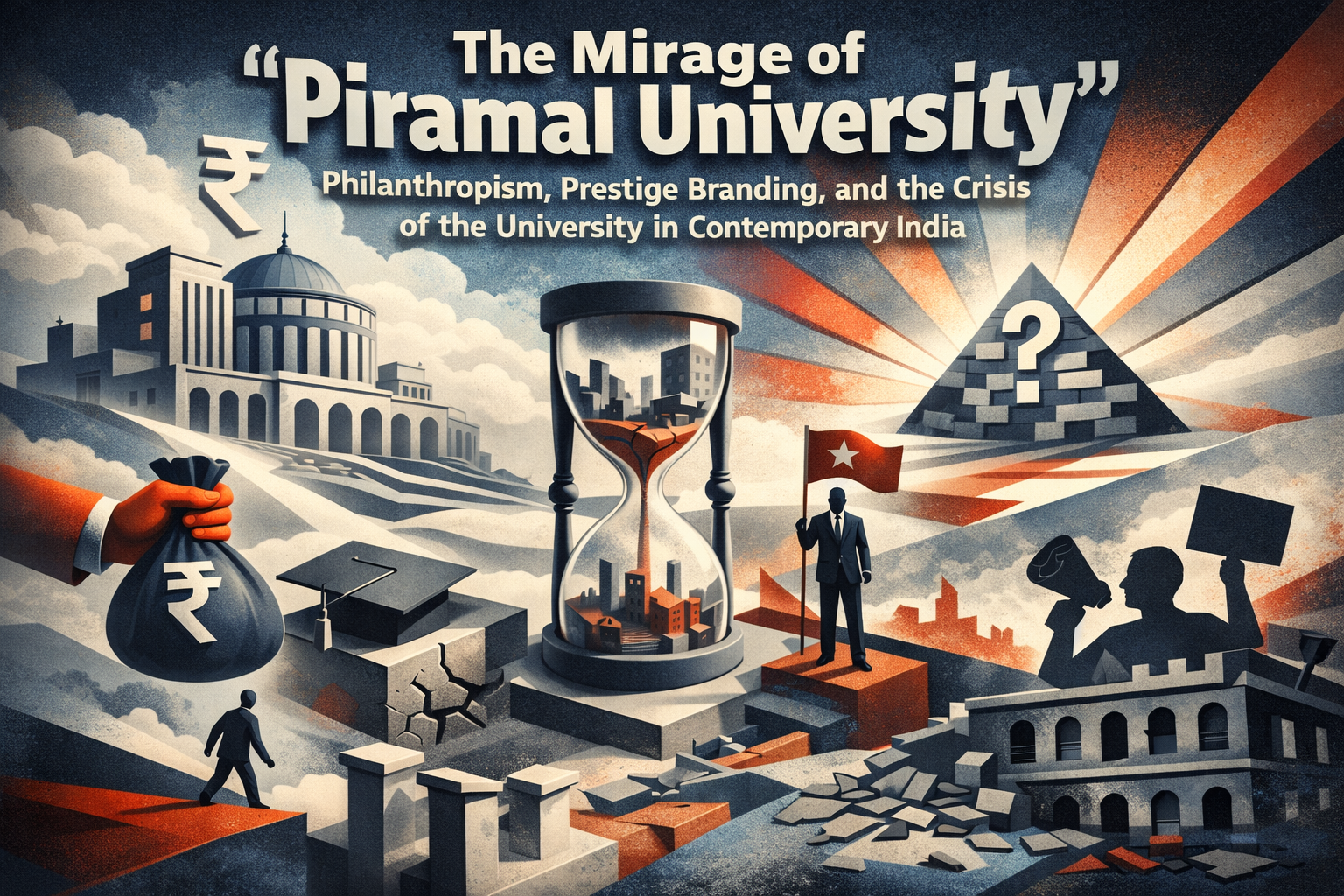
This essay critically interrogates the ambiguous phenomenon popularly referred to as “Piramal University,” situating it within the broader transformation of higher education in contemporary India. Beginning from a radical critique of institutionalized education inspired by thinkers such as Louis Althusser, Ivan Illich, Paulo Freire, and the pedagogical experiments of Rabindranath Tagore and Mahatma Gandhi, the article argues that modern academia increasingly operates as an “academiocracy” — a technocratic regime where knowledge production is subordinated to bureaucratic management, market rationality, and reputational metrics. Through an empirical examination of the Piramal School of Leadership and the sporadic appearance of the term “Piramal University” in corporate documents, CSR narratives, and public discourse, the essay reveals a striking disjunction between operational reality and symbolic branding. While no UGC-recognized university exists under this name, the label circulates widely in digital media, real-estate promotion, and philanthropic storytelling, generating an aura of academic legitimacy without corresponding institutional substance. By comparing this pattern with earlier cases such as the IIPM controversy and with prestige-borrowing strategies like Ajay Piramal’s widely publicized “Oxford Talk,” the essay develops the concept of “Schrödinger’s legitimacy”—a condition in which institutional prestige simultaneously exists and does not exist, sustained through strategic ambiguity and symbolic capital. Ultimately, the case is interpreted not as an isolated anomaly but as a symptom of a wider crisis in which universities are increasingly transformed from communities of inquiry into reputational assets within networks of corporate power, philanthropic branding, and knowledge commodification.
