
Posted on 7th April, 2026 (GMT 08:35 hrs)
ABSTRACT
In the DHFL insolvency — India’s first major NBFC case under the IBC — over 2.5 lakh retail depositors, including pensioners and widows, suffered heavy haircuts of 54–77% on their life savings. Yet the company emerged spotless in Piramal’s hands, fully discharged from a ₹5,050 crore PMLA case in February 2026 under Section 32A of the IBC. Inserted retrospectively via ordinance on 28 December 2019 — just 25 days after DHFL entered CIRP — this “clean slate” provision granted the new owner complete immunity from past offences, even as ₹45,000 crore in alleged fraud recoveries were valued at one rupee. Like Valmiki’s Ramayana, which existed before Rama’s birth and reconfigured reality itself, Section 32A rewrote corporate accountability after the fact (POST-FACTO), turning a law meant to protect creditors into a sophisticated mechanism that socialised losses and privatised gains for cronies like Piramal. The DHFL case stands as a stark example of how retrospective legislation can erase liability while ordinary citizens bear the burden.
The Retrospective Robbery: How Section 32A Turned the IBC into India’s Biggest Legalized Loot Machine
In post-Independent India, few financial scandals have hit ordinary citizens as hard as the DHFL collapse. More than 2.5 lakh retail depositors — pensioners, widows, and retirees among them — saw their life savings slashed by heavy haircuts while the company itself was reborn in new hands, stronger and more profitable than before. At the heart of this story is the Insolvency and Bankruptcy Code (IBC) of 2016, presented as a fair, time-bound way to revive distressed companies and repay creditors. In practice, it became a mechanism that shifted massive losses onto the public while delivering clean, fraud-tainted assets to select corporate players.
On paper, the IBC appeared straightforward and just. A troubled firm would go before the National Company Law Tribunal (NCLT). A Resolution Professional would step in. The Committee of Creditors — largely banks — would apply its “commercial wisdom” to bids. One plan would be chosen, either reviving the company or liquidating it fairly to repay those owed money.
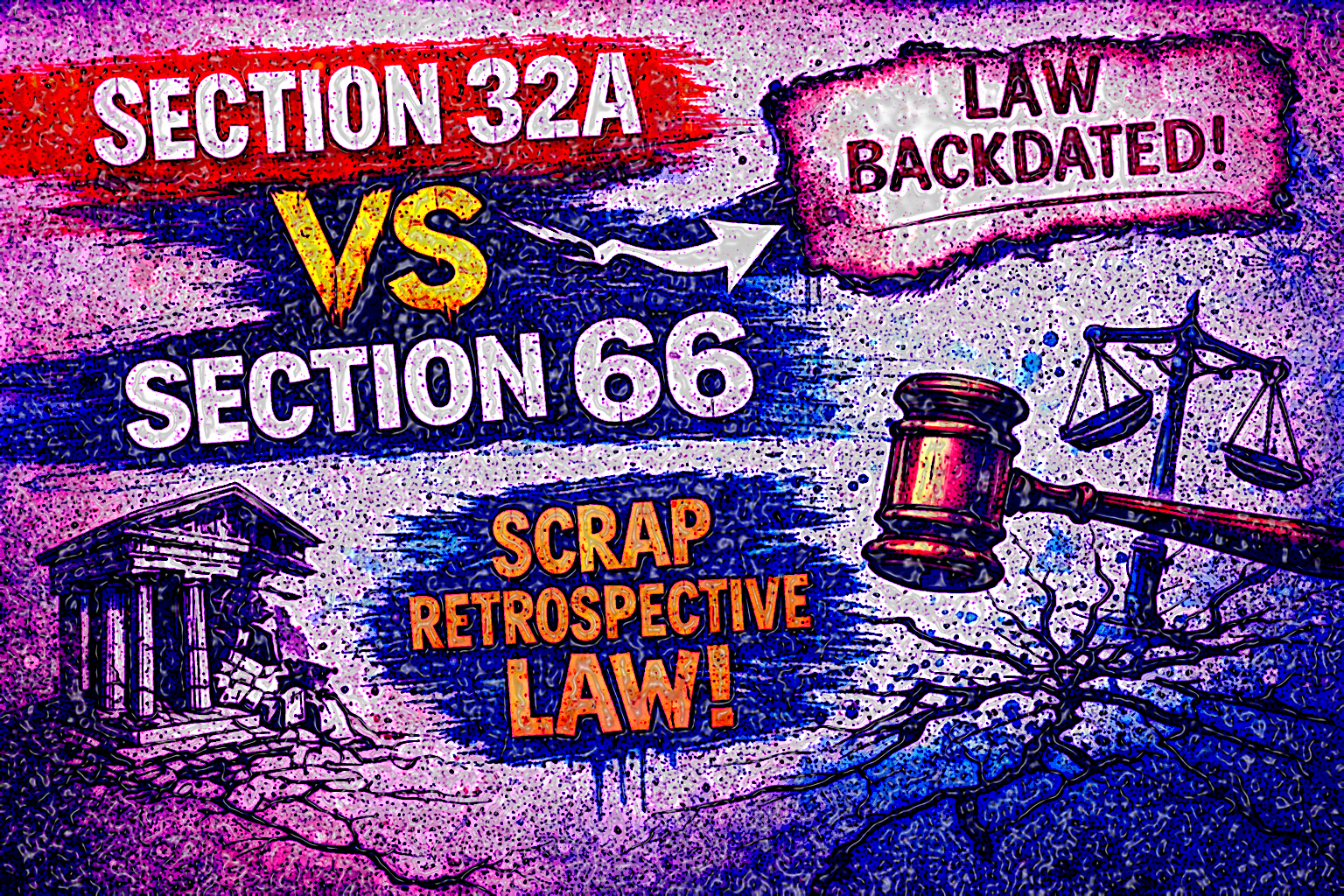
The reality diverged sharply. Two sections within the IBC pull in opposite directions. Section 66 acts as a shield against fraud. It allows the NCLT to hold dishonest directors and managers personally liable for wrongful or fraudulent trading, with any recoveries added to the common pool for all creditors — banks and small depositors alike.
Section 32A, the “clean slate” provision, works differently. Inserted by ordinance on 28 December 2019 and later enacted in March 2020, it was given retrospective effect from the date of the ordinance. A retrospective law is made after events have already occurred, yet it is applied backwards to those past events — changing their legal outcomes as if the new rule had always been in force.
This idea of rewriting the past finds a striking parallel in one of India’s greatest epics. There is a well-known saying: the Ramayana existed even before Rama was born. In Rabindranath Tagore’s reflection on the epic, sage Narada tells Valmiki: “Poet, know that your mind-realm is Rama’s birthplace — truer than Ayodhya itself.” Valmiki had not yet composed a single verse when the story was placed before him, yet the moment he began to meditate and write, the Ramayana created Rama retroactively. The events of history or myth became secondary to the poem’s truth. The poet does not merely record; he legislates a higher reality. The text precedes and reconfigures the hero. All that “happened” is declared “not wholly truth” so that a purer, more beautiful version can be born in the realm of imagination. The real Ayodhya of bricks fades beside the one that rises in the poet’s mind and in every reader’s heart.
Section 32A performs an almost identical operation on a corporate body. Even though fraud allegations and the Corporate Insolvency Resolution Process (CIRP) for DHFL had already begun, the new provision was applied backwards. Upon approval of a resolution plan and transfer of control to unrelated new owners, the company and its new masters receive complete immunity from past offences. No prosecution. No attachment or confiscation of assets for prior wrongs. The same legal entity — with the same assets, branches, loan book, and infrastructure — is declared spotless, as if the old liabilities had never truly burdened this “new avatar.” The resolution plan becomes the corporate janmabhoomi, a fresh birthplace that erases the “unpaid sins” of the past.
A darker historical precedent echoes the same pattern. The Lahore Conspiracy Case Ordinance III was enacted after arrests in the revolutionary case involving Bhagat Singh and others. It changed the rules of trial mid-process and applied them retrospectively to strengthen the state’s position and secure outcomes that might otherwise have been difficult. Law engineered after the fact to rewrite accountability.
In the DHFL case, this mechanism played out with precision. Once a ₹91,000 crore AAA-rated housing finance giant serving millions, DHFL entered IBC as India’s first major NBFC case. Forensic audits pointed to around ₹45,000 crore in alleged fraudulent diversions — territory clearly suited to Section 66 action. The former promoters reportedly offered full repayment to every creditor. Other bids promising better recovery were set aside. The plan ultimately approved for Piramal Capital and Housing Finance valued potential Section 66 recoveries at just one rupee.
Key moments in the timeline:
- January 2019: Warnings and exposés about irregularities at DHFL surface.
- November 2019: RBI supersedes the board.
- December 2019: NCLT admits DHFL into insolvency — and just 25 days later, the ordinance introducing Section 32A with retrospective effect is issued.
Higher courts raised concerns at times, but in April 2025 the Supreme Court upheld the plan as an exercise of commercial wisdom. Through a reverse merger, DHFL was absorbed into the Piramal group and rebranded. In February 2026, a Mumbai special PMLA court discharged the corporate entity from a ₹5,050 crore money-laundering case, citing Section 32A immunity.
The contrast was stark. Retail depositors absorbed haircuts of 54–77%, with some recovering as little as 23 paise in the rupee. Public sector banks also suffered significant losses. Meanwhile, the rebranded Piramal Finance reported robust growth: assets under management crossed ₹96,690 crore (up 23%), nine-month profit for FY26 reached ₹1,004 crore (a 162% jump), and it secured a fresh AA+ rating. Any potential upside from untapped fraud recoveries now belonged to the new owner.
Attempts by affected depositors to gain transparency — through RTI requests on Committee of Creditors decisions, legal expenses, meeting minutes, and voting patterns — were mostly stonewalled. Authorities deflected responsibility. Those who spoke out faced strategic defamation suits designed to silence them.
The DHFL episode stands as more than one company’s resolution. It served as the test case that normalised the use of retrospective clean-slate provisions in major financial insolvencies. Losses were spread across ordinary citizens; gains were concentrated. Section 32A effectively overrode the fraud-recovery spirit of Section 66, with rules altered after the process had begun.
Many of those impacted, along with observers, now call for deeper change: repeal of Section 32A to prevent clean slates from erasing accountability; full enforcement of Section 66 so that fraud recoveries actually benefit creditors; and a fresh look at the IBC framework if it continues to socialise pain while privatising upside. They seek independent audits of the entire DHFL process, efforts to claw back unjust enrichment where possible, and meaningful restitution for depositors whose hard-earned savings took the hardest hit.
The DHFL story remains a painful illustration of how a reform intended to bring efficiency and fairness can, in execution, leave thousands of ordinary Indians feeling that justice was rewritten in favour of continuity for the powerful. Their ongoing demand is simple yet profound: that accountability should not be so easily erased, and that the people’s money must find its way back to its rightful owners.
 Once in a Blue Moon Academia
This
LikeLike
This presentation is highly appreciable and superb as it contains all bitter truths through which our hard earned money was robbed. I suggest the author to send this to CJI of Supreme Court, RBI & Finance Minister with a copy to President of India which may enforce all of them to review and change the decision in our favour.
LikeLike