

This article outlines the mission and initiatives of Once in a Blue Moon Academia (OBMA), a self-funded, non-profit organization established in 2021 to address systemic injustices in India’s financial and ecological ecosystems. OBMA focuses on two primary issues: the devastating financial ecosystem, exemplified by the Dewan Housing Finance Corporation Limited (DHFL) scam, and the catastrophic natural ecosystem, emphasizing climate change and environmental degradation. Through non-violent civil disobedience inspired by Gandhian principles and the Occupy Wall Street movement, OBMA campaigns for justice for DHFL scam victims, who faced significant financial losses due to alleged corporate and political malfeasance. The organization employs academic activism, legal challenges, and digital campaigns to expose crony capitalism, regulatory failures, and environmental neglect. Guided by the Buddhist ethos of bahujana sukhaya, bahujanahitaya ca (“for the happiness and welfare of the many”), OBMA seeks to dismantle disciplinary boundaries, foster interdisciplinary praxis, and advocate for systemic reform to ensure accountability and equity
THE ART OF RESISTANCE
Posted on: 18/09/2021 (IST 11: 15 hrs) Updated on: 22/09/2o23 (GMT 13.32 hrs) Posted On 19th September, 2021 DEBAPRASAD BANDYOPADHYAY AKHAR BANDYOPADHYAY “Suffering comes from three quarters: from our own body, which is destined to decay and dissolution, and cannot even dispense with anxiety and pain as danger-signals; from the outer world, which can rageContinue reading “THE ART OF RESISTANCE”
CONVERGENCE TO PRAXIS: AN INTERNATIONAL JOURNAL ON SUFFERINGS: OBJECTIVES AND DESCRIPTION

This journal tries to demolish the administrative boundaries of academic disciplinary technology by amalgamating all the so-called “subjects” by condemning the objectification, subjectification and subjection. It strives to reach the vanishing point of theory and praxis. Thus, instead of so-called “inter-disciplinary studies”, it emphasizes on the convergence of earthian knowledges and praxiologies. The journal attemptsContinue reading “CONVERGENCE TO PRAXIS: AN INTERNATIONAL JOURNAL ON SUFFERINGS: OBJECTIVES AND DESCRIPTION”
“False”(?!) allegations on the collusion among the BJP, Dawood-Mirchi and the DHFL: A Letter to the BJP President
The article refutes allegations of collusion between the BJP, Dawood Ibrahim, Iqbal Mirchi, and DHFL, claiming they are politically motivated and intended to tarnish the BJP’s image. It argues that these accusations are unfounded and part of a smear campaign. The author defends the BJP, suggesting that the party has no links to these figures or the alleged financial scandal.
Once in a Blue Moon Academia (OBMA): MOA
1. Name of the CommunityThe name of the Society shall be “Once In A Blue Moon Academia”, hereinafter referred to as “OBMA.” 2. Objects of the Society 2.1.To promote and protect human and animal rights in all parts of the world; to study and disseminate knowledge on international human rights issues and the convergences ofContinue reading “Once in a Blue Moon Academia (OBMA): MOA”
Pressing Repeat: A Tragi-Comedy of DHFL Ruin, Viraha, and Satyagraha through Dilemma
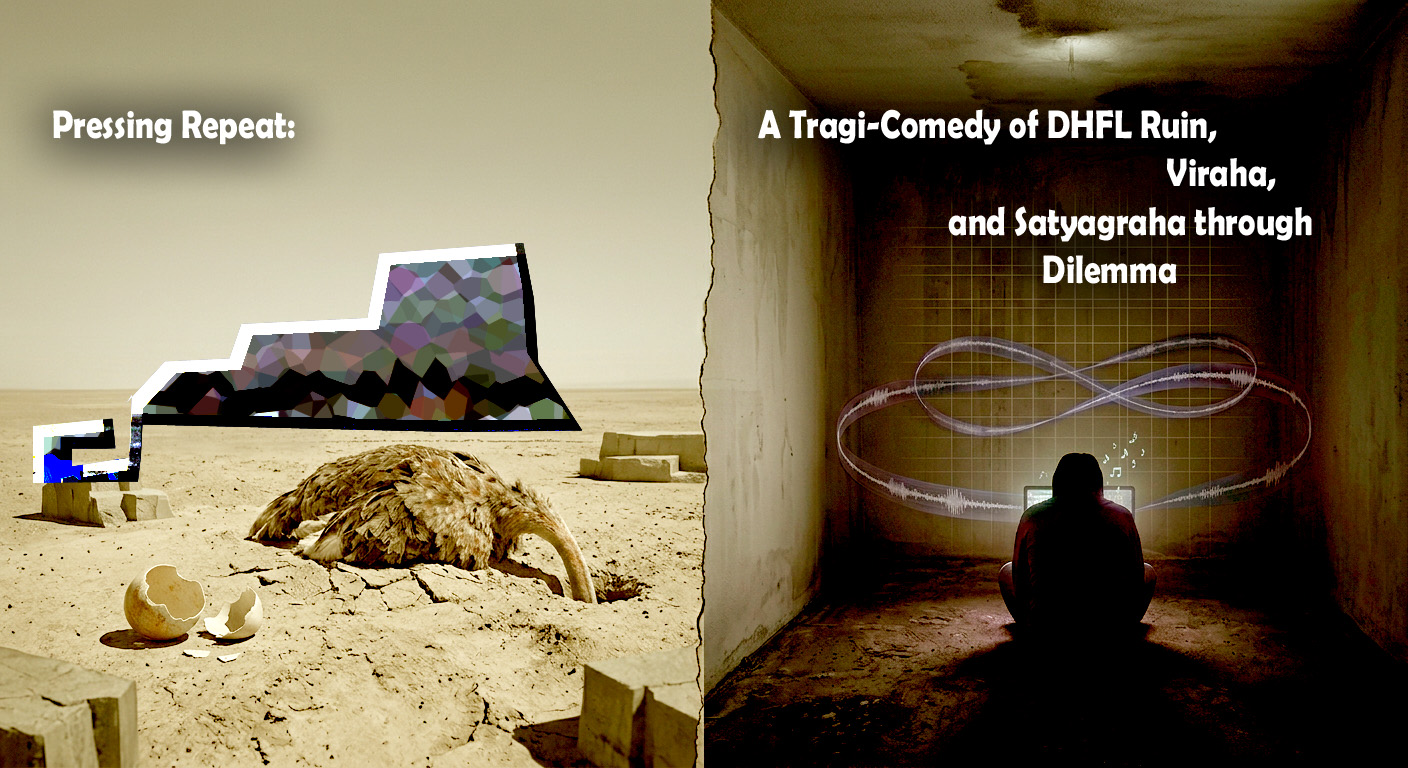
In this darkly comic, self-reflexive monologue, a financially devastated DHFL victim—robbed of her life savings and hounded by a 100-crore SLAPP suit under an undeclared emergency—chronicles her solitary existence through obsessive loops of Rabindrasangeet. Trapped between paralyzing fear and compulsive repetition, she navigates aesthetic intimate separation anxiety (biraha), confronts the absence of any divine or human companion, and mercilessly dissects the selective “divine intervention” granted to the powerful while she receives only silence. Weaving Tagore’s melodies, Sudhindranath Dutta’s merciless “Ostrich,” Socrates’ Euthyphro Dilemma, Nietzsche’s amor fati, and Gandhi’s faith in truth, she transforms personal malady into a weapon of creative resistance. Refusing fatalism or piety, she reclaims the pharmakon of crisis, turning her suffering into non-violent digital satyagraha against the state-corporate apparatus. The result is a haunting, non-conclusive testament: a lone whistleblower who, though penniless and abandoned, continues to press “send” — pressing repeat no longer as surrender, but as quiet, unrelenting war.
A DHFL Victim’s Anonymous Letter — and the YouTube “Dislike” Campaign
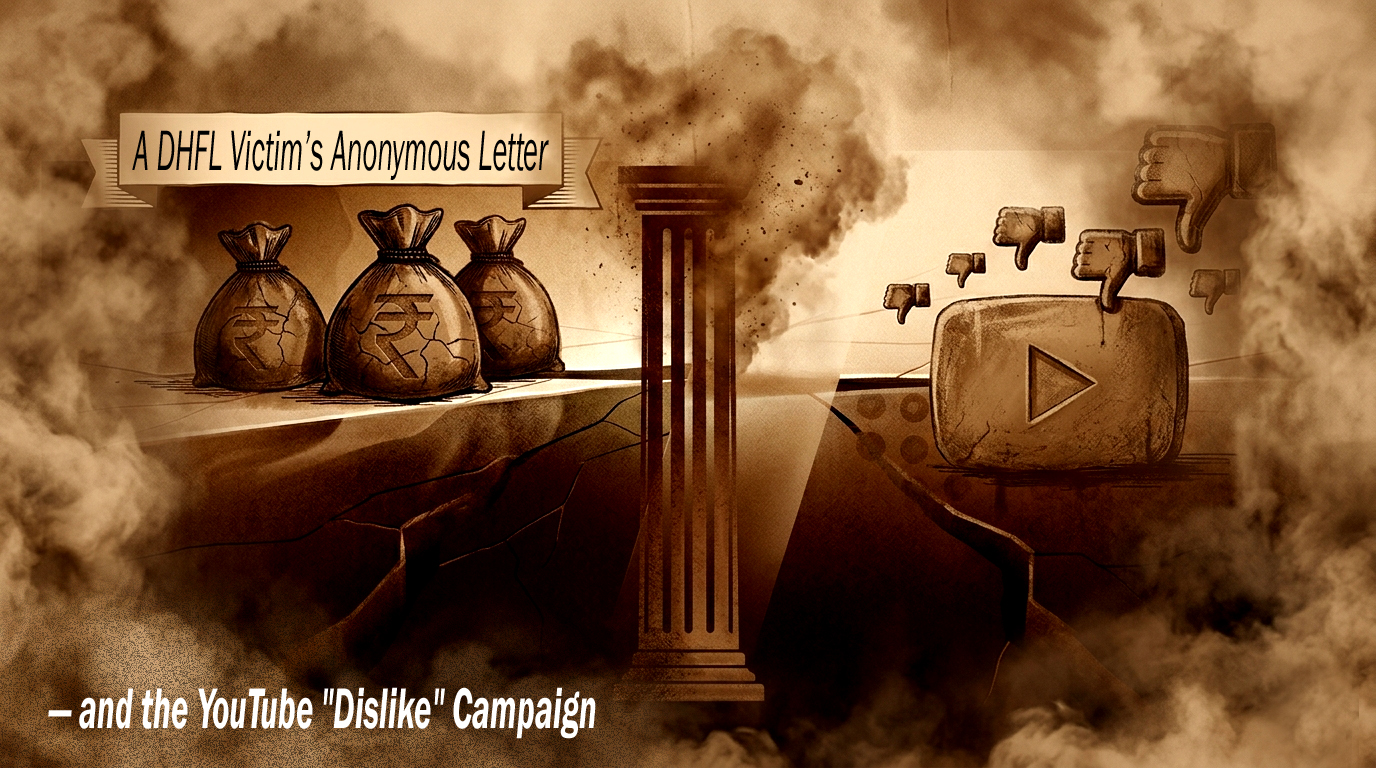
This post presents an anonymous testimony from a DHFL depositor, documenting the lived human cost of India’s crony-capitalist financial regime. Through a raw account of loss, dispossession, and psychological distress following the DHFL collapse and subsequent resolution process, the letter foregrounds how institutional decisions, regulatory opacity, and political–corporate entanglements translate into everyday suffering for ordinary citizens. At the same time, it traces a shift from despair to resistance, as the victim transforms personal trauma into acts of digital dissent and collective voice. By reproducing the testimony in both transliterated Hindi and English, this piece seeks not only to archive a voice often erased in financial discourse but also to situate it within broader critiques of the “money-signifier” as a structuring force that shapes visibility, accountability, and justice in contemporary India.
Opaque by Design: The DHFL “Resolution” and Institutional Evasion — An Open Letter to the Reserve Bank of India (RBI)
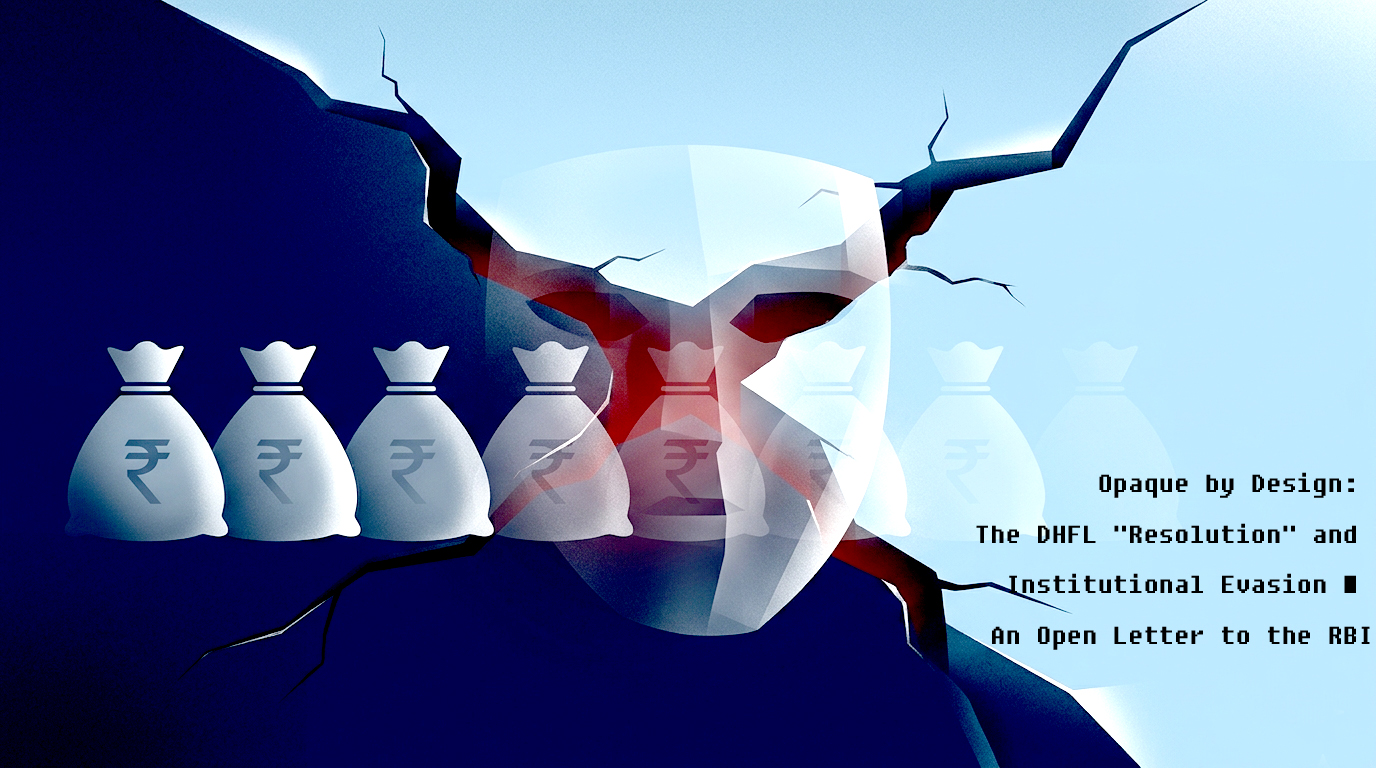
The DHFL insolvency resolution under the Insolvency and Bankruptcy Code (IBC), 2016, stands as a stark exemplar of systemic opacity, regulatory evasion, and alleged crony favoritism in India’s financial ecosystem. Initiated by the Reserve Bank of India (RBI) in November 2019 through the supersession of the DHFL Board and referral to the National Company Law Tribunal (NCLT), the Corporate Insolvency Resolution Process (CIRP) culminated in the approval of Ajay Piramal’s resolution plan by the Committee of Creditors (CoC), the NCLT (June 2021), and ultimately the Supreme Court (April 1, 2025), which upheld the plan—including the appropriation of avoidance recoveries by the successful resolution applicant—while reaffirming the primacy of the CoC’s “commercial wisdom.” The case has drawn sustained scrutiny from approximately 2.5 lakh retail fixed-deposit and NCD holders, who suffered severe haircuts (recovering around 23% of admitted claims), amid allegations of undervaluation, procedural irregularities, premature occupation by the acquirer, and the dilution of fraud-avoidance mechanisms under Sections 32A and 66 of the IBC. Persistent Right to Information (RTI) applications—filed notably by activists associated with “Once in a Blue Moon Academia”—seeking itemized disclosure of the RBI-appointed CoC’s total expenditures (including professional fees, litigation costs, and deductions from the resolution pool) have been met with uniform institutional denial, with the RBI repeatedly claiming it “has no information” and bears no responsibility to maintain or interpret such records, while the Insolvency and Bankruptcy Board of India (IBBI) and the Comptroller and Auditor General (CAG) have similarly deflected or transferred queries. This refusal to disclose even basic expenditure details—despite the RBI’s direct role in constituting the CoC—fuels concerns about a deliberate “will to hide,” potentially masking inflated costs borne by depositors, quid pro quo arrangements linked to political financing, and preferential treatment for well-connected acquirers. Critics increasingly frame the DHFL case as a “test case” for the IBC regime, wherein small savers became unwitting “guinea pigs” in a system dominated by institutional creditors, marginalizing retail stakeholders and entrenching judicial deference to CoC decisions—even in the face of documented NCLAT findings of irregularities. This analysis argues that the DHFL resolution reveals deeper structural flaws in India’s insolvency framework: the transformation of statutory immunity into structural impunity, the erosion of transparency obligations under the RTI Act, and the prioritization of private gain over public accountability. Absent independent investigation and full disclosure, the episode risks eroding trust in regulatory institutions and reinforcing perceptions of oligarchic capture under the guise of financial reform, making urgent rectification of the persistent opacity surrounding CoC expenditures essential to restoring legitimacy to the IBC process and securing justice for affected depositors.
Expose IBC’s Dirty Secret, Resist the Structural Impunity for Cronies!
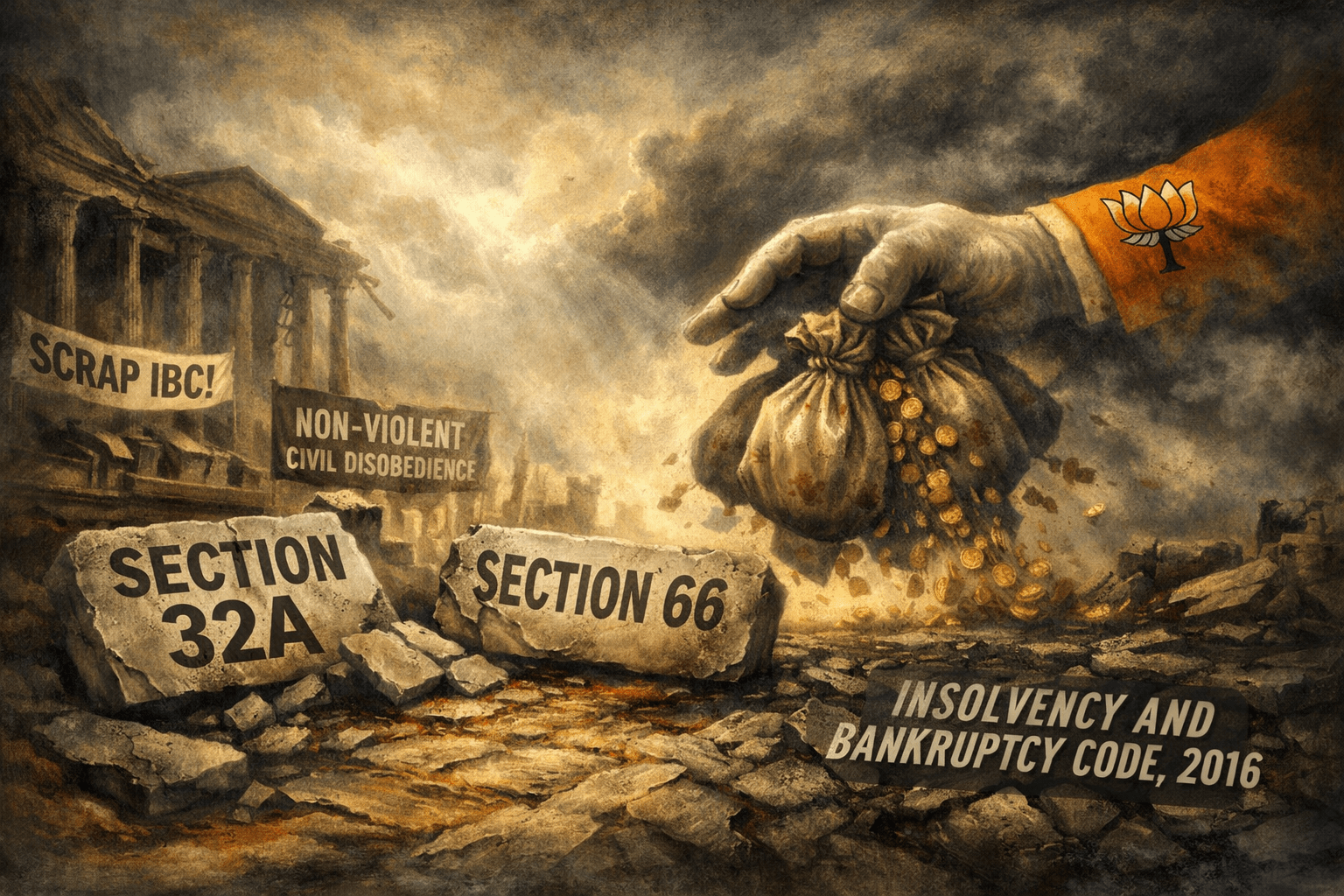
This dossier argues that the Insolvency and Bankruptcy Code, 2016 has evolved from a reform tool into a system of impunity, exemplified by the Dewan Housing Finance Corporation Ltd collapse, where depositors suffered massive losses while Section 32A IBC erased corporate liability for the “new owner” Mr. Ajay Piramal; highlighting repeated amendments and creditor dominance, it calls for repeal—especially of Section 32A in relation to its contradictory relationship to Section 66—and urges non-violent resistance inspired by Gandhiji to restore accountability.
Retrospective Truths: Valmiki, Ayodhya, IBC 32A, and the Stake of Constitutional Secularism
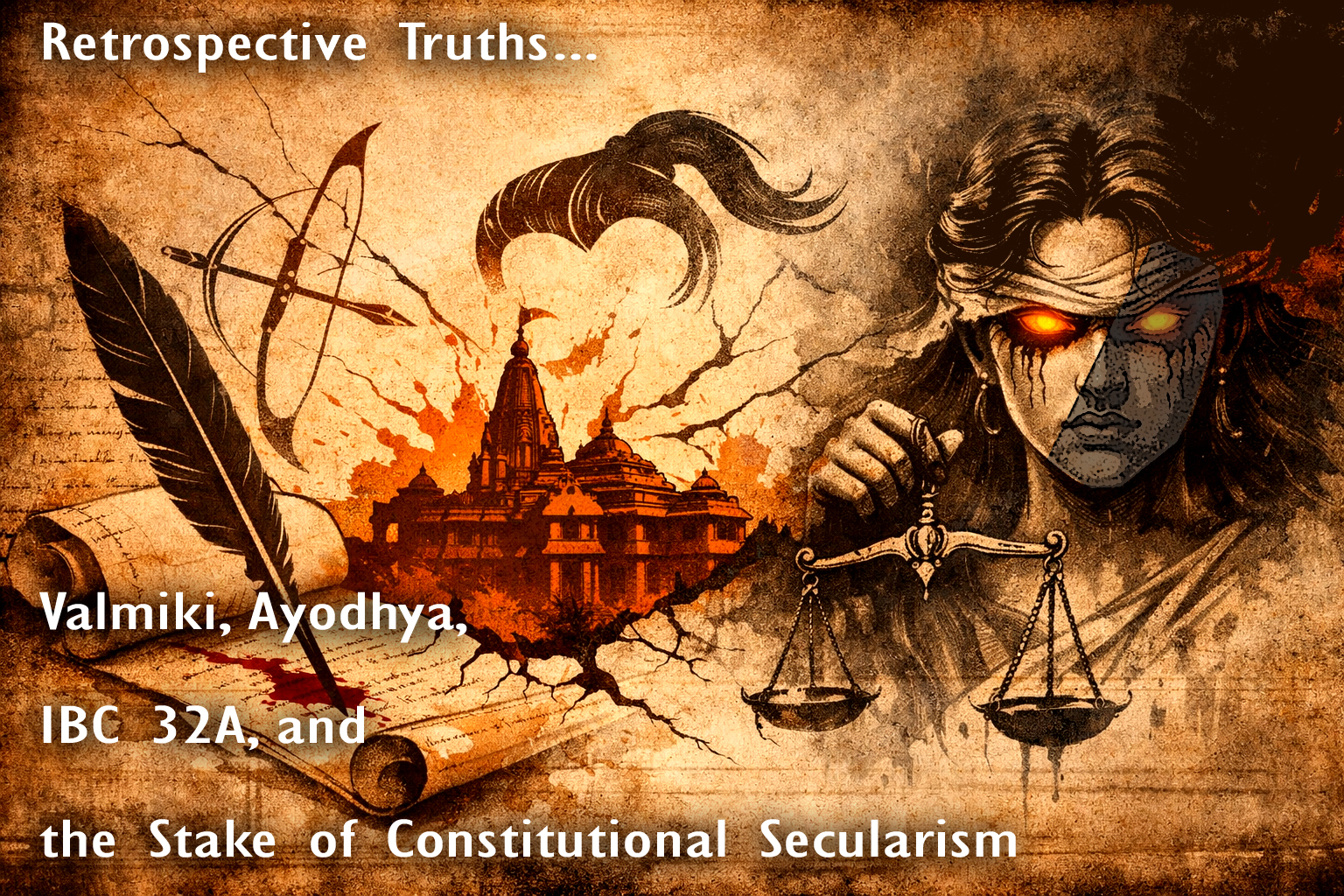
This short article explores a striking parallel between poetic creation and state-sanctioned reality-making in contemporary India. Drawing from Rabindranath Tagore’s poetic dialogue with Narada in the context of Valmiki’s Ramayana—where the poet’s imaginative mind-realm is declared Rama’s truer birthplace than historical Ayodhya—the discussion extends to two landmark institutional acts: the Supreme Court’s 2019 Ayodhya verdict (with Justice D.Y. Chandrachud’s later confession of seeking divine guidance) and Section 32A of the Insolvency and Bankruptcy Code (IBC), which retrospectively absolves corporate debtors of pre-insolvency offences upon plan approval, as vividly illustrated in the DHFL-Piramal takeover. Both instances represent exercises in retrospective ontological surgery: the poet erases or reconfigures the past through fiction for ecstatic delight (jouissance), while the judiciary and legislature do so through unsigned judgments infused with faith-based inspiration and statutory “clean-slate” mechanisms that shield economic continuity at the expense of accountability. The article argues that such sovereign rewritings—whether sacralising faith in a title suit or engineering corporate rebirth—breach the thick wall of separation between powers, subordinate evidence-based adjudication to revelation or expediency, and inflict profound injury on constitutional secularism. By collapsing the distinction between objective historical/legal truth and creatively decreed higher truth, these developments risk transforming the secular Republic into a palimpsest open to majoritarian or crony capture, where Article 51A(h)’s mandate of scientific temper yields to engineered absolution and divine endorsement. Ultimately, while the poet may harmlessly invent birthplaces, when the State borrows that crown, the stake is nothing less than the integrity of constitutional secularism itself.
The Archaeology of Architecture in the Piramal Archipelago

This article examines the ecological contradictions embedded in contemporary corporate development through a critical analysis of four interconnected cases linked to the activities of the Piramal Group. Situated within the broader environmental context of Mumbai—one of the world’s most climate-vulnerable coastal megacities—the study explores how industrial production, urban real-estate expansion, and superrich architectural consumption intersect with fragile ecosystems and emerging climate risks. The first case investigates allegations of groundwater contamination linked to pharmaceutical manufacturing in Digwal village in Telangana, where proceedings before the National Green Tribunal raised concerns about impacts on aquifers and agricultural landscapes. The second examines controversy surrounding a chemical manufacturing facility in Dahej in Gujarat, where the Gujarat Pollution Control Board ordered a plant shutdown after allegations that hazardous industrial waste had been discharged into a canal connected to the Narmada River system. The analysis then turns to Mumbai’s coastal urban landscape, where luxury developments by Piramal Realty illustrate the commodification of waterfront environments marketed through narratives of sustainability and “biophilic living.” Finally, the study examines the sea-facing residence Gulita as a symbolic expression of wealth concentration along a climate-exposed coastline. Drawing on environmental reports, regulatory proceedings, and urban climate research, the article situates these cases within a broader framework of coastal capitalism and urban ecological transformation, arguing that corporate sustainability narratives often coexist with environmental risks displaced onto rural landscapes, industrial waterways, and vulnerable urban coastlines.
Piramal’s “Green” Smokescreen: Reports and Radical Reflections
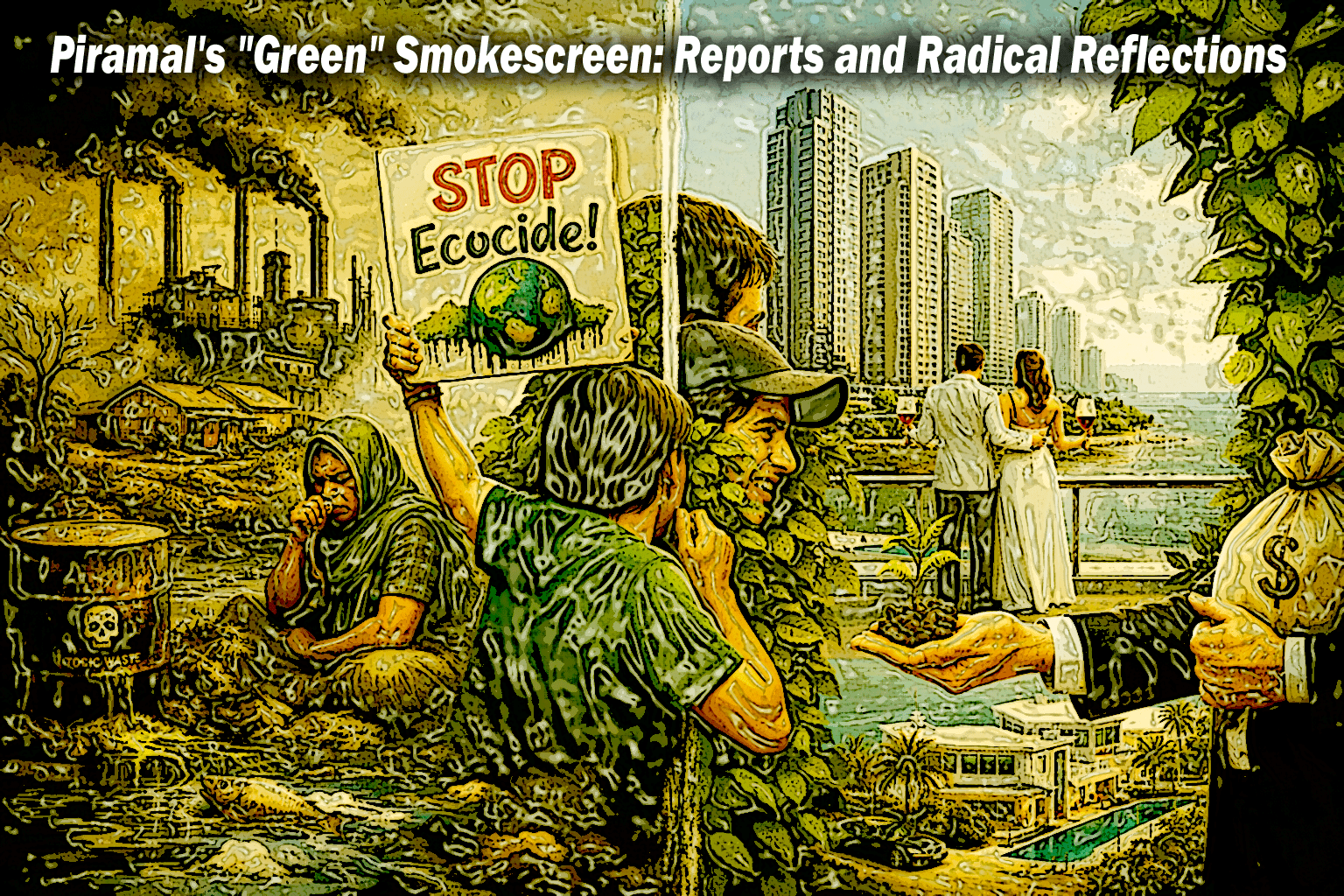
In a scathing indictment of 21st-century Indian philanthro-capitalism, billionaire Ajay Piramal’s empire exemplifies hegemonic subsumption of radical ecology: while Piramal Pharma faces verified allegations of chronic ecocide—groundwater poisoning in Digwal, Telangana (NGT ₹8.3 crore fine, net ₹3.2 crore paid as 0.09% of FY25 revenue; ongoing NGT case OA 1032/2024) and hydrochloric acid dumping in Dahej, Gujarat (GPCB closure, ₹1 crore fine, Supreme Court scrutiny in February 2026, swift interim resumption)—Piramal Realty markets ultra-luxury towers in Mumbai’s IPCC/CRZ high-risk flood zones (e.g., Piramal Mahalaxmi at ~3 m elevation) as “biophilic living” paradises with curated greenery, passive ventilation, and token sapling drives. The family’s own Worli sea-facing mansions (Gulita’s 50,000 sq ft diamond-glass palace) flaunt imported opulence with minimal genuine sustainability, embodying Lewis Mumford’s critique of architectural imperialism. Meanwhile, the Piramal School of Leadership’s Jaipur “walled garden” campus—shortlisted for the 2025 World Architecture Festival—parades biophilic design, passive cooling, and reduced concrete use while branding itself as the future “Piramal University” (a UGC violation) and indoctrinating 50,000–150,000 officials annually in appropriated radical terms like “regenerative agriculture” (Rodale/Shiva lineage), “One Water,” and “systems change” (Macy/Capra/Norberg-Hodge). Through Foucauldian selving, Piramal constitutes itself as “compassionate” and “regenerative” precisely by emptying anti-capitalist vocabularies. Backed by ₹85–88 crore in BJP electoral bonds (2019–2024), this discursive capture enables regulatory impunity amid slow violence on marginalized communities. The article calls for radical rupture: revenue-proportionate penalties, ecological restoration, de-subsumption of language, and militant reclamation by grassroots movements—exposing eco-extortionism where ecocide funds the performance of planetary salvation. Even the Department of Consumer Affairs’ February 2026 anti-greenwashing poster rings hollow when tycoons like Piramal and Adani greenwash unchecked.
The Mirage of “Piramal University”: Philanthropism, Prestige Branding, and the Crisis of the University in Contemporary India
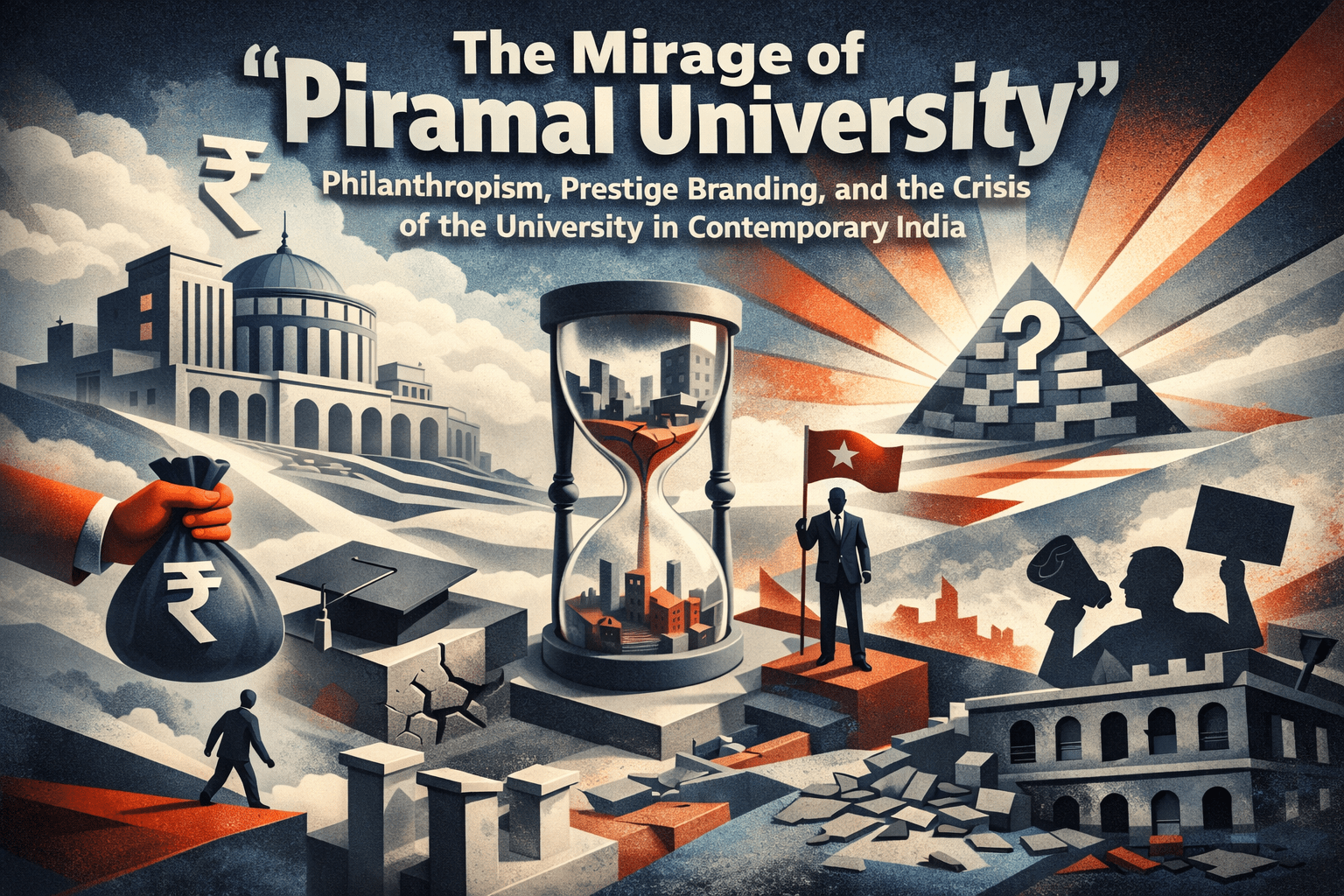
This essay critically interrogates the ambiguous phenomenon popularly referred to as “Piramal University,” situating it within the broader transformation of higher education in contemporary India. Beginning from a radical critique of institutionalized education inspired by thinkers such as Louis Althusser, Ivan Illich, Paulo Freire, and the pedagogical experiments of Rabindranath Tagore and Mahatma Gandhi, the article argues that modern academia increasingly operates as an “academiocracy” — a technocratic regime where knowledge production is subordinated to bureaucratic management, market rationality, and reputational metrics. Through an empirical examination of the Piramal School of Leadership and the sporadic appearance of the term “Piramal University” in corporate documents, CSR narratives, and public discourse, the essay reveals a striking disjunction between operational reality and symbolic branding. While no UGC-recognized university exists under this name, the label circulates widely in digital media, real-estate promotion, and philanthropic storytelling, generating an aura of academic legitimacy without corresponding institutional substance. By comparing this pattern with earlier cases such as the IIPM controversy and with prestige-borrowing strategies like Ajay Piramal’s widely publicized “Oxford Talk,” the essay develops the concept of “Schrödinger’s legitimacy”—a condition in which institutional prestige simultaneously exists and does not exist, sustained through strategic ambiguity and symbolic capital. Ultimately, the case is interpreted not as an isolated anomaly but as a symptom of a wider crisis in which universities are increasingly transformed from communities of inquiry into reputational assets within networks of corporate power, philanthropic branding, and knowledge commodification.
IBC’s Clean Slate and the Unpaid Sin: Section 32A, Section 66, and the Corporate Metamorphosis of Liability
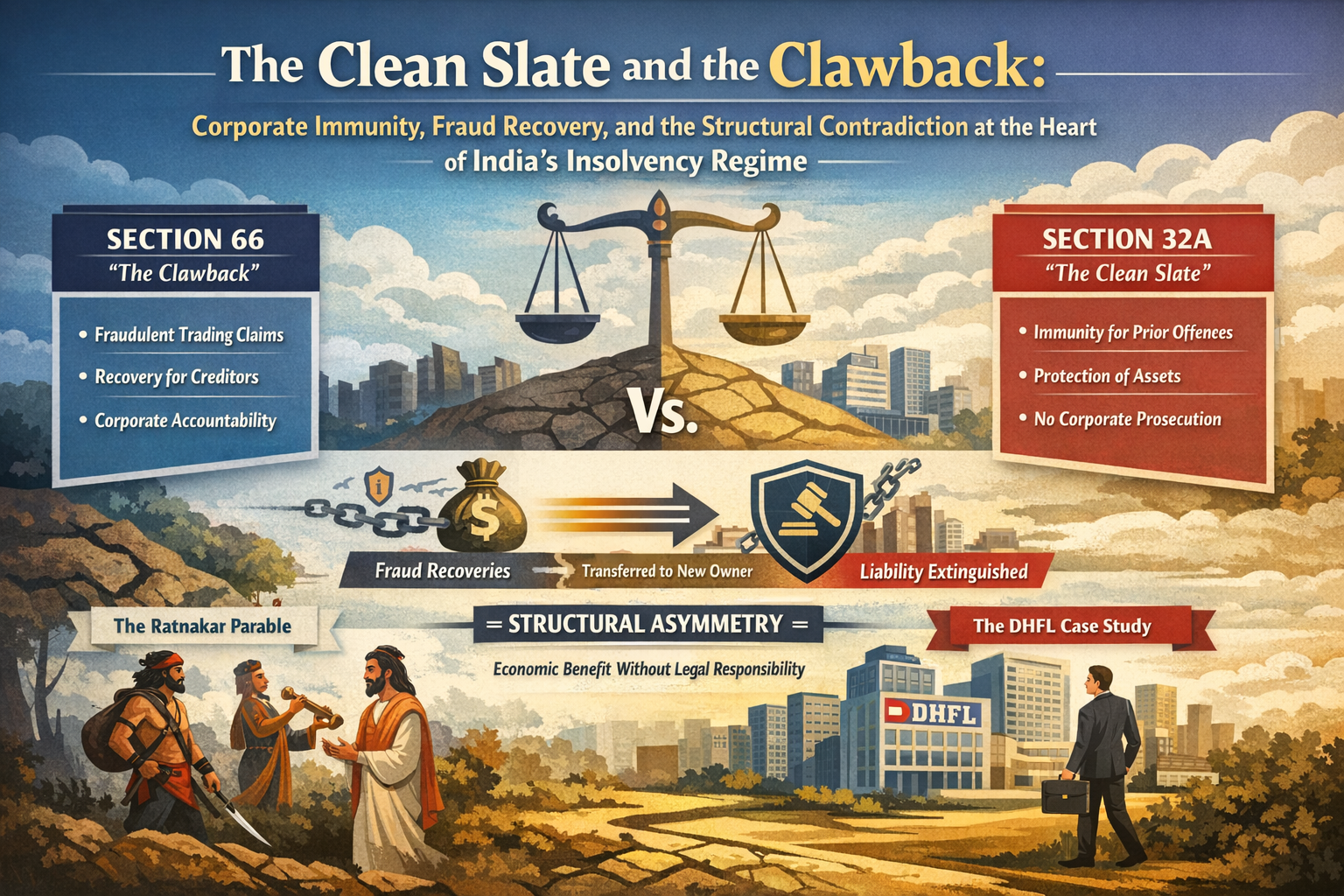
The Insolvency and Bankruptcy Code, 2016 establishes a dual legal framework combining fraud recovery and insolvency resolution. Section 66 embodies the Code’s accountability function by empowering recovery from fraudulent and wrongful trading, thereby restoring value to creditors. In contrast, Section 32A, introduced in 2019 with retrospective effect, extinguishes corporate criminal liability once a resolution plan is approved and control passes to new management. This paper argues that these provisions operate in structural tension: Section 66 presupposes continuity of corporate liability to enable recovery, while Section 32A extinguishes corporate criminal liability while preserving corporate identity, assets, and economic continuity. Through a doctrinal case study of Dewan Housing Finance Corporation Ltd. (DHFL), this paper demonstrates how avoidance recoveries identified under Section 66 remained corporate assets transferred to the resolution applicant, even as Section 32A extinguished the corporate debtor’s criminal liability for the underlying misconduct. This produced a structural asymmetry in which the corporate entity retained the economic benefits of fraud-linked recoveries while being legally immunized from responsibility for the fraud itself. The retrospective insertion of Section 32A further created a temporal dislocation, altering legal consequences after insolvency had commenced. The paper concludes that the interaction between Sections 32A and 66 represents a fundamental transformation in insolvency law—from a creditor-recovery framework grounded in accountability to an acquirer-protection framework grounded in corporate immunity—raising profound questions about equality before law and the political economy of insolvency resolution.
Piramal’s Fixated Obsession with Re 1: Documentation, Con-figured Equivocation and the Facade
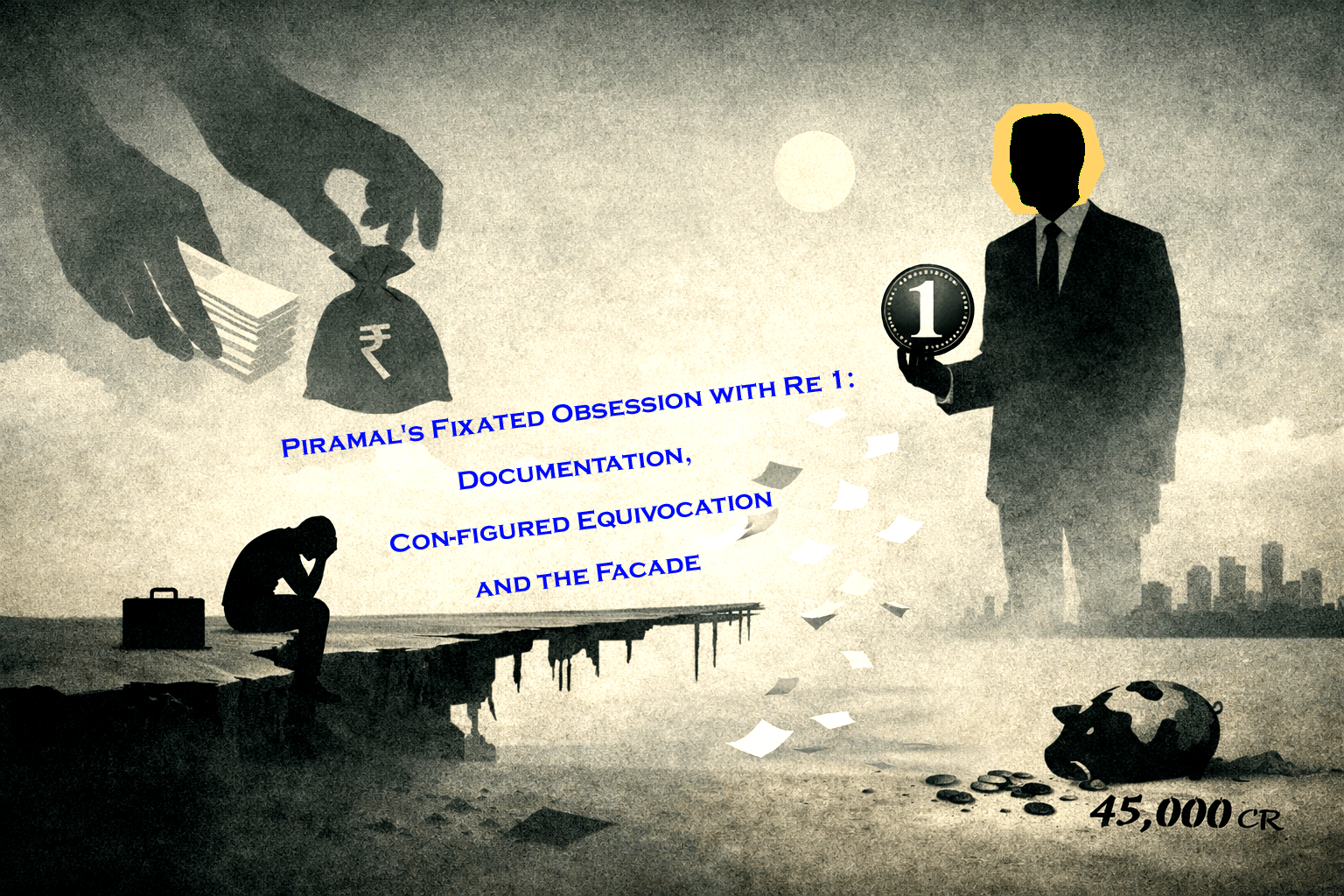
Written from the standpoint of one pauperised by the DHFL collapse—once a trusting fixed-deposit holder, now among the dispossessed—this essay interrogates Piramal Finance’s “Neeyat” campaign as an apparatus of aggressive linguistic marketing that weaponizes micro-honesty to legitimize macro-consolidation. Through semiotic, Marxian, psychoanalytic, and political-economic analysis, it traces how the repeated invocation of Re 1—returned in scenes of everyday virtue (a coin handed back, a packet retrieved, kinship invoked)—operates as myth: at the level of denotation, simple integrity; at the level of connotation, character over paperwork; at the level of ideology, ethical finance naturalized precisely after an insolvency process in which avoidance claims worth approximately ₹45,000 crore were assigned a notional value of Re 1 and retail creditors absorbed devastating haircuts under the shelter of IBC jurisprudence and Section 32A immunity. The same rupee circulates across regimes—as legal token, advertising prop, and ideological shield—while high-yield lending, SARFAESI enforcement, ratings upgrades, and judicial deference to “commercial wisdom” consolidate capital. Self-reflexively acknowledging its wounded vantage, the essay reads the compulsive return of Re 1 not as branding ingenuity but as symptomatic spectacle: a coin endlessly restored on screen while restitution remains foreclosed in law, revealing how moral minimalism at the micro level masks structural dispossession at the macro level.
 Once in a Blue Moon Academia