Dissent, Dynamics and Domination: India’s Protest Movements (2014-26)
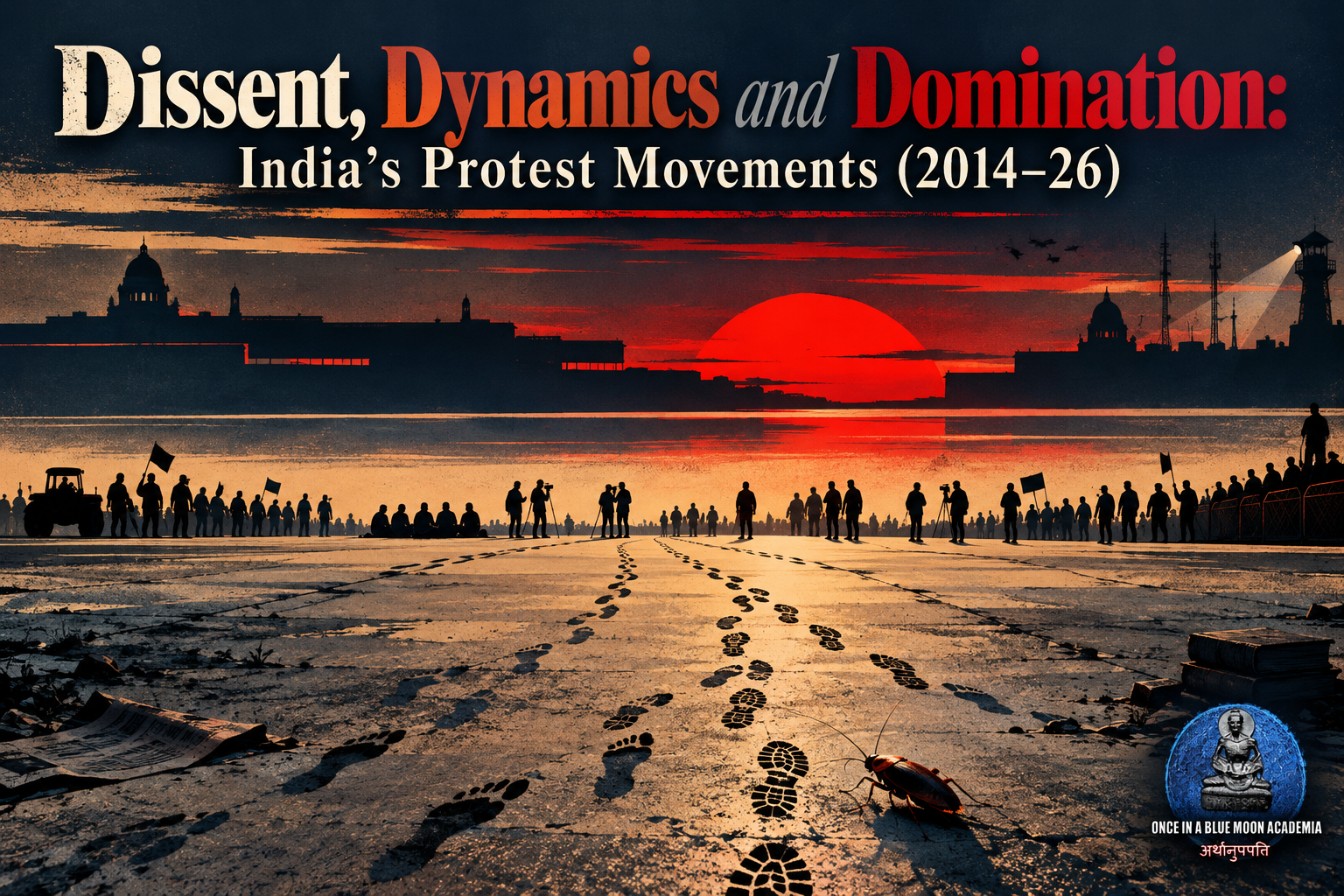
Between May 2014 and October 2026, India’s BJP-led National Democratic Alliance confronted an almost unbroken sequence of protest and resistance—from the 2015 land-ordinance agitation and the 2020–21 farmers’ siege of Delhi to the 2026 youth-led Cockroach Janta Party (CJP) rising—under conditions of sustained political domination rather than the successful production of consent. This article maps the ecology of that dissent: the movements themselves; a counter-public of non-Godi and crowdfunded media; satirists and stand-up comedians deploying hasya and vyanga against the regime’s bhayanaka and vibhatsya; organic intellectuals of political and civil society; dissenting advocates and judges; and watchdog NGOs. It documents the repertoire of domination deployed against them—imprisonment without trial, preventive detention, financial and regulatory strangulation, blocking, SLAPP litigation, career reprisals, threats, vigilante violence, surveillance, state violence and assassination by non-state actors—and reads the CJP against this longer inheritance through Gramsci’s account of hegemony and organic intellectuals, Partha Chatterjee’s distinction between civil and political society, Habermas’s concept of legitimation crisis, Ranajit Guha’s dominance without hegemony, and Ambedkar’s warning against bhakti in politics. The CJP’s speed and visibility rest on more than a decade of prior investigation, litigation and protest. Its demand for the resignation of named officeholders addresses persons rather than the paradigm or the chair; under a regime that has already closed ordinary channels and made the power to guarantee life the underside of the power to expose marked populations to the sovereign mark, the absorption of a name is the state’s work, not the movement’s. The article treats the CJP as a genuine opening for a new constituency whose unarmed presence has already forced the repressive and ideological apparatuses into public view. The further task is to keep the energy released by that showing from being returned, through the regime’s mechanisms of absorption and attribution, to the chairs that still decide who is to be made live and who is to be marked.
