Blooded Waters, Dirty Hands: An Elegy for Puṇyodaka
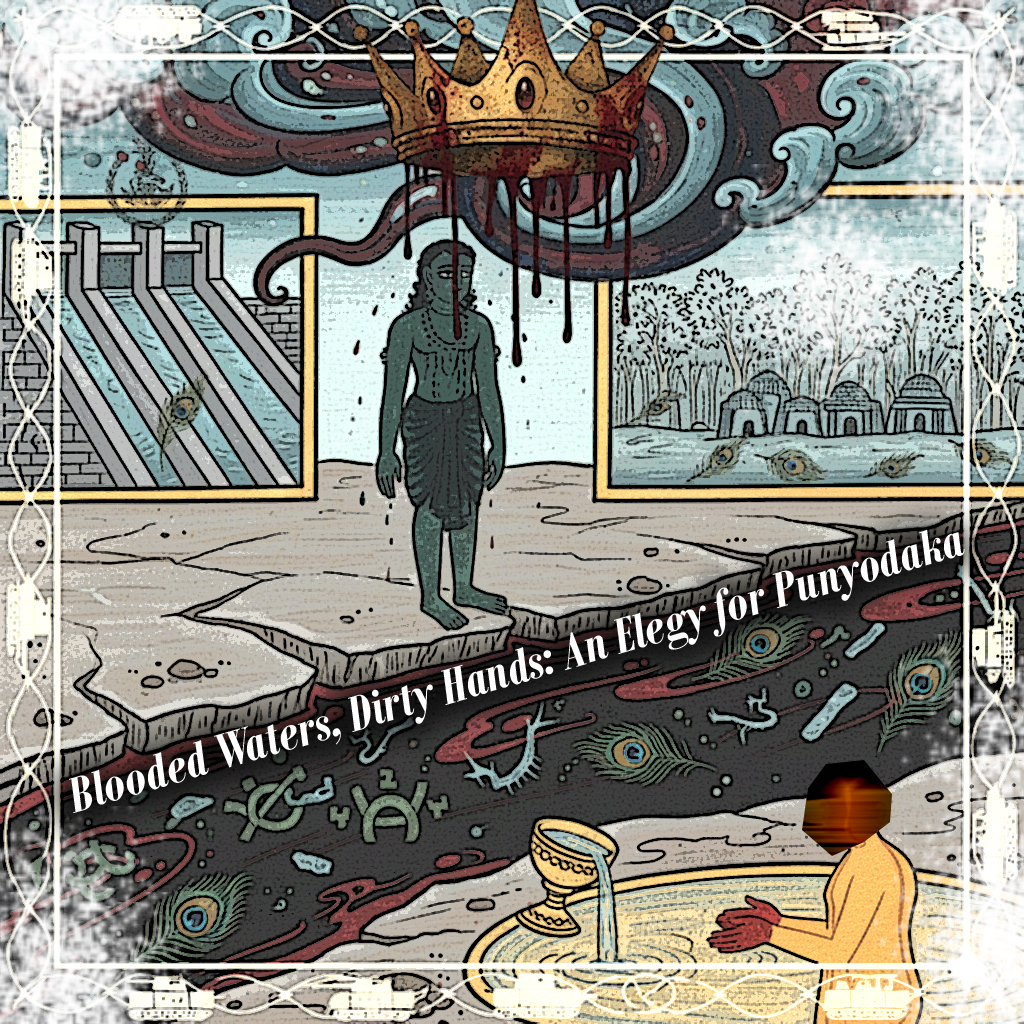
This text is an elegy for puṇyodaka—not as a lost ritual substance, but as a shattered moral condition. Moving across Kalidasa’s Meghadūta, the Vana Parva’s Yaksha-prashna, biblical plague, Macbeth’s indelible blood, and Sartre’s Dirty Hands, it traces how water—river, sea, confluence—has been converted into spectacle, alibi, and instrument of power. Empirical poisonings (heavy metals, fecal coliforms, ecological collapse) coexist with choreographed immersions, artificial ghats, and submarine devotions, revealing a regime of simulation where sanctity is performed while rivers rot and silences are enforced. The work argues that contemporary governmentality no longer seeks purity but stages it, laundering violence through ritual, nationalism, and necessity. Against Hoederer’s calculus and Macbeth’s despair, the Yaksha’s ancient answer—manomalatyāga, the renunciation of inner stain—returns as an indictment: when minds remain polluted by greed, vanity, and commanded quiet, no river can cleanse. Puṇyodaka vanishes not because water fails, but because power poisons meaning itself. What remains is refusal: the withdrawal of consent from any politics that needs blood to function, spectacle to survive, and dirty hands to rule.
