
Posted on 13th April, 2026 (GMT 11:48 hrs)
ABSTRACT
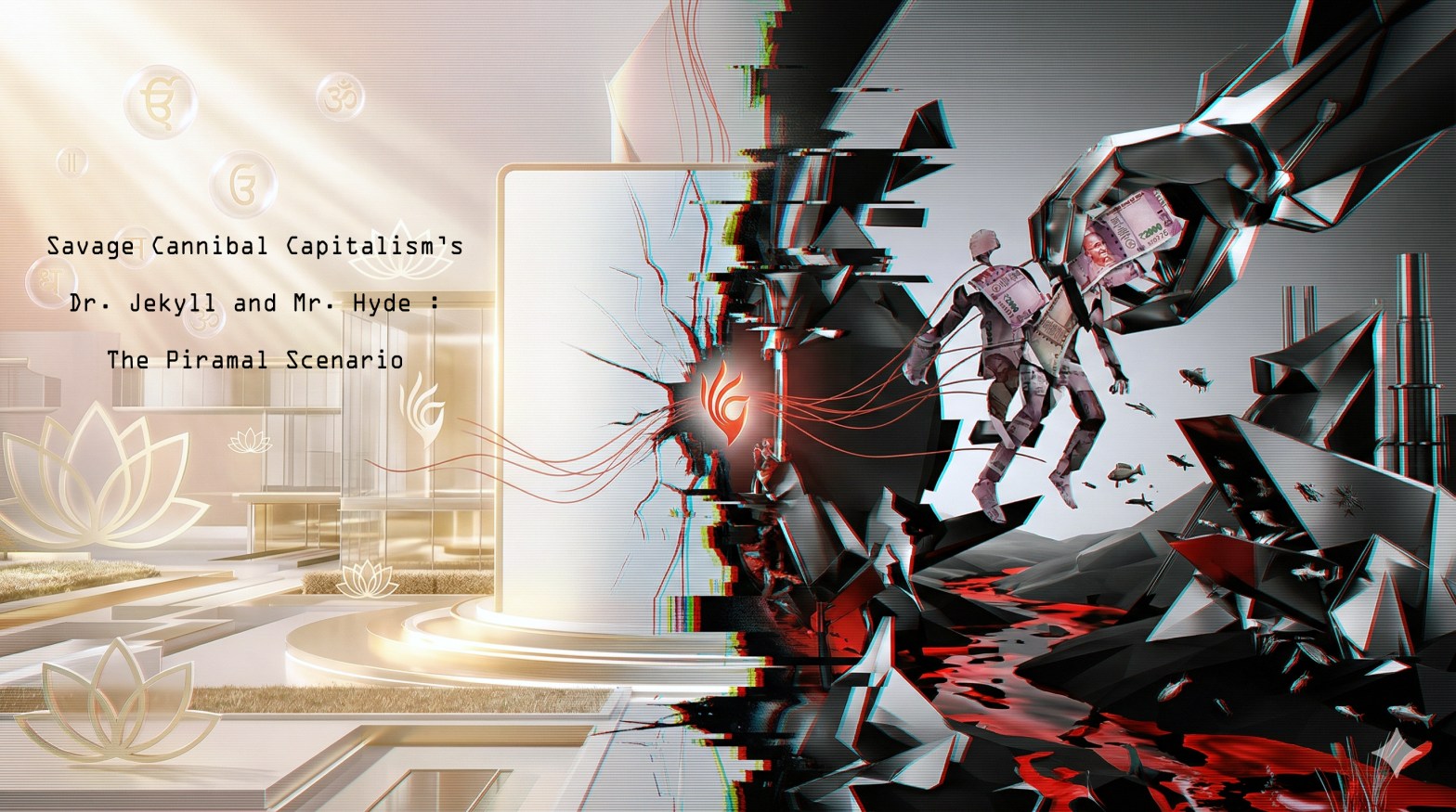
This article offers a structural critique of contemporary capitalism through Deleuze and Guattari’s Capitalism and Schizophrenia, exposing the persistent Dr. Jekyll and Mr. Hyde split between the ethically articulated philosophy of conscious capitalism — inclusive growth, Gandhian trusteeship, Karuṇā–Sevā–Samṛddhi, philanthro-capitalism, and animal spirits — and the savage cannibalistic logic of surplus value extraction. The luminous Dr. Jekyll face presents capitalism as purposeful and compassionate, with profit as mere “oxygen” and Shubh Labh as guiding intent, yet this high-definition screen conceals the relentless Mr. Hyde reality of appropriating crystallised labour, life savings, and ecological commons for endless accumulation. Marxist, anarcho-syndicalist, and Orwellian lenses reveal how ethical language merely re-describes extraction without altering its arithmetic, unmasking doublespeak and Memory Hole mechanisms in restructuring and philanthropic reterritorialization. The 2021 DHFL resolution, upheld by the Supreme Court on 1 April 2025 and culminating in the 2025 reverse merger into Piramal Finance, exemplifies the paradox: celebrated as bold value unlocking, it delivered steep haircuts for retail depositors while allowing the acquirer to retain avoidance recoveries — losses socialised downward, gains capitalised upward. Conscious-ethical-inclusive capitalism thus emerges as a Chimera, generating a Glitch Art aesthetic of smooth philanthropic visions atop crashing realities for the vulnerable, as capitalism deterritorializes moral and spiritual flows only to reterritorialize them as legitimacy capital, sustaining its schizophrenic reproduction. True change demands confronting the foundational mechanics of accumulation beyond moral rebranding.
“There are two circumstances that finally turn the scale: first, the constantly recurring experience that capital, so soon as it finds itself subject to legal control at one point, compensates itself all the more recklessly at other points; secondly, the cry of the capitalists for equality in the conditions of competition, i.e., for equal restrain on all exploitation of labour.” — The Capital, Vol. I, Chapter Fifteen
Well…….Marx is observing a rather predictable capitalist habit: whenever the law or public pressure tries to restrain capital in one place, it doesn’t humbly submit — it simply finds new, often more inventive ways to extract value somewhere else. Meanwhile, capitalists loudly demand “fair rules” and “equal competition” — not because they want less exploitation, but because they want everyone to enjoy the same unrestricted right to exploit.
This timeless pattern has found a particularly elegant and sophisticated expression in today’s world of “conscious” and “ethical” capitalism. What is proudly presented as moral restraint, philanthropic benevolence, and higher purpose often turns out to be the very mechanism through which capital compensates for legal or public scrutiny at one point by doubling down on accumulation at another — all while wrapped in the soothing language of ethics, service, compassion, inclusivity, consciousness and so on.
In the quiet chambers of a respectable Bombay laboratory, Dr. Ajay Piramal mixed an elegant elixir — a shimmering potion labelled Conscious Capitalism, flavoured with Shubh Labh, trusteeship, and Karuṇā–Sevā–Samṛddhi. By daylight he appeared the perfect gentleman: compassionate, purposeful, a steward of dharma who promised that profit was only oxygen and wealth a sacred trust for society. Yet every evening, when the boardroom lights dimmed and the markets stirred, the transformation began. The noble doctor’s features twisted into something feral and ravenous — Mr. Hyde, eyes gleaming with animal spirits, claws extended toward distressed assets and life savings. With one hand he signed philanthropic cheques and spoke of Building Bharat; with the other he devoured retirements through haircuts, poisoned rivers with industrial waste, and left communities gasping in toxic silence. The two were never truly separate. They were the same man — one face smiling in the spotlight of higher purpose, the other feasting in the shadows. The potion did not split him; it simply allowed the gentleman to walk among us while the monster continued its ancient, insatiable work.
0. Introduction
In the glittering discourse of post-industrial neoliberal late capitalism, few figures project a more “harmonious” vision of their corporate empire than Indian billionaire tycoon Mr. Ajay Piramal. He often speaks eloquently of “Conscious Capitalism” — business with a higher purpose beyond profit as well as beyond capital, guided by what he calls an auspicious gain. He champions something called “Inclusive Capitalism”, ensuring growth reaches the bottom of the pyramid. He invokes Gandhian Trusteeship, rooted in the advertised ethos of the Bhagavad Gita, portraying wealth creators not as owners but as caretakers of societal resources. He weaves in the spiritual triad of Karuṇā–Sevā–Samṛddhi — compassion that inspires selfless service and leads to holistic flourishing. He practises philanthropy/charity, applying corporate efficiency and innovation to scale social impact through initiatives like the Gandhi Fellowship, Karuna programs, and the Piramal School of Leadership. And at the same time, he celebrates “Animal Spirits”, the Keynesian optimistic drive to act boldly under uncertainty, turning “imperfect” opportunities into value, christened through his slogan: “Buy Imperfect, Sell Perfect”.
Here’s what struck us.
This is in fact the luminous Dr. Jekyll face of contemporary Indian enterprise: ethical, spiritually grounded, inclusive, and purposeful. It promises a capitalism tempered by dharma or virtuous conduct — where profit serves as mere “oxygen,” animal spirits fuel innovation in new-age “impact investing” entrepreneurship, and trusteeship ensures wealth benefits all stakeholders. In public discourses, including his 2016 Artha Forum talk, Piramal has blended modern business language with Gandhian trusteeship and Gita insights, often citing Karma Yoga and trusteeship as guiding principles.
Yet, beneath this polished narrative lies a structural reality that radical critiques describe as the savage Mr. Hyde of cannibal capitalism. Drawing on Deleuze and Guattari’s Capitalism and Schizophrenia, this could be radically viewed as a system that relentlessly deterritorializes sacred ethical flows — compassion, service, trusteeship, and Gita-derived detachment — only to reterritorialize them as brand capital, ESG optics, and CSR-oriented philanthro-capitalist legitimacy.
The result is a perpetual Dr. Jekyll and Mr. Hyde phenomenon: a smooth, high-definition smokescreen of conscious purpose that masks the underlying mechanics of surplus labour extraction, where value is ceaselessly consumed from labour, savings, communities, and ecosystems to reproduce and expand the extractive free flows of private capital.
In contrast to the more institutional and understated trusteeship associated with the Tata Group under Ratan Tata — often seen or idealised as a generational, less overtly spiritual model of nation-building philanthropy — Piramal’s framework is distinctly personalised and dharmic in its public articulation. Both models, however, operate within the same extractive logic of late capitalism, raising questions about whether spiritual or ethical branding genuinely restrains accumulation or primarily legitimizes it.
Now, here are some inter-weaved questions that bother us at the moment.
Is Mr. Piramal’s “conscious-ethical-inclusive capitalism” a genuine moral evolution, or is it a Mare’s Nest (an illusory discovery), a Square Peg in a Round Hole (incompatible ethics forced into an extractive engine), Pigs Might Fly (the fantasy of self-regulating benevolence), and ultimately a Chimera (a mythical hybrid that cannot cohere)?
The 2021 acquisition and resolution of Dewan Housing Finance Corporation (DHFL) by the Piramal Capital and Housing Finance Ltd. (PCHFL), culminating in the 2025 reverse merger into what became Piramal Finance Ltd. (PFL) by taking in Piramal Enterprises Limited within its fold, stands as a paradigmatic case study. What appears on one side as bold value creation and system stabilization reveals, on the other, asymmetric loss distribution — steep haircuts for small innocent retail depositors whose life savings funded the recovery — followed by rebranding that quarantines legacy costs while celebrating premium listings and subsequent growth in assets under management. Even beyond such reported financial expropriation, there has also been multiple reports of the Piramal empire being engaged in the expropriation of natural ecosystems and the communities therein.
This article offers a structural critique, not a personal indictment. Through Marxist, anarcho-syndicalist, and Orwellian lenses, it examines how savage cannibal capitalism operates: extracting surplus value (the labour and life-force of the exploited) while narrating it as profit and “inclusive progress.” It explores the Glitch Art aesthetic of the system — crashing realities for the vulnerable hidden behind smoothly resolving philanthropic visions. In the end, the Piramal paradox is not about one individual’s sincerity or failings. It reveals the much deeper schizophrenic condition of contemporary capitalism itself: a machine that must continually recode, appropriate and approximate ethical language to sustain its cannibal logic of accumulation.
The question isn’t about whether any individual voice, such as Piramal’s, resonates authentically. It concerns whether a system founded on endless surplus extraction can genuinely be conscious, ethical, or inclusive — or if the Dr. Jekyll facade is inherently necessary because Mr. Hyde relentlessly consumes, engulfs, and preys upon the gullible, the vulnerable, the sensitive, and the fragile.
I. The Piramals’ Preaching: Dharma as Corporate Operating Machinery
The Piramal Couple, viz., Ajay and Swati Piramal, exemplifies a partnership whose advertised engagement with the Bhagavad Gita reflects a commitment to applying its eternal teachings across leadership, business, philanthropy, and holistic well-being. Their shared journey began with regular Saturday study sessions at home, guided by scholars from the Chinmaya Mission. These intimate gatherings gradually evolved into a collaborative project: the couple curated and published a volume featuring 18 selected stanzas from the Gita, each accompanied by thoughtful explanations of its relevance to corporate and personal life. Enriched with soulful renditions of the verses sung by the legendary Pandit Jasraj, the book elegantly bridges ancient spirituality and contemporary action. Swati Piramal, a physician and strategic leader in the Piramal Group, has eloquently distilled 18 management lessons from the Gita, illustrating through real-life examples how these principles have informed their decisions, built resilience, and amplified their societal impact.
For Ajay Piramal, the Gita functions as the ultimate handbook for leadership and decision-making. He repeatedly emphasizes Karma Yoga — the path of selfless action — invoking the famous verse from Chapter 2, Verse 47: one has the right to perform one’s duty but not to the fruits of action. This teaching has trained him to focus intensely on effort and integrity while releasing attachment to outcomes, supposedly enabling bold yet composed choices amid uncertainty. He credits the Gita with instilling fearlessness and the courage to diversify the business — from textiles into pharmaceuticals and financial services — without being paralyzed by anxiety or conventional wisdom. As he has observed, “When intent is right and effort is sincere, fear should not dictate action.” The scripture’s insistence on fulfilling one’s dharma with full commitment has helped him maintain steadiness during challenging transitions and high-stakes negotiations.
Ajay also interprets the Gita as a powerful resource for mental health and emotional resilience. He has described it as “the world’s best anti-depression manual,” offering timeless strategies for managing stress, cultivating equanimity (sthitaprajna), and preserving inner peace amid highs and lows. In a high-pressure world, the Gita’s exhortation — “Do not grieve” — together with its teachings on mindfulness and detachment, supplies practical tools for well-being that allow leaders and individuals alike to thrive with balanced minds. He frequently reminds audiences that the Gita was delivered on a battlefield to a warrior overwhelmed by despair, underscoring its immediate relevance for anyone confronting intense “battles” in professional or personal spheres.
Central to Ajay’s reading is the concept of trusteeship, drawn from the Gita’s ethos of detachment and service. Wealth and resources, he maintains, are not personal possessions but divine trusts to be managed responsibly for the benefit of employees, communities, and society at large. This philosophy has profoundly shaped the Piramal Group’s culture and Ajay’s extensive philanthropic endeavors, aligning commercial success with selfless contribution. He sees the Gita as reinforcing that authentic leadership consists of focused action, ethical governance, and a higher sense of purpose. Swati Piramal complements this perspective with her own distinctive engagement, fusing her scientific background with spiritual insight. Her talks and writings highlight how the Gita’s lessons foster holistic growth — integrating mind, body, and spirit. Collectively, the couple has championed the fusion of ancient Indian wisdom with modern living, deploying the Gita to promote conscious leadership, ethical decision-making, and compassionate action. Their home study sessions and public sharing have created ripple effects, encouraging professionals to internalize Gita-inspired values such as detachment from results, clarity in duty, and inner strength. In their office spaces and public addresses, symbols of the Gita — such as sculptures depicting Lord Krishna revealing the Vishwaroop to Arjuna — serve as constant reminders of interconnectedness and the imperative to transcend personal dilemmas for the greater good.
These insights animate a deeply interconnected, layered philosophy that seeks to integrate ancient dharma with modern enterprise:
(1) Conscious Capitalism: Business as a force for good with a higher purpose beyond profit. Profit is essential — “like oxygen for the body” — but it is not the raison d’être of the enterprise. Piramal describes this as business that serves a larger goal beyond profit. Profit is the oxygen that keeps the body alive, but just as breathing is not the sole purpose of life, profit alone cannot be the sole purpose of business. Every decision must align with a moral and societal “why.” The core pillars include purpose-driven action, stakeholder orientation (measuring success by value created for customers, employees, suppliers, communities, and shareholders — not just owners), and ethical intent under the Indian concept of Shubh Labh (auspicious gain) earned with pure intention and integrity.
This overlaps with the global Conscious Capitalism movement (John Mackey et al.), but Piramal gives it a distinctly Indian spiritual flavour rooted in dharma and the Gita’s teachings on leadership and humility. Businesses should innovate and grow, but never at the cost of integrity. Piramal has cited this philosophy as the reason his group diversified from textiles into pharmaceuticals and financial services while maintaining a long-term ethical compass. In his public statements, he repeatedly emphasises that when business is done with the right intent and values, it becomes a powerful force for good, creating economic value while uplifting society. Conscious Capitalism, for him, is not an add-on but the very operating principle that allows companies to earn respect from consumers and stakeholders through conscientious decisions.
(2) Inclusive Capitalism: This addresses the systemic risk of inequality. Piramal warns that if globalisation and market growth benefit only the top 1% (or even the top 50%), capitalism will face the same fate as state socialism— social unrest, political backlash, and eventual collapse. He emphasises that for capitalism to survive and thrive in the long term, it must work for everyone, particularly the bottom of the pyramid.
The key idea is that GDP growth and technological progress (e.g., AI in finance and healthcare) must deliberately reach the “bottom quartile” and underserved populations. Inequality is not just immoral; it is dangerous to long-term stability. He has spoken about using AI for financial inclusion in rural India while cautioning that it could widen the skilled/unskilled divide if not managed thoughtfully. This echoes C.K. Prahalad’s concept of the “fortune at the bottom of the pyramid,” but Piramal frames inclusion not merely as a moral imperative or business opportunity, but as a survival imperative for capitalism itself. Without deliberate efforts to ensure broad-based growth, the system risks losing public legitimacy and facing the same backlash that brought down earlier ideological experiments. In his view, inclusive capitalism is essential to prevent the kind of social and political instability that could ultimately threaten the very existence of the market economy.
(3) Gandhian Trusteeship: The philosophical bridge that ties everything together. Popularised by Mahatma Gandhi and deeply rooted in the Gita, trusteeship holds that wealth creators are not owners but trustees or caretakers of resources that ultimately belong to society. Piramal has explicitly said the Bhagavad Gita taught him trusteeship and that it was the best advice he ever received. The caretaker mindset means a capitalist manages assets for the benefit of all stakeholders — employees, community, and nation — without personal attachment. Humility and sewa bhaav (spirit of selfless service) are non-negotiable; transparency and responsibility are essential. This internalises moral obligation within the capitalist role itself, making it different from purely Western stakeholder capitalism, which often adds ethics as an afterthought.
This trusteeship finds practical expression in initiatives such as the Gandhi Fellowship and the Piramal School of Leadership (PSL). The Gandhi Fellowship immerses young professionals in grassroots change, equipping them with experiential learning in education, health, and rural development. The Piramal School of Leadership trains thousands of government officials, headmasters, and teachers annually in empathetic governance and Sevā Bhāva, aiming to strengthen public systems from within. These programmes are presented as living embodiments of trusteeship — using wealth and influence not for personal gain but as a sacred trust to build capacity in public service and uplift communities. Yet from a structural perspective, even these well-intentioned efforts risk functioning as legitimacy capital: they channel philanthropic resources into training the very state apparatus that facilitates capital’s smoother reproduction, while the underlying power asymmetries and extractive logic remain untouched.
(4) Karuṇā–Sevā–Samṛddhi: A spiritual-cultural triad that adds profound depth and warmth. Drawing from Vedantic, Buddhist, Bhakti, and Gandhian thought, Karuṇā (boundless compassion) inspires Sevā (selfless, devotional action performed with humility and joy, without expectation of reward), which in turn cultivates Samṛddhi (holistic abundance and well-being — not merely material wealth, but comprehensive thriving that encompasses personal growth, community upliftment, sustainable development, and alignment with dharma). In their natural sequence, compassion opens the heart and clarifies higher purpose, selfless service translates empathy into practical humble action, and shared prosperity emerges as the natural, sustainable outcome. This triad finds concrete expression in initiatives such as the Karuna Fellowship (empowering women and girls from underserved communities with skills, self-confidence, leadership capabilities, self-defence training, digital skill-building, and community leadership development), the Piramal Academy of SEWA (institutionalising the spirit of service through structured frameworks and studies on selfless service), and Samruddhi programmes (focused on women’s empowerment through government-certified apprenticeships, skilling, and career pathways in financial services, alongside Project Samriddhi for improving girls’ enrolment and progression in school). These efforts seek to create sustainable prosperity by equipping individuals with tools for long-term economic participation and well-being.
(5) Grand Philanthropism: The practical execution layer. Philanthropism is applying business discipline — efficiency, scale, metrics, innovation, and risk-taking — to solve social problems. The Piramal Foundation exemplifies this approach through systems thinking rather than mere charity. It scales solutions in health (e.g., digitising rural health centres that unlock large public funds), education, and multidimensional poverty alleviation in India’s most backward states, collaborating with government while bringing private-sector innovation and accountability.
Piramal’s key distinction is that wealth generation (“doing well”) is the necessary “oxygen,” and philanthropy is not a guilt-driven correction after maximising profit but the logical extension of ethical, conscious, inclusive business. Over the years, these efforts have produced tangible outcomes: thousands of fellows have gained leadership skills, women have entered skilled apprenticeships, girls have remained in education longer, and rural communities have gained improved access to health services and economic opportunities. The Foundation has touched millions across 27 Indian states and 2 Union Territories through initiatives like telemedicine helplines, the Piramal School of Leadership training public servants in empathetic governance, Gandhi and Karuna Fellowships for grassroots leadership, and Piramal Sarvajal’s innovative solar-powered Water ATMs that provide affordable clean water to underserved areas. These programmes reflect a holistic approach: building resilient public systems, fostering inclusion, and ensuring that philanthropy catalyses — rather than supplants — government action.
Let us NOW come together to analyze, critique, and dissent.
These elements form an interdependent stack, each layer building upon the previous one: Conscious capitalist purpose provides the moral compass inside operations; Inclusive Capitalism ensures broad-based legitimacy and social stability; Trusteeship supplies the ethical ownership model drawn from Gandhi and the Gita; Karuṇā–Sevā–Samṛddhi infuses heart-centred spiritual depth; and philanthropism supplies the scalable tools to deliver measurable, sustainable impact. They are not separate initiatives but sequential and interdependent — conscious intent flows into inclusive growth, which is grounded in the trusteeship mindset, which in turn finds expression through philanthro-capitalist execution.
In Piramal’s worldview, this framework creates what is presented as a harmonious, distinctly Indian-rooted operating system. Unlike Western models that often separate profit-maximisation from later CSR “corrections,” ethical intent and stakeholder accountability are embedded from day one. Philanthropy flows naturally as an extension of trusteeship, not a reputational bandage. Spirituality is not an escape from the world but a transformative force within it; ancient wisdom is deployed not merely to inspire but to illuminate — and at times to legitimate — the conduct of modern enterprise. These are not isolated slogans but the operating system behind both the Piramal Group’s business empire and the Foundation’s extensive work.
Here, however, the structural critique becomes unavoidable.
The Piramal Group repeatedly invokes its core purpose of “Doing Well and Doing Good”, with values of Knowledge, Action, Care, and Impact embodied across its companies. The Foundation speaks of “Building Bharat” through leadership, decentralisation, digitisation, and inclusion led by women and youth, driven by Sewa Bhaav (spirit of selfless service). Piramal Pharma and Finance emphasise Trusteeship — “We protect and enhance the interests of our customers, community, employees, partners, and shareholders” — while Piramal Swasthya and the School of Leadership aim to transform public systems with empathy and governance rooted in dharma. Realty projects highlight “enriching lives” through design excellence and biophilic spaces. Shubh Labh and trusteeship are presented as the moral glue holding the stack together.
Yet when these powerful slogans and mission statements — “Doing Well and Doing Good”, Sewa Bhaav, Building Bharat, Trusteeship, and Shubh Labh — are examined structurally, they reveal capitalism’s schizophrenic operation in its purest form. The sacred ethical flows of the Gita and Gandhian thought — selfless duty as a radical check on greed, wealth as a trust belonging to society, compassion as boundless karuṇā, service as joyful sevā — are ruthlessly deterritorialized from their ethical and spiritual roots. Capitalism, as the ultimate decoding machine, breaks them down, strips them of their disruptive potential, and immediately reterritorializes them into smooth circuits of accumulation. Compassion and service are recoded as scalable “impact” metrics and philanthropic optics; trusteeship is reterritorialized as the perfect ideological alibi for retaining avoidance recoveries and quarantining legacy liabilities; dharma and Shubh Labh become high-definition brand capital that legitimises the very extractive engine they ostensibly temper.
What is marketed as an integrated dharmic operating system is, in reality, a classic schizo-analytic formation: the machine simultaneously produces the luminous ethical facade (the Dr. Jekyll screen of higher purpose and Sewa Bhaav) and the savage cannibal logic beneath it (Mr. Hyde’s relentless surplus extraction). The entire interdependent stack — Conscious purpose, Inclusive growth, Trusteeship, Karuṇā–Sevā–Samṛddhi, and Philanthro-capitalism — functions as a sophisticated apparatus of capture. It decodes radical ethical codes only to recode them as legitimacy capital, ensuring that losses continue to be socialised downward while gains are capitalised upward, all under the soothing, high-resolution narrative of dharma-tempered enterprise. In this sense, the Piramals’ framework, however sincerely articulated through its mottos and missions, perfectly exemplifies Deleuze and Guattari’s insight: capitalism does not repress desire or ethics — it liberates and redirects them into new flows that ultimately serve its own endless reproduction.
The Rupture: Conscious Capitalism versus Animal Spirits
Yet a subtle yet profound rupture emerges. Conscious Capitalism, trusteeship, and Karuṇā–Sevā–Samṛddhi demand measured, purpose-driven action with detachment from outcomes and stakeholder accountability — echoing the Gita’s nishkama karma. Animal Spirits, by contrast, ignites spontaneous urge, optimistic risk-taking, and decisive acquisition of distressed assets under conditions of informational asymmetry or uncertainty.
This antagonism arises because the logics diverge at a deep theoretical level. Ethical scaffolding provides moral legitimacy and narrative coherence; Animal Spirits propels the raw transactional momentum and value unlocking that capitalism requires for reproduction. When the drive to “buy imperfect” intersects with insolvency processes, the optimistic conviction that challenges can be perfected risks prioritising the acquirer’s upside over equitable outcomes. The result is not necessarily personal failing but a structural tension: ethical intent can become retrospective justification rather than ex-ante constraint, testing whether trusteeship and Shubh Labh genuinely temper the raw vitality of animal spirits or merely accommodate — and reterritorialize — it within the schizophrenic flows of capital.
At its core, Keynesian Animal Spirits represent far more than mere entrepreneurial optimism. In Keynes’ original formulation, they denote the non-rational, instinctive, confidence-driven forces that propel investment when cold calculation alone cannot suffice — the “spontaneous urge to action rather than inaction,” the “animal” element in human nature that overrides uncertainty. Piramal frequently invokes Animal Spirits in public speeches, interviews, economic conclaves, and forums, elevating it into a near-philosophical principle for Indian entrepreneurship. He speaks of habitual optimism, opportunity perception, and the willingness to act boldly amid imperfect information, crystallised in his signature mantra “Buy imperfect, sell perfect.”
What is celebrated as dynamic vitality is, in truth, the purest expression of capitalism’s law of the jungle — Matsya Nyaya, the logic where the big fish devour the small without restraint. Animal Spirits embody the de-enchanted state of nature that capitalism both creates and denies. Far removed from any romantic Rousseauvian wilderness or ecological harmony, this “nature” is a thoroughly artificial, hyper-competitive arena stripped of all ethical or communal restraints. It is the Hobbesian war of all against all, re-engineered through financial markets, insolvency regimes like the IBC, and informational asymmetry, where the strong (those with capital, access, and boldness) consume the weak (distressed assets, retail depositors’ life savings, vulnerable communities). The “animal” in Animal Spirits is not the noble savage but the predator in a de-enchanted world — instinctual, opportunistic, and ruthlessly adaptive.
Here the rupture becomes schizo-analytic in the fullest Deleuzian-Guattarian sense. Conscious Capitalism and its allied ethical flows attempt to re-enchant this brutal state of nature with dharma, trusteeship, and compassion. Yet Animal Spirits function as the decoding machine that continually breaks down those re-enchanting codes. The spontaneous urge to “buy imperfect” is not tempered by nishkama karma; it is the very force that deterritorializes ethical restraint and reterritorializes it as post-facto justification for aggressive accumulation. What appears as entrepreneurial courage is the raw, chaotic energy of capital’s law of the jungle — Matsya Nyaya operating at the speed of modern finance, where the big fish (resolution applicants) swallow the small (retail savers’ life savings) under the cover of “value unlocking” and “system stabilisation.”
The deeper irony is that this “state of nature” is not natural at all. It is a thoroughly produced, de-enchanted artificial wilderness — a financialised jungle engineered by legal frameworks, informational asymmetries, and competitive imperatives. Animal Spirits do not reconnect us to any authentic nature; they accelerate the final disenchantment, turning every distressed asset, every human savings, every ecological commons into raw material for surplus extraction. The Gita’s call for detached action is thus hijacked: fearlessness becomes the psychological fuel for predatory opportunism, while detachment from outcomes conveniently absolves the acquirer from the human cost of the “imperfect” assets they perfect.
In this antagonism, we witness capitalism’s schizophrenic genius: it simultaneously requires the ethical re-enchantment (Conscious Capitalism, trusteeship, Karuṇā–Sevā–Samṛddhi) to maintain legitimacy and the raw, chaotic Animal Spirits to drive actual accumulation. The two cannot coexist without contradiction; one must always serve as the ideological screen for the other. The rupture is not a flaw in Piramal’s borrowed philosophy — it is the necessary fault-line through which the machine reproduces itself.
II. The Piramal Paradox: Advertised Values Meet Practice — Where the Fault-Line Collapses
The 2021 DHFL resolution — India’s largest NBFC insolvency then — and its evolution into Piramal Finance exemplify this paradox. Piramal Capital & Housing Finance’s plan was approved by the Committee of Creditors, NCLT, and ultimately upheld by the Supreme Court on 1 April 2025. The Court affirmed the commercial wisdom of the CoC, allowed the successful resolution applicant to retain proceeds from avoidance applications under Section 66 of the IBC, and confirmed compliance. A subsequent 2026 PMLA order in February 2026 granted immunity to the corporate debtor under IBC Section 32A post-management change. The 2025 reverse merger created a listed entity re-named/re-branded as “Piramal Finance Ltd.” with a retail pivot, reporting significant AUM growth (crossing ₹1 lakh crore) and improved profitability.
From the philosophy’s standpoint, this embodied Animal Spirits in action: bold acquisition of an “imperfect” asset, restructuring for stability, and contribution to the financial ecosystem, aligned with long-term value creation. Post-resolution growth in retail lending and overall metrics demonstrates the “sell perfect” outcome.
Critics, however, highlight asymmetric realities that map directly onto the fault-lines of the advertised principles. The controversies do not appear as isolated incidents but as overlapping cracks where the projected dharma of Conscious Capitalism, Inclusive Capitalism, Trusteeship, Karuṇā–Sevā–Samṛddhi, and Philanthropism collides with lived suffering.
a) DHFL Victims: Retail fixed-deposit holders and unsecured creditors — numbering in the lakhs, including many retirees and middle-class savers — absorbed steep haircuts, with recoveries for certain segments reported as low as ~23%. The nominal ₹1 valuation for avoidance recoveries (potentially substantial) assigned to the resolution applicant, combined with the reverse merger’s quarantining of legacy liabilities, illustrates losses borne disproportionately by vulnerable depositors while upside accrues upward. “Possession before finality” during appeals reinforced perceptions of prioritised operational control. These are not abstract numbers: they represent shattered life savings, ruined retirements, destroyed trust in institutions, and families pushed into debt or destitution. The very “bottom of the pyramid” that Inclusive Capitalism claims to serve was left to bear the heaviest burden, while the acquirer walked away with future recoveries and a cleaned-up entity. This directly contradicts trusteeship (wealth as a sacred trust for society, not personal gain) and Shubh Labh (auspicious gain earned with pure intent), turning the rhetoric of stakeholder orientation into a hollow echo for those whose accumulated labour-value funded the “value unlocking.”
b) People, Animals, Insects, and Ecosystems in Digwal (Telangana): Historical and ongoing National Green Tribunal proceedings (2018–2021, with a 2024 case still alleging issues) have documented groundwater and soil contamination from untreated pharmaceutical effluents, solvents, heavy metals, and buried toxic waste at Piramal’s facility. Unlined pits and leachate have rendered aquifers unfit for drinking or irrigation, ruining crops and forcing abandonment of wells. Local residents report spikes in skin disorders, respiratory illnesses, cardiac problems, kidney failures, and cancers — a slow, attritional violence that medicalises entire communities. The soil and water poisoning extend to insects, birds, livestock, and the broader food chain, creating silent ecological collapse where biodiversity is quietly erased. This stands in stark contradiction to Karuṇā (boundless compassion) and Samṛddhi (holistic flourishing for all life forms), as well as the biophilic and sustainability branding that accompanies Piramal realty and Foundation initiatives. Trusteeship, which demands responsible caretaking of resources belonging to society (including future generations and non-human life), is exposed as selective when industrial externalities are externalised onto the very commons the philosophy claims to protect.
c) Fishes, Marine Life, and Communities in Dahej (Gujarat): In February 2026, the Gujarat Pollution Control Board issued a closure order after a tanker discharged spent hydrochloric acid from a Piramal Pharma unit into a canal feeding the Narmada River. The incident threatened drinking water, irrigation, and aquatic ecosystems for millions downstream. While the order was challenged and later granted interim revocation, the episode highlights the fragility of “zero-liquid-discharge” claims. Acid discharge risks acute harm to fishes, aquatic insects, microorganisms, and the entire riverine food web — a direct assault on the living commons. Human communities dependent on the Narmada for livelihood and sustenance face poisoned water sources and long-term health risks. This contradicts Sevā (selfless service to all beings) and the Foundation’s health and water initiatives (Piramal Swasthya and Sarvajal), which project compassion while industrial operations externalise toxicity. The swift restart of operations despite the Supreme Court noting the threat to a vital water source underscores how trusteeship and dharma are reterritorialized: ethical language protects the brand, while the material harm to life forms continues.
These mapped tensions — DHFL’s financial dispossession, Digwal’s toxic slow violence on human and non-human bodies, Dahej’s acute threat to riverine life — are not mere “regulatory disputes” or “industry challenges.” They are the felt trauma and lived suffering where the advertised principles collapse.
The luminous Dr. Jekyll face (Shubh Labh, Sewa Bhaav, inclusive growth, Karuṇā–Sevā–Samṛddhi, trusteeship as moral stewardship) is laid over the Mr. Hyde reality of surplus extraction: losses socialised onto the vulnerable (retail savers, polluted villagers, poisoned ecosystems), gains capitalised upward (restructured entity, retained recoveries, continued operations).
Under IBC’s revival-over-liquidation design, such outcomes for unsecured creditors are structurally common when assets fall short. The Supreme Court’s endorsement provides legal finality and underscores CoC’s commercial prerogative. Nevertheless, the episode probes the philosophy deeply: even when procedurally compliant and judicially upheld, does the process adequately honour stakeholder orientation, trusteeship, and inclusive claims when the “bottom of the pyramid” — retail savers — bears outsized pain? Does Shubh Labh and Sevā Bhaav extend meaningfully to those whose accumulated savings enabled recovery — or to the fishes, insects, crops, and communities bearing the toxic trails?
The Piramal Foundation’s tangible work — training public servants in empathetic governance, empowering women through fellowships, digitising health systems, and providing clean water via innovative ATMs — embodies Karuṇā–Sevā–Samṛddhi and philanthro-capitalism at scale. Yet these very initiatives, framed as “Building Bharat” through Sewa Bhaav and impact, sit atop the contradictions: philanthropy as symbolic capital that legitimises broader operations while the extractive logic (financial haircuts, environmental externalities) persists.
These are not binary proofs of hypocrisy but sites where the Dr. Jekyll and Mr. Hyde split becomes visible. What appears as genuine trusteeship and compassionate action is, structurally, philanthropo-capitalism — a refined mechanism through which the top 1–2% convert a portion of extracted surplus into tax-deductible CSR spending, thereby reducing their effective tax burden while converting guilt into sellable spectacle. The rich are not truly “taxed” in any redistributive sense; instead, they launder a fraction of their accumulated capital back into image-making, branding it as Sewa Bhaav, Shubh Labh, and dharma-driven impact.
This is not restitution. It is guilt-laundering: the dispossession and expropriation of the othered 98–99% (human labour, life savings, ecological commons) is partially offset by curated acts of benevolence that generate reputational capital, media praise, and social licence to continue operating. The natural world — poisoned rivers, contaminated groundwater, silenced insects and fishes — becomes the unacknowledged victim in this persona-construction process.
The values — dharma, trusteeship, Karuṇā, Sevā — function here as a schizophrenic veil. They are deterritorialized from any radical ethical demand (genuine relinquishment of ownership, full accountability to the dispossessed, restoration of the commons) and reterritorialized as marketable narrative. The structure that Mr. Piramal represents — like any other corporate tycoon in the top 1–2% — does not resolve the contradiction; it reproduces it. Surplus is extracted without full restitution to labour, to savers, or to the living world. A portion is then recycled through CSR and philanthropy into a high-definition spectacle of moral superiority. The 98–99% (workers, depositors, polluted communities, non-human life) continue to subsidise the system, while the extractors brand themselves as trustees and servants of dharma. This is not evolution toward conscious capitalism. It is the necessary ideological facade that allows the cannibal machine to keep devouring while wearing the mask of compassion.
This veil is particularly visible in the opaque mechanisms of political funding and regulatory navigation. Piramal Group companies donated significant sums through electoral bonds — a now-unconstitutional scheme widely criticised for enabling anonymous, untraceable contributions to the ruling BJP — while simultaneously channelling funds into the opaque PM CARES Fund, whose lack of transparency and audit has raised serious questions about accountability and potential misuse. Earlier dealings, such as the Flashnet transaction with BJP Minister Piyush Goyal and settled SEBI insider-trading probes, further illustrate patterns of navigating grey zones in ways that benefit the corporate structure while evading meaningful scrutiny.
Are these acts of dharma? Or are they the classic compensation Marx described — when capital faces restraint at one point (public scrutiny, legal oversight), it finds new, more inventive avenues at another (political influence, opaque trusts, financial restructuring) to protect and expand accumulation? Far from selfless service or trusteeship, these moves reveal how the language of higher purpose serves as ideological cover: the top 1–2% extract without restitution, then use a fraction of the spoils to buy legitimacy, influence, and social licence. This is not evolution toward conscious capitalism. It is the necessary ideological facade that allows the cannibal machine to keep devouring while wearing the mask of compassion.
Legal victories and philanthropic impact create jobs, assets, and social programs; yet the human, ecological, and felt trauma in specific episodes invite a deeper reflection. Trusteeship, radical in Gandhi’s vision and further interpreted by Vinoba Bhave as requiring labour performance by all — that every able person must contribute productive work and that no one should live off the labour of others without equivalent contribution — is here reduced to selective caretaking that never challenges the foundational ownership structures or power asymmetries.
Nishkama karma (detached duty) is invoked, yet the outcomes remain firmly attached to the logic of accumulation. The structural agent at work — the class fraction represented by figures like Piramal — expropriates the labour, savings, and ecological commons of the many without ever performing equivalent labour itself. It extracts surplus value from depositors’ life savings in DHFL, from workers in its factories, from communities bearing toxic burdens in Digwal and Dahej, and from the natural world itself, then recycles a fraction of that extracted surplus into philanthropic spectacle. This is not trusteeship in Vinoba’s or Gandhi’s radical sense. It is the opposite: a system in which the few extract without contributing productive labour, while using the language of Sewa Bhaav, Shubh Labh, and dharma to launder the spoils into legitimacy and moral superiority. The entire apparatus — from insolvency resolutions that socialise losses onto the vulnerable, to environmental externalities that poison rivers and soils, to philanthropic rebranding that converts guilt into brand capital — reveals the contradiction at the heart of the advertised philosophy. Trusteeship is preached, but extraction without restitution is practised. The Gita’s call for selfless action is repurposed; the radical demand that all must labour is quietly set aside for the few who accumulate.
III. Structural Critique: Conscious-Ethical-Inclusive Capitalism as Manufactured Chimera
Examined through radical lenses, these tensions expose a deeper, systemic irreconcilability that cannot be resolved by moral re-description or philanthropic rebranding alone.
From a Marxist perspective, the engine of capitalism remains the relentless extraction of surplus value. Capital does not create value ex nihilo; it appropriates the difference between the socially necessary labour required to reproduce the worker (or, in financialised forms, the depositor) and the total labour (or stored value) commanded in the production or circulation process. This difference, expressed as s/v = Δm (the rate of surplus value), appears to the capitalist as “value creation,” “turnaround,” or “premium listing.” From the standpoint of the exploited, however, it registers as the systematic conversion of crystallised labour into private capital.
In the Piramal case, this extraction operates through multiple circuits: depositors’ savings (crystallised past labour) are transferred via haircuts and nominal valuation of avoidance recoveries into corporate assets; industrial operations realise surplus through living labour exceeding the value of labour-power; and financial restructuring extracts surplus in the form of interest, spreads, and asset appreciation. Ethical vocabulary — stakeholder orientation, trusteeship, inclusive growth — functions as a Square Peg in a Round Hole: moral language is forced into an amoral arithmetic whose fundamental equation never changes. Philanthropy does not interrupt this circuit; it recycles a portion of the realised surplus value back into reputational capital, forming a Mare’s Nest — an elaborate ethical superstructure erected atop the same cycle of accumulation and dispossession.
An anarcho-syndicalist perspective rejects the very premise of “ethical capitalism.” As long as private ownership of the means of production and hierarchical control over decision-making remain in place, genuine conscience is structurally impossible. Power, not personal virtue or spiritual intent, ultimately shapes outcomes. The belief that a wealthy trustee can voluntarily restrain himself through compassion, service, or dharma while continuing to hold decisive authority over capital deployment, restructuring, and the allocation of surplus is pure fantasy — Pigs Might Fly.
Initiatives presented as inclusive or philanthropic become symbolic theatre: they invite the exploited to admire biophilic campuses, leadership fellowships, and impact metrics, while the underlying relations of domination stay untouched — wage labour that separates producers from the fruits of their work, private appropriation of surplus, and the systematic exclusion of workers and communities from real control over production and distribution. Authentic ethics cannot emerge from within this hierarchy. It requires the abolition of these structures and their replacement by direct, democratic management of production and distribution by the producers themselves, so that any surplus returns to the collective and the commons rather than being siphoned upward to reproduce corporate power and privilege.
An Orwellian lens exposes the doublespeak and doublethink at the heart of the system. Terms such as “resolution,” “value unlocking,” “stakeholder value,” and “conscious capitalism” function as Newspeak: they invert meaning to normalise contradiction and make structural violence appear harmonious. What is experienced as the destruction of life savings or the poisoning of ecosystems is reframed as “necessary restructuring for system stability” or “compliance challenges.” The reverse merger and rebranding serve as a literal Memory Hole: legacy suffering and ecological harm disappear from the official narrative, replaced by clean metrics of growth and impact. Ethical terms (Shubh Labh, Sevā Bhāva, trusteeship) do not challenge the system — they sanitise exclusion and reterritorialise extraction as moral progress, allowing the machine to reproduce itself under the sign of higher purpose. This is doublespeak and doublethink in action: the mind simultaneously holds two contradictory beliefs — that the enterprise is rooted in dharma and compassion, and that ruthless surplus extraction must continue — and accepts both as true.
Deleuze and Guattari’s framework illuminates the process at its deepest schizo-analytic level. Capitalism functions as a decoding machine that relentlessly breaks down traditional ethical, religious, and communal codes — compassion as karuṇā, service as sevā, wealth as trusteeship — only to reterritorialise the fragments into new circuits of accumulation. Sacred flows are deterritorialized from their disruptive potential and immediately recoded as legitimacy capital: ESG optics, philanthropic branding, and high-definition screens of dharma and Sewa Bhaav. The result is savage cannibal capitalism: a system that consumes its own — labour, savings, ecosystems, and social trust — in order to reproduce and expand. Conscious-ethical-inclusive capitalism is therefore a Chimera: a mythical hybrid whose saintly head (the language of higher purpose and moral stewardship) cannot tame the extractor’s claws. It produces a distinctive Glitch Art aesthetic — smoothly resolving philanthropic visions projected over the crashing realities experienced by the vulnerable and the living world. The greater the reliance on ethical reterritorialisation for legitimacy, the more visible the glitch becomes when outcomes diverge from the narrative.
The entire apparatus reveals capitalism’s structural genius: it simultaneously requires the ethical re-enchantment to maintain social legitimacy and the raw decoding force of accumulation to reproduce itself. The two faces are not accidental contradictions but necessary co-constituents of the machine. As long as surplus value extraction — expressed through the rate s/v and realised in profit, interest, and rent-like mechanisms — remains the foundational logic, the ethical vocabulary cannot transform the system. It can only serve as the ideological screen that allows the cannibal process to continue under the sign of dharma, trusteeship, and higher purpose.
IV. Implications and the Enduring Schizophrenic Condition
The Piramal paradox is not an exceptional anomaly — it is symptomatic of the deeper contradiction at the heart of contemporary Indian capitalism. In a rapidly growing India aspiring to trillion-dollar ambitions, experiments in oxymoronic “dharmic capitalism” continue to proliferate, offering the seductive promise that ancient wisdom can humanise the market. Yet the structural tension remains irreducible: a mode of production founded on the extraction of surplus value cannot be fundamentally transformed by ethical re-description, spiritual rhetoric, or philanthropic spectacle alone.
Animal Spirits drive the expansion; conscious framing supplies the cultural legitimacy; yet power asymmetries, IBC mechanics, competitive imperatives, and the relentless logic of accumulation continue to externalise costs onto the less powerful — whether retail depositors, polluted communities, or the living world itself. The deeper implication is stark: conscious-ethical-inclusive capitalism functions not as a genuine evolution but as the necessary ideological facade of savage cannibal capitalism. It deterritorializes moral and spiritual flows — compassion, service, trusteeship, dharma — only to reterritorialize them as stability, brand capital, and legitimacy, thereby sustaining reproduction while naturalising its contradictions.
Stronger retail protections in insolvency, voluntary exceeding of legal minima, greater CoC transparency, or broader stakeholder primacy debates may mitigate the most visible symptoms. But these are surface adjustments. Until the foundational arithmetic of accumulation is confronted — until the system moves beyond rebranding to genuine producer and community control over the means of production and the commons — the Dr. Jekyll and Mr. Hyde split, and the Glitch Art aesthetic of smooth ethical screens projected over crashing realities, will continue to define the schizophrenic condition of the entire order.
Gandhi warned that true trusteeship demands inner transformation and relentless societal vigilance; it is not a convenient slogan but a radical practice that challenges entitlement and/or ownership itself. The Gita teaches detached action, yet praxis must answer to equivalent standards when sacred language is invoked in the public sphere. The decisive question is not the sincerity of any single articulation, but whether a system built on perpetual surplus extraction — where the few continually expropriate the labour, savings, and life-worlds of the many without full restitution — can ever be truly conscious, ethical, or inclusive.
As long as capital compensates recklessly at other points when restrained at one — as Marx observed — the ethical screen will continue to mask the devouring beneath. The Piramal case, like so many others, reveals the limit: the top 1–2% can wrap their accumulation in the language of dharma, Sewa Bhaav, and higher purpose, but they cannot escape the structural logic that requires the dispossession of the other 98–99% and the instrumentalisation of the living world. True transformation demands more than refined facades. It requires dismantling the foundational mechanisms of extraction and replacing them with democratic, collective control over production and the commons. Anything less is not evolution — it is the machine reproducing itself in ever more sophisticated disguise.
Disclaimer: The terms “savage,” “cannibal,” and “savage cannibal capitalism” are used strictly as metaphors for the structural logic and systemic violence of contemporary capitalism, inspired by Satyajit Ray’s film Agantuk and its inversion of the civilised/savage binary. They highlight how modern institutions organise mass consumption of labour, savings, and ecosystems for profit and power. The analysis is structural, not a personal indictment; specific practices serve as illustrative case studies of broader tendencies. The author rejects any reading that demeans animals, indigenous peoples, or non-human life; on the contrary, the critique aligns with Ray’s insight that the most sophisticated cannibalism often resides in “civilised” boardrooms and systems.
SEE ALSO:
 Once in a Blue Moon Academia