
This affidavit opposes the 2025 Special Intensive Revision (SIR) of electoral rolls as an unconstitutional and discriminatory exercise that extends the exclusionary logic of the NRC–CAA–NPR regime. Framed as an administrative update, the SIR reproduces a politics of fear, surveillance, communal polarization and bureaucratic coercion—already driving marginalized citizens to despair and suicide. It exposes the State’s transformation of citizenship from birthright to conditional privilege, mediated by data and documents. Against this, the affidavit invokes planetary citizenship—an ethical-ecological vision affirming belonging beyond paper, religion, nation, or algorithm.
Category Archives: Art of Resistance
Following the dictum “Cultural revolution must precede political revolution”, we are striving to create the scope for an alternative cultural space, which can offer resistance to all forms of coercion, and can also serve as a medium for conducting non-violent, horizontal dialogical exchanges.
Why Indian Political Parties Are Ecologically Indifferent

This article examines the deep-rooted ecological indifference of Indian political parties across the ideological spectrum. Despite unprecedented environmental degradation—from the destruction of forests in Hasdeo and Nicobar to toxic urban air and vanishing rivers—ecology remains absent from India’s political grammar. The essay argues that this neglect is not accidental but structural: born of a development myth that equates progress with extraction and nationalism with industrial expansion. In a corporatized democracy, parties serve capital before climate, leaving the earth unrepresented in the republic’s moral imagination.
Why India Needs a No Kings Movement: From Fascist Corporatocracy to Partyless Democracy

This essay traces the global and Indian convergences of authoritarian populism, corporate capture, and digital surveillance through the metaphor of kingship. Beginning with the “No Kings” movement in the U.S., it reinterprets democracy as an anti-monarchical ethic — a practice of shared sovereignty rather than submission to personality cults. Through Modi’s curated spectacle of power, the text exposes India’s descent into corporatocracy, pseudology, and ecological tyranny. It ultimately envisions a “partyless democracy” rooted in decentralization, mutual care, and invisible leadership — a republic without kings, parties, or masters.
“Who’s Got the Paper? I’ve Got the Match”: Osibisa and the Politics of Documentation
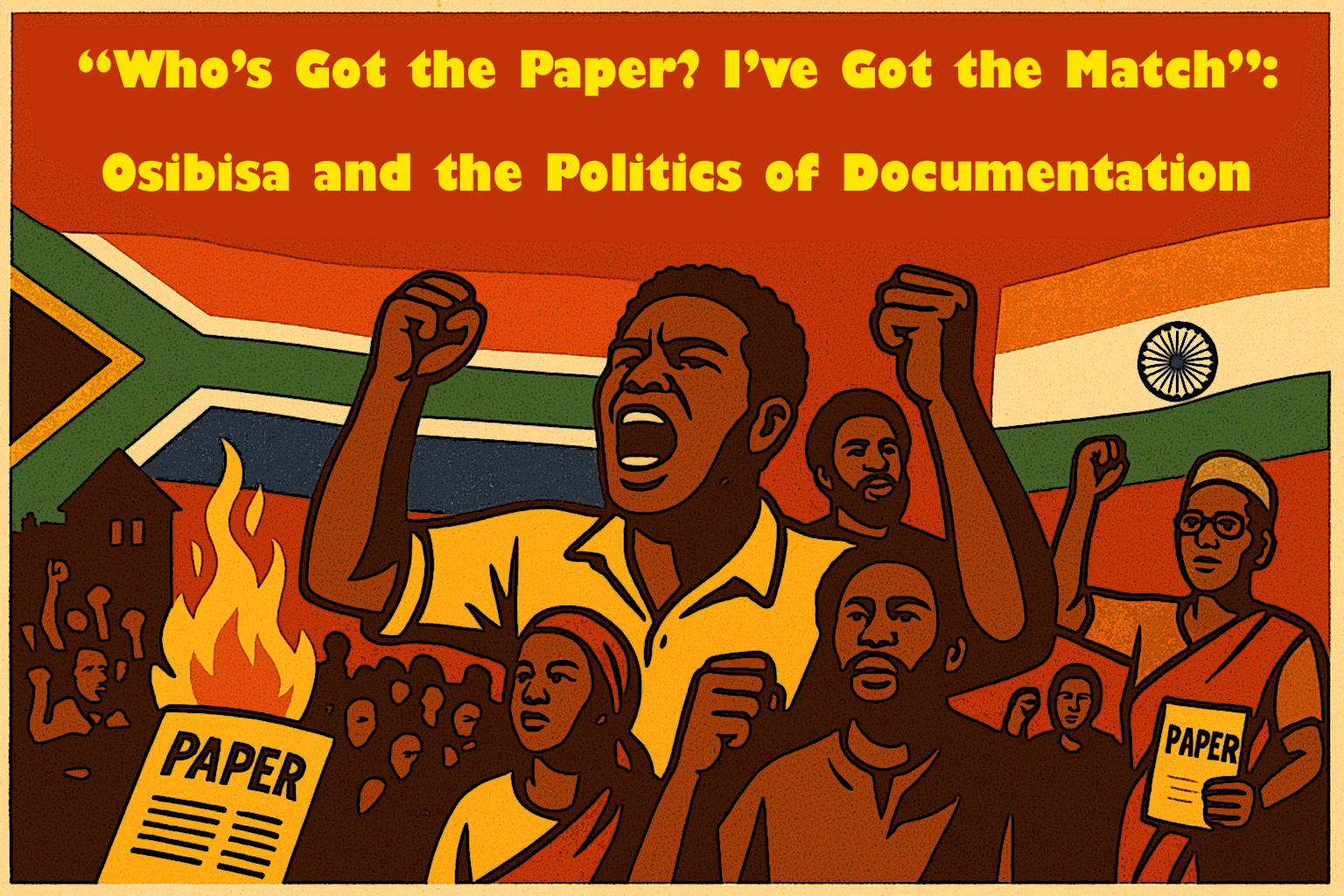
This paper offers an interpretive and historical reading of Osibisa’s 1970s Afro-rock track Who’s Got the Paper? as a sonic meditation on the politics of documentation, identity, and resistance. Beneath its surface as a jubilant “party anthem,” the song encodes a global genealogy of documentary surveillance—from colonial pass laws and apartheid bureaucracies to postcolonial citizenship registers and digital data regimes. The refrain’s dialectical call and response—“Who’s got the paper?” / “I’ve got the match”—stage an encounter between state surveillance and insurgent agency, between the archive’s demand for verification and the people’s capacity for ignition. Combining lyrical analysis with postcolonial, Foucauldian, and musicological frameworks, the paper interprets sound as a mode of political imagination that exceeds textual control. Extending this argument to the Indian context, it situates the song’s critique within contemporary regimes of legibility exemplified by the Citizenship Amendment Act (CAA), National Register of Citizens (NRC), National Population Register (NPR), the Special Intensive Revision (SIR) of electoral rolls, and the Digital Personal Data Protection Act (DPDPA)—each reiterating the colonial “paper logic” of inclusion through exclusion. Drawing upon Michel Foucault’s concept of governmentality, James C. Scott’s notion of legibility, Giorgio Agamben’s “state of exception,” and Achille Mbembe’s necropolitics, the essay argues that Who’s Got the Paper? performs the political imagination of music as resistance—where rhythm becomes revolt and dance becomes dissent. Through the contrapuntal readings of Edward Said, Ngũgĩ wa Thiong’o, and Frantz Fanon, Osibisa’s sound emerges as a postcolonial act of re-signification: transmuting the colonizer’s documentary order into an emancipatory rhythm of decolonial speech.
Nixit and the Pharmaco-Capitalist Soul: Hauntings Under Piramal Pharma

This essay interrogates Nixit—a nicotine lozenge produced by Piramal Pharma—as an artifact of contemporary bio-political control. By examining its chemical composition, rhetoric of health, and psychopolitical subtext, the paper situates Nixit within the neoliberal economy of purification, where addiction is not eliminated but reformatted for consumption. Drawing on Freud’s psychoanalysis and Foucault’s biopolitics, alongside the cinematic allegory of Anurag Kashyap’s No Smoking (2007), the article reveals how the pharmaco-industrial complex transforms rebellion into obedience, recoding the smoker’s desire into a commodified act of self-regulation. Incorporating Nietzsche’s genealogy of internalized violence and Derrida’s notion of hauntology, it further argues that the lozenge embodies the spectral persistence of repression under the guise of care. In the age of “managed freedom,” even the act of quitting becomes a performance of compliance—sweetened, packaged, and sold as virtue.
(W)holistic Resistance and the Courage to Stand Alone: OBMA’s Call for Justice and Dissent in India

This statement reflects OBMA’s introspection and reaffirmation of purpose amid ongoing struggles for justice, accountability, and ecological integrity in India’s increasingly oligarchic and censored environment. Drawing inspiration from Gandhi’s satyagraha, Tagore’s “Ekla Chalo Re,” and the resilience of figures like Umar Khalid, it underscores the moral necessity of walking alone when truth demands it. Acknowledging internal hesitations, systemic suppression, and self-censorship, OBMA calls for renewed ethical persistence, strategic communication, and collective courage — bearing one’s own cross with conscience, foresight, and faith in transformative action.
Defending Dissent, Protecting Ladakh: OBMA Stands with Climate Activist Sonam Wangchuk

The Once in a Blue Moon Academia (OBMA) stands in unwavering solidarity with Sonam Wangchuk and the Ladakh Movement, recognizing their struggle as a fight for environmental justice, climate action, cultural autonomy, and democratic dissent. Highlighting Ladakh’s vulnerability as the “Third Pole” of the world, the statement critiques the abrogation of Article 370 and the selective, contradictory application of Article 371, exposing the central government’s sidelining of local governance and ecological concerns. OBMA condemns Wangchuk’s arbitrary NSA detention and the violent suppression of peaceful protests, emphasizing that the movement’s constitutional demands for statehood, Sixth Schedule inclusion, and ecological protection are lawful, ethical, and globally aligned. The statement affirms that safeguarding communities, ecological integrity, and the right to dissent are duties of conscience, wisdom, and citizenship.
Joyful Festivals, Not Noise and Smoke in Kolkata and West Bengal (AN ONLINE MASS PETITION)

Kolkata, once the “City of Joy,” now faces climate fragility from rising seas, cyclones, and severe pollution. Festivals throughout the year amplify this crisis with high-decibel firecrackers, DJ systems, dazzling lights, and toxic idol immersions, worsening air, noise, and water quality. Despite strong laws and repeated court orders, lax enforcement and state subsidies for festival committees deepen unsustainable practices. The toll is stark—over 18,000 premature deaths annually from air pollution, alongside cardiovascular, respiratory, and mental health harms. This Fridays For Future (FFF) India petition calls for urgent enforcement of pollution laws, ending arbitrary state funding, ensuring just transition for firecracker workers, and promoting sustainable, culturally rooted celebrations that protect citizens, animals, and ecosystems.
Non-Godi Media, This Is Your Wake-Up Call: The DHFL Scam

This video is a direct appeal to India’s non-Godi media to break their silence on the DHFL scam—a financial catastrophe that destroyed the savings of pensioners, defence families, employees, and small investors while powerful corporations, auditors, rating agencies, and regulators escaped accountability. It exposes how political donations, celebrity endorsements, fraudulent credit ratings, judicial opacity, and sweetheart deals under the Insolvency and Bankruptcy Code enabled the systematic looting of public wealth and its transfer to oligarchs like Ajay Piramal. By demanding fearless reporting, a Judicial Truth and Accountability Commission, real penalties for gatekeepers, anti-SLAPP protections, and restitution for victims, the video insists that silence from independent media is not neutrality but complicity in state-corporate betrayal.
Shut Down Arms Factories to Stop Wars: Dismantling the Global War Profiteering Machine

The global arms industry—worth nearly $95 billion annually—is both a driver of human suffering and a silent engine of ecological collapse. Wars claim over 2,000 lives daily, displace millions, and shatter societies, while leaving behind poisoned aquifers, fragmented habitats, and toxic soils contaminated by unexploded ordnance and chemical residues. Arms manufacturers like Lockheed Martin and RTX thrive on this devastation, rewarded by soaring stock prices whenever conflict erupts, while shadowy brokers such as Viktor Bout and Aboubakar Hima profit from prolonging wars that ravage both communities and ecosystems. India exemplifies this global dilemma, channeling vast sums into defense while underfunding water, health, education, and environmental resilience. The campaign “Shut Down Arms Factories to Stop Wars” demands dismantling this war economy by halting weapons production, regulating brokers with ecological due diligence, mandating transparency of emissions and toxic legacies, and reallocating resources toward human well-being and planetary stewardship. Peace cannot be defined as the mere absence of war—it must mean fertile soils, clean water, healthy bodies, and thriving ecosystems within Earth’s limits. Yet even the green transition carries risks: critical mineral extraction for renewables, if pursued without justice, threatens to replicate the violence and exploitation of fossil fuel regimes. A just future requires confronting militarism, curbing extractivism, and investing in life over destruction. Only by linking disarmament with ecological restoration can humanity secure genuine peace within planetary boundaries.
 Once in a Blue Moon Academia