
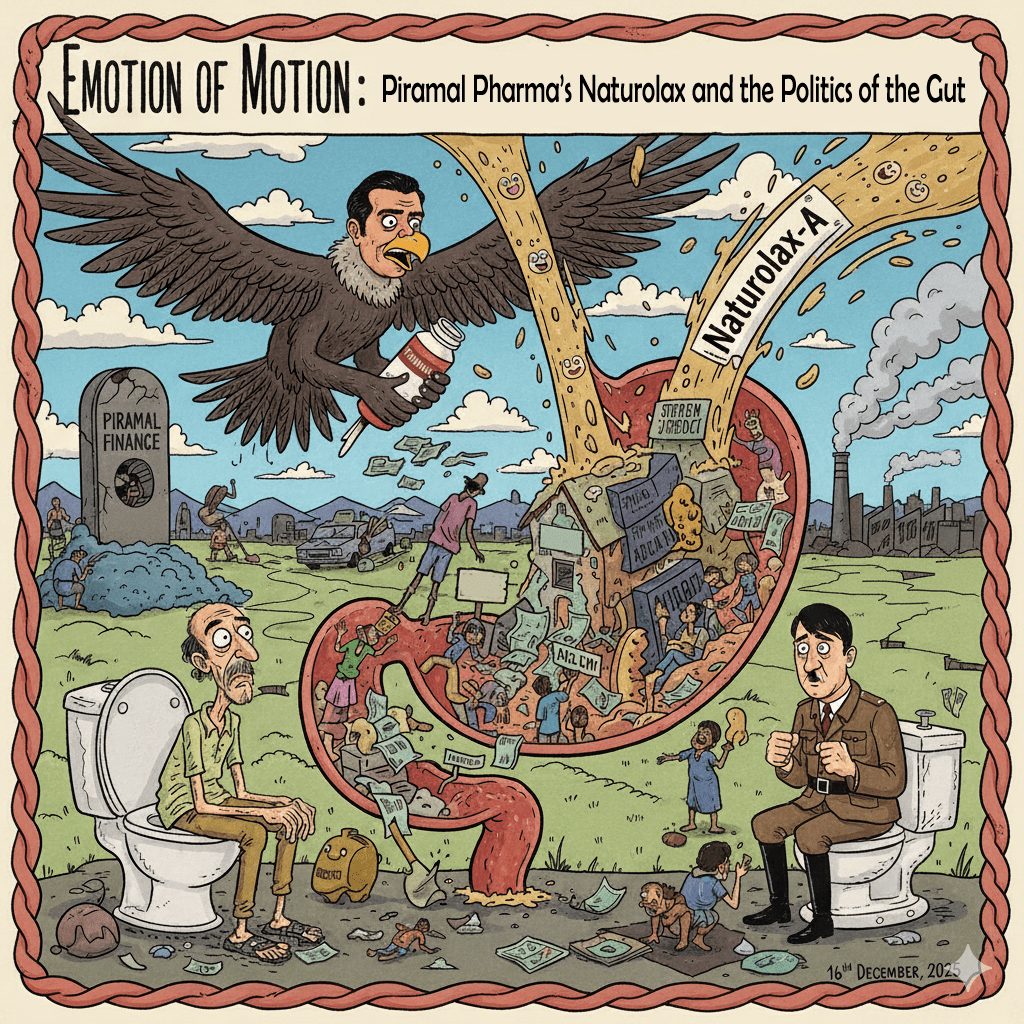
Posted on 16th December, 2025 (GMT 06:52 hrs) Updated on 17th December, 2025 (GMT 04:50 hrs) ABSTRACT Inspired by Chekhov’s “On the Harmful Effects of Tobacco”, this self-reflexive, darkly satirical essay stages constipation as a material, political, and ecological symptom of contemporary Indian capitalism, tracing an embodied genealogy from the Green Revolution’s chemical agriculture toContinue reading “Emotion of Motion: Piramal Pharma’s Naturolax and the Politics of the Gut”
Category Archives: Art of Resistance
Following the dictum “Cultural revolution must precede political revolution”, we are striving to create the scope for an alternative cultural space, which can offer resistance to all forms of coercion, and can also serve as a medium for conducting non-violent, horizontal dialogical exchanges.
Bhagat Singh Speaks in 2025: A Spectre Haunts the Rulers of India!

This manifesto—framed as Bhagat Singh’s return in 2025—condemns the erosion of democracy, secularism, and socialism in contemporary India. It denounces crony capitalism, authoritarian governance, and the DHFL scam as symbols of systemic exploitation. Calling for reason, scientific temper, and constitutional duty, it urges India’s oppressed citizens to resist through coordinated legal action, peaceful mass mobilization, and digital activism. The message rejects silence, warns against authoritarian decay, and invokes revolutionary solidarity to reclaim justice, dignity, and democratic rights.
DHFL Victims, Are We Still Ready to Fight for It?

This article argues that the DHFL collapse is not merely a corporate failure or legal dispute but a political event symptomatic of India’s deepening cronyist order, where executive power, judicial alignment, and corporate interests appear increasingly intertwined. Through comparative analysis of recent successful pressure-group interventions—such as the farmers’ movement and the pushback against Sanchar Saathi—the article highlights how public mobilization, not institutional goodwill, remains the only effective counterweight to state-corporate consolidation. It further examines the erosion of judicial independence, shrinking civil liberties, and declining democratic indicators reported by international watchdogs, situating the DHFL case within a broader crisis of accountability and participatory rights. The central thesis asserts that without organized mass resistance—legal, physical, and digital—victims of financial injustice remain fragmented, disempowered, and structurally silenced. Ultimately, the article calls on DHFL depositors to transform from isolated individuals into a collective civic force or pressure group, arguing that justice in contemporary India must be demanded, not awaited.
ধরিত্রীনির্ভর যাপনঃ সহজ জীবনের পাঠ ও শান্ত বিপ্লব (Earth-Centric Living: The Lessons of Simple Life and the Quiet Revolution)

Pathik Basu advocates for an “Planet/Earth-Centric Living” philosophy as a crucial response to both contemporary ecological and social crises, emphasizing a shift away from money-centric existence towards interdependence with nature and community. Based on his practical experience farming in small, decentralized units (even as small as 250 sq ft), Basu proposes a living framework where families can achieve self-sufficiency in food, nutrition, and health—producing daily vegetables, fruit, fish, and eggs organically—by treating “one’s waste as another’s nutrition.” This practical application is paired with a social call to action he terms “Tree, Bird, Fifteen,” urging individuals to nurture the environment in their immediate surroundings and strengthen bonds of trust and support with their 10-15 closest kins, thereby cultivating a network of love and mutual aid that forms the foundation of a prosperous, non-violent, and aesthetically grounded society.
From Cough Syrup to Contested Survival: Piramal Pharma’s Phensedyl and OTC Citizenship

This not-an-essay traces the cultural, political, and pharmaco-poetic life of Phensedyl—manufactured by Piramal Pharma—and situates the codeine-laced syrup within a broader history of scarcity, surveillance, and self-medication in South Asia. Moving between memoir, literary analysis, public-health framing, and theoretical lenses drawn from Foucault, Derrida, and contemporary critiques of cannibal capitalism, the piece investigates how a seemingly mundane cough syrup becomes a portal into the infrastructures of regulation, desire, and dispossession. It examines how Phensedyl served, for many in the 1980s–90s, as a substitute for alcohol in restricted environments, how codeine’s codification reflects state power over pain, and how bodies transformed into sites of both rebellion and compliance. Through lyric passages, sociological insight, and critical reflection on toxicity, addiction, and governance, the article argues that Phensedyl becomes more than a pharmaceutical artifact—it becomes a mirror through which we read the politics of breath, the bureaucratization of relief, and the evolving pharmacological citizenship of late-modern South Asia.
The Sovereign Insider: A Philosophical Indictment of Corporate Immunity in India — An Open Letter to Ajay Piramal

This open letter to Mr. Ajay Piramal is a philosophical indictment of the structural immunity enjoyed by India’s most privileged corporate actors, written from the vantage point of the outsider — the figure who stands scorched at the margins while power glides in the cool interior of impunity. Drawing on Camus, Kafka, Agamben, Śūdraka, and Brecht, the letter argues that the DHFL debacle and a string of insider-trading controversies reveal not isolated breaches but a systemic architecture in which political patronage, regulatory indulgence, and judicial hesitation combine to create a sovereign exception for the well-connected. Through satire, allegory, and critical theory, the narrative exposes how legality becomes porous, accountability becomes theatrical, and “honour” becomes a performative mask concealing a chaosophic, irrationally rational logic of sanctioned violence. The letter positions Piramal not merely as an individual accused of impropriety but as a symptom of a deeper political–economic disorder in which capital transcends consequence while ordinary depositors bear the existential weight of abandonment. Ultimately, it is a citizen’s dispatch from the perimeter of power — a call to recognise how India’s corporate–political nexus manufactures insiders and outsiders with sunlit inevitability.
SLAPPocalypse Now: When Corporate Fragility Meets the DPDP Act — A Sarcastic Missive to Ajay Piramal (Featuring A Case Against OBMA)

This satirical legal draft lampoons the alleged use of SLAPP suits by Ajay Piramal’s legal team, mocking their attempts to file defamation and DPDP-based complaints against the author and OBMA despite the obvious legal incoherence of such actions. Through exaggerated legal language, ironic self-deprecation, and political commentary, it portrays the Respondents as targets of authoritarian overreach while highlighting how the DPDP Act is being misapplied to suppress dissent. The document parodies courtroom procedure, inflates accusations to absurd extremes, and ultimately undercuts its own premise by noting that the DPDP Act cannot even be used for defamation—exposing the strategic misuse of lawfare against activists and critics.
The Fallen Sceptre(s) Of Your Justice: Dirty My-Self and Piramal Pharma’s Tri-Activ

“The Fallen Sceptre(s) of Your Justice: A Pseudo/Quasi-Pharmaco-Philosophical Reflection on Piramal Pharma’s Tri-Activ — and Other Things Otherwise” is an ecosophical and deconstructive meditation on the spectral transformation of power—from gods to kings to states to corporations—through the pharmaco-industrial complex. Anchored in the case of Piramal Pharma’s Tri-Activ disinfectant products, the piece entwines lyrical confession, ecological critique, and self-reflexive philosophical inquiry to expose how the rhetoric of purity and hygiene conceals necropolitical violence and ecological toxicity. Blurring boundaries between body and world, sickness and system, the text stages the body as a site of contamination, resistance, and remembrance, where care becomes commodified and justice spectral. Through interlacing idioms of Tagore, Derrida, and anarchist refusal, it calls for reclaiming the fallen sceptre of justice from algorithmic kings and chemical prophets—toward an ethics of vulnerability, ecological interdependence, and collective redemption.
Will to Hide: Vote Theft, DHFL Scam, and the Silencing of RTI in BJP-ruled India (Video)

In this video of OBMA, we trace how truth in contemporary India is not hidden in darkness, but blinded by the illegitimate, coercive glare of power itself. From the quiet theft of votes through digital deletions and duplicated identities, to the DHFL scam that turned public funds into private fortunes, to the slow asphyxiation of the Right to Information (RTI)— the same pattern of concealment runs through it all. This is not ignorance, but design: the rule of the “Golden Disc,” where polished words like development and national interest mask the disappearance of citizens, accountability, and justice. We ask: when every institution is scripted to glorify the untruth, who will unveil the face of truth?
Arrest Me or Erase Me — But Your Corporate Empire Cannot Silence Me: A Letter to Ajay Piramal

This satirical polemic addresses Ajay Piramal and the wider nexus of the BJP-led state and crony corporates (notably Adani-Ambani), charging them with using legal, political, and extra-legal means to silence dissent. Framed as two provocative requests, the author first volunteers to be arrested and prosecuted for “defamation” — demanding the spectacle of litigation as a public test of whether asking questions about the DHFL debacle is now a punishable offense. The letter catalogs named victims of legal harassment, violence, and suspicious deaths (journalists, RTI activists, and dissenting civil-society actors), criticizes SLAPP-style tactics attributed to corporate counsel (DSK Legal), and recalls Vijay Mallya’s critique of Indian prisons to underline the contested nature of incarceration. Second, in darker satirical mode, the author offers to be “erased” by the state-corporate apparatus to expose the climate in which inconvenient lives are neutralized, invoking calls previously made for legalizing active euthanasia as a political statement about living under a failing “welfare” state. The piece concludes by situating the critique within Mumbai’s cultural imagery — quoting “Yeh Hai Bombay Meri Jaan” — and appends a list of institutional and international recipients.
 Once in a Blue Moon Academia