
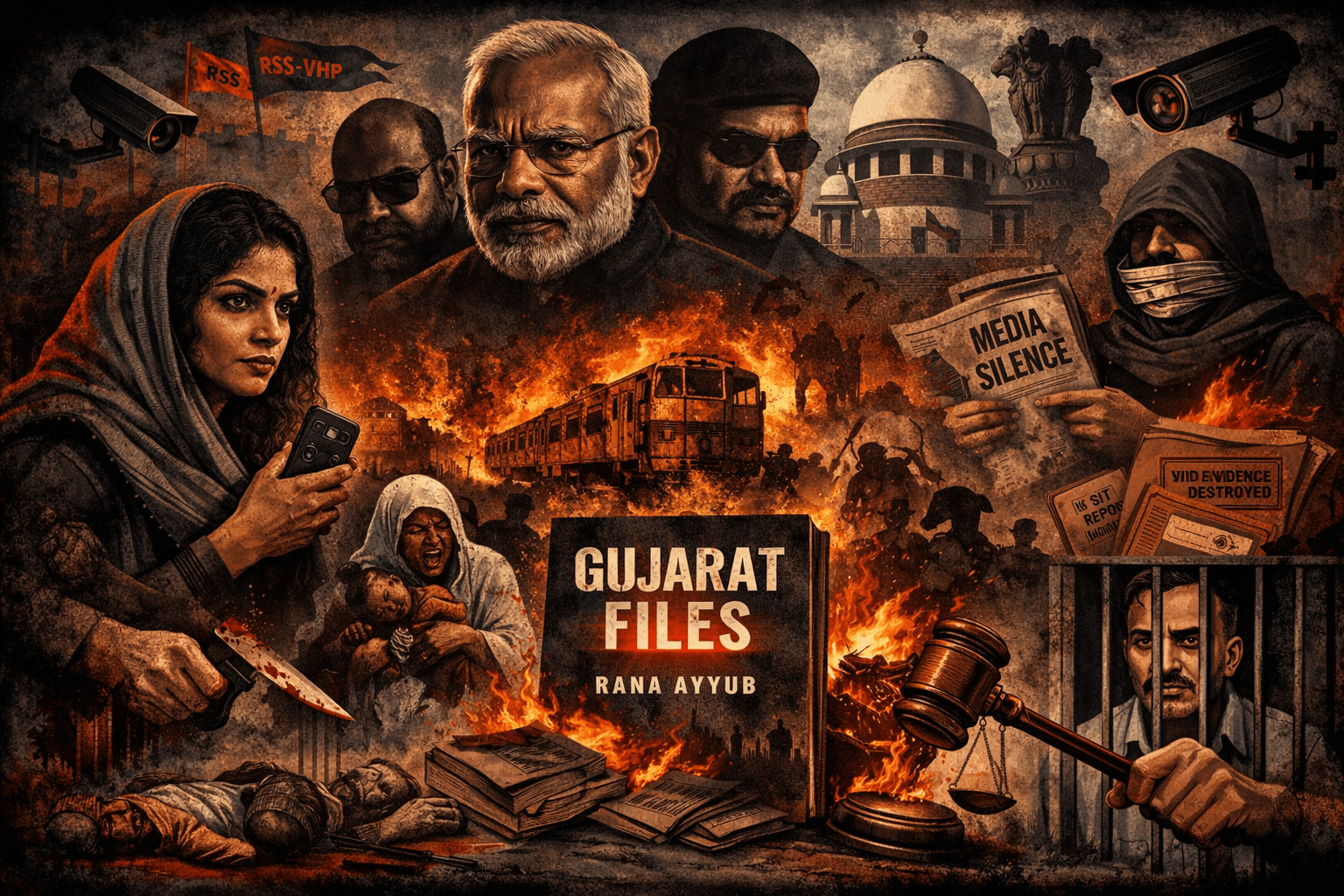
Gujarat Files: Anatomy of a Cover Up by Rana Ayyub is a hard-hitting, self-published investigative book (2016) based on an eight-month undercover sting operation she conducted in 2010–2011 while working for Tehelka, posing as “Maithili Tyagi,” a fictional Hindu-American filmmaker sympathetic to RSS ideology. Through covert recordings of candid conversations with senior Gujarat police officers, bureaucrats, politicians, and insiders—including a direct meeting with then-Chief Minister Narendra Modi—the book presents verbatim transcripts alleging state complicity in the 2002 Gujarat riots (an anti-Muslim pogrom killing over 1,000), orchestrated inaction during the violence, evidence tampering, fake encounters (such as those involving Ishrat Jahan, Sohrabuddin Sheikh, and others), extrajudicial killings used for political gain, caste-based exploitation in law enforcement, and broader cover-ups tied to the rise of Modi and Amit Shah. Rejected by mainstream publishers and media amid fears of reprisal, Ayyub self-funded and released it, selling hundreds of thousands of copies despite blackouts, threats, and criticisms over ethical concerns, lack of forensic tape verification, and sparse analysis; supporters hail it as brave evidentiary journalism exposing systemic impunity and majoritarian consolidation, while critics (including a 2019 Supreme Court dismissal in a related case) view it as conjectural or procedurally flawed, yet no implicated officials have sued or directly refuted the statements, underscoring its enduring, polarizing impact on debates about accountability, press freedom, and Indian democracy.
Category Archives: Art of Resistance
Following the dictum “Cultural revolution must precede political revolution”, we are striving to create the scope for an alternative cultural space, which can offer resistance to all forms of coercion, and can also serve as a medium for conducting non-violent, horizontal dialogical exchanges.
Blooded Waters, Dirty Hands: An Elegy for Puṇyodaka

This text is an elegy for puṇyodaka—not as a lost ritual substance, but as a shattered moral condition. Moving across Kalidasa’s Meghadūta, the Vana Parva’s Yaksha-prashna, biblical plague, Macbeth’s indelible blood, and Sartre’s Dirty Hands, it traces how water—river, sea, confluence—has been converted into spectacle, alibi, and instrument of power. Empirical poisonings (heavy metals, fecal coliforms, ecological collapse) coexist with choreographed immersions, artificial ghats, and submarine devotions, revealing a regime of simulation where sanctity is performed while rivers rot and silences are enforced. The work argues that contemporary governmentality no longer seeks purity but stages it, laundering violence through ritual, nationalism, and necessity. Against Hoederer’s calculus and Macbeth’s despair, the Yaksha’s ancient answer—manomalatyāga, the renunciation of inner stain—returns as an indictment: when minds remain polluted by greed, vanity, and commanded quiet, no river can cleanse. Puṇyodaka vanishes not because water fails, but because power poisons meaning itself. What remains is refusal: the withdrawal of consent from any politics that needs blood to function, spectacle to survive, and dirty hands to rule.
অঘোষিত জরুরি অবস্থার (দুঃ-)সময়ে না-রাষ্ট্রের বি-কল্প-না (Imagining No-State Alternities Amidst the Horrors of Undeclared Emergency)
এখানে সময়ের প্রয়োজনে, না-রাষ্ট্রের আশায়, অঘোষিত জরুরি অবস্থার মধ্যে দুটো লেখা সংকলিত করা হলো। বলা বাহুল্য, দুটো লেখাই বর্তমান ভারতবর্ষের রাজনৈতিক পরিস্থিতি আর দুরাশা নিয়ে সুরাশা করা হয়েছে। ভাজপার আইটি সেল মিথ্যে প্রোপাগাণ্ডা করে। উৎপল দত্ত উল্টে বলতেন, “আমি প্রোপাগান্ডিস্ট”। আমরা তাঁকে অনুসরণ করেই আরেকটু বাড়িয়ে বলছিঃ আমরা কাউন্টার-প্রোপাগান্ডিস্ট। ধরে নিন এই গোটাটাই একখানা রাজনৈতিক ইস্তেহারমাত্র, যেখানে ভেন্ন ধাঁচের আকাদেমিয়া সেঁধিয়ে আছে।Here, compelled by the urgency of the moment and sustained by the hope of a no-state imagination, two pieces have been brought together amid an undeclared emergency. Needless to say, both writings engage with the present political condition of India and attempt to wrest hope out of despair. The BJP’s IT cell manufactures false propaganda. Utpal Dutt, by contrast, would turn the charge on its head and declare, “I am a propagandist.” Following his lead—and pushing it a step further—we say: we are counter-propagandists. Consider this entire exercise as nothing more (and nothing less) than a political manifesto, into which a distinctly non-mainstream strand of academia has quietly seeped in.
Manifesto for Scrapping the Ill-Conceived Insolvency and Bankruptcy Code (IBC) 2016
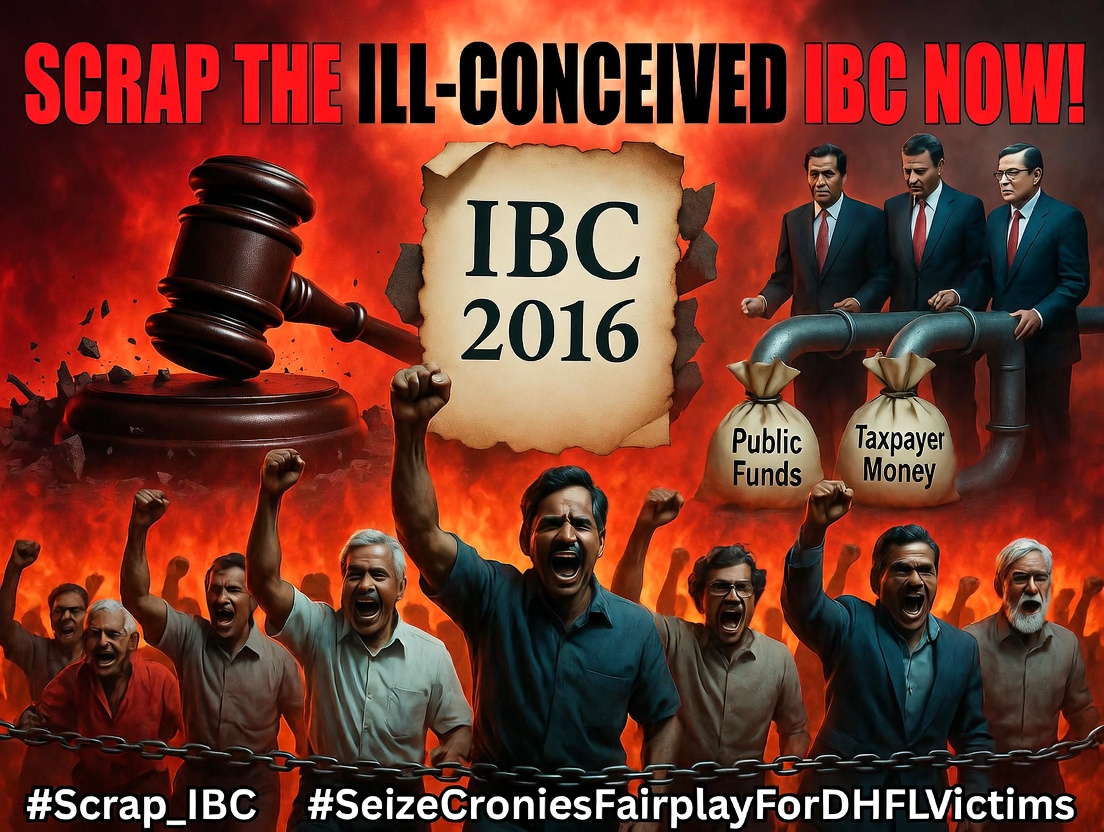
This manifesto advances a sustained, evidence-based critique of India’s Insolvency and Bankruptcy Code (IBC), 2016, arguing that the regime has evolved into a structurally predatory legal apparatus that facilitates large-scale transfer of public, depositor, and taxpayer-backed wealth into private corporate hands under the guise of “efficient insolvency.” Drawing on IBBI data up to 2025, landmark cases such as DHFL, Bhushan Power & Steel, Videocon, and Aircel, and recent Supreme Court jurisprudence, the analysis demonstrates how the IBC has systematically failed its own statutory promises of time-bound resolution, value maximization, equitable treatment, fraud recovery, and economic revival. Instead, prolonged delays, extreme haircuts averaging 67–68%, marginalization of retail depositors and public-interest claims, laundering of fraud through Section 32A immunity, and near-absolute deference to creditor “commercial wisdom” have produced a regime marked by judicial ritualism, moral hazard, and deep constitutional infirmities under Articles 14 and 21. The DHFL resolution is presented as a “laboratory case” exposing the IBC’s core pathologies—where a solvent, fraud-tainted institution was transferred at a steep discount, avoidance recoveries worth tens of thousands of crores were privatized, and lakhs of small savers were effectively dispossessed. Situating the IBC within a broader political economy of crony capitalism and opaque political funding, the manifesto rejects incremental reform as inadequate and calls for the complete scrapping of the Code in favor of a transparent, people-centric insolvency framework grounded in accountability, restitution, constitutional justice, and public interest.
OBMA Statement on Neo-Imperialist Violence: Iran, Venezuela, Palestine
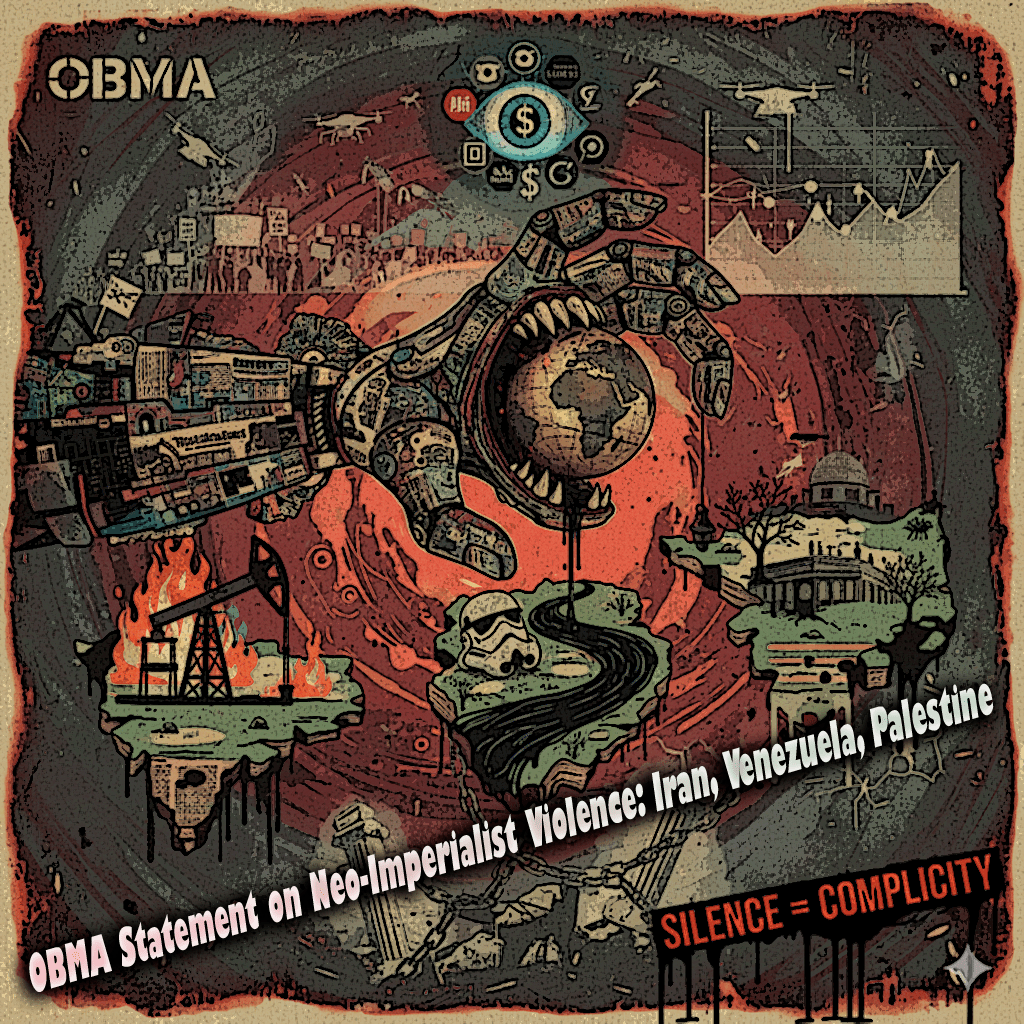
This statement asserts OBMA’s condemnation of neo-imperialist violence in Iran, Venezuela, and occupied Palestine, framing these crises as interconnected expressions of cannibalistic capitalism. It exposes how state repression, militarization, sanctions, and fossil-fuel geopolitics enable genocide, ecocide, and resource plunder. Rejecting technocratic and reformist fixes, OBMA affirms planetary justice, anti-imperialist solidarity, and life-centred transformation through collective struggle and ecological ethics.
End of Year Bombshell: How BJP-NDA-Hindutva Failed India – A Scathing 2014-2025 Indictment
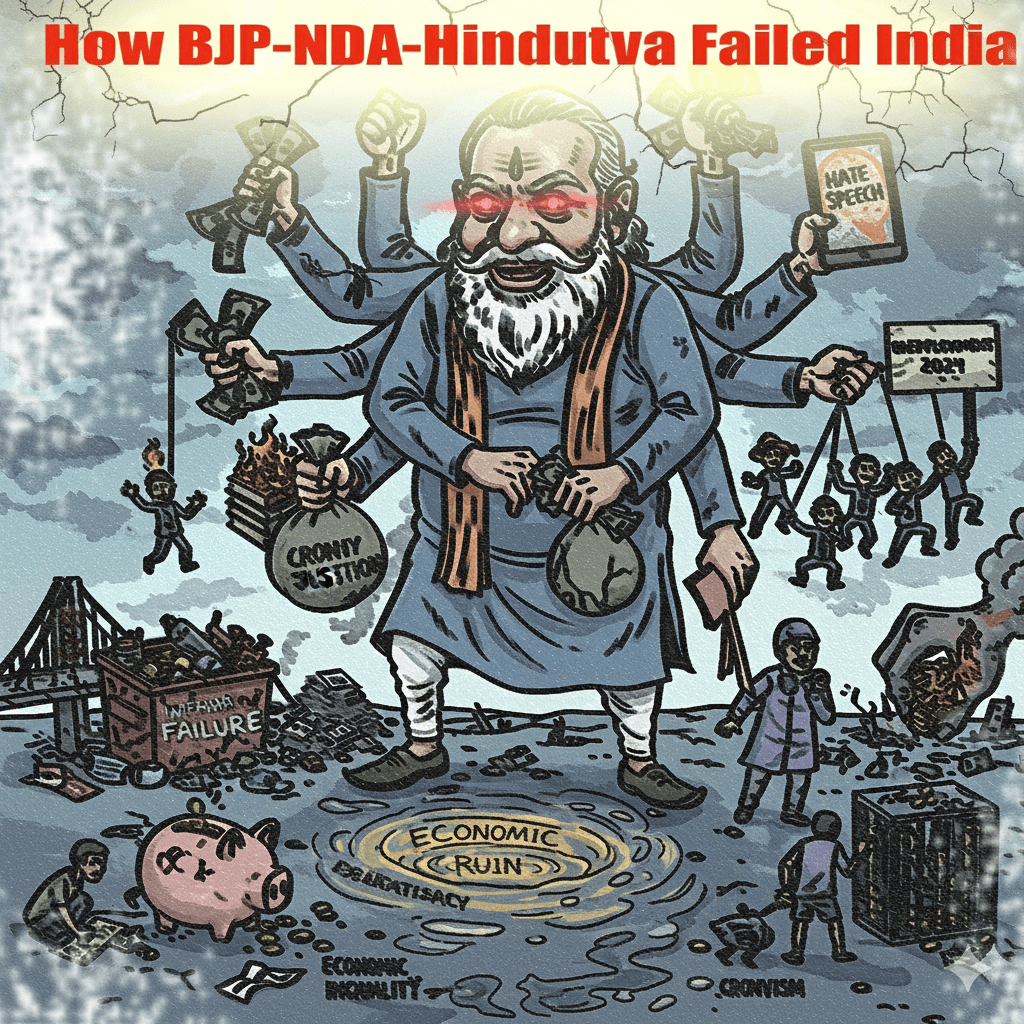
As 2025 draws to a close, this comprehensive dossier documents not a series of discrete policy missteps, but a systemic transformation of governance in India (2014–2025): a shift from democratic accountability to political executive dominance; from evidence-based policymaking to manufactured narrative control; from social protection to structural precarity. Spanning the economy, federalism, data integrity, labour, the natural environment, digital freedoms, education, public health, cultural institutions, civil liberties, and fundamental rights, the record reveals enduring patterns of power centralization, calibrated opacity, selective enforcement, and institutional hollowing—accompanied by crony consolidation and the routinized criminalization of dissent. Democratic indicators decline as surveillance infrastructures expand, grassroots welfare erodes, and truth itself is rendered an object of administrative management. This is not a partisan ledger, but a counter-archive: an evidence-grounded indictment that affirms accountability as the necessary cost of power. In closing the year, it calls for a civic reckoning—not to foreclose debate, but to reclaim and restore it.
Remembering What “Definitions” Make Us Forget: A Statement on the Aravallis and the Politics of Ecological Erasure

The Ecotopians of Alternity (EOA) as part of the Once in a Blue Moon Academia (OBMA) Collective asserts that the current legal crisis surrounding the Aravalli mountain range is a deliberate act of “definitional erasure” that threatens the ecological survival of North India. By narrowing the definition of these ancient hills to landforms rising 100 meters or more, the state effectively excludes over 90% of the range—including critical lower ridges, scrub forests, and groundwater recharge zones—from legal protection. This is not a neutral administrative update but a strategic maneuver that renders ecologically vital terrain “invisible” to the law, thereby clearing the path for corporate mining and real-estate expansion. Drawing on the Indian philosophical concept of lakṣaṇa (defining something based on characteristic mark), the EOA argues that a definition based solely on height fails to capture the holistic reality of an ecosystem that stops desertification and sustains regional aquifers. This logic of reductionism mirrors a broader national pattern of prioritizing extractivist “developmental rationality” over indigenous lifeworlds and long-term climate resilience, as seen in projects from Great Nicobar to Hasdeo Arand. Against this regime, the EOA calls for a coordinated resistance that refuses to let life be reduced to “administrative residue,” demanding a lived ecological imagination that protects the Aravallis as an indivisible, living system rather than a collection of disposable units.
Letters of Blood and Fire: “Terrorism”, Dispossession, and the Distorted Mirrorings of Domination
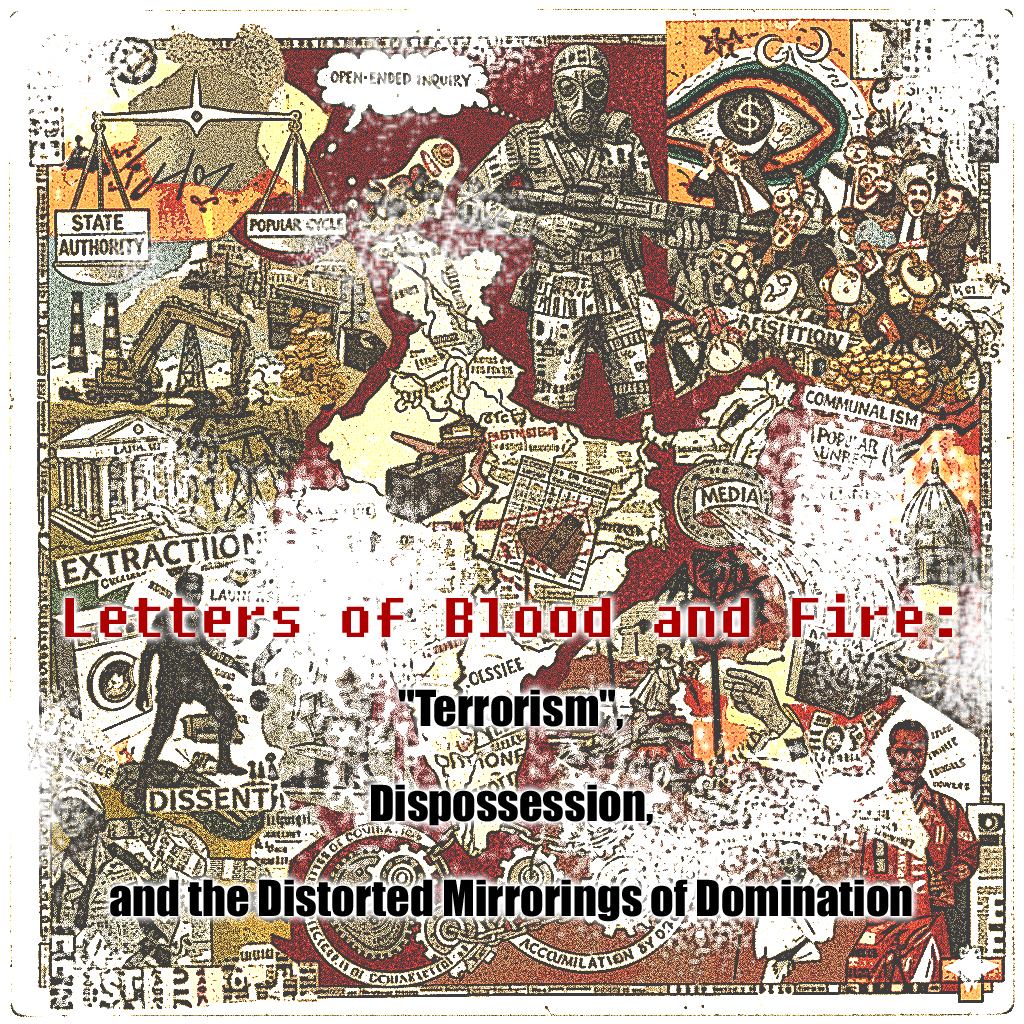
This article critically dissects “terrorism” as a politically contested and asymmetrically applied category, wielded to delegitimize subaltern and non-state violence while normalizing far greater state and corporate terror through legal, discursive, and institutional mechanisms. Drawing on an anarchist methodological lens amid India’s contemporary Islamophobic conjuncture, it provisionally defines terrorism as deliberate civilian-targeted violence intended to induce widespread fear for political, ideological, or social ends, exposing how state practices—from aerial bombings to militarized dispossession—evade the label via sovereign privilege. Integrating Marx’s primitive accumulation, Harvey’s views on accumulation by dispossession, and Toussaint’s analysis of debt-driven imperialism, the analysis frames terrorism as a systemic instrument embedded in neoliberal resource extraction, where conflict in mineral-rich zones (Afghanistan’s lithium, India’s Adivasi belts, Congo’s coltan) functions as both symptom and enabler of corporate plunder, preempted by advanced technologies like remote sensing and veiled by selective narratives that hyper-amplify “Islamic terrorism” while muting Hindutva extremism, Zionist settler violence, and BJP’s hypocritical Taliban engagement amid alleged terror-funding ties. Employing Sāṃkhya’s anyonyapratibimba to reveal power’s projection of its own predation onto the “other,” and balancing economic determinism with religion’s irreducible psychological role in motivating warriors, the piece ultimately reframes terrorism not as pathological or civilizational but as an intrinsic modality of unequal global orders, calling for discriminative clarity (viveka) to dismantle its intertwined logics of capital, technology, ideology, and domination.
Agnihotri’s “The Kashmir Files” and “The Bengal Files” in Violation of the Nāṭyaśāstra: An Open Sanātanī Hindu Indictment
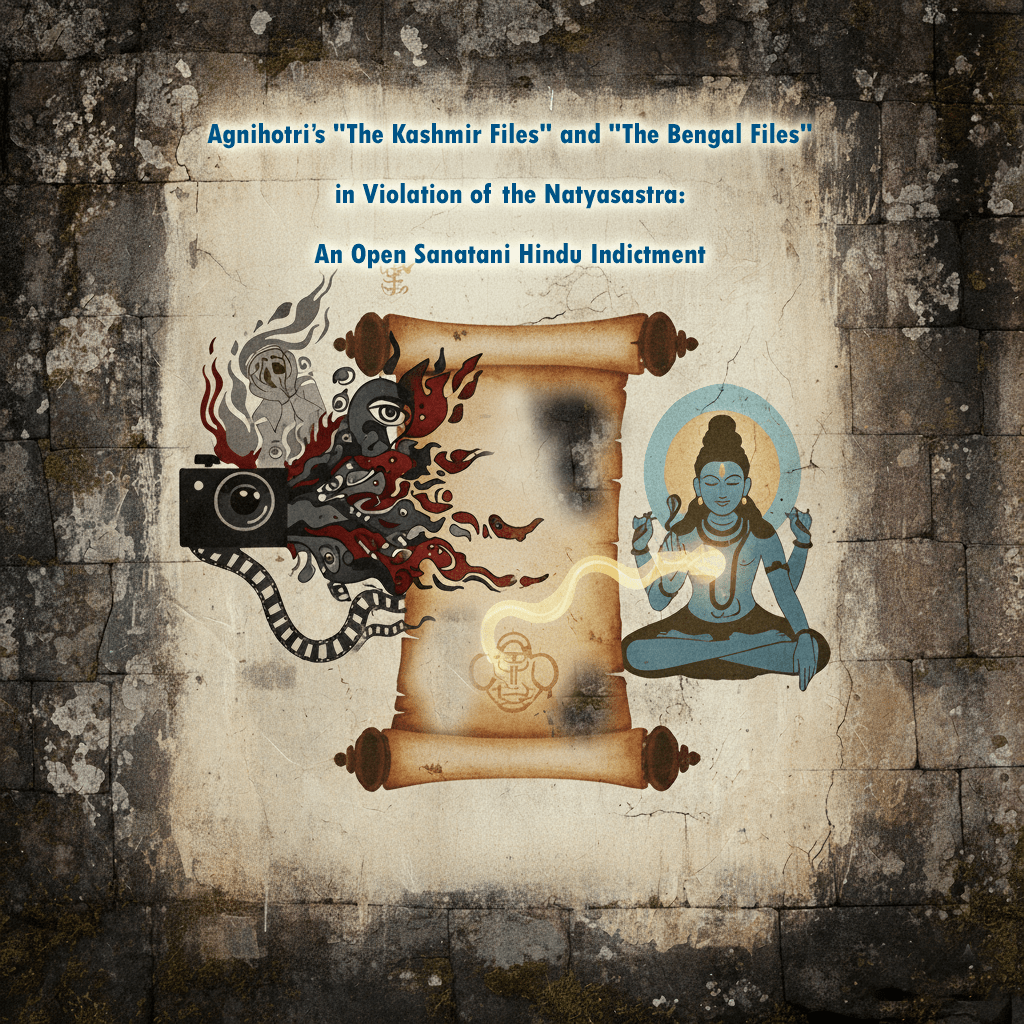
From the heart of Akhaṇḍ Hindutva, a Sanātanī Hindu United Family (HUF) indicts Vivek Agnihotri’s The Kashmir Files and The Bengal Files for brazenly violating Bharata Muni’s sacred Nāṭyaśāstra—turning Hindu grief into voyeuristic gore, rape imagery, and blood-spectacle. What claims to defend Sanātana Dharma abandons rasa, maryādā, and ahiṁsā, replacing ethical restraint with tāmasika exhibitionism and propaganda rage. True Hindutva demands dharma, not degeneration.
The Digital Leviathan: Inside the BJP IT Cell’s Architecture of Consent, Coercion, and Control
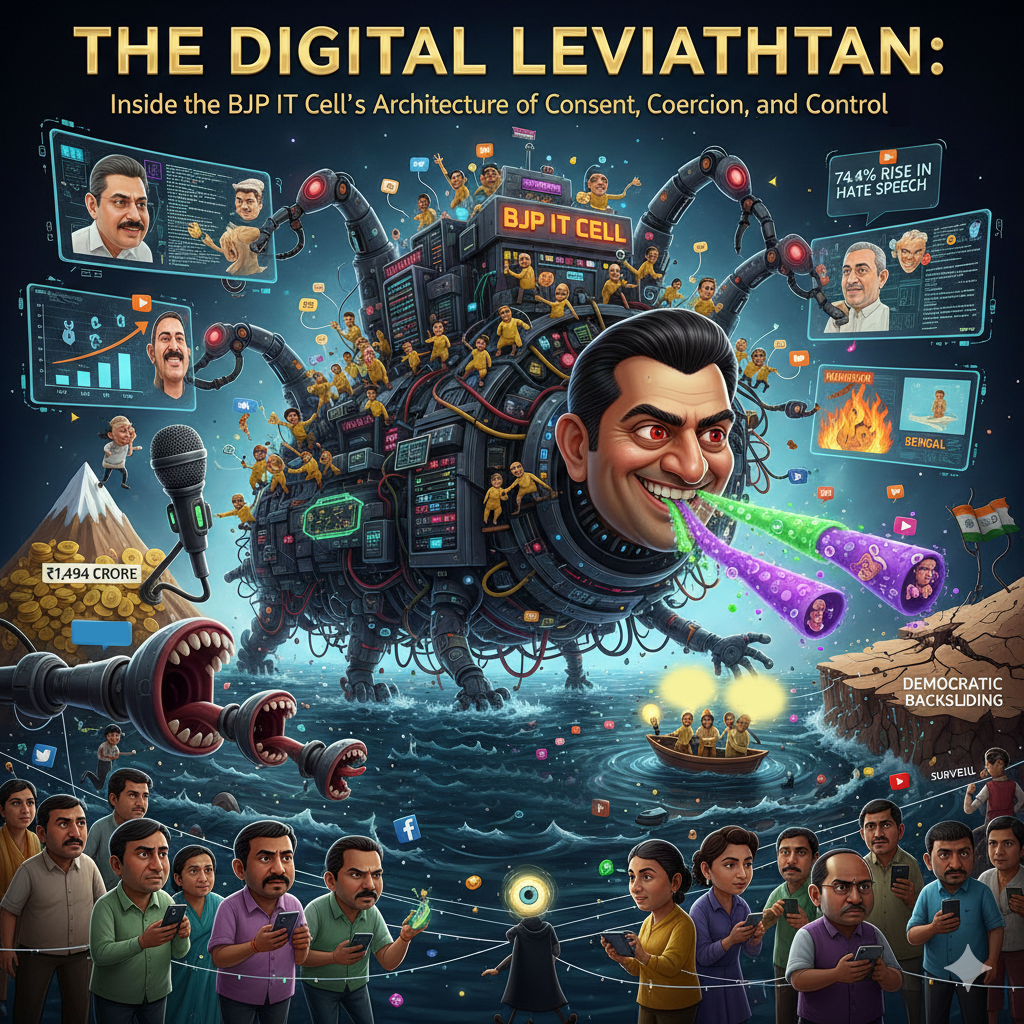
In December 2025, India’s digital political landscape is dominated by the Bharatiya Janata Party’s (BJP) highly professionalized IT Cell, currently led by Amit Malviya, which functions as a vast, hierarchical apparatus blending centralized strategy, AI-driven tools, paid operatives, and massive volunteer networks to orchestrate continuous propaganda, narrative control, and disinformation campaigns across platforms like WhatsApp, X, YouTube, and Facebook. Widely criticized for systematically disseminating misinformation, deepfakes, clipped videos, communal hate speech (particularly anti-Muslim), and coordinated trolling that incites offline violence and vigilantism—while rarely retracting debunked claims—the IT Cell is accused of manufacturing consent, suppressing dissent through intimidation and surveillance-linked tools, and diverting public attention from economic precarity, unemployment, and governance failures via spectacle-driven “statue-temple nationalism” and pseudoscientific Hindutva myths. Operating symbiotically with “Godi media” owned by aligned corporates (Adani, Ambani), fueled by opaque funding and asymmetric ad spends, and enabled by regulatory gaps in AI oversight, data protection exemptions, and platform passivity, this “digital Leviathan” erodes epistemic trust, polarizes society, chills free expression, and contributes to democratic backsliding, even as independent fact-checkers (e.g., Alt News), civil society, and media literacy initiatives offer resilient counter-efforts against the routinization of information warfare in India’s platform-mediated public sphere.
 Once in a Blue Moon Academia