Posted on 26th October, 2026 (GMT 17:39 hrs)
In Continuation With
“Every joke is a tiny revolution.” — George Orwell, “Funny, but not Vulgar” (1945)
ABSTRACT
This article examines post-2014 Indian political satire—stand-up comedy, digital satire, and editorial cartoons—through the classical Indian aesthetic framework of the Nāṭyaśāstra (the ancient Treatise on Dramaturgy). It draws on Abhinavagupta’s theory of sādhāraṇīkaraṇa (the universalisation of emotion) and K.C. Bhattacharyya’s elevation of bībhatsa (the odious, or disgust) as the supreme aesthetic sentiment (mahā-rasa). The argument is that under the BJP-RSS regime the negative sentiments no longer pass through an aesthetic frame: fear (bhayānaka) circulates as institutionalised dread through laws such as the UAPA, rebranded sedition provisions, raids, detentions, police repression, and digital regulations, while disgust (bībhatsa) appears as a sovereign “Will to Hide”—a pathological refusal of transparency over crony finance, electoral funding, and public accountability. Against this deadlock, satirists deploy a triad of playful wonder (kautuka), laughter (hāsya), and implied or ironic meaning (vyāṅga) as forms of subversive resistance. Tracing the work of comedians from the 2015 AIB Roast through Kunal Kamra, Munawar Faruqui, Vir Das, and others, and of cartoonists such as Rachita Taneja, Satish Acharya, Manjul, and G. Bala, the article shows that official reprisals—FIRs, venue attacks, contempt proceedings, and platform blocks—confirm rather than defeat the force of laughter. Satire universalises disgust and converts the sensitive spectator from a paralysed witness into an active resistor. The claim is not that laughter ends power, but that power which cannot contain laughter has already lost its claim to solemnity.
DISCLAIMER. This is not an exhaustive inventory of post-2014 Indian political satirists, digital creators, or editorial cartoonists, nor of every FIR, venue cancellation, contempt proceeding, platform block, or extra-legal pressure directed at them. The figures named—from the AIB Roast through Kunal Kamra, Munawar Faruqui, Nalin Yadav, Agrima Joshua, Shyam Rangeela, Anirban Dasgupta, Gaurav Gupta, Vir Das, Samdish Bhutani, Shamita Yadav, Varun Grover, Manjeet Sarkar, Pulkit Mani, Abhishek Walia, Masoom Rajwani, Rachita Taneja, Satish Acharya, Manjul, and G. Bala—are selected as representative cases whose documented encounters with state and non-state power illustrate the broader pattern of kautuka–hāsya–vyāṅga (playful wonder–laughter–implied meaning/satire/sarcasm) operating as resistance under the conditions described. Many other practitioners, incidents, and regional or linguistic variants fall outside the present scope.
I. Introduction: Laughter as Subversion in the Theatrics of Saffron Fascism
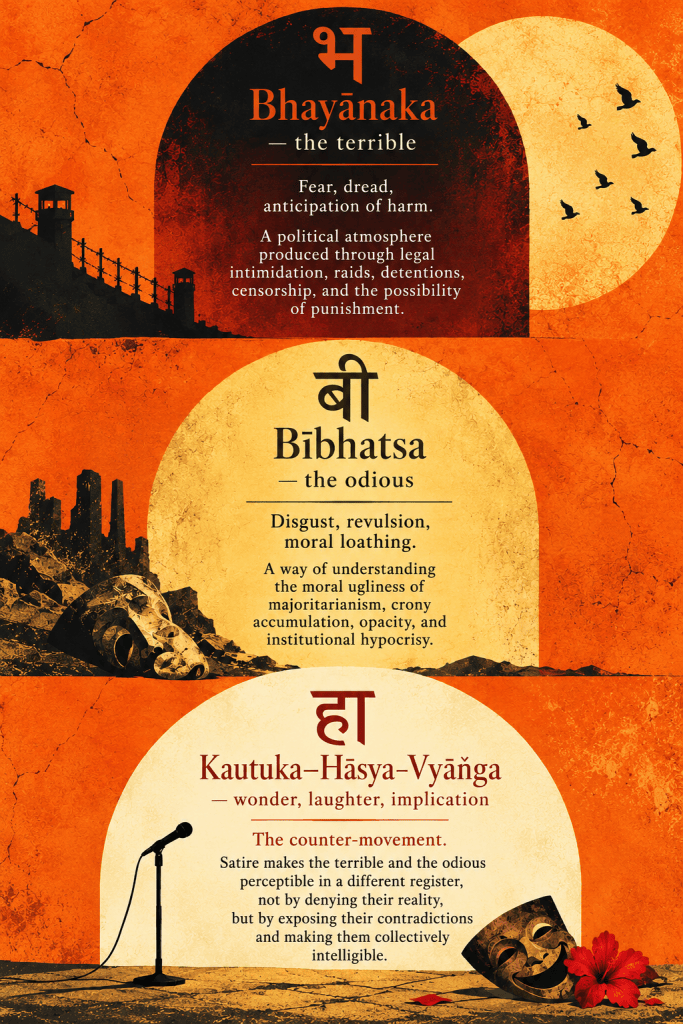
In the Nāṭyaśāstra (ca. 200 BCE–200 CE), Bharata Muni admits even the “painful” sentiments into the full spectrum of aesthetic savour. Bībhatsa rasa (the odious) rests upon the sthāyibhāva of jugupsā—disgust, revulsion, moral loathing—and is aroused by the putrid, the corporeal and, above all, by ethical ugliness and the inversion of dharma. Bhayānaka rasa (the terrible) rests upon bhaya—dread, terror, the anticipatory apprehension of imminent harm. Abhinavagupta’s doctrine of sādhāraṇīkaraṇa (universalisation) explains how such affects, once depersonalised within the aesthetic frame, yield śuddhi (purification) and even ānanda (contemplative bliss); K.C. Bhattacharyya goes further, crowning bībhatsa as mahā-rasa, the root sentiment that tests consciousness’s freedom to relish even the quintessence of ugliness.
The central problem of our conjuncture is that these rasas no longer pass through the aesthetic frame. Under the BJP-RSS regime since 2014, they circulate raw and ego-bound. Bhayānaka becomes a governing climate: the UAPA, the rebranded sedition clauses of the Bharatiya Nyaya Sanhita, ED and CBI raids, mob lynchings, cow vigilantism, vote theft, systemic corruption, love jihad, land jihad, the IT Rules 2021 and the Digital Personal Data Protection Act 2023 compose an undeclared emergency that retains the ceremonial scaffolding of democracy while eviscerating its substance. Bībhatsa becomes the sovereign “Will to Hide” (erit celare): a pathological jugupsā in which power produces institutional and moral filth—crony plunder, communal polarisation, opaque electoral finance, the PM CARES Fund shielded from RTI—and then recoils from its own excess into architectures of opacity. The golden disk of the Īśopaniṣad (hiraṇmayena pātreṇa satyasyāpihitaṁ mukham) is not lifted for the seeker of truth; it is bolted shut as sovereign armour. The polity is suspended in a rasa-deadlock: terror without spectacle, revulsion without purification.
Against this deadlock stands the triad of kautuka–hāsya–vyāṅga. Kautuka—playful creative wonder, mischievous astonishment, the sudden piercing of illusion—allies itself with adbhuta (the marvellous) and grounds itself in the Nāṭyaśāstra’s recognition of vismaya (astonishment) as a vyabhicāribhāva capable of elevating even the darkest sthāyibhāvas. Vyāṅga—the suggested, implied meaning at the heart of South Asian poetics—pierces the veil of power not by frontal accusation but by ironic insinuation, compelling the sahṛdaya bhoktā to complete the subversive meaning in a moment of astonished recognition. Hāsya supplies the contagious release that converts individual recoil into shared insurgent energy and vīra mobilisation. Together they constitute śilpita pratirodha, the crafted art of resistance, which does not deny the bhayānaka–bībhatsa combine but re-aestheticises it—and, more decisively, turns it against the sovereign that produces it.
Laughter, in the tradition that runs from the medieval hilaritas to Bergson’s Le Rire, is not merely a physiological discharge but a social and metaphysical force. Hilaritas—the joyful clarity that Augustine and later thinkers opposed to the weight of tristitia—marks a sudden lightening in which the mind refuses to be held by the gravity of the given. Bergson radicalises this: laughter, he argues, arises when the mechanical is perceived in the living, when a human being or an institution is revealed as behaving with the rigidity of a thing. The laugh is therefore an act of intelligence that corrects rigidity by exposing it. In the present conjuncture the sovereign’s claim to solemnity is precisely such a rigidity—an insistence that power be received as destiny rather than as a performance that can be interrupted. The joke, in Bergson’s terms, is the social gesture that restores elasticity: it shows the machine in the man, the formula in the face, the script in the speech, and thereby returns the living to itself.
Laughter, in this register, is not relief. It is a philosophical act. The joke does not merely discharge tension; it re-arranges the field of the sayable. By seizing the regime’s own signs—its slogans, its postures, its rituals of solemnity—and returning them inverted, the satirist forces the sahṛdaya to see what power works to keep unseeable. The philosophy of the joke is therefore the philosophy of the crack: a minimal, non-negotiable refusal of the claim that the present order is natural, necessary, or beyond mockery. Where the sovereign demands that disgust remain private and terror remain mute, the joke publicises both and converts them into a shared recognition that the emperor’s clothes are not merely absent but actively absurd. This is not catharsis that returns the spectator to the status quo. It is the production of a temporary but real space in which the “Will to Hide” is compelled to appear as what it is: a structure of concealment that can be laughed at, and therefore, however briefly, undone.
This lineage is hauntological. Husserl’s epochē brackets personal revulsion so that the sovereign appears as an absurd “alien ego”; Baudelaire’s and Benjamin’s flâneur meanders through the filth of modernity, gathering its fragments for ironic reassembly; Camus’ absurd man meets undeclared tyranny with lucid, laughing persistence; Tagore’s trapped bee is urged into the nīlimā of boundless freedom; and Charlie Chaplin’s Little Tramp turns the dictator’s pomp into pantomime. K.C. Bhattacharyya’s question returns with sharpened urgency:
How does the sahṛdaya bhoktā come—or fail to come—“in terms” with the bhayānaka–bībhatsa combine when the repulsive and the terrible are not aestheticised but lived as undeclared tyranny?
This article answers that Indian political satire—embodied most prominently by stand-up comedians and cartoonists—is the sharpest and most immediate deployment of the triad in contemporary India. These artists seize the repulsive vibhāvas of the regime—moral decay, communal polarisation, crony plunder, legal weaponisation, institutional capture and majoritarian hypocrisy—and transmute raw revulsion into astonished laughter and courageous dissent. They enact śilpita pratirodha not as passive catharsis but as insurgent refusal: the spectator is dragged from paralytic nausea or apathy into collective, laughter-fuelled recognition that power’s grotesque performance can be mocked into obsolescence. Satire thereby becomes a living laboratory of resistance against the forms of Saffron Fascism unleashed by the BJP-RSS regime, where the negative rasas are not suppressed but reframed, supplemented, universalised and turned against the very apparatus that produces them.
In the time of saffron fascism, the joke is not an ornament of dissent. It is one of its elementary forms.
II. Stand-up Comedians: The Verbal Vyāṅga of Astonished Dissent
Stand-up comedians operate as frontline verbal insurgents, directly confronting the regime’s manufactured jugupsā and converting it into kautuka-infused hāsya that disarms authority while mobilising vīra courage. Their work is not mere entertainment; it is a deliberate aesthetic intervention that forces the spectator to confront the absurdity of power through ironic suggestion, sudden rupture and liberating laughter.
A. The AIB Roast: An Early Flashpoint
The All India Bakchod (AIB) Knockout Roast, recorded in December 2014 and released online in January 2015, marked an early flashpoint. A single night of irreverent humour involving public figures triggered nationwide outrage, multiple legal complaints under Section 295A and defamation provisions, accusations of “hurting sentiments” and a wave of trolling. The episode foreshadowed the systematic targeting that would intensify in later years: the sovereign learnt early that the comic stage is a site where its claim to solemnity can be punctured.
B. Musicking Dissent: East India Comedy, Aisi Taisi Democracy and Newsance
East India Comedy (EIC) and the trio behind Aisi Taisi Democracy — Varun Grover, Sanjay Rajoura and Rahul Ram — pushed the envelope further with biting satire that blended accessible formats with sharp commentary on electoral malpractice, media capture and institutional decay. Crucially, both deploy musicking — resistance enacted through song, parody and rhythmic delivery. Political critique becomes catchy, memorable performance: melody, rhythm and humour are weaponised to evade censorship, amplify reach and turn collective outrage into shared, infectious defiance, grounding empirical truths about crony deals and policy failures in the affective power of performance.
Newslaundry’s Newsance, anchored by Manisha Pande, offers weekly satirical explainers that dissect media bias, governmental doublespeak and institutional rot with surgical precision and wry hāsya. Here satire turns its vyāṅga upon the “Godi media” itself, exposing the manufacture of consent by replaying its own footage back to the viewer.
C. Kunal Kamra: The Most Persistently Targeted Voice
Kunal Kamra remains the most persistent and relentlessly targeted voice. His earlier routines — lambasting familial WhatsApp propaganda (“Hindu is in danger… No mom, logic is in danger”), the chaos of demonetisation and the capture of the judiciary — exposed the ethical ugliness of majoritarian narratives and turned audience revulsion at everyday hypocrisy into astonished, liberating outrage. The sovereign response has been cumulative: airline flying bans in January 2020 after he questioned a television anchor on board a flight; contempt proceedings in late 2020 over his tweets on the Supreme Court; and, conversely, his successful petition before the Bombay High Court, which in September 2024 struck down the 2023 amendment to the IT Rules that would have empowered a government “Fact Check Unit” to adjudicate online content about the state.
In his 2025 special Naya Bharat, a parody song implicitly referencing Maharashtra Deputy Chief Minister Eknath Shinde as gaddar (traitor) for his 2022 party split and alliance with the BJP triggered immediate backlash: Shiv Sena (Shinde faction) workers vandalised The Habitat comedy club in Mumbai within hours, multiple criminal cases were filed across states, and the state’s leadership, including the Chief Minister, publicly demanded that “lessons” be taught to the comedian. The same special escalated the critique with sharp jabs at Prime Minister Narendra Modi — mocking his dramatic rhetoric and “Vishwaguru” persona through exaggerated mimicry and parody — while targeting BJP policies and the broader culture of majoritarianism. Kamra refused to apologise, insisting the joke stood as truth-telling. By his own account he then received more than 500 threatening calls, some explicitly urging that he be killed and cut to pieces; venues were vandalised, tours disrupted and FIRs filed. The cycle recurred in November 2025, when a photograph of Kamra wearing a T-shirt depicting a dog urinating on letters resembling “RSS” (which he playfully defended as “PSS”) provoked fresh outrage from BJP leaders and warnings of police action.
This recurring intimidation is not isolated; it reflects a broader strategy to silence voices that pierce the “Will to Hide” and force the spectator to laugh at the emperor’s new clothes.
D. Munawar Faruqui: The Minority Comedian and Contested Visibility
Munawar Faruqui exemplifies the regime’s targeted repression of minority voices. On 1 January 2021 he was arrested in Indore for allegedly insulting Hindu sentiments over jokes he had not even performed, and spent more than a month in jail under Section 295A before the Supreme Court granted interim bail in February 2021. Shows across cities were subsequently cancelled under threats from Hindutva groups; in November 2021, after a dozen cancellations in two months, he announced that “hate has won, the artist has lost.”
Faruqui’s routines on the 2002 Gujarat riots, lynching culture and the grotesque absurdity of communal hatred weaponise bībhatsa’s visceral nausea into dark kautuka-hāsya, forcing spectators to laugh at the regime’s inversion of dharma while recognising its deadly seriousness. His case shows how minority comedians are disproportionately subjected to legal and extra-legal pressure: a joke presumed rather than performed is enough, for the sovereign jugupsā attaches not to what was said but to who might say it. The stage itself becomes a site of contested visibility.
E. The “Othered” Names
On 1 January 2021 Nalin Yadav was arrested along with Munawar Faruqui and others at Monroe Café, Indore, after a complaint by Eklavya Singh Gaur (son of a BJP MLA) alleged insult to Hindu deities. Yadav had performed only a short opening set; Faruqui had not yet begun. Charged under Section 295A and related provisions, Yadav spent 57 days in jail (longer than Faruqui). Years later he has publicly stated that the case destroyed his comedy career, left him working odd jobs, and subjected him and his family to continuing harassment and violence from local affiliates of the ruling party. The case remains illustrative of how the same legal instrument that targeted a high-profile minority comedian also permanently sidelined a lesser-known supporting artist.
In July 2020 a 2019 stand-up clip by Agrima Joshua resurfaced in which she mocked extravagant Quora claims about the proposed Chhatrapati Shivaji Maharaj statue in the Arabian Sea (solar cells powering Maharashtra, GPS trackers, laser beams). The bit was widely misread as an attack on Shivaji himself. Organised online campaigns produced graphic rape and death threats; one YouTuber (Shubham Mishra) was arrested after posting an explicit video. Maharashtra Home Minister Anil Deshmukh publicly called for legal action against her, and the Habitat venue in Mumbai was vandalised. Joshua issued a forced apology and removed the material. The episode is routinely cited alongside the Faruqui and Kamra cases as evidence of extra-legal pressure that attaches to perceived insult rather than to the actual content of the joke.
In 2017 Shyam Rangeela’s mimicry of Prime Minister Modi, recorded for Star Plus’s Great Indian Laughter Challenge, was dropped after the channel decided it might provoke protest. He was asked to re-record without the Modi impression and was ultimately eliminated. The incident remains an early instance of soft, pre-emptive censorship inside mainstream television rather than formal legal action. Rangeela has nevertheless continued the practice on digital platforms: he maintains an active YouTube channel with ongoing political mimicry and satirical content, attempted (unsuccessfully) to contest the 2024 Lok Sabha election from Varanasi against Modi, and as of October 2026 continues to release new clips, including a recent Manchester video that uses the Modi persona for pointed political commentary. The persistence of the act outside broadcast television illustrates how the same material migrates to spaces where formal gatekeepers have less control.
Anirban Dasgupta has repeatedly addressed the same climate in his work and interviews: his Amazon special Take It Easy (2018) and later shows examine the culture of offence, the expectation that comedians write the apology before the joke, and the practical constraints on political material. He is not a primary flashpoint figure in the same way as Kamra or Faruqui, but he supplies an insider’s account of the self-censorship that many working comics describe.
Gaurav Gupta, a Delhi-based dentist-turned-comedian whose primary material is observational crowd-work and Baniya-family life, has repeatedly turned the same style against official BJP-Modi rhetoric. In May 2026, after Prime Minister Modi’s Hyderabad speech urging citizens to cut gold purchases, fuel use and foreign travel, Gupta performed a set that reframed the list of “don’ts” as the language of a household already in crisis, compared the assurances to the Titanic’s “everything is fine,” and joked that middle-class families would sell rather than buy gold if the actual reason were disclosed. The routine circulated widely and was covered alongside parallel material by Varun Grover. Such interventions show how even a comic whose repertoire is not primarily political can deploy the kautuka-hāsya move against austerity messaging and the gap between public instruction and private opacity. He continues to tour domestically and internationally as of October 2026.
View this amazing roast of the establishment here: https://www.facebook.com/share/v/1CeU8NYqDf/
F. Vir Das: Vyāṅga on the Global Stage
Vir Das occupies a distinctive, high-profile position, wielding vyāṅga, kautuka and hāsya on both domestic and global stages. After his 2020 Netflix special Vir Das: For India, his November 2021 monologue “I Come From Two Indias”, delivered at the John F. Kennedy Center in Washington, D.C., masterfully layered vyāṅga through ironic juxtaposition of the constitutional ideal and the majoritarian reality. Couplet by couplet, the routine sets an India that reveres against an India that violates, building subtle implication around communal violence, gendered brutality, institutional capture and constitutional erosion, then detonating kautuka in moments of astonished revelation before releasing into hāsya that is at once cathartic and defiant.
Police complaints followed, and the regime’s supporters branded him “anti-national” for “defaming India abroad.” Yet his international platform amplifies the resistance: global visibility becomes both shield and weapon. His refusal to self-censor demonstrates how the triad can scale from intimate club performances to worldwide stages without losing its insurgent edge.
G. Samdish Bhutani and Shamita Yadav: Raw Confrontation and Structured Sarcasm
Samdish Bhutani, of Unfiltered by Samdish, brings a raw, unapologetic energy. His field-visit routines target the absurdities of everyday majoritarianism, policy flip-flops and the performative piety of the ruling dispensation, using rapid-fire vyāṅga and deadpan delivery to expose the gap between rhetoric and reality. His interview series confronts political leaders, artists and public figures with out-of-the-box, uncomfortable questions that pierce scripted narratives and force contradictions into view. This no-filter style provokes immediate backlash yet resonates deeply with younger audiences seeking unvarnished critique.
Shamita Yadav — popular as @the.ranting.gola or “Queen Shamita” — operates with a different but equally sharp approach. Through her viral “Ranting Gola” persona, she delivers punchy, no-holds-barred socio-political explainers laced with mimicry and savage sarcasm, skewering hate-speech normalisation, institutional bias and the grotesque contradictions of “development” narratives. She thrives in the digital-native space, where short clips let kautuka strike instantly and hāsya spread virally, bypassing traditional gatekeepers while still drawing trolling and calls for censorship.
Though their methods differ — Samdish’s raw confrontation, Shamita’s structured, explanatory sarcasm — both turn disgust into defiant laughter that universalises the spectator’s revulsion.
H. Varun Grover and Manjeet Sarkar: Subaltern Vyāṅga
Varun Grover and Dalit voices such as Manjeet Sarkar extend verbal vyāṅga into subaltern critique. Grover — whose 2019 poem Hum Kagaz Nahi Dikhayenge (“We will not show our papers”) became an anthem of the anti-CAA–NRC protests — directly references in his 2025 tour Nothing Makes Sense the censorship faced by Kamra and Faruqui, skewering governmental and patriarchal hypocrisy through ironic exaggeration of policy absurdities and institutional capture. Sarkar’s political bits on vote chori (vote theft), caste violence and Brahmanical hegemony dismantle the regime’s identity politics from below, turning the disgust provoked by engineered inequality and reservation farces into astonished counter-laughter that reclaims narrative power for the marginalised.
I. Pulkit Mani and the Streisand Effect
In March 2026, comedian Pulkit Mani (@hunnywhoisfunny) posted a short satirical reel, “How Moody Gee Greets Foreign Ministers,” mimicking the Prime Minister’s signature bear hugs, dramatic “My friend” greetings, exaggerated gestures and speaking style with playful “khi khi hi hi” laughter. The reel crossed 16 million views on Instagram before being blocked for users in India following a government order under the IT Rules. Dhruv Rathee reposted the clip, observing that content praising Modi is promoted while even mild satire of the Prime Minister is suppressed. The block triggered the Streisand effect: the video spread further through mirrors and VPNs, and the incident reignited debate on the selective use of digital censorship against political satire. Here the “Will to Hide” defeats itself — the attempt to conceal multiplies the visibility of what it conceals.
J. Abhishek Walia and Masoom Rajwani
Comedians such as Abhishek Walia and Masoom Rajwani have likewise spoken in a fearless voice, using sharp observational humour and direct political critique to expose the absurdities and hypocrisies of the ruling dispensation.
These comedians do not sanitise the repulsive; they amplify it through mimicry, parody and suggestion, ensuring that jugupsā becomes the spark of vīra resistance rather than silent paralysis.
III. Cartoonists and Visual Satirists: The Framed Vyāṅga of Instantaneous Revulsion
Visual satirists deliver bībhatsa in compressed, instantly legible frames, where vyāṅga operates through minimalist suggestion and ironic juxtaposition, making the regime’s moral filth visually inescapable. Where the comedian unfolds vyāṅga in time, the cartoonist compresses it into space: the anubhāva of turning-away is arrested at a single glance and converted, before the eye can flee, into astonished recognition.
A. Rachita Taneja’s Sanitary Panels: The Stick Figure Against the Sovereign
Rachita Taneja’s Sanitary Panels — a long-running series of minimalist stick-figure webcomics launched in 2014 — stands as one of the most incisive and persistent examples of visual śilpita pratirodha in contemporary India. Through deceptively simple drawings, Taneja skewers patriarchal majoritarianism, cow vigilantism, institutional bias and the grotesque contradictions of “development” rhetoric that masks ecological and social decay.
Her 2020 panel critiquing the Supreme Court’s expedited bail to Republic TV’s Arnab Goswami — widely read as favouring a voice friendly to the ruling dispensation, while dissenters languished in jail — drew the Attorney General’s consent for criminal contempt proceedings, the panel being characterised as an “audacious assault” on the judiciary. Despite relentless trolling, rape and death threats and repeated attempts at censorship, Taneja has continued to publish. Each panel turns the spectator’s instinctive turning-away from moral ugliness into astonished recognition: power’s hypocrisy is rendered absurdly visible in simple lines, with hāsya arriving as the quiet, knowing chuckle that accompanies revelation. In single-frame kautuka-hāsya, she distils bībhatsa nausea into biting insight, proving that the humblest visual form can bypass controlled media and strike at the heart of sovereign opacity.
B. Satish Acharya: The Daily Takedown
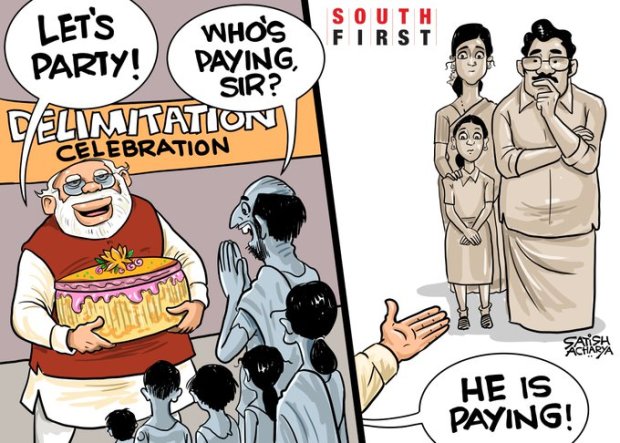
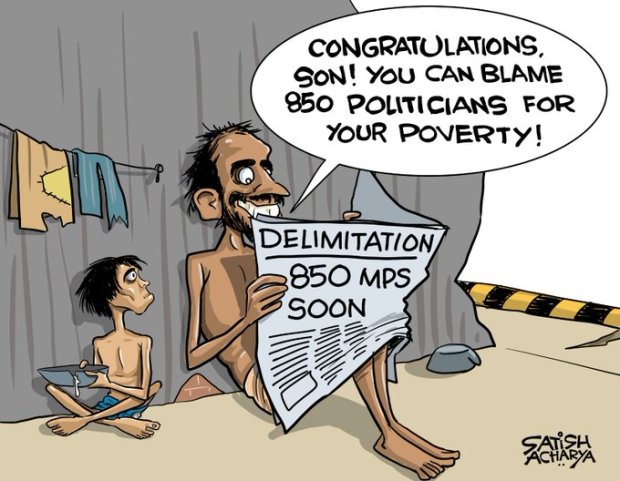
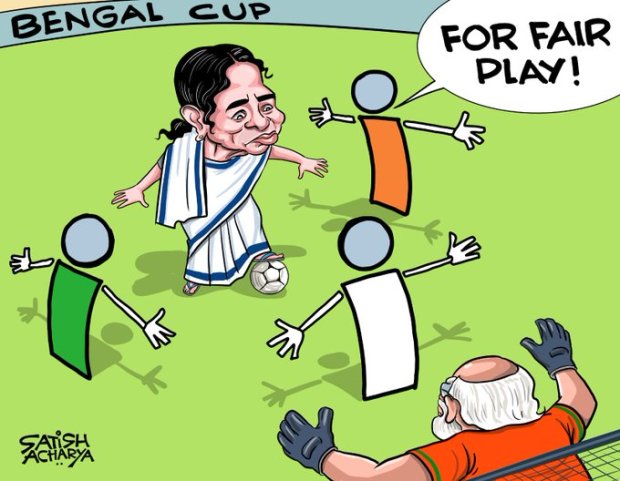
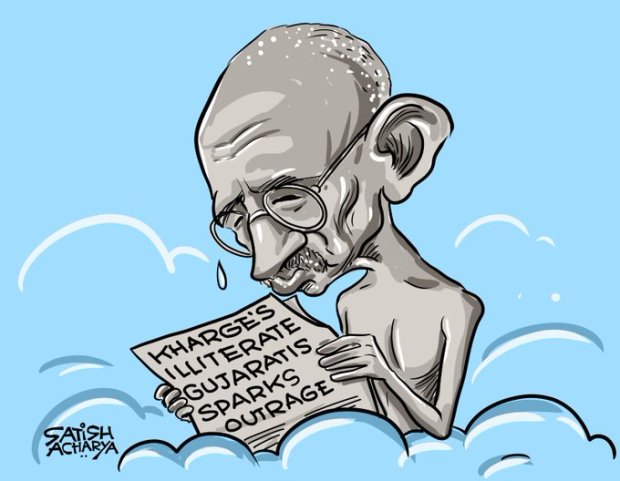
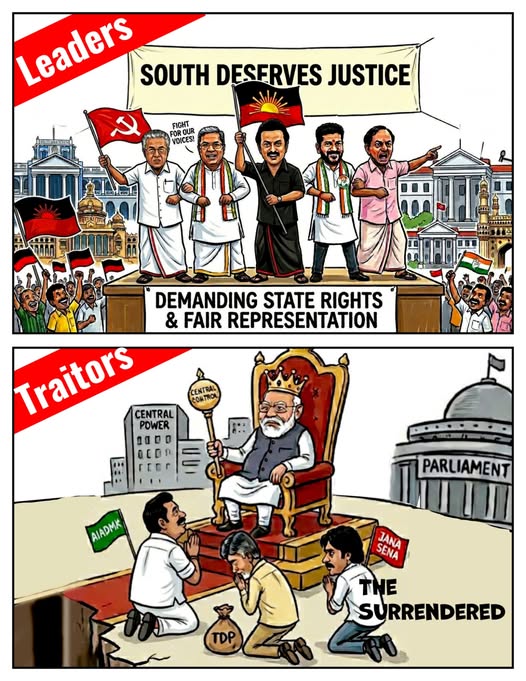
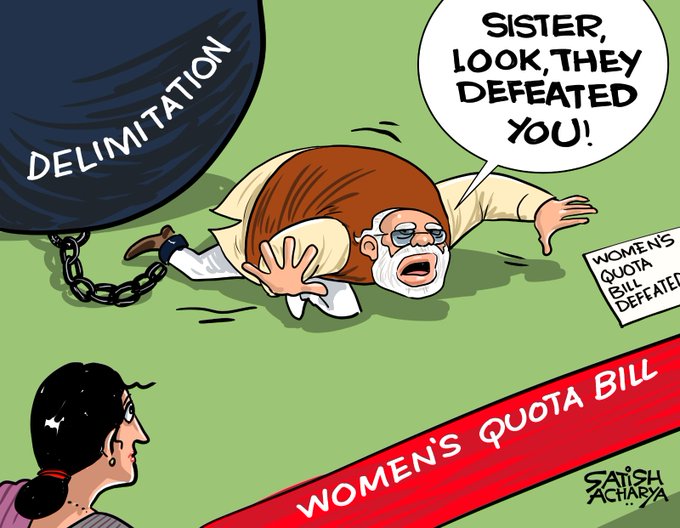
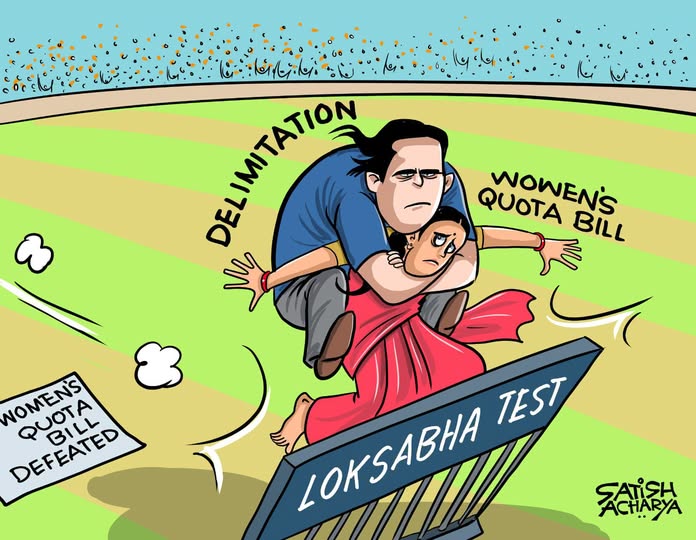
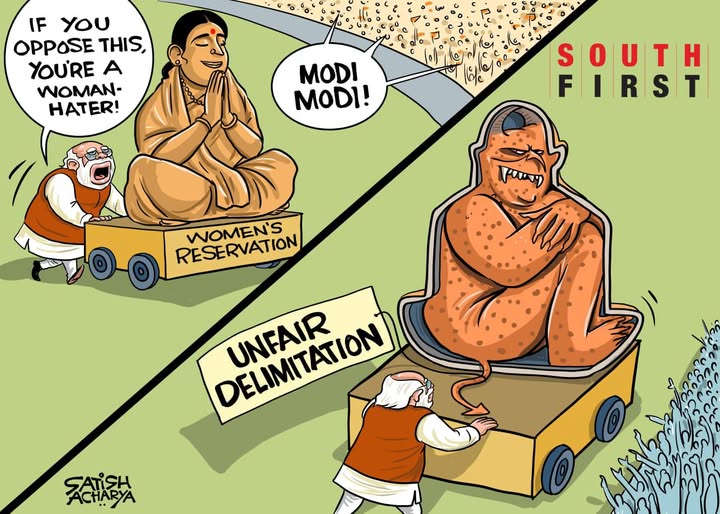
Satish Acharya, one of India’s most prolific editorial cartoonists, faces daily cyber-bullying, organised trolling and repeated legal pressure for his sharp takedowns of crony capitalism, institutional subversion and communal violence. His cartoons — widely shared on social media — capture the regime’s ethical ugliness in single-frame kautuka-hāsya: a bloated elite feasting while the masses starve, and so on. The regime’s response has included coordinated trolling, death threats and direct government orders: in early 2025 and again in March 2026, Acharya received notifications from X (formerly Twitter) that the Ministry of Electronics and Information Technology had ordered the blocking of his cartoons under Section 69A of the IT Act for criticising the government and the Prime Minister. He has also publicly warned that court orders against fellow cartoonists could be grossly misused against satirists, comedians and journalists alike. This pattern reveals how even visual suggestion terrifies sovereign opacity.
Here are a few selected instances of his work:
C. Manjul: The Cartoonist Dismissed
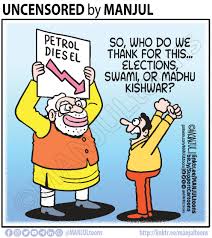
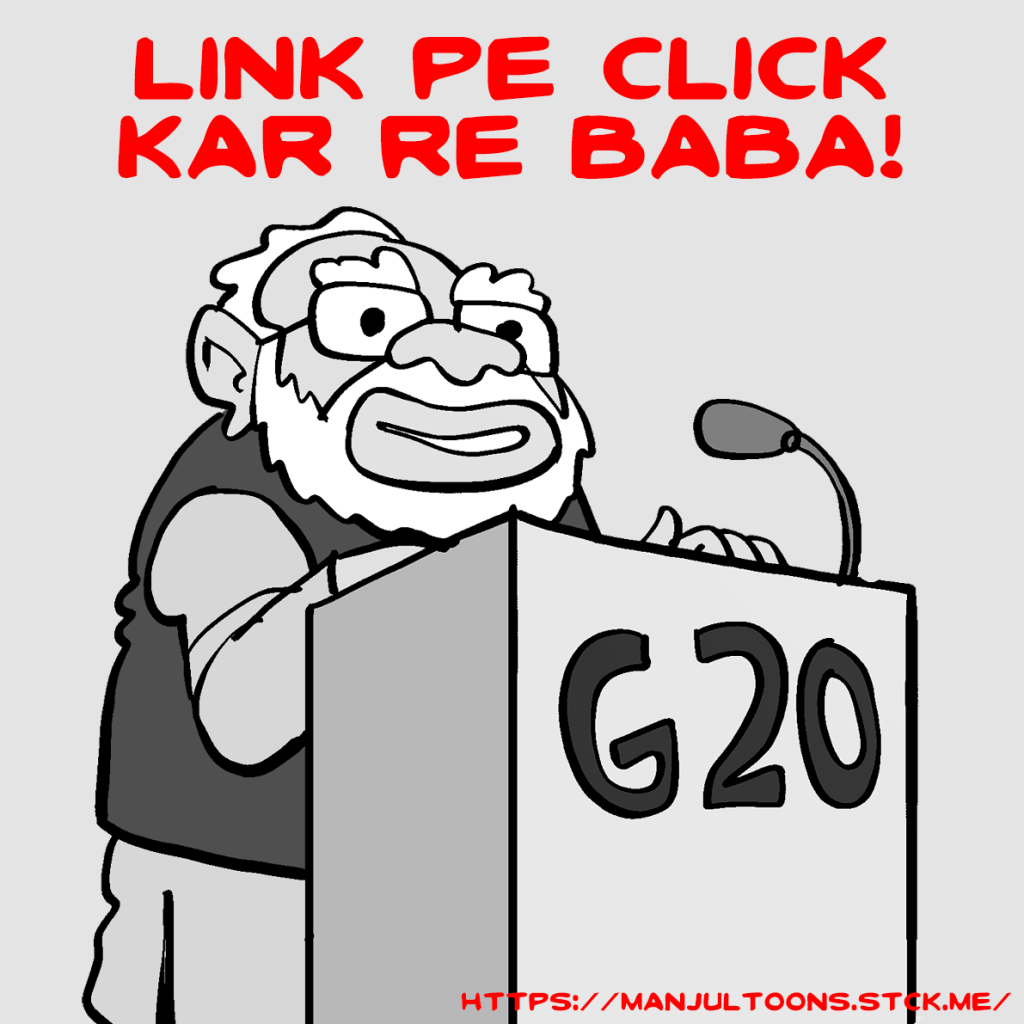
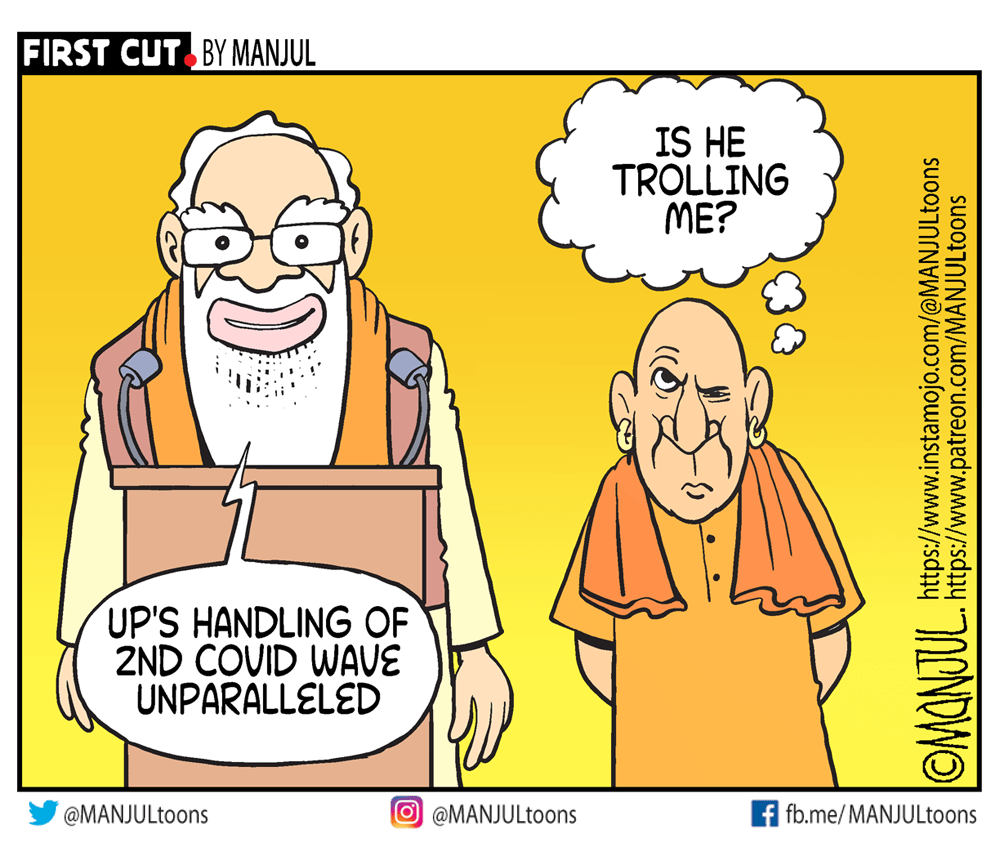
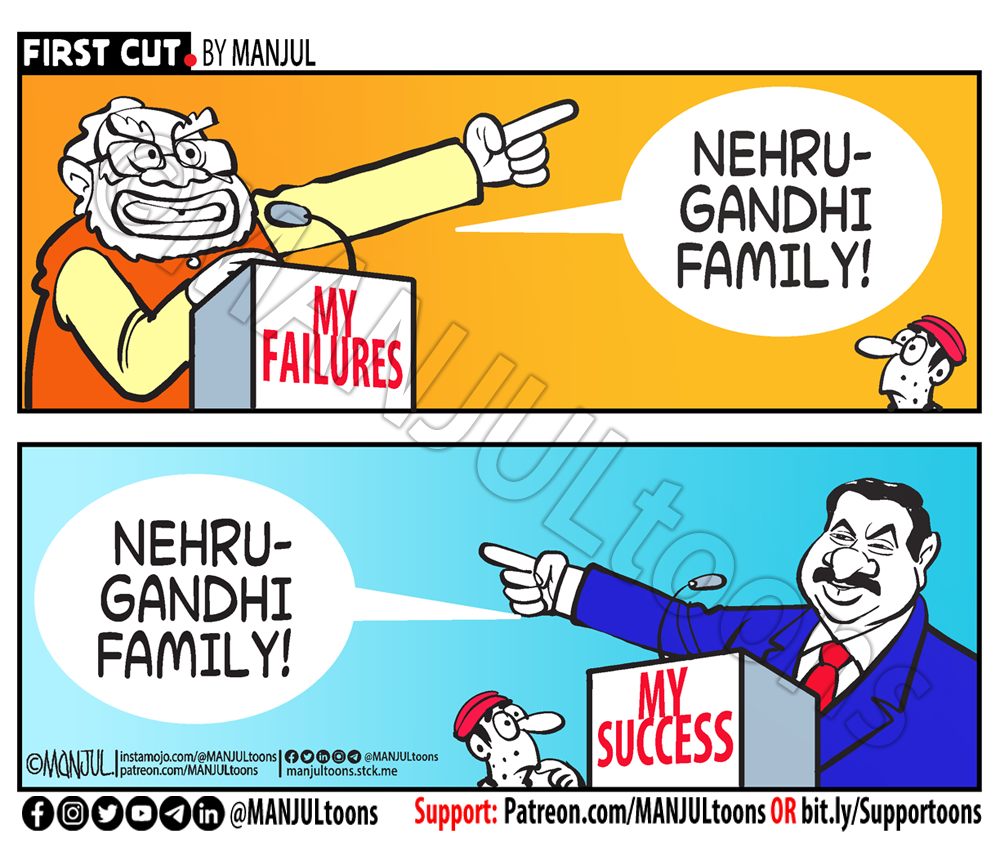
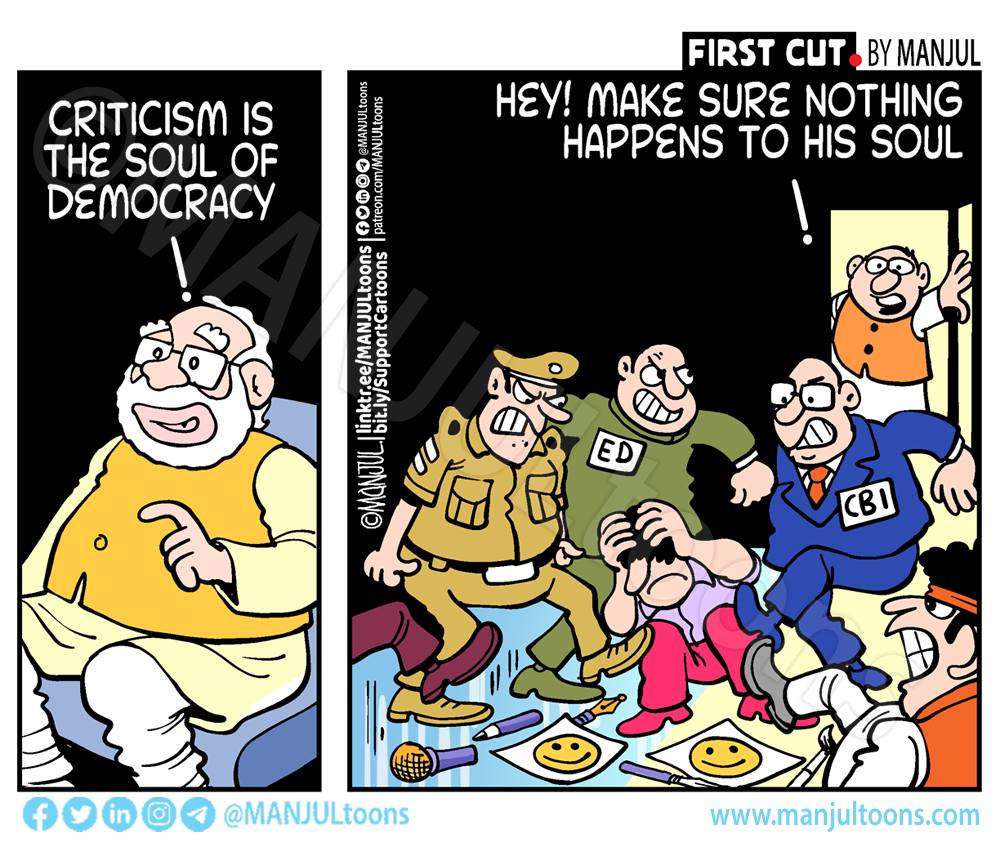
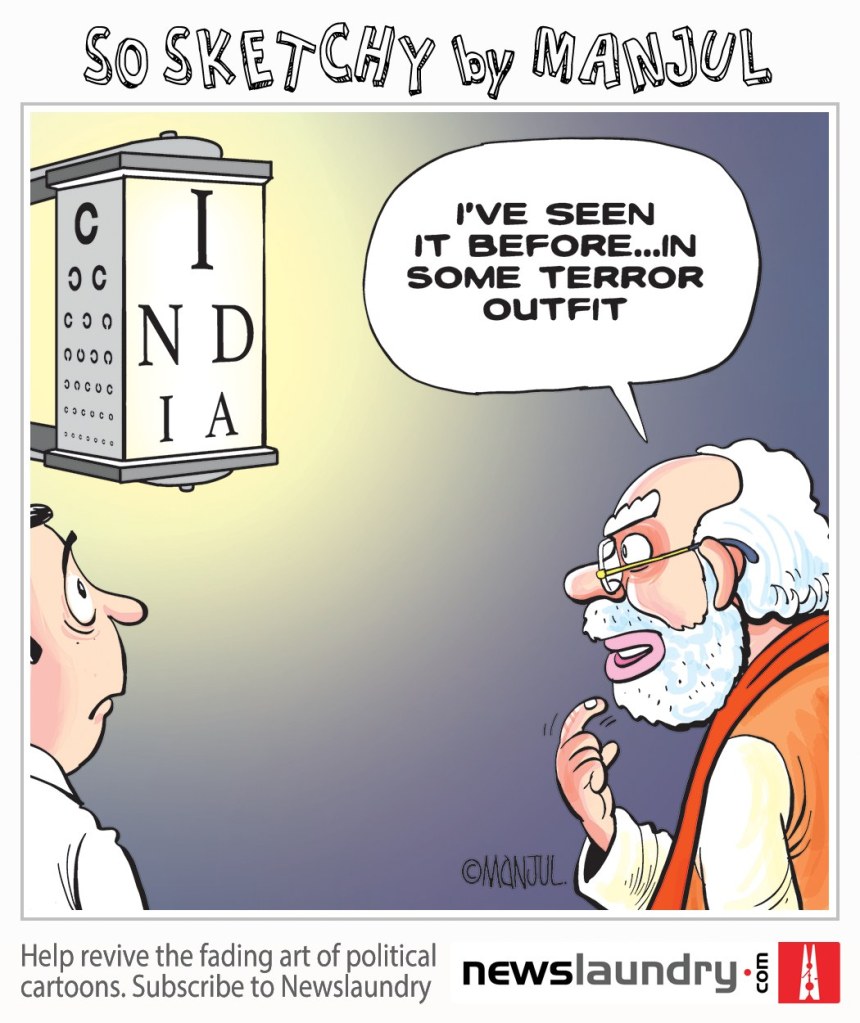
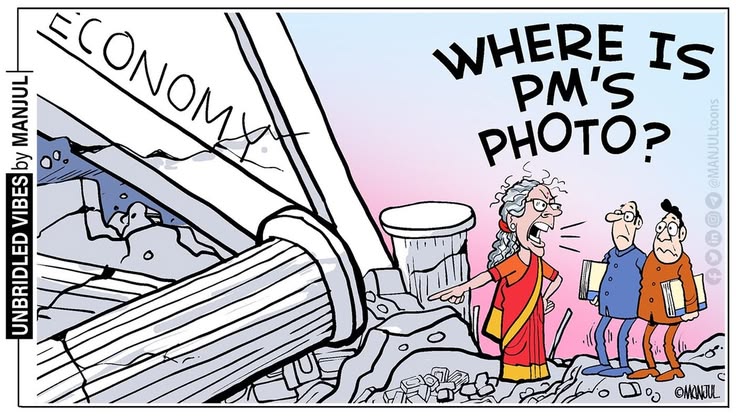
Manjul (Manjul Kumar) endured direct state intervention. In June 2021, Twitter notified him that the Government of India had sought action against his account over his cartoons; within weeks, Network18 suspended his contract after some six years of service. His work consistently lampoons the blurring of party, nation and leader, exposing the putrid inversion at the heart of the undeclared emergency. The sequence — a governmental notice followed by a corporate dismissal — shows the “Will to Hide” working through the capture of private media rather than through open censorship.
Here are a few selected cartoons composed by him:
D. G. Bala: The Cartoonist Arrested
G. Bala has faced platform censorship and direct legal harassment for satirical depictions of authoritarian excess. In November 2017 he was arrested by the Tirunelveli police over a cartoon indicting the Tamil Nadu government of Edappadi K. Palaniswami (then aligned with the BJP) after a family’s self-immolation outside the district collectorate. In 2021, Twitter informed him that the Union Government had ordered action against his cartoons under Section 69A of the IT Act for criticising the Prime Minister. He has endured multiple FIRs, police summons and coordinated complaints. His cartoons capture the regime’s ethical ugliness in single-frame kautuka-hāsya — majoritarian goons masquerading as guardians of dharma — and the regime’s response of trolling, threats, platform blocks and government orders reveals how deeply visual satire disrupts the carefully maintained facade of power.
E. The Legacy of R.K. Laxman’s “Common Man”
These cartoonists weaponise the frame’s immediacy: bībhatsa’s nausea is distilled into a single glance, then refracted through kautuka wonder and hāsya laughter into subversive insight that bypasses the regime’s controlled media. One is inevitably reminded of R.K. Laxman’s “Common Man” — the silent, bemused everyman who for decades stood as the moral conscience of the nation, quietly exposing the absurdities, hypocrisies and moral rot of those in power through minimalist lines and wry observation. Laxman showed how visual humour could hold a mirror to power without raising its voice, turning everyday political farce into a shared national language of critique.
In today’s far more repressive climate, Rachita Taneja, Satish Acharya, Manjul and G. Bala carry this legacy forward — but at a price Laxman’s Common Man was rarely asked to pay. That the same mirror now draws contempt notices, blocking orders, dismissals and arrests is itself the measure of how far the sovereign has retreated behind its golden disk. For more such instances, see:
IV. Shared Tactics, Collective Impact and the Triumph of Śilpita Pratirodha
Comedians and cartoonists alike deploy Michel de Certeau’s “tactics of the weak”: poaching the regime’s own symbols — WhatsApp forwards, policy slogans, judicial rituals, television anchors — and inverting them through parody and suggestion. Lacking a territory of their own, they operate within the sovereign’s space, seizing its signs on the fly and turning them inside out. Their satire is also a performance of subversive facework in Erving Goffman’s sense: by mimetically exaggerating the grotesque pomp of power, they disrupt the sovereign’s carefully staged front and expose the backstage machinery of oppression. Mimicry deflates authority, and the ruler’s imposed “face” collapses into pantomime.
Subaltern counterpublics — Dalit, Muslim, feminist and queer voices — forge alternative laughscapes that challenge the homogenised majoritarian truth. In a captured public sphere where the “Godi media” manufactures consent, these artists build digital counterpublics on YouTube, Instagram and independent platforms, democratising dissent for millions. Laughter here is not a private release but a collective act of sādhāraṇīkaraṇa: the spectator’s disgust is universalised, shared and turned outward.
The regime’s countermeasures form a recognisable repertoire. Defamation law, Section 295A of the IPC (now re-enacted in the Bharatiya Nyaya Sanhita), the IT Rules, Section 69A blocking orders, platform notices, contempt petitions and the street violence of affiliated cadres are deployed to file FIRs, issue summons, vandalise venues and order content blocks against those who pierce the “Will to Hide.” (How India’s IT Laws Are Silencing Political Satire, Outlook.)
| Artist | Medium | Instrument of reprisal |
|---|---|---|
| AIB collective | Roast (stage/online) | Section 295A and defamation complaints, trolling |
| Kunal Kamra | Stand-up, parody song | Venue vandalism, FIRs across states, airline bans, contempt proceedings, threats |
| Munawar Faruqui | Stand-up | Arrest and imprisonment under Section 295A, show cancellations |
| Vir Das | Stand-up (global stage) | Police complaints, “anti-national” campaign |
| Pulkit Mani | Satirical reel | Geo-blocking order under the IT Rules |
| Rachita Taneja | Webcomic | Criminal contempt proceedings, rape and death threats |
| Satish Acharya | Editorial cartoon | Section 69A blocking orders, trolling, threats |
| Manjul | Editorial cartoon | Government notice via Twitter, dismissal from Network18 |
| G. Bala | Editorial cartoon | Arrest, FIRs, Section 69A notice |
Yet every FIR, every vandalised venue, every contempt notice and every government-directed platform block confirms the potency of kautuka-hāsya-vyāṅga. Backlash multiplies reach; the attempt to conceal amplifies what it conceals. This pattern is magnified by meme culture, in which anonymous digital creators rapidly remix and circulate satirical images and clips, turning individual jokes into collective, unstoppable waves of ridicule that bypass traditional gatekeepers. A blocked reel returns as a thousand mirrors; a banned cartoon as a thousand screenshots. The sovereign that can neither declare its emergency nor contain its laughter finds that its “Will to Hide” crumbles under astonished collective mirth.
V. Conclusion: Until Power Trembles Before the Laughter It Cannot Contain
In the BJP-NDA regime’s undeclared emergency, political satire restores what the sovereign has foreclosed: śuddhi. Disgust is universalised rather than suppressed, and the sahṛdaya bhoktā passes from paralysed spectator to active resistor. Through verbal, visual and memetic śilpita pratirodha, the comedians and cartoonists studied here demonstrate that even in the darkest hybrid theatre, wonder, laughter and implication can dance with the wave of bhayānaka and bībhatsa rather than drown in it. Kamra’s parody, Faruqui’s unperformed joke, Das’s two Indias, Mani’s reel, Taneja’s stick figures, Acharya’s and Bala’s blocked frames, Manjul’s lost commission — each is a small rehearsal of the Upaniṣadic prayer: tat tvaṁ pūṣann apāvṛṇu, remove the golden disk, that truth may be beheld.
Yet laughter is not self-sufficient. A joke that remains catharsis alone can become a safety valve that the regime tolerates precisely because it discharges outrage without disturbing the structure. Satire that targets proper names rather than the chair — the person who occupies power rather than the paradigm that reproduces it — risks the same limitation OBMA has identified in single-agenda protest; and audiences who turn comedians into messiahs repeat the bhakti in politics against which Ambedkar warned. The emancipatory horizon of kautuka–hāsya–vyāṅga is realised only when astonished laughter becomes the threshold of collective, structural critique — of crony accumulation, the legitimation crisis of the state, the compromised four pillars and the ecological ruin that “development” disguises.
Within those bounds, Orwell’s maxim holds: every joke is a tiny revolution. The spectres of Husserl, Baudelaire, Benjamin, Camus, Tagore and Chaplin continue to haunt and arm the present Indian stage, demanding that wonder, laughter and satirical implication not merely counteract horror but dance with it — until power itself trembles before the laughter it can neither declare nor contain. Only through such crafted resistance can the sensitive spectator attain the reflective relish Bhattacharyya envisioned: not by escaping the repulsive and the terrible, but by astonishingly subverting them into the universal wave of freedom, ensuring that the repulsive never has the last word.
References
Primary and classical sources
- Bharata Muni. Nāṭyaśāstra (ca. 200 BCE–200 CE), esp. Chapters 6, 20, 23 and 24.
- Abhinavagupta. Abhinavabhāratī (commentary on the Nāṭyaśāstra), c. 1000 CE.
- Bhattacharyya, Krishna Chandra. “The Concept of Rasa.” In Studies in Philosophy, ed. Gopinath Bhattacharyya. Calcutta: Progressive Publishers, 1958.
- Īśopaniṣad, Mantra 15.
Theoretical sources
- Benjamin, Walter. The Arcades Project. Trans. Howard Eiland and Kevin McLaughlin. Cambridge, MA: Harvard University Press, 1999.
- Bergson, Henri. Laughter: An Essay on the Meaning of the Comic. Trans. Cloudesley Brereton and Fred Rothwell. London: Macmillan, 1911.
- Camus, Albert. The Myth of Sisyphus. Trans. Justin O’Brien. London: Hamish Hamilton, 1955.
- de Certeau, Michel. The Practice of Everyday Life. Trans. Steven Rendall. Berkeley: University of California Press, 1984.
- Goffman, Erving. The Presentation of Self in Everyday Life. New York: Doubleday, 1959.
- Husserl, Edmund. Cartesian Meditations. Trans. Dorion Cairns. The Hague: Martinus Nijhoff, 1960.
- Orwell, George. “Funny, but not Vulgar” (1945).
OBMA companion articles
- The Bad, the Ugly, and the Defiant: Bhayānaka, Bībhatsa, and Satire in Contemporary India (20 April 2026) — parent treatise.
- Why Today’s India Cannot Deny Its Undeclared Emergency (25 August 2025).
- Anatomy of Democratic Unmaking: An Open Letter on India’s Transparency, Human Rights, and Accountability Crises (9 December 2025).
- Cartoons on Contemporary India (6 September 2022).
Press

