
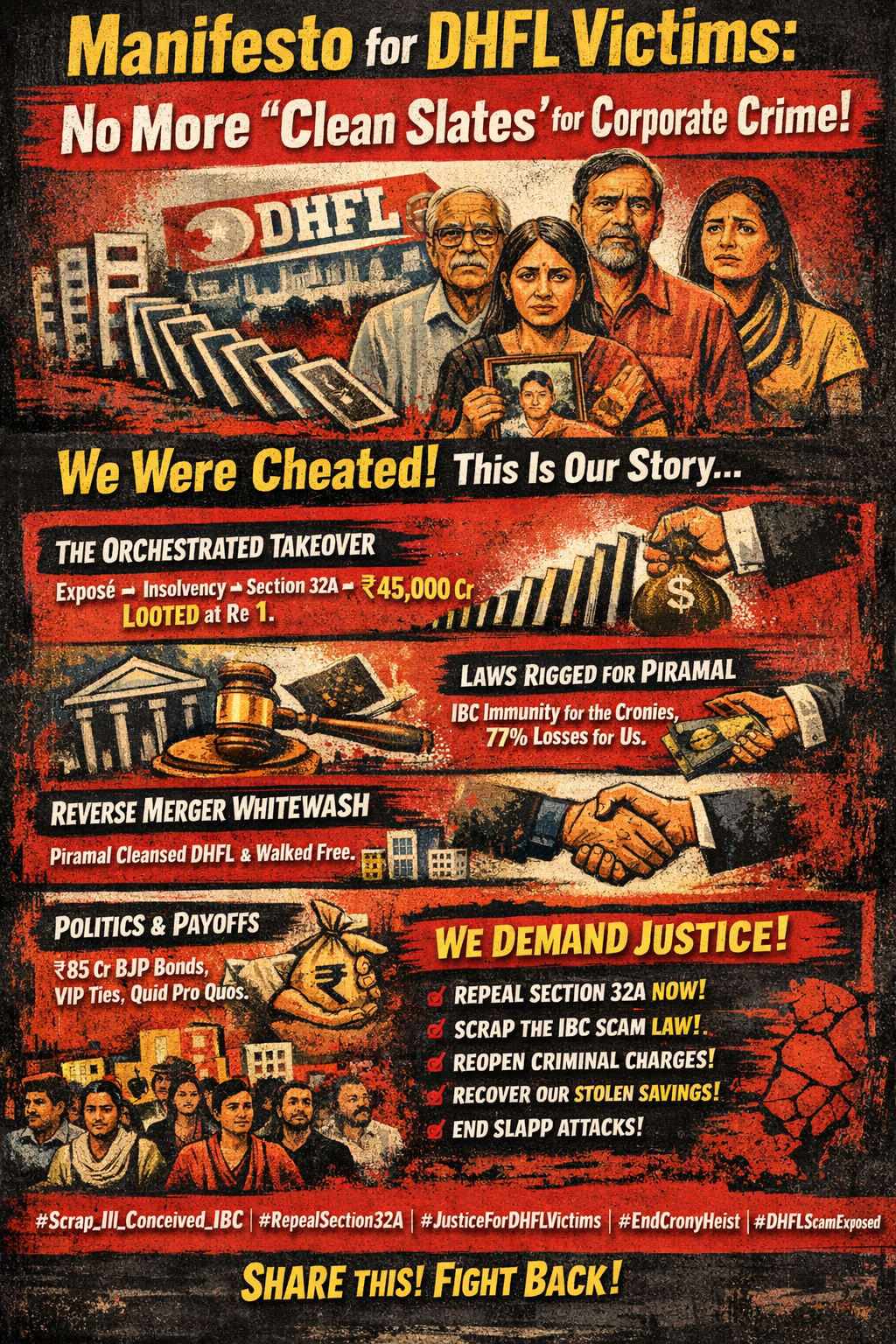
This manifesto is a fact-based cry from over 2.5 lakh DHFL depositors who lost life savings in massive 54–77% haircuts. It chronicles how India’s first AAA-rated NBFC — a sound ₹91,000+ crore housing finance company — was deliberately dismantled under the IBC: starting with Ajay Piramal’s “shock” warning (28 Jan 2019) followed by the Cobrapost exposé (29 Jan 2019), RBI supersession (20 Nov 2019), CIRP admission (3 Dec 2019), mid-process insertion of Section 32A immunity (28 Dec 2019), ignored full-repayment proposals, a Re 1 giveaway of ₹45,000 crore Section 66 recoveries, judicial overrides culminating in Supreme Court approval (1 Apr 2025), reverse mergers to sanitize legacy, and PMLA discharge of the corporate debtor (2 Feb 2026) under Section 32A — while Piramal Finance now thrives (AUM ₹96,690 crore up 23% YoY, PAT up 162%). Highlighting statutory contradictions, CoC bias allegations, and a documented political-corporate nexus, it demands repeal of Section 32A, scrapping the IBC, restitution, and an end to SLAPP suits — framing the DHFL case as engineered crony sanitisation, not genuine resolution.
Category Archives: News Channel
OBMA Statement on Neo-Imperialist Violence: Iran, Venezuela, Palestine
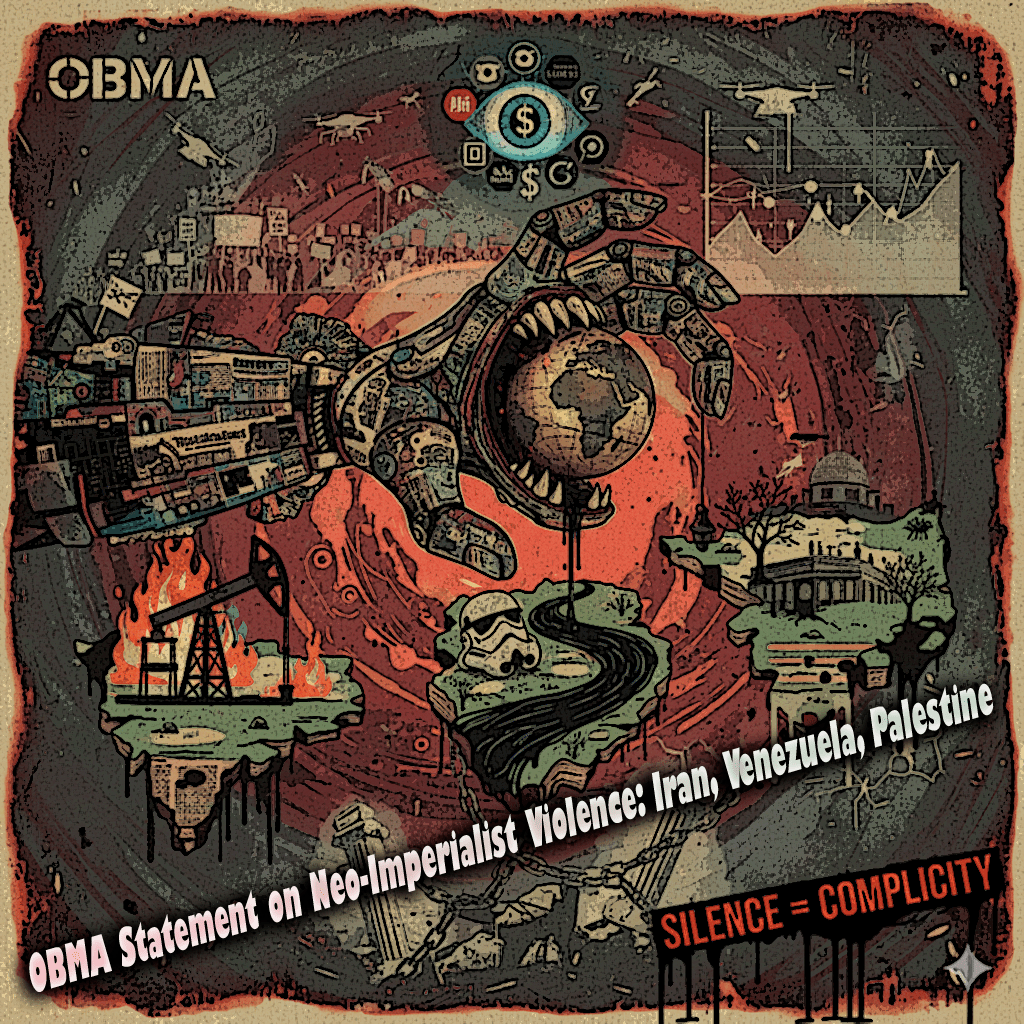
This statement asserts OBMA’s condemnation of neo-imperialist violence in Iran, Venezuela, and occupied Palestine, framing these crises as interconnected expressions of cannibalistic capitalism. It exposes how state repression, militarization, sanctions, and fossil-fuel geopolitics enable genocide, ecocide, and resource plunder. Rejecting technocratic and reformist fixes, OBMA affirms planetary justice, anti-imperialist solidarity, and life-centred transformation through collective struggle and ecological ethics.
When AA+ Means “Ask Again”: Manufactured Ratings, Piramal Finance, and the Credit Ratings Trap
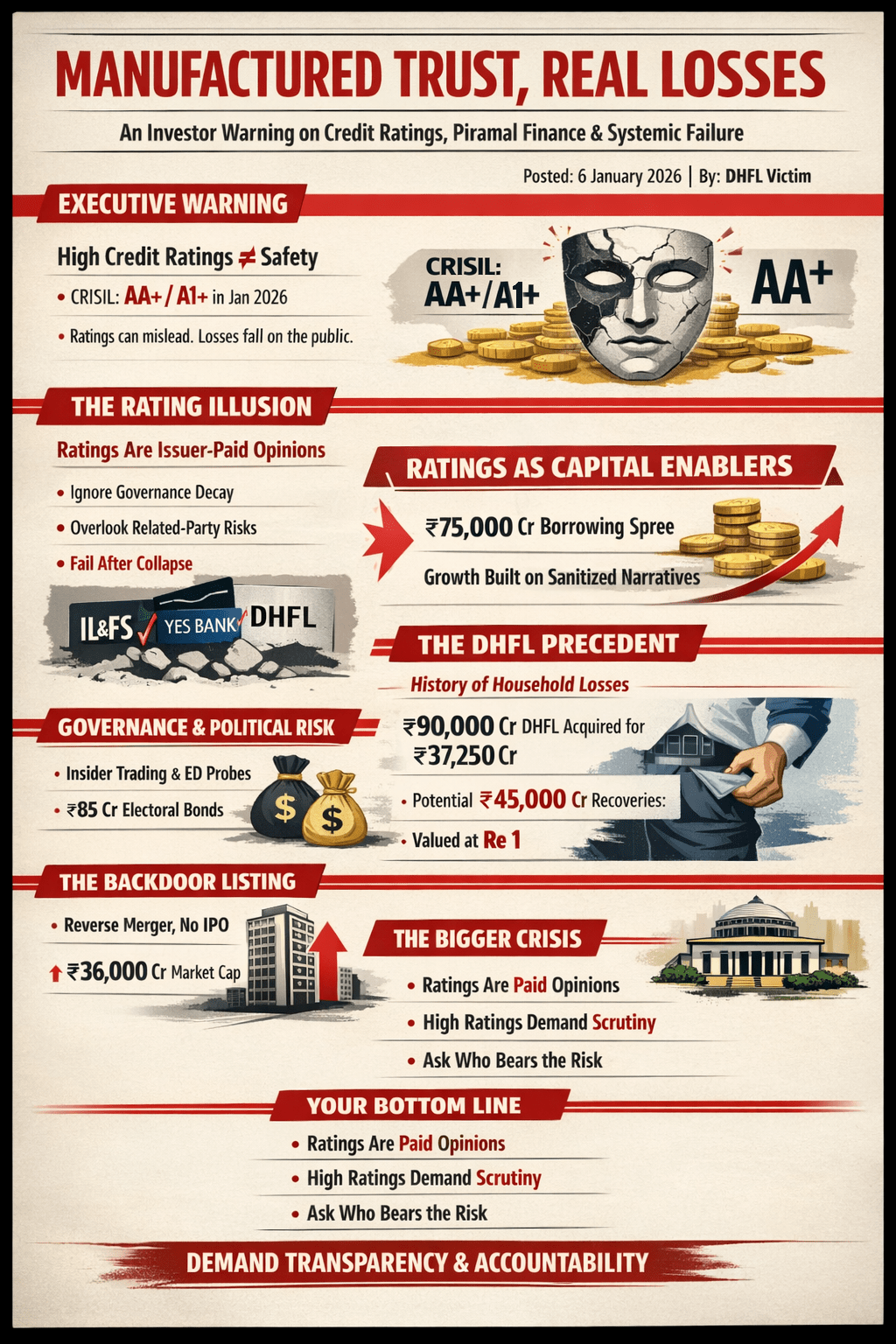
Despite glowing CRISIL AA+/Stable ratings, Piramal Finance’s strength is an illusion built on conflicted issuer-paid ratings, legacy DHFL fraud asymmetries (₹45,000 Cr recoveries valued at Re 1, massive retail haircuts), governance controversies, political proximity, and a backdoor listing that bypassed scrutiny. High ratings enable cheap funding and retail mobilisation—while systematically ignoring forensic risks, related-party issues, and resolution inequities seen in IL&FS, Yes Bank, DHFL. This is systemic: manufactured trust, socialised losses, privatised gains. Ratings are opinions, not guarantees. Demand truth before investing.
End of Year Bombshell: How BJP-NDA-Hindutva Failed India – A Scathing 2014-2025 Indictment
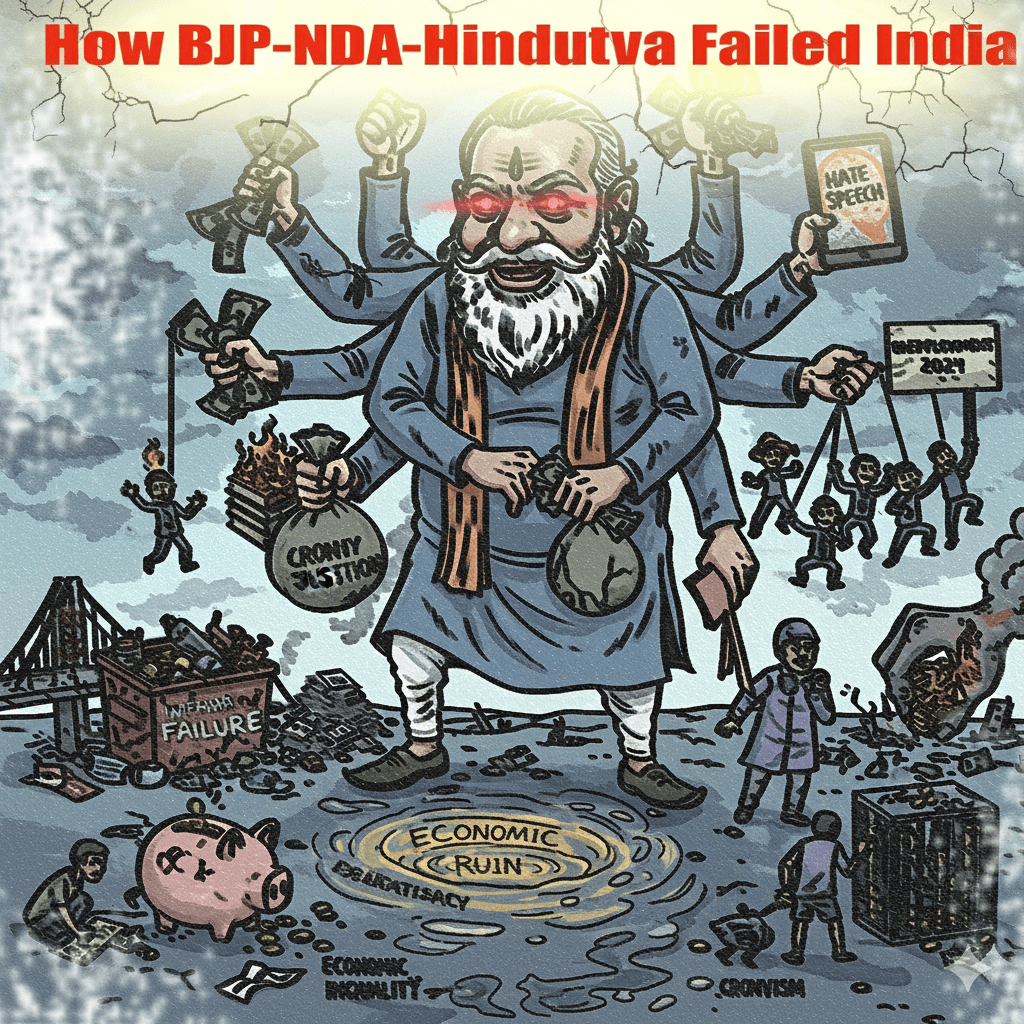
As 2025 draws to a close, this comprehensive dossier documents not a series of discrete policy missteps, but a systemic transformation of governance in India (2014–2025): a shift from democratic accountability to political executive dominance; from evidence-based policymaking to manufactured narrative control; from social protection to structural precarity. Spanning the economy, federalism, data integrity, labour, the natural environment, digital freedoms, education, public health, cultural institutions, civil liberties, and fundamental rights, the record reveals enduring patterns of power centralization, calibrated opacity, selective enforcement, and institutional hollowing—accompanied by crony consolidation and the routinized criminalization of dissent. Democratic indicators decline as surveillance infrastructures expand, grassroots welfare erodes, and truth itself is rendered an object of administrative management. This is not a partisan ledger, but a counter-archive: an evidence-grounded indictment that affirms accountability as the necessary cost of power. In closing the year, it calls for a civic reckoning—not to foreclose debate, but to reclaim and restore it.
Remembering What “Definitions” Make Us Forget: A Statement on the Aravallis and the Politics of Ecological Erasure

The Ecotopians of Alternity (EOA) as part of the Once in a Blue Moon Academia (OBMA) Collective asserts that the current legal crisis surrounding the Aravalli mountain range is a deliberate act of “definitional erasure” that threatens the ecological survival of North India. By narrowing the definition of these ancient hills to landforms rising 100 meters or more, the state effectively excludes over 90% of the range—including critical lower ridges, scrub forests, and groundwater recharge zones—from legal protection. This is not a neutral administrative update but a strategic maneuver that renders ecologically vital terrain “invisible” to the law, thereby clearing the path for corporate mining and real-estate expansion. Drawing on the Indian philosophical concept of lakṣaṇa (defining something based on characteristic mark), the EOA argues that a definition based solely on height fails to capture the holistic reality of an ecosystem that stops desertification and sustains regional aquifers. This logic of reductionism mirrors a broader national pattern of prioritizing extractivist “developmental rationality” over indigenous lifeworlds and long-term climate resilience, as seen in projects from Great Nicobar to Hasdeo Arand. Against this regime, the EOA calls for a coordinated resistance that refuses to let life be reduced to “administrative residue,” demanding a lived ecological imagination that protects the Aravallis as an indivisible, living system rather than a collection of disposable units.
DHFL Victims, Are We Still Ready to Fight for It?

This article argues that the DHFL collapse is not merely a corporate failure or legal dispute but a political event symptomatic of India’s deepening cronyist order, where executive power, judicial alignment, and corporate interests appear increasingly intertwined. Through comparative analysis of recent successful pressure-group interventions—such as the farmers’ movement and the pushback against Sanchar Saathi—the article highlights how public mobilization, not institutional goodwill, remains the only effective counterweight to state-corporate consolidation. It further examines the erosion of judicial independence, shrinking civil liberties, and declining democratic indicators reported by international watchdogs, situating the DHFL case within a broader crisis of accountability and participatory rights. The central thesis asserts that without organized mass resistance—legal, physical, and digital—victims of financial injustice remain fragmented, disempowered, and structurally silenced. Ultimately, the article calls on DHFL depositors to transform from isolated individuals into a collective civic force or pressure group, arguing that justice in contemporary India must be demanded, not awaited.
Will to Hide: Vote Theft, DHFL Scam, and the Silencing of RTI in BJP-ruled India (Video)

In this video of OBMA, we trace how truth in contemporary India is not hidden in darkness, but blinded by the illegitimate, coercive glare of power itself. From the quiet theft of votes through digital deletions and duplicated identities, to the DHFL scam that turned public funds into private fortunes, to the slow asphyxiation of the Right to Information (RTI)— the same pattern of concealment runs through it all. This is not ignorance, but design: the rule of the “Golden Disc,” where polished words like development and national interest mask the disappearance of citizens, accountability, and justice. We ask: when every institution is scripted to glorify the untruth, who will unveil the face of truth?
Affidavit And Public Legal Representation In Opposition To The Special Intensive Revision (SIR) Of Electoral Rolls, 2025

This affidavit opposes the 2025 Special Intensive Revision (SIR) of electoral rolls as an unconstitutional and discriminatory exercise that extends the exclusionary logic of the NRC–CAA–NPR regime. Framed as an administrative update, the SIR reproduces a politics of fear, surveillance, communal polarization and bureaucratic coercion—already driving marginalized citizens to despair and suicide. It exposes the State’s transformation of citizenship from birthright to conditional privilege, mediated by data and documents. Against this, the affidavit invokes planetary citizenship—an ethical-ecological vision affirming belonging beyond paper, religion, nation, or algorithm.
Unmasking Electoral Fraud in India: Patterns of Voter Roll Manipulation and Institutional Complicity

This article investigates the phenomenon popularly termed Vote Chori (“vote theft”) in contemporary India, revealing a systemic pattern of voter roll manipulation that challenges the credibility of the world’s largest electoral democracy. Drawing upon verified evidence from Rahul Gandhi’s disclosures, Ajit Anjum’s field investigations, voter testimonies such as that of Punam Kumari, and journalistic reporting from The Wire, the study identifies recurring techniques of disenfranchisement—including bulk deletions, forged Form-7 entries, and centralized, software-enabled tampering. Evidence from Karnataka, Bihar, and Maharashtra demonstrates how digital governance infrastructures, designed for efficiency, have become instruments of exclusion and partisan control. The Karnataka Special Investigation Team’s findings of call-centre operations and monetary inducements (₹80 per deletion) corroborate the allegations of industrial-scale roll manipulation. The Election Commission of India’s opacity and resistance to external audits reveal deeper institutional complicity and democratic erosion. By situating these developments within theoretical frameworks of algorithmic governance and bureaucratic authoritarianism, the paper argues that India’s electoral crisis marks not a failure of democracy per se, but its mutation into a technocratic apparatus of managed consent. The conclusion calls for independent digital audits, legislative oversight, and citizen-led verification systems as urgent correctives to restore electoral legitimacy.
RTI Under Siege: The Deadly Costs of Transparency in BJP-Run India

The Right to Information Act (RTI), once hailed as a revolutionary tool empowering citizens to hold power accountable, now stands at a critical crossroads. Two decades after its enactment, the law that once illuminated corruption, exposed scams, and strengthened democracy has been systematically hollowed out through political interference, bureaucratic evasion, and legislative dilution. From the 2019 amendments weakening Information Commissions to the Digital Personal Data Protection Act’s Section 443 shielding the government under the guise of privacy, transparency has been recast as a threat. India today suffers from data opacity, manipulation, and denial—where evidence is replaced by erasure and secrecy becomes governance. Institutions once devoted to public integrity—the NSSO, CAG, and Indian Statistical Institute—face interference, delayed data releases, and censorship of inconvenient truths. Activists who dared to ask questions have been attacked or killed, while citizens encounter silence and obstruction. The RTI’s decline mirrors a deeper democratic crisis: the transformation of a people’s right to know into the state’s right to conceal. Yet amid suppression, citizens continue to resist—filing mass RTIs, exposing institutional failures, and demanding reform. The fight to save RTI is no longer just about access to information; it is a struggle to reclaim the soul of Indian democracy itself.
 Once in a Blue Moon Academia