

Posted on 13/11/2023 (GMT 17:35 hrs) Abstract The narrative follows the format of stream of consciousness or internal dialogic reflectivity in order to present an existentialist theme of a chain smoker’s world-construction, specifically in relation to the business of politics as well as the politics of business in the realm of burnout society. The storyContinue reading ““SmoKING Kills”: The Paradoxes of Contemporaneity”
Category Archives: Journal
CONVERGENCE TO PRAXIS
This journal tries to demolish the administrative boundaries of academic disciplinary technology by amalgamating all the so-called “subjects” by condemning the objectification, subjectification and subjection.
It strives to reach the vanishing point of theory and praxis. Thus, instead of so-called “inter-disciplinary studies”, it emphasizes on the convergence of earthian knowledges and praxiologies. The journal attempts to achieve this end by means of dialogue without manipulation in the context of a participatory, local-resource based, low-energy efficient, small-scale, self-reliant, partyless, moneyless, decentralized democracy. As this journal is against the academiocratic elitism and patron-client relationship, it maintains the Copyleft Writers’ Movement and follows the Creative Commons License.
Is there any one-to-one correspondence between Bharatiya Janata Party’s increasing assets and abrupt bankruptcies in India?
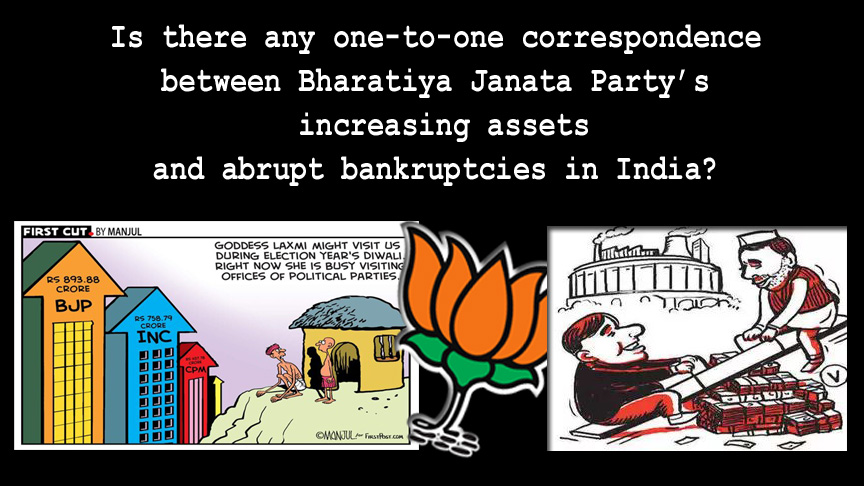
Posted on 16/10/2023 (GMT 11:10 hrs) I. INTRODUCTION The article cum compilation introduces a hypothesis standing for a supposed correlation in the political economy of India: rising assets of the current ruling party and the rampant bankruptcies witnessed in the past nine years, i.e., during the regime of the BJP. In order to extend the hypothesis,Continue reading “Is there any one-to-one correspondence between Bharatiya Janata Party’s increasing assets and abrupt bankruptcies in India?”
চিকিচ্ছে ব্যবস্থার দানখয়রাতির রাজনৈতিকতা (The Problem of the Health System in India and the Dole Economy of the Political Parties)

Posted on 23/08/2023 (GMT 16:40 hrs) Updated on 24/08/2023 (GMT 04:47 hrs) Abstract This interview in Bangla language is on dole economy in different domains of human necessities as practiced by the Indian political parties in West Bengal. The fact of Indian politics is that the political parties are imitating the Bharatiya Janata Party’s (BJP)Continue reading “চিকিচ্ছে ব্যবস্থার দানখয়রাতির রাজনৈতিকতা (The Problem of the Health System in India and the Dole Economy of the Political Parties)”
THE CHOSEN ONES IN INDIAN POLITICAL ECONOMY: A CASE STUDY OF THE DHFL SCAM
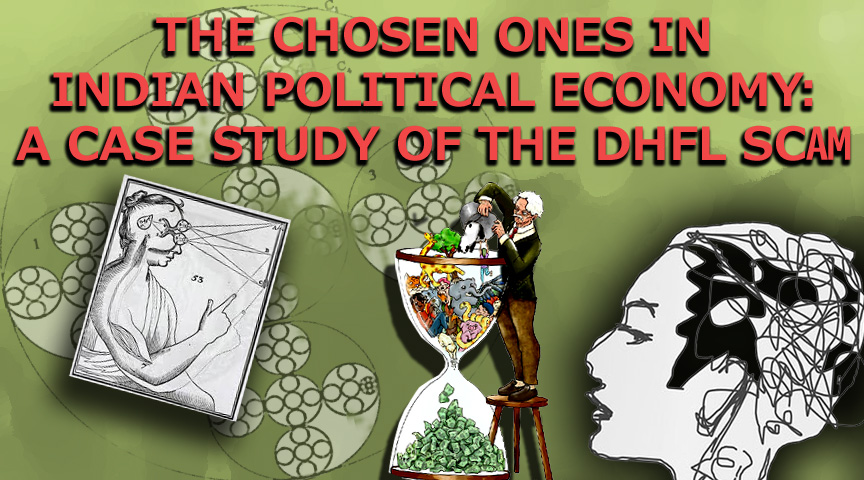
Posted on 20/08/2023 (GMT 05:50 hrs) ABSTRACT To understand the present state of affairs in Indian polity with regard to financial crises, the paper would present a case-study on the Dewan Housing Finance Corporation Limited (DHFL) scam, which is now occupied through adverse possession by one of the ruling party’s close associates, viz., Mr. AjayContinue reading “THE CHOSEN ONES IN INDIAN POLITICAL ECONOMY: A CASE STUDY OF THE DHFL SCAM”
The DHFL Rigmarole: A Further Look(-back) Into the Matter: A Review
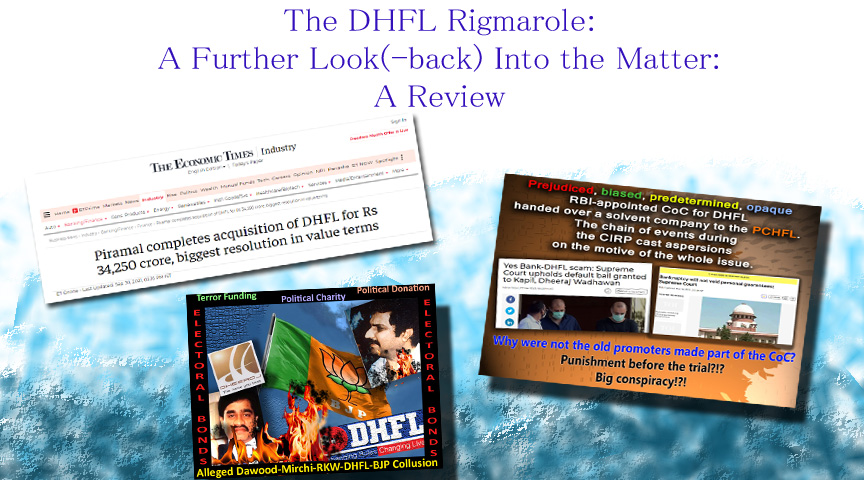
Posted on 15/08/2023 (GMT 07:30 hrs) Updated on 16/08/2023 (GMT 17:30 hrs) The present compilation focuses on a particular research-paper written by ADITI SHOBHA AND DIKSHA KUMARI, entitled “DHFL Scam and the Entire Rigmarole”, published in INTERNATIONAL JOURNAL OF LAW MANAGEMENT & HUMANITIES (Volume 4, Issue 3, 2021, pp. 6065-6075), focusing on the biggest financialContinue reading “The DHFL Rigmarole: A Further Look(-back) Into the Matter: A Review”
“অজেয়” পিরামলের পীড়াদায়ক তথা নরখাদক পুঁজিবাদ

Posted on 06/08/2023 (GMT 07:00 hrs) দেবপ্রসাদ বন্দ্যোপাধ্যায় আখর বন্দ্যোপাধ্যায় আগাম নিবেদনঃ এই লেখাটা মাগনা পড়ে যাঁরা আমাদের মতামতের সঙ্গে সহমত হবেন, তাঁদের কাছে একটাই অনুরোধঃ আমাদের এই লেখাটার জন্য খাটা-খাটনির মজদুরি মোতাবেক “বিনিময় মূল্য” (হায়, সবই শর্তাধীন বিনিময়ী বন্দোবস্ত) হিসেবে নিচের এই লিঙ্কটা টিপে পিটিশনে দয়া করে স্বাক্ষর দেবেন। এইটুকু প্রত্যাশা আমরা আপনাদের কাছেContinue reading ““অজেয়” পিরামলের পীড়াদায়ক তথা নরখাদক পুঁজিবাদ”
পীড়া-মল-এর পীড়া আর নরখাদক পুঁজিবাদ

Posted on 30/07/2023 (GMT 11:25 hrs) ABSTRACT This paper vents out its anger on the face of savage capitalism that thrives through the cannibalistic instinct. It particularly focuses on the case of one such savage capitalist: Mr. Ajay Piramal, and reflects upon his deeds from the perspective of a self-reflexive account. https://doi.org/10.13140/RG.2.2.31986.68807 পীড়া-মল-এর পীড়া আরContinue reading “পীড়া-মল-এর পীড়া আর নরখাদক পুঁজিবাদ”
Reflections on the Uniform Civil Code (UCC) in India from the perspective of Homo Sapiens Sapiens, inhabitants of the no-nation: A Letter to The 22nd LCI
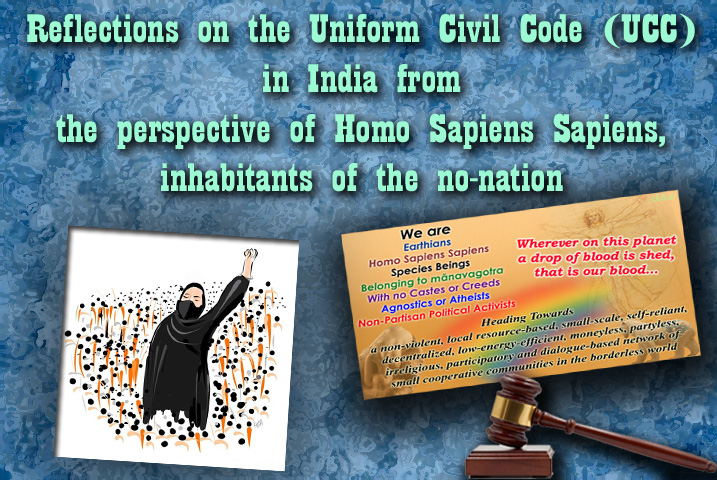
Posted on 13/07/2023 (GMT 07:00 hrs) Updated on 14/07/2023 (GMT 18:15 hrs) As requested by the 22nd Law Commission of India, we have sent our theoretical take on the #Uniform_Civil_Code or #UCC_Controversy to the concerned mail ID. The letter is reproduced below. To engage with this issue, we have pursued long-research work by interrelating theContinue reading “Reflections on the Uniform Civil Code (UCC) in India from the perspective of Homo Sapiens Sapiens, inhabitants of the no-nation: A Letter to The 22nd LCI”
UNIFORM CIVIL CODE IN INDIA: READY-STEADY-GO?

Posted on 11/07/2023 (GMT 15:50 hrs) ABSTRACT The following paper is an attempt at exposing the hidden agenda of the Uniform Civil Code (UCC) as it is supposed to be implemented by the BJP government in India. It starts with the experience of the domain of the externally threatened subjectivity and moves on to criticizeContinue reading “UNIFORM CIVIL CODE IN INDIA: READY-STEADY-GO?”
Islamophobia: The Manufactured Illness of Sick Indian Hindutvavādins

The article critically examines the rise of Islamophobia in India as a constructed phenomenon driven by Hindutva ideology. The author argues that Hindutva, a politico-religious movement, systematically manufactures Islamophobia to consolidate Hindu nationalist power, portraying Muslims as existential threats through narratives of “love jihad,” demographic invasion, and terrorism. Drawing on postcolonial and psychoanalytic frameworks, the article traces this “illness” to colonial legacies, RSS propaganda, and media amplification, which dehumanize Muslims and justify violence against them. It highlights the socio-political consequences, including mob lynchings, discriminatory laws like the CAA-NRC, and the marginalization of Muslim voices. The piece critiques the complicity of India’s ruling elite and calls for dismantling Hindutva’s divisive rhetoric through inclusive dialogue and resistance to nationalist hegemony, warning of democracy’s erosion if unchecked.
 Once in a Blue Moon Academia