
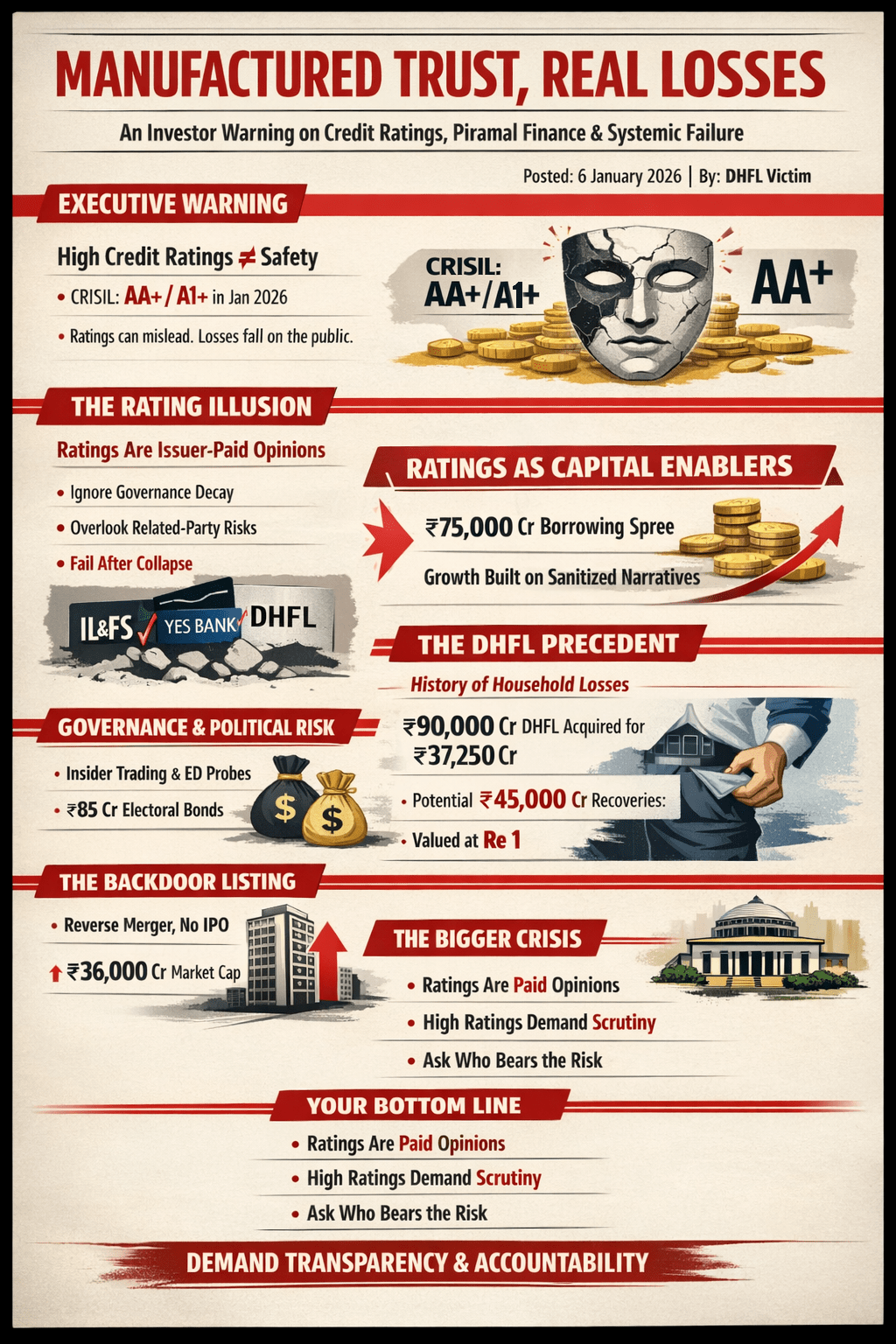
Despite glowing CRISIL AA+/Stable ratings, Piramal Finance’s strength is an illusion built on conflicted issuer-paid ratings, legacy DHFL fraud asymmetries (₹45,000 Cr recoveries valued at Re 1, massive retail haircuts), governance controversies, political proximity, and a backdoor listing that bypassed scrutiny. High ratings enable cheap funding and retail mobilisation—while systematically ignoring forensic risks, related-party issues, and resolution inequities seen in IL&FS, Yes Bank, DHFL. This is systemic: manufactured trust, socialised losses, privatised gains. Ratings are opinions, not guarantees. Demand truth before investing.
Category Archives: Activities
Our current activities concentrate on the case of Dewan Housing Finance Corporation Limited (DHFL), India. While exploring and investigating this particular case, we have found that India’s crony ruling party, gangsters, banksters as well as religious gurus and institutions are involved in the same. Therefore, to break such collusion, we have decided to deploy an “all out attack” on the existing paradigm of neoliberal market economy as well as market fundamentalism. ***DISCLAIMER: We have collected all the data from available sources on the internet as given on the official portals of media houses, websites and institutions and organizations. We are not first-hand reporters and hence, we are not liable for any inadvertent error or value-loaded statements made on those portals. All propositions have to be viewed as descriptive assertions on the given point of concern.***
Piramal Finance and the Rating Ruse: How India’s Credit Rating Agencies Manufacture Trust to Enable Systemic Expropriation
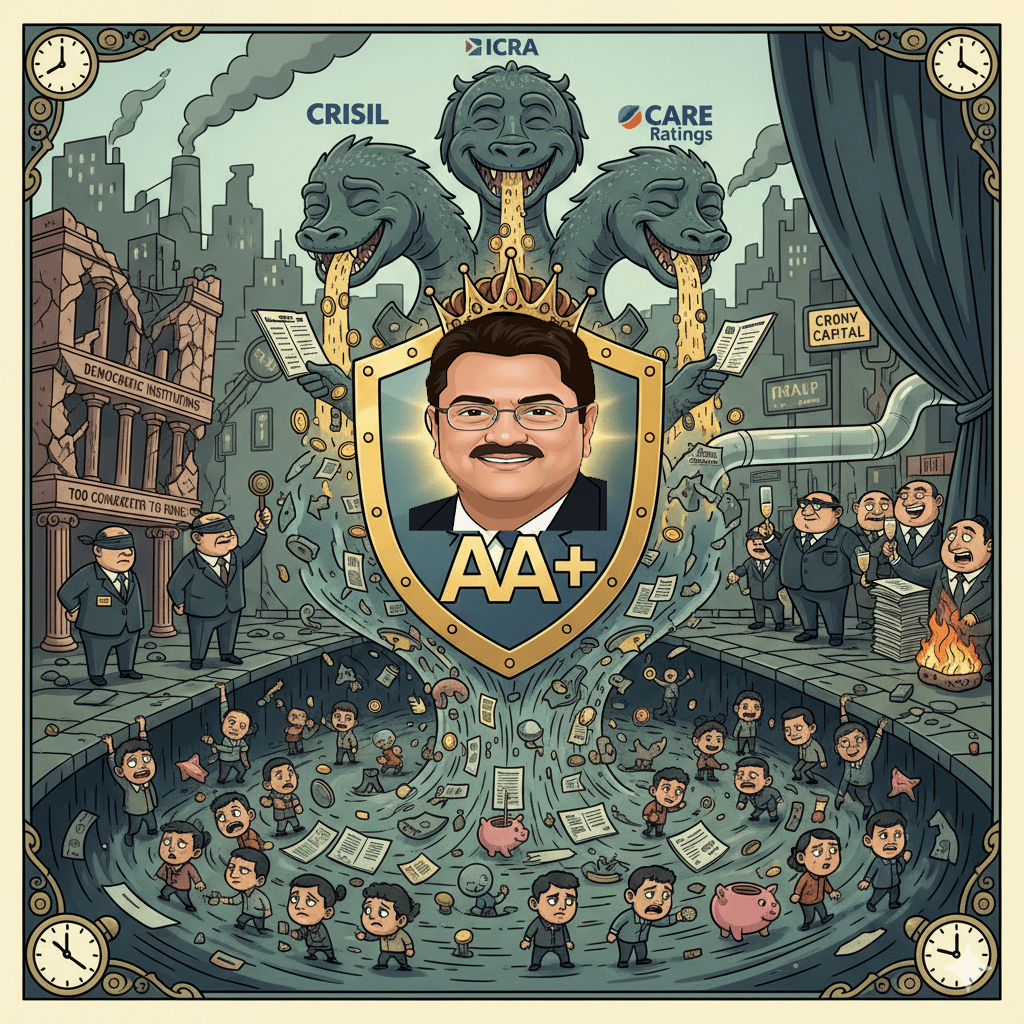
In India’s deeply captured financial regime under prolonged BJP-NDA rule (2014–2025), credit rating agencies (CRAs)—dominated by the CRISIL-ICRA-CARE triopoly—have degenerated from purported risk sentinels into systemic enablers of crony expropriation, perpetuating a predatory cycle of manufactured trust, retail mobilization, delayed collapse, and elite consolidation. The Piramal Finance–DHFL saga stands as the paradigmatic indictment: investment-grade ratings (AA to AAA) were stubbornly retained despite whistleblower alerts, Cobrapost exposés, and KPMG audits exposing ~₹29,000–34,000 crore in promoter diversions through shells and evergreening, facilitating continued borrowing until 2019 defaults; post-crisis, Piramal—bolstered by dynastic kinship to Mukesh Ambani (via his son’s marriage to Isha Ambani) and alleged political shielding through disproportionate ruling-party contributions—secured DHFL via a sweetheart IBC resolution that controversially valued ~₹45,000 crore in fraud/avoidance recoveries at a nominal Re 1, acquiring the ~₹90,000+ crore portfolio for ~₹37,250 crore while the Supreme Court’s April 1, 2025, ruling vested all future windfalls exclusively in the bidder and condemned ~2.5 lakh retail depositors (mostly middle-class and elderly savers) to brutal 55–77% haircuts, aggregating colossal losses exceeding ₹50,000 crore across similar NBFC failures. Swiftly rebranded as Piramal Finance through reverse merger alchemy, the entity achieved rapid rehabilitation—~₹91,447 crore AUM with over 80% retail pivot, PAT doubling to ~₹327 crore in Q2 FY26, and fortified net worth ~₹27,000 crore—crowned by CRISIL’s fresh AA+/Stable assignment in January 2026 (with A1+ short-term), shaving funding costs by 50–80 bps and unlocking diversified inflows, even as Moody’s Ba3/Stable alone cautioned lingering wholesale exposures (~14%) and volatility. Driven by issuer-pays conflicts, oligopolistic convergence, epistemic blindness to governance rot and political proximity, and implicit “too connected to fail” pricing, CRAs orchestrate performative legitimacy—inflating optics pre-crisis, reacting belatedly post-default (as in IL&FS’s AAA-to-junk plunge and Yes Bank’s pre-moratorium investment-grade persistence), and aggressively upgrading post-consolidation—thereby externalizing ruin onto vulnerable constituencies while privatizing distressed assets for networked oligarchs within a broader architecture of institutional capture, democratic erosion, and cunning capitalism that demands radical rupture: abolishing issuer-pays, imposing personal liability, deconcentrating markets, and centering retail justice to reclaim accountability from this reverse merger republic.
The Bankruptcy Bazaar: How India’s Ill-Conceived Insolvency and Bankruptcy Code (IBC) Turns Public Money into Private Profits
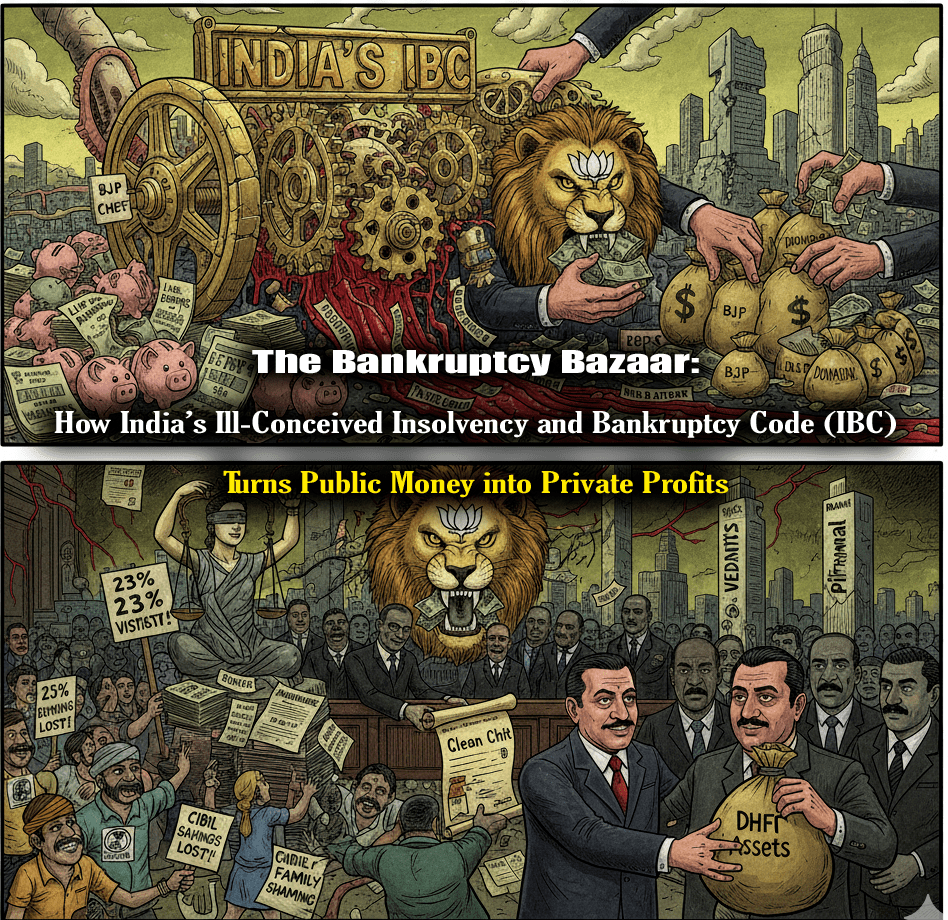
This article delivers a comprehensive indictment of India’s Insolvency and Bankruptcy Code (IBC), 2016, exposing it as a structurally predatory regime that facilitates crony expropriation rather than genuine resolution. Through doctrinal analysis, tribunal data, and emblematic case studies—Videocon, Aircel, Essar Steel, Bhushan Power, Reliance Communications, and most starkly DHFL—it demonstrates how time-bound resolution is a legal fiction, recoveries are abysmally low, avoidance provisions are systematically neutralised, and fraud is laundered through procedural finality. The DHFL case emerges as the perfect crime scene: mass dispossession of 2.5 lakh retail savers, assignment of vast avoidance recoveries at notional value to the acquirer, and judicial deference that extinguished constitutional claims. Situated within a wider political economy of crony capitalism and opaque political funding, the IBC is shown not as a failed reform but as rule by plunder—an insolvency regime that has gone rogue.
End of Year Bombshell: How BJP-NDA-Hindutva Failed India – A Scathing 2014-2025 Indictment
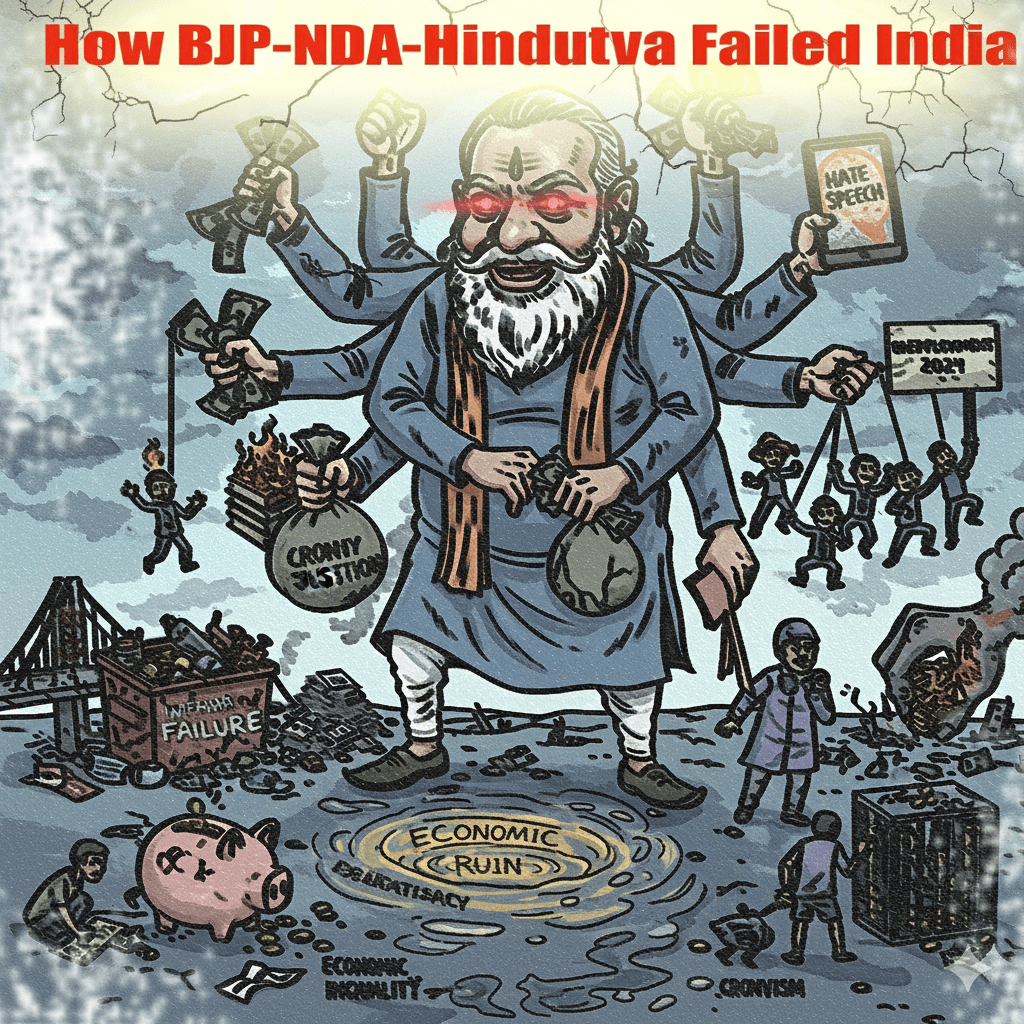
As 2025 draws to a close, this comprehensive dossier documents not a series of discrete policy missteps, but a systemic transformation of governance in India (2014–2025): a shift from democratic accountability to political executive dominance; from evidence-based policymaking to manufactured narrative control; from social protection to structural precarity. Spanning the economy, federalism, data integrity, labour, the natural environment, digital freedoms, education, public health, cultural institutions, civil liberties, and fundamental rights, the record reveals enduring patterns of power centralization, calibrated opacity, selective enforcement, and institutional hollowing—accompanied by crony consolidation and the routinized criminalization of dissent. Democratic indicators decline as surveillance infrastructures expand, grassroots welfare erodes, and truth itself is rendered an object of administrative management. This is not a partisan ledger, but a counter-archive: an evidence-grounded indictment that affirms accountability as the necessary cost of power. In closing the year, it calls for a civic reckoning—not to foreclose debate, but to reclaim and restore it.
Remembering What “Definitions” Make Us Forget: A Statement on the Aravallis and the Politics of Ecological Erasure

The Ecotopians of Alternity (EOA) as part of the Once in a Blue Moon Academia (OBMA) Collective asserts that the current legal crisis surrounding the Aravalli mountain range is a deliberate act of “definitional erasure” that threatens the ecological survival of North India. By narrowing the definition of these ancient hills to landforms rising 100 meters or more, the state effectively excludes over 90% of the range—including critical lower ridges, scrub forests, and groundwater recharge zones—from legal protection. This is not a neutral administrative update but a strategic maneuver that renders ecologically vital terrain “invisible” to the law, thereby clearing the path for corporate mining and real-estate expansion. Drawing on the Indian philosophical concept of lakṣaṇa (defining something based on characteristic mark), the EOA argues that a definition based solely on height fails to capture the holistic reality of an ecosystem that stops desertification and sustains regional aquifers. This logic of reductionism mirrors a broader national pattern of prioritizing extractivist “developmental rationality” over indigenous lifeworlds and long-term climate resilience, as seen in projects from Great Nicobar to Hasdeo Arand. Against this regime, the EOA calls for a coordinated resistance that refuses to let life be reduced to “administrative residue,” demanding a lived ecological imagination that protects the Aravallis as an indivisible, living system rather than a collection of disposable units.
The Digital Leviathan: Inside the BJP IT Cell’s Architecture of Consent, Coercion, and Control
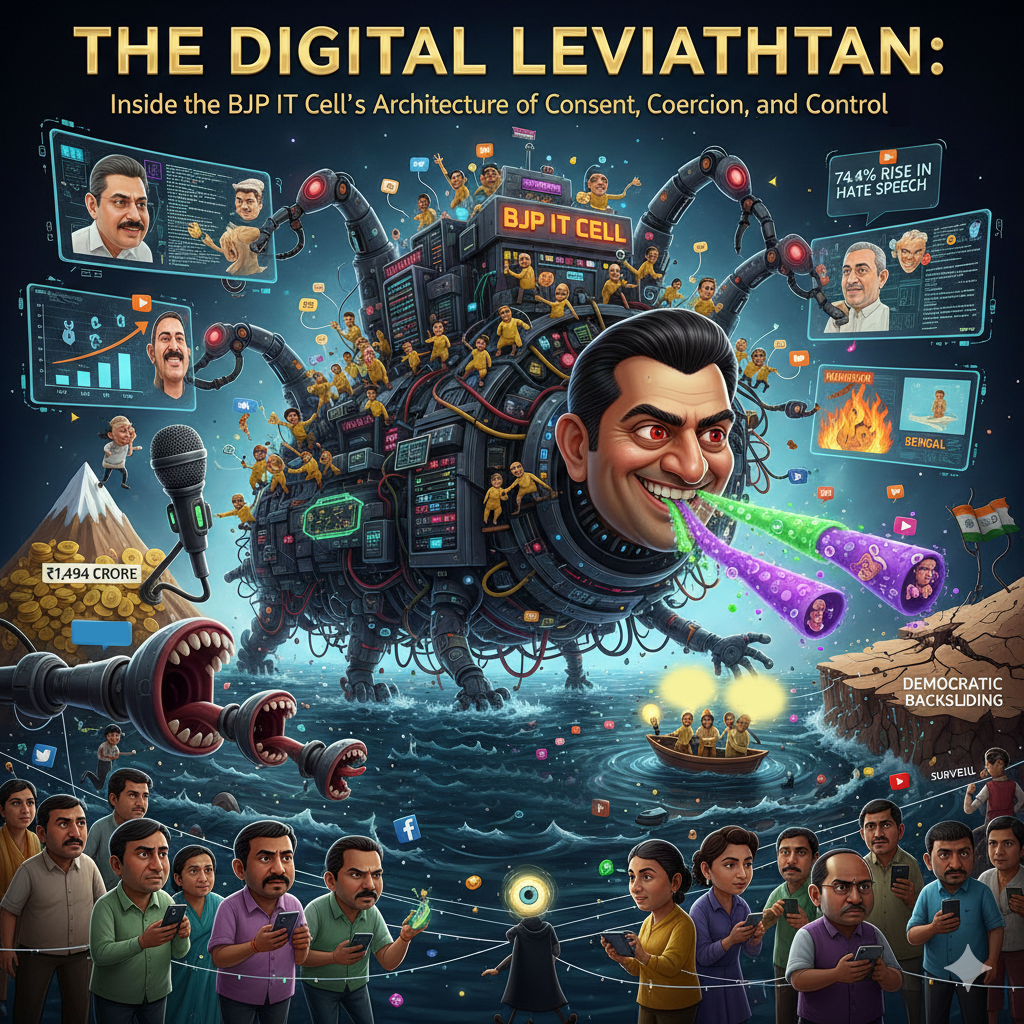
In December 2025, India’s digital political landscape is dominated by the Bharatiya Janata Party’s (BJP) highly professionalized IT Cell, currently led by Amit Malviya, which functions as a vast, hierarchical apparatus blending centralized strategy, AI-driven tools, paid operatives, and massive volunteer networks to orchestrate continuous propaganda, narrative control, and disinformation campaigns across platforms like WhatsApp, X, YouTube, and Facebook. Widely criticized for systematically disseminating misinformation, deepfakes, clipped videos, communal hate speech (particularly anti-Muslim), and coordinated trolling that incites offline violence and vigilantism—while rarely retracting debunked claims—the IT Cell is accused of manufacturing consent, suppressing dissent through intimidation and surveillance-linked tools, and diverting public attention from economic precarity, unemployment, and governance failures via spectacle-driven “statue-temple nationalism” and pseudoscientific Hindutva myths. Operating symbiotically with “Godi media” owned by aligned corporates (Adani, Ambani), fueled by opaque funding and asymmetric ad spends, and enabled by regulatory gaps in AI oversight, data protection exemptions, and platform passivity, this “digital Leviathan” erodes epistemic trust, polarizes society, chills free expression, and contributes to democratic backsliding, even as independent fact-checkers (e.g., Alt News), civil society, and media literacy initiatives offer resilient counter-efforts against the routinization of information warfare in India’s platform-mediated public sphere.
Emotion of Motion: Piramal Pharma’s Naturolax and the Politics of the Gut
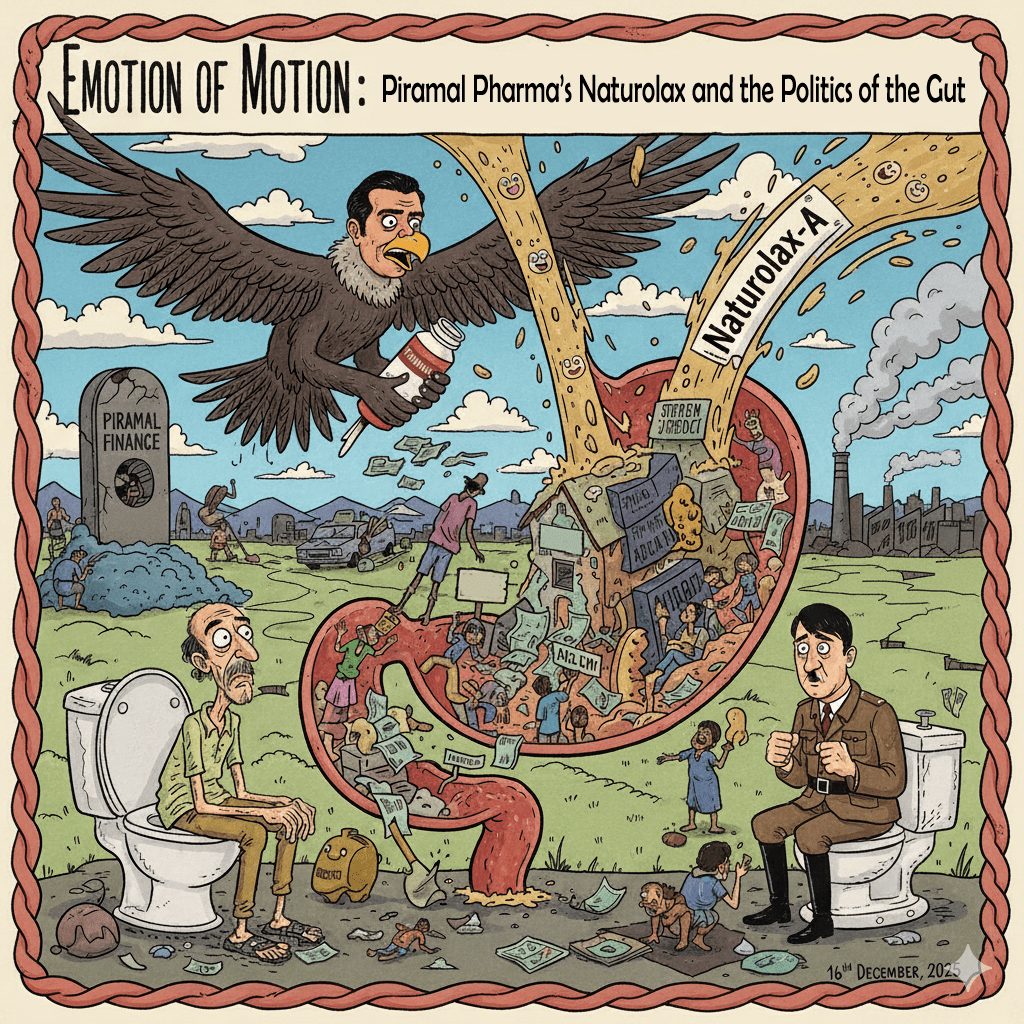
Posted on 16th December, 2025 (GMT 06:52 hrs) Updated on 17th December, 2025 (GMT 04:50 hrs) ABSTRACT Inspired by Chekhov’s “On the Harmful Effects of Tobacco”, this self-reflexive, darkly satirical essay stages constipation as a material, political, and ecological symptom of contemporary Indian capitalism, tracing an embodied genealogy from the Green Revolution’s chemical agriculture toContinue reading “Emotion of Motion: Piramal Pharma’s Naturolax and the Politics of the Gut”
Anatomy of Democratic Unmaking: An Open Letter on India’s Transparency, Human Rights, and Accountability Crises

Submitted by activists, whistleblowers, and citizens associated with Once in a Blue Moon Academia (OBMA), this appeal documents a systematic regression in transparency, accountability, civic space, and human-rights protections in India from 2014 to 2025 under successive BJP-led governments. Key manifestations include: declining global rankings on corruption (CPI 96/180 in 2024), press freedom (151/180 in 2025), and rule-of-law indices; erosion of the RTI Act through 2019 amendments, administrative obstruction, and violence against over 100 RTI activists; the impending GANHRI downgrade of the NHRC from “A” to “B” due to executive capture and neglect of systemic violations, exemplified by its handling of the opaque DHFL insolvency harming lakhs of small depositors; electoral-finance opacity via Electoral Bonds and post-2024 anonymous channels; credible allegations of large-scale voter deletions and manipulations (2024–2025); shrinking civic space through UAPA, sedition, PMLA, FCRA, and SLAPP suits; pervasive surveillance (Pegasus, Aadhaar profiling, Sanchar Saathi) with weak data-protection safeguards; and deepening crony-capitalist capture of media, regulators, and public assets. Petitioners urge OHCHR, Amnesty International, HRW, Transparency International, and allied bodies to monitor, investigate, report, provide technical support, protect defenders, and press for urgent reforms to halt India’s slide toward electoral autocracy and restore constitutional guarantees of transparency, accountability, and human rights.
Bhagat Singh Speaks in 2025: A Spectre Haunts the Rulers of India!

This manifesto—framed as Bhagat Singh’s return in 2025—condemns the erosion of democracy, secularism, and socialism in contemporary India. It denounces crony capitalism, authoritarian governance, and the DHFL scam as symbols of systemic exploitation. Calling for reason, scientific temper, and constitutional duty, it urges India’s oppressed citizens to resist through coordinated legal action, peaceful mass mobilization, and digital activism. The message rejects silence, warns against authoritarian decay, and invokes revolutionary solidarity to reclaim justice, dignity, and democratic rights.
DHFL Victims, Are We Still Ready to Fight for It?

This article argues that the DHFL collapse is not merely a corporate failure or legal dispute but a political event symptomatic of India’s deepening cronyist order, where executive power, judicial alignment, and corporate interests appear increasingly intertwined. Through comparative analysis of recent successful pressure-group interventions—such as the farmers’ movement and the pushback against Sanchar Saathi—the article highlights how public mobilization, not institutional goodwill, remains the only effective counterweight to state-corporate consolidation. It further examines the erosion of judicial independence, shrinking civil liberties, and declining democratic indicators reported by international watchdogs, situating the DHFL case within a broader crisis of accountability and participatory rights. The central thesis asserts that without organized mass resistance—legal, physical, and digital—victims of financial injustice remain fragmented, disempowered, and structurally silenced. Ultimately, the article calls on DHFL depositors to transform from isolated individuals into a collective civic force or pressure group, arguing that justice in contemporary India must be demanded, not awaited.
 Once in a Blue Moon Academia