

The Ecotopians of Alternity (EOA) as part of the Once in a Blue Moon Academia (OBMA) Collective asserts that the current legal crisis surrounding the Aravalli mountain range is a deliberate act of “definitional erasure” that threatens the ecological survival of North India. By narrowing the definition of these ancient hills to landforms rising 100 meters or more, the state effectively excludes over 90% of the range—including critical lower ridges, scrub forests, and groundwater recharge zones—from legal protection. This is not a neutral administrative update but a strategic maneuver that renders ecologically vital terrain “invisible” to the law, thereby clearing the path for corporate mining and real-estate expansion. Drawing on the Indian philosophical concept of lakṣaṇa (defining something based on characteristic mark), the EOA argues that a definition based solely on height fails to capture the holistic reality of an ecosystem that stops desertification and sustains regional aquifers. This logic of reductionism mirrors a broader national pattern of prioritizing extractivist “developmental rationality” over indigenous lifeworlds and long-term climate resilience, as seen in projects from Great Nicobar to Hasdeo Arand. Against this regime, the EOA calls for a coordinated resistance that refuses to let life be reduced to “administrative residue,” demanding a lived ecological imagination that protects the Aravallis as an indivisible, living system rather than a collection of disposable units.
Letters of Blood and Fire: “Terrorism”, Dispossession, and the Distorted Mirrorings of Domination

This article critically dissects “terrorism” as a politically contested and asymmetrically applied category, wielded to delegitimize subaltern and non-state violence while normalizing far greater state and corporate terror through legal, discursive, and institutional mechanisms. Drawing on an anarchist methodological lens amid India’s contemporary Islamophobic conjuncture, it provisionally defines terrorism as deliberate civilian-targeted violence intended to induce widespread fear for political, ideological, or social ends, exposing how state practices—from aerial bombings to militarized dispossession—evade the label via sovereign privilege. Integrating Marx’s primitive accumulation, Harvey’s views on accumulation by dispossession, and Toussaint’s analysis of debt-driven imperialism, the analysis frames terrorism as a systemic instrument embedded in neoliberal resource extraction, where conflict in mineral-rich zones (Afghanistan’s lithium, India’s Adivasi belts, Congo’s coltan) functions as both symptom and enabler of corporate plunder, preempted by advanced technologies like remote sensing and veiled by selective narratives that hyper-amplify “Islamic terrorism” while muting Hindutva extremism, Zionist settler violence, and BJP’s hypocritical Taliban engagement amid alleged terror-funding ties. Employing Sāṃkhya’s anyonyapratibimba to reveal power’s projection of its own predation onto the “other,” and balancing economic determinism with religion’s irreducible psychological role in motivating warriors, the piece ultimately reframes terrorism not as pathological or civilizational but as an intrinsic modality of unequal global orders, calling for discriminative clarity (viveka) to dismantle its intertwined logics of capital, technology, ideology, and domination.
Agnihotri’s “The Kashmir Files” and “The Bengal Files” in Violation of the Nāṭyaśāstra: An Open Sanātanī Hindu Indictment
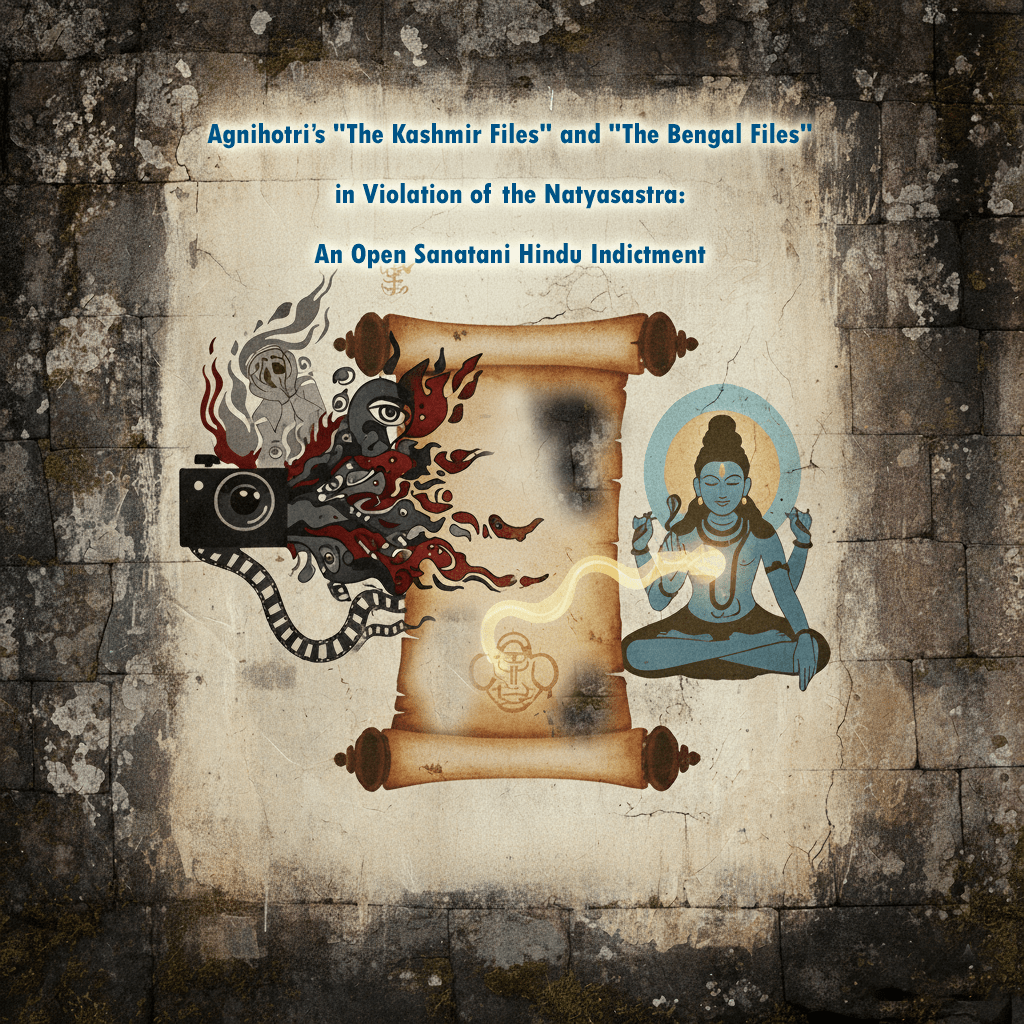
From the heart of Akhaṇḍ Hindutva, a Sanātanī Hindu United Family (HUF) indicts Vivek Agnihotri’s The Kashmir Files and The Bengal Files for brazenly violating Bharata Muni’s sacred Nāṭyaśāstra—turning Hindu grief into voyeuristic gore, rape imagery, and blood-spectacle. What claims to defend Sanātana Dharma abandons rasa, maryādā, and ahiṁsā, replacing ethical restraint with tāmasika exhibitionism and propaganda rage. True Hindutva demands dharma, not degeneration.
The Digital Leviathan: Inside the BJP IT Cell’s Architecture of Consent, Coercion, and Control
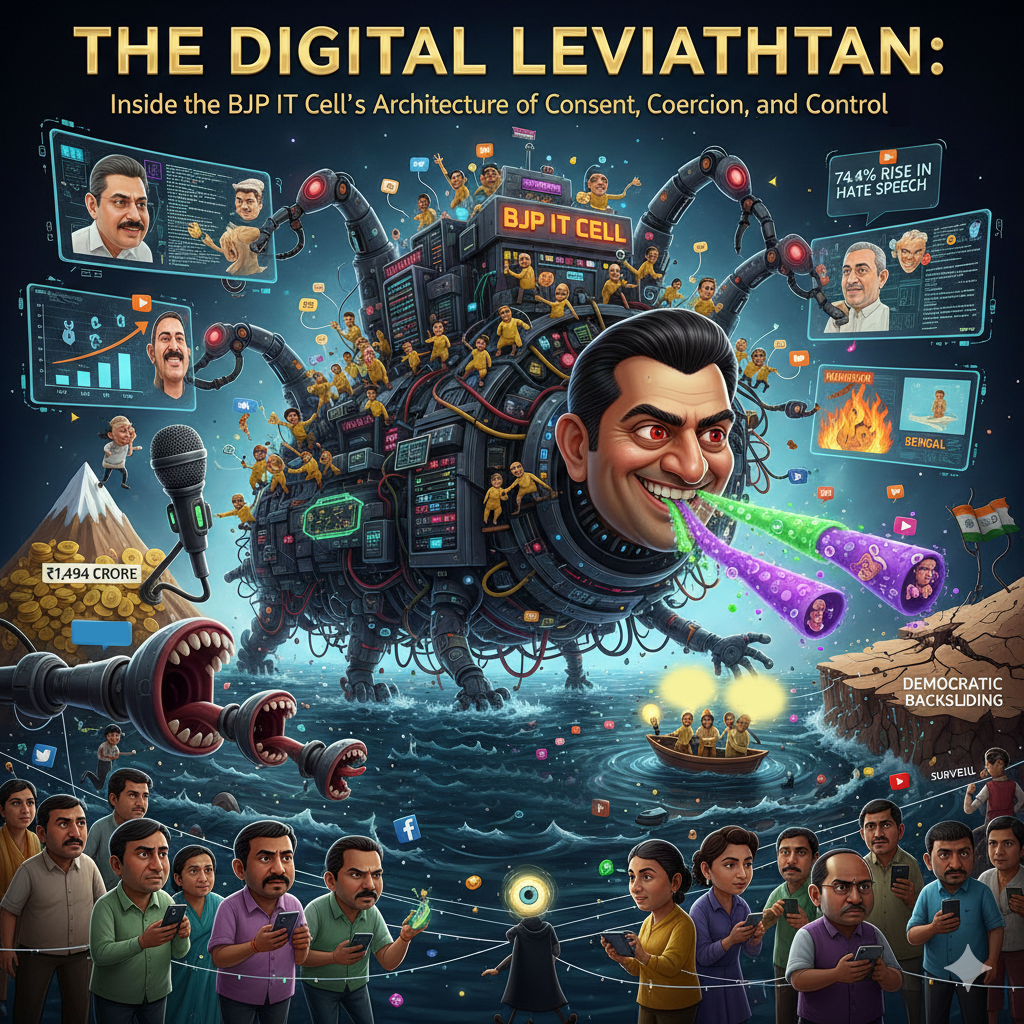
In December 2025, India’s digital political landscape is dominated by the Bharatiya Janata Party’s (BJP) highly professionalized IT Cell, currently led by Amit Malviya, which functions as a vast, hierarchical apparatus blending centralized strategy, AI-driven tools, paid operatives, and massive volunteer networks to orchestrate continuous propaganda, narrative control, and disinformation campaigns across platforms like WhatsApp, X, YouTube, and Facebook. Widely criticized for systematically disseminating misinformation, deepfakes, clipped videos, communal hate speech (particularly anti-Muslim), and coordinated trolling that incites offline violence and vigilantism—while rarely retracting debunked claims—the IT Cell is accused of manufacturing consent, suppressing dissent through intimidation and surveillance-linked tools, and diverting public attention from economic precarity, unemployment, and governance failures via spectacle-driven “statue-temple nationalism” and pseudoscientific Hindutva myths. Operating symbiotically with “Godi media” owned by aligned corporates (Adani, Ambani), fueled by opaque funding and asymmetric ad spends, and enabled by regulatory gaps in AI oversight, data protection exemptions, and platform passivity, this “digital Leviathan” erodes epistemic trust, polarizes society, chills free expression, and contributes to democratic backsliding, even as independent fact-checkers (e.g., Alt News), civil society, and media literacy initiatives offer resilient counter-efforts against the routinization of information warfare in India’s platform-mediated public sphere.
Emotion of Motion: Piramal Pharma’s Naturolax and the Politics of the Gut
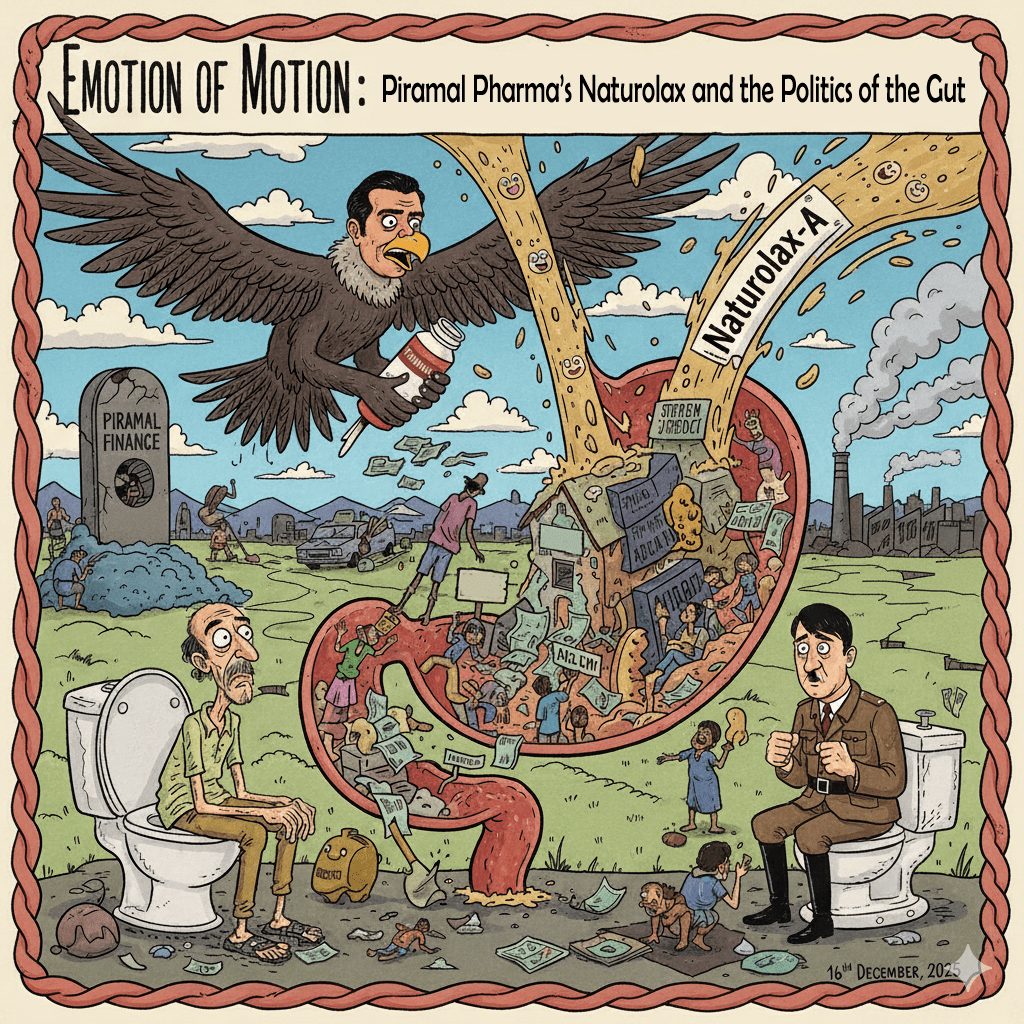
Posted on 16th December, 2025 (GMT 06:52 hrs) Updated on 17th December, 2025 (GMT 04:50 hrs) ABSTRACT Inspired by Chekhov’s “On the Harmful Effects of Tobacco”, this self-reflexive, darkly satirical essay stages constipation as a material, political, and ecological symptom of contemporary Indian capitalism, tracing an embodied genealogy from the Green Revolution’s chemical agriculture toContinue reading “Emotion of Motion: Piramal Pharma’s Naturolax and the Politics of the Gut”
Anatomy of Democratic Unmaking: An Open Letter on India’s Transparency, Human Rights, and Accountability Crises

Submitted by activists, whistleblowers, and citizens associated with Once in a Blue Moon Academia (OBMA), this appeal documents a systematic regression in transparency, accountability, civic space, and human-rights protections in India from 2014 to 2025 under successive BJP-led governments. Key manifestations include: declining global rankings on corruption (CPI 96/180 in 2024), press freedom (151/180 in 2025), and rule-of-law indices; erosion of the RTI Act through 2019 amendments, administrative obstruction, and violence against over 100 RTI activists; the impending GANHRI downgrade of the NHRC from “A” to “B” due to executive capture and neglect of systemic violations, exemplified by its handling of the opaque DHFL insolvency harming lakhs of small depositors; electoral-finance opacity via Electoral Bonds and post-2024 anonymous channels; credible allegations of large-scale voter deletions and manipulations (2024–2025); shrinking civic space through UAPA, sedition, PMLA, FCRA, and SLAPP suits; pervasive surveillance (Pegasus, Aadhaar profiling, Sanchar Saathi) with weak data-protection safeguards; and deepening crony-capitalist capture of media, regulators, and public assets. Petitioners urge OHCHR, Amnesty International, HRW, Transparency International, and allied bodies to monitor, investigate, report, provide technical support, protect defenders, and press for urgent reforms to halt India’s slide toward electoral autocracy and restore constitutional guarantees of transparency, accountability, and human rights.
Bhagat Singh Speaks in 2025: A Spectre Haunts the Rulers of India!

This manifesto—framed as Bhagat Singh’s return in 2025—condemns the erosion of democracy, secularism, and socialism in contemporary India. It denounces crony capitalism, authoritarian governance, and the DHFL scam as symbols of systemic exploitation. Calling for reason, scientific temper, and constitutional duty, it urges India’s oppressed citizens to resist through coordinated legal action, peaceful mass mobilization, and digital activism. The message rejects silence, warns against authoritarian decay, and invokes revolutionary solidarity to reclaim justice, dignity, and democratic rights.
DHFL Victims, Are We Still Ready to Fight for It?

This article argues that the DHFL collapse is not merely a corporate failure or legal dispute but a political event symptomatic of India’s deepening cronyist order, where executive power, judicial alignment, and corporate interests appear increasingly intertwined. Through comparative analysis of recent successful pressure-group interventions—such as the farmers’ movement and the pushback against Sanchar Saathi—the article highlights how public mobilization, not institutional goodwill, remains the only effective counterweight to state-corporate consolidation. It further examines the erosion of judicial independence, shrinking civil liberties, and declining democratic indicators reported by international watchdogs, situating the DHFL case within a broader crisis of accountability and participatory rights. The central thesis asserts that without organized mass resistance—legal, physical, and digital—victims of financial injustice remain fragmented, disempowered, and structurally silenced. Ultimately, the article calls on DHFL depositors to transform from isolated individuals into a collective civic force or pressure group, arguing that justice in contemporary India must be demanded, not awaited.
Fictitious Capital, Felt Consequences: A Market Check-In for the Piramal Empire

This letter-cum-article presents a public-interest reflection on recent market developments surrounding Piramal Group companies and the wider governance questions they have sparked among investors, analysts, and civil society. Drawing on publicly available financial data, media reportage, and long-circulating discussions in the public sphere, it examines the convergence of market underperformance, debt concerns, corporate restructuring decisions, and historical reputational debates linked to the group. The letter raises broader issues about transparency, accountability, political economy, and investor sentiment in contemporary India, especially in a climate where corporate influence, public institutions, and regulatory processes often appear intertwined. Without making allegations, the article highlights the anxieties and questions currently shaping public discourse—ranging from concerns about debt write-offs and governance norms to perceptions shaped by high-profile acquisitions and controversies. Its purpose is to invite open dialogue, encourage clarity, and reflect on how market narratives and public trust intersect in an era increasingly defined by corporate power and political proximity.
Mukesh Ambani and the Reliance Empire: A Chronicle of Controversies

This December 2025 dossier by OBMA chronicles Mukesh Ambani and Reliance Industries as the distilled essence of India’s crony-capitalist oligarchy: a $108-billion empire built not on innovation but on systematic resource plunder (KG-D6 gas “migration” worth billions still sub judice), predatory telecom consolidation (Jio’s zero-pricing massacre followed by tariff hikes and 40%+ market monopoly), regulatory capture via massive BJP electoral-bond funding, environmental devastation masked by greenwashed spectacles like the refinery-adjacent Vantara menagerie, and dynastic consolidation through the Ambani–Piramal marriage alliance, offshore tax havens (Stoke Park’s “charitable” conversion), and the spiritual whitewashing provided by the controversy-shadowed Radhanath Swami. From insider-trading settlements and GST wrist-slaps to the deliberate silencing of critics via Network18 ownership and legal intimidation, every scandal—from Antilia’s disputed Waqf land to Nita Ambani’s conspicuous silence during Vinesh Phogat’s Olympic heartbreak—reveals the same pattern: profit privatized, risk and ecological burden socialized, accountability deferred indefinitely by a captured state and judiciary that moves at lightning speed for the powerful and glacial pace for everyone else. In Modi’s “Viksit Bharat,” Ambani is not an outlier but the archetype: the apex predator of a political economy where billionaires do not merely influence the rules—they write them, enforce them, and, when necessary, transcend them with impunity.
 Once in a Blue Moon Academia