
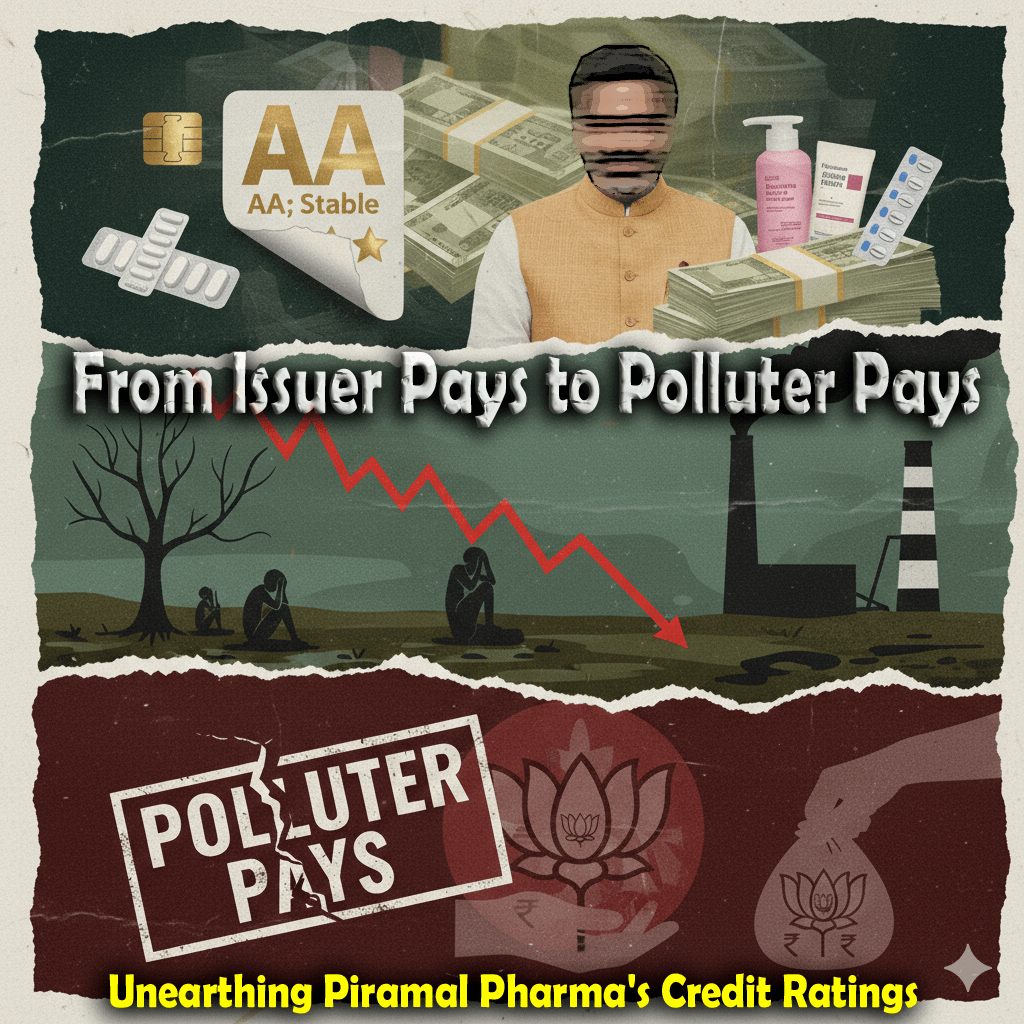
Piramal Pharma Limited (PPL), demerged from Piramal Enterprises in 2022, enjoys high investment-grade credit ratings (e.g., CARE AA; Stable upgraded July 2025) under the issuer-pays model, which critics claim manufactures trust to enable cheap borrowing despite severe financial strain—Q2 FY26 revenue down ~9% to ₹2,044 crore, EBITDA crashed 44%, net loss ₹99 crore, high leverage (~3x net debt-to-EBITDA), weak interest coverage, and share price falling ~19% from ₹204 (July 2025) to ~₹166 (mid-January 2026). This rating resilience contrasts sharply with the alleged “Digwal massacre” at its Telangana plant: repeated effluent dumping (comprehensively reported by 2018) contaminating water/soil, devastating farmland, and linked to spikes in kidney failures, respiratory issues, and cancers among villagers; despite NGT’s ₹8.3 crore polluter-pays fine (2019), TSPCB closure orders, and weak enforcement, SEBI deemed events non-material post-demerger, reportedly shielded by Ajay Piramal’s substantial BJP donations and crony ties. Echoing the Piramal Finance rating controversy, PPL’s playbook—restructurings to quarantine liabilities, OTC pivot to mask industrial risks, and paid-for “stable” ratings—externalizes financial, environmental, and human costs onto investors and poisoned communities, highlighting the urgent need to dismantle the ratings oligopoly and opaque political funding that sustain such systemic expropriation.
OBMA Statement on Neo-Imperialist Violence: Iran, Venezuela, Palestine
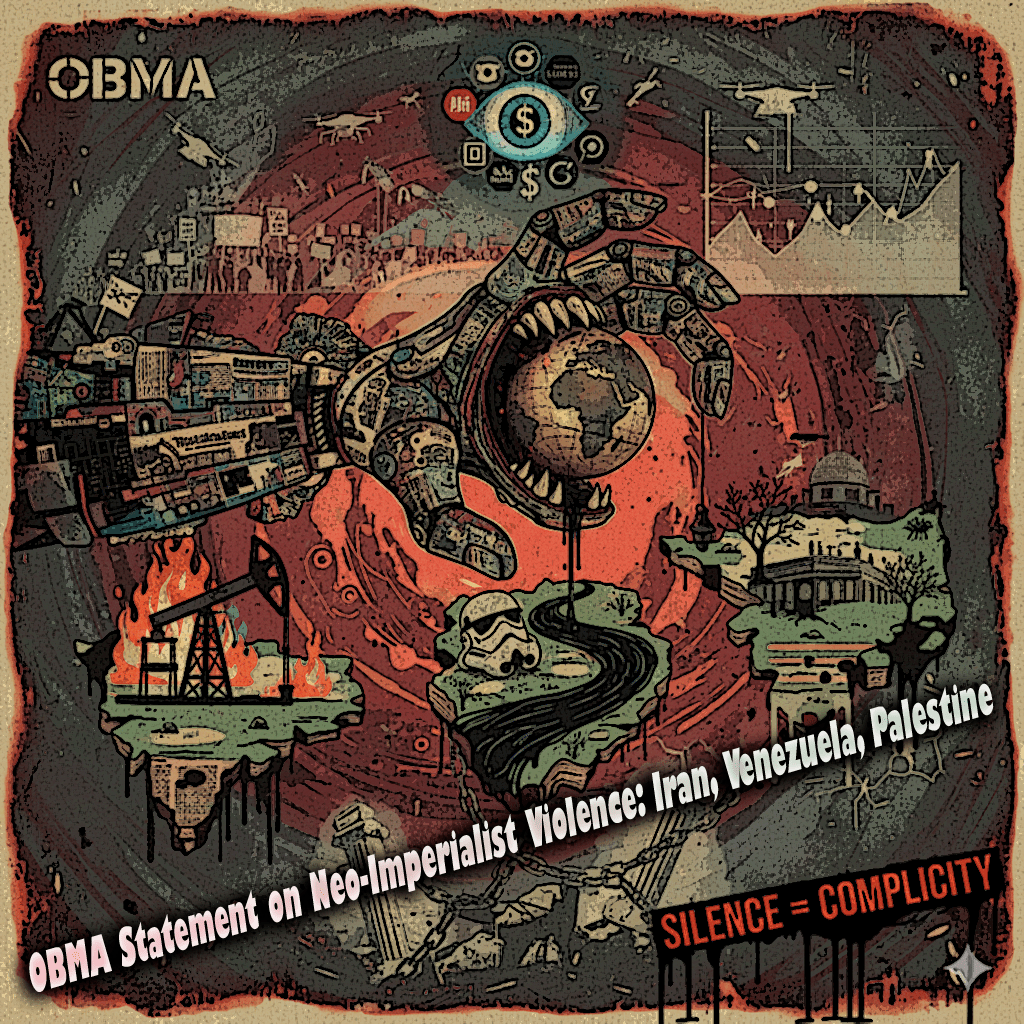
This statement asserts OBMA’s condemnation of neo-imperialist violence in Iran, Venezuela, and occupied Palestine, framing these crises as interconnected expressions of cannibalistic capitalism. It exposes how state repression, militarization, sanctions, and fossil-fuel geopolitics enable genocide, ecocide, and resource plunder. Rejecting technocratic and reformist fixes, OBMA affirms planetary justice, anti-imperialist solidarity, and life-centred transformation through collective struggle and ecological ethics.
“Islamic Terrorism” as a Discursive Formation: Power, Paradox, and the Politics of Naming

This article critically examines the persistence of the term “Islamic terrorism” in global discourse, highlighting its paradoxical nature as a contested label that essentializes Islam as inherently violent in a monolithic manner while being reinforced by the explicit religious self-framing of militant groups like ISIS and Al-Qaeda. Drawing on Orientalist epistemologies, post-Cold War geopolitical imaginaries such as Huntington’s “Clash of Civilizations,” and Barthesian myth theory, the analysis reveals how the term functions as a disciplinary tool of power, asymmetrically applied to Muslim-perpetrated violence compared to similar acts by Christian, Hindu, Zionist or other extremists/fundamentalists/terrorists, thereby naturalizing civilizational hierarchies and obscuring historical contexts like colonial legacies, proxy wars, and political economies of jihadism. Incorporating defenses of the term’s empirical utility alongside critiques of bias and oversimplification, the piece argues for a shift toward nuanced framings that recognize militant Islamism as a product of imperial disruption, authoritarianism, and gendered crises rather than religious essence, ultimately advocating for pluralist transformations to combat all forms of fundamentalist violence without hypocrisy.
One Rupee, Piramal Finance, and the Ruins of DHFL: A Letter to Mr. Ajay Piramal
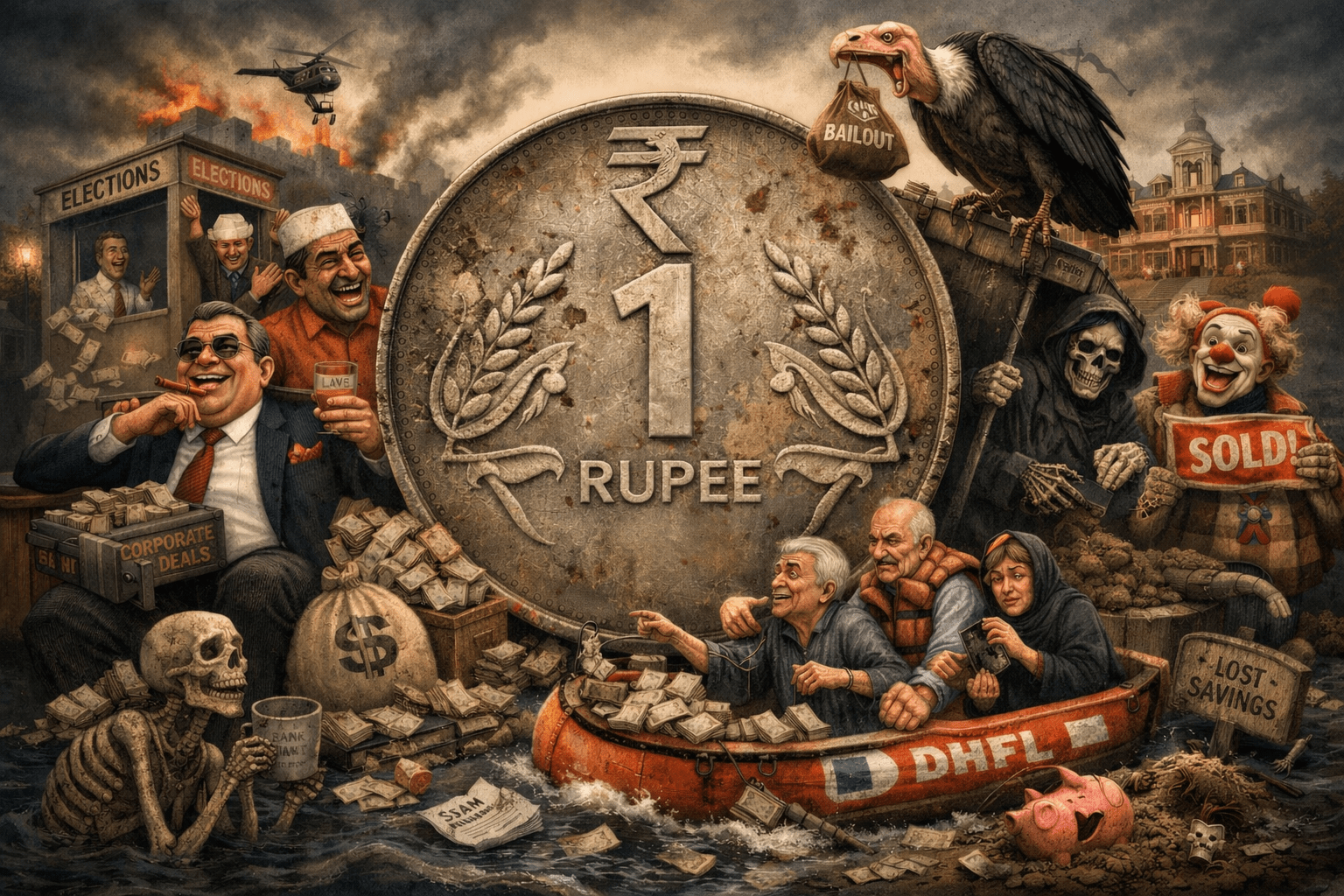
This open letter to Ajay Piramal interrogates the moral dissonance between Piramal Finance’s “Neeyat” advertising campaign, which celebrates honesty through the return of a single rupee, and the lived reality of DHFL depositors whose life savings were erased through a deeply contested insolvency process. By juxtaposing corporate virtue-signalling with the transfer of nearly ₹45,000 crore of DHFL assets for ₹1, the text argues that legality has been deployed to eclipse legitimacy, and branding to obscure accountability. Situating the DHFL resolution within a wider system of crony capitalism, opaque political financing, captured institutions, and manufactured consent, the letter frames the episode as part of a broader legitimation crisis in BJP-ruled India, where ethics are subordinated to power and proximity. At its core, the piece demands that “conscious capitalism” be measured not by advertisements or philanthropy, but by what is returned to those who trusted, funded, and were dispossessed.
Who Pays, Who Bribes, Who Flees, Who Profits: BJP’s Swelling Coffers Amid Exploding External Debt

Posted on 6th January, 2026 (GMT 06:26 hrs) ABSTRACT India’s neoliberal delusion stands exposed in this searing critique: As the ruling Bharatiya Janata Party (BJP) amasses an astronomical financial empire—ballooning from modest pre-2014 assets to ₹7,113 crore in cash/bank balances and over ₹10,107 crore in election war chests by late 2025, propelled by ₹6,088 croreContinue reading “Who Pays, Who Bribes, Who Flees, Who Profits: BJP’s Swelling Coffers Amid Exploding External Debt”
When AA+ Means “Ask Again”: Manufactured Ratings, Piramal Finance, and the Credit Ratings Trap
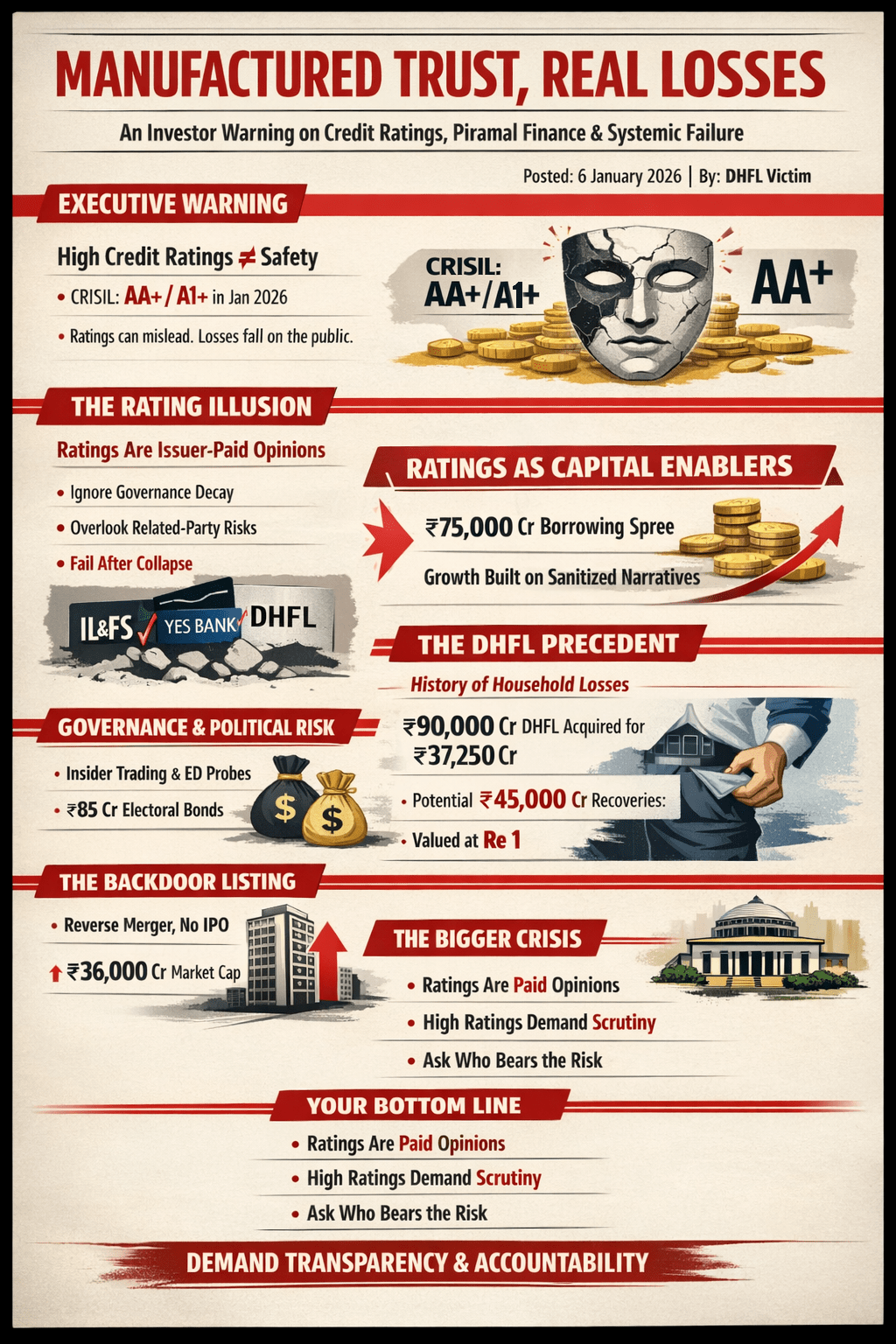
Despite glowing CRISIL AA+/Stable ratings, Piramal Finance’s strength is an illusion built on conflicted issuer-paid ratings, legacy DHFL fraud asymmetries (₹45,000 Cr recoveries valued at Re 1, massive retail haircuts), governance controversies, political proximity, and a backdoor listing that bypassed scrutiny. High ratings enable cheap funding and retail mobilisation—while systematically ignoring forensic risks, related-party issues, and resolution inequities seen in IL&FS, Yes Bank, DHFL. This is systemic: manufactured trust, socialised losses, privatised gains. Ratings are opinions, not guarantees. Demand truth before investing.
Piramal Finance and the Rating Ruse: How India’s Credit Rating Agencies Manufacture Trust to Enable Systemic Expropriation

In India’s deeply captured financial regime under prolonged BJP-NDA rule (2014–2025), credit rating agencies (CRAs)—dominated by the CRISIL-ICRA-CARE triopoly—have degenerated from purported risk sentinels into systemic enablers of crony expropriation, perpetuating a predatory cycle of manufactured trust, retail mobilization, delayed collapse, and elite consolidation. The Piramal Finance–DHFL saga stands as the paradigmatic indictment: investment-grade ratings (AA to AAA) were stubbornly retained despite whistleblower alerts, Cobrapost exposés, and KPMG audits exposing ~₹29,000–34,000 crore in promoter diversions through shells and evergreening, facilitating continued borrowing until 2019 defaults; post-crisis, Piramal—bolstered by dynastic kinship to Mukesh Ambani (via his son’s marriage to Isha Ambani) and alleged political shielding through disproportionate ruling-party contributions—secured DHFL via a sweetheart IBC resolution that controversially valued ~₹45,000 crore in fraud/avoidance recoveries at a nominal Re 1, acquiring the ~₹90,000+ crore portfolio for ~₹37,250 crore while the Supreme Court’s April 1, 2025, ruling vested all future windfalls exclusively in the bidder and condemned ~2.5 lakh retail depositors (mostly middle-class and elderly savers) to brutal 55–77% haircuts, aggregating colossal losses exceeding ₹50,000 crore across similar NBFC failures. Swiftly rebranded as Piramal Finance through reverse merger alchemy, the entity achieved rapid rehabilitation—~₹91,447 crore AUM with over 80% retail pivot, PAT doubling to ~₹327 crore in Q2 FY26, and fortified net worth ~₹27,000 crore—crowned by CRISIL’s fresh AA+/Stable assignment in January 2026 (with A1+ short-term), shaving funding costs by 50–80 bps and unlocking diversified inflows, even as Moody’s Ba3/Stable alone cautioned lingering wholesale exposures (~14%) and volatility. Driven by issuer-pays conflicts, oligopolistic convergence, epistemic blindness to governance rot and political proximity, and implicit “too connected to fail” pricing, CRAs orchestrate performative legitimacy—inflating optics pre-crisis, reacting belatedly post-default (as in IL&FS’s AAA-to-junk plunge and Yes Bank’s pre-moratorium investment-grade persistence), and aggressively upgrading post-consolidation—thereby externalizing ruin onto vulnerable constituencies while privatizing distressed assets for networked oligarchs within a broader architecture of institutional capture, democratic erosion, and cunning capitalism that demands radical rupture: abolishing issuer-pays, imposing personal liability, deconcentrating markets, and centering retail justice to reclaim accountability from this reverse merger republic.
The Bankruptcy Bazaar: How India’s Ill-Conceived Insolvency and Bankruptcy Code (IBC) Turns Public Money into Private Profits
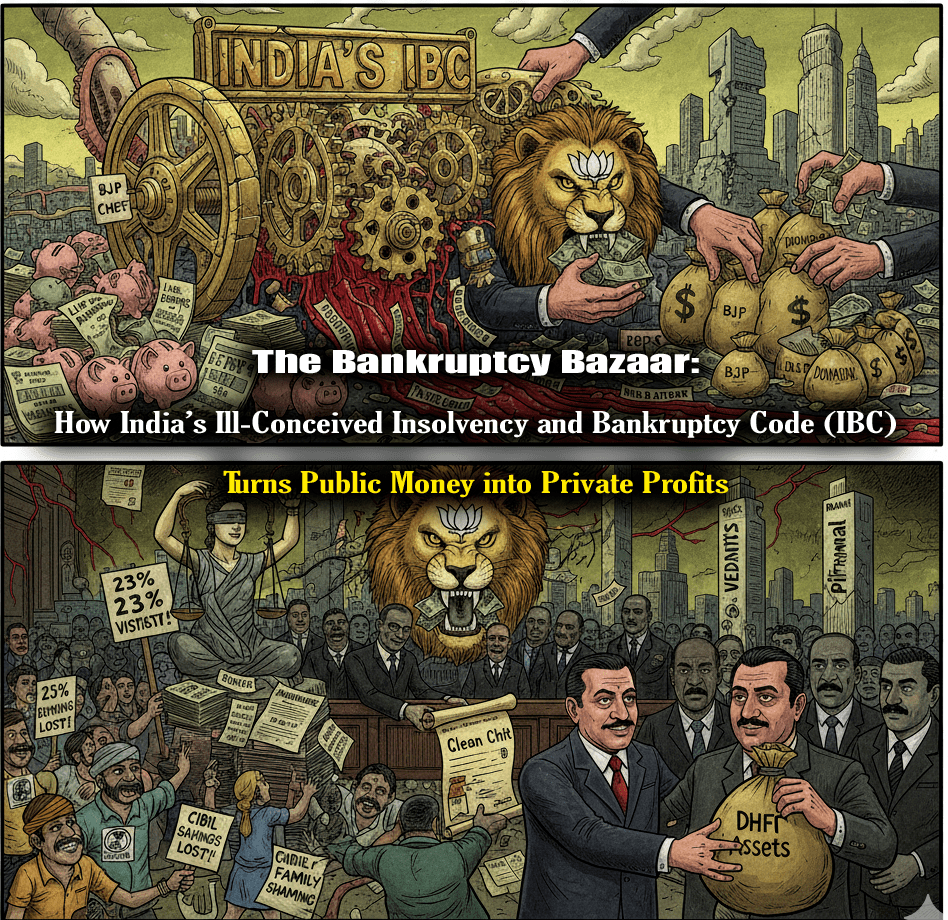
This article delivers a comprehensive indictment of India’s Insolvency and Bankruptcy Code (IBC), 2016, exposing it as a structurally predatory regime that facilitates crony expropriation rather than genuine resolution. Through doctrinal analysis, tribunal data, and emblematic case studies—Videocon, Aircel, Essar Steel, Bhushan Power, Reliance Communications, and most starkly DHFL—it demonstrates how time-bound resolution is a legal fiction, recoveries are abysmally low, avoidance provisions are systematically neutralised, and fraud is laundered through procedural finality. The DHFL case emerges as the perfect crime scene: mass dispossession of 2.5 lakh retail savers, assignment of vast avoidance recoveries at notional value to the acquirer, and judicial deference that extinguished constitutional claims. Situated within a wider political economy of crony capitalism and opaque political funding, the IBC is shown not as a failed reform but as rule by plunder—an insolvency regime that has gone rogue.
End of Year Bombshell: How BJP-NDA-Hindutva Failed India – A Scathing 2014-2025 Indictment
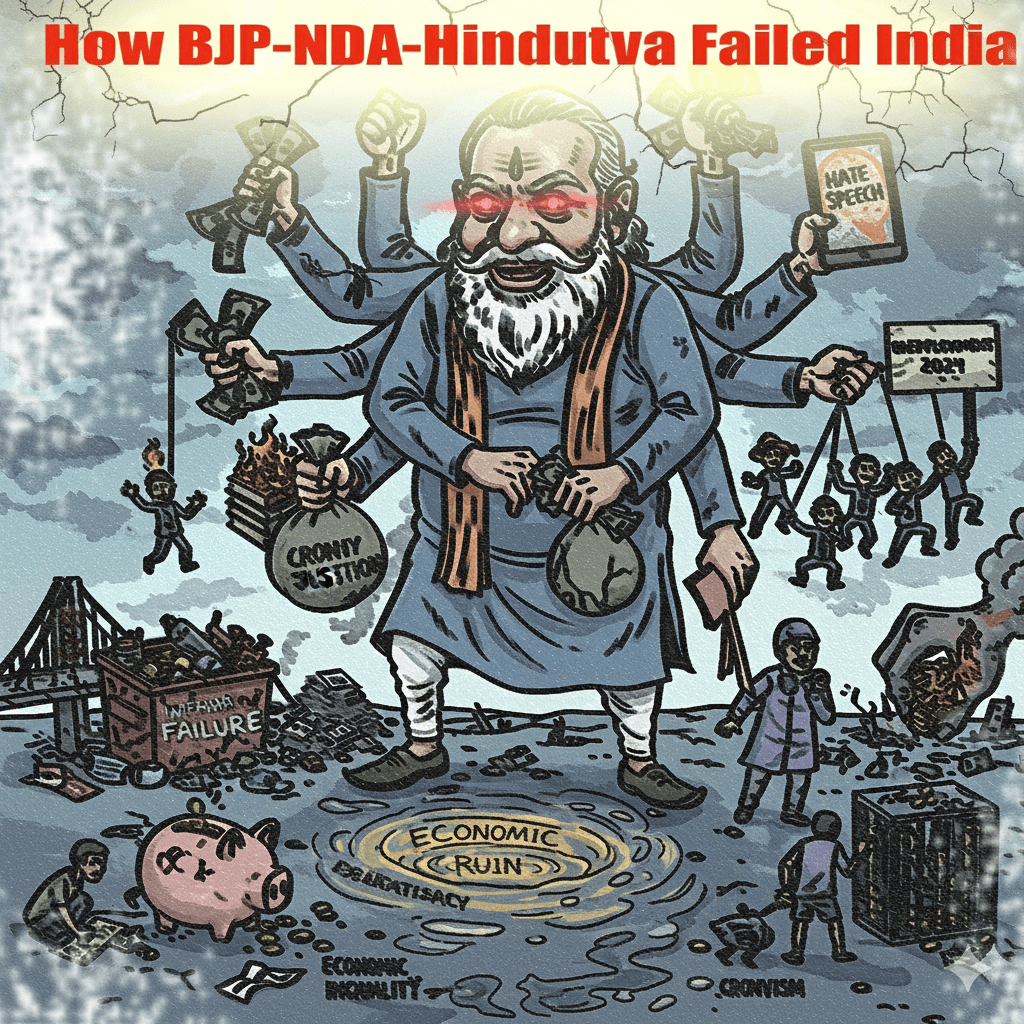
As 2025 draws to a close, this comprehensive dossier documents not a series of discrete policy missteps, but a systemic transformation of governance in India (2014–2025): a shift from democratic accountability to political executive dominance; from evidence-based policymaking to manufactured narrative control; from social protection to structural precarity. Spanning the economy, federalism, data integrity, labour, the natural environment, digital freedoms, education, public health, cultural institutions, civil liberties, and fundamental rights, the record reveals enduring patterns of power centralization, calibrated opacity, selective enforcement, and institutional hollowing—accompanied by crony consolidation and the routinized criminalization of dissent. Democratic indicators decline as surveillance infrastructures expand, grassroots welfare erodes, and truth itself is rendered an object of administrative management. This is not a partisan ledger, but a counter-archive: an evidence-grounded indictment that affirms accountability as the necessary cost of power. In closing the year, it calls for a civic reckoning—not to foreclose debate, but to reclaim and restore it.
Of Debt and Delusion: India’s $747 Billion Burden and the Mirage of Neoliberal GDP Fetishism
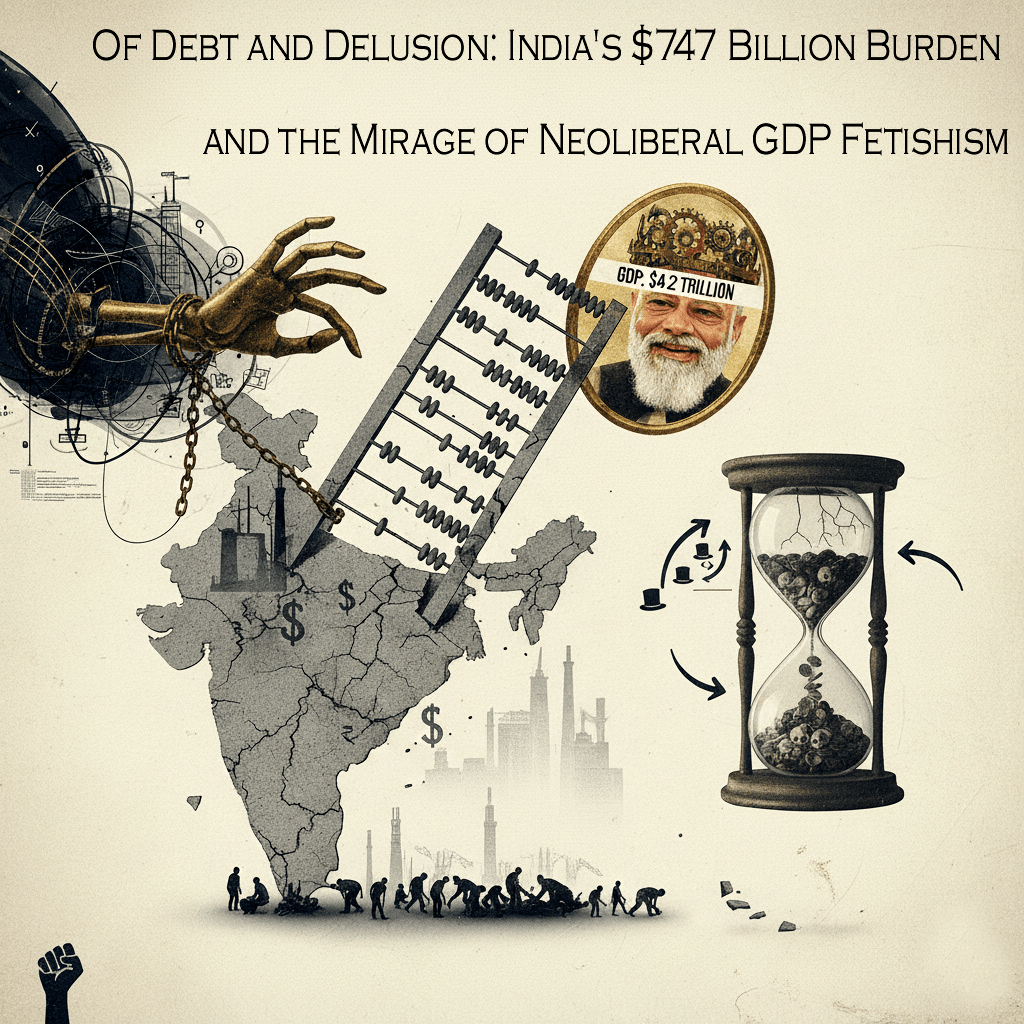
This article critically examines India’s external debt surge to approximately USD 747 billion by mid-2025—a near-doubling since 2014—as a hallmark of crony capitalism under the Modi regime, where liberalized external commercial borrowings (ECBs) and public sector bank hollowing facilitate upward redistribution, oligarchic consolidation (favoring conglomerates like Adani and Ambani), and asymmetric risk socialization amid volatile private dominance (over 77% non-government), USD-heavy exposure (54%), and intergenerational burdens. Intersecting with GDP misreporting flaws (IMF C-grade accounts, unorganized sector proxies inflating growth) and colonial-era inequality peaks (top 1% holding 40% wealth), this financialized precarity—diagnosed via Toussaint’s World Bank “never-ending coup” and Lazzarato’s “indebted man”—enforces neoliberal discipline, commodifies survival, and erodes sovereignty despite orthodox “sustainability” metrics. Countering GDP fetishism’s ontological violence, it invokes Mahabharata’s aṛṇī ethics of non-indebtedness alongside nisargaṛṇa stewardship, proposing pluriversal alternatives like Felber’s Common Good Balance Sheet (non-commensurable axes of dignity, solidarity, ecology), A. K. Dasgupta’s Economics of Austerity, Raworth’s Doughnut Economics, Norberg-Hodge’s localization, degrowth/post-growth sufficiency, and gift/moneyless economies to reclaim community sovereignty from predatory entanglement toward justice, reciprocity, and unburdened flourishing.
 Once in a Blue Moon Academia