
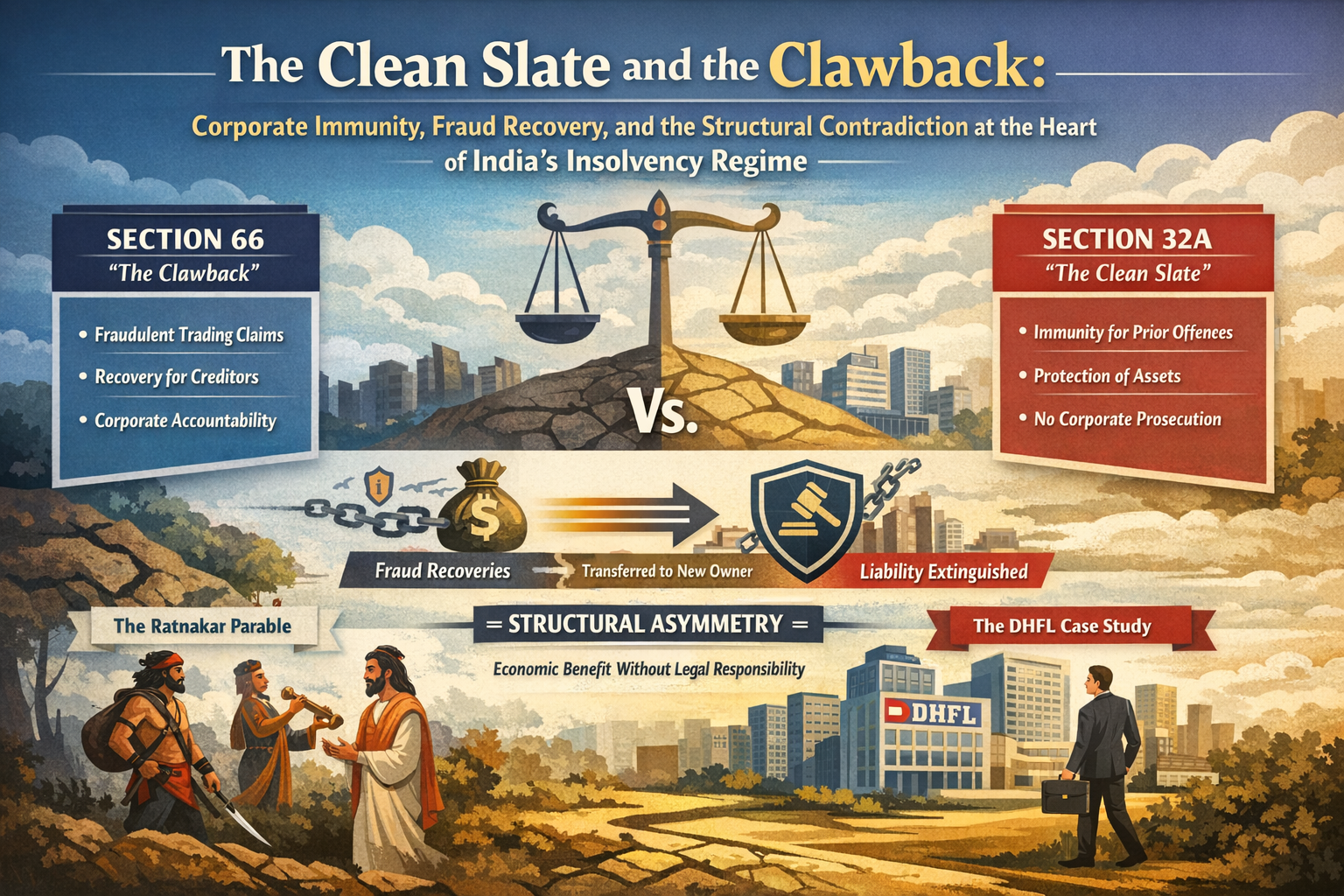
The Insolvency and Bankruptcy Code, 2016 establishes a dual legal framework combining fraud recovery and insolvency resolution. Section 66 embodies the Code’s accountability function by empowering recovery from fraudulent and wrongful trading, thereby restoring value to creditors. In contrast, Section 32A, introduced in 2019 with retrospective effect, extinguishes corporate criminal liability once a resolution plan is approved and control passes to new management. This paper argues that these provisions operate in structural tension: Section 66 presupposes continuity of corporate liability to enable recovery, while Section 32A extinguishes corporate criminal liability while preserving corporate identity, assets, and economic continuity. Through a doctrinal case study of Dewan Housing Finance Corporation Ltd. (DHFL), this paper demonstrates how avoidance recoveries identified under Section 66 remained corporate assets transferred to the resolution applicant, even as Section 32A extinguished the corporate debtor’s criminal liability for the underlying misconduct. This produced a structural asymmetry in which the corporate entity retained the economic benefits of fraud-linked recoveries while being legally immunized from responsibility for the fraud itself. The retrospective insertion of Section 32A further created a temporal dislocation, altering legal consequences after insolvency had commenced. The paper concludes that the interaction between Sections 32A and 66 represents a fundamental transformation in insolvency law—from a creditor-recovery framework grounded in accountability to an acquirer-protection framework grounded in corporate immunity—raising profound questions about equality before law and the political economy of insolvency resolution.
Piramal’s Fixated Obsession with Re 1: Documentation, Con-figured Equivocation and the Facade
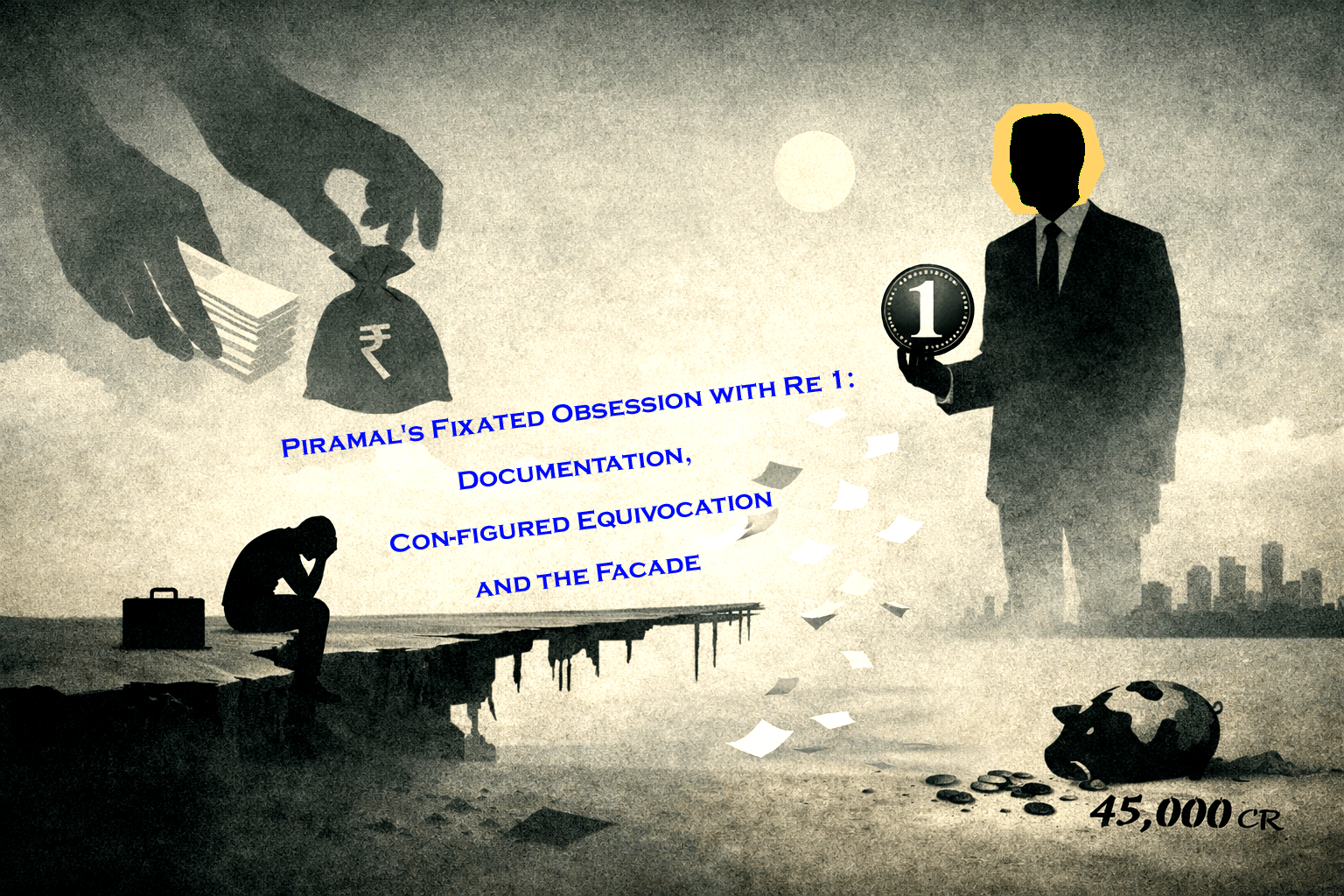
Written from the standpoint of one pauperised by the DHFL collapse—once a trusting fixed-deposit holder, now among the dispossessed—this essay interrogates Piramal Finance’s “Neeyat” campaign as an apparatus of aggressive linguistic marketing that weaponizes micro-honesty to legitimize macro-consolidation. Through semiotic, Marxian, psychoanalytic, and political-economic analysis, it traces how the repeated invocation of Re 1—returned in scenes of everyday virtue (a coin handed back, a packet retrieved, kinship invoked)—operates as myth: at the level of denotation, simple integrity; at the level of connotation, character over paperwork; at the level of ideology, ethical finance naturalized precisely after an insolvency process in which avoidance claims worth approximately ₹45,000 crore were assigned a notional value of Re 1 and retail creditors absorbed devastating haircuts under the shelter of IBC jurisprudence and Section 32A immunity. The same rupee circulates across regimes—as legal token, advertising prop, and ideological shield—while high-yield lending, SARFAESI enforcement, ratings upgrades, and judicial deference to “commercial wisdom” consolidate capital. Self-reflexively acknowledging its wounded vantage, the essay reads the compulsive return of Re 1 not as branding ingenuity but as symptomatic spectacle: a coin endlessly restored on screen while restitution remains foreclosed in law, revealing how moral minimalism at the micro level masks structural dispossession at the macro level.
Beyond the $55 Trillion Dream: A Diary of Doubt on India@100’s Vision for “Viksit Bharat”
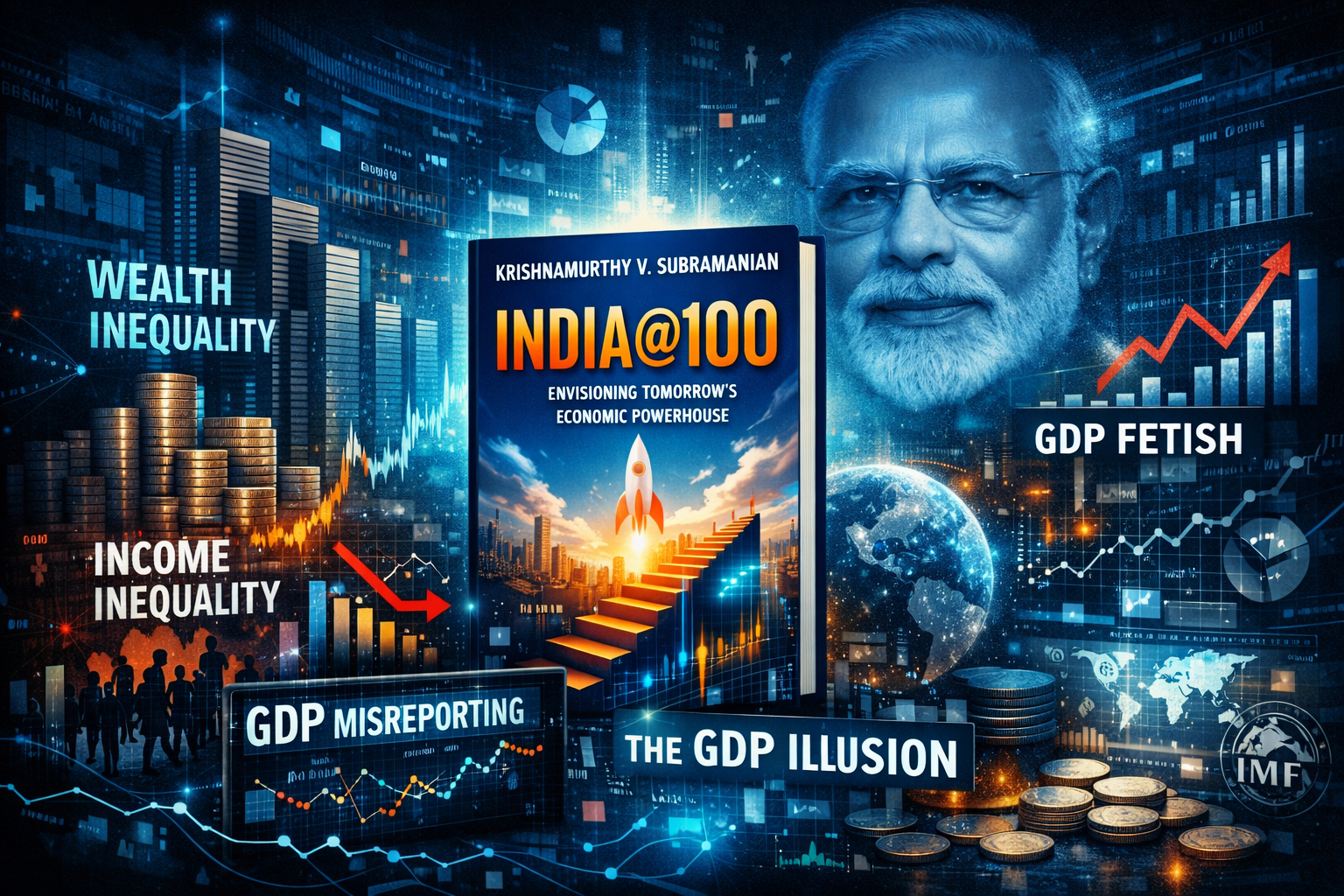
This diary, spanning February 21–23, 2026, offers a multifaceted critique of Krishnamurthy V. Subramanian’s book India@100: Envisioning Tomorrow’s Economic Powerhouse (2024). Through personal reflections, it dissects the bulk purchase controversy involving Union Bank of India, the book’s promotional events and political alignments, pricing anomalies, and core economic projections for a $55 trillion economy by 2047. Interwoven are broader analyses challenging GDP as a fetishized metric, exposing structural misrepresentations in India’s national accounts, rising external debt amid IMF concerns, unaddressed inequality and crony capitalism, and superficial treatment of climate crises. Contrasting Subramanian’s optimistic, growth-oriented “ethical capitalism” with Gandhian austerity and deep ecological alternatives, the entries highlight potential democratic backsliding (per Freedom House and V-Dem reports) and polycrisis risks. Ultimately, it questions whether India@100 serves as pro-BJP propaganda with social myopia, urging a nuanced separation of policy insights from ideological biases in an era of profound global inequalities.
Pamphlet For DHFL Victims: No More “Clean Slates” For IBC-Proof Crony Capitalism!
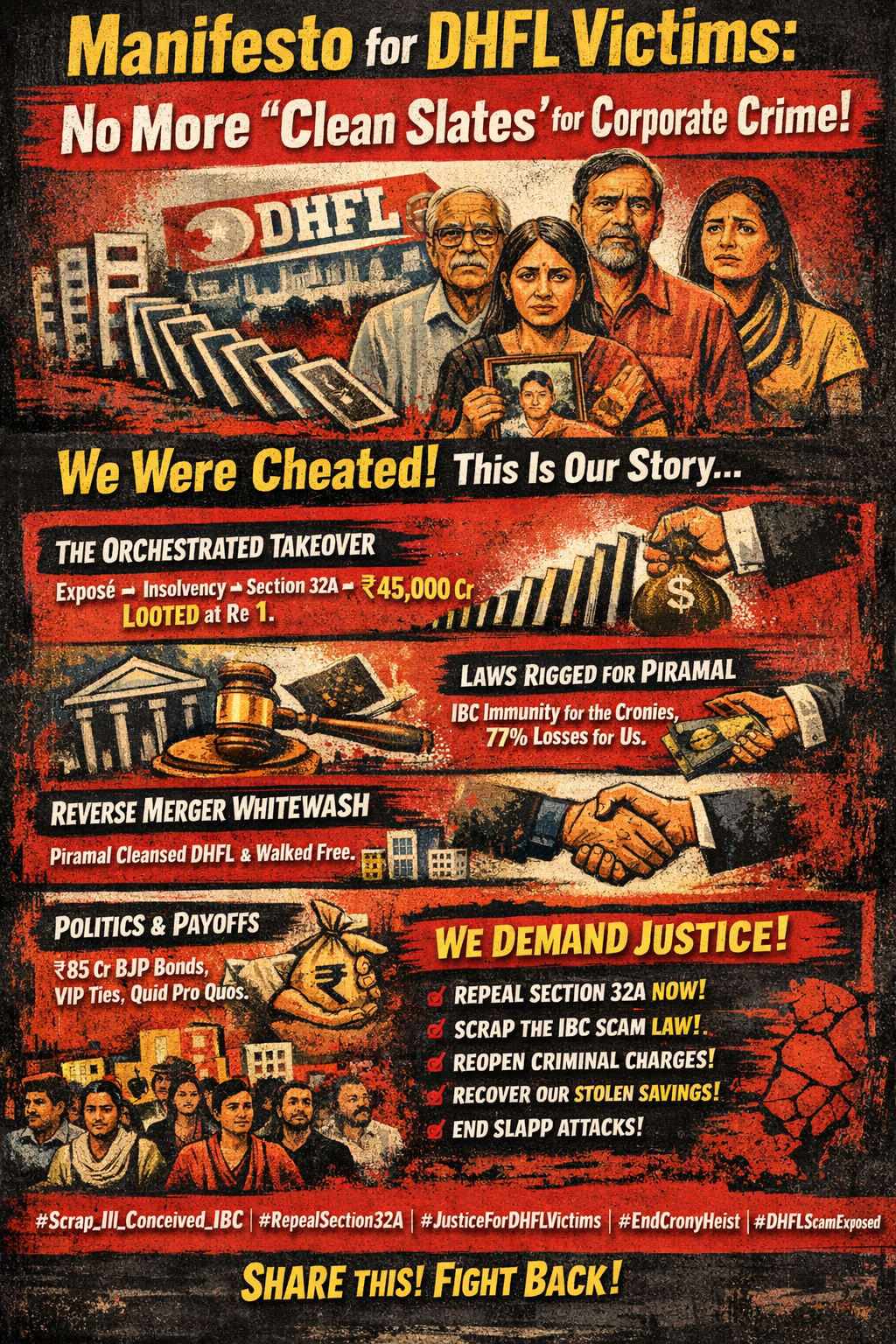
This manifesto is a fact-based cry from over 2.5 lakh DHFL depositors who lost life savings in massive 54–77% haircuts. It chronicles how India’s first AAA-rated NBFC — a sound ₹91,000+ crore housing finance company — was deliberately dismantled under the IBC: starting with Ajay Piramal’s “shock” warning (28 Jan 2019) followed by the Cobrapost exposé (29 Jan 2019), RBI supersession (20 Nov 2019), CIRP admission (3 Dec 2019), mid-process insertion of Section 32A immunity (28 Dec 2019), ignored full-repayment proposals, a Re 1 giveaway of ₹45,000 crore Section 66 recoveries, judicial overrides culminating in Supreme Court approval (1 Apr 2025), reverse mergers to sanitize legacy, and PMLA discharge of the corporate debtor (2 Feb 2026) under Section 32A — while Piramal Finance now thrives (AUM ₹96,690 crore up 23% YoY, PAT up 162%). Highlighting statutory contradictions, CoC bias allegations, and a documented political-corporate nexus, it demands repeal of Section 32A, scrapping the IBC, restitution, and an end to SLAPP suits — framing the DHFL case as engineered crony sanitisation, not genuine resolution.
The “Clean Slate” That Was Engineered: How IBC’s Section 32A Enabled the DHFL–Piramal Takeover
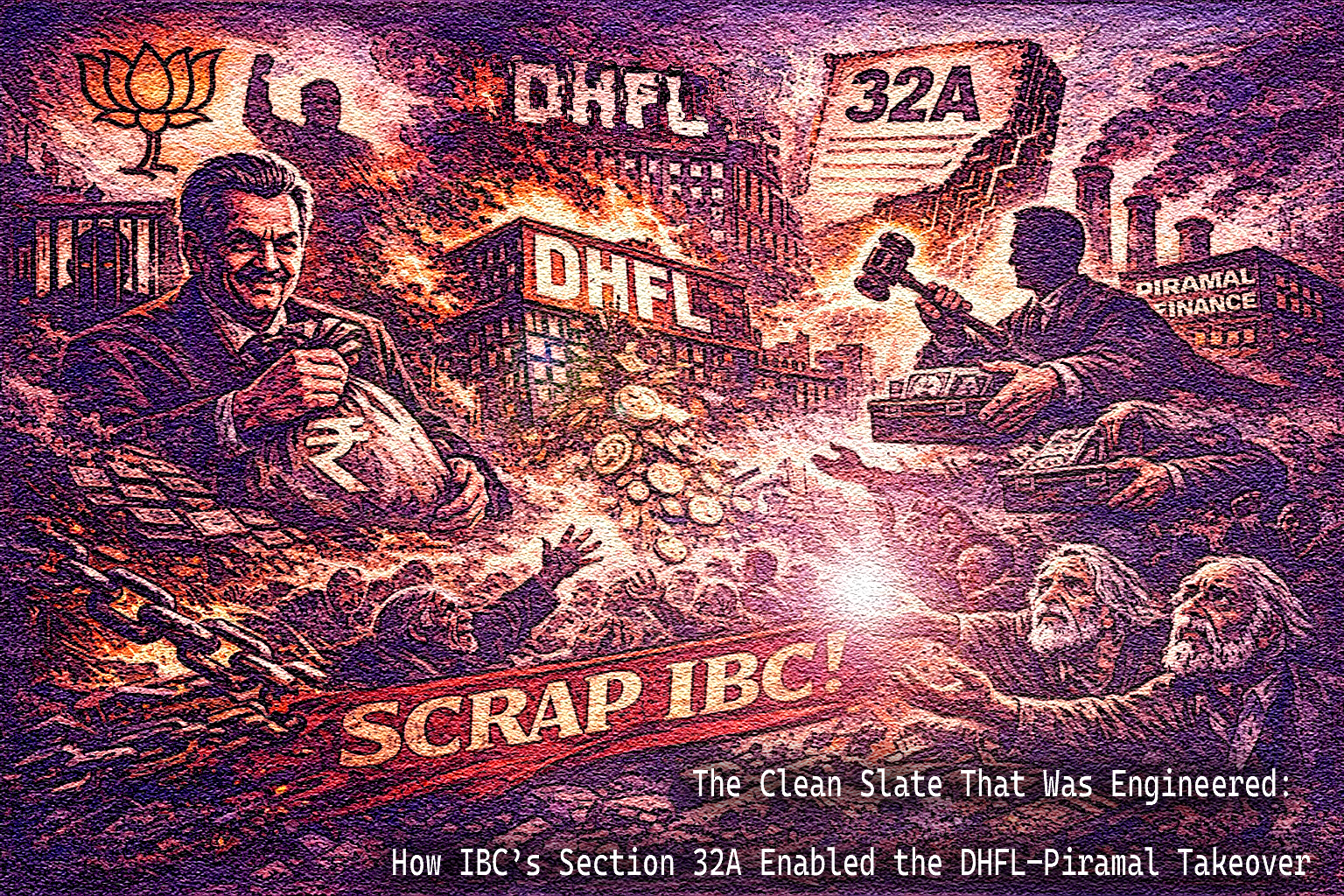
The DHFL insolvency resolution, culminating in its acquisition by Piramal Capital and Housing Finance (now Piramal Finance) and the February 2, 2026, Mumbai PMLA Special Court discharge from a ₹5,050 crore money-laundering case under Section 32A of the Insolvency and Bankruptcy Code (IBC), exemplifies alleged systemic flaws in India’s insolvency framework. This “clean slate” immunity extinguished corporate criminal liability for pre-CIRP offences while preserving prosecution against former promoters like the Wadhawan brothers, despite their ignored full-repayment proposals. Critics portray the process—marked by retrospective Section 32A insertion in December 2019 just before DHFL’s CIRP admission, Ajay Piramal’s January 2019 “shock” prediction preceding the Cobrapost exposé, massive creditor haircuts (54–77% on retail FDs/NCDs), nominal Re 1 valuation for ₹45,000 crore Section 66 avoidance recoveries benefiting Piramal, and upheld “commercial wisdom” in the Supreme Court’s April 1, 2025, judgment—as engineered cronyism favoring politically connected acquirers via electoral bond donations (Piramal entities contributed significantly to BJP coffers per 2024 ECI data), family ties to Ambani, Flashnet deal controversies, and PM CARES funding. Amid Piramal Finance’s resurgence (AUM ₹96,690 crore up 23% YoY, 9M FY26 PAT ₹1,004 crore up 162%, CRISIL AA+ rating), victim groups decry SLAPP suits silencing dissent, statutory contradictions prioritizing new owners over creditors, and demand full repeal of Section 32A to dismantle what they term a sophisticated mechanism of crony enrichment at the expense of lakhs of ordinary depositors’ savings.
Stones, Frogs, and Divine Dividends: Piramal’s Philanthro-Capitalist Lila
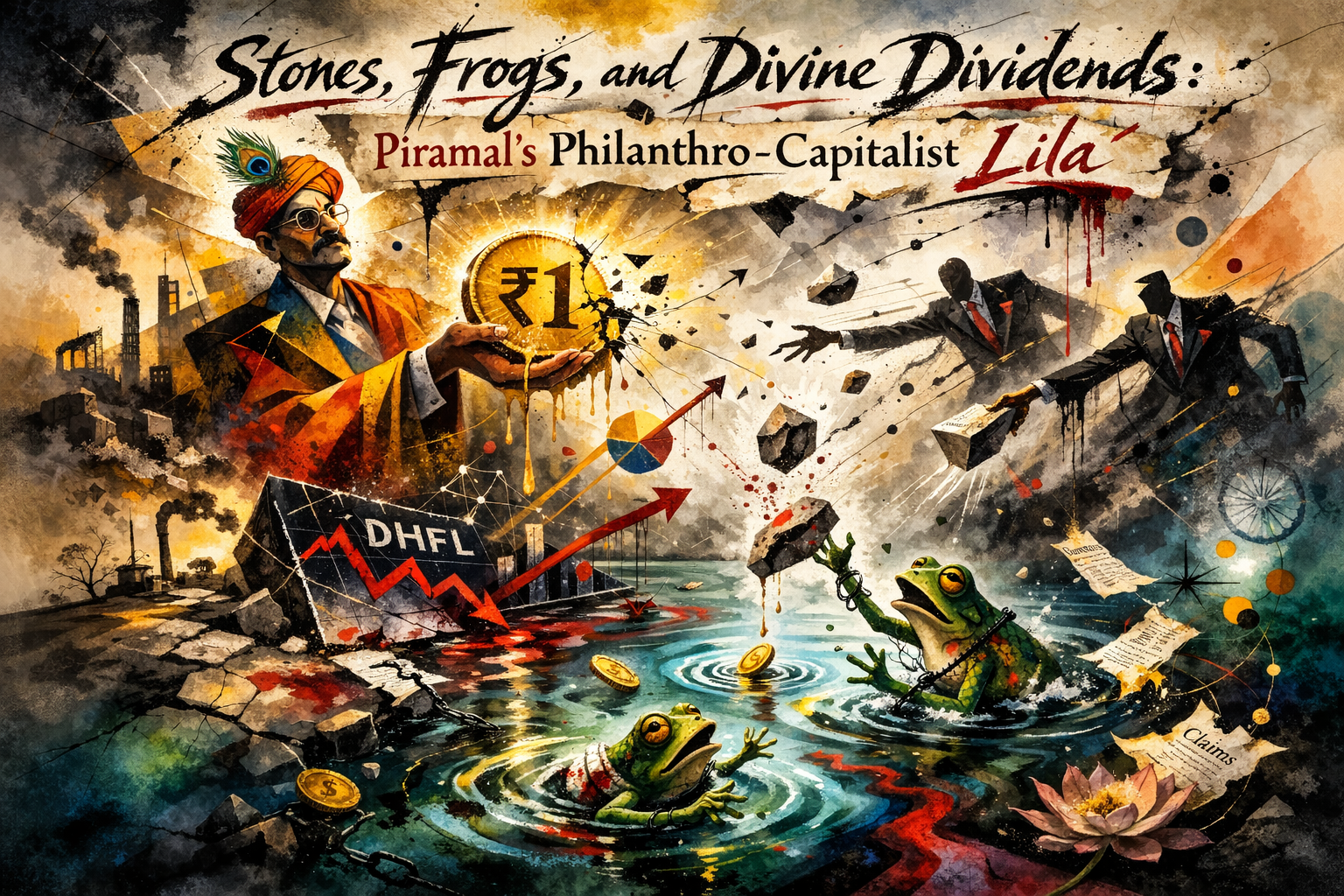
In this delightfully biting exposé, we reimagine Aesop’s timeless fable of boys hurling stones at hapless frogs as a metaphor for the Piramal Group’s “doing well by doing good” empire-building antics. Through sarcastic lenses, we link the innocent cruelty of playground games to corporate resolutions that crush small investors, pollute environments, and silence critics—all while cloaking it in Vaishnava philosophy and Gandhi-branded CSR. Prepare for a romp through divine “lila,” chaotic casinos of capitalism, and a conclusion that leaves you pondering: is this sport, spirituality, or just splendid self-interest?
Pre-Admission, Perpetual Intimidation: Piramal’s Defamation SLAPP Against DHFL Victims
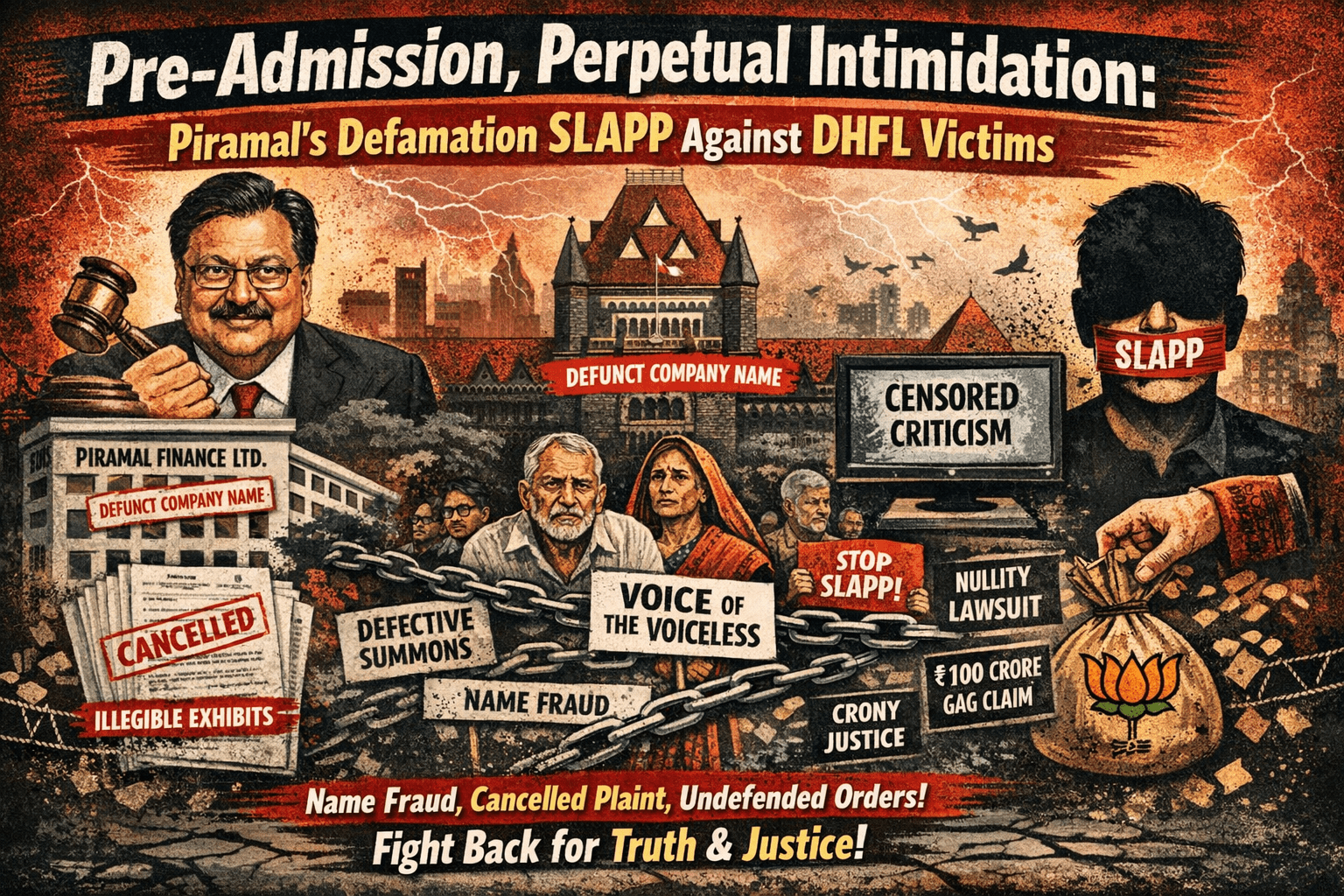
This document contends that the defamation suit filed by corporate tycoon Mr. Ajay Piramal (through DSK Legal) against DHFL victims and activists in Bombay High Court Suit S/42/2025 constitutes a textbook Strategic Lawsuit Against Public Participation (SLAPP), designed to chill constitutionally protected public-interest speech arising from criticism of the 2021 DHFL IBC resolution. Drawing on official court orders, registry records, and procedural chronology, it argues that the suit remains mired at the pre-admission/directions stage due to fatal defects—including continued filings under a defunct corporate name, defective service, ignored written statements, asymmetrical timelines, and uncured plaint infirmities—rendering it vulnerable to rejection under Order VII Rule 11 CPC. Situating the case within broader Indian jurisprudence cautioning against chilling-effect litigation, and invoking Articles 19(1)(a), 14, and 21 of the Constitution, the document frames the proceedings not as bona fide reputational redress but as corporate intimidation of financially devastated citizens engaged in non-violent civil dissent, warranting dismissal with exemplary costs.
Grapes are Always Sour for the Other 98%? A Tale Told by a Fox

I, the fox—displaced, hungry, forever circling the perimeter of what others call success—have written this howl from the ashes of vanished forests and the margins of a city that builds towers while drowning its poor. Through five chapters I trace how the grapes of sweetness remain forever sour, not from any defect in my leap, but because the vineyard itself is enclosed by design: fortified mansions rising above flood-prone shores, weddings costing hundreds of millions while hunger indices stay serious, births secured with foreign passports and luxury medicine while preaching national self-reliance to the rest, nationalism demanded as sacrifice from the many yet practiced as portable privilege by the chosen few, and finally an economics of limitless spectacle that devours the very earth required for any future life. From Aesop to Panchatantra to lived memory of deforestation and corporate predation, I refuse the fable’s tidy moral—that effort alone decides access—and instead diagnose structural denial, crony spectacle through conspicuous consumption and ostentatious display, ecological myopia, as well as selective patriotism. In the end I unlearn the dream of joining the feast; I choose instead the difficult, unglamorous arithmetic of limits—sufficiency, repair, localisation, care without applause—because the bulldozers have already flattened the last vine and my vixen beneath them, and what remains is no longer a question of reaching the grapes, but whether any shared ground can still sustain breath in a world that mistakes endless extraction for destiny. This is my testimony, not of envy, but of ruthless clarity: the sourness was never in the fruit; it was always in the fence.
Digwal’s Poison, Dahej’s Acid, Mumbai’s Climate Time-Bombs: Mr. Piramal’s Toxic Trails
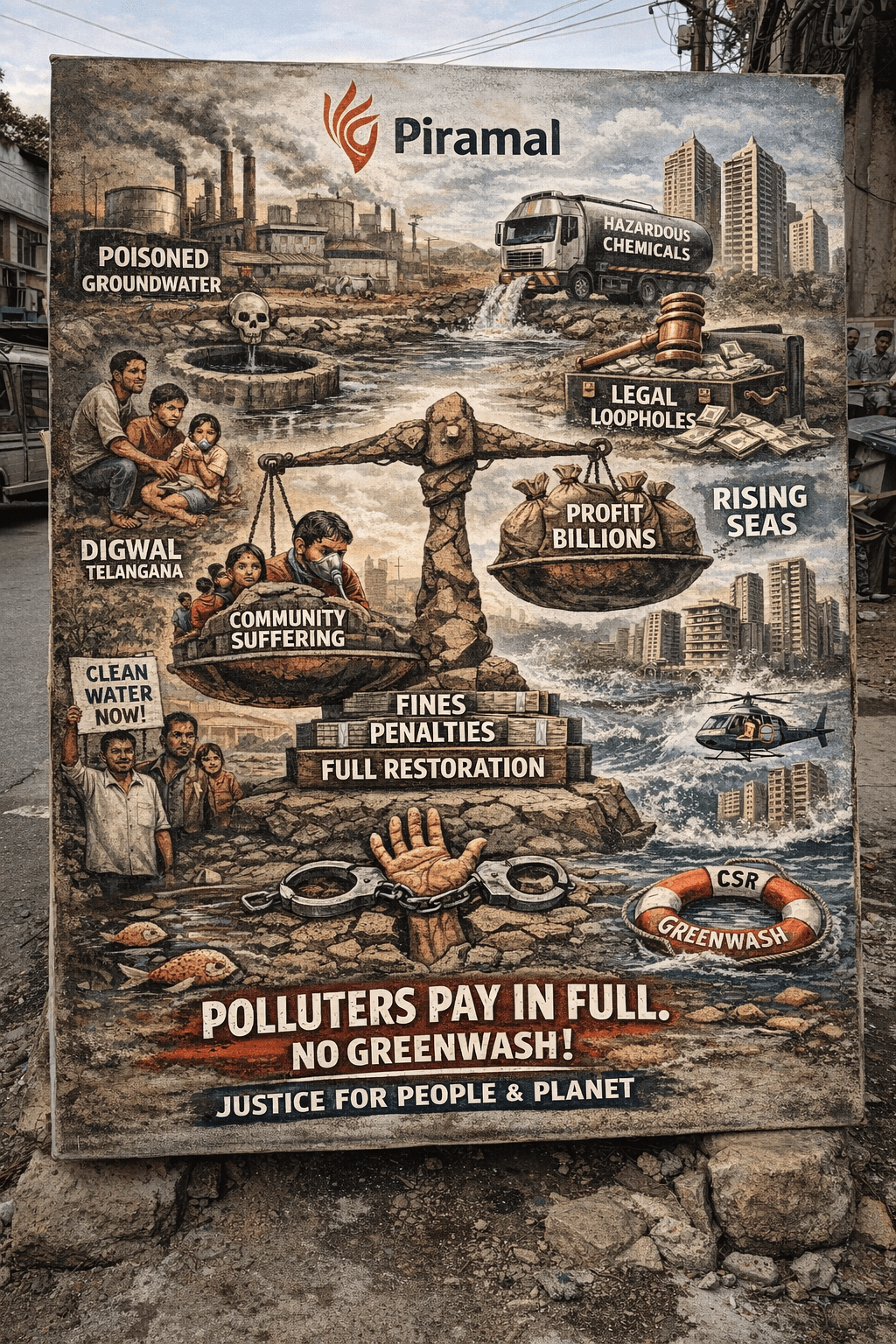
This essay argues that the Piramal Group’s pharmaceutical and real-estate operations exemplify a systemic model of accumulation by dispossession in contemporary capitalism, wherein ecological harm, public-health burdens, and climate vulnerability are externalized onto marginalized communities while profits are privatized and reputational risk is managed through regulatory reprieves, corporate restructuring, and CSR spectacle. Through the long-running groundwater contamination crisis at Digwal, the very recent February 2026 hazardous discharge episode at Dahej affecting the Narmada-linked canal system, and the development of ultra-luxury coastal real estate in flood-prone zones of Mumbai, the text demonstrates a recurring pattern: violation, brief enforcement theatre, rapid operational normalization, and uninterrupted high-margin expansion. It situates these cases within theoretical frameworks of slow violence, ecological surplus extraction, and philanthropic greenwashing, arguing that fines function as licensing fees rather than deterrents and that dynastic corporate networks convert environmental risk into both profit and spectacle. The essay concludes by demanding a materially enforced Polluter Pays regime—extending beyond monetary penalties to full ecological restoration, community restitution, structural limits on expansion, and legally binding accountability—insisting that environmental justice cannot be offset through philanthropy, CSR branding, or procedural compliance while the biosphere itself absorbs irreversible damage.
The Piramal Paradox: Karuṇā–Sevā–Samṛddhi as Valourized Capital?

This essay is a self-reflexive critique that interrogates the corporate deployment of sacred Indian ethical concepts—karuṇā (boundless compassion), sevā (embodied relational service), and samṛddhi (ethically conditioned flourishing)—within the assemblages of philanthro-capitalism, particularly through the Gandhi Foundation and CSR initiatives linked to Ajay Piramal. Drawing on Deleuze and Guattari’s schizoanalysis, it traces how these terms, deterritorialized from Buddhist, Bhakti, Gandhian, and epic traditions, are reterritorialized as branded values that legitimize accumulation while masking asymmetries of power, dispossession, and structural harm—most poignantly exemplified by the author’s lived experience of financial violence in the DHFL collapse. Through philological excavation, ontological reflection (via the Aupaniṣadika two-birds metaphor), and a Kafkaesque plea for coherence before the Supreme Court, the text demands philosophical vigilance: whether ethical rhetoric can coexist with praxis that disperses risk downward and concentrates prosperity upward, or if such invocation fractures the triad, reducing compassion to optics, service to branding, and prosperity to unchecked growth. Ultimately, it calls not for condemnation but for symmetry—where sacred words, once uttered, become answerable to those wounded by the very systems they adorn.
 Once in a Blue Moon Academia