Posted on 18th November, 2026 (GMT 08:43 hrs)
There is a silence that falls after the lathi has done its work and the complaint has been filed. It is the silence of a classroom whose books have been removed, of a teacher who has learned that the next blow will not be answered, of a student who has understood that the university no longer belongs to those who study in it. For seventy-seven years the Sangh has cultivated this silence. The ABVP is its instrument on the ground: the campus enforcer, the complaint desk, the nursery that turns a street action into a ministry letter and a ministry letter into an appointment. What begins as a brawl over a bookstall or a seminar becomes, by design, the clearing of a syllabus, the suspension of a Dalit scholar, the vanishing of a student, the acquittal of those who beat a professor to death. The pattern is not accidental. It is the method by which the BJP-RSS-ABVP-Bajrang Dal machine converts the university from a space of argument into a parade ground, then staffs the parade ground with its own.
We in OBMA write as those who refuse this conversion. The university should remain the commons where a society argues with itself. When that commons is seized by outright violent force, by appointment, and by syllabus, free thought itself becomes the offence. We do not meet the attack with another alibi of distance. We name the machine. We record the turnstile that lets the attacker walk free while the victim is pushed into the police station or the grave. And we say, without ornament, that this regime of capture must end. The books that were burned on College Street, the essay that was dropped, the student who disappeared, the teacher who was beaten while cameras watched—these are not separate cases. They are the same campaign. The answer is not another inquiry that will be closed. It is the return of the university to its students and teachers, and the refusal of the Sangh’s claim to own the places where a people learns to think.
ABSTRACT
For seventy-seven years the Akhil Bharatiya Vidyarthi Parishad (ABVP) in India has done one job for the Rashtriya Swayamsevak Sangh (RSS): to take the Indian university by force, then by appointment, then by syllabus; this dossier sets out the record from the founding counter-mobilisation of 1948–49 to the bookstall brawl on College Street on 18 November 2026, the eve of its publication, including a professor beaten to death at Ujjain in 2006 with all six ABVP accused later acquitted after witnesses turned hostile, the 2008 ransacking of Delhi University’s History Department over A.K. Ramanujan’s essay which the University then dropped, the complaint chain that ran from an ABVP leader through a Union minister and the Human Resource Development Ministry to Rohith Vemula’s suspension and death in 2016, Najeeb Ahmed missing since the night after a scuffle with ABVP-linked students and a case closed in 2025 with nobody charged, Ramjas in 2017 and the masked mob at JNU on 5 January 2020 still unprosecuted, and Jadavpur, the Satyajit Ray Film and Television Institute and College Street in 2026 after the BJP took power in West Bengal—the pattern being one machine, not a list of incidents: disruption, then complaint, then state action against the victim, then impunity for the attacker, then a promotion for the alumnus. What this unbroken chain of violence, administrative capture and judicial vanishing proves is that the ABVP is not a student organisation at all but the campus arm of a political project that treats the Indian university as enemy territory to be conquered, emptied of dissent and restocked with loyalists, while the BJP in power converts every complaint into state sanction and every acquittal into a green light for the next assault.
Disclaimer
This is an OBMA accountability dossier. It is partisan by design: it takes the side of students, teachers, books and the freedom to think, read, write and criticise.
Every factual claim is drawn from independent, non-“Godi” journalism (The Wire, Scroll, Newslaundry, The Caravan, The Quint, The News Minute, Frontline, Sabrang, Mainstream Weekly, eNewsroom, National Herald, Deccan Herald, The Telegraph and wire copy carried by them) and is linked in the Sources section.
Where a court has acquitted, a probe has closed, or an accusation is contested, the dossier says so plainly. It names the state’s failures as failures and does not invent findings the courts never made. The words “alleged” and “reportedly” mark legal status, not doubt about the pattern. Individuals named are named because the cited reports name them, in the roles those reports describe. Nothing here is an incitement to anything but scrutiny, dissent and organised, non-violent resistance.
Preamble: Not a Student Body, a Battering Ram
The ABVP calls itself “the world’s largest student organisation” and an independent body for “national reconstruction”. Strip the slogan, “Gyan, Sheel, Ekta” (Knowledge, Character, Unity), and three functions remain. It is the Sangh’s campus enforcer, the Sangh’s complaint desk to the state, and the Sangh’s nursery for the ruling class.
The welfare talk of metro passes, Wi-Fi and hostel seats is the shop-front. The back room holds the lathi, the FIR and the WhatsApp group. The ABVP’s own line, that students are “citizens of today, not citizens of tomorrow”, is honest in one way: it treats eighteen-year-olds as cadre to be deployed now.
The ABVP’s founders called the “academic family” of teachers and professors their stabilising core. Read politically, that family is a capture apparatus. It is the bridge by which a street mob becomes a selection committee, and a selection committee becomes a Vice-Chancellor’s office.
The Sangh’s favourite alibi is distance. In August 2026, after the night raid on Jadavpur University, West Bengal BJP president Samik Bhattacharya told reporters that “ABVP is not the student wing of BJP” and functions independently (Mainstream Weekly; eNewsroom). In November 2026 he called the burning of books on College Street “youthful exuberance” (National Herald). Distance when the blood is fresh, fraternity when the ministries are handed out: that double-entry bookkeeping is the subject of this dossier.
Place the ABVP’s self-description beside its record, incident by incident, and let the gap speak. The gap is not a lapse. It is the design.
I. Genealogy, 1948–1977: Born to Break the Left
The ABVP was conceived in the RSS’s darkest hour, and that birth explains its character. Its activities began in 1948, while the RSS was banned after Nathuram Godse, a man formed in the Sangh’s milieu, assassinated Mahatma Gandhi. It was formally registered under the Societies Registration Act on 9 July 1949, days before the ban was lifted. A banned organisation needed a legal face among the young. The student council was that face.
The Founders’ Purpose
The initiative is credited to Balraj Madhok, an RSS pracharak who later rose in the Bharatiya Jana Sangh, the BJP’s forerunner. The stated aim was counter-mobilisation. Post-Independence campuses were shaped by communist and socialist student federations, and the ABVP was built to break them.
Its first campaigns already carried the programme of the next seven decades. It ran signature drives to rename the country “Bharat”, impose Hindi as the national language, and install “Vande Mataram” as the anthem. Majoritarian culture was the first syllabus. The student was the first recruit.
Kelkar’s Machine
From the late 1950s, Yashwantrao Kelkar, a Mumbai lecturer and RSS worker, built the structure that made the ABVP durable. His innovation was to anchor it in teachers as well as students. Students graduate; the professors stay. That “academic family” gave the ABVP an institutional memory no student union possesses, and a permanent foothold inside staff rooms, examination boards and, later, selection committees.
The organisation runs a disciplined, multi-tier hierarchy: college unit, then city and district units, then state (prant) units, then national leadership. Professors often hold the state and national presidential posts. The ABVP calls this an “academic family” rather than an agitational body. Its record shows a family that agitates very well.
The Counter-“Revolution” in a Student’s kurta
The ABVP began contesting union elections soon after its founding, with the explicit goal of dislodging the Left, and by the mid-1970s it controlled several major unions. Its strategy has never changed. Elections are not ends but recruitment drives, discourse-shaping exercises and talent scouting for the Sangh.
The Sangh likes to call the ABVP “apolitical”. Its founding documents, its first campaigns and its first electoral targets say otherwise. It was political from the first signature drive: a nationalist wedge driven into the one public space where the young could think against the grain.
Two Registers: “Welfare” in Front, Hindutva Behind
The ABVP’s slogan is “Gyan, Sheel, Ekta”, and its favourite line is that students are “citizens of today, not citizens of tomorrow”. The line sounds like empowerment. In practice it means that student energy is a present political resource, to be channelled now into “nation-building” as the Sangh defines the nation.
Officially, the ABVP is neither a trade union nor a party wing but an “independent social organisation” for education and “national reconstruction”. Its programme says otherwise. It promotes “Indian cultural values” in education, campaigns against ideologies it brands “anti-national” or “separatist”, opposes religious conversion, and, in unit after unit, pushes cow protection and the conspiracy theory of “Love Jihad”. That is the Hindutva agenda, item for item.
The dual register is the organisation’s signature, not a contradiction to be explained away. Metro passes, Wi-Fi, hostel seats and “One Course, One Fee” are what it advertises. Cow, conversion, “Love Jihad” and the hunt for the “anti-national” are what it organises. The welfare front recruits the student; the ideological rear disciplines the campus. Anyone who weighs only the first half is reading the ABVP’s brochure, not its record.
The Forums: Many Faces, One Spineless Spine
The satellites multiply the masks. Students for Development (SFD) handles “development” and service work. Think India targets professional and technical institutes in management, engineering, law and medicine, carrying the Sangh into campuses that once thought themselves above politics. The World Organisation of Students and Youth (WOSY) faces the diaspora and the world. Each forum offers a different face to a different audience, while the spine and the chain of command stay the same.
The Numbers Game: 76,98,448
The ABVP calls itself the world’s largest student organisation. At its 71st national conference in Dehradun in late 2025 it announced a 2025–26 membership of 76,98,448, nearly 77 lakh. No independent auditor has ever checked these self-reported figures, which inflate at every membership drive and are announced as triumphs rather than published as registers.
The exact number matters less than what it is used for. Nobody, not even the ABVP’s opponents, disputes that its cadre is vast and that its units are dense. The question this dossier answers is what that mass is deployed to do: a cadre of tens of lakhs, permanently organised, available for any campus, any night, any “surgical strike”.
Who Commands It in 2026
The ABVP is headquartered in Mumbai. For 2025–26 its national president is Prof. Raghuraj Kishore Tiwari, an agronomy professor at Jawaharlal Nehru Krishi Vishwavidyalaya’s Rewa campus who has been with the ABVP since 1987. Its national general secretary, re-elected, is Dr Virendra Singh Solanki, a doctor pursuing an MD at Sri Aurobindo Institute of Medical Sciences, Indore. Its national organising secretary, the RSS-style pracharak post that actually runs the machine, is Ashish Chauhan (Careers360; NewsDrum/PTI; The Statesman).
The line-up proves the Kelkar template: a senior professor at the top, a professional-college student as general secretary, a full-timer holding the reins. Office-bearers rotate every year, so readers should check names against current reporting.
Two facts about this leadership sum up the double-entry bookkeeping. After the BJP took West Bengal in 2026, the “independent” ABVP’s Central Working Committee, with Tiwari, Solanki and Chauhan present, formally welcomed the new government (The Statesman). And in August 2026, the same month ABVP men climbed Jadavpur’s Gate 4 (Section VII), Solanki declared that the ABVP “firmly believes” student concerns must be addressed “not through violence” (Organiser, cited here as the Sangh’s own record). Place the sentence beside the gate, and the gap speaks.
II. Laundering and Rehearsal, 1974–2015
For four decades before Modi, the ABVP rehearsed the methods it would later run with state backing: borrowed legitimacy, then the lathi, then the lawsuit, then the purge of the syllabus.
Borrowed Moral Capital: Navnirman, JP, the Emergency
The ABVP joined Gujarat’s Navnirman agitation in 1974 and the wider student upsurge that fed Jayaprakash Narayan’s movement. The resistance to Indira Gandhi’s Emergency (1975–77) gave Sangh cadres a share of genuine democratic credit, which they have spent ever since. The Sangh’s official memory omits the other half. RSS chief Balasaheb Deoras wrote from Yerawada jail to Indira Gandhi offering cooperation in exchange for lifting the ban. The anti-Emergency halo was real for many individual students. For the institution it was a laundering operation.
Ram Janmabhoomi: the Campus as Recruiting Ground
The Ram Janmabhoomi mobilisation of the 1980s and early 1990s, culminating in the demolition of the Babri Masjid on 6 December 1992, became the ABVP’s great expansion. Campuses supplied bodies for kar seva and slogans for the street. The ABVP’s growth curve and the curve of communal mobilisation are the same curve.
Ujjain, 26 August 2006: a teacher beaten to death
Professor H.S. Sabharwal, head of Political Science at Madhav College, Ujjain, had tried to postpone or cancel the college union election after finding irregularities. He was beaten on campus in front of students, staff, police and television cameras, and died of lung and rib injuries (Siasat/agencies; eNewsroom). Six ABVP activists were charged with his murder.
The trial is a textbook of impunity. Police first arrested 22 people, mostly Congress members. Eyewitnesses resiled from their statements. The Supreme Court moved the trial out of BJP-ruled Madhya Pradesh to Nagpur because of the risk of pressure (eNewsroom). On 13 July 2009 a Nagpur sessions court acquitted all six for lack of evidence, once the eyewitnesses had turned hostile (Deccan Herald; TwoCircles/IANS). The Supreme Court later refused to entertain his son’s direct challenge to the acquittal.
The Sangh’s response was whitewash. Within weeks of the killing, RSS leader Ram Madhav declared the ABVP “not at all involved” (OneIndia). The RSS weekly Organiser later recast the killing as a “heart attack”. A professor died on his own campus. Nobody was convicted. The Sangh called it vindication.
Delhi University, 25 February 2008: The Ramayana Raid
ABVP activists stormed the History Department of Delhi University and ransacked the office of its head, Professor S.Z.H. Jafri, over the inclusion of A.K. Ramanujan’s essay “Three Hundred Ramayanas: Five Examples and Three Thoughts on Translation” in an undergraduate reading list (Newslaundry; TwoCircles). The raid was staged in front of invited media (Mainstream Weekly). The campaign targeted historian Upinder Singh, who had compiled the reader (SACW/The Telegraph).
The vandalism won. In October 2011 DU’s Academic Council dropped the essay, overruling the History Department’s own recommendation to keep it (Governance Now/PTI; Sabrang). Mukul Kesavan put it bluntly in The Telegraph: the opponents of the essay got their way by trashing the department and assaulting its head (SACW). The template was set: wreck the room, file the suit, wait for the committee to fold.
In November 2008 the ABVP disrupted a DU seminar titled “Communalism: Fascism and Democracy, Rhetoric and Reality” (The Quint). A seminar on fascism, broken up by the people it described.
Pune, 21 August 2013: The Day After Dabholkar
On 20 August 2013 the rationalist Narendra Dabholkar was gunned down in Pune. The next evening, students of the Film and Television Institute of India (FTII) and the youth forum Yugpath held a tribute: a screening of Anand Patwardhan’s Jai Bhim Comrade and a performance by the Dalit cultural troupe Kabir Kala Manch. ABVP activists attacked the students outside the National Film Archive, shouting “Down down Naxals”. About a dozen ABVP men beat four students with the wooden poles of their flags; one, Sriram Raja, was hit on the head with a helmet and needed stitches (NewsClick; Kafila; NewsClick).
The following year ABVP threats ended a Pune screening of Patwardhan’s Ram Ke Naam (Scroll; Indie Journal). In 2018 FTII itself cancelled the student documentary Hora, on Kabir Kala Manch, after ABVP threats (The Quint). An anti-caste song, a film on Babri, a documentary on Dalit artists: the ABVP’s enemies list is a list of art.
Delhi, August 2015: Banning Memory of a Pogrom
The ABVP disrupted a screening of Muzaffarnagar Baaqi Hai, Nakul Singh Sawhney’s documentary on the 2013 Muzaffarnagar riots, at DU’s Kirori Mal College (The Quint). That disruption lit the fuse that ran, within months, to Hyderabad.
III. 2016: The Year the Machine Went National
In 2016 the ABVP stopped being a campus nuisance and became an instrument of state power. Three names mark the year: Rohith Vemula, Kanhaiya Kumar, Najeeb Ahmed. In each case an ABVP complaint or confrontation set the state in motion, and the state moved against the ABVP’s opponents.
Hyderabad: The Complaint Chain That Ended a Life
On 3 August 2015 the Ambedkar Students’ Association (ASA) at the University of Hyderabad protested the ABVP’s disruption of Muzaffarnagar Baaqi Hai in Delhi. ABVP campus leader N. Susheel Kumar called them “ASA goons” on Facebook (Newslaundry). A night-time confrontation followed. Kumar then alleged assault.
What happened next is the anatomy of the ABVP-to-state relay:
- Kumar approached Union Minister Bandaru Dattatreya, BJP MP for Secunderabad; Kumar’s uncle, a Hyderabad BJP vice-president, wrote to him about “anti-national activities” (Scroll; The News Minute).
- On 17 August 2015 Dattatreya wrote to HRD Minister Smriti Irani, calling the campus a “den of casteist, extremist and anti-national politics” (The News Minute).
- The HRD Ministry wrote to the university five times demanding a response (Deccan Herald).
- Five Dalit scholars, Rohith Vemula among them, were suspended and expelled from their hostel. A university inquiry later found no evidence to support Kumar’s assault claim (The News Minute).
- On 17 January 2016 Rohith Vemula died by suicide. His letter, about being reduced to “a vote, a number, a thing”, became the founding text of a Dalit student uprising.
An abetment case under the SC/ST Act was registered against Dattatreya, Vice-Chancellor Appa Rao Podile, Susheel Kumar and others (Newslaundry). In March 2024 Telangana Police filed a closure report that cleared every accused by asserting that Rohith was not Dalit, a claim his mother answered with: “How can my own child not be a Dalit when I am?” (ThePrint; The Quint). The DGP then promised further investigation (The News Minute). Ten years on, nobody has been tried.
The reward came instead. In 2025 the BJP made N. Ramchander Rao, the MLC who had joined the pressure on the university administration, its Telangana state president (The News Minute). Karnataka’s Cabinet cleared a Rohith Vemula anti-discrimination Bill in April 2026; Telangana’s version still sits with a Cabinet sub-committee (Deccan Chronicle). The persecutors were promoted; the law in the victim’s name is still being drafted.
JNU, 9 February 2016: Inviting the Cameras, Then the Police
On 9 February 2016 JNU withdrew permission for a student event on the hanging of Afzal Guru, reportedly at the ABVP’s behest. ABVP member and JNUSU joint secretary Saurabh Sharma had invited the press; the visitors’ register showed ANI and Zee News crews entering on his reference (The Caravan). Clips of “anti-national” slogans ran on loop. Their authenticity was later called into question. On 19 February Zee News producer Vishwa Deepak resigned, asking whether his channel had become a mouthpiece of the BJP and the RSS (The Caravan).
On 12 February JNUSU president Kanhaiya Kumar was arrested for sedition. Lawyers and BJP supporters assaulted students, teachers and journalists at Delhi’s Patiala House court, and Kanhaiya himself was attacked inside the court complex (Millennium Post). The ABVP organised a “Nation First Tricolour March” (Newslaundry).
The most damning testimony came from inside. On 17 February three ABVP office-bearers at JNU, joint secretary Pradeep Narwal and School of Social Sciences unit leaders Rahul Yadav and Ankit Hans, resigned. They said they could not be “mouthpiece of such a government which has unleashed oppression on student community” (The News Minute). Narwal warned against a “Taliban culture” and said that hooliganism is not nationalism (Business Standard/PTI). His verdict to Newslaundry: those who beat people in the name of the flag are the most anti-national (Newslaundry).
JNU, 15 October 2016: Najeeb Ahmed “Disappears”
Najeeb Ahmed, a 27-year-old first-year MSc Biotechnology student, vanished from Mahi-Mandvi hostel on 15 October 2016, the morning after he was assaulted in a scuffle with students linked to the ABVP (ThePrint). The CBI told a court he had refused treatment at Safdarjung Hospital after that assault (Deccan Herald).
The Delhi Police, and from 2017 the CBI, never arrested or charged anyone. The CBI filed a closure report in 2018. On 30 June 2025 a Delhi court accepted it, holding that “existence of a motive is no substitute for proof” (Newslaundry; The Wire). His mother, Fatima Nafees, said the agencies took no action against “the goons who assaulted my son and then made him disappear” (Dinamalar/PTI).
Nine years. A missing Muslim student, a known set of assailants, two investigating agencies, zero charges. Najeeb’s absence is the ABVP era’s most eloquent silence.
IV. Delhi University: The Showroom and the Slaughterhouse
Delhi University is the ABVP’s shop-window. DUSU results make national headlines, and the ABVP has dominated the union for most of the last decade. The same campus is where its contempt for teachers is most openly on camera.
Ramjas College, 21–22 February 2017: “We Beat Teachers Too”
Ramjas College’s literary society organised a two-day seminar titled “Cultures of Protest”. JNU scholar Umar Khalid was to present his doctoral research on Bastar; former JNUSU vice-president Shehla Rashid was also invited (Newslaundry). On 21 February ABVP activists locked down the seminar room and pelted stones at the auditorium (Tribune). The college withdrew the two invitations.
On 22 February students and teachers marched against the vandalism and were attacked. More than 20 people were injured, among them teachers and journalists (Millennium Post). English professor Prasanta Chakravarty was left battered and bloodied (Hindustan Times via PressReader). Students were locked inside the college for over four hours (Tribune). A teacher told Newslaundry that “this time even teachers were identified and beaten up”, and that the teacher’s own Miranda House student, an ABVP member, joined the assault and pulled the teacher by the hair (Newslaundry).
A recording published by The Wire caught an ABVP supporter boasting that if Umar Khalid had come to Ramjas, he would not have gone back alive. The headline was his own phrase: “We beat teachers too” (The Wire).
When Lady Shri Ram College student Gurmehar Kaur, daughter of a soldier killed in Kashmir, posted a placard saying she was not afraid of the ABVP, she was hounded with rape threats until she withdrew from the campaign (The Quint). The ABVP’s answer to the outcry was to expel two members (The Quint), the standard sacrifice of two pawns to save the board.
The Syllabus as Battlefield
What the lathi starts, the committee finishes.
- 2011: Ramanujan’s “Three Hundred Ramayanas” dropped, three years after the ABVP ransacked the History Department (Section II).
- August 2021: DU’s Oversight Committee, which had no experts from the departments concerned, removed Mahasweta Devi’s “Draupadi”, a story about a tribal woman taught since 1999, and the Dalit women writers Bama and Sukirtharani from the BA (Hons) English course (Scroll; The Wire). Fifteen Academic Council members filed a dissent note. More than 1,100 academics and writers, including Romila Thapar, Arundhati Roy and Perumal Murugan, demanded reinstatement (Hindustan Times via PressReader). The RSS-aligned National Democratic Teachers’ Front defended the purge (Careers360/PTI).
- May 2023: The Academic Council removed the unit on Muhammad Iqbal, author of “Saare Jahan Se Achha”, from the political science syllabus. The ABVP celebrated the removal of a “fanatic theological scholar” (Deccan Herald/PTI; The Quint). A professor told The Quint that a similar attempt 15 years earlier had failed because the right lacked a majority on the council then (The Quint).
A tribal woman’s story, two Dalit women’s poems, a Muslim poet’s anthem: the targets are chosen with care.
Ambedkar College, 16 October 2025: The Union Slaps a Teacher
DUSU joint secretary Deepika Jha, elected on the ABVP panel, entered Dr Bhim Rao Ambedkar College with about 50 students, among them DUSU president Aryan Maan, demanding the resignation of Professor Sujit Kumar, convener of the college’s disciplinary committee. CCTV caught Jha slapping him in the Principal’s office, in the presence of Delhi Police (Tribune; Careers360; The Week).
The ABVP’s first statement blamed the victim, accusing the professor of smoking, drinking and “political bias” and demanding an inquiry against him (Careers360). DU’s six-member committee found that Jha had physically assaulted the professor and recommended three months’ suspension; the University cut it to two months from union office, with classes and exams untouched (Free Press Journal). Professor Kumar called it “eyewash”, noting that the suspension fell over the exam-and-vacation break (Tribune; ThePrint). Then DU revoked it a week early, on 7 January 2026 (Tribune). A teacher is slapped on camera, and the assailant loses a few weeks of a title nobody was using.
DUSU 2026: the Season of Fists
The last day of DUSU campaigning in September 2026 brought clashes between ABVP and NSUI workers across colleges and the assault of a teacher at Motilal Nehru College (Evening) during poll campaigning, after which DU suspended three law students (Careers360). The campus culture the ABVP built, in which teachers are fair game at election time, now outlives any single panel. Violence is not a by-product of the DUSU machine. It is part of the fuel.
V. JNU: The Long Siege, 2016–2026
JNU is the citadel the Sangh has besieged for a decade, and 5 January 2020 is the night the siege turned into a sack.
5 January 2020: The Masked Mob
Between about 7 and 10 pm, a masked mob armed with rods, sticks, sledgehammers and bricks moved through JNU’s hostels, selectively wrecking rooms believed to belong to Left-affiliated students (The Caravan). More than 30 students and teachers were injured (Newslaundry). JNUSU president Aishe Ghosh’s bleeding head became the image of the night. Teachers said the mob fractured heads, including that of former JNUTA president Atul Sood (Careers360).
The evidence pointed one way.
- The WhatsApp groups. The violence was allegedly coordinated through groups called “Unity Against Left” and “Friends of RSS”; the Delhi High Court ordered police to identify their members on a petition by three injured professors (Newslaundry; Newslaundry).
- The confession. In a hidden-camera sting, first-year student Akshat Awasthi identified himself as an ABVP member, confessed to mobilising the attack on Periyar hostel, and claimed a police officer had encouraged them (Scroll; The News Minute). The ABVP disowned him. Alt News then published photographs and videos of Awasthi at ABVP rallies and with ABVP office-bearers (The Wire/Alt News).
- The masked woman. A masked woman photographed in the mob was identified as Komal Sharma of the ABVP’s DU chapter. The ABVP’s JNU secretary denied she was a member; Alt News found her giving interviews as an ABVP representative and staffing its help desk at Daulat Ram College (Alt News).
The police did the opposite of investigating. They stood by while the mob ran riot (The Wire). Students reported that an official’s response to calls for help was, in effect, “this is what you people do, this is what should happen to you” (The Caravan). On 9 January the police released photographs of nine “suspects”: seven from Left groups, including the injured Aishe Ghosh, and two from the ABVP, and none from the masked mob (The Wire; Newslaundry). Komal Sharma told police she was not on campus, and the police appear to have accepted it (Sabrang). An internal probe gave the police a clean chit for their own conduct (Sabrang).
A year later there were no arrests and no chargesheet (Millennium Post). Nearly six years later, nobody has been prosecuted for the attack. The Delhi Police answer to Amit Shah’s Home Ministry. The mob was masked; the impunity was not.
April 2022: Food Fascism at Kaveri Hostel
On Ram Navami, 10 April 2022, ABVP members allegedly told the Kaveri hostel mess not to serve its usual Sunday chicken, stopped the meat vendor and, when the mess committee refused, attacked students with flag-sticks, flower pots and stones; women students were among the injured (Udayavani/PTI; Newslaundry). Police later put the injured at 20 (Careers360/PTI). An FIR was registered against ABVP members (The Quint). The JNU administration publicly sided with the ABVP’s version (Newslaundry). What a student eats on a Sunday became a question of national faith.
October 2025: burning Muslim students in effigy
At the Vijayadashami procession on 2 October 2025, a “Ravan Dahan” burned effigies depicting former JNU students Umar Khalid and Sharjeel Imam, both jailed under UAPA since 2020 and still under trial, along with images of others the organisers branded “Naxal”, among them Afzal Guru and G.N. Saibaba (Kashmir Life; The Logical Indian). JNUSU called it a deliberate attempt to exploit religion and spread Islamophobia (Devdiscourse). The ABVP JNU president called the opposition “cultural aggression” (News Arena). Undertrial prisoners, never convicted, were burned as demons on the campus where they had studied.
February 2026: Stones on the Encampment
On the night of 22–23 February 2026, JNUSU’s march against Vice-Chancellor Santishree Dhulipudi Pandit’s remarks on Dalits was confronted by ABVP workers. JNUSU president Aditi Mishra said the administration sent “goons and sanghis” who pelted stones and abused protesters (ThePrint). Left groups said ABVP activists stoned the JNUSU encampment and attacked unarmed students; the ABVP alleged that its own members were attacked (The Week; Careers360/PTI). The pattern holds: an administration that will not meet protesters, an ABVP that will.
The Scoreboard the Sangh Wants You to Watch
The ABVP won JNUSU’s joint secretary post in April 2025, Vaibhav Meena’s victory being its first central-panel seat in a decade. In November 2025 the Left swept all four central posts again; Aditi Mishra beat the ABVP’s Vikas Patel 1,937 votes to 1,488 on a 67% turnout of 9,043 eligible voters (Careers360; The Week). JNU’s students legitimately keep voting the ABVP down. The ABVP’s ground was built anyway, through a decade in which the University’s leadership, the Delhi Police and the Home Ministry stood on one side of every confrontation.
VI. Jamia Millia Islamia: When the Alumni Run the Police
At Jamia the ABVP rarely needed its own lathis. The state did the beating, and the state was run by the ABVP’s most famous graduate. Union Home Minister Amit Shah, who controls the Delhi Police, began his political life in the ABVP.
15 December 2019: The Library
During the protests against the Citizenship (Amendment) Act, the Delhi Police and paramilitary forces entered the Jamia campus, fired tear gas inside it, stormed the Ibn-e-Sina library and the reading halls, and beat students at their desks (ThePrint; The Quint). At least two dozen students were injured that night (The Caravan). One student lost the use of an eye (Scroll). The People’s Union for Democratic Rights documented “unprovoked and brutal attacks on students and staff in the library, mosque, and other parts of the university” (Counterview/PUDR).
The police denied entering the library until the videos made denial absurd. In February 2022 a Delhi court dismissed Jamia’s own plea for action, holding that the police were “acting in order to control the law and order situation” (The Quint). More than five years and dozens of hearings later, petitions seeking accountability are still pending in the Delhi High Court (The Caravan; TwoCircles).
The Gun and the Slogan
The Sangh ecosystem supplied the soundtrack. In the weeks before the Delhi election, BJP leaders led crowds in the chant “desh ke gaddaron ko, goli maaro” (shoot the traitors). On 30 January 2020 a young gunman shouting Hindutva slogans fired at anti-CAA marchers outside Jamia while police stood by, wounding a student. The slogan became a bullet within days.
After the Crackdown: the Surveillance Campus
Jamia’s administration has since turned the memory itself into an offence. It shut the campus on the anniversary of the police assault to block a commemorative march; in February 2025 the Delhi Police, with university security, detained 14 students at dawn (The Caravan; Polis Project).
October 2024: Rangoli as Provocation
Meanwhile the ABVP’s cultural front moved in. Its Jamia cultural wing, Yuva Jamia, staged an annual Diwali event, “Jyotirgamya”, at Gate 7 of a Muslim minority institution (Radiance; Tribune). When a scuffle broke out, the ABVP blamed “religious fanatics” and “anti-national and radical slogans”; SFI said the trouble was caused by outsiders invited by the administration (Tribune). Students alleged that the outsiders included BJP and RSS cadres and a former DUSU candidate. In March 2025 the Delhi Police arrested a Jamia student, not an outsider, over the scuffle (Hindutva Watch).
The method is the same everywhere: plant a majoritarian ritual on a minority’s campus, frame any objection as “anti-national”, and let the police finish the argument.
VII. Bengal 2026: The “Final Battle” for Jadavpur, the Film School and the Bookstall
When the BJP took West Bengal in May 2026, the Sangh declared open season on the last great Left-liberal campus culture in India. Within six months the record ran from Jadavpur’s gate to the Satyajit Ray Film and Television Institute (SRFTI), from Presidency’s walls to Durga Puja pandals and College Street’s pavements. Bengal shows what the ABVP does once the state government is its own.
The Prelude: Jadavpur, 2019–2025
- 19 September 2019. Union Minister Babul Supriyo came to an ABVP freshers’ event at Jadavpur University and was gheraoed by protesters. Stick-wielding ABVP supporters chanting “Jai Shree Ram” then ransacked the Arts Faculty Students’ Union room, set fire to furniture, computers and fans, painted “ABVP” on the walls, and burned tyres at Gate 4 (Onmanorama; The Wire). They broke the shops of the campus stationers who served students for decades (Newslaundry).
- 22 January 2024. When JU stopped an ABVP live-stream of the Ayodhya consecration, about 50 ABVP members clashed with security guards and a pro-vice-chancellor was injured (Careers360/PTI).
- April 2025. JU refused permission for an ABVP Ram Navami event, citing that clash; an ABVP member vowed to hold it anyway (Careers360/PTI).
May–August 2026: “Dimagi Naxals”
The day after the 2026 results, ABVP and DSO students clashed near Calcutta University’s College Street campus, injuring several (Careers360/PTI). On 15 August 2026 Prime Minister Modi coined the epithet “dimagi Naxal” (Naxals of the mind). On 16 August The Bengal Files, banned under the previous government, was screened inside the Jadavpur campus (eNewsroom).
19–20 August 2026: The Night Raid on Jadavpur
A dispute at a general body meeting of the engineering faculty students’ union (FETSU) became the pretext. That night Jadavpur’s BJP MLA, Sarbori Mukherjee, stood outside the university with right-wing supporters and announced, “Aaj sara rat tandav cholbe” (there will be a rampage all night) (The Wire).
The chronology from The Wire, eNewsroom and The Telegraph (via Mainstream Weekly):
- A large group of BJP supporters and outsiders broke open a university gate and entered the campus. Students counted about 60 bike-borne intruders and 100–150 men, some in their forties and fifties, armed with sticks and iron rods.
- At about 1:15 am fires began on campus. Within half an hour the CCTV control room was attacked and its footage destroyed.
- Left flags and banners were burned to cries of “Happy Diwali”. Left students were hit with burning cloth balls.
- A mob tried to force the Main Hostel gate while security stood by. A guard locked 30–35 students inside Aurobindo Bhavan for their safety.
- Students with head injuries were taken to MR Bangur Hospital.
- On the afternoon of 20 August an ABVP “Jadavpur University Abhiyan” march broke through successive police barricades. Its men climbed Gate 4, used the lotus-and-flames emblem designed by Nandalal Bose as a foothold, and broke and trampled part of it. Stones, bricks, eggs, shoes and bottles flew over the wall.
(The Wire; eNewsroom; Mainstream Weekly)
ABVP supporters shouted at The Wire’s reporter that they would “roll up the SFI’s skin”, and a man taunted her with sexualised intimidation (The Wire). Students told Careers360 of rape threats and police inaction (Careers360). An ABVP-aligned student filed a complaint against at least 11 Left students, invoking the SC/ST Act (The Wire).
The raiders did not hide their intent. ABVP leaders called it a “surgical strike” and a “Ram Navami puja” to “rid the campus of cockroaches”. On 23 August the ABVP vowed to free Jadavpur of “anti-national activities” and “Naxal influence” within six months (Mainstream Weekly). Former BJP state president Dilip Ghosh called Jadavpur the “final battle” after JNU, DU and Osmania. Urban Development Minister Agnimitra Paul called it an “ideological battle against dimagi Naxals” (eNewsroom).
The state’s response completed the picture. Chief Minister Suvendu Adhikari waited two days and then condemned not the raiders but the “tukde tukde gang, jihadis and anti-nationals”. The Vice-Chancellor took about 36 hours to file a complaint against “unknown outsiders” (Mainstream Weekly). Four days later, no one had been arrested (The Week). The University dissolved its students’ grievance cell. CCTV reportedly showed a former VC, now an office-bearer of the RSS-linked teachers’ body ABRSM, entering the campus during the attack and speaking with an ABVP central committee member (eNewsroom, citing The Times of India). JU English professor Abhijit Gupta called it planned and carried out at night with outsiders (Mainstream Weekly).
One number explains the raid. In Jadavpur’s last students’ union election, on 19 February 2020, the ABVP contested nine of 13 central-panel seats and won none (eNewsroom). What it could not win at the ballot box, it came to take at 1:15 am.
SRFTI, 27 September and 4 October 2026: The Film School Under Siege
At the Satyajit Ray Film and Television Institute, the Sangh sent a different affiliate. The Akhil Bharatiya Grahak Panchayat (ABGP), an RSS-linked consumer body, was given the institute’s auditorium for an event on 27 September. Students objected to Hindutva slogans and put up posters criticising the RSS. A video showed an organiser kicking a student; stones and bottles followed. About 30 students and two faculty members were reported injured, and students said they were attacked inside their own residential campus (Scroll; ThePrint/PTI). Female students said they were manhandled.
On 4 October members of the Bangiya Hindu Jagaran Mancha threw bricks, stones and bottles at students from outside the main gate, claiming that students had insulted Swami Vivekananda and Bharat Mata (Scroll).
The administration punished the victims. Vice-Chancellor Santosh Ajmera, an Indian Information Service officer who took charge two days before the first attack, blamed “external forces” for the student agitation. Classes were suspended, hostels ordered vacated, and water and electricity cut during the Durga Puja break. The Dean’s Council recommended rusticating six student leaders, and the VC filed an FIR against one of them. Police have been posted on the campus since late October (Scroll). Following police directives, the institute banned wall graffiti and whitewashed the students’ political art (The Week). Thirty-one faculty members demanded the police leave. Naseeruddin Shah, Saeed Akhtar Mirza and Payal Kapadia stood with the students (Scroll). The fact-finding committee’s report on 27 September is not due until 27 November (Tribune). A school named after Satyajit Ray now whitewashes its students’ walls under police guard.
Presidency, October 2026: The Poster as Charge-Sheet
At Presidency University on College Street, the ABVP’s Kolkata unit filed a police complaint over the alleged defacement of a Swami Vivekananda poster and “offensive graffiti” (Organiser, cited as the ABVP’s own record). Four Left student organisations themselves condemned the defacement and demanded a probe (Careers360/PTI). On 28 October the SFI-led union marched against the “forays” of RSS-linked outfits into Bengal’s institutions (Careers360/PTI). Vivekananda, who called for feeding the hungry before preaching religion to them, has been drafted as the Sangh’s pretext for police complaints.
Durga Puja, October 2026: Bulldozers for Bookstalls
For decades Left parties have set up bookstalls of Marxist and progressive literature at Bengal’s Durga Puja venues. In October 2026 Chief Minister Suvendu Adhikari urged puja committees to deny the CPI(M) space. Days later BJP workers allegedly vandalised an under-construction stall at Dhakuria, injuring CPI(M) and CPI(ML) Liberation activists (Alt News). On Saptami, more than two dozen men arrived at a CPI(M) bookstall in Jadavpur with two dumpers and a JCB excavator to demolish it (ThePrint). The Kolkata Municipal Corporation brought bulldozers while police and central forces stood by, and men claiming allegiance to the BJP, VHP and Bajrang Dal tore up books (National Herald). A stall at Bijpur was set on fire (Free Press Journal). The CPI(M) filed ten complaints in Kolkata alone (ThePrint).
The damage was so naked that the BJP’s own Finance Minister, Swapan Dasgupta, and a senior RSS leader condemned it, saying ideological differences cannot justify destroying books (The Federal). Condemnation came from the top; the bulldozers came from the government that top commands.
College Street, 18 November 2026: Burning Books in Boi Para
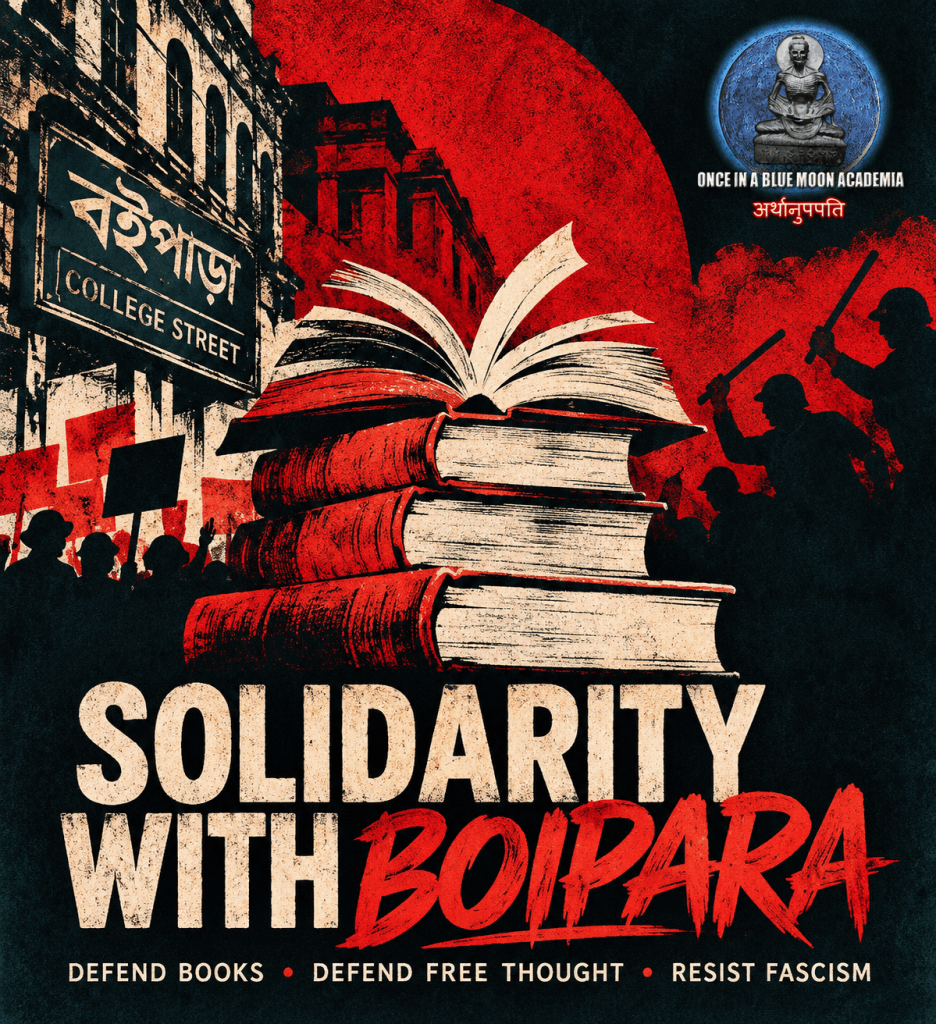
College Street is Boi Para, “Book Town”: the world’s largest second-hand book market, flanked by Presidency, Calcutta University and Sanskrit College. On 17 November the CPI(M) opened a three-day mini book fair of Left and progressive writing in front of the Mahabodhi Society. On 18 November ABVP members set up a rival stall of “nationalist” literature, with Vivekananda’s books and Bharat Mata pictures, directly in front of the SFI stall. SFI and Left leaders said ABVP members tore down its banners and ripped and burned books. ABVP supporters blockaded the road outside Calcutta University for more than an hour, tried to break through police barricades, and chanted “go back” at Left Front chairman Biman Bose (National Herald). Stones, firecrackers and eggs flew; by evening nobody had been arrested (NewsBytes; IANS via Punjab Kesari).
SFI supporters raised the national flag and said what needed saying: “No student would indulge in burning books.” BJP state president Samik Bhattacharya called it “only an expression of their youthful exuberance” (National Herald).
This is the street where generations of Bengal’s students bought Marx, Tagore, Lenin and Vidyasagar in dark back rooms and on open pavements. The ABVP brought fire to it, and the ruling party called it exuberance. There is an older word for burning books in a university quarter, and every reader knows it.
Medical College Kolkata, 18 November 2026: The White Coat and the Saffron Flag
On 17 October 2026, a crowd surge amid rain at the Chorbagan Durga Puja pandal in north Kolkata left at least 19 dead and 25 injured. Seventeen people were declared dead on arrival at Medical College Kolkata, and fourteen patients were transferred to Apollo Hospital following the state government’s decision to shift the injured to a private hospital. The interns who were first to treat the injured spoke out. They told the media there was a lack of infrastructure to handle such an emergency, and that essential supplies were short, including tranexamic acid, syringes and blood-clotting vials. They asked why critically injured patients needing advanced, life-saving treatment had to be moved to a private hospital when government medical colleges were equipped to provide such care free of cost (ETV Bharat; ThePrint/PTI). Junior docs stage protest at Kolkata Medical College, demand withdrawal of show-cause notices +2
The new government answered the question with so-called “discipline”. On 17 November the college served show-cause notices on eight interns. The notices declared their infrastructure allegations “entirely false”, said the remarks had tarnished the government’s so-called image, and called speaking to the media while on duty a disciplinary breach under the National Medical Commission’s 2021 internship rules. They warned of temporary suspension or cancellation of internships. The interns called the notices political vendetta. Dr Aniket Mahato said they were “exercising their democratic rights” (ETV Bharat). etvbharat
On 18 November junior doctors sat in outside the principal’s office. They demanded withdrawal of the notices and a copy of the inquiry committee’s report, on whose recommendations the notices were reportedly issued, and Principal Indranil Biswas was reportedly gheraoed for several hours. Then the ABVP arrived. A junior doctor linked to the Medical Students’ Council alleged that the group barged in, assaulted him and some interns, and snatched and broke his phone while he tried to record. ABVP state secretary Neelkantha Bhattacharya denied that its supporters assaulted protesters, claiming its members were attacked instead. The state’s Health Minister said protests should not take the form of a gherao and that action was taken in line with NMC guidelines. The interns alleged the college authorities acted under pressure from higher officials rather than their own assessment (ThePrint/PTI; ETV Bharat). theprint
Medical College stands on College Street. On the same day, a few hundred metres away, books were being ripped and burned at the SFI stall. Two years ago the ABVP marched for justice after the RG Kar rape and murder, when its Ludhiana chapter demanded swift justice for the RG Kar Hospital victim. Now it walks into a medical college to confront the junior doctors who asked why the poor were not treated free in a public hospital. The doctors who told the truth about tranexamic acid got show-cause notices. The men who allegedly broke a doctor’s phone got a denial from their state secretary. tribuneindia
VIII. The War on Books, Syllabi, Plays, Films and Art
The ABVP’s most durable damage is not to bodies but to texts. A broken head heals. A deleted chapter, a pulped book, a rusticated artist and a play that is never staged again shape what a generation is allowed to know. The method has four steps, repeated everywhere: take offence, stage a disruption, file a police complaint, and let the administration punish the artist.
Books
- Three Hundred Ramayanas (2008–2011). Department ransacked, essay dropped (Section II).
- The Hindus (2014). Wendy Doniger’s history was withdrawn and pulped by its publisher after a legal campaign by Dinanath Batra’s Shiksha Bachao Andolan, an outfit of the Sangh’s education ecosystem. It set the template for lawfare against books.
- Collective Violence and Criminal Justice System (Indore, 2022). On 1 December 2022, after ABVP protests, Government New Law College in Indore took six teachers, four of them Muslim, off duty for allegedly promoting “fundamentalism” (Free Press Journal). The ABVP then targeted Dr Farhat Khan’s law textbook in the college library. Principal Inamur Rahman was forced to resign and, hours later, booked with the author, the publisher and a professor for promoting enmity, on the complaint of ABVP member Lucky Adiwal (Scroll; Sabrang). The author was arrested in Pune while undergoing dialysis (Free Press Journal). Rahman said he was targeted for his faith (The Wire). In January 2023 the Supreme Court asked the Madhya Pradesh government, “You want to arrest a college principal for a book found in the library? Are you serious?” (Sabrang). On 14 May 2024 it quashed the FIR and rebuked the High Court for denying him relief; Justice B.R. Gavai called the case an “absurdity” (Sabrang). By then Rahman’s career at the college was over.
- Bengal’s bookstalls (October–November 2026). Bulldozers on Durga Puja stalls; books ripped and burned on College Street (Section VII).
Syllabi
The ABVP’s street pressure and the Sangh’s control of committees work as a single pincer.
- Delhi University: Ramanujan (2011); Mahasweta Devi, Bama and Sukirtharani (2021); Iqbal (2023) (Section IV).
- NCERT school textbooks (2022–23): Deleted, often without notification, were passages saying Gandhi’s pursuit of Hindu-Muslim unity “provoked Hindu extremists” and that “organisations like RSS were banned for some time” after his assassination, the description of his assassin Nathuram Godse as “a Brahmin from Pune”, the chapter on the Mughal courts, and references to the 2002 Gujarat riots (Careers360/PTI; Scroll; ThePrint). NCERT called the undeclared deletions an “oversight” and refused to restore them (The Wire). The RSS erased its own ban from the textbooks of every CBSE child.
Plays
- Pune, 2 February 2024. ABVP workers led by the organisation’s Pune chief stopped Ramleela, a backstage comedy staged by first-year students of Savitribai Phule Pune University’s Lalit Kala Kendra as part of their internal examination. The ABVP’s complaint got Professor Pravin Bhole, head of the centre and a faculty member since 1997, arrested along with five students (Maktoob; Scroll). The next day BJYM workers vandalised the Lalit Kala Kendra (Indie Journal). The University filed no complaint against those who assaulted its students, and instead sent the arrested professor a show-cause notice (Newslaundry).
- Pondicherry University, 29 March 2024. Somayanam, a Therukoothu-style student play questioning patriarchal notions of chastity, was branded a “mockery of the Ramayana” by the ABVP on the strength of WhatsApp clips. Police registered a case against students, the head of Performing Arts was removed, and women students reported vulgar and threatening messages (The Wire; The Wire; Deccan Herald/PTI).
Films
- Jai Bhim Comrade (Pune, 2013): students beaten (Section II).
- Muzaffarnagar Baaqi Hai (DU, 2015): screening disrupted (Section II).
- Ram Ke Naam and Hora (Pune, 2014 and 2018): screenings cancelled under ABVP pressure (Section II).
- FTII, January 2024: the day after the Ayodhya consecration, a right-wing mob forced its way into FTII, tore down a banner remembering the Babri Masjid and assaulted students while chanting “Jai Shri Ram” (The Quint; Indie Journal).
- SRFTI, 2026: a film school under police guard with its walls whitewashed (Section VII).
Art
- MSU Baroda, 5 May 2022. A mob including ABVP and VHP activists disrupted an in-house examination display at the Faculty of Fine Arts and vandalised the dean’s office over “objectionable” artworks. Police said they found nothing objectionable (Careers360/PTI; Telegraph via Kalimpong Online). The University expelled sculpture student Kundan Kumar Mahato, and Gujarat police jailed him on 4 June 2022 for “outraging religious feelings” (The Quint). The Gujarat High Court later quashed his debarment (LiveLaw). It was a rerun of 2007, when Sangh men stormed the same faculty over Chandramohan’s exam works (Outlook).
The artist is expelled and jailed. The mob is never named in a single FIR. That asymmetry is not a failure of the system; it is the system.
IX. Teachers, Vice-Chancellors and the Capture of University Lineages
The guru is the ABVP’s favourite word and its favourite target. In two decades its cadres and their Sangh siblings have killed, beaten, slapped, jailed, booked and forced out teachers from Ujjain to Kolkata. Over the same years, the Sangh’s “academic family” moved into the chairs that decide who teaches what.
The Register of Teachers Targeted
| Year | Teacher | Institution | What happened | Outcome |
|---|---|---|---|---|
| 2026 | Jadavpur faculty and students | Jadavpur University | Night raid; JUTA said teachers “lack words” to condemn it (The Wire) | No arrests reported (The Week) |
| 2026 | Two SRFTI faculty members | SRFTI, Kolkata | Injured in the 27 September attack (Scroll) | Students face rustication instead |
| 2025 | Prof. Sujit Kumar | Ambedkar College, DU | Slapped by ABVP’s DUSU joint secretary on CCTV | Union suspension of weeks, revoked early |
| 2025 | Prof. Ali Khan Mahmudabad | Ashoka University | Arrested over a post on Operation Sindoor, on a complaint by Haryana BJYM general secretary Yogesh Jatheri (Scroll; Al Jazeera) | Professor arrested; complainant untouched |
| 2024 | Prof. Pravin Bhole | Pune University | Arrested with five students after ABVP stopped a play | University show-caused the professor |
| 2024 | Head of Performing Arts | Pondicherry University | Removed after ABVP campaign against Somayanam | Students booked |
| 2022 | Prin. Inamur Rahman; Prof. Mirza Mojiz Beg | Govt New Law College, Indore | Forced resignation; FIR on ABVP member’s complaint | SC quashed FIR as “absurdity” (2024) |
| 2022 | Prof. Ravikant Chandan | Lucknow University | Heckled by an ABVP-led mob for quoting Pattabhi Sitaramayya on Kashi; FIR on ABVP member Aman Dubey’s complaint (The Quint; The Wire) | The Dalit professor booked; the mob not |
| 2020 | Prof. Atul Sood and colleagues | JNU | Heads fractured by the masked mob (Careers360) | No prosecution |
| 2017 | Prof. Prasanta Chakravarty | Ramjas College, DU | Beaten bloody | ABVP expelled two members |
| 2008 | Prof. S.Z.H. Jafri | History, DU | Office ransacked | Essay dropped in 2011 |
| 2006 | Prof. H.S. Sabharwal | Madhav College, Ujjain | Beaten to death | All six ABVP accused acquitted |
Read the outcome column. Not one of these attacks ended with an ABVP activist in prison. Several ended with the teacher in a police station.
The Chairs: Vice-Chancellors and Gatekeepers
The Kelkar template matures at the top. The ABVP’s “academic family” and its sibling teachers’ bodies, the Akhil Bharatiya Rashtriya Shaikshik Mahasangh (ABRSM) and DU’s National Democratic Teachers’ Front (NDTF), supply the cadre from which the Sangh’s university leadership is drawn.
- JNU. M. Jagadesh Kumar ran JNU through the 2016 sedition crackdown and the January 2020 attack, despite demands for his removal (The News Minute). He was then made chairman of the University Grants Commission (Careers360). His successor’s administration backed the ABVP’s version of the 2022 Kaveri violence, and in 2026 JNUSU accused it of sending “goons and sanghis” against a march over the VC’s remarks on Dalits (Section V).
- Jadavpur. CCTV reportedly showed a former Vice-Chancellor, now an ABRSM office-bearer, entering the campus during the August 2026 raid (eNewsroom). The University dissolved its students’ grievance cell.
- SRFTI. A bureaucrat from the Indian Information Service took charge two days before an RSS affiliate was given the auditorium, then blamed “external forces” for the student response (Section VII).
- Delhi University. Oversight committees with no departmental experts rewrite syllabi; the NDTF defends them (Section IV).
This is how a university’s lineage is seized. Jadavpur was founded by the National Council of Education in the Swadeshi movement. JNU was built as Nehru’s republic of argument. SRFTI carries Satyajit Ray’s name. The Sangh does not need to abolish these institutions. It needs only to hollow out the senates, staff the selection committees and leave the name over the gate, with the emblem broken.
The Measurable Result
The V-Dem Institute’s Academic Freedom Index puts a number on the damage. India’s score fell from 0.58 in 2015 to 0.38 in 2022 and 0.16 in the 2025 update, ranking 156th of 179 countries; the report names the electoral success of anti-pluralist parties as a driver of the decline (The Diplomat; The Wire). Scholars at Risk’s 2026 report puts India’s score at 0.14 for 2025 and its academic freedom as “severely restricted”, citing government influence over governance and leadership appointments and curbs on student protest (ThePrint; Outlook). Its Free to Think 2024 report found the country at its lowest point since the mid-1940s (Endangered Scholars Worldwide).
The ABVP did not do this alone. But no organisation did more, on the ground, to produce the incidents those indices count. The entire Sangh Parivar—RSS, BJP and its campus wing (and violent outlets like Bajrang Dal, Ranbir Sena, Ram Sena etc.)—must be named for what it is: saffron fascism that has systematically assaulted the Indian university, converting student violence into state power and impunity into permanent capture.
X. The National Register: Beyond Delhi and Bengal
The pattern is not a Delhi peculiarity. From Bengaluru to Prayagraj and Udupi, the same script runs: a discussion the ABVP dislikes, an invasion, a complaint, and an administration that disciplines its own students.
Azim Premji University, Bengaluru, 24 February 2026
The student group Spark Reading Circle announced a discussion marking 35 years since the 1991 Kunan Poshpora mass rape allegations against Indian security forces in Kashmir. Around 18 to 20 ABVP members forced their way into the Sarjapur campus, scrawled “Ban Spark” on the entrance wall, vandalised property and assaulted guards and students. Bengaluru Police detained them (Careers360/PTI; The South First). An APU faculty member told Alt News the ABVP had been “looking for a pretext” (Alt News).
Then the University turned on the victims. It filed an FIR against its own students who had organised the discussion (The Quint). The ABVP wrote to Home Minister Amit Shah demanding action against AISA, Spark and the University itself (Free Press Journal/IANS). In May 2026 the University suspended a woman scholar for two years (The Wire; The News Minute). A civil-society fact-finding report concluded that “the only party that must be held responsible” was “the ABVP vigilante mob” (The News Minute). PUCL Karnataka called it part of “a calculated strategy to intimidate the spirit of inquiry into silence” (PUCL). Even a private university with a philanthropist’s fortune behind it chose to surrender.
Allahabad University, February 2026: Caste in the Open
On 13 January 2026 the UGC notified regulations to curb caste discrimination in higher education, extending protection to OBC students. On 3 February, students of the Disha Student Organisation held a discussion on the regulations on the university’s Banyan Lawn. Students alleged that ABVP members and other right-wing activists attacked them with sticks and hurled casteist abuse; Nidhi Yadav and Sanjay were among the injured (The Wire; The Mooknayak). Disha students said the administration let the ABVP-linked students get away (The Quint Hindi). Another clash between Disha and the ABVP on 4 August 2026, during a fee-hike agitation, happened while security staff reportedly looked on (The Wire).
The organisation that petitions proctors in the name of “social harmony” was on the ground beating students for discussing an anti-caste-discrimination rule. Rohith Vemula’s ghost walks every campus where that happens.
Udupi and Coastal Karnataka, 2022: Saffron Shawls Against Hijabs
When Muslim girls in Udupi fought to wear the hijab to class, more than 100 saffron-shawled students breached the walls of MGM College to confront them. One of them, an ABVP member, told The News Minute that ABVP students had been alerted and told to come in saffron shawls, supplied by the Hindu Jagarana Vedike (The News Minute; The News Minute). ABVP saffron-shawl protests had already been held in Chikkamagaluru, Mangaluru and Shivamogga (The News Minute). A dress-code dispute was manufactured into a communal confrontation, and Muslim girls lost classes and exams.
The pattern had a coastal prehistory. In Puttur, a Muslim student, Sahira Shameela, was hospitalised after fellow students allegedly assaulted her for refusing to join an ABVP protest; police registered complaints against five students (Deccan Herald).
The Wider Map
- Lucknow University, May 2022: Dalit Hindi professor Ravikant Chandan heckled and booked (Section IX).
- Pune, Pondicherry, Indore, Baroda, Ujjain: plays, books, art and a professor’s life (Sections II, VIII).
- Hyderabad Central University: the Rohith Vemula complaint chain (Section III). In 2025 the ABVP reportedly swept HCU’s union elections after years of Left and Ambedkarite dominance, a victory built on a campus the state had already disciplined.
What distinguishes the ABVP from other campus bodies is not that its members fight. It is that, after it fights, the police, the administration and the ministry move in the same direction, against the people it attacked.
XI. The Electoral Machine: Money, Muscle, Fake Degrees
The ABVP treats union elections not as ends but as recruitment drives, discourse engines and talent scouting for the BJP. It began contesting soon after 1949 to dislodge the Left and controlled several major unions by the mid-1970s. Its showroom is the Delhi University Students’ Union.
DUSU 2025: The Bentley Campaign
In September 2025 the ABVP won three of DUSU’s four central posts. Aryan Maan took the presidency with 28,841 votes, beating NSUI’s Joslyn Nandita Choudhary by 16,196; Kunal Chaudhary and Deepika Jha took secretary and joint secretary. NSUI’s Rahul Jhansla kept the vice-presidency (Careers360; Free Press Journal). Some analyses put the ABVP’s vote share around 48%.
The Delhi High Court described how such victories are bought. On the day of the results it said it was “most disappointed with students” and asked where candidates got the Bentleys, Rolls-Royces and Ferraris, and the JCB earthmovers, used in their campaigns. It issued notices to all four winners, three of them from the ABVP, and called the spectacle a “sad commentary on democracy” (LiveLaw; Free Press Journal/PTI). The previous year the same court had halted the counting of DUSU votes until candidates’ defacement of public property was cleaned up, holding that the University had neglected the Lyngdoh Committee rules (LiveLaw; Careers360/PTI). Those rules cap a candidate’s spending at Rs 5,000 (Education21).
The 2025 joint secretary elected in that campaign is the same Deepika Jha who, four weeks later, slapped a professor (Section IV).
2018: The President With a Fake Degree
In September 2018 the ABVP’s Ankiv Baisoya was elected DUSU president. He had secured admission to DU’s MA in Buddhist Studies with a BA degree from Thiruvalluvar University in Vellore. The university’s controller of examinations said no student by that name had studied there and the certificate was fake (Sabrang; The Quint). Newslaundry found that Baisoya had been registered at DU itself in 2013–16, the same years he claimed to have studied in Vellore (Newslaundry).
The ABVP called the charges fraudulent and Baisoya performed a havan at the DUSU office before taking charge. DU dragged its feet for two months, long enough to avoid a re-election (The Quint). It cancelled his admission only on 14 November; Baisoya resigned the next day on the ABVP’s order, the ABVP vice-president slid into the chair, and the Delhi Police filed an FIR on 20 November (Scroll). The ABVP kept the presidency; only the face changed.
2019: Savarkar Smuggled in at Midnight
In the intervening night of 20–21 August 2019, weeks before the DUSU polls, outgoing ABVP president Shakti Singh installed a pillar with busts of V.D. Savarkar, Subhas Chandra Bose and Bhagat Singh outside DU’s Arts Faculty, without permission, under the plaque “heroes of freedom” (The Wire; Mainstream Weekly). When the row exploded, the busts vanished as they had come, in a post-midnight operation (Scroll; Telegraph via Edugraph). Section XII deals with what the stunt reveals.
Beyond DU
The ABVP has also reported wins at Hyderabad Central University (a 2025 sweep), Assam University, Ladakh University, the Central University of Himachal Pradesh and Panjab University. At JNU it took a central-panel seat in April 2025 and lost all four again in November 2025 (Section V). At Jadavpur it won nothing in 2020 (Section VII). On the most argumentative campuses, JNU and Jadavpur, the ABVP keeps losing at the ballot box. Where it wins big, money and muscle are on the field, as the Delhi High Court itself recorded.
Two Models, One Difference That Matters
The ABVP’s usual rival in DU is the Congress-linked NSUI. On welfare the two raise similar issues: fees, hostels, safety, placements. The difference lies elsewhere.
| ABVP | NSUI | |
|---|---|---|
| Ideological frame | “Nation First”, cultural nationalism, the hunt for “anti-nationals” | Secularism, social justice, constitutional values |
| Organisation | Year-round RSS-style cadre; non-ticketed members campaign for the panel | Election-centric and candidate-driven; prone to factional splits |
| Campaign | Concrete deliverables (metro passes, Wi-Fi, hostels, “One Course, One Fee”) plus saturation social media | Rights-based messaging (menstrual leave, gender cells, anti-fee-hike) |
| What it brings to campus after the vote | Disruption, complaints to police, a direct line to ministries and the Home Ministry | A weaker machine with no state behind it |
The ABVP’s real advantage is not ideas. It is continuity backed by state power: a permanent machine that never switches off between elections, and that benefits whenever the opposition vote splits, as at JNU, where the anti-ABVP vote consolidates behind the Left and NSUI is marginal.
XII. Hegemonic Co-optation and Appropriation: Stolen Icons, Borrowed Festivals
An organisation with no anti-colonial heroes of its own must borrow other people’s. The ABVP’s iconography is a pawnshop of other people’s legacies, each one turned against what its owner stood for.
- Bhagat Singh and Subhas Bose, chained to Savarkar. The 2019 midnight pillar at DU put the atheist Marxist who wrote “Why I Am an Atheist” and the commander of the secular, multi-faith INA beside the man who petitioned the British for clemency and whose Hindu Mahasabha sat out the Quit India movement (Section XI). The plaque called all three “heroes of freedom”. The point of the stunt was the third bust; the first two were cover (NewsClick).
- Swami Vivekananda, as a charge-sheet. Vivekananda’s books were the props of the ABVP’s rival stall on College Street on the day Left books were burned (Section VII). A Vivekananda poster became the basis for a police complaint at Presidency. An alleged insult to Vivekananda was the excuse for the brick-throwing at SRFTI. The monk who denounced priestcraft and caste has been made a mascot for mobs.
- Ambedkar, invoked while Dalits are beaten. The ABVP speaks the language of “social harmony” (Organiser, its own record). Its record runs from the complaint chain against the Ambedkar Students’ Association in Hyderabad (Section III), through the FIR against Dalit professor Ravikant Chandan (Section IX), to casteist abuse at a discussion of the UGC’s anti-discrimination rules at Allahabad (Section X). A professor was slapped inside a college named after Ambedkar.
- Nandalal Bose’s emblem. At Jadavpur the lotus-and-flames emblem designed by the master of Santiniketan was used as a foothold by men scaling the gate, and was broken (Section VII).
- Satyajit Ray’s name. Over a film school now under police guard, its students’ art whitewashed (Section VII).
- Festivals as wedges. Ram Navami at JNU became a ban on Sunday chicken (Section V). Vijayadashami became the burning of jailed Muslim alumni in effigy (Section V). The Ayodhya consecration became a scuffle that injured a pro-vice-chancellor at Jadavpur, and a Diwali rangoli at Gate 7 of Jamia became a staged confrontation (Sections VI, VII). Durga Puja, Bengal’s great shared festival, became the season of bulldozing Left bookstalls (Section VII). Faith is turned into a territorial marker on campuses that the Sangh wants to claim.
- Women’s safety, selectively. The ABVP marched nationwide after the rape and murder of a doctor at Kolkata’s RG Kar hospital in 2024 (Tribune). Two years later, at Jadavpur, students reported rape threats from the raiders, and a reporter was taunted with sexualised intimidation by ABVP supporters (Section VII). Women’s safety is a cause when the government is the opposition’s, and an afterthought when the mob is its own.
- Welfare, as camouflage. Metro passes, Wi-Fi and “One Course, One Fee” are real demands that real students need. The ABVP uses them as the respectable face of a machine whose other face is described in every section of this dossier.
XIII. The Pipeline: From the Campus Lathi to the Cabinet
The pipeline is the single most important fact about the ABVP. A student body that merely fought campus elections would be a footnote. A student body that supplies a third of the ruling party’s Union ministers is a structural organ of the Indian state.
The Roll of Alumni
Amit Shah has called himself an “organic product” of the ABVP (ThePrint). ThePrint’s count: when Modi returned to power in 2019, about 24 of 56 ministers inducted came from the ABVP; of the BJP’s 70 Union ministers in 2024, 23 did (ThePrint). The alumni list includes Amit Shah, J.P. Nadda, Rajnath Singh, Dharmendra Pradhan, Nitin Gadkari, Piyush Goyal, Bhupender Yadav, the late Arun Jaitley and Delhi Chief Minister Rekha Gupta, a former ABVP DUSU president (ThePrint; Open). Several of the BJP’s chief ministers chosen after 2023, among them Vishnu Deo Sai in Chhattisgarh and Bhajan Lal Sharma in Rajasthan, also rose through the ABVP (Open).
The Circuit, Closed
Read the pipeline beside the record, and the machine becomes visible.
- The Home Minister who controls the Delhi Police is an ABVP alumnus. The Delhi Police stood by at JNU on 5 January 2020, named the injured JNUSU president as a suspect, and never charged the masked mob. It entered the Jamia library, and was cleared by a court (Sections V, VI). The ABVP wrote to that same Home Minister in 2026 demanding action against Azim Premji University’s students (Section X).
- The Education Minister, Dharmendra Pradhan, is an ABVP alumnus. On his watch NCERT erased the RSS ban from textbooks, and he congratulated the ABVP on its 2025 DUSU win as a “symbol of trust” (Free Press Journal). He was forced to resign in 2026 after the Gen-Z protests at Jantar Mantar (Outlook).
- Bandaru Dattatreya and N. Ramchander Rao turned an ABVP leader’s complaint into five letters from the HRD Ministry. Dattatreya went on to be a state Governor; Rao became Telangana BJP president (Section III).
- Delhi’s Chief Minister came out of the same DUSU machine that the Delhi High Court rebuked for Bentleys and JCBs (Section XI).
This is not a coincidence of careers. It is a closed circuit. The ABVP generates the incident, its alumni in the ministry and the police decide who is investigated, and the incident becomes the cadre’s credential for the next promotion.
The Honest Comparison
Student wings everywhere feed their parties. The Congress has the NSUI, the CPI(M) the SFI, and the SFI’s own record of campus violence in Kerala is real and documented. What sets the ABVP apart is scale, continuity and direction. Its pipeline flows into a party that has held power at the Centre since 2014 and now in Bengal too, into the Home Ministry that controls the police of the national capital, and into the Education Ministry that writes the textbooks. No other student organisation in India has its graduates sitting on both ends of the lathi.
XIV. The Chronological Register, 1948–2026
Thirty-nine entries, oldest first, each one sourced in the section noted. The last column is the one that matters.
| Date | Place | What happened | Accountability | Section |
|---|---|---|---|---|
| 1948–49 | National | ABVP formed while the RSS is banned after Gandhi’s assassination; registered 9 July 1949 | n/a | I |
| 1974–77 | Gujarat, Bihar, national | Navnirman and anti-Emergency moral capital banked by the Sangh | n/a | II |
| 1980s–1992 | National | Campus mobilisation for Ram Janmabhoomi, ending in Babri’s demolition | n/a | II |
| 26 Aug 2006 | Madhav College, Ujjain | Prof. H.S. Sabharwal beaten to death on camera | Six ABVP accused acquitted, 2009; witnesses turned hostile | II |
| 25 Feb 2008 | History Dept, DU | Office of HoD S.Z.H. Jafri ransacked over Ramanujan essay | Essay dropped, 2011 | II |
| Nov 2008 | DU | Seminar on “Communalism: Fascism and Democracy” disrupted | None | II |
| 21 Aug 2013 | NFAI, Pune | FTII students beaten after Jai Bhim Comrade screening, a day after Dabholkar’s murder | None | II |
| Aug 2015 | Kirori Mal College, DU | Muzaffarnagar Baaqi Hai screening disrupted | None | II |
| Aug 2015–Jan 2016 | Univ. of Hyderabad | ABVP complaint → Union minister → HRD Ministry → five Dalit scholars suspended; Rohith Vemula’s death, 17 Jan 2016 | 2024 closure report claims he was not Dalit; no trial | III |
| 9–17 Feb 2016 | JNU, Patiala House | ABVP-invited cameras; sedition arrest of Kanhaiya Kumar; three ABVP JNU office-bearers resign in protest | Students prosecuted for sedition; no one punished for the court-complex assaults | III |
| 15 Oct 2016 | JNU | Najeeb Ahmed vanishes after assault by ABVP-linked students | CBI closure accepted, 30 Jun 2025; no one charged | III |
| 21–22 Feb 2017 | Ramjas College, DU | Seminar stoned; teachers and students beaten; Gurmehar Kaur hounded with rape threats | Two members expelled by ABVP | IV |
| Sep–Nov 2018 | DU | ABVP’s DUSU president Ankiv Baisoya found using a fake degree | Resigns after two months; ABVP keeps the post | XI |
| 20–21 Aug 2019 | Arts Faculty, DU | Savarkar bust installed with Bhagat Singh and Bose overnight, without permission | Removed overnight | XI |
| 19 Sep 2019 | Jadavpur | Students’ union room ransacked and set on fire | Suo motu case against “unknown people” | VII |
| 15 Dec 2019 | Jamia | Police storm library under ABVP alumnus’s Home Ministry | Court dismisses Jamia’s plea, 2022; petitions pending | VI |
| 5 Jan 2020 | JNU | Masked mob injures 30+; ABVP links shown by sting and Alt News | No chargesheet, no prosecution | V |
| Aug 2021 | DU | Mahasweta Devi, Bama, Sukirtharani dropped from English syllabus | Dissent of 15 AC members overruled | IV |
| Feb 2022 | Udupi | ABVP members in saffron shawls confront hijab-wearing classmates | Muslim girls lose classes | X |
| 10 Apr 2022 | Kaveri hostel, JNU | Attack over Sunday chicken on Ram Navami; 20 injured | FIR; administration backs ABVP | V |
| May 2022 | MSU Baroda | Fine Arts exam display attacked; student expelled and jailed | Gujarat HC quashes debarment | VIII |
| 10 May 2022 | Lucknow Univ. | Dalit professor Ravikant heckled; FIR on ABVP member’s complaint | Professor booked | IX |
| Dec 2022 | Govt New Law College, Indore | Principal forced out and booked over a library book | SC quashes FIR as “absurdity”, 2024 | VIII |
| 2022–23 | NCERT, national | RSS ban, Gandhi’s assassin, Mughals, Gujarat riots erased from textbooks | NCERT calls it an “oversight”, refuses to restore | VIII |
| May 2023 | DU | Iqbal removed from political science; ABVP celebrates | n/a | IV |
| 22 Jan 2024 | Jadavpur | Scuffle over Ayodhya live-stream; pro-VC injured | n/a | VII |
| 2 Feb 2024 | Pune Univ. | ABVP stops a student play; professor and five students arrested; BJYM vandalises centre | University files no complaint against attackers | VIII |
| 29 Mar 2024 | Pondicherry Univ. | ABVP campaign against Somayanam; HoD removed | Students booked | VIII |
| 22 Oct 2024 | Jamia | ABVP cultural wing’s Diwali event at Gate 7 ends in scuffle | Jamia student arrested, 2025 | VI |
| 18 May 2025 | Ashoka Univ. | Prof. Ali Khan Mahmudabad arrested on BJYM leader’s complaint | Professor arrested | IX |
| 2 Oct 2025 | JNU | Jailed alumni Umar Khalid and Sharjeel Imam burned in effigy as Ravan | None | V |
| 16 Oct 2025 | Ambedkar College, DU | DUSU joint secretary slaps Prof. Sujit Kumar | Suspension revoked early, 7 Jan 2026 | IV |
| 3 Feb 2026 | Allahabad Univ. | Casteist abuse and assault at UGC anti-discrimination discussion | Police complaints; two students suspended, affiliation unreported | X |
| 22–23 Feb 2026 | JNU | Stones on JNUSU encampment during march over VC’s remarks | Mutual allegations | V |
| 24 Feb 2026 | Azim Premji Univ. | Campus invaded over Kunan Poshpora discussion | University files FIR against its own students | X |
| 19–20 Aug 2026 | Jadavpur | Night raid after BJP MLA’s “tandav” call; CCTV destroyed; emblem broken | No arrests; grievance cell dissolved | VII |
| 27 Sep, 4 Oct 2026 | SRFTI, Kolkata | RSS-affiliate event ends in ~30 students and 2 faculty injured; bricks a week later | Students face rustication; police on campus | VII |
| Oct 2026 | Durga Puja, Bengal | Left bookstalls bulldozed, vandalised, burned after CM’s call | CPI(M) files 10 complaints in Kolkata | VII |
| 18 Nov 2026 | College Street, Kolkata | Books allegedly ripped and burned at SFI stall | BJP calls it “youthful exuberance” | VII |
XV. The Saffron Turnstile and the Two-Column Test
The Saffron Turnstile
Seventy-seven years of incidents pass through one revolving gate, turning the same way every time: the attacker walks through, the victim is pushed back out. Each stage is documented above.
- Provocation by designation. An event, book, play, film, meal or poster is branded “anti-national”, “Naxal”, “Hinduphobic” or “urban Naxal”. (Kunan Poshpora at APU; Somayanam; Kaveri’s chicken; Ramanujan.)
- Disruption. Stones, lathis, flag-poles, locked rooms, burning cloth balls, or a crowd at the proctor’s door. (Ramjas; JNU 2020; Jadavpur 2026.)
- Counter-complaint. The ABVP files the first FIR, against its victims. (Susheel Kumar’s assault claim; Lucky Adiwal on the Indore book; Aman Dubey on Ravikant; the Pune play; the SC/ST Act complaint against 11 Jadavpur students.)
- State relay. A minister writes, a ministry sends reminders, police arrive late or stand by, a VC calls the victims “external forces”. (Dattatreya’s letter and five MHRD reminders; Delhi Police at JNU; SRFTI.)
- Victim punished. Suspension, rustication, arrest, forced resignation, a syllabus purge. (Rohith Vemula; Kundan Mahato; Pravin Bhole; Inamur Rahman; the APU scholar.)
- Attacker cleared or forgotten. Acquittal, closure report, “unknown persons”, or a token suspension revoked early. (Sabharwal; Najeeb; JNU 2020; Deepika Jha.)
- Promotion. The cadre’s record becomes a credential; the minister becomes a Governor; the MLC becomes state president; the alumnus becomes Home Minister. (Section XIII.)
The turnstile does not need anyone’s guilt to be proven. That is what makes it work. An allegation becomes punishment for the accuser’s opponents, and an acquittal becomes a certificate of virtue.
The Two-Column Test: The Mask and the Face
Set what the Sangh says on the left and what the record shows on the right, and read across.
| What the Sangh says | What the record shows |
|---|---|
| “Gyan, Sheel, Ekta”: knowledge, character, unity | An essay purged (Ramanujan), a library book criminalised (Indore), a professor beaten to death (Ujjain) |
| The ABVP is “an independent social organisation” | Its Central Working Committee formally welcomed the BJP government in Bengal; 23 of 70 Union ministers are its alumni |
| “ABVP is not the student wing of BJP” (Samik Bhattacharya, August 2026) | A BJP MLA announced “tandav all night” outside Jadavpur hours before the raid |
| Concerns must be addressed “not through violence” (Virendra Singh Solanki, August 2026) | That month: CCTV destroyed, emblem trampled, students hospitalised at Jadavpur |
| The raid was a “surgical strike” to “rid the campus of cockroaches” (ABVP leaders) | The same language the regime uses for enemies, applied to students |
| The ABVP “always promotes discussion” (ABVP Delhi leader, Ramjas 2017) | “If Umar Khalid had come, he would not have gone back alive” (ABVP supporter, Ramjas 2017) |
| Burning books was “youthful exuberance” (BJP Bengal president, November 2026) | “No student would indulge in burning books” (SFI, the same day) |
| Professor Sabharwal died of a “heart attack” (Organiser) | Lung and rib injuries after a beating watched by TV cameras |
| Rohith Vemula was not a Dalit (Telangana Police closure report) | “How can my own child not be a Dalit when I am?” (Radhika Vemula) |
| Najeeb’s disappearance: “no credible lead” (CBI) | “The goons who assaulted my son and then made him disappear” (Fatima Nafees) |
The gap between the left column and the right is not hypocrisy. Hypocrisy implies a value betrayed. Here the left column is the camouflage and the right column is the programme.
XVI. Demands
OBMA demands the following, from Parliament, the courts, the University Grants Commission, state governments and every university’s statutory bodies.
Truth
- A Supreme Court-monitored judicial commission on campus violence from 2016 to 2026, with power to examine the Delhi Police, the West Bengal Police and university administrations: JNU (2016, 2020, 2022, 2025, 2026), Ramjas (2017), Jamia (2019), Jadavpur (2019, 2026), SRFTI (2026), Azim Premji University (2026) and Allahabad University (2026).
- Reopening of the 5 January 2020 JNU attack under an agency independent of the Union Home Ministry, with the “Unity Against Left” and “Friends of RSS” WhatsApp groups examined in full.
- A fresh, court-monitored probe into the disappearance of Najeeb Ahmed, as the closure order itself permits on new evidence.
- A completed reinvestigation into Rohith Vemula’s death, and a central Rohith Vemula Act against caste discrimination in higher education.
Justice
- Prosecution of the Jadavpur raiders of 19–20 August 2026, an inquiry into the conduct of the MLA who announced the “tandav”, and a public account of who destroyed the CCTV.
- Withdrawal of every FIR, rustication and suspension imposed on victims: the SRFTI six, the Azim Premji scholar, the Jadavpur students named in the SC/ST Act complaint, and the remaining cases against teachers and students in Pune, Pondicherry and Lucknow.
- Compensation and apology to Prof. Sujit Kumar, Inamur Rahman, Kundan Kumar Mahato, Pravin Bhole and the Jamia library victims.
Repair
- Restoration of A.K. Ramanujan, Mahasweta Devi, Bama, Sukirtharani and Iqbal to Delhi University’s syllabi, and of the deleted passages on Gandhi’s assassination, the RSS ban, the Mughals and the 2002 Gujarat riots to NCERT textbooks.
- Statutory protection for libraries, bookstalls and book fairs, including Durga Puja stalls and College Street, against demolition, seizure or destruction for content.
- Collegial appointment of Vice-Chancellors by search committees free of ministry nominees, with conflict-of-interest bars for office-bearers of ABRSM, NDTF and every party-linked teachers’ body.
Accountability for the Organisation
- Enforcement of the Lyngdoh Committee rules with automatic disqualification for candidates booked for violence against teachers or students, and audited campaign spending.
- De-recognition of the ABVP as a campus organisation wherever a university inquiry finds its office-bearers responsible for violence against teachers or students, until it publicly accepts responsibility for its record and disowns the “surgical strike” doctrine.
We in OBMA are counter-academiocracy. But when the attack is on free thought and education as such, we always unequivocally stand with the right to critical thinking and the right to the culture of reading-writing-questioning. OBMA strongly condemns the seventy-seven-year campaign of the Saffron Fascist BJP-ABVP-RSS to seize the Indian university by force, by appointment and by syllabus. From the founding counter-mobilisation of 1948–49 to the professor beaten to death at Ujjain, the ransacking of Delhi University’s History Department, the complaint chain that led to Rohith Vemula’s death, the disappearance of Najeeb Ahmed, the attacks at Ramjas and the masked mob at JNU, the night raid on Jadavpur, the siege of SRFTI, the purging of syllabi and the burning of books on College Street on 18 November 2026, the record is one machine: disruption, then complaint, then state action against the victim, then impunity for the attacker, then promotion for the alumnus. The latest attack on Boipara—the neighbourhood of books, College Street in Kolkata, Asia’s largest book-selling neighbourhood—and on Left bookstalls across West Bengal as well as Calcutta Medical College and Hospital lays bare just how deeply the BJP-RSS fears books, educational clarity, reading, independent thinking and critical inquiry. For them, those who dare to think independently are “dimagi Naxals”—another name for what Orwell chillingly anticipated as thoughtcrime. At a time when India is being subjected to an undeclared Emergency, we stand firmly with those who continue to defend the fundamental right to read, write, think, criticise, dissent, protest and resist. Fascists have always feared thinking people. They have always sought to suppress free thought, silence dissent and crush intellectual freedom. The university is not a parade ground for the Sangh. It is the commons where a society argues with itself. OBMA demands that it be returned to its students and teachers. THIS REGIME MUST GO. NOW OR NEVER.
Sources
Founding, leadership, numbers (I): Careers360 on 2025–26 office-bearers · The Statesman on ABVP welcoming the Bengal government
1974–2015 (II): Siasat on Prof. Sabharwal · eNewsroom on the Sabharwal trial · Newslaundry, “The Kids Are Not Alright” · Mukul Kesavan, The Telegraph, via SACW · The Quint’s ABVP violence timeline · NewsClick on FTII, 2013
2016 (III): Newslaundry, “Anatomy of a Tragedy” · The News Minute on MHRD reminders · ThePrint on the 2024 closure report · The Caravan, “How the ABVP Brought the State into JNU” · Newslaundry interview with Pradeep Narwal · Newslaundry on the Najeeb closure
Delhi University (IV, XI): The Wire, “We Beat Teachers Too” · Scroll on the Mahasweta Devi deletion · Tribune on the Ambedkar College slap · Tribune on the suspension revoked · Newslaundry on Ankiv Baisoya · LiveLaw on the 2025 luxury-car campaign
JNU (V): The Caravan on 5 January 2020 · The Wire, a year on · The Wire/Alt News on Akshat Awasthi · Alt News on Komal Sharma · Newslaundry on Kaveri hostel · ThePrint on February 2026
Jamia (VI): ThePrint on the library assault · The Caravan on campus insecurity · PUDR via Counterview
Bengal (VII): The Wire, “12 Hours of Saffron Mob Violence” · eNewsroom, “Who Owns Jadavpur?” · Mainstream Weekly, “Jadavpur University is the Target Now” · Scroll on SRFTI · Alt News on bookstall attacks · ThePrint on Puja bookstalls · National Herald on College Street
Books, plays, art (VIII): Sabrang on the Indore SC ruling · Newslaundry on the Pune play · The Wire on Somayanam · Scroll on NCERT deletions · The Quint on Kundan Mahato
Teachers and academic freedom (IX): The Wire on Lucknow · Scroll on Ali Khan Mahmudabad · The Wire on the Academic Freedom Index · ThePrint on Scholars at Risk 2026
National register (X): The News Minute fact-finding on APU · PUCL Karnataka · The Wire on Allahabad · The News Minute on Udupi
Pipeline (XIII): ThePrint, “Cradle of BJP Leadership” · ThePrint, “BJP Leaders’ Launchpad”

