
Posted on 5th November, 2026 (GMT…)
In the markets of Bombay and the outskirts of Kolkata, in the kitchens that feed the factories and the queues that once bought time with the body, a single inversion holds. The state that sells hope keeps sixty paise of every rupee; the game it calls crime keeps ten. What is legal extracts more than what is outlawed. What is counted is cleaner than what is lived. The street agent who moves lakhs is statistically absent; the lottery that drains the same neighbourhood is booked as revenue and welfare. The tout who once sold the gap between the administered price and the desperate traveller has been replaced by the algorithm that performs the same function under a public-service name. The copy that taught a generation sits outside the accounts; the counterfeit note that threatens the state’s own original is counted with care. The kitchen that returns a rested worker to the office each morning is invisible, until a diamond chain arrives and the unpaid becomes the instrument of surplus.
These are not separate shadows. They are one apparatus, sorted by class. The poor meet the high edge, the violence, the criminal record, the protection rent. The affluent meet the low margin, the private table, the unmeasured kitty, the impunity. Between them runs the Iron Triangle: the cultural claim, the crony capital, the organised muscle, each feeding the others so that the loop remains closed. Measurement is not a neutral mirror. It is the act that decides which transfers count as economy and which may be ignored, criminalised, or rendered weightless. What the national accounts refuse to see is not thereby free. The uncounted can still be captured—by the firm that thanks the wife, by the rights-holder who was once a copyist, by the platform that sells scarcity as growth. Not counted is not the same as not subsumed.
The paper begins from that recognition. It refuses the vocabulary that treats the shadow as residual, the informal as transitional, the unmeasured as unreal. It places the lottery beside the satta, the queue beside the flexi fare, the footpath copy beside the counterfeit, the kitchen beside the firm. It stages the quarrel between the welfare economist who would internalise the costs and the critic of institutions who would defend the autonomous life, and finds that each fails alone where the regulator is the operator and where autonomy cannot answer the acid and the debt. What remains is neither formalisation nor its opposite. It is the demand that systems serving real needs be left standing, that specific harms be prosecuted, and that the desperation driving people into the extraction be attacked at the root—so that participation becomes a choice rather than a symptom. The extraction is not inevitable. It is maintained by the decision, every day renewed, about what is allowed to count.
ABSTRACT
India’s state lottery retains roughly 60 paise of every rupee staked while the satta it criminalises retains roughly 10. This inversion organises an analysis of interlocking systems—satta, sports betting, hawala, mandoli and chit funds, kitty parties, state lotteries, tin patti, flexi and surge fares, the copy economy, sex work as an unorganised sector, and professional over-billing with police and party tolabaaji—as a single, class-differentiated apparatus of extraction. The heaviest take falls on the precariat; elite variants run at low margins under impunity. The systems interlock with organised crime, protection rents and political finance inside an Iron Triangle. “Legality as protection” is a fiction: the legal lottery out-extracts its outlawed rival, and the 2025 ban on online money games prohibits competitors while state draws continue. Official statistics do not merely miss these flows; the line between “economy” and “shadow” is drawn by measurement authority as a constitutive exclusion. The same systems are at once rational responses to the failures of formal finance and instruments of elite consolidation. Staging a dialogue between Pigou and Illich, the paper shows that each fails alone and synthesises them as accountable autonomy: decriminalise autonomous community systems that meet real needs, prosecute specific harms rather than whole systems, and attack the desperation that drives participation. Three extensions sharpen the thesis: the ticket tout’s rent has been subsumed by flexi fares and surge pricing that launder the identical scarcity premium into the national accounts as growth; the copy economy, read through Plato’s cave, separates a knowledge commons from counterfeit predation; and the homemaker’s kitchen, read through Illich, Engels and Marx, shows that the uncounted can still be subsumed—the kitchen is free not when it is unpaid, but when it is unprivatised. India’s extraction economy is offered as a test case for theories of peripheral capitalism, institutional predation and the political economy of knowledge production.
Before the Beginning: The Unequal Dice
INT. HASTINAPURA ASSEMBLY HALL — NIGHT
The hall is vast, lit by oil lamps that throw more shadow than light. The pillars are carved with yaksas and nagas; the floor is polished stone that reflects the figures gathered around a low table. At the centre sits the dice board. The pieces are ivory and blackwood, already warm from handling.
YUDHISHTHIRA sits opposite SHAKUNI. His brothers—BHIMA, ARJUNA, NAKULA, SAHADEVA—stand behind him. Across from them, DURYODHANA reclines, one knee drawn up, watching. DRUPADA’s daughter DRAUPADI is not yet in the room.
SHAKUNI
(soft, almost intimate)
The stake is yours to name.
YUDHISHTHIRA
The kingdom.
A murmur moves through the assembly and dies. The lamps flicker. SHAKUNI’s hand moves once. The dice fall. He does not look at them.
SHAKUNI
Again.
They play. Each throw is quiet. YUDHISHTHIRA names Indraprastha, then the jewels, then the herds, then the brothers one by one. BHIMA’s fists open and close. ARJUNA’s bow-hand stays still. NAKULA and SAHADEVA do not speak. The assembly does not intervene. The rules of the hall require silence while the dice are moving.
SHAKUNI
And the queen.
YUDHISHTHIRA’s mouth opens. No sound comes. He looks at the dice already in SHAKUNI’s palm. The hand is steady. The thumb knows the weight of each piece.
YUDHISHTHIRA
Draupadi.
The word is small in the large room. DURYODHANA smiles without showing teeth. From the inner chambers a woman is summoned. She arrives unbound, hair still wet from the bath, a single cloth about her. She stops at the edge of the circle of light.
DRAUPADI
(to the assembly, not to the players)
Was I staked before or after he lost himself?
No one answers. The question hangs. SHAKUNI does not pick up the dice. The game, for a moment, has stopped being a game.
DUSHASANA steps forward. He takes the edge of her cloth. The hall is very quiet. The oil in the lamps makes a small sound. Somewhere beyond the pillars a guard shifts his weight and the leather of his armour creaks.
DRAUPADI looks at the floor where the dice lie. They have not been gathered. One black piece has rolled against a pillar base and stopped. She does not look at YUDHISHTHIRA. She looks at the piece.
DRAUPADI
(quietly)
The stake was named after the thrower was already lost. The throw was never equal. And still the hall is silent.
She does not raise her voice. The cloth does not tear. In the space between the question and any answer, the lamps continue to burn. The dice remain on the floor. The assembly remains seated. Outside, the night is ordinary. Inside, the rules of the game continue to hold because no one has yet broken them.
The same hall, the same silence, the same unequal dice: what is “legal” extracts more than what is outlawed, and what is counted remains “cleaner” than what is lived.
We’re all set to begin now.
0. Prolegomenon: Categories Before Systems
The argument begins by refusing the vocabulary in which the problem is usually posed. “Shadow economy,” “informal sector,” “parallel economy,” “grey economy,” “black market,” “shadow work,” and “shadow play” are not neutral descriptors. They are classificatory acts that decide in advance what counts as economy, what counts as deviation, and what is allowed to remain uncounted. The paper therefore starts not with the systems but with the authority that draws the line around them.
A knowledge apparatus, not a citation list.
The references are organised as an argument about where existing scholarship stops. A note on the grade of every figure precedes the analysis. The paper does not claim to have measured what official statistics have chosen not to measure; it claims only that the choice itself is political and must be made visible.
Who defines the mainstream, and by what right?
Conventional analysis begins from a self-evident “formal” or “mainstream” economy and treats everything else as residual, pathological, or transitional. We reverse the order. By what authority are some flows declared economic and others informal, criminal, or shadow? The term “informal sector” was coined by an anthropologist (Hart, 1973) precisely to name activity that official categories could not see. Half a century later the label still marks the edge of official sight rather than any intrinsic property of the activity. Corporate turnover, government spending, and recorded wages cross the boundary and become real. Doctor’s bills, advocate’s fees, police and local-party tolabaaji, sex workers’ payments, and the daily hafta remain on the other side—linguistically and statistically absent, however large the capital they move. The distinction is not technical. It is an exercise of measurement power.
Invisibly visible, visibly invisible.
The shadow lives in an ontological paradox. It is invisibly visible: every neighbourhood knows its satta agent, every policeman knows the monthly protection rent, every party knows who funds whom, yet the street agent handling lakhs a day is statistically nonexistent. Conversely, much of the formal economy’s predation is visibly invisible. A state lottery’s take is booked as “revenue” and “welfare.” A corporate collapse such as DHFL—at the centre of what the CBI in 2022 called a ₹34,615 crore bank fraud—appears in court records but never as extraction in the national accounts. Professional extraction (medical and legal bills that routinely exceed any published schedule, tolabaaji collected under the colour of party or police authority) is normalised as fee or contribution. The more legitimate the predation, the less visible it is as predation. Sex work, long treated as the paradigmatic unorganised and therefore invisible sector, makes the same point in reverse: its payments are real, its extraction real, its statistical absence deliberate.
Why “shadow”? Parallel, grey, and the politics of the name.
“Shadow” implies a secondary reflection of a primary, legitimate economy. “Parallel” implies a second track running beside the first. “Grey” implies a temporary or mixed zone awaiting clarification. Each metaphor conceals the same decision: that the official economy is the original and everything else is derivative, lesser, or transitional. Shadow work (Illich) and shadow play are not residual toil or residual gambling; they are the unpaid and the uncounted labour and risk that the formal economy requires and then disowns. The paper therefore treats these terms as symptoms of the classification problem, not as solutions to it. What is called shadow is often the economy that formal institutions have failed to provide, or the economy they have chosen not to see.
Extend the kitty party—and every other system filed under leisure or vice.
The women’s kitty is usually filed under leisure. We read it as a class-reproduction apparatus: a site of genuine female financial autonomy that also gatekeeps caste, class and community networks, launders some money, and hosts some Ponzi schemes. The same refusal of the leisure/vice frame applies to tin patti, to casual satta, and to sex work. Once the activity is named leisure or vice, its economic functions—saving, credit, risk transfer, income, extraction—become invisible by definition. The classification does the work of exclusion before any statistic is collected.
Exclusion from GDP, and the GDP fetish itself as exclusionary.
The problem is not only that GDP misses things. It is that GDP, treated as the measure of national worth, makes whatever it misses politically weightless. Measurement is governance. Unregistered legal production is estimated, however badly; illegal production is excluded by choice. The boundary is not required by the System of National Accounts; it is drawn by the measurement authority and defended in the language of legitimacy. What remains outside—satta commissions, hawala spreads, protection rents, sex workers’ earnings, tolabaaji—is thereby rendered irrelevant to growth, resilience, or welfare debates. The fetish of the measured economy is itself an act of power.
Shadow systems as rational responses to formal exclusion.
Hawala persists because cross-border formal remittance is slower, dearer and document-heavy. Mandoli persists because banks offer no socially enforced lump sum timed to a wedding or an emergency. Satta persists because the poor are shut out of every legal speculative market except the one with the worst odds. Sex work and petty professional extraction persist because formal credit, formal employment, and formal justice are unavailable or unaffordable. The criminological question (“why do they gamble / sell sex / pay hafta?”) must give way to the institutional one (“why have formal alternatives failed them?”).
Not counted is not the same as not subsumed.
The black market in tickets, the copy on the footpath, the homemaker’s kitchen, and the sex worker’s earnings all lie outside GDP, yet each can be—and is being—captured: the tout’s rent by the algorithm and the government order, the copy by the rights-holder who was once a copyist, the kitchen by the firm’s gratitude, the sex worker’s income by intermediaries, platforms, and protection. The question is never only whether a flow is counted, but who captures it once it is seen.
1. Introduction
1.1 The core question: why does the measured economy look both smaller and cleaner than the economy that actually exists?
India’s nominal GDP for 2025–26 stands in the order of ₹350 lakh crore. Running beneath and beside it is a second set of circuits—unregistered production, untraced finance, protection rents, and outright predation—whose scale is known only through models that largely re-describe activity the national accounts already attempt to capture. Schneider’s series put the shadow economy at 23.1 percent of official GDP for 1999/2000; a 2025 MIMIC working paper reports 41.1 percent (Ahmed, 2025). On the current base those percentages imply ₹80–140 lakh crore. The figures, however, mostly overlap with the informal layer that official statistics already try (and fail) to estimate. What remains constitutively outside is the illegal layer: satta commissions, unlicensed bookmaking, hawala spreads, protection rents, and the earnings of sex workers treated as an unorganised sector.
The discrepancy is not a technical lag. It is the product of a measurement authority that records taxable, documented flows with precision and leaves everything else uncounted or criminalised. When doctor’s bills, advocate’s fees, police and local-party tolabaaji, and sex workers’ payments are statistically absent while corporate turnover and government spending are fully present, the boundary itself is the decision. The state is not mirroring the economy; it is determining which transfers count as economic activity and which are rendered invisible, illegitimate, or irrelevant to growth.
1.2 Extraction as system, not residual vice
Standard accounts treat the uncounted circuits as pathology to be reduced by tax, regulation, and enforcement. The framing is both empirically thin and politically useful. Many of the systems examined here are institutional replies to the absence or failure of formal alternatives: hawala where cross-border remittance is slow and document-heavy; mandoli where banks supply no socially enforced lump sum timed to need; satta where the poor are excluded from every legal speculative market except the one with the worst odds. At the same time they are predatory. Match-fixing syndicates, satta networks that enforce debts with acid and sexual violence, and police–operator partnerships that criminalise street players while shielding organised ones are not deviations from the systems; they are internal to them.
The paper therefore refuses the binary of “rational survival” versus “criminal predation.” All six systems are placed inside a single logic of extraction—the transfer of surplus from vulnerable populations to organised operators, political financiers, and state structures. The instrument changes (house edge, commission, social obligation, protection rent), but the direction does not. Class sorts exposure. Precariat and working-class participants meet the highest margins, the violence, and the criminal record. Elite variants—private club tables, high-value investment kitties, professionally managed chits—operate at low margins under effective impunity. Professional extraction (medical and legal over-billing, party and police tolabaaji) and sex work (organised as an unorganised sector) follow the same gradient: the same activity is fee or livelihood at one end of the class scale and predation or criminality at the other.
1.3 The Iron Triangle and the strategic state
The systems do not run in isolation. They are networked through an Iron Triangle of cultural-theocratic nationalism, crony capital, and organised crime, held together by police protection rents and political finance. Betting and satta cash enters campaigns; syndicates place capital in real estate; hawala moves untracked funds for trade, diaspora households, and illicit purposes alike; mandoli supplies the social insurance the state declines to fund. Sex-work networks and local tolabaaji circuits feed the same protection economy.
The state does not simply combat these circuits; it engages them selectively. It criminalises competitors to its own lotteries, harvests protection payments, tolerates flows it finds useful, and enforces along class lines. Government-sponsored gambling continues while non-government gambling is banned or taxed into the offshore shadow. This is not corruption understood as departure from proper function. It is system logic: an impunity loop in which each vertex of the triangle draws advantage from the others and therefore reproduces them.
1.4 Scope and structure
Section 2 records sources and assigns every figure one of three grades. Sections 3–9 examine satta, hawala, mandoli and chit funds, kitty parties, state lotteries and tin patti, the subsumption of the ticket tout’s rent by flexi fares, surge pricing and cinema price orders, the horse-racing/horse-trading couplet, and sports betting. Section 10 treats measurement as governance—how the shadow is counted, by whom, and how an auditor might register the copy economy. Section 11 stages the dialogue between Pigou and Illich, using a domestic parable to bring Engels into the question of the uncounted kitchen. Section 12 assembles the comparative taxonomy; Section 13 proposes accountable autonomy; Section 14 situates the argument in the literature; Section 15 concludes.
The theoretical spine is placed where the empirical systems have already made its necessity plain: formalisation under a revenue-maximising state intensifies extraction, while unguarded autonomy cannot answer organised violence. The synthesis—accountable autonomy—decriminalises systems that meet real needs, prosecutes specific harms, and attacks the insecurity that drives participation.
2. Methods, Sources and a Note on Figures
2.1 Evidence bases
The analysis rests on twelve overlapping bodies of material, none of which is treated as self-sufficient. Shadow-economy measurement literature (Schneider & Enste 2000; Schneider 2005; Chaudhuri, Schneider & Chattopadhyay 2006; Medina & Schneider 2018) supplies the macro estimates and their known calibration problems. IMF and World Bank work on informal value transfer (El Qorchi, Maimbo & Wilson 2003; Passas 2005) and the economics of rotating savings (Besley, Coate & Loury 1993; Anderson & Baland 2002) provide the institutional logic of hawala and mandoli. Enforcement and investigative records—CBI and ED statements on chit-fund and Ponzi collapses, the Mudgal and Lodha committee findings on IPL betting, Al Jazeera’s 2018 spot-fixing investigations—document predation and protection. Kerala government disclosures and RTI data on lottery sales, costs and profits fix the state’s own take. The Law Commission’s Report No. 276 (2018), the Promotion and Regulation of Online Gaming Act 2025, and the GST Council’s September 2025 rate decisions record the legal architecture. NSO/PLFS survey design documents reveal what the labour and enterprise surveys are built not to see. The CAG’s audit of the railways’ flexi-fare scheme, the Railway Ministry’s 2025 Tatkal rules, the Ministry of Civil Aviation’s December 2025 fare caps, and government and court records on cinema ticket pricing in Telangana and Karnataka track the subsumption of the tout. Statute and case law on copying—the Copyright Act 1957, the Cinematograph (Amendment) Act 2023, the Rameshwari Photocopy judgment—and investigative records on ticket black-marketing and counterfeit currency frame the copy economy. The OECD exhaustiveness framework for the non-observed economy supplies the international standard against which India’s exclusions are measured. Finally, OBMA field observation and activist research in informal-sector communities in and around Kolkata, including the author’s long acquaintance with the city’s footpath copy markets, supply the ground-level texture that desk methods miss.
These sources are deliberately heterogeneous. Official disclosures are precise about what they choose to record and silent about what they exclude. Enforcement data measure policing intensity as much as markets. Academic models are desk constructions. Field observation is local and partial. The paper does not claim to have solved the measurement problem; it claims only to have made the choices inside it visible.
2.2 Three grades of figure
Shadow systems are badly measured by construction. Public debate routinely mixes sourced numbers with working guesses. This paper marks the difference. Every figure is assigned one of three grades:
- Sourced — taken from an official disclosure, court or agency record, or peer-reviewed study, and cited in place.
- Reported estimate — an industry, association, press or working-paper figure that is widely repeated but not independently verifiable; cited and treated as indicative only.
- OBMA working estimate — our own order-of-magnitude reasoning, flagged as such and offered as a hypothesis for others to test. These remain desk estimates; Section 10.7 proposes how to replace them with fieldwork.
The grading is itself a methodological intervention. Official statistics claim precision for what they count and silence for what they do not. Doctor’s bills, advocate’s fees, police and local-party tolabaaji, and sex workers’ payments—treated as an unorganised sector—illustrate the silence: they move substantial capital yet appear in no systematic table. We prefer stated uncertainty to false precision.
2.3 Turnover is not value added
One correction runs through the paper. Turnover (total stakes, total transfers, total chit value) is not contribution to GDP. In national accounting the output of a gambling service is stakes minus prizes—the operator’s take. If gambling were fully counted, what would be added is precisely the extraction. National accounts would book the house’s take from the poor as the “production” of a service. The same logic applies to protection rents, intermediary cuts on sex work, and professional over-billing: the measured “output” is the surplus transferred. The measurement question and the extraction question are therefore the same question seen from two sides.
2.4 Theoretical frame
The paper reads Pigou’s welfare economics (market failure, externality, corrective regulation) against Illich’s critique of institutional colonisation (convivial tools, shadow work, the professional capture of autonomous life). Extraction is situated in the political economy of dispossession (Harvey 2003; Sassen 2014) and of extractivism (Acosta 2013; Veltmeyer 2013), extending a framework built for minerals and land to financial predation in everyday life—including the everyday predation of medical and legal fees, tolabaaji, and the organisation of sex work as an unorganised sector.
Three further lenses serve particular sections. Marx’s distinction between the formal and real subsumption of labour under capital frames the state–corporate capture of the black market’s rent (7.6); the author’s reading of necessary labour as labour for self, family and community—not as “unpaid” labour—frames the household (11.2). Plato’s cave and the theory of the simulacrum (Deleuze, Baudrillard) frame the copy economy (10.5). Engels, Mauss and feminist political economy—Dalla Costa and James, Federici, Rubin, Lerner and Chakravarti’s brahmanical patriarchy—frame the kitchen as a site of bondage and of possible commune (11.2).
2.5 Comparative axes
Each system is compared on seven axes: extraction rate; scale; primary function (transfer, saving, consumption, speculation); criminality (organised crime, violence, terror finance); class target; relationship to the state (tolerated, criminalised, operated); and persistence mechanism. The comparison exposes the political economy of law: not neutral protection, but an instrument of class power and of the state’s monopoly over extraction. Government-sponsored gambling and non-government gambling, professional fees and street tolabaaji, sex work organised as livelihood and sex work organised as predation, all fall on the same axes. The law does not sort harm from harmlessness; it sorts who may extract and who must be extracted from.
3. Satta: Extraction in the Informal Economy
Satta Matka began in 1950s–60s Bombay as bets on New York cotton rates relayed by telegraph to the Bombay Cotton Exchange. When the American cotton figures ceased, operators shifted to drawing numbers from a matka (clay pot). The game peaked in the 1980s–90s under figures such as Ratan Khatri. Successive crackdowns—first municipal, later under organised-crime statutes—pushed it from central markets to industrial outskirts, then into private rooms, and finally onto encrypted apps and Telegram channels. The paper treats it not as residual vice but as a fully articulated extraction economy. It reproduces the core mechanisms of formal speculative finance (asymmetric information, leverage on thin margins, variable-reward psychology, and the downward socialisation of risk) while remaining exposed to physical enforcement and police–party rents that the formal markets have largely institutionalised or laundered.
3.1 Structure: four tiers, money up, risk down
The system is organised in four tiers whose flows run in opposite directions.
Agents are the street interface: recruiters in industrial slums, wholesale markets, construction sites and, increasingly, chat groups. They collect bets typically between ₹10 and ₹500 from low-income players and retain a commission of roughly 5–10 percent. Their capital is almost entirely working capital; they rarely hold risk overnight.
Collectors aggregate the books of multiple agents inside a defined territory, take a further 2–5 percent, manage cash logistics, and settle routine disputes. They are the first point at which violence becomes routine rather than exceptional.
Bankers (“kings”) set the payout rates, hold the central bank, decide whether to absorb or lay off large exposures, and convert residual profit into property, political patronage and further enterprises. Ratan Khatri remains the historical type; contemporary bankers are less publicly visible but perform the same function at city or regional scale.
The police–political nexus sits above and inside the other three tiers. Monthly protection payments—OBMA working estimate ₹500–1,000 crore a year across major regions—buy advance warning of raids, selective enforcement, and continuity of operations. Local-party tolabaaji and police hafta are not external corruption; they are Tier 4, the price of the licence that prohibition itself creates. The same nexus that collects these rents also decides which operators are allowed to expand and which are eliminated.
The architecture inverts the risk distribution of formal finance. Losses and criminal exposure concentrate at the bottom; profits and political cover concentrate at the top. The identical gradient appears when government-sponsored gambling is set beside non-government gambling: the state lottery enjoys advertising budgets, festival “bumper” draws, mass distribution networks and moral normalisation; satta operates under a prohibition that raises barriers to entry and thereby generates the very protection rents the police and local parties collect.
3.2 The mathematics of extraction, corrected
Popular and press accounts frequently place satta’s house edge at 40–50 percent. The published payout tables contradict this. A single-digit (ank) bet pays 9:1 against a 1-in-10 probability; a jodi pays 90:1 against a 1-in-100 probability. The nominal house edge is therefore approximately 10 percent, rising to 15–20 percent on more complex panna bets. This is roughly four times the edge of a European roulette wheel, yet still far below the take of the state lottery examined in Section 7.
The higher figure was measuring a different quantity: the cumulative household drain on heavy players. A 10 percent edge applied to stakes that are recycled daily rapidly consumes the bankroll. Agent commission, occasional non-payment of winning tickets, rigged or delayed draws, and usurious “recovery” loans offered by the same networks push the effective loss toward the entire stake. A worker who stakes ₹100 a day from a monthly wage of ₹10,000 commits 30 percent of income from the first day. OBMA field observation indicates that commitments of 25–50 percent of income are not unusual among regular players. Two measures must therefore be kept analytically separate: the edge per stake (modest and comparable to other gambling products) and the drain per household (devastating and self-reinforcing).
National scale remains unknown. Claims of ₹500 crore monthly turnover in pre-crackdown Mumbai are folklore rather than data. OBMA’s working estimate for current national turnover, combining residual offline networks and digital channels, is of the order of ₹50,000 crore a year, involving perhaps 10–20 million players. These remain desk figures; they await the ground-up methods proposed in Section 10.7.
3.3 Violence as enforcement, not aberration
Once a player falls into debt, enforcement is systematic rather than episodic. Standard methods include sustained harassment, seizure of jewellery and small savings, coercion of spouses and children, sexual violence, acid attacks, and, in extreme cases, murder. The same networks that hold the debt immediately offer interest-bearing “recovery” loans, converting a one-time loss into ongoing debt peonage. Impunity is structural: it flows from Tier 4, where private muscle and selective state tolerance converge. Formal courts are either inaccessible or slower than the collector’s timeline. Violence is therefore not a breakdown of the satta economy; it is the residual enforcement mechanism once the formal legal system has been priced out of reach for the debtor and captured, at the margin, by the creditor.
3.4 Criminalisation as rent creation
Prohibition does not eliminate satta. It raises the fixed cost of operation, so that only operators who can pay protection survive and expand. Raids function either as public theatre or as instruments for eliminating rivals. Satta profits routinely enter election campaigns and land transactions; operators in turn supply “services” (crowd mobilisation, intimidation, cash movement) to political patrons. The statutory ban therefore operates as a de facto licensing regime administered jointly by the police and local party structures through tolabaaji and hafta. Government-sponsored gambling continues with full legal and advertising cover; non-government gambling is raided, taxed at punitive rates, or driven onto offshore platforms according to the convenience of the same nexus. The law does not sort harmful from harmless play; it sorts who is permitted to extract and who must pay for the privilege of being extracted from.
3.5 Engineered addiction
Satta mobilises the standard cognitive biases of commercial gambling: near-miss illusions, variable-ratio reinforcement, the gambler’s fallacy, and pattern-seeking (numerology, daily “charts” of past results). Loss aversion converts early losses into chasing. The trajectory is typically initiation through peer groups or festival periods, escalation into a daily ritual, entrapment through debt, and, for a minority, desperation-driven high-stakes play or crime to service the recovery loans. Digital platforms have extended the reach of the game into households that previously had no street access—particularly women in conservative settings and adolescents with smartphones. Under the conditions OBMA has termed electronic/digital capitalism, the physical matka is replaced by an algorithm and the paper chart by a push notification; the extraction logic remains unchanged while the surveillance and targeting capacity increases.
3.6 Systemic functions
Within neoliberal precarity satta performs several stabilising functions. It extracts surplus directly from informal and precarious wages. It operates as a decentralised fiscal instrument outside the formal tax system. It atomises potential collective grievance by converting structural insecurity into a private wager on luck. And it binds street operators, police and politicians into reciprocal loyalty through shared rents. It also functions as an unmasked mirror of formal speculative markets. Both rely on asymmetric information, leverage, and the exploitation of cognitive bias. The difference is institutional wrapping: Dalal Street embeds the same mechanisms inside regulatory legitimacy and limited liability; satta leaves them naked and enforced by violence.
3.7 The legalisation trap
Legalisation, absent hard constraints, is not a remedy. Incumbent officials and syndicates frequently earn more from the illicit protection rents created by prohibition than they would from transparent taxation of a legal market. Legal expansion simultaneously normalises play and enlarges the player base, increasing aggregate extraction. The state lottery (Section 7) supplies the empirical demonstration: a fully legal product whose take from the buyer is substantially higher than that of the illegal game it criminalises. Any future “regulated” satta that leaves both the revenue-maximising imperative of the state and the existing protection nexus intact will reproduce the same outcome—optimised extraction under a new legal title.
4. Hawala: The Invisible Global Ledger
Hawala (or hundi) is a trust-based, largely paperless value-transfer system organised through reciprocal networks of hawaladars. A sum paid in at one node—Dubai, Sharjah, Muscat, or a Gulf labour camp—is paid out within hours at another—Malda, Murshidabad, a Kerala coastal town, or a Delhi trading quarter—while the two ends settle later, sometimes weeks afterward, through trade-invoice manipulation, cash couriers, gold, commodity offsets, or pure counter-balancing of obligations running in the opposite direction. No single payment crosses a formal banking border; the ledger exists only as a web of personal and commercial trust. The IMF–World Bank study (El Qorchi, Maimbo & Wilson, 2003) describes the mechanism as fast, cheap, culturally embedded, and structurally resistant to conventional supervision. Reported estimates of India-linked annual flows range from ₹1 lakh crore to ₹5 lakh crore at their peaks. The breadth of that range is the substantive finding: the system is large enough to shape regional liquidity and household survival, yet opaque enough that neither the state nor academic models possess a reliable census of it.
4.1 Why it persists
Four interlocking reasons account for its durability; none is primarily cultural nostalgia.
Economic superiority on the corridors that still matter. Hawala commissions of 1–2 percent continue to undercut formal cross-border remittance once transfer fees, foreign-exchange spreads, correspondent-bank charges, and compliance costs are aggregated. Formal channels further require identity documents, bank accounts, and source-of-funds paperwork that large numbers of migrant construction workers, domestic workers, and small traders simply do not possess. Inside India, UPI has largely erased the speed and cost advantage for domestic rupee transfers; hawala’s residual centre of gravity is therefore cross-border and trade-linked, precisely where formal substitutes remain slower, dearer, or inaccessible. The system is not competing with an efficient banking product; it is occupying the space the banking product has left empty.
Detection is structurally difficult. Settlement occurs through trade mis-invoicing (over- or under-valuation of goods), physical movement of cash or gold, commodity barter, or pure offsetting of obligations. Each individual leg can be made to appear legitimate on its own books. Standard anti-money-laundering architectures, built around bank wires, SWIFT messages, and card payments, therefore capture only the thin residual that touches the formal system. The bulk of the flow never generates the administrative trace that would allow it to be counted, taxed, or systematically interdicted.
State utility cuts both ways. Intelligence and security agencies have repeatedly been reported to use informal channels for operational movement of funds. At the same time, a comprehensive shutdown would sever the diaspora remittances on which numerous border districts and migrant-sending regions depend for household consumption, school fees, medical emergencies, and local cash liquidity. The state therefore possesses simultaneous incentives to condemn the system in public, to tolerate it in practice, and, at the margin, to employ it. This dual posture is not hypocrisy in the ordinary sense; it is the rational management of a channel the state has never successfully replaced.
Enforcement arithmetic is unfavourable. Arresting or prosecuting an individual hawaladar removes a node, not the network. Trust relations, settlement pathways, and customer lists reconstitute around the vacancy within days. Continuous suppression would require a level of territorial control and documentary penetration that Indian policing does not possess on the relevant corridors, and whose collateral damage to legitimate migrant remittances would be politically and economically costly.
4.2 The darker linkages
The identical architecture that moves a construction worker’s wages also moves capital flight, trade-based money laundering, political black money, and, on specific corridors, funds associated with organised crime and terror finance. These uses are documented and serious. They are not, however, the quantitative or functional centre of the system. Passas (2005) notes that aggressive, undifferentiated formalisation tends to push the legitimate majority of users toward still more opaque and higher-risk channels while leaving the criminal minority largely intact—precisely because the criminal minority already possesses alternative methods and higher risk tolerance. The necessary policy distinction is therefore between the transfer technology and the specific crimes committed through it. Large-scale laundering and terror finance can be investigated and prosecuted on evidence; the ordinary remittance of migrant wages cannot be criminalised without destroying the livelihood channel that formal banking has failed to supply at comparable cost, speed, and accessibility.
Where hawala intersects street-level protection economies, police and local-party tolabaaji appear as secondary rents. They are not constitutive of the core cross-border mechanism in the way they are constitutive of satta. The primary extraction in hawala remains the commission and the settlement spread, not monthly territorial tribute.
4.3 Reading
Hawala is not primarily a criminal enterprise. It is a superior financial technology that arose from formal exclusion—exclusion by price, by documentation barriers, by settlement speed, and by the absence of trusted interfaces for populations the regulated banking system was never designed to serve at scale. At its edges it has been captured by criminal users, political finance, and the state’s own covert requirements. Criminalising the system as such attacks the symptom while leaving the underlying exclusion untouched. The flows will continue, and will migrate toward worse substitutes, for as long as formal channels fail to match hawala’s combination of trust, speed, cost, and documentary lightness on the corridors that matter to ordinary users.
The measurement implication is direct. Because the system generates almost no administrative trace, it remains outside both GDP and most financial-intelligence aggregates. This absence is not an accidental data gap; it is a constitutive exclusion that renders invisible both the welfare function the system performs for migrant households and the extraction and laundering functions it simultaneously enables. Any serious account of India’s financial architecture that omits hawala is therefore an account that has already decided which transfers count as economic and which do not.
5. Mandoli and Chit Funds: Forced Savings for the Precariat
A mandoli is a rotating savings and credit association (ROSCA). A group—very often of working-class women—pays a fixed sum each month; one member receives the entire pot each round, allocated by lot, by declared need, or by auction. Economists have long recognised the institution’s efficiency: every member except the last obtains a lump sum earlier than solitary saving would allow (Besley, Coate & Loury, 1993), and women can shield the accumulating capital from intra-household claims (Anderson & Baland, 2002). The mechanism is ancient, socially enforced, and still unmatched by any formal product on the dimensions that matter to its users—timing, trust, and low documentation.
5.1 Scale
The registered chit industry alone is reported at ₹30,000–75,000 crore a year, varying by year and source (All India Association of Chit Funds figures carried in the business press). The same association has repeatedly claimed that the unregistered sector is many times larger. Informal neighbourhood mandolis remain entirely uncounted. OBMA’s working estimate for the whole rotating-savings ecosystem, registered and informal, is of the order of ₹50,000–80,000 crore a year, involving tens of millions of participants. Social pressure keeps repayment extremely high; registered operators report default rates of only one to two percent. These figures are desk estimates; they do not capture the full volume of pure neighbourhood rotation.
5.2 Three tiers — and a persistent misnomer
The ecosystem contains three distinct tiers that public discourse routinely collapses.
Pure mandoli is informal, neighbourhood-based, and socially embedded. There is no organiser’s margin. Allocation follows custom, lot, or negotiated need. It is a convivial institution, not a pathology.
Registered chit funds operate under the Chit Funds Act, 1982. The foreman’s commission is capped at 5 percent of chit value. Operator risk exists, but outright failures of registered entities are rare. The regulatory framework is imperfect yet functional for this tier.
Predatory schemes scale to hundreds of groups, promise high or “guaranteed” returns, invest speculatively or simply recycle contributions, and collapse. These are not chit funds in the legal sense. Saradha, the emblematic Bengal collapse of 2013, was a collective investment and Ponzi scheme marketed in chit-fund language. The Enforcement Directorate records that it mobilised about ₹2,459 crore, of which about ₹1,983 crore was never repaid; wider estimates run substantially higher. In 2016 the CBI estimated that such schemes had collected at least ₹80,000 crore across the country, including about ₹51,000 crore by the Pearls group and over ₹30,000 crore in four eastern and north-eastern states. The Indian government has since begun returning money collected by 58 such Ponzi agencies to their customers; Sahara and Saradha remain the largest and most politically salient cases. Victims are overwhelmingly working-class, and a large proportion are women.
The misnomer is politically consequential. When a Ponzi scheme borrows the name “chit fund,” the scandal attaches to the oldest working-class savings institution in the country. The policy reflex becomes suppression or over-regulation of the mandoli rather than prosecution of the fraudster who appropriated its language and trust.
5.3 Class, gender and welfare substitution
Domestic workers and informal labourers commonly commit 25–50 percent of meagre incomes to a mandoli. The institution works for them because it delivers a usable lump sum at the precise moment of a wedding, an illness, a school fee, or an asset purchase—timing that a bank’s illiquid savings account does not provide. For women it creates capital that sits outside direct patriarchal control inside the household. It persists through centuries of cultural legitimacy and because no formal product replicates its combination of social enforcement, low documentation, and need-timed payout.
The state tolerates the pure and registered forms for a less flattering reason. When women organise their own social insurance, they make fewer claims on public provision. The mandoli is welfare the state does not have to finance, administer, or politically defend. This substitution is efficient for the treasury and costly for any project of universal social security: it individualises risk that could have been socialised and leaves the precariat dependent on institutions the state neither supports nor protects when they are captured by fraud.
5.4 Reading
Mandoli is economic necessity and institutional innovation from below. The fraud that periodically erupts comes from scaling, promised returns, and greed, not from the rotating mechanism itself. Blanket criminalisation would meet deep resistance and destroy a functioning savings technology used by tens of millions. The appropriate response is to protect the pure neighbourhood form, apply light registration and basic disclosure only to larger groups, impose full regulation and deposit-like safeguards above a clear threshold, and prosecute fraud as fraud—without allowing the Ponzi to contaminate the name or the legal status of the ROSCA. The recent government repayments to customers of 58 Ponzi agencies underscore the scale of the predatory tier; they do not alter the rationality or the necessity of the underlying rotating institution.
6. The Kitty Party: Social Finance as Class Reproduction Apparatus
Kitty parties spread through urban India from the 1970s onward as monthly gatherings of middle- and upper-class women that combine leisure—cards, food, conversation—with a pooled contribution. A twelve-member kitty at ₹5,000–10,000 a month delivers ₹60,000–1.2 lakh to one member each round, allocated by draw, auction or declared need. OBMA working estimate: ₹10,000–30,000 crore a year across 2–5 million participants. The institution is routinely filed under leisure. The paper reads it instead as a class-reproduction apparatus: a site of genuine female financial autonomy that simultaneously gatekeeps caste, class and community networks, circulates privileged information, launders some undeclared cash, and occasionally hosts Ponzi dynamics.
6.1 “Autonomy” (?) within patriarchy
The emancipatory function is real. For many women the kitty is the only capital that sits outside direct household control. It is used for children’s education, a small business, jewellery treated as strīdhan, or a daughter’s future without requiring a husband’s sign-off. It also creates a women-only space for exchange, judgment and mutual observation. Recent accounts continue to describe the arrangement as a practical route to financial agency for women whose formal bank deposits remain statistically and substantively limited.
Yet the autonomy depends on a disguise. The kitty is culturally permitted because it is framed as leisure or “entertainment spending” rather than finance. Husbands tolerate it under that description. A woman who accumulates ₹50 lakh through a decade of kitty rotations and investments is not recorded as an investor or an entrepreneur. She is “playing kitty.” Her capital is autonomous precisely because it is diminished—linguistically, statistically and, often, in her own self-description. The diminishment is the condition of its survival inside patriarchal households (see Section 11.2).
6.2 Gatekeeping and class consolidation
Entry is not open. It requires introduction and credentials: residential address, husband’s occupation, sometimes caste, community or school networks. Once inside, membership circulates privileged information—a property coming onto the market before listing, a promotion before announcement, the presence at one table of a corporate lawyer, a banker and a venture investor. Contribution levels stratify sharply. Elite kitties in Delhi, Mumbai and Bengaluru run at lakhs a month; working- and lower-middle-class circles operate at a few thousand. The same institutional form therefore yields generational wealth at the top and modest survival or consumption capital at the bottom.
Segregation along caste, religion and class is normalised as “compatibility” or shared lifestyle. It functions as exclusionary network reproduction: the wealth, the information and the social capital stay inside the network that generated them. The kitty does not merely reflect existing class boundaries; it actively maintains and transmits them across generations of women.
6.3 From rotation to speculation
Many kitties have moved from pure rotation to collective investment in shares, gold, real estate or mutual funds. The shift introduces a coordinator—often the highest-status member—who may receive a fee or a share of returns. With her arrive the classic agency problems:
Perverse incentives. A fee or share tied to returns rewards risk (penny stocks, speculative IPOs, crypto, leveraged gold) that most members cannot independently evaluate. Social hierarchy suppresses scepticism.
Embezzlement. Collected funds are partly diverted and discovered only at the moment of distribution or collapse.
Ponzi dynamics. “Guaranteed” returns of 12–18 percent (or higher, sometimes promised in gold) are paid to early members from later contributions until recruitment slows. Reported cases range from a few lakh to several crore rupees. Recent prosecutions include schemes that used kitty gatherings themselves as the trust-building front for gold and real-estate frauds running into multiple crores.
Laundering. Undeclared cash enters as “contributions” and exits as clean assets or jewellery.
Prosecution rarely follows in ordinary cases. Victims frequently blame themselves, contracts are unwritten or social rather than legal, and shame silences disclosure. When cases do reach the police, they are often framed as personal disputes among women rather than as financial crime.
6.4 Legal ambiguity and comfortable invisibility
The kitty occupies a legal half-light. Strictly, an unregistered rotating pool can breach the Chit Funds Act, 1982; a Ponzi variant falls under the Prize Chits and Money Circulation Schemes (Banning) Act, 1978 and the Banning of Unregulated Deposit Schemes Act, 2019. In practice the ordinary kitty is left alone. That tolerance is strategic. The institution is used by elite and middle-class women and is therefore politically protected; it substitutes for credit and saving products the state would otherwise have to supply; and it generates almost no routine enforcement cost.
Household surveys do not ask about it. Tax data register it only when fraud surfaces. It appears in no financial statistic. Unlike satta’s invisibility, which is produced by criminalisation and predation, the kitty’s invisibility is mutually comfortable for participants, husbands and the state. The price of that comfort is clear: when a kitty fails, the loss is treated as a “personal dispute,” not a financial crime. Elite shadow finance thereby enjoys immunity from criminalisation and, simultaneously, an absence of protective regulation.
6.5 Policy without paternalism
The kitty requires minimal, carefully bounded intervention. Pure rotation should be left alone. Investment kitties above a clear threshold (for example ₹1 crore a year) can be asked for basic disclosure of strategy, coordinator compensation and accounts. Embezzlement and fraud should be prosecuted as such, without contamination of the underlying rotating form. Cheap, accessible arbitration for intra-kitty disputes would reduce the reliance on shame and silence. Above all, regulation premised on “protecting women from risk” must be avoided; such paternalism would destroy the autonomous capital the kitty exists to create and would reinforce the very diminishment that currently secures its cultural permission. The institution’s class-reproductive function can be criticised and its fraudulent variants prosecuted without extinguishing the limited financial autonomy it supplies inside patriarchal households.
7. The State as Satta King: Lotteries, Tin Patti and Flexi Fares
India’s gambling law descends from the colonial Public Gambling Act, 1867. Betting and gambling remain a State subject; lotteries organised by States are governed by the Lotteries (Regulation) Act, 1998. The resulting regime criminalises some games, operates others, and protects a third set by default or omission. Its organising principle is not consumer protection. It is the state’s monopoly over extraction—government-sponsored gambling against non-government gambling, legal title against prohibition, and the conversion of private scarcity rents into public or corporate revenue.
7.1 The core revelation: the lottery is the superior satta
Kerala, which by press estimates accounts for the overwhelming share of state-lottery revenue in India, sold tickets worth ₹13,244 crore in 2024–25, against ₹11,893 crore in 2022–23. In 2022–23 lottery sales constituted 78.67 percent of the State’s non-tax revenue.
What does a buyer receive? Take the flagship Onam Bumper of 2025: a ₹500 ticket, a total prize pool of ₹140 crore, and sales of over 72 lakh tickets—roughly ₹360 crore of face value. The prize pool is therefore about 39 percent of what buyers paid. In the 2026 draw, agents bought each ₹500 ticket for ₹390, a margin of 22 percent to the selling chain before tax. On these reported figures, about 40 paise of each rupee returns to buyers as prizes; about 20 paise goes to the agent chain; the remainder is tax, cost and the State’s margin.
The buyer’s loss is therefore about 60 percent of every stake. Satta’s nominal edge on its commonest bets is about 10 percent (Section 3.2). The legal lottery keeps roughly six times as much of each rupee as the illegal game the State prosecutes. Legitimacy is not a constraint on extraction; it is the condition that makes a higher take possible—through advertising, festival “bumper” draws, mass distribution networks, and moral normalisation. Government-sponsored gambling out-extracts non-government gambling precisely because it is legal.
7.2 The welfare pretext
Kerala’s Finance Minister has argued that the lottery is a modest earner: of ₹13,244 crore in 2024–25 sales, about ₹12,222 crore went on prizes, agents’ commissions, advertising and staff, leaving a net profit of about ₹1,022 crore. RTI data for April 2021 to December 2024 tell the same story: sales of ₹41,138 crore, tax of ₹11,519 crore, profit of ₹2,782 crore.
The defence is revealing. It concedes that the State’s own net is thin, then counts agents’ commissions alongside prizes as money “returned to the people.” A commission paid to a seller is not a return to a buyer. From the buyer’s side the take is about 60 percent. From the State’s ledger the take is distributed: to the agent network (a real livelihood, including for disabled sellers), to printers and advertisers, and to GST collected by Centre and State. The lottery is less a pure revenue machine than an employment-and-tax programme financed by the hope of the poor. The welfare claim survives only because extraction from buyers is never set against the benefits.
Three features complete the picture. Proceeds are fungible: they merge into general revenue, and the “welfare” they fund (Kerala’s Karunya health scheme, the agents’ welfare fund) is a budgetary label rather than additional, ring-fenced spending. Audit is thin: utilisation is rarely reported scheme by scheme. Incidence is regressive: the poor buy disproportionately, while benefits are diffuse.
7.3 The hypocrisy, and the 2025 turn
If consumer protection were the aim, the higher-take legal product would face the stricter scrutiny. Instead the State eliminates competitors to protect its monopoly. Two decisions in 2025 sharpened the pattern. In August, Parliament passed the Promotion and Regulation of Online Gaming Act, 2025, which bans online money games outright—games of skill and chance alike—and their advertising and payments, citing addiction, fraud and money laundering. Industry bodies warned that the ban would push players to offshore platforms. In September, the GST Council moved lotteries, betting, casinos, horse racing and online money gaming into a new 40 percent “demerit” slab.
State lotteries were neither banned nor capped. The regime that prohibits a private rummy app at any stake continues to sell a paper draw that returns 40 paise in the rupee. The law does not distinguish harmful from harmless gambling. It distinguishes the State’s gambling from everyone else’s. Government-sponsored extraction is revenue; non-government extraction is crime or demerit.
7.4 Tin patti: dual nature and class apartheid
Tin patti (teen patti), the three-card game, displays the class logic at its plainest.
Social tin patti—small stakes among family and friends at Diwali—has no house, no rake, no violence. It should be decriminalised as private activity.
Organised street tin patti—professional dealers, marked cards and collusion, high rake, debt enforced by coercion and violence—operates in slums and on construction sites. Policing falls on the players.
Elite tin patti—private clubs and farmhouses, stakes from ₹10,000 to lakhs—runs at low effective margins, with full protection, no violence, and grey legality for the connected.
The mechanics are identical; the enforcement is opposite. Indiscriminate bans criminalise the harmless while organised operators pay protection. Police collect fines from players and monthly hafta from dens. The wealthy gamble with impunity; the poor collect criminal records or debts enforced by violence. The same class apartheid structures government-sponsored versus non-government gambling more broadly.
7.5 What the lottery proves about “legalisation”
Advocates of regulated satta promise lower margins, consumer safeguards, revenue and less violence. The state lottery falsifies the promise. Its take remains predatory—higher than the illegal alternative. Its welfare is partial and unaudited. Its addiction is engineered by frequent draws and festival marketing. Its violence is not abolished but converted into economic coercion, all the more efficient for being legitimate. Legalisation under a revenue-maximising monopoly optimises extraction; it does not reduce harm. Any regulated satta that leaves the state’s revenue imperative and the protection nexus intact will reproduce the same outcome.
7.6 Flexi Fare: The Subsumption of the Black Market by the State–Corporate Nexus
The lottery shows the State out-extracting the illegal game it prosecutes. The ticket economy shows a subtler move. The tout, the dalal, was the satta agent of the queue: he sold the gap between an administered price and what a desperate traveller or an eager fan would pay. Dynamic pricing did not abolish that gap. It moved the rent from the tout’s pocket to the operator’s ledger, and moved the act from the criminal code to the national accounts.
7.6.1 The tout’s economy
Before online booking, the poor paid for a berth in time: overnight queues at reservation counters, days lost from work. The tout bought that time with bribes, proxies and bulk bookings and resold it at a premium. The Railways Act, 1989 (s. 143) makes the unauthorised procurement and supply of tickets an offence. The cinema “blacker” outside the single screen, selling a “house full” first-day-first-show at three times face value, is the same figure in popular memory. The tout’s margin is a pure scarcity rent: illegal, uncounted and, in this paper’s language, invisibly visible, since everyone at the station knew him.
7.6.2 Three steps of subsumption
Marx distinguished the formal subsumption of labour under capital, in which capital takes over an existing labour process unchanged, from its real subsumption, in which capital reorganises the process itself. The State’s capture of the tout’s rent followed the same two moves.
Tatkal (1997): formal subsumption. The administered fare keeps its form, but the State sells “urgency”—the tout’s own commodity—as a surcharge on a reserved quota.
Premium Tatkal (2014): the hinge. Part of the urgency quota is priced dynamically.
Flexi fare (2016): real subsumption. The algorithm now performs the tout’s function. On 9 September 2016 the railways applied flexi fares to 44 Rajdhani, 52 Duronto and 46 Shatabdi trains. The base fare rises by 10 percent for every 10 percent of berths sold, up to a ceiling that could lift it by half. The purpose was revenue: the Railway Board proposed the scheme in August 2016 to raise an additional ₹5,800 crore in passenger earnings.
The auditor’s verdict was damning. The CAG’s report for the year ending March 2017 found that between 9 September 2016 and 31 July 2017 the premium trains carried 6.75 lakh fewer passengers—2.40 crore against 2.47 crore in the same period a year earlier—while earning ₹552 crore more. Over the 120-day booking window, air travel was the cheapest mode in 17 directions of travel, and occupancy had been very low wherever dynamic or enhanced fares had been tried before; the Railways had ignored that evidence when extending flexi fares to every premium train.
The design was also one-way. The railways omitted the elementary principle of dynamic pricing: fares should fall as well as rise. A dynamic price that only rises is not a market; it is a toll. The retreat was partial. In late 2018 the railways dropped flexi fares on 15 trains with year-round occupancy below 50 percent, suspended them on 32 more in lean periods, and cut the ceiling from 1.5 to 1.4 times the base fare on 101 trains.
7.6.3 From the queue to the purse
The deeper change is in the rule of allocation. The queue allocated by time, the one currency the poor hold in abundance. The tout corrupted the queue; flexi fare abolished it, replacing time with money and first-come with highest-pay. The State “solved” touting by becoming the tout, with a public-service veneer. The shift is from the public queue to the private purse—the moment the scarcity rent is captured by the operator who can demand payment rather than waiting. In popular idiom this is the origin of the figure who holds the purse: Mr. Moneybag, and the companion figure of Mrs. Heartthrob whose desire or emergency justifies the premium. The poor’s time is extinguished as a claim; only money remains.
Flexi fares fell first on premium trains and the middle classes. Tatkal, however, reaches every class at the moment of emergency: a hospital summons, a death, a migrant worker’s job call. Here the State’s war on the tout has entered a new phase. From 1 July 2025 only Aadhaar-authenticated users may book Tatkal tickets online, and from 15 July 2025 an Aadhaar-based OTP is mandatory, with the stated aim of eliminating touts and unauthorised agents. Authorised agents may not book in the first 30 minutes of the window, and IRCTC deploys AI tools to detect the bots touts used to book in bulk. The reform does not abolish the urgency premium. It secures the premium for its lawful owner and adds a biometric toll gate that widens the surveillance apparatus. The enclosure of the queue is complete.
7.6.4 The corporate half: airlines and concerts
In deregulated aviation the tout never needed to exist, because the revenue-management algorithm is the tout. The IndiGo collapse of December 2025 showed what that algorithm does in a crisis. As cancellations mounted, fares spiked—Delhi–Mumbai to about ₹60,000, Chennai–Delhi to about ₹69,000, some routes past ₹1 lakh—until on 6 December the Ministry of Civil Aviation invoked its regulatory powers and capped economy fares at ₹7,500 to ₹18,000 by distance. Caps had last been used during the COVID-19 pandemic and were lifted in 2022. The episode is a confession: the State knows surge pricing is extraction, names it “opportunistic,” and caps it only when the extraction becomes a televised scandal. In ordinary weeks the same algorithm runs unremarked.
Live events show the alternative path, in which the official channel sells at face value and the rent leaks out. For Coldplay’s January 2025 Mumbai concerts, tickets sold out on BookMyShow within minutes; a complaint alleged that tickets priced at ₹2,500 were being resold for up to ₹3 lakh. Mumbai’s Economic Offences Wing summoned the platform’s chief executive, the platform filed its own FIR, and in October 2024 the Enforcement Directorate searched 13 locations in five states over illegal and fake ticket sales for Coldplay and Diljit Dosanjh concerts. Either way the fan pays the scarcity rent; the only questions are who collects it and whether collecting it is legal. The global industry’s answer—“dynamic” or “platinum” pricing—is to bring the scalper’s margin inside the official channel. This is the satta–lottery inversion of 7.1 in another register: criminalise the private collector, legalise the institutional one.
7.6.5 The cinema hall: from the blacker to the algorithm and the government order
The cinema is where the tout first entered popular memory, and it now displays all three forms of subsumption at once: the corporate algorithm, the State’s order, and the State’s failed attempt to cap the rent.
Corporate subsumption: the multiplex becomes the blacker. In July 2024 a filmgoer noticed that his PVR INOX ticket had risen 10 percent in the listings; the chain replied that its ticket prices are not fixed but dynamic, and presented this as a way to get tickets at a lucrative rate. Users reported the same seat rising from ₹270 to ₹350, and a listed ₹480 becoming ₹540 at payment. The company’s managing director has since described dynamic pricing as core to its business model. Cinema pricing does fall as well as rise—discounted ₹99 Tuesday tickets now draw about six lakh viewers, comparable to a weekend—but the structure is familiar: discount the trough, surge the peak, and keep the blacker’s premium on the big release inside the official box office.
State subsumption: the government order as the blacker’s licence. The Telugu states show the purest form, in which the State grants the surge film by film. In December 2024, after a woman, Revathi, died in a stampede at Hyderabad’s Sandhya Theatre during a Pushpa 2 benefit show, Telangana’s Cinematography Minister told the Assembly that the government would no longer permit benefit shows or ticket hikes. The pledge did not last a month. The government allowed hikes—₹100 at multiplexes, ₹50 at single screens—and extra shows for Game Changer, produced by Dil Raju, who also chairs the Telangana Film Development Corporation; the orders were withdrawn only after the High Court’s rebuke. In July 2025 it reversed itself again for Hari Hara Veeramallu, starring Andhra Pradesh Deputy Chief Minister Pawan Kalyan, approving a special screening at ₹600 plus GST. Neighbouring Andhra Pradesh had already permitted hikes and benefit shows for big-budget Sankranti releases. Here the State–corporate nexus becomes a State–corporate–celebrity nexus: a government order performs the blacker’s function on exactly the shows where demand outruns seats, and where the beneficiary is a producer heading a State film body, or a star who is also a deputy chief minister, the order and the conflict of interest converge. The rent goes to producer and exhibitor; the GST goes to the treasury.
The failed cap: when the State tries to reclaim the price. The opposite move runs into capital in court. On 12 September 2025 Karnataka notified a cap of ₹200 (excluding GST) on cinema tickets, at the request of the Karnataka Film Chamber of Commerce, exempting premium screens of 75 seats or fewer. On 23 September the High Court stayed the rule on petitions by the Multiplex Association of India and film producers, who recalled that a similar cap ordered in 2017 had been withdrawn after challenge. Their counsel argued that the statute gave no power to fix a price and that a ticket is a contract between exhibitor and viewer. The asymmetry is the point: an order raising prices for a star’s film is issued overnight; a rule lowering prices for everyone is stayed within eleven days by litigants who can retain the country’s most expensive advocates.
The tax line as class line. Since 22 September 2025, cinema tickets of ₹100 or less attract 5 percent GST (down from 12 percent), while tickets above ₹100 remain at 18 percent. The ₹100 line roughly divides the surviving single screen from the multiplex, and the GST Council declined the Multiplex Association’s request to extend the 5 percent slab to tickets up to ₹300. The mass audience gets a tax break on the shrinking cinema it still attends; the multiplex keeps its surge, and the State takes 18 percent of every rupee of it.
The ledger. The blacker’s margin on a first-day show was black money: prosecuted, never counted. The same margin, charged as a dynamic price or a government-sanctioned special rate, is booked as gross box office, reported as an industry record, counted as entertainment output and taxed at 18 percent. The black market is not destroyed; it is renamed as growth.
7.6.6 The nexus and the ledger
The beneficiaries are neither purely State nor purely private. They are hybrids: IRCTC, a listed public-sector company earning convenience fees on every e-ticket; a national carrier sold to a conglomerate in 2022; private platforms that hold the State’s licence to sell scarcity; and, in cinema, exhibitor chains and producers whose surges are licensed by government order. This is the State–corporate nexus in its everyday form.
The measurement consequence completes the argument of Sections 2.3 and 10. The tout’s premium was black money, prosecuted under s. 143 and absent from GDP. The identical premium, charged by an algorithm as a flexi or surge fare, is booked as passenger earnings and counted as transport output. Reclassification turns extraction into growth. The black market is not abolished but laundered into the national accounts: subsumption is economic, and it is also statistical.
7.6.7 Accountable autonomy applied
Symmetric pricing. Fares must fall when trains and flights run empty, not only rise when they fill.
A permanent surge cap on public transport and essential routes, not one imposed only in scandal.
A protected emergency quota at administered fares for medical and bereavement travel, outside Tatkal.
Published algorithms and surge revenue, so the premium is visible and auditable.
Prosecute hoarding, not resale. The tout’s real offence is cornering supply with bots and bulk bookings.
Face-value resale exchanges for events, as a regulated alternative to both the scalper and the platform’s surge.
No film-specific hike orders. Government orders granting ticket hikes and benefit shows for individual films turn the State into the blacker and invite conflicts of interest.
Disclosed dynamic ticketing. Exhibitors using dynamic prices must publish each show’s floor, ceiling and base price at the moment of booking.
8. Horse Racing and Horse Trading: The Freudian Slip
On 29 June 2022, briefing reporters after the 47th GST Council meeting in Chandigarh, Finance Minister Nirmala Sitharaman was explaining why the Council had deferred a decision on 28 percent GST for casinos, online gaming, horse racing and lotteries. Listing the Group of Ministers’ remit—“betting, gambling, casinos”—she said “horse-trading,” then corrected herself to “horse-racing.” The clip went viral. Opposition leaders called it a Freudian slip; one asked whether the truth had galloped out. The joke landed because the slip named the real business of the season: the Maharashtra government was falling that same week. The verbal stumble exposed a structural truth. The State regulates one form of horse with fiscal severity and practises the other with constitutional ease. The two are not separate domains; they are parallel extraction games, one semi-legal and one fully institutionalised.
8.1 Horse racing: a semi-legal extraction game
Betting on licensed turf-club races (Mumbai, Pune, Bengaluru, Hyderabad, Chennai, Kolkata, Mysuru, Ooty) is lawful when conducted as a game of skill through the totalisator. The tote’s takeout is typically in the region of 15–20 percent—higher than satta’s nominal edge on its commonest bets, lower than the state lottery’s take from the buyer. Around the legal handle runs a much larger illegal bookmaking market that offers worse odds, cash settlement, credit, and debt risk enforced outside the courts. Every tax increase on the legal product—28 percent on the full bet value from 2023, 40 percent from September 2025—raises the relative price of the licensed form and pushes more punters toward the bookies. The pattern is now familiar across the gambling regime: tax and restrict the visible, legal channel; enlarge the invisible, illegal one. Government-sponsored or licensed extraction is metered and taxed; non-government extraction is driven further into the shadow where protection rents can be collected without public accounting.
The legal tote itself is not a neutral marketplace. It extracts a fixed percentage before any race is run, socialises risk across the pool, and returns the residual to winners. The illegal book extracts more, settles in cash, and adds the possibility of non-payment or violence. Both are extraction; the law sorts them by visibility and by who is permitted to keep the margin.
8.2 Horse trading: institutionalised predation
Horse trading—buying legislators with cash, office, protection or other inducements to topple or form governments—is the shadow economy of democracy. The Tenth Schedule’s anti-defection rules were written to prevent exactly this practice, yet they leave a wide door open: a “merger” backed by two-thirds of a legislature party escapes disqualification. Split by split, electoral mandates are negated. Public resources, contracts, postings and policy are redirected to those who arranged the trade. No one is raided for the transaction itself. The traders are rewarded with ministerial berths, committee chairs or other offices. The scale of this extraction is unmeasured and probably unmeasurable in cash terms, but its logic is transparent. It operates through legal loopholes rather than in spite of them. Its costs are borne by every voter whose choice is reversed. Its returns accrue as office, contracts and policy capture rather than as entries in a ledger that could be audited.
Unlike the punter at the tote, the legislator who is bought does not risk his own money on an uncertain outcome. The trade converts an electoral probability into a near-certainty for the buyers. The public pays twice: once in the original election, and again in the diverted resources and altered policy that follow the purchase. The transaction is protected by the same constitutional text that claims to defend the mandate.
8.3 The couplet
| The ‘What’ | Horse racing | Horse trading |
|---|---|---|
| What is bought | A chance at the tote | A legislator’s vote |
| Legal status | Licensed on track; criminal off track | Enabled by the merger exception |
| State response | 40% GST, raids on bookies | Ministerial berths, “democratic flexibility” |
| Who pays | The punter | The electorate |
| Outcome | The poor punter is criminalised | The trader is rewarded |
Horse racing is a game of probability whose edge is known in advance and whose illegal fringe is policed. Horse trading is a rigged game of near-certainty for the traders, conducted inside the constitutional text and rewarded with office. The State regulates the first with fiscal severity and practises the second with constitutional ease. That is the Freudian truth of the slip: the State is not primarily regulating vice. It is perfecting its own extraction—metering the visible gamble while institutionalising the invisible purchase of political power. The two horses run on the same track of selective legality. One is taxed and raided; the other is constitutionalised and compensated. The difference is not moral. It is who is allowed to keep the take.
9. Sports Betting: The Apex Shadow System
Sports betting is the largest, most organised and most politically protected of India’s shadow systems. Unlike a random draw, it can be steered: a fixed match or a fixed passage of play converts probability into near-certainty for those inside the fix. Reported estimates of annual turnover run from ₹1 lakh crore to ₹5 lakh crore, with cricket dominant and football the fastest-growing segment. The width of the range is itself the finding. No authority possesses a reliable census; the system’s scale is known only through the persistence of the estimates and the regularity of the scandals.
9.1 The cricket betting machine
Cricket supplies the perfect substrate: mass passion, long formats divisible into countless micro-markets (sessions, overs, individual deliveries, player performance), and a calendar that never stops. The hierarchy mirrors satta’s but is more professionalised and geographically extended. Street bookies with 50–500 clients pay monthly protection. City and regional operators aggregate the book. State and national syndicates coordinate across regions and lay off risk. International nodes in the Gulf and Pakistan handle high-stakes laying-off, credit and laundering. The bookmaker’s margin on an honest market is modest—typically single digits. The real money is in knowing the outcome, or a passage of the outcome, in advance. Once information asymmetry is purchased or coerced, the edge ceases to be statistical and becomes extractive certainty.
9.2 The documented record
The public record establishes vulnerability, not prevalence.
2000 — Delhi Police intercepts led to South African captain Hansie Cronje’s admission of dealings with bookmakers; Cronje was banned for life. In India, Mohammad Azharuddin was banned for life by the BCCI; the Andhra Pradesh High Court set the ban aside in 2012.
2013 — Delhi Police arrested S. Sreesanth and two Rajasthan Royals teammates in an IPL spot-fixing case. A Delhi court discharged them in 2015; Sreesanth’s BCCI life ban was set aside by the Supreme Court in 2019 and reduced to seven years. Separately, the Mudgal committee and then the Lodha committee found that Gurunath Meiyappan, Chennai Super Kings team principal and son-in-law of the then BCCI president, had bet on IPL matches; in 2015 the Lodha committee banned him from cricket for life.
2018 — Al Jazeera’s investigative unit broadcast purported recordings of an alleged fixer calling in 26 spot-fixes across 15 international matches played in 2011–12, involving players from several countries. The English and Australian boards rejected the claims; the ICC said the broadcaster had declined to share unedited evidence.
No reliable estimate exists of how many professional matches are fixed, and this paper offers none. The structural point stands without one: players on modest domestic contracts, a betting market measured in lakhs of crores, and an anti-corruption apparatus that learns of fixes mainly through police intercepts, journalistic investigation, or internal leaks rather than through systematic monitoring. The incentives and the information gaps are permanent; only the visibility of particular cases fluctuates.
9.3 Laundering and terror finance
Betting is an efficient laundry. Dirty money enters a pool, is “won” on an outcome its owner knew in advance, and leaves as apparently legitimate winnings. Enforcement agencies and the press have repeatedly linked high-end bookmaking to organised crime syndicates operating from the Gulf and Pakistan. The alleged fixer at the centre of the Al Jazeera investigation was reported to be connected to Dawood Ibrahim’s D-Company. These links make the flow of Indian betting money toward criminal and terror networks a serious hypothesis. They do not support any published figure for its size, and we decline to invent one. The laundering function does not require the system to be primarily criminal; it requires only that a portion of the volume be steerable and that settlement occur in cash or through opaque international nodes.
9.4 Protection and politics
Protection is institutional, not ad hoc. Monthly payments that scale from thousands at street level to crores at syndicate level buy tip-offs, selective raids and operational continuity. At the top, bookmaking money is widely alleged to fund election campaigns in untraceable cash. The loop is self-reinforcing: betting profits fund politics; politics shields betting; shielding preserves the profits. The same Iron Triangle that organises satta and hawala organises the upper reaches of sports betting. Selective enforcement—raids on street bookies, impunity for connected operators—reproduces the class gradient visible across the other systems.
9.5 Football, apps and the offshore future
Football betting is expanding on the back of English Premier League audiences and the Indian Super League. Lower salaries in lower-tier leagues make fixing cheaper; endless global fixtures sustain round-the-clock betting cycles. The 2025 ban on online money games removed the domestic, taxable, partly regulated layer of this market. It did not remove demand. Under the conditions of electronic/digital capitalism, a prohibited app is one VPN away. The predictable result is that more of India’s betting migrates to offshore platforms beyond Indian tax, consumer protection and evidentiary reach. The shadow is enlarged by the act meant to abolish it. Government-sponsored or licensed gambling continues; non-government online play is prohibited and thereby offshored, where neither the State’s revenue claim nor its regulatory claim can follow.
9.6 What the commissions said
The Lodha committee (2016) recommended that betting on cricket be legalised and regulated. The Law Commission of India (Report No. 276, 2018) recommended a regulatory framework for gambling and sports betting with safeguards, rather than outright prohibition. The State took the opposite path for online play while expanding taxation of the remaining legal residue (horse racing, lotteries). Its own expert bodies had warned that prohibition hands the market to the syndicates. The 2025 legislation confirmed the warning in real time: domestic platforms were eliminated, offshore platforms absorbed the demand, and the protection and laundering functions of the illegal market were left intact. The apex shadow system remains apex precisely because the legal response has consistently chosen monopoly and prohibition over regulated visibility.
10. The Political Economy of Measurement: GDP Exclusion as Governance
10.1 What GDP counts, and what it chooses not to
The common claim that “shadow economies are not in GDP” is too simple, and the correction does not dilute the critique—it intensifies it. India’s national accounts do attempt to include unregistered legal production—small workshops, street trade, household enterprises—by extrapolating from benchmark enterprise and labour surveys. They do so badly, with dated multipliers, incomplete frames and large residual errors, but the attempt itself is real. What they exclude by deliberate practice is illegal production: satta commissions, unlicensed bookmaking, hawala spreads, the rents of protection, and the earnings of sex workers treated as an unorganised sector.
This selective inclusion does not redeem GDP. The measure remains a fetish: the single number elevated as the authoritative expression of national worth, resilience and progress. Whatever crosses into it is rendered real, comparable and politically weighty; whatever is left outside—by outdated method, by incomplete survey frames, or by the decision to stop at the illegal layer—is rendered weightless and irrelevant to official narratives of growth. The fact that statisticians already try to capture some unregistered legal activity only makes the remaining exclusions more pointed. The boundary is not a temporary technical lag. It is a choice, made by a measurement authority and defended in the language of legitimacy, about which transfers count as economic life and which may be ignored, criminalised or dismissed.
That choice is not required by the international standard. The UN System of National Accounts (2008) holds that illegal production should in principle be recorded, and since 2014 several EU member states have added estimates of illicit drugs, prostitution and smuggling to their GDP. India’s refusal is therefore constitutive rather than accidental: the excluded is not a residue at the edge of the measure but a condition of what the measure is allowed to mean. What is left outside defines, by negation, what the official economy is permitted to be. A growth series built on this selective visibility reports expansion where extraction has simply been left uncounted, and resilience where distress has been made statistically invisible. The fetish of GDP does not merely fail to see the shadow; it actively produces the political irrelevance of everything the measurement authority has decided not to count.
10.2 Who decides what counts as “economic”?
The boundary between “economic” and “criminal” or “informal” is drawn by state statisticians, establishment economists and formal-sector actors who benefit from it. A woman managing ₹50 lakh of kitty capital is not an investor in any table. A hawaladar moving ₹10 crore a year is not a financial intermediary. A satta banker moving crores a month is not an economic agent; he is a criminal. A sex worker’s payments, organised as an unorganised sector, do not appear as labour income. Doctor’s bills and advocate’s fees that systematically exceed any published schedule are recorded as professional services; police and local-party tolabaaji are not recorded at all. Each classification is defensible in isolation. Together they produce a picture in which popular economic agency disappears and elite or state-sanctioned agency is the only agency there is.
10.3 Five political functions of exclusion
It protects the growth narrative—or at least insulates it from scrutiny. Including shadow activity would change the level and composition of GDP. Whether growth rates would rise or fall depends on whether shadow activity grows faster or slower than the formal economy—which is exactly what the State declines to find out. Shadow activity is also counter-cyclical in part: desperation betting and self-employment swell when formal jobs shrink, so a measure blind to them reports “resilience” where there is distress.
It obscures the scale of extraction. Uncounted, satta’s and the syndicates’ takes can be described as marginal vice. Counted, they would sit beside formal sectors as wealth transfers from poor to powerful.
It makes criminalisation costless on paper. A raid that destroys a street agent’s livelihood and enriches a protected rival records an “anti-crime victory” and no economic loss.
It reinforces elite measurement privilege. Formal elite income is counted precisely; informal popular income is invisible but policed; informal elite income (kitty capital, protection rents, political cash) is invisible and protected.
It enables selective criminalisation. Comparison requires measurement. As long as satta and the lottery are never placed in the same table, no one need explain why the higher-take product is “revenue” and the lower-take one a crime. The same silence protects the distinction between government-sponsored and non-government gambling.
10.4 How the Shadow Is Counted, and by Whom
If the shadow is hidden, where do its numbers come from? Are they the work of armchair fiscal auditors? Largely, yes—but not of fiscal auditors, and the armchair numbers are not the ones that enter GDP. Three different groups count the hidden economy, and their figures measure different things.
10.4.1 Three producers of numbers
Academic modellers. Schneider, Medina and their collaborators—the source of the 23–41 percent figures in Section 1.1—work entirely from published statistics and econometric assumptions. Nobody in this tradition visits a satta den. The armchair charge is fair.
National accountants at the National Statistics Office (formerly the CSO), under the Ministry of Statistics and Programme Implementation. They compile GDP and do adjust for hidden activity, using survey and administrative data, not the academic models.
Enforcement agencies—police, the Enforcement Directorate, the Directorate of Revenue Intelligence, the CBI—whose seizure, raid and case data are a by-product of policing, not an act of measurement.
The Comptroller and Auditor General audits government accounts; it neither estimates the shadow economy nor compiles GDP. The “fiscal auditor” of popular imagination is in fact three people who rarely speak to one another.
10.4.2 The indirect, desk-based methods
| Method | How it works | Main weakness |
|---|---|---|
| Currency demand (Tanzi) | Assumes hidden deals use cash; models how much cash “should” circulate given taxes and incomes, and attributes the excess to the shadow | Cash is also held for saving, festivals and rural payments; UPI breaks the cash–hidden link; rupees held abroad inflate the residual |
| Electricity consumption | Power use tracks real output; growth in power use beyond growth in official GDP is read as hidden output | Efficiency gains and power theft distort it; services and gambling use little power |
| Night-lights and satellites | Light intensity from space as a proxy for activity | Measures how much activity, not whether it is legal or hidden |
| Income–expenditure gap | Households report spending more than they earn; the gap suggests undeclared income | Survey errors accumulate on both sides |
| Labour-force gap | More people report working in household surveys than appear on enterprise or payroll records | Partly classification differences, not only hidden work |
| MIMIC model | Treats the shadow economy as an unobserved variable “caused” by tax burden, regulation and corruption and “indicated” by cash, participation and GDP | Yields only an index of relative movement; the absolute level must be borrowed from another method |
The last weakness is decisive. A MIMIC estimate’s size as a percentage of GDP is fixed largely by the calibration fed into it, not by the model (Breusch, 2005). Different calibrations can move India’s estimate by ten percentage points or more. That is why this paper treats the 41.1 percent figure as an upper-bound reported estimate and not as a measurement.
10.4.3 The direct, ground-level methods
These require fieldwork rather than desks:
Random tax audits, such as the United States’ programme for measuring its tax gap. India publishes nothing comparable.
Prevalence × price for illegal markets. For drugs, the number of users times the quantity consumed times the street price, cross-checked against seizures and wastewater testing.
Sensitive-question survey techniques. In randomised response (Warner, 1965), a private coin toss decides whether the respondent answers the sensitive question or a harmless one, so no single answer incriminates. In list experiments, respondents report only how many items on a list apply to them, never which.
Digital traces: payment flows to betting platforms, app downloads, offshore-site traffic, VPN spikes and UPI patterns, increasingly the only way to size online betting and the dark-web fringe of the copy economy.
10.4.4 How hidden activity actually enters GDP
National accountants do not take Schneider’s percentage and add it to GDP. They follow the exhaustiveness framework of the OECD’s Measuring the Non-Observed Economy (2002) and the SNA 2008, which sorts the missing economy into five types:
Underground: legal production hidden from tax—an undeclared workshop, under-reported shop sales.
Informal: small unregistered enterprises and the self-employed.
Household production for own use.
Statistical gaps: units that survey frames miss.
Illegal production: drugs, illegal gambling, smuggling.
India covers the first four, imperfectly. Its main instrument is the labour input method: the number of informal workers in each industry, from the Periodic Labour Force Survey and the Census, is multiplied by value added per worker from enterprise surveys—the Annual Survey of Unincorporated Sector Enterprises for the unincorporated sector and the Annual Survey of Industries for factories. Detailed benchmark surveys are carried out every few years and the intervening years filled with indicators such as production indices and tax data, which is where errors creep in. Upward adjustments for under-reporting, and supply–use balancing that reconciles what is produced, imported, consumed and invested, catch some hidden flows as discrepancies.
The fifth category is where India stops. Were it to include illegal gambling, the accountant would estimate total stakes, estimate total prizes paid, record the difference—the operator’s take—as “output of gambling services,” and subtract inputs such as rent, phones and wages to arrive at value added. National accounts would literally book extraction as production (Section 2.3). The same accounting logic would apply to sex work organised as an unorganised sector or to protection rents: the measured output would be the surplus transferred.
10.4.5 What this means for the argument
The “shadow economy = X% of GDP” figures largely overlap with activity GDP already attempts to capture; they are not a measure of what GDP leaves out. What is truly excluded is the illegal layer—and that layer has no official estimate in India at all. This paper’s own working estimates for satta, mandoli and the rest are, by the same standard, armchair figures, and are labelled as such. The way out is fieldwork, which Section 10.7 proposes: the critique of the armchair must be answered from the footpath.
10.5 The Copycat Economy and the Auditor in Plato’s Cave
10.5.1 Shadows on the wall
In Book VII of the Republic, Plato’s prisoners sit chained in a cave, facing a wall on which they see only the shadows of objects carried behind them, and take the shadows for reality. In Book X he adds a hierarchy of copies: the Form of a bed, made by the god; the bed made by the carpenter, a copy of the Form; and the painter’s picture of the bed, a copy of a copy, “thrice removed from the truth.” India’s copy economy is Book X at industrial scale—copies of copies, sold on footpaths at the price of shadows. Its question for this paper is the one 10.4 leaves open: how can an auditor at the cave wall count what moves in the dark?
The present author writes from inside the cave. Like most students of his generation in Kolkata, he photocopied course material near Sealdah and bought copied cassettes, CDs, DVDs and books from the footpath hawkers of Shyambazar, Hatibagan, Golpark and Gariahat. This was not deviance but the ordinary infrastructure through which a generation without money acquired knowledge and music—what Ravi Sundaram (2009) calls India’s pirate modernity.
10.5.2 Cassette is not asset: T-Series and the copy that became the original
In the late 1980s and the 1990s, Gulshan Kumar’s Super Cassettes Industries, trading as T-Series, broke the price structure of Indian film music. Where a licensed album cassette carried an MRP of around ₹32, the T-Series version sold for around ₹18 (prices as the author recalls them from the period). Part of the business rested on a legal device: Section 52 of the Copyright Act, 1957 then permitted “version recordings”—cover versions made with new singers on payment of a statutory royalty—a provision that also launched singers such as Anuradha Paudwal and Sonu Nigam. Part of the trade, in the industry’s accusation, shaded into outright piracy. The grey zone between the version and the copy was the business model.
The same logic travelled across every new format: from soundtrack cassettes to VHS tapes, VCDs and DVDs. The “hall copy” was a film recorded on a camcorder inside the cinema and sold on the footpath within days of release, audience laughter and the silhouette of a latecomer’s head included. Parliament answered only in 2023: the Cinematograph (Amendment) Act made unauthorised recording in a cinema punishable with imprisonment of three months to three years and a fine of at least ₹3 lakh, extending to 5 percent of the film’s audited gross production cost.
The arc completes the Platonic inversion. Gulshan Kumar was murdered in 1997. The company he built became one of the world’s largest music rights-holders, and its YouTube channel one of the most subscribed on the planet. The copyist became the owner of originals; the firm that once undercut copyright now enforces it, issuing takedowns against the copyists who follow it. Deleuze’s reading of Plato is apt: the simulacrum, the copy that no longer resembles any original, does not remain in its place in the hierarchy—it overturns the hierarchy. Baudrillard went further: in the order of simulacra the copy precedes the original it supposedly imitates. In the cassette market, the “original” ₹32 album was itself a mass-produced copy; what the MRP certified was not authenticity but a legal title.
10.5.3 Xerox culture: the brand that became a verb
Costly books are photocopied and sold at throwaway prices; the copy is locally called a “Xerox,” after the company. When a brand becomes a common noun, trademark law calls it genericide: the owner loses the mark by being too successful. India’s Xerox culture performed the same generic conversion on the textbook, turning a priced commodity into a commons.
The law has partly agreed. In The Chancellor, Masters & Scholars of the University of Oxford v. Rameshwari Photocopy Services (Delhi High Court, 2016), three international publishers sued a photocopy shop at the Delhi School of Economics over course packs; the court held that photocopying for classroom instruction fell within the educational exception of Section 52, and in 2017 the publishers withdrew the suit. Much of what looks like shadow economy is, on examination, lawful.
The digital successor is the shadow library: PDFs of copyrighted books on download sites, printed locally. Here the law runs the other way: publishers have pursued such sites in the Delhi High Court, which has developed “dynamic” injunctions blocking mirror sites as they reappear. As with the hawkers of Gariahat and College Street, enforcement chases a supply that regenerates.
10.5.4 YouTube and the VPN: copies, distortions and the banned original
On platforms, the copy economy becomes re-upload. Original videos are downloaded, slightly distorted—mirrored, cropped, sped up, re-voiced—to evade automated matching such as Content ID, and uploaded again to earn advertising revenue. The distortion is the copy’s camouflage: the shadow alters its outline so that the guard at the mouth of the cave will not recognise it. The same techniques operate on the dark web and through VPN tunnels when platforms or states attempt total interdiction.
Censorship produces the most instructive case. In January 2023 the government used emergency powers under the IT Rules, 2021 to direct the blocking of clips and links to the BBC documentary India: The Modi Question. The film did not vanish; it moved through VPNs, mirrors, campus screenings and darker channels. Here the allegory runs in reverse. The official screen shows the curated shadow; the copy, reached through a tunnel, leads towards what the State has hidden. Banning an original does not destroy it. It converts it into a shadow good whose only access is the copy. The State’s power to censor is also a power to create grey markets.
10.5.5 The darker copies: currency, arms and the border
Not every copy is a commons. At the far end of the spectrum the copy becomes predation.
Counterfeit currency. Kaliachak in Malda district has repeatedly been named in central investigations as a hub for fake Indian currency notes crossing the Bangladesh border. A counterfeit note is not new value. It is a theft from every holder of genuine money and a usurpation of the State’s monopoly over issue. It is also the one shadow the State counts meticulously: the Reserve Bank reports counterfeit notes detected in the banking system each year, denomination by denomination. When the copy threatens the sovereign’s own original, measurement suddenly becomes possible.
Illegal arms. Crude firearms are assembled in workshops across the Bengal–Bihar belt and parts of the border districts; the author’s field observation includes the Bongaon region. The only systematic window on this trade is Arms Act seizure statistics, which measure policing intensity as much as the market.
Border currency. In the border bazaars of the Nepal, Bhutan and Bangladesh frontiers, Indian rupees circulate alongside local money. Officially the relations differ: the Bhutanese ngultrum is pegged 1:1 to the rupee, the Nepali rupee at 1.6 to one Indian rupee, and the Bangladeshi taka floats. Where traders nonetheless exchange notes at face value, the convention is an informal exchange regime with its own arbitrage, visible to the balance of payments only as “errors and omissions.” Rupees held across the border also inflate the cash residual on which the currency-demand method relies, so that Nepal’s and Bhutan’s rupee holdings can be misread as India’s shadow economy.
10.5.6 How can the auditor count copies of copies?
The auditor meets three difficulties here, each deeper than the last.
First, which ledger? The same pirated cassette can be entered in three incompatible books.
The rights-holder’s loss ledger. Industry studies count each copy as a lost sale at full price. This is the substitution fallacy: the student who bought an ₹18 cassette or a ₹40 photocopy would mostly not have paid ₹32 or ₹800. The honest measure is the displacement rate—the share of copies that actually replaced a sale—which empirical studies typically find to be far below one.
The national-accounts production ledger. Under the SNA, producing pirated goods is illegal production, recorded in principle at its own transaction price. The hawker’s margin and the copy shop’s output count; the counterfeit note does not, on the logic the SNA applies to theft. And many photocopy shops are registered, GST-paying businesses whose output already enters GDP as printing services: the infringement is invisible inside a legal activity. That is what makes the zone grey rather than black.
The commons ledger. The access, learning and cultural participation that copying made possible for those priced out of the “original.” No official account records it, yet for a generation of Indian students it was the most valuable entry of all.
Second, what can be measured, and how? The copy economy leaves traces an auditor can follow without leaving the desk, and better ones from the footpath:
Input tracing. Blank cassettes and discs, paper and toner are imported, taxed and sold; their volumes bound the copy trade from below—the copy economy’s equivalent of the electricity method.
Footpath surveys. Count stalls, sample their turnover, repeat across release seasons—the ground-up method proposed in 10.7 for the whole paper.
Digital exhaust. Takedown notices, Content ID claims, court blocking orders, mirror-site traffic panels, spikes in VPN downloads after a ban, and dark-web marketplace listings.
Enforcement data, read critically. Copyright Act and Cinematograph Act cases, Arms Act seizures, the Reserve Bank’s counterfeit detections—figures that measure the police as much as the market.
Price signals. A falling street price for an illegal good, whether a firearm or a pirated disc, signals rising supply; the method is used internationally for illicit markets.
Third, the Platonic problem itself. The auditor’s deepest difficulty is not technical. GDP values goods at their transaction price, so an ₹18 cassette and a ₹32 cassette carrying identical sound register as different quantities of output. The difference measures legal status, not use-value: the price records which side of the copyright line the object was sold on. The auditor counts shadows by their legal title, not by what they illuminate. Where the State bans the original, as with the BBC film, the only available object is the copy, and its price measures the cost of evading the ban, not the value of what was seen.
10.5.7 Accountable autonomy for the copy economy
Protect the commons. Copying for education, personal use and access to censored information should be treated as the Rameshwari court treated course packs: as legitimate access, not crime. Extending Section 52’s educational and library exceptions to digital copies would legalise what students do anyway.
Prosecute predation. Counterfeit currency, illegal arms and organised commercial piracy that defrauds buyers with fakes are harms and should be pursued as such.
Measure honestly. Official statistics should abandon industry loss figures built on the substitution fallacy and build a copy-economy satellite account on input tracing and displacement rates.
Name the cave. Censorship that creates grey markets in banned information should be counted as a cost of the ban, not of the copy.
Plato wanted the prisoners turned towards the light. The copy economy suggests that, for much of India’s poor, the copy has been the light—and that those who own the originals have been the ones keeping the fire behind the wall.
10.6 Why the surveys cannot see it: NSSO and PLFS
The Periodic Labour Force Survey (PLFS, from 2017–18) improved on the old quinquennial NSSO employment rounds in frequency and design. Neither was built to see criminalised activity.
| Phenomena | NSSO quinquennial rounds | PLFS (2017–18 onward) |
|---|---|---|
| Frequency | Every five years | Annual, with quarterly urban estimates |
| Design strength | Deep enterprise and consumption detail | Rotational panel tracks short-run labour flux |
| What it catches of the shadow | Informal enterprises, broadly | Shifts into casual and self-employment, informality indicators |
| What it misses | Rapid shifts between rounds; any illegal income | Any illegal income; mobile and hidden networks; panel attrition |
The shared blind spots are structural:
Self-reporting. No respondent discloses satta commission, bookmaking, hawala income or sex-work earnings to an enumerator; the questionnaires do not ask.
Sampling frames. Migrants central to hawala, betting dens in slums, closed elite circles and sex-work networks organised as an unorganised sector are under-sampled or invisible.
Multipliers. Ratios calibrated on petty trade fail for cash-based, event-driven, highly concentrated flows.
Timing. Snapshots miss IPL seasons, festival bumper draws and election-time cash.
The household head. Surveys that interview the head of household miss women’s kitty and mandoli capital.
No negative output. Addiction, suicide, family breakdown and violence never appear as subtractions.
A satta agent earning ₹3,000–5,000 a month in commission appears as a casual labourer or as unemployed. A woman receiving a ₹1 lakh mandoli pot records a savings withdrawal, not income. The gap is not random. It falls hardest on criminalised and informal systems—the ones that would most embarrass the official story.
10.7 Toward measurement transparency
Four reforms would change the politics without forcing a crisis in the headline numbers:
Accountability for exclusion. Official statistics should state what they exclude, why, and with what estimated magnitude.
Satellite accounts. Separate shadow-economy accounts, as the SNA permits, would publish estimates of illegal and unrecorded activity alongside GDP. They should include the State’s own gambling take, measured from the buyer’s side, and the earnings of sex workers treated as an unorganised sector.
Plural measurement authority. Independent academic surveys, anonymised modules on sensitive activity, civil-society monitoring and triangulation with enforcement and financial-intelligence data would end the State’s monopoly over what counts.
Ground-up estimation. Field surveys of informal workers using randomised-response and list-experiment techniques on satta, mandoli, Tatkal-tout use, sex work and the copy trade; payout tables and agent commissions collected on the ground; footpath stall counts across release seasons; cross-checks against ED, police and Reserve Bank records. OBMA’s field presence around Kolkata makes it well placed to produce the first ground-up estimates of India’s illegal extraction economy—and to answer the armchair critique from the footpath.
None of this requires rewriting the growth series. It requires only that the State stop treating what it does not count as what does not exist. Measurement authority is itself a site of power. Reclaiming it is a precondition for any politics that can see the extraction it currently renders invisible.
11. Pigou and Illich in Conversation
Two thinkers who never met supply the theoretical spine. Each sees what the other cannot; each breaks against Indian evidence; their quarrel yields a policy neither could reach alone. The dialogue is not decorative. It is the point at which the extraction systems examined above force a choice between two incomplete remedies: the regulatory state that internalises externalities, and the defence of autonomous, human-scale life against institutional colonisation.
11.1 Two lenses
Pigou (The Economics of Welfare, 1920; 4th ed. 1932) starts from the divergence between private and social net product. Where an activity generates uncompensated costs or benefits to third parties—negative or positive externalities—the free play of self-interest will not maximise the national dividend. High margins, fraud, addiction and violence are welfare losses. The remedy is to internalise the externalities through regulation, taxation, measurement and, where necessary, direct state operation. The formal market is the norm; the informal or unmeasured is a deviation to be corrected so that private and social products converge. Pigou’s framework assumes a state capable of identifying the divergence and acting to close it in the direction of welfare rather than revenue.
Illich (Tools for Conviviality, 1973; Shadow Work, 1981) starts from the opposite end. Beyond a threshold of intensity, industrial tools and institutions become counter-productive: they disable the capacities they claim to serve and colonise autonomous life. Convivial tools are those that remain under the control of their users, enhance rather than replace human agency, and can be used, repaired or refused without professional monopoly. “Shadow work” is not praise; it is the unpaid toil that industrial society requires as the complement of wage labour—the housework, commuting, shopping and schooling that keep the wage-earner fit for work yet never enter the accounts. Illich’s positive category is the vernacular: activity embedded in custom, done for use rather than for the economy, and resistant to professional capture. The formal institution is frequently the predator; the informal is frequently resistance or residual autonomy.
11.2 The Diamond Chain: Shadow Work, Engels and the Subsumption of the Kitchen
A homemaker receives a parcel from her husband’s company. Inside is a gold chain set with diamonds. The letter thanks her: without her dedicated support, it says, her husband could not have become so successful a worker. She is delighted. From that day she presses him to spend longer hours at the office.
11.2.1 The kitchen outside the ledger
The domestic arena is the largest economy GDP refuses to see. Cooking, nursing, the first teaching of children—Gandhi’s mātā śikṣayitrī, the mother as first teacher—never enter the national accounts, though the kitchen is among the greatest sources of a healthy economy. There is a reading, which staunch wage-feminists will resist, in which this exclusion is not only a loss but a protection: the homemaker is not a wage labourer, her work is not yet subsumed by the market, and the kitchen stands as a fragment of the moneyless commune.
That reading is clearest in Marx’s own terms, read without the later paid/unpaid binary. Necessary labour is socially necessary labour: the work one does for oneself, one’s family, community and neighbours, the elderly and the young, largely outside the market. Surplus labour is labour performed for the capitalist. On this axis the question is not whether the kitchen is paid but for whom it labours. A kitchen that labours for the household and its community belongs to necessary labour, and to what the author has called mudrār artha-neti—the negation of money’s meaning.
11.2.2 Shadow work is not the vernacular
Illich’s vocabulary must be read precisely. In Shadow Work the term is critique, not praise. It names the unpaid toil industrial society requires as the complement of wage labour. The vernacular is the positive category: activity embedded in custom and done for use rather than for the economy. The kitchen can belong to either. The mother as first teacher is vernacular. A kitchen organised to return a rested, fed and punctual employee to the office each morning is shadow work. GDP sees neither, but only the first lies outside the economy. The vernacular kitchen performs necessary labour; the shadow-work kitchen has been turned toward surplus labour without anyone being paid.
11.2.3 Engels and the head servant
Engels gave this bondage a history. In The Origin of the Family, Private Property and the State (1884), drawing on Morgan, he argues that in the communistic household of early kin societies domestic management was a public function and women’s work in it was social labour. When wealth became private and male, the need to transmit property to sons of certain paternity overthrew mother-right—the “world-historic defeat of the female sex.” The monogamous family was built to transmit property; housework lost its public character and became private service; the wife became the household’s head servant. Within the family, Engels writes, the husband is the bourgeois and the wife represents the proletariat; the modern individual family rests on the wife’s domestic slavery, open or concealed.
11.2.4 The third party: from head servant to overseer
Engels’ family has two classes; the parable has three. Capital reaches past the husband and contracts directly with the wife. The firm extracts surplus labour from the husband; the wife, rewarded by the firm, extracts hours from the husband on the firm’s behalf; the husband is proletarianised twice, at work and at home. The head servant has been promoted to overseer. Her bondage is not abolished but redistributed, and partly turned against him: concealed domestic slavery becomes concealed domestic foremanship.
The form of the payment matters. Mauss showed that a wage settles a debt and closes the relation, whereas a gift opens an obligation and binds. Her counter-gift is her husband’s overtime, which she now collects herself. Power moves from the office into the household and becomes internalised, affectionate and self-administered—power at its most efficient. For the price of one necklace the firm has bought an overseer and a supply of overtime: the cheapest labour contract imaginable. The gift converts the kitchen’s necessary labour into an instrument of surplus labour. The theft lies not in the absence of a wage but in that conversion.
11.2.5 Strīdhan: the ornament as fetter
Jewellery is the one form of property Indian custom has let a woman call her own: her strīdhan, her gold. The firm’s gift lands exactly there. It gives her a personal stake in the household’s accumulation, binding her interest to her husband’s salary, his promotions and the inheritance of their children. In Engels the family exists to transmit private property; the chain makes the wife a shareholder in that function and turns her from its victim into its enforcer. Her ornament and her fetter are one object. It is, after all, a chain.
11.2.6 Free when unprivatised
The parable unsettles both sides of a familiar debate. Against the view that the uncounted kitchen is automatically free, it shows that the uncounted can be fully harnessed to capital: not counted does not mean not subsumed. Dalla Costa and James (1972) and Federici (1975) argued that the husband’s wage always silently contained the wife’s labour, which the firm captured for free; on that point they are partly right. Against the view that only a wage can free her, the parable shows that recognition is the moment of capture. The firm’s gratitude, like a state satellite account of household production, is the first step of enclosure—echoing the kitty party of Section 6, whose capital is autonomous precisely because it is diminished.
The debate with Federici is narrower than it looks. Wages for Housework was a strategic demand: to make housework visible as work so that women could refuse it, not to turn the home into a market. Her goal and the moneyless commune meet at the same place—a kitchen that answers to the household, not to the firm. They differ on the route: she demands a wage to expose the theft; the vernacular is defended by keeping money out.
Engels supplies the resolution because his destination was never the factory gate. It was the end of the private household as an economic unit and the return of domestic labour to a public, communal footing—the communistic household he described, not a wage for the wife. The commune is not the nuclear family’s private stove, which is precisely Engels’ site of bondage and the easiest place for capital to reach. It is the communal kitchen: Gandhi’s ashram, the langar, the collective cooking of the partyless commune. The kitchen is free not when it is unpaid, but when it is unprivatised. The formula holds for the author’s reading of Marx, for Illich’s vernacular and for Engels at once.
11.2.7 The Indian correction
Engels’ ethnography is dated: Morgan’s evolutionary sequence and a universal primitive matriarchy are not accepted by modern anthropology, and Rubin (1975) and Lerner (1986) reworked his history with better evidence. He is also blind to caste. Uma Chakravarti’s brahmanical patriarchy (1993) shows that in India women’s sexuality is controlled not only to transmit property but to reproduce caste through endogamy. The homemaker’s chain has two links—property and jāti—and Engels saw only the first.
11.3 System by system
| System | Pigou’s diagnosis and remedy | Illich’s diagnosis and remedy | The paradox |
|---|---|---|---|
| Satta | Deadweight loss, addiction and violence externalities; legalise, cap the edge, tax, fund treatment | Convivial play captured by capital and violence, driven by insecurity; remove the insecurity, decriminalise casual play, prosecute predation | Pigouvian formalisation already exists—it is the lottery, and it takes more |
| Mandoli | Efficient forced saving, fraud-prone at scale; license and audit large operators | The exemplary convivial tool, run on unpaid coordination; keep it informal | Licensing professionalises the coordinator and dissolves the social bond that makes it work |
| Hawala | Untraced flows enable evasion and terror finance; formalise cheaper channels, prosecute illicit use | Trust-based, credential-free finance for migrants; decriminalise legitimate flows | Formal channels remain inferior on the corridors that matter; formalisation displaces rather than removes |
| State lottery | Revenue, but a take above the illegal rival; cap the edge, add transparency | Institutional colonisation of hope: communal risk turned into individual extraction by the State | Pigou’s experiment fails on its own terms; Illich’s critique is confirmed |
| Tin patti | Regulate by scale and harm, not blanket bans | Casual play is bonding; organised play is colonised predation | The law enforces class apartheid and serves neither welfare nor autonomy |
| Kitty party | Information asymmetry and fraud; regulate operators | Female autonomy and networking; preserve informality, confront exclusion | Regulation risks destroying conviviality; leaving it alone perpetuates class closure |
11.4 The empirical test
Where Pigou fails. His framework assumes a state that maximises welfare. The lottery shows a state that maximises revenue: a legal product returning roughly 40 paise in the rupee, beside an outlawed rival returning 90. Formalisation under such a state does not correct the market failure; it monopolises it. The problem is not market failure but state predation. Pigou’s own later caution—that one is rarely in a position to know whether the theoretical conditions for beneficial intervention actually obtain—is confirmed in the Indian case with unusual clarity.
Where Illich fails. His framework assumes communities capable of self-governance without organised predation. Saradha’s collapse—about ₹1,983 crore never repaid to small depositors, by the ED’s count—and the acid attacks and sexual violence used to collect satta debts show that unguarded autonomy can shelter organised extraction. The victims of Saradha did not consent to an experiment in conviviality. Convivial tools remain desirable; they are not self-protecting against violence or fraud once scale and cash enter.
A short exchange captures the turn:
Pigou: I assumed institutions could be regulated toward the public good. Your Indian lottery returns forty paise in the rupee and calls it welfare. I must concede that my faith in better regulation was naïve where the regulator is the operator.
Illich: And I must concede that I can defend the autonomy of a mandoli in principle, but I cannot defend an acid attack on a defaulter’s daughter. Autonomy that cannot protect its weakest member has become something else.
Pigou: Then we agree on more than either of us expected: prosecute the harm, not the institution.
Illich: And attack the desperation that sends people to the harm in the first place. Neither your regulator nor my commune can do that alone.
Pigou: Then consider the chain the company sent the homemaker. My welfare economics would record it as income to the household.
Illich: And I record it as the moment her kitchen was enclosed. You see a transfer; I see a vernacular domain turned into shadow work.
Pigou: Engels would tell us we are both looking at the wrong unit—not the market, not the institution, but the private household itself.
11.5 Convergence and remaining disagreement
They converge on five propositions. State predation is real, and formalisation can be a tool of monopoly rather than protection. Autonomy has value even when imperfect. Root causes matter, because desperation cannot be regulated or decriminalised away. Specific harms, not whole systems, should be prosecuted. Outcomes should be measured—and the authority that measures them must itself be interrogated.
They still disagree on four. Scale: can autonomy survive beyond small groups? Risk: how much fraud is tolerable for the sake of autonomy? Sequence: remove desperation first, or remove harms first? Success: maximised welfare, or preserved autonomy? This paper does not pretend to resolve them; only practice will show whether decentralised coordination works at scale and whether economic security can be guaranteed.
11.6 Synthesis: accountable autonomy
The synthesis has three simultaneous moves.
Legal differentiation—separate autonomous systems serving real needs (casual play, small mandolis, legitimate remittance) from predatory ones (organised violence, fixing, fraud, terror finance).
Targeted prosecution—prosecute crimes, not systems.
Root-cause elimination—income and employment security, so that participation becomes a choice rather than a symptom.
Criminalisation alone fails because it leaves the need untouched. Formalisation alone fails because it hands extraction to the state. The dialogue has an epistemological corollary: measurement authority is itself a site of power. Accountable autonomy must regulate extraction and interrogate who decides what counts as economic, and on whose behalf. The kitchen is free when it is unprivatised; the mandoli is free when it is protected from both the fraudster and the licensing state; the lottery is free of its present hypocrisy only when its take is capped or abolished. Neither Pigou’s regulator nor Illich’s commune suffices alone. Together they name the minimum conditions under which extraction can be seen, limited and, where possible, refused.
12. A Comparative Taxonomy of Extraction
Ranked by the share of each rupee the operator keeps, India’s systems invert the moral order the law proclaims. The highest take is fully legal and state-run; lower takes belong to the tolerated, the criminalised, or the hybrid. The operator’s share is only one axis. Function, legality, violence, class target and persistence complete the picture and expose the political economy of the law: not neutral protection, but an instrument of class power and of the state’s monopoly over extraction.
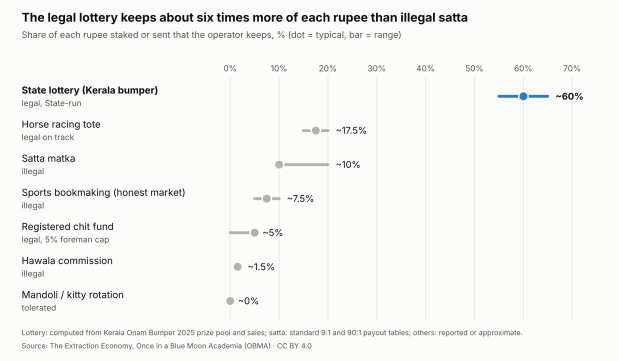
| System | Primary function | State relationship | Violence | Class target | Why it persists |
|---|---|---|---|---|---|
| State lottery | Consumption of hope; state revenue | Operated and marketed | Structural, economic | The poor, disproportionately | Legitimacy, advertising, festival draws |
| Satta | Speculation | Criminalised, protected for a fee | Physical debt enforcement | Informal workers | Exclusion from legal speculation; police rents |
| Street tin patti | Gambling | Criminalised, raided | Physical | Slum and site workers | Leisure scarcity; organised dens |
| Elite tin patti | Leisure, networking | Tolerated | Minimal | The affluent | Class protection |
| Sports betting | Speculation; laundering | Criminalised; online play banned 2025 | Debt enforcement; fixing | Cross-class, youth-heavy | Mass passion; offshore platforms |
| Hawala | Value transfer | Criminalised, quietly used | Low, except in crime corridors | Migrants, traders | Superior cost, speed, trust |
| Mandoli / chit | Saving, lump-sum credit | Tolerated or registered | Low; fraud in Ponzi imitations | Working-class women | No formal substitute |
| Kitty party | Saving, investment, networking | Tolerated, unmeasured | Minimal | Middle- and upper-class women | Autonomy; class closure |
| Flexi fares, surge fares, dynamic ticketing | Allocation of scarce seats by price | Operated (railways), licensed (airlines, platforms), sanctioned by order (cinema hikes); the tout criminalised | Economic: exclusion by price; crowd risk at sanctioned benefit shows | Emergency travellers, migrants, fans, cinema-goers | Algorithmic legitimacy; the state’s share in the surge |
| Copy economy (piracy, photocopies, re-uploads) | Access to culture and knowledge; resale | Selectively prosecuted; partly lawful (education) | Low, except counterfeit currency and arms | Students, the urban poor | Price gap with “originals”; censorship |
| Sex work (organised as unorganised sector) | Income, survival, extraction by intermediaries | Criminalised or semi-tolerated; statistically invisible | Physical and economic; intermediary cuts | Precariat women, migrants | Absence of formal employment and credit; protection rents |
| Professional over-billing and tolabaaji | Fee extraction; protection | Normalised as professional service or party contribution; unmeasured | Low physical; high economic coercion | Cross-class, but incidence heaviest on the poor | Information asymmetry; state and party power |
Three patterns follow, and each is sharper once the full set of systems is placed on the same axes.
By legality, the highest extraction is legal for the state, while lower-take and necessary forms are criminalised or left in deliberate ambiguity. The lottery keeps roughly 60 paise in the rupee under full legal title and advertising cover. Satta keeps roughly 10 and is prosecuted. Hawala and pure mandoli meet real needs at low margins and remain formally criminal or unregistered. Sex work organised as an unorganised sector and street-level tolabaaji are policed or ignored according to convenience, never measured as economic activity. The law does not sort harm from harmlessness. It sorts who may extract under colour of law and who must extract under colour of prohibition. Government-sponsored gambling is revenue; non-government gambling is crime or demerit. The same inversion appears in the ticket economy: the tout’s scarcity rent was black money; the identical rent charged as flexi fare, surge price or government-sanctioned cinema hike is booked as output and taxed.
By violence, physical coercion concentrates in the illegal forms that target the poor. Satta debt is enforced by harassment, seizure, sexual violence and acid. Street tin patti and unprotected sex-work networks rely on the same repertoire. The state’s version of extraction substitutes economic coercion—regressive incidence, engineered hope, price exclusion from emergency travel or peak cinema—which is more efficient precisely because it is legitimate. Elites face neither: club tables, high-value kitties and professionally managed chits run at low margins under effective impunity. Professional over-billing and party tolabaaji occupy the middle ground: economic coercion backed by information asymmetry or organisational power, rarely by open violence, and almost never by criminal prosecution.
By class, the predatory systems face downward (lottery, satta, street tin patti, unprotected sex work), the discretionary ones face upward or inward (kitty, elite tables), and the functional ones serve migrants and workers who have been excluded from formal substitutes (hawala, mandoli). The copy economy splits along the same line: educational and personal copying functions as a knowledge commons for those priced out of originals; counterfeit currency and illegal arms are pure predation. The inversion of justice is complete. The law protects the predator—state lottery, licensed surge, protected syndicate, elite table—and criminalises or abandons the prey. Measurement authority ratifies the inversion: what the state operates or tolerates for elites enters the accounts as revenue or remains comfortably invisible; what the precariat uses or suffers remains uncounted or appears only as crime statistics.
The taxonomy is not a list. It is the empirical demonstration that selective criminalisation, selective measurement and selective violence are a single apparatus. The systems interlock through the Iron Triangle; the law sorts them by class; the national accounts record only the portion the measurement authority has chosen to see. Any policy that treats them one by one, or that equates legality with protection, reproduces the apparatus it claims to reform.
13. Toward Accountable Autonomy: An Integrated Framework
The Pigou–Illich synthesis does not yield a menu of technocratic adjustments. It yields a rupture with the existing extraction apparatus. Accountable autonomy requires six simultaneous shifts: decriminalise participation in autonomous systems; prosecute specific harms rather than whole systems; regulate by scale and demonstrated harm rather than by blanket ban or moral panic; attack the desperation that drives participation; measure what is currently rendered weightless; and end the state’s monopoly claim over extraction. The framework is radical because it refuses both the revenue-maximising state and the unguarded market. It starts from the footpath—from the mandoli that already works, the hawala that already moves wages, the copy that already teaches—and asks what would protect those practices without capturing them.
13.1 System by system
| System | Decriminalise | Regulate | Prosecute | Root cause |
|---|---|---|---|---|
| Satta | Participation and casual play | Any legal successor capped at a low, published take; no state-operated alternative | Organised violence and debt enforcement, with enhanced sentences for sexual violence and acid attacks | Living wage floors and urban employment guarantee that make daily staking unnecessary |
| Tin patti | Social play among family and friends | Licensed tables only above a clear stake threshold, with published rake caps | Cheating dealers and debt violence | Public leisure space and non-extractive recreation for the urban poor |
| Mandoli | All neighbourhood mandolis | Light registration and basic disclosure only above ₹1 crore annual throughput; full deposit-like safeguards only above that | Fraud and Ponzi schemes that borrow the name, not “operating without a licence” | Public and cooperative products that deliver timed lump sums without destroying social enforcement |
| Kitty party | Pure rotation | Disclosure of strategy and coordinator compensation for investment kitties above a threshold | Embezzlement and Ponzi variants | Cheap, non-shame-based arbitration; refusal of paternalist “protection” |
| Hawala | Ordinary remittances | Formal corridors that match cost, speed and documentary lightness; no forced migration onto inferior products | Terror finance and large-scale laundering on evidence | Reduction of distress migration; recognition of migrant remittances as livelihood infrastructure |
| State lottery | — | Hard cap on the buyer’s loss at 5–10 percent; scheme-wise published utilisation; independent oversight with power to halt draws; or abolition if the cap is refused | Mis-selling, agent coercion and any residual violence | Replacement of the regressive take with direct income and employment support |
| Sports betting | Participation | Regulated domestic model along the lines the Law Commission and Lodha committee already recommended; no 2025-style blanket offshore push | Match- and spot-fixing through an independent sports-integrity body with real investigative power | Livable contracts across domestic cricket and football that reduce the price of a fix |
| Horse trading | — | Close the Tenth Schedule merger exception; time-bound disqualification decisions by an authority other than the Speaker | Bribery of legislators under existing law, actually enforced | Public party-finance transparency and limits that make the purchase of legislators unprofitable |
| Flexi fares, surge fares, dynamic ticketing | — | Symmetric pricing that falls as well as rises; permanent surge caps on essential and emergency routes; published algorithms; no film-specific hike orders | Bot-driven hoarding of supply | Protected emergency quota at administered fares for medical and bereavement travel |
| Copy economy | Educational, personal and access-to-censored-material copying | Digital extension of Section 52 exceptions; abandonment of substitution-fallacy industry loss figures | Counterfeit currency, illegal arms and commercial fraud that sells fakes as originals | Affordable legal access to books, media and public-domain works |
| Sex work (as unorganised sector) | Adult consensual sex work | Labour and safety standards for organised workplaces; no criminalisation of the worker | Trafficking, coercion, violence and intermediary predation | Exit options through employment guarantee and housing; recognition of earnings as labour income |
| Professional over-billing and tolabaaji | — | Published fee schedules and mandatory disclosure of deviations; party-finance rules that treat tolabaaji as reportable income | Extortion and systematic over-billing that meets fraud thresholds | Public alternatives to private medical and legal services; end of informal territorial tribute |
13.2 The economic-security floor
Every line above collapses without a floor. Decriminalisation without security leaves desperate people to the same predators with fewer police. Formalisation without security hands them to the state that already runs the higher-take lottery. The floor has three concrete parts, each already partially tested in India and each requiring radical extension.
An employment guarantee on the MGNREGA model, extended to towns and cities, at a living wage, with durable public assets and a right to work that cannot be rationed by local discretion. The existing rural scheme already demonstrates that demand-driven public work can reduce distress migration and the need for high-interest or high-edge alternatives.
A universal or near-universal basic income, calibrated to remove the daily necessity of staking a portion of wages or of accepting usurious recovery loans. Partial experiments and cash-transfer programmes have shown administrative feasibility; the political obstacle is the refusal to treat income security as a right rather than a residual.
Public and cooperative credit—credit unions, community banks and state-backed timed-savings products—that deliver the lump-sum function of the mandoli without destroying its social enforcement or replacing it with a professionalised, high-margin intermediary. The pure neighbourhood mandoli already proves the demand; the policy task is to stop treating that demand as a regulatory problem.
13.3 Measurement as policy
The final instrument is epistemic and therefore political. A shadow-economy satellite account, published alongside GDP and including the state’s own gambling take measured from the buyer’s side, would end the constitutive exclusion. Anonymised survey modules on gambling participation, informal credit, remittance channels and sex-work earnings would make the invisible visible without criminalising respondents. Independent researchers must be given access to enforcement and financial-intelligence data under strict privacy safeguards; the state’s monopoly over what counts is itself part of the extraction apparatus.
A society that cannot see its extraction economy cannot argue about it. Accountable autonomy therefore begins with the refusal to treat measurement authority as neutral. The satellite account is not a technical appendix. It is the condition under which the rest of the framework can be contested rather than administered from above. The systems examined in this paper will not be reformed by better licensing of the predators. They will be reformed only when participation is no longer a symptom of desperation, when harm is prosecuted without abolishing the autonomous institution, and when the state is forced to account for the extraction it currently books as revenue or renders invisible. That is the minimum content of accountable autonomy. Anything less reproduces the Iron Triangle under a new name.
14. Where This Paper Sits in the Literature
The scholarship on each component is substantial; the synthesis is absent. Existing work documents systems one at a time and asks how each can be measured, regulated or eliminated. It rarely asks why the state measures what it measures, why it criminalises some forms of extraction and operates others, or how class organises both enforcement and the boundary of the visible economy. This paper does not replace those literatures. It claims that, read together and against the Indian evidence, they describe a single apparatus of class-differentiated extraction whose legality, violence and measurement are politically organised.
14.1 What the literature establishes
Measurement. Schneider and collaborators constructed the dominant MIMIC and currency-demand series. Across 158 countries over 1991–2015 the average shadow economy is about 32 percent of official GDP (Medina & Schneider, 2018). India’s estimates range from roughly 23 percent (Schneider, for 1999/2000) to the 41.1 percent reported in a 2025 working paper (Ahmed, 2025). At the state level, Chaudhuri, Schneider and Chattopadhyay (2006) found that the shadow economy co-moves with political variables, including the electoral cycle. MIMIC models, however, fix only relative movement; their absolute levels depend on external calibration (Breusch, 2005). National accountants do not use these percentages. They apply the exhaustiveness framework of the OECD (2002) and the SNA 2008, which sorts non-observed activity into underground, informal, household, statistical and illegal categories—and India stops before the last.
Informal finance. The IMF–World Bank study of hawala (El Qorchi, Maimbo & Wilson, 2003) and Passas (2005) establish its speed, cost advantage and regulatory dilemmas. The ROSCA literature (Besley, Coate & Loury, 1993; Anderson & Baland, 2002) establishes the economic rationality of rotating savings and its particular value to women who must shield capital from intra-household claims.
Corruption in sport. Committee reports (Mudgal, Lodha), the Law Commission’s Report No. 276 (2018) and investigative journalism document fixing cases and recommend regulation rather than blanket prohibition. They do not integrate the betting market with the wider extraction apparatus or distinguish vulnerability from prevalence.
Extraction. Harvey (2003) theorises accumulation by dispossession as the continuation of primitive accumulation inside contemporary capitalism. Sassen (2014) analyses finance as an extractive sector that sells what it does not have and leaves expulsion in its wake. Acosta (2013) and Veltmeyer (2013) develop extractivism primarily for land, minerals and commodities. None extends the framework systematically to everyday financial predation—lottery takes, protection rents, dynamic pricing, professional over-billing.
Theory. Pigou and Illich are each studied extensively, but not as a pair applied to a single extraction economy. Engels’ account of the privatised household and its feminist and Indian revisions (Dalla Costa & James, 1972; Federici, 1975; Chakravarti, 1993) remain largely separate from measurement debates. Sundaram’s (2009) account of pirate modernity documents illicit media urbanism in Delhi but is rarely read as a problem of national accounting—three incompatible ledgers for the same copy.
14.2 The gaps this paper fills
| Topic | State of the literature | This paper’s contribution |
|---|---|---|
| Extraction rates | Measured, if at all, system by system | Compared across legal and illegal systems on one axis, exposing the inversion (Section 12) |
| The lottery–satta asymmetry | Not examined | Shown to be the organising principle of the gambling regime: the legal product takes roughly six times the illegal one |
| GDP exclusion | Treated as a data gap or technical lag | Analysed as a constitutive exclusion that performs political functions and ratifies class power |
| Sports betting | Split between crime, sport governance and addiction studies | Treated as one integrated system; vulnerability distinguished from prevalence; 2025 ban read as enlargement of the offshore shadow |
| Hawala and mandoli | Described as informal, second-best finance | Shown to be superior on the dimensions that matter to their users; formalisation often displaces rather than replaces |
| Extraction theory | Applied to land, minerals and high finance | Extended to everyday financial predation, including the state’s own lottery and the subsumption of the tout’s rent |
| Pigou and Illich | Studied separately | Staged as a dialogue that fails on Indian evidence and yields the synthesis of accountable autonomy |
| Horse trading | Studied as anti-defection law | Read as the shadow economy of democracy, set beside the regulated vice it mirrors |
| Dynamic pricing | Treated as revenue management or consumer protection | Read as the state–corporate subsumption of the black market’s scarcity rent, laundered into GDP as growth (7.6) |
| Copy economy | Studied as industry loss or as media culture (Sundaram’s pirate modernity) | Read through Plato’s cave as a measurement problem with three ledgers—loss, production, commons—and as a knowledge commons distinct from counterfeit predation (10.5) |
| Household labour | Debated as paid versus unpaid | Reframed as necessary versus surplus labour; the kitchen free when unprivatised, not merely unpaid (11.2) |
The paper’s claim is narrower and sharper than a general theory of the informal sector. The separate findings, once placed on the same axes of extraction rate, legality, violence, class target and measurement status, describe a single apparatus. Selective criminalisation, selective violence and selective visibility are not independent policy failures. They are the operating logic of an Iron Triangle in which the state, organised crime and political finance each benefit from the boundaries the others help maintain. Existing literatures supply the components. This paper supplies the comparison that makes the apparatus visible.
15. Conclusion: The Shadow Economy as System
India’s shadow systems—satta, sports betting, hawala, mandoli, kitty parties, tin patti, the state’s own lotteries, and the adjacent economies of tickets, copies and the kitchen—are not a residue of informality awaiting modernisation. Read together they form an integrated, class-differentiated apparatus of extraction. The apparatus transfers wealth from the precariat to organised crime, political operators and state structures. It operates through institutionalised partnerships of criminals, police and politicians—the Iron Triangle and its impunity loops. It uses selective criminalisation to monopolise extraction, prosecuting a game that keeps roughly 10 paise in the rupee while selling one that keeps 60, and subsuming the tout’s premium into flexi fares, surge pricing and cinema price orders that are counted as growth. It remains invisible in the national accounts by choice rather than necessity. It sustains growth narratives while concealing institutional predation. It rests on an unequal distribution of measurement authority, in which the state and elites decide what counts as economic, render popular activity invisible and brand state predation as welfare. It extends into the copy economy, where the state criminalises the knowledge commons of the poor while counting with meticulous care the one copy that threatens its own original, the counterfeit note. And it reaches into the household, where the uncounted kitchen is not thereby free, because recognition by capital is the moment of its capture.
Neither Pigou’s regulator nor Illich’s commune suffices alone. Accountable autonomy—decriminalise what serves real needs, prosecute what does real harm, and build the economic floor that makes participation a choice—is not utopian. It is what decades of failed prohibition and predatory formalisation leave standing. The 2025 decisions, which banned private online play while raising taxes on everything and leaving the state’s lottery untouched, show how far policy remains from it.
The extensions sharpen the same point. The railway tout, the concert scalper and the cinema blacker were prosecuted for a rent that the railways, the airlines, the multiplex and the government order now collect lawfully and record as output. The footpath copy that educated a generation is treated as theft, while the copyist who became a rights-holder enforces the law he once evaded. And the homemaker’s kitchen, uncounted, proves no safer for being invisible: a diamond chain is enough to turn her necessary labour into an instrument of her husband’s surplus labour. In each case the decisive question is not whether a flow is counted, but who captures it once it is seen.
Measurement transparency is the precondition. A satellite account that recorded the lottery’s take beside satta’s would make the inversion visible in the state’s own tables, and visibility creates political pressure. This is the paper’s contribution: not a finished solution, but clarity about what requires solving, grounded in the best available evidence and stated plainly where the evidence ends.
The extraction economy is not inevitable. It is a choice maintained by selective criminalisation, selective violence and selective visibility. Changing it begins with seeing it—making visible what measurement excludes, asking whose interests the exclusion serves, and reclaiming measurement authority as an exercise of democracy rather than of power over it. Until that authority is contested, the Iron Triangle will continue to book its predation as revenue, growth or welfare, and the precariat will continue to pay the difference.
References
Scholarship
Acosta, A. (2013). Extractivism and neoextractivism: Two sides of the same curse. In M. Lang & D. Mokrani (Eds.), Beyond development: Alternative visions from Latin America (pp. 61–86). Transnational Institute & Rosa Luxemburg Foundation.
Ahmed, M. (2025). Estimating the shadow economy in India: A MIMIC model approach [Working paper]. SSRN. https://papers.ssrn.com/sol3/papers.cfm?abstract_id=5704342
Anderson, S., & Baland, J.-M. (2002). The economics of roscas and intrahousehold resource allocation. Quarterly Journal of Economics, 117(3), 963–995. https://doi.org/10.1162/003355302760193931
Baudrillard, J. (1994). Simulacra and simulation (S. F. Glaser, Trans.). University of Michigan Press. (Original work published 1981)
Besley, T., Coate, S., & Loury, G. (1993). The economics of rotating savings and credit associations. American Economic Review, 83(4), 792–810.
Breusch, T. (2005). Estimating the underground economy using MIMIC models [Working paper]. Australian National University.
Chakravarti, U. (1993). Conceptualising brahmanical patriarchy in early India: Gender, caste, class and state. Economic and Political Weekly, 28(14), 579–585.
Chaudhuri, K., Schneider, F., & Chattopadhyay, S. (2006). The size and development of the shadow economy: An empirical investigation from states of India. Journal of Development Economics, 80(2), 428–443. https://doi.org/10.1016/j.jdeveco.2005.02.011
Dalla Costa, M., & James, S. (1972). The power of women and the subversion of the community. Falling Wall Press.
Deleuze, G. (1990). Plato and the simulacrum. In The logic of sense (M. Lester, Trans.). Columbia University Press. (Original work published 1969)
El Qorchi, M., Maimbo, S. M., & Wilson, J. F. (2003). Informal funds transfer systems: An analysis of the informal hawala system (IMF Occasional Paper No. 222). International Monetary Fund. https://www.imf.org/external/pubs/ft/op/222/
Engels, F. (1884). Der Ursprung der Familie, des Privateigenthums und des Staats [The origin of the family, private property and the state]. Hottingen-Zürich.
Federici, S. (1975). Wages against housework. Power of Women Collective & Falling Wall Press.
Hart, K. (1973). Informal income opportunities and urban employment in Ghana. Journal of Modern African Studies, 11(1), 61–89. https://doi.org/10.1017/S0022278X00008089
Harvey, D. (2003). The new imperialism. Oxford University Press.
Illich, I. (1973). Tools for conviviality. Harper & Row.
Illich, I. (1981). Shadow work. Marion Boyars.
Illich, I. (1982). Gender. Pantheon.
Lerner, G. (1986). The creation of patriarchy. Oxford University Press.
Marx, K. (1976). Results of the immediate process of production. In Capital: A critique of political economy (Vol. 1, B. Fowkes, Trans., pp. 941–1084). Penguin. (Manuscript written 1863–1864)
Mauss, M. (1925). Essai sur le don. L’Année sociologique, nouvelle série, 1, 30–186.
Medina, L., & Schneider, F. (2018). Shadow economies around the world: What did we learn over the last 20 years? (IMF Working Paper No. 18/17). International Monetary Fund. https://www.imf.org/en/Publications/WP/Issues/2018/01/25/Shadow-Economies-Around-the-World-What-Did-We-Learn-Over-the-Last-20-Years-45583
OECD, IMF, ILO, & CIS STAT. (2002). Measuring the non-observed economy: A handbook. OECD Publishing. https://www.oecd.org/en/publications/measuring-the-non-observed-economy_9789264197458-en.html
Passas, N. (2005). Formalizing the informal? Problems in the national and international regulation of hawala. In International Monetary Fund, Regulatory frameworks for hawala and other remittance systems (pp. 7–16). IMF.
Pigou, A. C. (1932). The economics of welfare (4th ed.). Macmillan. (Original work published 1920)
Plato. Republic (Books VII and X).
Rubin, G. (1975). The traffic in women: Notes on the “political economy” of sex. In R. R. Reiter (Ed.), Toward an anthropology of women (pp. 157–210). Monthly Review Press.
Sassen, S. (2014). Expulsions: Brutality and complexity in the global economy. Belknap Press of Harvard University Press.
Schneider, F. (2002). Size and measurement of the informal economy in 110 countries around the world [Paper presentation]. Workshop of the Australian National Tax Centre, Australian National University, Canberra.
Schneider, F. (2005). Shadow economies around the world: What do we really know? European Journal of Political Economy, 21(3), 598–642. https://doi.org/10.1016/j.ejpoleco.2004.10.002
Schneider, F., & Enste, D. H. (2000). Shadow economies: Size, causes, and consequences. Journal of Economic Literature, 38(1), 77–114. https://doi.org/10.1257/jel.38.1.77
Sundaram, R. (2009). Pirate modernity: Delhi’s media urbanism. Routledge.
United Nations, European Commission, IMF, OECD, & World Bank. (2009). System of National Accounts 2008. United Nations. https://unstats.un.org/unsd/nationalaccount/docs/sna2008.pdf
Veltmeyer, H. (2013). The political economy of natural resource extraction: A new model or extractive imperialism? Canadian Journal of Development Studies, 34(1), 79–95. https://doi.org/10.1080/02255189.2013.755917
Warner, S. L. (1965). Randomized response: A survey technique for eliminating evasive answer bias. Journal of the American Statistical Association, 60(309), 63–69. https://doi.org/10.1080/01621459.1965.10480775
Official reports and statutes
Law Commission of India. (2018). Legal framework: Gambling and sports betting including in cricket in India (Report No. 276).
Supreme Court Committee on Reforms in Cricket (Chair: R. M. Lodha). (2016). Report of the Supreme Court Committee on Reforms in Cricket.
Comptroller and Auditor General of India. (2018). Report on Union Government (Railways) for the year ended March 2017 [including the audit of the flexi-fare scheme]. Tabled July 2018.
The Chancellor, Masters & Scholars of the University of Oxford v. Rameshwari Photocopy Services, Delhi High Court (2016).
Multiplex Association of India v. State of Karnataka, Karnataka High Court, interim order of 23 September 2025.
Public Gambling Act, 1867 · Prize Chits and Money Circulation Schemes (Banning) Act, 1978 · Chit Funds Act, 1982 · Lotteries (Regulation) Act, 1998 · Banning of Unregulated Deposit Schemes Act, 2019 · Promotion and Regulation of Online Gaming Act, 2025 · Constitution of India, Tenth Schedule · Railways Act, 1989 (s. 143) · Copyright Act, 1957 (s. 52) · Cinematograph (Amendment) Act, 2023 · Information Technology (Intermediary Guidelines and Digital Media Ethics Code) Rules, 2021 · Karnataka Cinemas (Regulation) (Amendment) Rules, 2025.
Disclosures, investigations and press sources
Kerala lottery net profit, 2024–25 — Deshabhimani, Finance Minister’s clarification (July 2025)
Kerala lottery sales, tax and profit, April 2021–December 2024 (RTI) — Onmanorama (March 2025)
Lottery share of Kerala’s non-tax revenue, 2022–23 — The Week (October 2024)
Kerala lottery revenue series, 2022–25 — Dhanam
Onam Bumper 2025 prize pool and sales — Onmanorama (September 2025)
Onam Bumper 2026 agent price — Kerala Kaumudi
40% GST on lotteries, betting, casinos, horse racing and online money gaming — Upstox (September 2025)
Online Gaming Act, 2025 — Business Today (August 2025)
Finance Minister’s “horse-trading” slip, 29 June 2022 — Business Standard / PTI
Saradha: sums mobilised and unpaid — Enforcement Directorate press note (February 2023)
CBI estimate of chit-fund and Ponzi collections — Business Standard / PTI (April 2016)
Registered chit industry size — Business Standard / PTI (2015); Business Standard (December 2022)
Registered chit default rates — Business Standard (2010)
DHFL bank-fraud case — Business Today / PTI (June 2022)
Spot-fixing allegations in 15 internationals, 2011–12 — Al Jazeera (October 2018); boards’ and ICC’s response — The Week (October 2018); alleged D-Company link — The Papare
Flexi fare: occupancy, revenue and the CAG audit — Scroll (2018); Business Today (July 2018); air cheapest in 17 directions — The Quint / IANS; one-way design — Mint, via inkl; the 2018 rationalisation — The Print
Tatkal Aadhaar and OTP rules, 2025 — Free Press Journal (June 2025)
IndiGo crisis fares and caps — Moneylife (December 2025); COVID precedent — Business Today (December 2025)
Coldplay and Diljit Dosanjh ticket black-marketing — The Week (October 2024); resale complaint — Telangana Today / IANS
PVR INOX dynamic pricing — Curly Tales (July 2024); ScanX
Telangana ticket hikes and benefit shows — Telangana Today (December 2024); Game Changer withdrawal; Hari Hara Veeramallu (July 2025); Andhra Pradesh Sankranti hikes
Karnataka ₹200 cap and stay — The South First (September 2025); LiveLaw (September 2025)
GST on cinema tickets from 22 September 2025 — Business Today; Multiplex Association’s ₹300 request — 123Telugu
A note on references
Ahmed (2025) is cited as reported in secondary discussion; the working paper is available on SSRN, and its 41.1% figure is treated as an upper-bound reported estimate. Satta payout ratios (9:1 single, 90:1 jodi) are the standard published rates of the game, consistent across operators.
The 1990s cassette prices in Section 10.5.2 (₹18 for T-Series against about ₹32 for licensed albums) are the author’s recollection of the period and await confirmation from a contemporary trade or press source. The field observations from Kolkata’s footpath markets and the Bongaon region are the author’s own and are reported as such.

