

Posted on 24th September, 2026 (GMT 07:25 hrs)
ABSTRACT
On 24 September 2026 we write in the light of The Indian Express report: two Election Commissioners of India objected fourteen times to roll changes, Form 6 and control of the voter database, while the Election Commission of India still called every decision unanimous. The DHFL Depositors have watched the same grammar inside the DHFL CoC. A vote is manufactured, dissent is filed away, and the person on the line is told the count is final. Depositors recovered 23 percent; Oaktree’s stronger bid was set aside; Ajay Piramal took fraud-recovery claims estimated at ₹45,000 crore for ₹1. Multiple RTIs produced no figure for CIRP costs. Then Piramal Capital sued us for ₹100 crore — a SLAPP of defamation and contempt against research and RTIs. Money taken. Votes taken. Then the summons.
They took the depositors’ money.
They kept the power.
They used that power against the depositors.
Depositors’ loss became their weapon.
Why we write this today
On 23 September 2026, The Indian Express put on record what two of three Election Commissioners had already put on file. Over ten months, Sukhbir Singh Sandhu and Vivek Joshi formally objected at least fourteen times — once, four times in a single day — to decisions taken in the Commission’s name on voter registration, deletion, restoration, Form 6, and custody of the electoral-roll software.
The flashpoint was not a slogan. It was a form. Form 6 is the statutory gate through which a first-time voter enters the roll. A new declaration was added to the online version, asking the applicant to say whether they, a parent, or a grandparent “existed” on the last Special Intensive Revision. The box was not marked mandatory. The portal would not let you submit without answering it.
Joshi warned on file in May that a form prescribed under the Registration of Electors Rules, 1960 cannot be rewritten by guideline or portal design. Only an amendment of those Rules, notified by the Union government after consultation with the Commission, can change it. Sandhu concurred three days later. In August, after the newspaper had already reported the live change, Sandhu wrote that the “unauthorised / illegal” alteration was still on the site and “must be removed immediately.” Joshi asked for something still more basic: an audit certifying that no one except the designated statutory authorities holds credentials to alter the voter database.
The Commission’s reply is that every decision was “unanimous”. The opposition legitimately calls it vote chori and wants the Chief Election Commissioner gone. With Immediate Effect.
We write in its light because we, in solidarity with the DHFL depositors, have watched the same grammar work from inside another ballot.
A vote is not only a mark on polling day. It is the medium by which a crowd is converted into a decision that courts will not reopen. In the Election Commission, two members can minute “illegal” and still watch the portal keep the question. In the DHFL Committee of Creditors, depositors could dissent through an authorised representative and still be bound by a 93.65 per cent approval they did not control. In both rooms the file says consulted. In both rooms the outcome says settled. In both rooms the person whose name, or whose savings, is on the line is told that so-called commercial wisdom — or so-called institutional unanimity — has already done the thinking.
That is the grammar. First the list is altered. Then the vote is declared. Then the dissent is filed, and filed away. Then, if anyone keeps speaking, the legal notice from the powerful arrives.
Money taken. Votes taken. Then the SLAPP.
I. Two ballots, one grammar
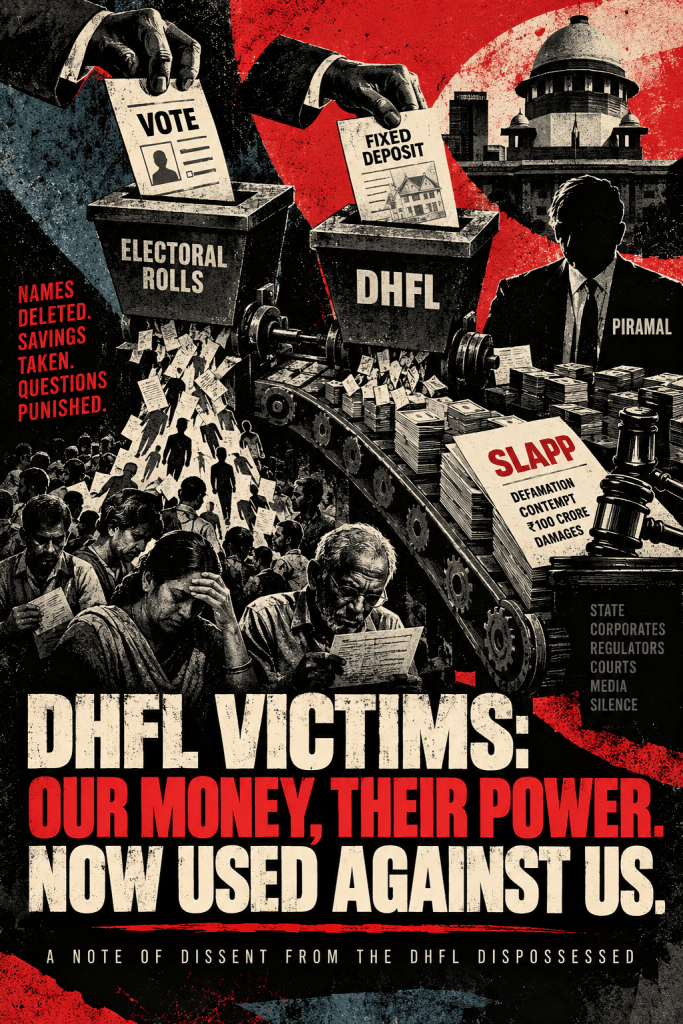
We say plainly what we have argued since 2024. The DHFL resolution vote and the electoral roll are two modules of one machine, and what happens in one is legible in the other. We call it cross-modular vote chori. It rests on five mechanics that appear in both domains.
- Erasure of the eligible. The rolls have lost names through deletion and non-recording. One explainer reports 13 crore names struck from draft rolls across 30 states and Union Territories. In Goa, 97 voters whom local officials found eligible were left off the final roll because centralised software could not record the decision. In West Bengal, 3.8 million appeals are reported pending after judicial reinstatement. In the CoC, about 2.5 lakh depositors held over 65% of the votes. They were never shown the Piramal plan before the vote, and the ex-promoter’s offer of full repayment was shut out. Those who counted most were heard least.
- The centralised chokepoint. In one domain, a portal and its access credentials. In the other, a committee of institutional creditors and an interim professional. Both decide who may act on the record, and neither lets the affected verify the count.
- The unverifiable tally. Depositors reported failed attempts to register votes after CoC meetings, and were told these were “technical glitches”. Documents were made non-downloadable. On the electoral side, citizens report being refused audit trails, deletion records and CCTV.
- The inverted burden. Every process demands that the citizen or depositor prove standing while the system proves nothing. Form 6 asks whether you and your relatives “exist”. The CoC never asked depositors what they would accept.
- Finality by formula. “Unanimous with the consent of both Commissioners” is the ECI’s answer. “Over 90% CoC approval” and “commercial wisdom” are the CoC’s. A majority, once manufactured, is offered as proof of legitimacy. It cannot explain who was outside the count.
This is what suppression looks like when it is done procedurally. Nobody is told they cannot vote. They are simply not in the room, not in the software, or not in the plan.
II. What the count produced
The NCLT ordered the ex-promoter’s full repayment proposal considered on 19 May 2021, and the NCLAT stayed that order within six days. Piramal took control in September 2021 while appeals were pending. On 27 January 2022 the NCLAT called the process “discriminatory, illegal, materially irregular”. The Supreme Court stayed that finding on 11 April 2022 and upheld the plan on 1 April 2025. Small depositors recovered about 23% of their lifetime savings, ₹1,241 crore against ₹5,375 crore admitted, a shortfall of about ₹4,134 crore. The winning bid was ₹32,250 crore against a ₹93,700-crore book. Oaktree’s bid was better. Adani Capital stood in as a dummy bidder. The CoC set the stronger offer aside. Mukesh Ambani’s secondary kin, Ajay Piramal — the same Piramal who poured money into the BJP through electoral bonds and PM CARES, and who bought into the Flashnet deal with BJP minister Piyush Goyal — then took the ₹45,000-crore fraud-recovery claims of DHFL for just ₹1.
III. The questions that were never answered
We asked the most elementary audit question through RTIs. What did the CoC spend, what was reserved for future litigation, and what is the source of funds for court proceedings?
- RBI (22 June 2024): the RBI passed the query to a “nodal department” and then said it had “no data”. The IBBI said the same.
- CAG (24 August 2024): the request went to the Department of Financial Services, then the RBI, then the IBBI, then the National Housing Bank. The IBBI finally said the data was “not maintained in the manner sought”.
- First Appellate Authority (24 September 2024): it held that an authority cannot “create” information, and that our question was not “information” under the Act.
- Supreme Court (23 October 2024): it declined to say which authority holds the records.
- RBI (30 September 2025): it said it has “no information” and that the interim professional, not the RBI, constitutes the CoC. The regulator that superseded the board and started the CIRP now disowns the committee.
Across multiple RTIs to more than 10+ authorities, the evasion rate was 100%. This is the audit-trail refusal, seen from the other side. In neither domain can the affected obtain the record of what was done in their name. The fees remain unanswered.
IV. Litigation, then silencing
Piramal Capital & Housing Finance Ltd. has sued some of the DHFL victims in the Bombay High Court. Suit S/42/2025 (CNR HCBM020012272023). One of us, the OBMA founder-member, is (supposedly) Defendant No. 6 in that suit. The plaint takes aim at public-interest research, RTI filings and open letters on the DHFL resolution. It comes dressed as defamation. It is punched up with contempt. The damages claimed are ₹100 crore.
A layperson needs the word for this. SLAPP means Strategic Lawsuit Against Public Participation. It is not a suit to settle a genuine injury. It is a suit to exhaust the person who spoke. It does not have to win. It has to cost — time, lawyers, listings, blood pressure, the fear of opening the next envelope. A question becomes a defence. A depositor becomes a defendant. The next victim learns that asking has a price.
₹100 crore is not a measure of harm. It is theatre. Fictitious. Absurd. Astronomical. It is a number chosen so that a person who already lost a fixed deposit cannot look at it without flinching. A pauper is told that speech about her own theft might now cost a hundred crores more.
That is the inversion made visible. The party that emerged from the resolution holds the balance sheet. We hold the summons.
Call the sequence by its name. First the haircut: the depositor is cut to 23 paise under an ill-conceived IBC that treats commercial wisdom as almost sacred and the small saver as residual. Then the SLAPP: the so-called successful resolution applicant of DHFL — Piramal Capital & Housing Finance Ltd. (this company no more exists, a reverse merger made it Piramal Finance Ltd., still it uses the old name in the court records!) — uses defamation and contempt to punish the same depositor for naming what the process did. Doubly punished. Once by the Code. Again by the plaintiff who took the company.
The pending suit is not a verdict, and we treat it as none. Our OBMA writing rests on the NCLAT’s own findings, court orders, RTI replies and the official, public domain record. Where we argue, we mark it as argument. Defamation law exists to answer falsehood. Contempt exists to protect the court. Neither exists to refinance a resolution with silence, nor to hang a ₹100-crore tag on a common citizen who used the RTI Act Parliament wrote for her.
V. The displacement: how the depositors’ loss becomes their litigation budget
The figure we could not obtain matters because of how the waterfall works. CIRP costs rank ahead of depositors. Watch the sequence.
- Extraction. The haircut parks about ₹4,134 crore of shortfall on depositors.
- Conversion. That shortfall does not vanish. It becomes the buyer’s margin and, through the ₹1 valuation, the buyer’s option on the recoveries. One party’s loss is the other party’s capital.
- Priority. Professional, legal and consultancy costs are paid from the same pool, senior to the depositors, and undisclosed.
- Reserve. “Funds reserved for future litigation” is exactly what we asked about. Nobody would say how large it is or where it comes from.
- Inversion. The buyer who took the company now sues the depositor who asked where the money went.
We call this displacement of the cost of accountability. The cost of the fraud was shifted from wrongdoer to depositor. The cost of naming the fraud is then shifted onto the same depositor — through fees that come ahead of us, and through a litigation capacity funded, in our reading, by the depositors’ losses. We pay twice. First in the haircut. Then in defence, in years, and in the fear of saying what happened.
We do not claim to have traced each rupee from the pool to the plaintiff’s legal bills. Tracing is what the refusal to answer prevents. The structure permits the displacement. The secrecy makes it unfalsifiable. That is the charge.
VI. Demands
A republic that answers “no data” to a rupee question, and “₹100 crore” to a sentence, has not run out of remedies. It has refused them. These are not wishes. They are the minimum that would make the five pillars of democracy mean something again.
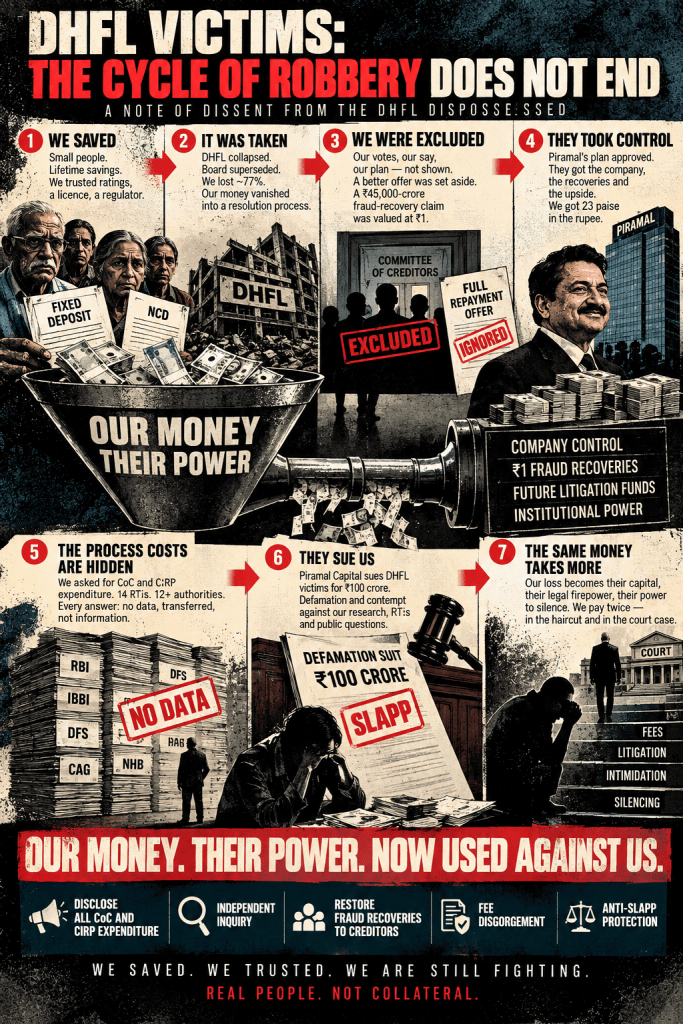
1. Open the books. Publish, on a dated and short clock, an itemised account of every CoC and CIRP rupee: professionals, lawyers, consultants, sitting fees, the litigation reserve, and the source from which each was drawn. CIRP costs rank ahead of depositors. The depositor is therefore entitled to see what was taken off the top.
2. Answer the RTI as if the Act still exists. RBI, IBBI, DFS and CAG will swear to why a single expenditure query was walked through a dozen doors and returned as “no data,” “not information,” “not maintained in the manner sought.” Rule that an account of public process-costs is information under the RTI Act. An authority that starts a resolution cannot disown its ledger.
3. Open both ballots. Independent verification of the CoC vote — who voted, on what text, after what access to the plan — and of the electoral rolls: audit logs, deletion and restoration records, Form 6 change-history, and a certification of who holds credentials to alter the database. A count that cannot be checked is not a count. It is a claim.
4. Return the clawback. Avoidance and fraud recoveries were not a complimentary asset of the successful applicant. They were the one remaining instrument written for creditors. Restore them to the estate they were meant to repair. A ₹45,000-crore claim sold for ₹1 is not commercial wisdom. It is a transfer.
5. Disgorge the fees. Where a competent forum finds illegality, irregularity or unjust enrichment in the process itself, recover the professional and advisory fees paid senior to depositors. No one should profit from a file that the State will not produce.
6. End the SLAPP. Withdraw Suit S/42/2025 and every action that treats RTI, research and dissent as a balance-sheet risk. Enact an anti-SLAPP shield so that defamation and contempt cannot be used to hang a ₹100-crore tag on a citizen who quoted the record. The pending case is not a verdict. Using it as a muzzle is the point.
7. Inquire outside the house. An independent inquiry into the DHFL CIRP — costs, vote, ₹1 clause, distribution — not housed in RBI or IBBI, the two bodies that already say they do not keep the file. In the electoral sphere, a Supreme Court-monitored inquiry into Form 6, deletions, software custody and the claim of unanimity against fourteen recorded objections.
Without the books, the vote is a rumour. Without the clawback, the fraud is a gift. Without an anti-SLAPP rule, speech is a luxury of those who can afford the summons. We are done paying twice.
VII. Five pillars. Five terms.
The pillars are the judiciary, the executive, the legislature, the media, and digital media. The terms they owe the republic are accountability, legitimacy, credibility, transparency and integrity. These are not ornaments. They are load-bearing walls.
A judiciary that stayed the NCLAT’s finding of “illegal,” then blessed the ₹1 clawback, while a ₹100-crore SLAPP hangs over the depositor who merely cited the record, has not interpreted the law. It has pawned accountability and called the receipt a judgment.
An executive — RBI, IBBI, CAG, the ministries that shuffle the file — that triggered the CIRP and then answered “no data,” “not information,” “not maintained in the manner sought,” has not lost the papers. It has emptied transparency on purpose.
The public purse makes the method visible. In August 2026 the Ministry of External Affairs told the Rajya Sabha that Narendra Modi’s foreign visits since 2021 have taken at least ₹557.51 crore from the exchequer — about ₹36 crore in 2021, rising to roughly ₹188 crore in 2025, and ₹74.6 crore already by July 2026. France ₹25.59 crore. Brazil ₹17.72 crore. The United States ₹16.54 crore. A new Prime Minister’s residence was pegged, in 2022, at about ₹467 crore; later the figure was locked as a secret. Some of that spend is the cost of an office. Some of it is splendour the files will not fully open. The point is the double standard. A Prime Minister’s overseas bill can be tabled to the compiled rupee. A depositor’s question about CoC fees is “not information.” People’s money paid for the journey. People’s money paid for the haircut. Only one of those accounts was allowed to exist.
A legislature that wrote an IBC fit for crony capture, then left the RTI Act and the Representation of the People Act standing as exhibits while Form 6 was rewritten by a portal and “commercial wisdom” was treated as scripture, has a thin claim to legitimacy. It authored the lock and feigns surprise at the key.
The fourth and fifth pillars were meant to watch the other three. Much of what now calls itself the press — godi media, on air and online — does not watch. It sits. It repeats the unanimity, skips the fourteen dissents, and treats a depositor’s RTI as noise. The fifth pillar has a second floor: the IT cell, which does not report the count but manufactures it — hashtags for the annexure, silence for the empty file, a pile-on for anyone who names the ₹1 clause. Credibility cannot live there. It can only be bought, frightened, or shouted to death.
What still stands is narrower. The press that put fourteen Commissioners’ notes on the front page. The digital media that can still carry an RTI when the courtroom is used as a muzzle. Those are the last rooms in which credibility can live — and the first rooms the SLAPP and the cell will try to close.
Our charge is this. Under the BJP’s long hold on the Centre, the five pillars were not chipped in five separate accidents. They were levered in one motion. Nirvachan Sadan and the CoC. Form 6 and the ₹1 clause. The electoral bond and the summons. Same hand on the list. Same claim that the vote was already final. Same punishment for anyone who asks to see the count. That is argument. We mark it as such.
And still they are waking. This is post–Bharat Jodo Yatra India. Post–Jantar Mantar India. Two Commissioners put dissent on the file. Judges still have to write reasons. A newspaper still printed the notes. Depositors who were told they were residual kept the RTI moving. Readers who were meant to fear a ₹100-crore tag are still reading. We remember the farmers’ protests. We remember Shaheen Bagh. We will not stop. The pillars were not withdrawn from the language. They were withdrawn from the practice. The language is coming back for them — and so are we.
The people saved. The people trusted. The people are still fighting.
People’s money. Their weapon. People’s votes. Their count.
The OBMA record:
- 13 Feb 2024: RTIs filed by Once in a Blue Moon Academia (OBMA)
- 22 Aug 2024: RBI-appointed CoC for DHFL’s total expenditure: an RTI to the RBI
- 24 Aug 2024: Have the RBI and IBBI lost their accountability? An RTI to the CAG, India
- 25 Sep 2024: Autopsy of RTI in the police universe of the Indian polity
- 14 Oct 2024: RTI on RTIs: after the autopsy
- 1 Dec 2024: Manipulation allegations in DHFL CIRP: echoes of electoral malpractices and erosion of trust
- 15 Apr 2025: If CoC under IBC is the king, is justice just a ritual?
- 10 Aug 2025: Demand transparent accountability: the mass RTI appeal to the DHFL victims
- 20 Aug 2025: When institutions dodge responsibility: who answers to the DHFL victims?
- 25 Oct 2025: RTI under siege: the deadly costs of transparency in BJP-run India
- 4 Nov 2025: Highly suspicious vote theft: from electoral rolls to the DHFL CIRP
- 8 Nov 2025: The will to hide: vote theft, DHFL scam and the silencing of RTI in BJP-ruled India (video)
- 9 Nov 2025: On systemic erasure: from electoral rolls to the DHFL resolution process, a letter to Ajay Piramal
- 26 Jan 2026: From immunity to impunity: India’s predatory insolvency regime, electoral autocracy and DHFL scam
- 23 Mar 2026: Opaque by design: the DHFL resolution and institutional evasion, an open letter to the Reserve Bank of India (RBI)
- 1 Apr 2026: Who owns the crisis? Indian banking from nationalization to crony regime
- 11 Apr 2026: Speed, exclusion and the state: electoral legitimacy amid administrative violence in India’s accelerated SIR regime
Context, 23 Sep 2026 (coverage of the Indian Express probe): Opposition seeks removal of CEC after Express probe · Controversy explained, with ECI’s clarification · Opposition targets Gyanesh Kumar over ECI rift

