
Posted on 18th September, 2026 (GMT 19:45 hrs)
ABSTRACT
India’s so-called Naxalite–CPI (Maoist) “insurgency”, declared “effectively finished” around 2026, is called “Maoist” by the state, the press, and the movement itself; this article treats that name as a misnomer that does ideological work. It reconstructs Mao’s actual method — concrete analysis in On Practice and On Contradiction, the gun-and-pen doctrine of Yan’an, sinification rather than imported catechism, self-reliant base areas, a restless Confucian–classical substratum, and the brief Hundred Flowers opening toward a plural field of standpoints later formalised, in another idiom, as overdetermination by Althusser — and shows that the Indian movement kept the words and dropped the grammar: iconolatry (“China’s Chairman is India’s Chairman”), MLM as a frozen universal system, Gutian-condemned annihilationist militarism, and a parasitic levy-and-loot economy on a mineral frontier that is not the feudal countryside the doctrine presupposes. The name was decided; the referent would not coincide with Mao. Mapping the Red Corridor onto bauxite, iron, coal, chromite and uranium, and walking Bastar, Kalinganagar, Niyamgiri and Jadugoda through Marx, Sanyal and Levien on primitive accumulation and the need economy, it argues that “Maoist” functions as a security brand affixed to Adivasi resistance to ecological dispossession, while Foucault’s warning about people’s courts is inverted in bulldozer (in)justice. What remains is a compound the doctrine cannot cover: a frontier defence of jal–jangal–zameen, a Blanquist core, the armed edge of the governed. The brand erases the dispossessed subject the conflict was about.
Keywords — Mao Zedong; On Practice; On Contradiction; Yan’an Forum; sinification of Marxism; Louis Althusser; CPI (Maoist); politics of naming; Red Corridor; extraction corridor; primitive accumulation; Kalyan Sanyal; Foucault; bulldozer justice; cartographic imperialism; Akhand Bharat
“…written in the annals of mankind in letters of blood and fire.” — Karl Marx, Capital, Vol. I
“No investigation, no right to speak.” — Mao Zedong, “Oppose Book Worship” (1930)
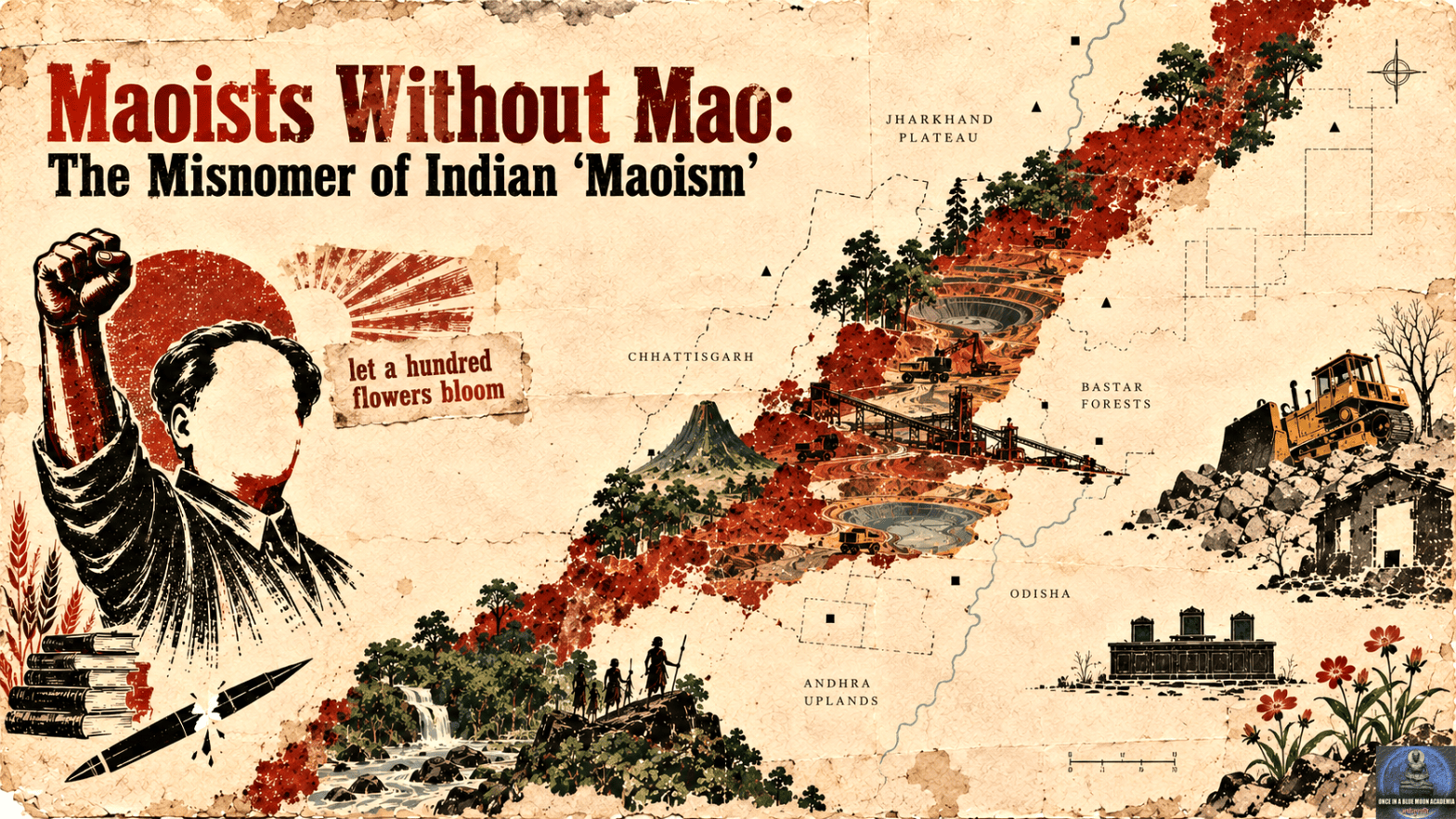
“Let a hundred flowers bloom, let a hundred schools of thought contend.” — Mao Zedong, Hundred Flowers slogan (1956)
1. Introduction
For half a century a so-called communist “insurgency” burned along the forested spine of central and eastern India. It began at Naxalbari in May 1967, splintered and regrouped across decades, consolidated in September 2004 as the Communist Party of India (Maoist) through the merger of the People’s War Group and the Maoist Communist Centre, and at its height operated across a broad “Red Corridor” from the Bihar–Jharkhand plateau through the Dandakaranya forests to the Andhra–Telangana border. Around 2026 the Indian state declared it effectively finished. Throughout that history, one word was fixed to the movement from every direction at once: Maoist. The state that criminalises it under the Unlawful Activities (Prevention) Act, the press that reports it, and the guerrillas who name themselves all agree on the label, if on nothing else.
This article contends that the label is simply mis-placed with a dis-placed meaning — not loosely, but in a precise and demonstrable sense — and that the wrongness is not innocent. Its thesis has two joined halves. The first is semiotic: “Maoist,” as it functions in India, is a brand whose referent — Mao Zedong’s actual body of revolutionary method — is systematically absent from the thing it names. The Indian analytic tradition supplies the exact instruments for this claim: anupalabdhi, knowledge by non-apprehension, the cognition of an absence; and arthānupapatti, the meaning that refuses to cohere with its object. The second half is a matter of political economy: if these were not Maoists, what were they, and why were they named so?
The answer developed here is that the insurgency’s territory coincides, almost point for point, with India’s mineral wealth — bauxite, coal, iron ore, chromite, uranium — and that “Maoist” operates as a security designation that reframes legitimate Adivasi/indigenous resistance to mining-driven displacement as extremism, licensing an ecological counterinsurgency under which extraction proceeds while land rights are rolled back. The urgent question the case studies pose is not rhetorical: are these zones inherently conflict-ridden, or kept unstable to ease extraction?
To answer, one must first know what Mao’s philosophy actually was, since the whole argument turns on a gap between a name and a method. Sections 2 and 3 reconstruct the referent — Mao’s own thought from the primary texts, and its rigorous inheritance in Althusser. Section 4 turns to the brand and the politics of naming, asking whether the branded Maoists know Mao at all. Section 5 examines the so-called insurgency’s parasitic political economy. Section 6 maps the mineral frontier and walks the extraction corridors in detail. Section 7 reads the whole as a secret moment of primitive accumulation. Section 8 turns to popular justice and its confiscation, from the Maoist tribunal to the bulldozer. Section 9 offers a positive characterisation of what the movement actually was, and Section 10 draws the threads together.
2. The Referent I — Mao’s Philosophical Inheritance
Mao’s standing as a philosopher rests less on originality of vocabulary than on the sinification of Marxism (马克思主义中国化) — a program he named explicitly in 1938: the adaptation of a European industrial doctrine to an agrarian civilisation with a philosophical inheritance of its own. Four things must be grasped to fix the referent: his theory of knowledge, his dialectics, his doctrine of the two fronts of struggle, and the classical-Chinese substratum beneath all three. (The New Democratic “semi-feudal, semi-colonial” theory of revolution, often treated as the centre of Maoism, is deliberately set aside here: it is the most conjuncturally dated part of his thought, and — as Section 6 shows — the part the Indian terrain most flatly refutes.)
2.1 On Practice (1937): knowledge as a moment of doing
On Practice (实践论) advances a materialist epistemology in which cognition is not contemplation but a phase of social practice — above all productive labour, class struggle, and scientific experiment. Knowing ascends from the perceptual (sensuous, immediate impressions) to the rational (concepts, judgements, inference) and then returns to practice, which alone is the criterion of truth: a theory is verified or refuted only when acted upon and its predicted results obtained or missed. Knowledge is therefore a spiral — practice, knowledge, again practice, again knowledge — not a mirror held up to a finished world. From this follows Maoism’s constitutive anti-dogmatism, condensed in the 1930 injunction of Oppose Book Worship: “no investigation, no right to speak,” and the demand that Marxism be integrated with the concrete conditions of each revolution rather than recited as a catechism. The first commandment of Mao’s method is the concrete analysis of concrete conditions.
2.2 On Contradiction (1937): the dialectic of the concrete
On Contradiction (矛盾论) generalises the dialectic into a doctrine of the universality and particularity of contradiction. Its operative concepts are precise and were meant to be used as instruments, not slogans: the principal contradiction (the one whose resolution governs an entire situation at a given stage) and the secondary contradictions ranged around it; the principal aspect of a contradiction and its subordinate aspect; and the distinction between antagonistic and non-antagonistic contradictions, which Mao would extend in 1957 to contradictions among the people under socialism. Decisively, dominance is mutable: the principal contradiction can be displaced by a secondary one as conditions change, and the principal aspect can pass over into its opposite. Development is uneven; the social whole is a knot of unequal, shifting contradictions, not the placid self-unfolding of a single essence. The formula Mao gave this — one divides into two (一分为二) — became the signature of his dialectics.
2.3 The Yan’an Forum (1942): the gun and the pen fronts
If On Practice and On Contradiction are the philosophical core, the Talks at the Yan’an Forum on Literature and Art (延安文艺座谈会, May 1942) supply the doctrine of the two fronts on which the referent’s politics rests. Mao’s premise there is that the revolution is fought by two armies: the army with guns and a cultural army — the “pen” — and that the cultural army is indispensable for uniting one’s own ranks and defeating the enemy. From this he draws a hard subordination: literature and art are a “component part” of the revolutionary machine; they must serve the people — defined as the workers, peasants, and soldiers — and, through the people, serve politics. There is, in this doctrine, no art for art’s sake; the political criterion comes first and the artistic second, and the writer must “become one with the masses” whose life supplies the only raw material of art. The Yan’an line is thus the theoretical seed of the Cultural Revolution’s “revolutionary model operas,” and — as Section 3 shows — of the “ideological front” that Mao’s French readers would later theorise. It pairs with the doctrine of the gun (“political power grows out of the barrel of a gun,” 1938) and with its indispensable corollary, that the Party commands the gun. The gun and the pen: two fronts, one command.
2.4 The Confucian substratum
Mao’s dialectic did not arrive on a blank Chinese slate, and the referent is misread if this substratum is ignored. Mao was schooled in the Confucian classics — the Four Books and Five Classics — and his speeches to the end of his life were saturated with allusions to Confucius, Zhuangzi, the Mohists, and the classical strategists, allusions that, by some counts, outnumbered his references to Marx and Lenin. Scholars of the sinification of Marxism (notably Germaine Hoston) argue that Neo-Confucian idealism fed directly into the sinified Marxism that crystallised by the 1940s: Zhu Xi’s account of a real material world apprehended by the mind-and-heart; Wang Yangming’s emphasis on human will and consciousness; and the recognition of an autonomous, even decisive, role for consciousness and culture in social change — the root of what critics call Maoist voluntarism, the faith that correct thought and mobilised will can move material mountains. Wang Yangming’s central tenet, the unity of knowledge and action (知行合一, zhixing heyi), stands as the Neo-Confucian ancestor of On Practice’s unity of theory and practice — inverted into materialism but structurally recognisable; and his notion of innate knowing (良知) and the “learning of the heart-mind” (心学) hovers behind Maoist claims about the transformability of the human person. Chinese correlative dialectics — the yin–yang polarity, the Yijing, Laozi’s maxim that reversal is the movement of the Way — underwrite the guerrilla dialectic itself: when the enemy advances we retreat, when he tires we harass, when he retreats we strike.
The classical novels furnished the political imagination as much as the classics furnished the philosophy. Mao read the Water Margin (水浒传), with its bandit-rebels of Liangshan Marsh, as a manual of righteous peasant revolt; he invoked the Monkey King Sun Wukong of Journey to the West as the rebel who wields his cudgel against a corrupt heaven; and he made a classical parable the emblem of revolutionary perseverance. In his closing speech to the Seventh Party Congress (1945), The Foolish Old Man Who Removed the Mountains (愚公移山) — a fable from the Liezi about an old man who sets his sons and grandsons to dig away two mountains, confident that where human resolve is endless the mountains are finite — became one of Mao’s “three constantly read articles”; the two mountains he glossed as imperialism and feudalism, to be removed by the massed will of the people. Here the Confucian-classical inheritance and the Marxist telos fuse.
And yet the relationship was one of inheritance and repudiation, a live contradiction in Mao himself. He attacked the Confucian doctrine of social hierarchy; and in 1973–74 the campaign to “Criticise Lin Biao, Criticise Confucius” (批林批孔) denounced Confucius as an apologist for a slave-owning, feudal ruling class, exalted the Legalists and the first Qin emperor, and compelled the philosopher Feng Youlan (Fung Yu-lan) to recant publicly his lifelong veneration of the sage. Mao was thus both the most classically literate of modern revolutionaries and the sponsor of the century’s most systematic assault on the classical tradition — a man who quoted the Analects while ordering their author tried in the court of history. This double bind is itself Maoist: the principal aspect of a contradiction passing into its opposite. To inherit Mao is to inherit this restless, self-revising relation to one’s own tradition — which is exactly what, as we will see, the Indian movement did not do.
2.5 Pluralism and purge: from “let a hundred flowers bloom” to “bombard the headquarters”
Nowhere is the mutability of the principal aspect (§2.2) more consequential — or more terrible — than in Mao’s own political line, which oscillated between the invitation to pluralism and the order to purge. In 1956 he launched the Hundred Flowers campaign under the classical-sounding slogan “let a hundred flowers bloom, let a hundred schools of thought contend” (百花齐放,百家争鸣) — an allusion to the “hundred schools” of the Warring States — inviting intellectuals to voice criticism of the Party. The slogan is not a decorative variant of “one divides into two.” A hundred schools is already more than a binary: it names a field of non-antagonistic differences that cannot be reduced to a single principal contradiction and its opposite, and so momentarily exceeds the two-term grammar in which dialectical logic is so often frozen. The theoretical warrant was his doctrine of non-antagonistic contradictions “among the people,” set out in On the Correct Handling of Contradictions Among the People (February 1957): such contradictions, he held, were to be resolved by persuasion and self-criticism, not by suppression. For that interval the social whole was to be treated as a garden of unequal growths rather than a duel. Yet when the criticism that bloomed proved sharper than expected — questioning the Party’s very monopoly of power — the flowers were reclassified as weeds. Plurality was forced back into a binary of fragrant and poisonous, people and enemy; the opening that had exceeded binaristic dialectic was closed by that same dialectic’s capacity to reassign the principal aspect overnight.
In mid-1957 Mao turned to the Anti-Rightist Campaign, in which several hundred thousand intellectuals who had spoken were branded “rightists,” dismissed, and sent to labour and re-education; the very essay that had licensed the opening was revised before publication to add “six criteria” for distinguishing fragrant flowers from poisonous weeds. Whether the Hundred Flowers was a sincere thaw later reversed or, as Mao’s phrase “luring the snakes out of their holes” (引蛇出洞) suggests, a deliberate trap to draw dissenters into the open, is debated by historians; either way, a contradiction classed as non-antagonistic had been reclassified as antagonistic almost overnight, and the pen that had been invited to bloom was punished for blooming.
The same logic, turned against the Party itself, produced the Cultural Revolution. On 5 August 1966 Mao wrote his own big-character poster (dazibao), “Bombard the Headquarters” (炮打司令部), calling the masses to attack a “bourgeois headquarters” inside the Communist Party — a charge aimed at Liu Shaoqi, Deng Xiaoping, and the Party establishment. This is the doctrine of continuing revolution under the dictatorship of the proletariat: the claim that a new bourgeoisie regenerates within the ruling party, so that revolution must be permanently renewed and, if need be, turned against its own leadership, mobilising the Red Guards against the apparatus. Here the “pen” (§2.3) becomes literal — a single wall-poster igniting a decade — and “one divides into two” (§2.2) is applied to the Party’s own body. From the hundred flowers to the bombarded headquarters, Mao’s line is a study in the mutability of the principal contradiction, purchased at catastrophic human cost. It is also, decisively for this article, a capacity the branded Maoists never inherited: neither the pluralist opening nor the auto-critical turning of the revolution against its own vanguard survived the passage of Mao’s name to the Indian forest, where the doctrine was frozen precisely at the point Mao insisted nothing could be.
3. The Referent II — Mao’s Philosophical Afterlife: Structural Marxism and Althusser
Before turning to the branded Maoists in India who did not read Mao, it is worth marking what a rigorous inheritance of Mao looks like — because the contrast is the argument. That inheritance is Louis Althusser’s.
Writing inside the French Communist Party after 1956, Althusser wanted to break simultaneously with the economism that reduced history to the mechanical unfolding of the productive forces and with the Hegelian humanism — the “expressive totality” in which every phenomenon merely voices a single inner essence — that had returned through the newly fashionable young Marx. He needed a Marxist authority impeccable enough to license heterodoxy, and On Contradiction was ideal. Mao had already refused the simple contradiction: every process contains many contradictions; they are unequal; one is principal at a given stage and the others secondary; within each, one aspect is principal and the other subordinate; dominance can pass from one contradiction or aspect to another as conditions change; development is uneven; the whole is therefore a knot, not the self-unfolding of a single essence. That is the conceptual gate through which overdetermination enters. If the social whole is complex from the start, no contradiction can express the whole by itself; each is specified, displaced, and intensified by the others that surround it. Althusser’s name for that specification is overdetermination.
In “Contradiction and Overdetermination” and “On the Materialist Dialectic” (in For Marx, 1965), he fused Mao’s principal/secondary distinction and uneven development with Freud’s condensation and displacement. The Marxist contradiction is never simple: it is always overdetermined, because the principal contradiction is itself an effect of the structure in which it sits, and secondary contradictions can accumulate upon it until they displace its dominance. From Mao’s mutable dominance Althusser built the complex structured whole — a “structure in dominance” whose dominant instance can shift — and promoted uneven development from an empirical observation into the mode of existence of the whole. Taking up Engels’ formula that the economy is determinant only “in the last instance,” he added the twist that made it his own: the economy determines which level is dominant but rarely acts as dominant itself, so that “the lonely hour of the last instance never comes” and the superstructures enjoy a relative autonomy. This is the political correlate of Mao’s “politics in command” and of the Yan’an doctrine of the ideological front: the refusal to believe that transforming the base automatically transforms everything else. On Contradiction thus does not merely supply Althusser with vocabulary; it supplies the anti-expressive topology without which overdetermination would collapse back into Hegelian essence or into economic last-instance reduction.
The affinity became political through Althusser’s own students. The École normale supérieure of the Althusserian years was a nursery of French Maoism; an unsigned 1966 essay in the Cahiers Marxistes-Léninistes, generally attributed to Althusser, theorised the Chinese Cultural Revolution as a mass ideological revolution — the transformation of the superstructure that the relative autonomy of the ideological makes both possible and necessary. That concern feeds directly into his most influential later text, “Ideology and Ideological State Apparatuses” (1970), with its account of the reproduction of the relations of production through ideology and its theory of interpellation. His pupils and associates — Alain Badiou, who became and remains the most committed philosophical Maoist; Jacques Rancière, who would break with him in La Leçon d’Althusser (1974); Robert Linhart, who went to work on the assembly line; Étienne Balibar, who stayed closest — carried the master’s premises into a militancy the master himself, remaining in the Party, declined to join.
Three cautions keep this honest, and each sharpens the contrast with India. Much of Althusser’s use of Mao was strategic, a communist shield behind which to conduct an anti-Stalinist operation. The debt involved creative misreading: On Contradiction is more Hegelian and evolutionary than Althusser’s structuralism admits, and overdetermination is as much Freud’s child as Mao’s. And Althusser kept his distance from organised Maoism even as his framework fed it. But the decisive point is this: Althusser, who never called himself a Maoist, practised Mao’s first commandment — the concrete analysis of the complex conjuncture, the refusal of the simple essence — more faithfully than any self-declared Maoist. One text, On Contradiction, thus had two afterlives: in Paris an instrument that turned uneven, shifting contradiction into overdetermination and anti-dogmatism; and, as the next sections show, in the Indian forest a catechism recited over a countryside it no longer fit. The measure of the distance between fidelity to a name and fidelity to a method is that the structuralist who borrowed Mao unfaithfully kept his method, while the so-called “insurgents” (from the state machinery’s gaze) who bore his name did not.
4. The Brand — India’s “Maoists” Tagged and Stamped: The Politics of Naming
“Maoist” in India is a brand in a double sense, affixed from two directions at once. From above, it is a stigma burned on by the state, which folds a heterogeneous field — Adivasi resistance to displacement, agrarian unrest, forest-rights agitation, civil dissent — into a single criminal category legible to the security apparatus and prosecutable under anti-terror law. From within, it is a self-applied identity-mark by which the movement claims a lineage, an authority, and an international pedigree. The two namings collaborate: the state needs an enemy called “Maoist,” and the vanguard needs to be that enemy. The question this article presses is whether the thing thus named has any purchase on Mao himself. It does not — and not, crucially, because the leadership never read him. The Central Committee of the CPI (Maoist) circulated the Selected Works and issued citation-heavy Strategy and Tactics documents. The claim is sharper: they possess the words and not the grammar; their relation to Mao is iconic, dogmatic, and nominal, so that what survives is the brand precisely in the absence of the method — knowable, in the vocabulary of Section 1, only as anupalabdhi, the shape of an absence.
Four proofs establish this. First, the founding utterance is a devotion, not an analysis: Charu Mazumdar’s Naxalbari-era slogan that China’s Chairman is India’s Chairman and China’s path is India’s path. To make a foreign leader one’s own Chairman is to perform the exact opposite of what Mao did, whose whole labour was the sinification of Marxism — the refusal to make Moscow’s Chairman China’s Chairman. The slogan venerates the icon while inverting the operation. Second, and most damning, is the dogmatism that betrays the method: to hold, as the movement’s self-designation “Marxism-Leninism-Maoism” does, that Maoism is a finished, universally applicable system is to assert precisely the doctrine Oppose Book Worship was written to destroy. Fidelity to the letter is here the betrayal of the spirit; converting a method of concrete analysis into a frozen creed is the one thing that method forbids. Third, the militarist deviation Mao had already condemned: at the Gutian Conference of December 1929 Mao’s resolution named and anathematised the “purely military viewpoint” and the “roving-rebel-band ideology” (流寇主义) of armed bands that raid without building stable political power among the masses — a description that fits Mazumdar’s founding “annihilation of the class enemy” (khatam) line, the individual liquidation of enemies as the motor of revolution, so exactly that the Indian movement’s inaugural strategy is the specific error Maoism was constituted against. Fourth, the doctrine of the two fronts was halved: the gun was kept and the pen — the mass line, the cultural-ideological front, the united front Mao made one of his “three magic weapons” alongside armed struggle and Party-building — was largely discarded, leaving a militarism that Mao would have recognised not as his method but as its disease.
The politics of naming is therefore not a quarrel about labels. It is the mechanism by which two powerful actors agree to call a frontier revolt something it is not, each for its own reasons, and in doing so write its actual subject — the dispossessed Adivasi — out of the account. That subject is the concern of the sections that follow.
5. The Political Economy of a Undecidedly Decidable “Maoist” Insurgency in India
Mao’s people’s war was, before anything else, a doctrine of material self-reliance: land reform that generated genuine peasant surplus and support, production by the Red Army itself, a base-area economy that made the liberated zone a functioning proto-state. The Indian movement inverted every term, and the inversion is among the strongest proofs of the thesis.
Financing. The CPI (Maoist) ran a territorial extortion economy, euphemised in Article 60 of its own constitution as membership fees, levies, donations, taxes, penalties, and wealth confiscated from enemies. In practice — as the Union Home Ministry conceded to Parliament in December 2013 — the load-bearing sources were extortion from tendu-leaf and bamboo contractors (a per-bag “levy” of roughly ₹500–900), cuts skimmed from iron-ore and coal mining and from road, bridge, and transport contracts, and, tellingly, a tax on the government’s own development disbursements — the rural employment guarantee, rural housing. The economy was symbiotic, not redistributive: the contractor, the cadre, and the corrupt official drew from the same till, and the cost fell on the villager through the shoddy public works that resulted. Extorted cash was laundered through banal local channels — real estate, front entities, over-ground sympathisers. The headline totals are worth citing because they are unreliable: estimates span an order of magnitude, from a government study’s roughly ₹140 crore a year to a Chhattisgarh figure of ₹250–300 crore to an intelligence “guesstimate” of up to ₹2,000 crore. Nobody knew; the numbers were political artefacts produced by the apparatus that had an interest in their size.
Weapons. The arsenal was overwhelmingly the state’s own, acquired involuntarily: an estimated 20,000 modern weapons — INSAS, AK-series, self-loading rifles — mostly looted from the security forces in ambushes and camp raids, supplemented by improvised explosive devices, a domestic cottage industry of clandestine arms manufacture concentrated in the gun districts of Bihar, and ammunition pilfered from ordnance factories through contractor-couriers embedded in the state’s supply chain. Foreign procurement, via the LTTE and Northeastern smuggling routes, was always marginal and dried up after around 2011. An insurgency whose firepower is drawn chiefly from looting the adversary has not built the self-supplying base of protracted people’s war; it is materially parasitic on the force it claims to be defeating.
The conflict-and-debt discourse. It is tempting to leap from “symbiotic rent” to the stronger claim that circulates in dissident commentary: that the same dealers arm both sides and that financiers launder the proceeds to sustain a profitable, permanent conflict and its attendant debt. This must be handled in two tiers of differing evidentiary standing. The defensible tier is a structural, functional analysis: that the state was the insurgency’s principal armourer through looting and leakage; that a shared-rent economy produced beneficiaries on every side; that counterinsurgency intensity has demonstrably tracked mineral value (Section 6). The unfalsifiable tier — a directed cabal of named agents intending the war — is not a claim to endorse but a discourse to analyse, precisely because it cannot specify what evidence would refute it. The most seductive articulation of that discourse is not archival but cinematic: in Tom Tykwer’s The International (2009), the fictional IBBC — transparently modelled on the real Bank of Credit and Commerce International, which collapsed in 1991 amid money-laundering and arms-financing — is made to state the doctrine outright, correcting the naïve assumption that a bank wishes to control the conflict when its true object is to control the debt the conflict produces: “you control the debt, you control everything.” The film earns its place here because it is fiction and therefore the ideal specimen of the discourse to be anatomised: it compresses the strong-conspiracy intuition into an epigram and thereby exposes both its seductive economy and its unfalsifiable form. Its kernel is real — debt is a technology of discipline, as David Graeber and Maurizio Lazzarato have argued, and the doctrines of odious debt and structural adjustment show sovereign debt operating as a lever over nations — but its overreach is to personify a structural logic as a single controlling agent, where the defensible claim is that a debt-based political economy produces beneficiaries with no Calvini required to will it. Arthānupapatti once more: the omnipotent bank is a signifier straining to name a structural power that exceeds any agent who might wield it.
6. The Mineral Frontier and the Extraction Corridors
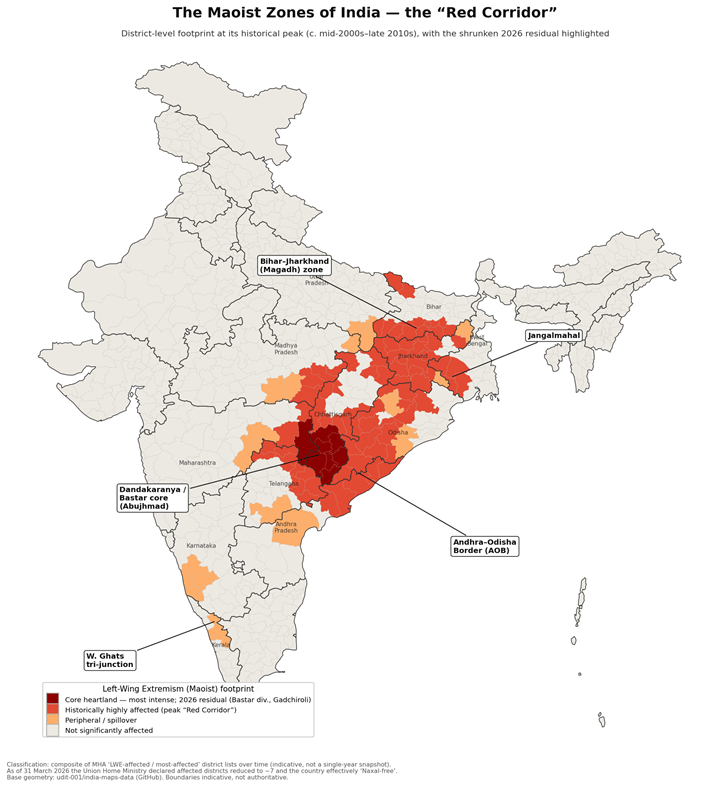
Figure 1. The Maoist zones of India — the “Red Corridor” at its historical peak (c. mid-2000s–late 2010s), with the shrunken 2026 residual highlighted. District-level footprint; classification is a composite of MHA “affected / most-affected” district lists over time (indicative, not a single-year snapshot). Base geometry: udit-001/india-maps-data (GitHub).
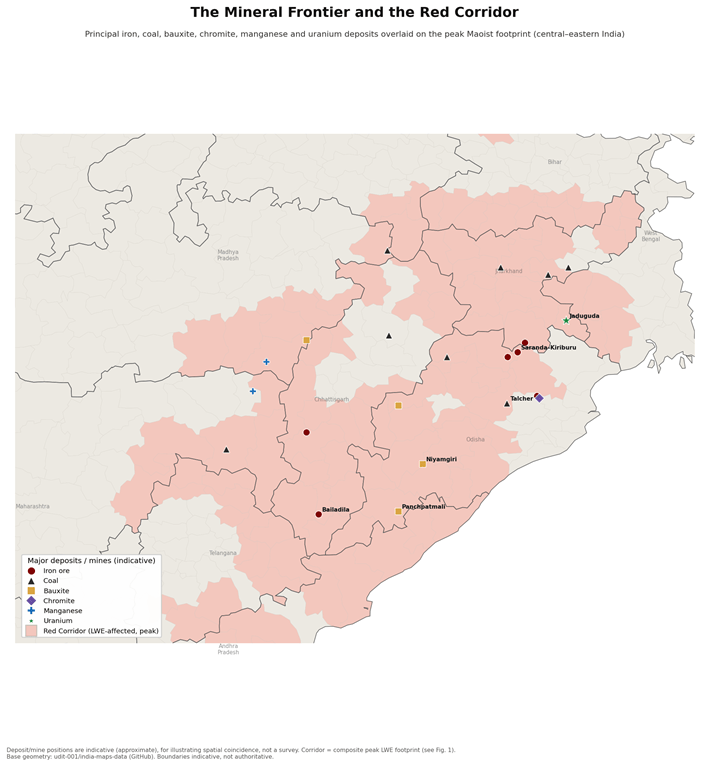
Figure 2. Major iron, coal, bauxite, chromite, manganese and uranium deposits (indicative positions) overlaid on the peak Red Corridor, central–eastern India. The coincidence is the argument: the insurgency’s territory is, almost point for point, the country’s ore body. Base geometry: udit-001/india-maps-data (GitHub).
The geography is the first witness against the name. Plotted at its peak, the “Red Corridor” does not trace India’s densely settled agrarian plains but a diagonal band of forested, mineral-rich, Adivasi-majority uplands running from the Bihar–Jharkhand plateau through the Chhattisgarh–Odisha forests to the Andhra–Telangana border, with its dark core in the Dandakaranya/Bastar massif (Figures 1 and 2). Odisha alone holds roughly 28% of India’s iron ore, 59% of its bauxite, 98% of its chromite, and about a quarter of its coal; Jharkhand holds about a quarter of the iron ore and the country’s uranium; Bastar sits atop the Bailadila iron-ore ranges. The insurgency lived precisely where the state was administratively thin and the resource rents geologically thick. This dissolves the movement’s own “semi-feudal, semi-colonial” premise: the ground it actually held was not Mao’s feudal manor but the frontier of contemporary extractive capital, and the principal contradiction there is not landlord versus tenant but dispossession — the collision between forest-dwellers with constitutionally recognised forest and land rights (PESA 1996; the Forest Rights Act 2006) and the state–capital extractive complex.
Two calibrations keep the argument rigorous. First, the detecting hand is overwhelmingly the state’s, not a secret corporate one: the Geological Survey of India’s National Aerogeophysical Mapping Programme has surveyed over 6.5 lakh sq km with airborne geophysics and hyperspectral remote sensing, and the blocks it delineates are auctioned to firms under the post-2015 mineral-law regime; the marquee deposits (Bailadila mined since the 1960s) were known long before satellites. The claim is therefore not that corporations discovered hidden wealth by remote sensing and engineered the war, but that a state-led geospatial-and-auction apparatus converts Adivasi geology into corporate leases, and counterinsurgency clears the last obstacle. Second, the value-sensitivity of that clearing is measurable: an econometric study found that after India raised the iron-ore royalty to 10% in 2007, incidents in which government forces killed Maoists or their supporters roughly doubled in iron-ore districts, with no comparable effect in bauxite or coal districts whose fiscal terms did not change — a documented pattern of value-sensitive state violence, not an imputed intent. Where indigenous communities resist displacement, the state routinely invokes “national security,” militarises, surveils, and represses; what unfolds is an ecological counterinsurgency in which mining proceeds while land rights recede. Four corridors make this concrete.
6.1 Dantewada and Bastar (Chhattisgarh)
The Dandakaranya core is rich in iron ore (NMDC’s Bailadila) and central to the offensive the press named Operation Green Hunt, the coordinated central–state paramilitary campaign from around 2009. In 2005 the Chhattisgarh government signed memoranda of understanding with Tata Steel (for a plant at Lohandiguda, Bastar) and Essar Steel (Dhurli and Bhansi villages, Dantewada; and a slurry pipeline from Bailadila), and in the same year the state launched the Salwa Judum, a state-backed vigilante militia that burned villages and herded populations into roadside camps — a campaign the Supreme Court declared unconstitutional in Nandini Sundar v. State of Chhattisgarh (2011), ordering the disbanding of the Special Police Officers. The temporal coincidence of the mining MoUs and the militia is the crux of the critical reading: villagers resisting displacement faced violent crackdowns, and the Tata Lohandiguda project, stalled by resistance, was eventually abandoned around 2016 with much of the acquired land returned. The state’s account frames the same events as the belated arrival of constitutional governance and development to a neglected periphery held hostage by an armed group; the two readings interpret the same undisputed facts.
6.2 Kalinganagar (Odisha)
Kalinganagar, in Jajpur district, sits in a belt of chromite (the nearby Sukinda valley) and iron ore. On 2 January 2006, police opened fire on Adivasis — of the Ho and allied communities — who had gathered to stop construction of a boundary wall for a proposed Tata Steel plant; 13 tribal people (including three women) and one policeman were killed, and some forty were injured. The judicial commission under Justice P. K. Mohanty, whose report was tabled in the state assembly in 2017, cleared the government and police and blamed local leaders and activists for instigating confrontation — a finding activists and opposition parties denounced as one-sided, noting that villagers armed with axes and bows had faced twelve platoons of armed police. Of the roughly 13,000 acres earmarked for the Kalinganagar Industrial Complex, around 7,057 were privately owned, much of it claimed as public land and transferred to a private company. Two decades on, the “Maoist” presence in the region is widely noted to have surged after the state violence, not before it, and Kalinganagar today accounts for a large share of Odisha’s approved investment — a sequence in which resistance, repression, and the label followed the mineral, not the reverse.
6.3 Niyamgiri Hills (Odisha)
In the Niyamgiri Hills of Kalahandi and Rayagada districts, the Dongria Kondh — a particularly vulnerable tribal group who revere the mountain as the seat of Niyam Raja, the earth-spirit — resisted Vedanta’s plan to mine bauxite to feed its Lanjigarh alumina refinery. The Supreme Court, in Orissa Mining Corporation v. Ministry of Environment and Forests (2013), referred the decision to the affected gram sabhas; twelve village assemblies voted unanimously to reject mining, a rare instance of statutory consent defeating an extractive project. In the course of the struggle the state and company hinted at “Maoist” links among the resisters — a device, critics argue, to delegitimise a lawful, sacred defence of land by recoding it as extremism. Niyamgiri is thus the clearest case in which the label itself, rather than any insurgent act, does the political work of criminalising resistance.
6.4 Singhbhum and Jadugoda (Jharkhand)
West Singhbhum and the wider Singhbhum shear zone are rich in iron ore, copper, and uranium and are routinely flagged as “Maoist” territory where state crackdowns coincide with corporate encroachment. At Jadugoda (Jaduguda), in East Singhbhum, the state-owned Uranium Corporation of India Limited (UCIL) has mined uranium since 1967, storing radioactive waste in tailings ponds sited close to Adivasi villages. Activists, journalists, and several independent studies report a pattern of congenital deformities, cancers, primary sterility and other reproductive problems, and lung and kidney disease among residents: the nuclear physicist Surendra Gadekar’s 2001 survey found radiation five to six times normal in some pockets; the Jharkhand High Court, taking suo motu notice in 2014 of a photo-report titled “The Nuclear Graveyard,” observed that some fifty thousand people were at risk and that the mostly tribal population appeared to suffer serious radiation-related problems. Against this stands the official record: UCIL, replying under the Right to Information Act, states that no adverse health effect attributable to its operations is observed in the surrounding tribal population, and both the Jharkhand High Court and the Supreme Court ultimately declined to find the allegations proven, an official medical committee attributing the anomalies to genetic disorders, malaria, and malnutrition rather than radiation. The facts are thus contested — reported and denied, unofficial and official — and it is precisely villagers and activist groups pressing for accountability who have, at times, been branded insurgents. This is the extraction corridor’s characteristic epistemic condition: a harm asserted from the ground and disavowed from the office, with the security label available to settle the dispute by other means.
In each corridor the same question recurs, and the article poses it without prejudging every case: is what unfolds an armed insurgency, or a strategy to displace people by framing resistance as extremism while corporate interests proceed unchecked? The financing pattern (Section 5), the map (Figures 1–2), and the value-sensitivity of counterinsurgency together make the second reading, at minimum, unavoidable as a hypothesis with real evidentiary weight.
7. The “Secret” Moment of Primitive Accumulation
Two inferences tempt the reader of Section 6, and only one survives. The first — that capital manufactured the insurgents to clear the land — must be refused: the movement has an organic genealogy in real agrarian and Adivasi grievance, an armed movement that for fifty years obstructed extraction (attacking NMDC convoys, sabotaging the Essar pipeline, blocking Vedanta) is a preposterous instrument for letting miners in, and the land-clearing that occurred was driven far more by the counterinsurgency the rebels provoked than by the rebels. The second inference is not only defensible but correct, and it is the one your phrasing invokes: this is a secret moment of primitive accumulation.
Marx’s Part VIII of Capital, Volume I — “So-Called Primitive Accumulation” — opens with the chapter titled, with deliberate irony, “The Secret of Primitive Accumulation.” The secret is polemical: against the classical-economic idyll in which capital is the reward of thrift, Marx argues that the real historical precondition of capital was expropriation — the forcible divorce of the direct producer from the means of production, the enclosures, the clearing of the estates, the dissolution of the commons, written in the annals of humanity “in letters of blood and fire,” with the state as the concentrated coercive force that midwifes the new order. Set beside the extraction corridors, the schema fits closely: the forcible separation of Adivasi forest-dwellers from the jal–jangal–zameen commons, to open that ground to extractive capital, with state coercion — Salwa Judum, the Kalinganagar firing, the criminalising label — as the lever. This is evacuation in its exact Marxian sense: not incidental collateral of conflict but the productive core of it, the making of empty ground.
The concept has been reworked for the present. Enclosure did not close with the birth of industrial capital; the forcible taking of commons, the conversion of shared land, forest and water into alienable assets, and the expulsion of those who lived by them remain ordinary operations of accumulation, not a primitive stage left behind. Most productively for the Indian case, Kalyan Sanyal’s Rethinking Capitalist Development (2007) rebuilds primitive accumulation from a postcolonial standpoint, drawing Marx and Foucault together: postcolonial capitalism is a formation not of capital and labour but of capital and non-capital, in which an accumulation economy coexists with a vast need economy — the informal, subsistence production of those whom accumulation dispossesses but does not employ. Its dispossessed do not become a proletariat; they form a surplus “wasteland,” politically dangerous, whom the state manages through a welfarist governmentality that Sanyal calls a reversal of primitive accumulation — the developmental tending of the dispossessed outside capital. Michael Levien’s Dispossession without Development (2018) documents the Indian case in which that reversal frequently fails, leaving expulsion without incorporation or rehabilitation. On the Adivasi frontier both moments are visible at once: the accumulation economy takes the ore, while the need-economy apparatus — employment guarantee, housing grants, rations, resettlement colonies — is deployed to manage the displaced, and routinely under-delivers.
Here the frame turns from description to indictment, and closes a circuit with Section 5. The Maoists subjectively understood themselves as resisting expropriation, and for five decades they materially slowed it. Yet objectively the protracted war they waged summoned the militarised counterinsurgency that, in places, accelerated the very clearing it claimed to resist. And Sanyal sharpens the irony from the other side: the government transfers the insurgency taxed (Section 5) — employment-guarantee wages, housing grants, welfare disbursements — are precisely the need economy, the developmental machinery by which the state pacifies the dispossessed surplus. The movement thus levied a toll on the very apparatus that manages the population primitive accumulation had displaced, feeding on the reversal of primitive accumulation while calling this a war against primitive accumulation. A movement that ends by greasing the wheels of the expropriation it exists to fight has fallen into a performative self-contradiction — which is, once more, not a digression from the thesis but its deepest confirmation: to fight primitive accumulation and, through the manner of the fighting, hasten it, is not to do what Maoism claims to do. And it is why the first inference (capital crafted the rebels) must be refused in the name of the second: in Marx’s schema the Adivasi are the expropriated — the object of primitive accumulation, not the dispossessor’s instrument — and Marx’s causal power is structural, not conspiratorial. The moment the argument reaches for a secret committee of cronies it abandons Marx for melodrama; the defensible claim is functional — the conflict, and above all the state’s response to it, served the ends of expropriation — not intentional.
8. Popular Justice and Its Confiscations: From the Maoist Tribunal to the Bulldozer (In)Justice
The problem of the form of revolutionary justice was posed directly in the 1971–72 exchange published as “On Popular Justice: A Discussion with Maoists,” between Michel Foucault and “Pierre Victor” (Benny Lévy of the Gauche Prolétarienne). The concrete question was whether the masses should set up people’s courts to try class enemies. Foucault’s startling objection was that the court-form is itself a state apparatus: the neutral third party — the judge — placed above and between two contending parties, invoking a universal law that stands apart from both, is precisely the ideological shape of the state. Historically, he argued, the court did not express popular justice but confiscated it, inserting the state between the people and their adversaries to capture and neutralise mass action. His warning to the Maoists followed: institute people’s courts, complete with judges and a penal apparatus, and you will smuggle the state back into the heart of the revolution. The Maoist interlocutor defended the tribunal as an organised, pedagogical form that gives mass anger a disciplined shape; the disagreement turned on spontaneity versus organisation, and on whether revolutionary justice needs an apparatus at all. The dialogue anticipates the analysis of the prison in Discipline and Punish (1975), and its worry — that a revolutionary form reproduces the apparatus it opposes — is exactly the pattern this article has traced in the insurgency’s economy and its objective effects.
The Indian present, however, lets us catch Foucault in a productive incompleteness. The contemporary majoritarian state performs the mirror image of his scenario. It does not reimport the court; it sheds it. Bulldozer (in)justice is the anti-court: no judge, no charge, no procedure, no appeal — the executive arriving with a demolition machine to raze the home of an accused person, most often from a minority community, before or instead of any trial. Where Foucault’s tribunal inserts a false neutral above two parties, the bulldozer drops the pretence of neutrality: the state is now openly one party acting against the other, while wearing the aesthetics of swift, righteous, popular wrath. Yet it retains a fig-leaf of neutral law — the demolition is reclassified as the removal of an “illegal encroachment,” a neutral municipal act — so that the apparatus performs both Foucauldian operations at once: it abandons the court-form and keeps the court’s alibi. This hybrid is more insidious than either, and it is the impunity loop rendered architectural: reclassification of punishment as zoning, manufacture of consent, displacement of cost onto the razed family, fast-track cover, and resumption. Lynching and cow-vigilante violence complete the picture: the “spontaneous” popular justice that Foucault feared the vanguard would organise reappears as violence organised enough to be effective and spontaneous enough to be disowned — the mob as deniable executive, doing what the court will not and what the state cannot be seen to do, with the impunity loop closing over it.
The same loop runs through language before it runs through machines. The dominant nationalist formation in contemporary India — the Sangh’s long pedagogical project and the party that now speaks from office — does not need a people’s court if it already owns the names. A portable lexicon decides the enemy in advance, so that investigation becomes optional and demolition, arrest, or smear can follow as if they were merely administrative. Urban Naxal and dimagi Naxal (“Naxal of the mind”) extend the forest brand into the university, the newsroom and the courtroom: one need not have held a gun; proximity to dissent is enough for the stamp. Terrorist does the harder work of collapsing protest, militancy and community into a single security object. Gunda (goon) strips politics of politics and returns the opponent as mere crime. Deshdrohi, gaddar, deshvirodhi and anti-national perform the oldest confiscation of all: they convert a dispute within the people into treason against the people, so that contradiction among citizens is reclassified as antagonism against the nation. Tukde-tukde gang names a fantasy of vivisection and then treats the named as already guilty of it. Sickular mocks secular citizenship as pathology; liberandu is not argument but caste-coded insult dressed as wit. Andolanjeevi recodes the right to assemble as a livelihood racket; Khan Market gang spatialises class and minority presence as an elite conspiracy against “the real country.” Each exonym is a miniature bulldozer: it razes the specific claim — a land title, a forest right, a critic’s sentence — and leaves a vacant lot called the nation.
Compounded, these terms are additive, not ornamental. They do what “Maoist” did on the mineral frontier, only at national scale. A decidable name is affixed; the referent is not required to cohere; the subject underneath — Adivasi, Muslim, student, journalist, opposition worker — is written out as terrorist, traitor, goon or paid agitator (“Soros-funded”?!?). Foucault’s fear was that revolution would smuggle the court back in. The present arrangement is cruder and more efficient: the court is sidelined, the alibi of law is kept, and a choir of slurs supplies the popular wrath that makes the machine look like the people. The analysis does not need a cabal behind every demolition. It needs only this grammar: brand first, facts later, rubble as proof that the brand was correct.
There is a Foucauldian refinement the Indian case forces. Discipline and Punish narrates the passage from the spectacle of the scaffold to the invisibility of the prison; bulldozer justice is a startling return of the scaffold — punishment restaged as public, broadcast, deterrent theatre — married to the modern administrative disavowal of intent. Spectacular visibility of the act, total concealment of its purpose: the demolition is filmed so that a whole community internalises the lesson, while the state files it under zoning. This is the coupling of jugupsā (disgust-concealment) and the will-to-display — spectacle as discipline, where Foucault gave us spectacle or discipline. It is the same operation as the branding of the Adivasi resister as “Maoist”: power that punishes in public while disavowing that it is punishing at all.
9. What They Were Instead
A negative thesis owes a positive counterpart. If “Maoist” misnames them, what names them better? The phenomenon is a compound, and none of its elements is Maoism. It was, first, an Adivasi ecological revolt on a mineral frontier — non-capital defending the jal–jangal–zameen commons against enclosure — not the New Democratic agrarian revolution of a landless peasantry seeking redistribution of tilled estates. The grievance is anti-dispossession of forest, hill, river and ore-bearing ground; it only appears to coincide with the Maoist template because both speak of countryside. What was at stake was a lived ecology: tendu and bamboo as livelihood, Bailadila iron and Niyamgiri bauxite as the mountain’s body, Jadugoda’s tailings as poisoned water and damaged reproduction, the Forest Rights Act and PESA as paper claims on a bioregion the auction state had already redrawn as lease. The movement’s map follows the ore body and the remaining forest, not the feudal manor.
Its form, second, is best named not by Mao but by Auguste Blanqui: a small, largely clandestine vanguard of professional revolutionaries substituting its own armed action for the self-activity of the masses, with Charu Mazumdar’s annihilation line as textbook Blanquist terror — the very deviation Mao condemned at Gutian, so that to call it “Maoist” is to mistake a disease for its cure. That form sat badly on an ecological struggle. People’s war, in Mao’s register, had to grow a base-area economy inside the landscape it claimed; a Blanquist core can tax the forest and sabotage the pipeline without inhabiting the watershed, and so can defend a commons in slogan while treating it as a rear area and a revenue floor.
Third, extending Sanyal through Partha Chatterjee’s political society, it functioned as the armed edge of the governed — a violent bargaining over the terms of ecological dispossession by populations whom developmental governmentality manages and, on the resource frontier, coerces. Employment guarantee, rations, roads and resettlement colonies are the need-economy’s answer to a wrecked subsistence ecology; the levy on those same transfers is the insurgency’s answer to the same wreckage. This accounts for the fact most fatal to its self-image: that in fifty years it never seriously approached the cities or the state, because it was not, at bottom, trying to take them. It was fighting over who would stand on the remaining ground — ore, forest, river — and on what terms that ground could still be lived.
Fourth, it was led by a déclassé vanguard over a frontier base: Alpa Shah’s ethnography (Nightmarch, 2018) documents an educated, largely upper-caste and middle-class leadership commanding local Adivasi youth recruited less by ideological conversion than by solidarity, so that “Marxism-Leninism-Maoism” sat atop the movement as a superstructure loosely coupled to the substructure of grievance beneath it. The coupling is ecological as well as sociological. The leadership’s imported agrarian schema could not see that the principal contradiction on this ground was not landlord and tenant but extraction and remaining life — hill against refinery, commons against lease, sacred geography against the mineral map. The name and the terrain came apart.
Naming the grievance honestly does not license romanticising the vehicle. The same insurgency that slowed mines and pipelines also coerced the Adivasis it claimed — extorting them, conscripting their children, killing suspected informers, and shading at times into the predatory racket of Section 5 — and so damaged the social ecology of the forest as well as confronting its industrial destruction. Many welcomed its end as deliverance; the state’s development account, too, has real Adivasi takers, not only official spokesmen. “A frontier revolt against ecological dispossession” names the grievance the movement fed on, not a certificate for its conduct. Holding a just defence of land, water and forest together with an often-unjust vehicle is what separates analysis from advocacy.
10. Conclusion: The Brand and Its Referent
The argument gathers into a single shape: a brand without its referent. The referent, reconstructed in Sections 2 and 3, is Mao’s actual method — situated, anti-dogmatic, self-reliant, mass-line, two-fronted, and restlessly self-revising even toward its own Confucian inheritance. For a brief interval that method opened further than its own binary grammar. “Let a hundred flowers bloom, let a hundred schools of thought contend” is not a flourish on “one divides into two.” It is an epistemological wager: that a social world is a constellation of standpoints, not a duel of essences; that criticism among the people need not be recoded at once as enmity; that truth is approached from many sides or it is not approached. Call that wager, in another lexicon, anekānta: a commitment to plural constellation-worlds, against the comfort of a single decided name. Althusser, who never called himself a Maoist, took from On Contradiction not a catechism but the topology of an uneven, overdetermined whole — one technical name for the same refusal of the simple essence. The brand is “Maoist” as it functions in India: a label affixed by a state that needs its enemy named and by a vanguard that needs the name’s borrowed grandeur. The name was decided. The thing named would not coincide with Mao.
Reviewed together, the sections form one cognition of absence: Mao is missing behind the word that claims him. Section 4 found the method absent — iconolatry, dogmatism, the roving-band militarism condemned at Gutian. Section 5 found the self-reliance absent — a parasitic levy on contractors, mines and welfare, and an arsenal looted from the enemy. Section 6 found the terrain absent — not the feudal countryside of the doctrine’s premise but an extraction corridor, on which counterinsurgency tracked the price of ore, and along which Bastar, Kalinganagar, Niyamgiri and Jadugoda tell one ecological story in four registers: forest, firing, sacred hill, poisoned water. Section 7 found the aim inverted — a movement feeding on the need-economy that manages those whom accumulation expels, while calling this a war against primitive accumulation. Section 8 found popular justice confiscated and returned as spectacle: the tribunal Maoists wanted, the bulldozer the present prefers. What they were instead, named in Section 9, is a compound no single doctrine can cover — an Adivasi defence of jal–jangal–zameen, a Blanquist core, the armed edge of the governed — ideology sitting loosely on a substructure of dispossession. A sign that will not cohere with its object has been doing political work all along.
The misnomer is not innocent, and this is where analysis touches ethics. The brand serves both hands that affix it — consolidation for the state, legitimation for the vanguard — and what both namings share is an erasure. The Adivasi, the dispossessed subject the conflict was about, is written out twice: criminalised as “Maoist” by the state, instrumentalised as “the peasantry” by the vanguard. The hill becomes a lease, the forest a rear area, the villager either extremist or mass. The hundred schools collapse into one security word. To insist that these were not Maoists is therefore not lexical fastidiousness. It is an attempt to return the missing object — ecological dispossession on a mineral frontier, seen from more than one side — to a discourse that two powerful namings agreed to hide.
The problem of all “-isms” is the paradox that founds this article. An “-ism” lives by a double motion: it claims a world, and in the same breath it fences that world. To say that Marxism, Maoism, nationalism, developmentalism, or security-think “includes” a people is already to decide who counts as the people and what may not be thought beside them. The marked territory of the “-ism” — its legitimised vocabules, its semantic field, its authorised “friends and foes” — does not merely describe a situation; it installs a structure of power in which free investigation and plural potentials are treated as noise. Ethics, epistemology and ontology then cease to sit in conversation. They are flattened until they confirm the diktat. “Maoist,” in India, is this operation in one word. It includes the forest in a revolutionary pedigree and excludes the forest as forest; it includes the Adivasi as “peasantry” or “cadre” and excludes the Adivasi as a perpetual dweller of jal–jangal–zameen; it includes Mao as substance-less icon and excludes Mao as philosophical method or intervention — the method that once, under another pressure, said let a hundred schools contend, and so briefly admitted that a social world is a constellation of standpoints, not a single decided name. The brand is the “-ism” at its most efficient: a decidable inclusion that is already an expulsion. Against that flattening, the article’s wager is modest and Maoist in the only sense worth keeping. Keep ethics (who is erased), epistemology (how we are licensed to know, and the limits to that knowing therein), and ontology (what the ground is; the is-ness of phenomena) in unfinished talk with one another. Refuse the imported category that will not fit. Let the field stay plural long enough for the missing object — dispossession on a mineral frontier — to come back into view. And name the present “-ism” with the same bluntness it names others: “saṃgha mānei sāṅghātik” (“সংঘ মানেই সাংঘাতিক”) — any Sangh (club, institution, organisation) based on a branded “-ism” means the catastrophic; organisation as fatality; a closed fraternity that cannot hear a hundred schools because it has already decided there is only one. That decision has a Maoist precedent, and it is the wound inside the slogan this article keeps. After the Hundred Flowers came the revision: six criteria, fragrant versus poisonous, the essay rewritten so invited criticism could be reclassified as weed. The question is not whether some growths ruin a garden. It is who decides the poisonous weeds, and by what right the decider is never one. An “-ism” that answers “the Party,” “the High Command,” “the Sangh,” “national security,” or “the line” has left investigation for ism-cracy: rule by the categoreme that names flower and weed in one gesture. Mao’s mutable principal aspect made the overnight reclassification possible; the Indian present repeats it as Urban Naxal, Dimagi Naxal, anti-national, andolanjeevi. Keep the opening before the revision. Every “-ism” carries a Ministry of Weeds.
Culmination: the only Maoist act available at the end of this history is the one the movement abandoned, and it is the Hundred Flowers act before the flowers were renamed weeds. Name the thing by its concrete conditions. Refuse the imported category that will not fit. Keep the field plural long enough for investigation to be possible. Practise speech as something earned by looking. In dismantling their name, this article has tried to do what they professed and did not perform. The Maoists without Mao are answered by a Maoism without Maoists — a method that outlives the men who wore the name and betrayed the practice — and by the demand that the ground beneath the name be seen as a constellation, not a corridor: a razed home, a poisoned stream, a sacred hill, and a people who were never the single word stamped upon them.
References
Mao Zedong and the Maoist canon (in Selected Works of Mao Tse-tung, Foreign Languages Press, Peking)
- “Report on an Investigation of the Peasant Movement in Hunan” (1927); “On Correcting Mistaken Ideas in the Party” (Gutian Resolution, 1929); “Oppose Book Worship” (1930).
- “On Practice” (1937); “On Contradiction” (1937).
- “On Protracted War” (1938); “Problems of War and Strategy” (1938).
- “Talks at the Yan’an Forum on Literature and Art” (1942).
- “The Foolish Old Man Who Removed the Mountains” (1945); “Serve the People” (1944); “In Memory of Norman Bethune” (1939) — the “three constantly read articles.”
- “On the Correct Handling of Contradictions Among the People” (1957); the “Hundred Flowers” campaign and slogan (1956–57) and the ensuing Anti-Rightist Campaign (1957).
- “Bombard the Headquarters — My First Big-Character Poster” (1966).
- Revolutionary Internationalist Movement. “Long Live Marxism-Leninism-Maoism!” (1993).
Mao’s philosophy, sinification, and the Confucian substratum
- Hoston, Germaine A. “Revolutionary Confucianism? Neo-Confucian Idealism and Modern Chinese Revolutionary Thought.” Political Research Quarterly (2024).
- Schram, Stuart R. The Thought of Mao Tse-tung. Cambridge University Press, 1989.
- Knight, Nick. Marxist Philosophy in China: From Qu Qiubai to Mao Zedong, 1923–1945. Springer, 2005.
- Wakeman, Frederic. History and Will: Philosophical Perspectives of Mao Tse-tung’s Thought. University of California Press, 1973.
- On Wang Yangming, the unity of knowledge and action (知行合一), and “innate knowing” (良知); Zhu Xi’s Neo-Confucianism; and the “Criticise Lin Biao, Criticise Confucius” campaign (1973–74), including Feng Youlan’s self-criticism.
Structural Marxism
- Althusser, Louis. For Marx (1965), esp. “Contradiction and Overdetermination” and “On the Materialist Dialectic”; and, with Étienne Balibar, Reading Capital (1965).
- Althusser, Louis. “Ideology and Ideological State Apparatuses” (1970), in Lenin and Philosophy and Other Essays (1971); “Sur la révolution culturelle,” Cahiers Marxistes-Léninistes 14 (1966, attributed).
- Elliott, Gregory. Althusser: The Detour of Theory (1987; 2006). Montag, Warren. Althusser and His Contemporaries (2013). Rancière, Jacques. La Leçon d’Althusser (1974).
Marxian theory: primitive accumulation, dispossession, debt
- Marx, Karl. Capital, Vol. I (1867), Part VIII, esp. chs. 26–28.
- Sanyal, Kalyan. Rethinking Capitalist Development: Primitive Accumulation, Governmentality and Post-Colonial Capitalism (2007; 2nd ed. 2014).
- Chatterjee, Partha. The Politics of the Governed (2004). Levien, Michael. Dispossession without Development (2018).
- Graeber, David. Debt: The First 5,000 Years (2011). Lazzarato, Maurizio. The Making of the Indebted Man (2012).
Foucault and popular justice
- Foucault, Michel. “On Popular Justice: A Discussion with Maoists” (1972), in Power/Knowledge (1980); Discipline and Punish (1975).
The insurgency, Bastar, and Adivasi India
- Shah, Alpa. Nightmarch: Among India’s Revolutionary Guerrillas (2018).
- Sundar, Nandini. The Burning Forest: India’s War in Bastar (2016); Nandini Sundar v. State of Chhattisgarh (Supreme Court of India, 2011).
- Padel, Felix, and Samarendra Das. Out of This Earth: East India Adivasis and the Aluminium Cartel (2010/2020). D’Mello, Bernard. India after Naxalbari (2018).
The extraction corridors (reports and journalism)
- Bastar/Dantewada: reporting on Operation Green Hunt, the 2005 Tata (Lohandiguda) and Essar (Dhurli–Bhansi) MoUs, and Salwa Judum.
- Kalinganagar: Down to Earth, The Week, NewsClick, Business Standard, Countercurrents, and Mines and Communities on the 2 January 2006 firing and the Justice P. K. Mohanty Commission.
- Niyamgiri: Orissa Mining Corporation v. Ministry of Environment and Forests (Supreme Court of India, 2013) and the Dongria Kondh gram sabha decisions.
- Jadugoda: Al Jazeera; The Caravan (Sagar, 2018); Center for Public Integrity; India Water Portal; the Jharkhand High Court (2014); and academic health studies (e.g., IDPD; the 2006–2010 epidemiological survey); with UCIL’s contrary official position.
Government, policy, and data
- Ministry of Home Affairs, Government of India — replies to Parliament on LWE financing (Rajya Sabha, December 2013) and LWE-status statements (2024–2026).
- Ministry of Mines / Geological Survey of India — National Aerogeophysical Mapping Programme; National Mineral Exploration Policy (2016).
- Working paper on iron-ore royalties and counterinsurgency intensity, HAL archive halshs-01245496.
Legal and statutory; film
- Nandini Sundar v. State of Chhattisgarh (2011); Orissa Mining Corporation v. MoEF (2013); PESA (1996); the Forest Rights Act (2006); the LARR Act (2013); the MMDR (Amendment) Act (2015); the UAPA (1967).
- The International, dir. Tom Tykwer (2009).

