Dhirendra Krishna Shastri (Bageshwar Baba): The Hindutva Godman, And The Death Of Reasoned Dissent In Contemporary India
Posted on 7th September, 2026 (GMT 05:26 hrs)
ABSTRACT
Dhirendra Krishna Shastri (Bageshwar Baba) is not a free-floating saint but a ruling-party political project: a twenty-nine-year-old hereditary Bundelkhand priest whose “Divya Darbar” cold-readings — sold as Balaji’s voice — underwrite medical harm (gaumutra for cancer, “Muslim-peer” possession), communal mobilisation (Hindu Rashtra, “ticket to Lahore,” economic boycott), and a cash-opaque temple trust now crowned by a Prime Ministerial cancer hospital and Y-category security. Activists who asked him to take a controlled test (Nagpur, 2023) were answered with flight, a police “clean chit,” death threats, and, in February 2025, Modi’s branding of critics as foreign-sponsored enemies of the nation; ministers then walked his November 2025 padyatra. The machine met its first state-side no in September 2026, when Bengal BJP president Samik Bhattacharya rejected Shastri’s Durga Puja meat ban as outsider diktat against Shakta custom — electoral franchise management, not a conversion to secularism — exposing Hindutva’s homogenising fiction at the plate of Navami mutton.
0. Prefatory Note: Why Bageshwar Baba Matters — And Why The Date On This Essay Is 7th September 2026
Dhirendra Krishna Shastri — popularly styled Bageshwar Baba — is not merely a godman. He is a political project. This distinction, fundamental to the analysis that follows, separates his case from the other major contemporary guru institutions examined in this series and gives it a specific urgency the others lack. Sadhguru Jaggi Vasudev and Sri Sri Ravi Shankar are politically aligned: they take positions that serve the Hindu-nationalist project while maintaining a studied formal distance from partisan identity. Shastri maintains no such distance. He is, as sources including one inside Madhya Pradesh’s own BJP establishment have conceded, a BJP-sponsored pandit whose events are logistical productions of the ruling party’s ecosystem. His content — the demand for a Hindu Rashtra, the communal targeting of Muslims, the incitement of a unified Hindu identity against an implied Muslim enemy — is the political programme of the Sangh Parivar, delivered from a temple platform rather than an election dais, and it is amplified by the machinery of a movement that has learned that a saffron-robed twenty-nine-year-old with a microphone can do work that a party spokesperson cannot.
When the first version of this essay was drafted, its analytical centre was a single date: 23 February 2025, when Prime Minister Narendra Modi laid the foundation stone of a cancer hospital at Bageshwar Dham, called Shastri his “younger brother,” and denounced those who “mock faith” as foreign-sponsored forces. That moment — the head of the Indian state formally embracing a man whose documented record includes advising cancer patients to drink cow urine, diagnosing illness as spirit-possession by “Muslim peers,” and fleeing a public test of his claimed clairvoyance — remains the hinge of the argument. But the essay must now be re-dated, because the machine it describes has, in the eighteen months since, achieved something the February 2025 endorsement only forecast.
Between the first draft and this one, three events converted forecast into fact. First, in November 2025, Shastri led the Sanatan Ekta Padyatra, a nine-day, celebrity-studded, minister-flanked march from Delhi to Vrindavan, at which sitting chief ministers and Union ministers walked behind a man demanding the abolition of the constitutional republic, and at whose stops the rhetoric slid — on the public record, town by town — from “unity” into open incitement: “why do these people become terrorists,” dissenters told to collect “their ticket to Lahore,” oaths against “love jihad,” calls to “buy from Hindus, employ only Hindus.” Second, in May 2026, the Bharatiya Janata Party “won” (?!) the West Bengal Assembly election in a supposed landslide — 208 of 294 seats, a 45.92 per cent vote share (mostly by vote manipulation through SIR), and the distinction of being the first far right-wing party ever to govern the state — installing Suvendu Adhikari as Chief Minister. Third, in September 2026, Shastri arrived in that newly conquered Bengal not as an interloper needing police permission, as he had been in December 2025 under the outgoing Trinamool government, but as an honoured guest sharing the Chief Minister’s own stage, where Adhikari publicly invited him to “open a centre here.”
And there — precisely there — the machine hit something it had not encountered from any organ of the Indian state in years: a no. When Shastri, from a Kolkata platform, called on Bengalis to stop selling and eating non-vegetarian food during Durga Puja and Navratri, branding meat-eaters pakhandis (heretics), the rejection came not from the defeated opposition but from the BJP’s own West Bengal president, Samik Bhattacharya, who told a press conference that “nobody coming from outside can sit in Bengal and decide who will eat what,” invoked Swami Vivekananda and the mutton offered to Maa Kali, and declared: “Bengalis will eat what they have been eating.” This essay’s thesis is built on that collision. The Bengal episode is not a footnote to the story of Bageshwar Baba’s rise; it is the first visible fracture-line in the very machine this essay anatomises — the point at which the manufactured, Hindi-cow-belt, upper-caste, vegetarian, Sanskritised Hindutva that Shastri retails ran headlong into a living regional “Hindu” culture that experiences his prescriptions not as piety but as conquest. The godman who could not be challenged by rational-activists, courts, or the free press was, in the end, snubbed by a plate of Navami mutton.
This episode also exposes a prior fact the project cannot admit. “Hinduism,” as a single named religion with one diet, one book, and one enemy, is an exonym and a pretty much contemporary construct: a mirror held up to Judeo-Abrahamic form so that a civilisational plurality of rites, gods, and kitchens could be counted as one mechanical flock. Its internal contradictions are not bugs; they are the evidence that no such unity existed to begin with. Hindutva is the political attempt to force the construct shut — a majoritarian project that treats variance as heresy. What Bengal refused was not a suggestion about bhog. It was food fascism in miniature: the claim that the only authentic Hindu is the vegetarian, Sanskritised, cow-belt subject, and that Shakta offering, dress, speech, and appetite must be corrected toward that standard. The plate of Navami mutton did not refute a theology. It showed the police-work inside the piety.
This is the analytical territory of the essay: not Shastri alone, but what his trajectory — from a Bundelkhand village temple to the Prime Minister’s embrace, and now to the awkward frontier of a Hindutva that does not travel — reveals about the Indian state’s relationship to reason, to accountability, and to the safety of its minorities. The essay draws primarily on Alt News’ investigations; The Print’s reporting on the Nagpur confrontation and the electoral calculus behind him; Newslaundry’s dissection of the ABP News episode and the November 2025 yatra; Scroll’s profile of the rationalist Shyam Manav; The Wire, SabrangIndia, and Citizens for Justice and Peace on the Sanatan Ekta Padyatra; The Federal, The Statesman, National Herald, and Oneindia on the September 2026 Bengal controversy; the Nagpur Police’s “clean chit” under Maharashtra’s Anti-Superstition Act; the Prime Minister’s Office’s own published transcript; and court and police records relating to violence around Bageshwar Dham events. A critical appendix returns to the December 2025 Kolkata Gita Path and the assault on Muslim street vendors that occurred in its shadow — an episode whose meaning is transformed, not diminished, by everything that has happened in Bengal since.
A word on method and on tone. This essay does not pretend to neutrality between the man who tells a cancer patient to drink gaumutra and the oncologist who would treat her, nor between the exorcist and the psychiatrist, nor between the demagogue who calls for a Hindu Rashtra and the Constitution that forbids one. Neutrality between the documented and the fraudulent, between incitement and its victims, is not scholarship; it is complicity wearing scholarship’s gown. What the essay owes the reader is not balance but accuracy — every factual claim below is sourced, every quotation attributed — and it is on the ground of accuracy, not agnosticism, that the critique is built.
I. The Bare Godman: A Theoretical Frame For The Explicitly Political Guru
1.1 The Spectrum Of Political Engagement
Bageshwar Baba sits at the far end of a visible range of political engagement among contemporary Hindu gurus. Some figures, such as Sadhguru and the Isha Foundation, keep a formal non-partisanship while remaining structurally aligned with Hindutva: the positions are consistently compatible with the ruling project, but the guru presents himself as apolitical, ecological, and universal. Others, such as Sri Sri Ravi Shankar and the Art of Living, keep documented, named political connections — an RSS lineage, the Ayodhya “mediation,” endorsement of the Citizenship (Amendment) Act — inside the form of a global, humanitarian, universalist enterprise. Dhirendra Krishna Shastri claims none of that cover. He does not present himself as universal. He calls openly for a Hindu Rashtra from the stage, names Muslims as the antagonist of Hindu unity, and is rewarded for exactly this with the Prime Minister’s fraternal embrace and a ruling-party security detail.
That contrast is the frame of this essay, not a prelude to other case studies. It is used only to locate Shastri: the mobiliser who performs the mass communal work that the cosmopolitan and humanitarian preceptors do not have to do in public, and whose defects therefore show first.
The spectrum matters because it exposes the ecology of the guru-system under manufactured “Hindu” nationalism. There is a role for the cosmopolitan guru who supplies international legitimacy and upper-middle-class cultural cachet (Sadhguru); a role for the peace-broker guru who supplies humanitarian cover (Sri Sri); and a role for the mobiliser guru who performs the grunt-work of mass communal polarisation among the Hindi-belt peasantry and lower-middle class (Bageshwar Baba). Each function is necessary; each reinforces the others; none can be understood apart from the structure that houses them all. Shastri is the shop-floor of the operation — and, as Bengal in September 2026 demonstrated, the place where the product’s defects show first.
1.2 Gramsci, The Organic Intellectual, And The Spiritual Mobiliser
Antonio Gramsci’s account of hegemony — the manufacture of consent to ruling-class power through ideological rather than coercive means — identifies the organic intellectual as the agent who articulates a rising class’s worldview until it reads as common sense. In Hindutva’s specific configuration the temple-priest-turned-television-personality-turned-mobiliser is precisely this figure: he renders Hindu-majoritarian identity in the idiom of tradition, pilgrimage, and devotion, so that hostility toward a minority appears as the natural, righteous expression of religious loyalty rather than as a political programme with a body count.
Shastri’s assigned constituency is the one the BJP most needs to hold in the Hindi belt and now to convert on the peripheries: the rural and peri-urban Other Backward Class and lower-caste Hindu, partly lost historically to Ambedkarite and socialist formations, whose recapture requires a guru who speaks their dialect, addresses their ailments and anxieties in their own register, and mobilises their faith against a Muslim other. The Divya Darbar — the “divine court” at which he performs his miracle-readings — is the perfect institutional vehicle: it fuses medical advice (for a population starved of healthcare), spiritual legitimation (for a population whose faith is identity), mass entertainment (in the manner of a gifted showman working a crowd of lakhs), and political indoctrination (through the Hindutva content of the sermons that wrap the Darbar). It is a single machine that diagnoses, consoles, thrills, and radicalises in one sitting.
1.3 Debord’s Spectacle And The Miracle As Political Instrument
Guy Debord’s society of the spectacle — the thesis that social life is progressively replaced by its representation, and that power now sustains itself through the ceaseless production of spectacle rather than the direct application of force — describes the Divya Darbar with uncomfortable precision. The miracle-reading, Shastri’s performance of “knowing” a stranger’s name, address, ailment, and family without being told, is a spectacle in Debord’s exact sense: a display of power that produces consent not through argument but through the overwhelming felt experience of witnessing the apparently supernatural. The devotee “knows” Shastri has divine power not because evidence persuaded her but because experience flooded her.
The political payload of that spectacle is what the mentalist Suhani Shah named when she challenged him: the miracle-claim is the mechanism by which authority over the follower’s whole life — her health, her family decisions, her religious and political loyalties — is installed and maintained. If Bageshwar Baba can know your ailment without being told, he can be trusted to know what is right for you politically. If Hanuman speaks through him, then to resist him is to resist a god. The occult claim is not incidental to the communal sermon that surrounds it; it is the sermon’s precondition. Strip out the miracle and the Hindu Rashtra demand is just a young man shouting; keep the miracle and it becomes divine instruction. This is why the rational challenge — the demonstration that the miracle is a skill — is not a sideshow to the politics. It is an attack on the politics at its root, and it is treated as such.
II. From A Gada Temple To The National Stage: Biography, The Family Throne, And The Manufacture Of A Miracle-Worker
2.1 Origin: The Village, The Inheritance, And The Name He Dropped
Dhirendra Krishna Shastri was born on 4 July 1996 in Gada (Garha) village, Chhatarpur district, Madhya Pradesh — in Bundelkhand, among the most economically distressed regions of India, historically defined by chronic drought, farmer distress, distress migration, and a durable culture of landlord–priest temple networks. His family name is Garg — he was born Dhirendra Krishna Garg — the “Shastri” being an honorific of Vedic learning that he adopted as a public surname, and which does the quiet work of implying scholarly attainment where the record shows inheritance. He reached national prominence in his mid-twenties, making him, as the YouTuber Dhruv Rathee observed, among the youngest men ever to assemble a mass godman-following in modern India. As of 2026 he is twenty-nine years old and commands, by the platforms’ own counts, on the order of 7.5 million social-media followers, roughly 3.4 million of them on YouTube — a broadcast reach that makes the sermon in a Bundelkhand field a national event before nightfall.
Bageshwar Dham is a Balaji (Hanuman) temple that, on the institution’s own telling, has functioned for roughly 300 years in Gada. The samadhi of Dhirendra’s grandfather, Setulal Garg (Sanyasi Baba), who gave the Dham its present institutional form, sits within the temple precincts. Dhirendra thus inherited the headship through family lineage, not through any recognised spiritual attainment: the Peethadhishwar — the “throne-lord” — of the Dham is a hereditary family office. The point is not decorative. Shastri’s authority is a property he was born into, laundered into charisma by the Darbar’s claim that “Balaji Maharaj hears your problem and delivers the solution through the Peethadhishwar of the Dham.” The god, conveniently, speaks only through the incumbent of a throne that passes from Garg to Garg.
2.2 The Political Break: First Patrons And The BJP’s Adoption
His ascent from local temple-head to national phenomenon was not spontaneous; it was produced, through a documented chain of patronage traced by The Print and The Indian Express. His first significant break beyond Chhatarpur came, tellingly, through a Congress politician — Alok Chaturvedi, a former Congress MLA from Chhatarpur, who organised programmes and larger platforms for him. In 2022 a Congress functionary organised a seven-day programme at Chil Pahadi; in August 2023 the Congress veteran Kamal Nath hosted a three-day katha involving Shastri in his home district of Chhindwara. The cross-party courtship is itself a datum: it shows a political class of every stripe scrambling for proximity to a crowd-magnet. But the courtship should not blur the decisive fact — it was the BJP’s embrace that converted a regional draw into a national asset.
Madhya Pradesh’s then-Home Minister Narottam Mishra, whom Shastri publicly hails as “Babbar Sher” (lion), is on record as an ardent follower and regular visitor. BJP leaders across states have attended and endorsed his events. The MP government granted him Y-category security — a state-funded armed detail of the kind ordinarily reserved for sitting politicians and judges — and formally requested other state governments to extend equivalent protection when he holds programmes in their jurisdictions. This is not crowd management; it is the conversion of the state’s coercive apparatus into a resource dedicated to the protection of a specific political project, and it is examined further in §V.
2.3 The Divya Darbar: Performance, Mechanism, And Mob Psychology
The Divya Darbar — “Divine Court” — is the engine of his fame, run on the temple’s twin sacred days, Tuesdays and Saturdays. Devotees approach with their problem written on an arzi (petition), placed before the deity. Shastri then announces, ostensibly without reading the slip or questioning the supplicant, the details of the person’s life: name, address, ailment, family circumstance. He prescribes a religious remedy — a mantra, an offering, a dietary restriction, and, in cases of illness, a home remedy or a medicine “available from the Dham itself.”
Suhani Shah, India’s first woman mentalist and stage magician, explained the mechanism to national audiences with unusual precision: what Shastri does is what professional mentalists and cold-readers do. Cold reading is a well-documented performance craft in which the reader, through high-probability guesses, close observation of behavioural and physical cues, and rapid processing of the subject’s own feedback, appears to know what he could not have known. It is neither rare nor supernatural; it is a skill honed by stage performers, fraudulent psychics, and self-styled miracle-workers across every culture and century. On the account of Shah and of other trained observers who have watched him closely, Shastri is a skilled cold-reader whose apparent accuracy is further assisted by a support apparatus that gathers information on attendees before the Darbar — and whose “miracles” therefore require no divine hypothesis whatsoever.
The devotees do not experience it as cold reading. They experience it as a miracle — and that experience is both real and explicable. The untrained brain is not equipped to distinguish a skilled cold-reading from genuine clairvoyance; it processes the performance as the miracle it is engineered to resemble. This is not a failure of the devotee’s intelligence; it is a feature of human cognition, and its exploitation is the business model. What makes that exploitation culpable is the use to which the manufactured certainty is put: the extraction of money (medicines sold from the Dham, offerings collected at scale), the substitution of mantra and cow-urine for oncology, and the manufacture of political loyalty on the authority the “miracle” confers.
III. The Miracle Claims: Occultism, Medical Fraud, And The Flight From Nagpur
3.1 Cancer, Cow Urine, And The Weaponisation Of The Sickbed
The gravest specific harm in the Darbar is the medical advice dispensed to the sick who arrive as an alternative — or a fatal supplement — to real treatment. Alt News’ February 2025 investigation, built on videos from Bageshwar Dham’s own official YouTube channel, documented the pattern.
In a 2022 episode, a young man approached Shastri about his ailing mother. Shastri, apparently unprompted, “diagnosed” cancer and prescribed gaumutra — cow urine — as a curative supplement. The recommendation is not merely useless; it is actively dangerous. Cow urine has no demonstrated anti-cancer property; it may interact with genuine treatment; and the spiritual authority behind the prescription materially reduces the patient’s likelihood of seeking timely oncological care. In a second documented case, a man was told his wife’s cancer would be answered by mantras, the avoidance of onion and garlic, the grinding of turmeric root — and by “cancer medicines” to be bought from the Dham, a conflict of interest that in any regulated medical setting would be actionable, and that ties the Dham’s revenue directly to the credulity of the dying.
The irony Alt News drew is devastating and worth stating flatly: the Bageshwar Baba who in 2022 told cancer patients to drink cow urine stood, in February 2025, beside the Prime Minister of India at the foundation-laying of a ₹200-crore cancer hospital — a facility whose future chemotherapy suites will work precisely because they are not based on faith, mantra, or gaumutra, but on the evidence-based oncology his Darbar displaced. The state did not require him to account for the interval between the two. It simply promoted the fraudulent medical advisor into an institutional healthcare provider and let the foundation stone bury the record.
A third case fuses the medical fraud with the communalism: a woman’s physical ailment was “diagnosed” as possession by “the spirit of a Muslim peer,” with a Hindu mantra prescribed as cure. This is Shastri’s signature innovation — the grafting of Hindu-nationalist content onto the ancient exorcism-and-diagnosis format of the rural healer. The Muslim becomes the aetiology of the Hindu woman’s suffering; the mantra becomes simultaneously her medicine and her politics. Communalism is thereby administered not from a rally stage to a crowd but from a healer to a frightened individual at the most intimate and suggestible moment of her life. It is, as §IV argues, the most effective delivery system for hatred ever devised, because it arrives disguised as care.
3.2 The Pret Darbar: Exorcism And Its Casualties
Alongside the Divya Darbar, Shastri conducts the Pret Darbar — “Court of Spirits.” Videos on the Dham’s official channel show distressed men and women subjected to exorcism: physical manipulation, incantation, and the theatrical staging of a spirit’s departure. Clinically, the afflicted are exhibiting presentations consistent with dissociative disorders, psychogenic non-epileptic seizures, or acute psychiatric episodes — conditions that require mental-health intervention and that are worsened, not relieved, by the suggestion that a malevolent spirit is the cause and a ritual the cure.
The rational case here is narrow, empirical, and unanswerable: (a) the conditions “treated” in exorcisms are, in the clinical majority, medical and psychiatric conditions with established biological bases; (b) the exorcism does not address those bases and often aggravates them through suggestion and physical stress; and (c) the charismatic authority of the exorcist actively displaces the patient’s path to effective care. When the exorcist is also a political mobiliser who has publicly named Muslims as a spiritual danger, the claim that a Muslim spirit causes a Hindu woman’s suffering is not a neutral expression of cosmology — it is medicalised communalism, and the two harms compound.
3.3 Nagpur: Shyam Manav’s Challenge And The Baba Who Left Town
The pivotal episode of Shastri’s public career came in January 2023, when the Akhil Bharatiya Andhashraddha Nirmoolan Samiti, led by the veteran rationalist Shyam Manav, challenged him to demonstrate his claimed powers during a Ram Katha he was conducting in Nagpur from 5 to 13 January.
Manav’s test was simple and fair: let Shastri correctly produce the names, phone numbers, and personal details of ten randomly chosen people — the very feat he performs daily at the Darbar. Succeed, and Manav would pay him ₹30 lakh and disband his anti-superstition organisation. Manav simultaneously complained to Nagpur Police under Maharashtra’s Anti-Superstition and Black Magic Act, 2013, alleging that the Divya and Pret Darbars constituted the fraud and exploitation the Act was written to reach.
Shastri appeared to accept — then left Nagpur on 11 January, two days before his own programme was due to end, without taking the test. “He fled,” Manav said, and the sequence bears him out: Shastri did not publicly decline; he simply removed himself from the city before the test could be administered. This is not the conduct of a man confident in his clairvoyance. It is the conduct of a man who knows that under controlled conditions — conditions designed precisely to separate genuine second-sight from practised performance — the powers will not hold.
The Nagpur Police, having reviewed the complaint and Manav’s video evidence, issued what was reported as a “clean chit”: Commissioner Amitesh Kumar stated that nothing in the material attracted action under the Act. The finding must be read for exactly what it is and no more. The anti-superstition law requires proof of a specific criminal intent — the deliberate exploitation of superstition to extract money or inflict harm — and the police concluded the submitted videos did not, in their assessment, cross that evidentiary threshold. A “clean chit” is a statement about the sufficiency of particular evidence against a demanding legal standard. It is emphatically not a scientific finding that the powers are real. That distinction — between “not prosecuted” and “not fraudulent” — is one the machine has worked hard, ever since, to erase.
3.4 ABP News And The Manufacture Of The Myth
Newslaundry’s January 2023 analysis of ABP News’ coverage is a case study in how mainstream Hindi television manufactures godman-celebrity. ABP sent reporters to investigate the miracle claims; the coverage then abandoned its critical frame and became a platform for his defenders and devotees — producing, in Newslaundry’s phrase, “mythmaking” where a “crusade against superstition” had been promised.
The structural cause is the same one that shapes all commercial Indian media’s relationship to popular godmen: the incentive to maximise viewership. Shastri’s events draw lakhs in person and millions online; critical coverage draws the same eyeballs, because controversy is engagement. The net effect of continuous coverage — celebratory or critical in framing alike — is amplification. Shastri understood this perfectly and said so: the controversy, he remarked, had been good for him. The reason-activists, by generating national attention, handed him the national stage his regional following alone could never have built. This is the tragic structure within which every subsequent challenger — Manav, Shah, the journalists of Alt News and The Print — has had to operate: to expose him is to advertise him, unless the exposure reaches the one audience that can act on it, which under a patron-state it cannot.
IV. Hindu Rashtra From The Temple Floor: The Anatomy Of Incitement, 2023–2026
4.1 The Standing Repertoire
Shastri’s sermons — the political matter that wraps the Darbar and the Ram Katha — contain a documented, repeated pattern of communal incitement that travels far beyond devotion or religious instruction. In Raipur he told an audience: “Today we need to make Hindu Rashtra. You support me and I will give you Hindu Rashtra.” On Netaji Subhas Chandra Bose’s birth anniversary he coupled the demand with a call to make the Ramcharitmanas India’s national scripture. In Bihar he declared that “Bihar will ignite the Hindu Rashtra fire,” prompting the then-Chief Minister Nitish Kumar — at the time in alliance with the BJP — to call the statement a violation of the Constitution. In Surat he told followers that “love jihad” would stop only when India became a Hindu country; in another speech he boasted that India could “turn Pakistan into a Hindu nation.”
None of this is protected devotional speech. A promise to “give” followers a Hindu Rashtra in exchange for support is not a theological aspiration; it is a political demand for the repudiation of a constitutional order the Supreme Court has held to include secularism as a basic, unamendable feature. That it issues from a temple platform does not exempt it from the Indian Penal Code’s provisions on promoting enmity between groups (§153A) or on deliberate acts outraging religious feeling (§295A); it merely explains why, against a background of vigorous prosecution of the project’s critics, none of these provisions has been made to bite on Shastri. The selectivity is not a failure of law. It is the law functioning as an instrument of the political power that shelters him.
4.2 The Darbar As Delivery System: The “Muslim Spirit”
The integration of anti-Muslim content into the Darbar’s diagnostic frame — the “Muslim peer” possessing a Hindu woman’s body (§3.1) — deserves emphasis as a distinct political technology. When Shastri tells a specific suffering woman that a Muslim is the cause of her pain and a Hindu mantra its cure, he is not theorising in the abstract; he is installing an ethno-religious enemy at the exact site of maximum vulnerability and suggestibility. The intimacy is the point. Ideological formation is more durable in the one-to-one therapeutic encounter than in any rally, because it arrives fused to relief and gratitude. The woman who came with cancer leaves with a misattributed disease and a named enemy — and she leaves loyal.
4.3 The Sanatan Ekta Padyatra, 7–16 November 2025: The Machine On The Road
If the Darbar is the intimate delivery system, the Sanatan Ekta Padyatra was the mass one — and the clearest single demonstration to date of what “unity” means in Shastri’s mouth. From 7 to 16 November 2025, he led a nine-day foot-march from Delhi to Vrindavan, routed along National Highway-19 through Haryana and Madhya Pradesh, advertised under the twin banners of a “clean Yamuna” and “Hindu Rashtra.” The yatra’s most telling feature was not what was said from the stage — that was merely the standing repertoire, at volume — but who walked behind it.
The march was a carnival of the Indian establishment’s great suck-up, in Newslaundry’s exact characterisation. The celebrity contingent included Shilpa Shetty, Ekta Kapoor, Rajpal Yadav, the cricketer Shikhar Dhawan, Bhagyashree, and Lakshyaraj Singh Mewar. The political contingent was heavier still: Union Minister Manohar Lal Khattar, Madhya Pradesh Chief Minister Mohan Yadav, Haryana Chief Minister Nayab Singh Saini, and a train of state ministers from Madhya Pradesh and Haryana. Sitting chief ministers and a Union minister walked, on camera, behind a man demanding — over a public-address system, day after day — the abolition of the secular republic they had each sworn a constitutional oath to defend. The image is the argument: there is no longer any daylight between the demand for a Hindu Rashtra and the personnel of the state that is constitutionally forbidden from delivering one.
And as the march moved, the “unity” curdled — town by town, on the record, as documented by SabrangIndia and The Wire:
- Ghaziabad (3 November): India “should become a Hindu Rashtra,” coupled with remarks about the demographic “decline” of the majority community — the standard alarmism that frames Muslims as a reproductive threat. Co-speakers warned of Hindu women falling to “love jihad.”
- Faridabad (8 November): chants invoking the erasure of named historical (Muslim) figures.
- Palwal (10 November): a public oath administered against “love jihad and religious conversion.”
- Palwal (12 November): in the wake of a car blast in Delhi, Shastri asked “why do these people become terrorists,” casting an entire community as a collective security threat.
- Chhatarpur, MP (14 November): dissenters told to collect “their ticket to Lahore” — the standard Hindutva formula for stripping a citizen of belonging.
- Across stops: explicit calls for economic boycott — “buy from Hindus, employ only Hindus” — the deliberate construction of a saffron economy from which Muslim livelihood is expelled.
The violence tracked the rhetoric. At Datia, MP (9 November), an attempted effigy-burning by residents was met with stone-pelting by a Hindu outfit; multiple FIRs followed. At Vrindavan (17 November), the visit produced a scuffle at the Banke Bihari temple. A Public Interest Litigation was moved before the Supreme Court by the Azaad Samaj Party and the Dalit Pichhda Samaj Sanathan; Citizens for Justice and Peace moved the National Commission for Minorities over the surge of hate speech. The pattern is not a coincidence of a rowdy fringe. It is the predictable output of a machine that spends nine days telling a mobile crowd that a minority is the enemy of the nation and then expresses surprise when the crowd acts on the instruction. The causal chain requires no explicit order — only the ideological preparation the sermons reliably supply.
4.4 “If I Speak, There Will Be Riots”: The Grammar Of The Threat
At Banda, Uttar Pradesh, on the invitation of BJP MLA Prakash Dwivedi (late January 2026), Shastri deployed a rhetorical form worth isolating, because it recurs. Speaking on divorce practices across communities, he said: “Wherever you look, there is divorce. May God protect us. We have nothing to say, otherwise riots may break out.” The construction — I could say the thing that causes a riot, but I am restraining myself — is not a disavowal of incitement. It is incitement’s most efficient grammar: it plants the communal charge while pre-assigning the blame for any resulting violence to the restraint-breaking provocation of the other side. It is the verbal equivalent of a match held beside petrol with the announcement that one is being careful not to strike it.
4.5 “Raghuvar, Not Akbar”: Kolkata, September 2026
On the eve of the Durga Puja controversy that is the subject of §VIII, Shastri supplied, from a Kolkata discourse (reported 6 September 2026, i.e., just yesterday!), the compressed creed of the whole project: the country, he said, belongs to “Raghuvar” and Lord Ram, not to Akbar; the Quran and the Bible are “respected in India out of regard for humanity”; and any attempt to “erase Indian culture” through the promotion of Christianity or Islam would be “unacceptable.” The formulation performs the classic majoritarian sleight-of-hand: it stages tolerance (“we respect your books”) as an act of Hindu condescension — a grace extended, and therefore revocable — while relocating national ownership to a single religious lineage and recasting the mere existence of minority faith as a civilisational assault to be resisted.
The exchange also illuminated the ecosystem’s internal reflexes. When the All India Imam Association’s Maulana Sajid Rashidi criticised the remarks, Jagadguru Paramhans Acharya, the Peethadhishwar of Tapasvi Chhawani in Ayodhya, closed ranks behind Shastri: “We are liberal and wish well for everyone, but we will not tolerate any challenge to our very existence.” The sentence is a small masterpiece of the form — self-described liberality in the first clause, an existential threat-frame in the second — and it shows the seminary-and-akhara network moving instantly to convert one man’s provocation into a collective grievance. The Rashidi–Shastri feud, running since at least the summer of 2026 through the Kanwar Yatra and triple-talaq controversies, is not a debate between equals; it is a manufactured antagonism that serves Shastri precisely by keeping a Muslim cleric permanently cast as his foil.
4.6 Violence In The Dham’s Own Orbit
Alt News also documented that violence attaches to Shastri’s immediate institutional circle, not only to his crowds. In one episode, Garg family members and associates entered the home of the Dham’s caretaker and assaulted the women there with sticks and rods, fracturing a minor girl’s hand and injuring elderly residents; an FIR followed only after the matter became public. There was no denunciation from Shastri, no accountability statement from the Dham, and no comment from the politicians who compete to be photographed with him. Silence, here as in Bengal (§VIII, §Appendix), is not neutrality. From a man who has told lakhs that Muslims threaten Hindu existence, silence in the face of violence by his own people is the clearest instruction of all.
V. “My Younger Brother”: State Patronage, Prime-Ministerial Endorsement, And The Conquest Of Bengal
5.1 The February 2025 Event: What Modi Said, And What It Licensed
On 23 February 2025, Prime Minister Narendra Modi stood before a vast gathering at Gada, Chhatarpur, to lay the foundation stone of the Bageshwar Dham Medical and Science Research Institute — the ₹200-crore cancer hospital proposed by Shastri, with a ward to be named after the Prime Minister’s late mother, Heeraben Modi. This was no private darshan; it was a formal Prime-Ministerial function, carried on Doordarshan and transcribed on the government’s own website. The words, drawn from the PMO’s published transcript, are the analytical centre of this essay:
“There have always been people who mock our faith, ridicule religion, and seek to divide society. Many times, foreign powers also try to weaken our country and religion by supporting such elements. These forces have been present in different phases for centuries. Their agenda is to break the unity of our society. But in such an environment, my younger brother Dhirendra Shastri has been working tirelessly to spread the mantra of unity across the country.”
— Prime Minister Narendra Modi, official address, 23 February 2025, Bageshwar Dham, Gada
Read closely, the passage does three things at once. First, it confers Prime-Ministerial endorsement on a man whose documented record includes prescribing cow urine for cancer, refusing a controlled test of his powers, exorcising “Muslim spirits” from Hindu women, and demanding the abolition of the constitutional republic. Second, it recasts his critics — the non-believers, atheists, agnostics, irreligious persons, the anti-superstition activists, the reporters of Alt News and The Print — as “foreign powers” whose “agenda is to break the unity of our society.” Third, it deploys, from the highest office in the land, the exact conspiratorial frame Shastri himself uses to delegitimise scrutiny: the idea that a challenge to the guru is an attack on India.
To attack those who “mock faith” while laying the foundation of a cancer hospital built by a man who told cancer patients to drink cow urine is an act of political cynicism so compressed that its dimensions take a moment to register. The hospital, once built, will heal by means of everything Shastri’s Darbar is not — evidence, trial, and dose. The Prime Minister praised the man for the building while damning those who questioned the medicine the man actually prescribes. The foundation stone was, in the most literal sense, laid over the record.
5.2 Y-Category Security: The State’s Body Around The Guru’s
The Madhya Pradesh government’s grant of Y-category security to Shastri, and its request that other states extend the same when he travels, is not a security arrangement but a political declaration. Y-category cover — a personal detail drawn from state police forces — is ordinarily reserved for serving politicians, senior judges, and individuals under credible threat. Extended to a private religious figure and exported across state lines, it makes the state’s protective apparatus an asset of one man’s political project, and it broadcasts to his followers that the state stands bodily between the guru and his critics.
The contrast with the treatment of those critics is the whole point. Shyam Manav, who challenged Shastri and was then threatened by his followers with being made “another Dabholkar” — a reference to a rationalist who was assassinated (§VI) — received security only reactively, as a response to threats the guru’s ecosystem generated. The guru is protected proactively, as a political ally; the reason-activist is protected belatedly, as a victim of the guru’s own crowd. The asymmetry in how the state deploys its body is the exact shape of its allegiance.
5.3 The Electoral Calculus: The Guru As Vote-Bank Manager
The function is stated most plainly not by his critics but by his patrons. A source inside the Madhya Pradesh government’s own inner circle told The Print: “Elections are coming and the state government is looking at translating his followers into a vote bank. So they will not disturb him till the elections.” This is not inference; it is the machine describing itself. Shastri’s events draw the rural and peri-urban OBC Hindu of Bundelkhand and beyond — precisely the economically stressed, healthcare-starved constituency the BJP must retain. He supplies access to it through the idiom of devotion, which is more durable than policy loyalty and more immune to economic disappointment. A devotee who has “witnessed a miracle” will not abandon the guru’s political patrons because irrigation failed or a job never came. The miracle manufactures a loyalty that governance cannot erode — which is exactly why the miracle must never be tested.
5.4 The Bengal Arc: From Interloper To “Guest Of Honour”
Nowhere is the fusion of guru and state written more legibly than in the eighteen-month arc of Shastri’s relationship with West Bengal — a state that, until 2026, was governed by a Trinamool Congress hostile to precisely his kind of mobilisation.
In December 2025, Shastri came to Kolkata for a mass Gita recitation at the Brigade Parade Ground (the Appendix returns to it) under a TMC government from which such events reportedly extracted their permissions with difficulty and friction. He came, that is, as an interloper asserting saffron presence on hostile ground.
In May 2026, that ground changed hands. The BJP won the West Bengal Assembly election in a landslide unprecedented in the state’s history: 208 of 294 seats, a 45.92 per cent vote share against the AITC-led coalition’s 40.68 per cent, on a record turnout of about 93.71 per cent, ending fifteen years of Trinamool rule and installing Suvendu Adhikari as the first Chief Minister from a right-wing party in Bengal’s history. The election was held in two phases on 23 and 29 April 2026, with results on 4 May.
By September 2026, the transformation of Shastri’s status was total. He returned to Kolkata not to seek permission but to share the Chief Minister’s stage, where the incumbent CM Suvendu Adhikari publicly urged him — “Baba Maharaj Ji, please open a centre here” — to plant Bageshwar Dham’s institutional flag in Bengal. In the space of nine months the same man had travelled from a barely-tolerated visitor under one government to a co-sovereign of the platform under the next. This is the endpoint the February 2025 endorsement forecast: not merely a guru the state protects, but a guru the state invites in to build. What §VIII documents is what happened the moment he tried.
VI. The Exposer And The State: The Republic of Reason And Its Progressive Destruction
This section is the analytical heart of the essay. It traces the arc of rational challenge to guru-fraud in India — from P. C. Sorcar Jr.’s 1975 confrontation with Sathya Sai Baba, through the assassination of Narendra Dabholkar, to Suhani Shah‘s 2023 challenge to Shastri — and argues that this tradition has been progressively broken by the state’s active co-option of the guru-ecosystem, to the point where the exposer now faces organised suppression while the target receives Prime-Ministerial endorsement and state-funded arms.
6.1 P. C. Sorcar Jr. And Sathya Sai Baba: The 1975 Rossogolla
The modern phase of rational challenge to guru-fraud begins vividly with P. C. Sorcar Jr.’s confrontation with Sathya Sai Baba, the most globally famous of India’s mid-century miracle-workers, who claimed to materialise vibhuti, gold rings, watches, and food from thin air, and whose followers among senior politicians, businessmen, and international celebrities made him effectively unchallengeable. When Sai Baba produced a sandesh “from the air,” Sorcar — heir to his father’s showman lineage and among the greatest stage magicians India has produced — immediately produced a rossogolla the same way, and made the point explicit: “Whatever magical powers he showed, I can do all that without claiming myself to be a god.” The confrontation was, in one contemporary account, “immediately hushed as sentiments of people were hurt.” That hushing — the protection of the miracle-worker by the invocation of wounded sentiment — was the first, mildest form of the pattern that would intensify for the next half-century.
The tradition Sorcar’s gesture belongs to was carried forward by Abraham Kovoor, H. Narasimhaiah, and above all Basava Premanand, who spent their lives replicating godmen’s feats and publishing the mechanics — the chemistry of vibhuti, the physics of fire-walking. They were marginalised, threatened, and wholly unprotected by any political authority. They worked at their own risk.
Magician P.C. Sorcar demonstrates how Sai Baba performs his miracles VIEW HERE ⤡ (As reported on 26th November, 2026 ©India Today)
6.2 Narendra Dabholkar: The Full Price Of Reason
Narendra Dabholkar — physician, rationalist, founder of the Maharashtra Andhashraddha Nirmoolan Samiti — spent three decades exposing fraud-babas across Maharashtra: investigating black-magic and possession cases, challenging godmen who charged the rural poor for false cures, and campaigning for six years for an Anti-Superstition and Black Magic Act. That Act was the specific legislative tool he believed could give rationalism institutional teeth, criminalising exactly the exorcism, miracle-diagnosis, and fraudulent cure that would later become Shastri’s stock-in-trade.
On 20 August 2013, Dabholkar was shot dead in Pune by two men on a motorcycle during his morning walk. The Maharashtra government promulgated the Anti-Superstition Act as an ordinance the same week. The assassins, investigated by the CBI, were connected to the network around Sanatan Sanstha, a right-wing Hindutva organisation — the same organisational orbit implicated in the murders of the communist leader Govind Pansare (2015) and the Kannada scholar-rationalist M. M. Kalaburgi (2015). Dabholkar was posthumously awarded the Padma Shri. His murder has never been fully resolved up the chain of command. The case is the starkest instance of the state’s differential relationship to rationalist critics and the outfits that threaten them: the reason-activist is killed; the organisation continues; the state’s response is belated, partial, and dressed in a posthumous honour that stands in for the justice it did not deliver.
6.3 Suhani Shah: The Mentalist Who Named The Trick
In January 2023, as the Nagpur confrontation drew national coverage, a second challenger arrived from an entirely different tradition: Suhani Shah, India’s first woman mentalist, who appeared across national television debates to explain, in the precise technical vocabulary of a working professional, exactly what Shastri does and how. Where Manav operated in the register of the activist — complaint, challenge, press conference — Shah operated in the register of expertise. She did not call Shastri evil; she said that what he does is a skill she and other mentalists perform for transparent entertainment, that it is fully explained by psychology and stagecraft, and that to sell it to vulnerable, sick people as divine power is fraud, whatever the performer privately believes.
For this, Shah received the same reward Manav had: death threats from Shastri’s followers, serious enough to require police attention. The reason-activist who explained the trick and the activist who challenged the man were both answered not with a demonstration of the powers — which would have silenced them instantly and cost Shastri nothing, had the powers existed — but with threats to their lives.
6.4 The Inversion, Completed
The arc from Sorcar’s 1975 rossogolla to Suhani Shah’s 2023 explanation describes a qualitative transformation. In 1975 the challenge was hushed by social pressure. In 2013 the challenger was murdered by an outfit in the Hindutva orbit. In 2023 the challengers were threatened with becoming “another Dabholkar” — while the challenged godman received state security, cross-state ruling-party patronage, and, in 2025, the Prime Minister’s fraternal embrace and the foundation-stone of his hospital. By 2026 he walked from Delhi to Vrindavan with two chief ministers and a Union minister at his back, and shared a third chief minister’s stage in Kolkata.
This is not evolution; it is construction. The rational tradition has been broken not chiefly by prosecution but by the withdrawal of the political incentive to enforce accountability and the simultaneous supply of state protection that signals to the guru’s followers that violence against his critics carries no cost. The Prime Minister’s phrase at Bageshwar Dham — critics of the guru as forces that “foreign powers try to weaken our country and religion by supporting” — is, in this context, not abstract ideology. It is a message with named addressees: Manav, Shah, and the journalists who documented the record. In a country where Dabholkar, Pansare, and Kalaburgi were murdered for far less, to have the head of government brand a godman’s critics as foreign-sponsored enemies of the nation is not a rhetorical flourish. It is a signal, and everyone in the ecosystem knows how to read it.
VII. The Business Of Balaji: The Empire, Its Balance Sheet, And The Opacity That Is The Point
7.1 What The Empire Consists Of
Stripped of the divine claim, Bageshwar Dham is a vertically integrated enterprise with at least seven revenue and influence streams: (1) donations and offerings collected at the Divya Darbar and satellite events, which draw lakhs of pilgrims to Gada and to touring programmes across India; (2) the sale of medicines and religious products prescribed from within the Darbar itself — the “buy the cancer medicines from the Dham” model, a closed loop in which the diagnostician is also the pharmacist; (3) fees for katha and discourse engagements; (4) project-specific fundraising (the ₹200-crore hospital, the Annapurna Rasoi kitchen, the Gurukul, mass-wedding programmes); (5) the pilgrimage economy of Gada, which the Dham anchors; (6) a media empire of roughly 7.5 million social-media followers, ~3.4 million on a YouTube channel that both broadcasts and monetises the Darbar; and (7) the intangible but decisive asset of political access, convertible into security cover, permissions, land, and institutional partnerships.
7.2 The Numbers — And Why They Cannot Be Trusted, Which Is The Story
The publicly circulating financial figures should be handled with tongs, and the reason they must be is itself the most important finding of this section. Popular “net-worth” trackers place Shastri’s personal net worth at roughly ₹19.5–20 crore (2025), list katha fees in the range of ₹1–3.5 lakh per engagement (events running ten to fifteen days, two or three a month), and catalogue a personal vehicle fleet valued around ₹2.65 crore — a Range Rover Evoque, a Mercedes-Benz SUV, a Toyota Fortuner, and others. These are not audited figures; they are the estimates of celebrity-wealth websites, and they should be cited only as what they are: indicative, unverified, and almost certainly incomplete.
But hold the largest of those numbers — a claimed personal net worth of ~₹20 crore — against a single, hard, state-witnessed fact: the hospital whose foundation the Prime Minister laid is a ₹200-crore project. The declared personal wealth of the man is one-tenth of the cost of a single edifice raised in his name. Whatever the true figure, the arithmetic tells you that the money moving through the trust dwarfs any wealth attributed to the individual — and that is precisely where the accountability vanishes. Bageshwar Dham is not a listed company; it is a religious trust. Donations to religious trusts in India are not subject to the transparency demanded of registered political parties or of corporate CSR spending. There is no published, audited, publicly accessible account of how much the Dham collects, from whom, or where it goes. The opacity is not a gap in the reporting. The opacity is the design. A cash economy of devotion, immune to disclosure, sitting atop a mass following manufactured by a “miracle” that may never be tested and protected by a state that has an electoral interest in never testing it — this is the structure, and every unverifiable net-worth number that circulates in its place is a small monument to the audit that will never happen.
7.3 The ₹200-Crore Hospital: The Questions No One Is Permitted To Ask
The Bageshwar Dham Medical and Science Research Institute raises questions that its Prime-Ministerial christening was, in effect, designed to foreclose. What share of ₹200 crore is drawn from the offerings of followers — many of them the rural poor who came seeking cures for the very cancers the hospital will treat, and some of whom were sold gaumutra for those cancers first? Are the suppliers, contractors, and equipment vendors connected to the politicians who compete to appear beside him? What governance will ensure the medicine practised inside is evidence-based and does not import, under a white coat, the gaumutra and mantra-diagnostics dispensed from the same institutional platform a corridor away? The hospital is simultaneously the empire’s most defensible public good and its most effective instrument of legitimation — a genuine chemotherapy suite that launders the record of the man who prescribed cow urine, financed by an undisclosed river of devotional cash, and consecrated by the state so that the questions above can be dismissed as the mockery of “foreign-sponsored” cynics.
7.4 The Celebrity–political Suck-Up As An Asset Class
The November 2025 Sanatan Ekta Padyatra (§4.3) should be read, in balance-sheet terms, as the flotation of Shastri’s most valuable asset: proximity. Newslaundry’s account of the “great suck-up” — Shilpa Shetty, Ekta Kapoor, a cricketer, chief ministers, a Union minister, all queuing for the frame — is a portrait of a market pricing access to his crowd. Each celebrity who walks and each minister who garlands him converts his devotional following into their own reputational or electoral capital, and in return lends him theirs. This mutual laundering is the empire’s true growth engine. It is why the “clean chit,” the unbuilt audit, the fled test, and the documented incitement do not slow him: in the market that matters, his stock is proximity to power, and that stock has only risen.
VIII. The Bengal Reckoning: Durga Puja, The Non-Veg Diktat, And The Day The Machine Was Told No
This section is where the essay’s central argument meets its first real test. For three years the machine anatomised above rolled over every obstacle — rationalists threatened, activists dismissed, journalists ignored, courts unmoved, a Prime Minister enlisted. In Bengal, at the threshold of Durga Puja 2026, it met resistance from the one quarter that could not be branded “foreign-sponsored”: the BJP’s own state leadership, speaking for a living regional Hindu culture that experiences Shastri’s Sanskritised, vegetarian, Hindi-belt Hindutva not as devotion but as annexation.
8.1 The Diktat
Arriving in a Bengal now governed by the BJP (§5.4), and sharing the platform of Chief Minister Suvendu Adhikari, Shastri issued, on and around 7 September 2026, an appeal that in the Bundelkhand register sounds like ordinary piety and in the Bengali register sounds like an occupation order. He called on the Hindus of Bengal to shun non-vegetarian food during Navratri and Durga Puja, branded those who eat meat during the festival pakhandis (heretics), and — in the formulation reported verbatim — urged: “I am appealing to the Hindus of Bengal, that during Navratri, even if you don’t keep the idols of the Goddess, do not sell non-veg near the idols.” The Vishwa Hindu Parishad had laid the ground with a similar advisory on 26 August 2026.
“UNIFORM VEGETARIAN FOOD CODE” FOR ALL THE “HINDUS”??? VIEW HERE ⤡
The demand is an act of cultural illiteracy so complete it functions as a confession. In Bengal, Durga Puja is not a Navratri fast; it is a carnival of consumption in which bhog, feasting, and specifically non-vegetarian food are woven into the rite itself. The Navami mutton and the Ashtami luchi are not lapses from piety; they are the piety. Above all, in the Shakta tradition that defines the construct called “Bengali Hinduism”, meat is offered to the Goddess — goat sacrifice to Maa Kali is a sacrament, not a sin. To stand in Kolkata and instruct Bengalis that eating what they offer their own Goddess makes them heretics is not to correct their Hinduism; it is to announce that their Hinduism does not count — that the only authentic Hindu is the vegetarian, upper-caste, Sanskritised, cow-belt Hindu, and that the Shakta Bengali, the Goddess’s own devotee, must be re-educated by a Balaji priest from Chhatarpur.
8.2 The Refusal — From Inside The Party
The rejection did not come from the vanquished Trinamool. It came from the West Bengal BJP president, Samik Bhattacharya, at a press conference on and around 8 September 2026, and it was total. “Nobody coming from outside can sit in Bengal and decide who will eat what,” he said. “Let me live the way I want to. Bengalis will eat what they have been eating.” He reached, precisely, for the two authorities that outrank any imported godman in the Bengali imagination — Swami Vivekananda and the Goddess herself: “Swami Vivekananda has said it. Who is above him?” and “Here, goat meat is offered as an offering to Maa Kali.” He added the sting that named the thing directly — “If someone claims himself to be above [Vivekananda], it would be dangerous.” Is the Bengal BJP living a real contradiction, or rather a wholesale paradox — two Hinduisms under one flag — or only running cheap damage control after the kitchen rebelled?
The significance is hard to overstate, and it is worth stating in the plainest terms. The man who could not be checked by the Constitution, by the Anti-Superstition Act, by a free press, or by the reason-oriented movement was checked, publicly and contemptuously, by the state president of the very party that governs the state and that has spent years elevating him. The essay’s earlier sections describe a machine without a brake. §VIII records the brake — and shows that it was not reason, law, or conscience, but the collision of one regional franchise of Hindutva with another. Bhattacharya did not repudiate majoritarianism; he repudiated a rival’s majoritarianism that threatened the BJP’s Bengal project by insulting the Bengali voter it had just won. The brake is electoral, not ethical. But it is real, and it is the first of its kind in this story.
8.3 The Eleven-Armed Goddess: The Machine Cannot Count Her Arms
The episode acquired a perfect emblem. As the new government courted the Durga Puja committees, an official West Bengal government advertisement — for Chief Minister Suvendu Adhikari’s meeting with the puja organisers — depicted the Goddess with eleven arms instead of the canonical ten (the dashabhuja, the ten-armed one, is so basic to the iconography that the epithet is one of Durga’s names). Bhattacharya blamed “a mistake by the advertising agency.” The image is the argument in miniature, as National Herald observed: the political formation that has appointed itself the guardian of tradition — that flew a Bundelkhand priest into Kolkata to lecture Bengalis on how to worship their own Goddess and what they may eat before her — could not itself count the arms of the dashabhuja. The self-styled restorers of authentic Hinduism revealed, in their own advertisement, that they do not know the tradition they claim to defend. The lecture on purity was delivered by people who added a limb to the Goddess.
CM apologises after West Bengal government advertisement depicts Durga with 11 hands instead of 10 VIEW HERE ⤡ (As reported on 7th September, 2026 ©The Hindu)
8.4 What Bengal Exposes About The Whole Project
The Bengal reckoning is not a local squabble over diet. It is the moment the manufactured, homogenising, cow-belt Hindutva that Shastri retails ran into the limit of its own artifice. Hindutva’s foundational fiction is that “the Hindus” are a single, uniform political community with a single, uniform practice — vegetarian, Sanskritic, Ram-centred, north-Indian — of which regional traditions are mere dialects to be corrected toward the standard. Bengal’s Shakta, meat-offering, Goddess-centred Hinduism is not a dialect of that standard; it is a different language, and it does not consent to translation. When Shastri demanded the translation, the fiction cracked in public — and it cracked along the fault-line the project can least afford, because the Bengali Hindu whose plate he insulted is the very voter the BJP had just spent a so-called “landslide winning”. The godman who spent three years as the machine’s sharpest instrument became, in a single week in Kolkata, its most expensive liability. That is the measure of what he is: not a spiritual authority, but a tool — and Bengal is where the tool was found, for the first time, to be the wrong shape for the job.
IX. The Accounting: Welfare As The Mechanism Of Exploitation, Not Its Alibi
An honest critique does not deny what the Dham provides; it explains how what it provides is precisely what makes the harm work. For the rural poor of Bundelkhand — a region of severe healthcare deficits, thin educational infrastructure, chronic farmer distress, and almost no access to the psychological care the Pret Darbar pretends to substitute for — Bageshwar Dham offers real things: social connection, the sense of being heard by name by an authority, communal ritual, free food from the Annapurna Rasoi, dignified mass weddings for families who cannot afford them, a Gurukul. These are not nothing, and to pretend they are nothing is to misunderstand the machine.
But welfare and exploitation are not in tension in this model; they are mutually constituting. The free kitchen manufactures the gratitude that makes the Darbar’s prescriptions credible. The belonging generated by the katha makes the Hindu Rashtra sermon feel like homecoming rather than incitement. The genuine care creates the vulnerability the exploitation requires. This is why the “balance sheet” framing beloved of the guru’s defenders — so much good, weighed against so much harm — is a category error. The good is not a counterweight to the harm; it is the harm’s delivery mechanism. A man who fed you will find it easy to tell you a Muslim spirit made your daughter ill, and easier still to tell you which nation you belong in and which you should collect your ticket to. The plate of free food and the “ticket to Lahore” are served from the same hand, and the first is what makes the second go down.
The scale is national and growing. Events draw lakhs in person; the channel reaches tens of millions; the Prime Minister’s endorsement lent the whole apparatus the legitimation of the highest office; the November 2025 yatra put chief ministers in the frame; the May 2026 Bengal result opened a new front; the September 2026 stage-sharing with a serving Chief Minister showed the front being built out. This is not a regional fraud with local consequences. It is a nationally scaled operation that dispenses medically harmful advice, administers communal hatred at both intimate and mass scale, demands the abolition of the constitutional order, and — until Bengal — met no institutional resistance that the state was willing to enforce.
X. The Constitutional Ledger
The constitutional violations are multiple and, on the documented record, plain. The repeated public demand for a Hindu Rashtra from temple platforms is not protected religious speech; it is a demand to repudiate a secularism the Supreme Court has held to be a basic feature of the Constitution. The communal incitement — “love jihad,” the “ticket to Lahore,” “why do these people become terrorists,” the economic-boycott calls — is prima facie within IPC §153A and §295A. The Darbar’s fraudulent medical advice falls within consumer-protection law and the Drugs and Magic Remedies (Objectionable Advertisements) Act, 1954. None has been made to bite to any consequential effect. The Maharashtra Anti-Superstition Act — the law Dabholkar was killed to pass — was applied to the Nagpur programme and produced a “clean chit.” The IPC’s communal-incitement provisions, which generate instant FIRs and arrests when applied to Muslim clerics or secular activists, produce, when pointed at Shastri, only silence. This is not law failing. It is law working as its holders intend — as an instrument aimed downward at the project’s enemies and never upward at its assets.
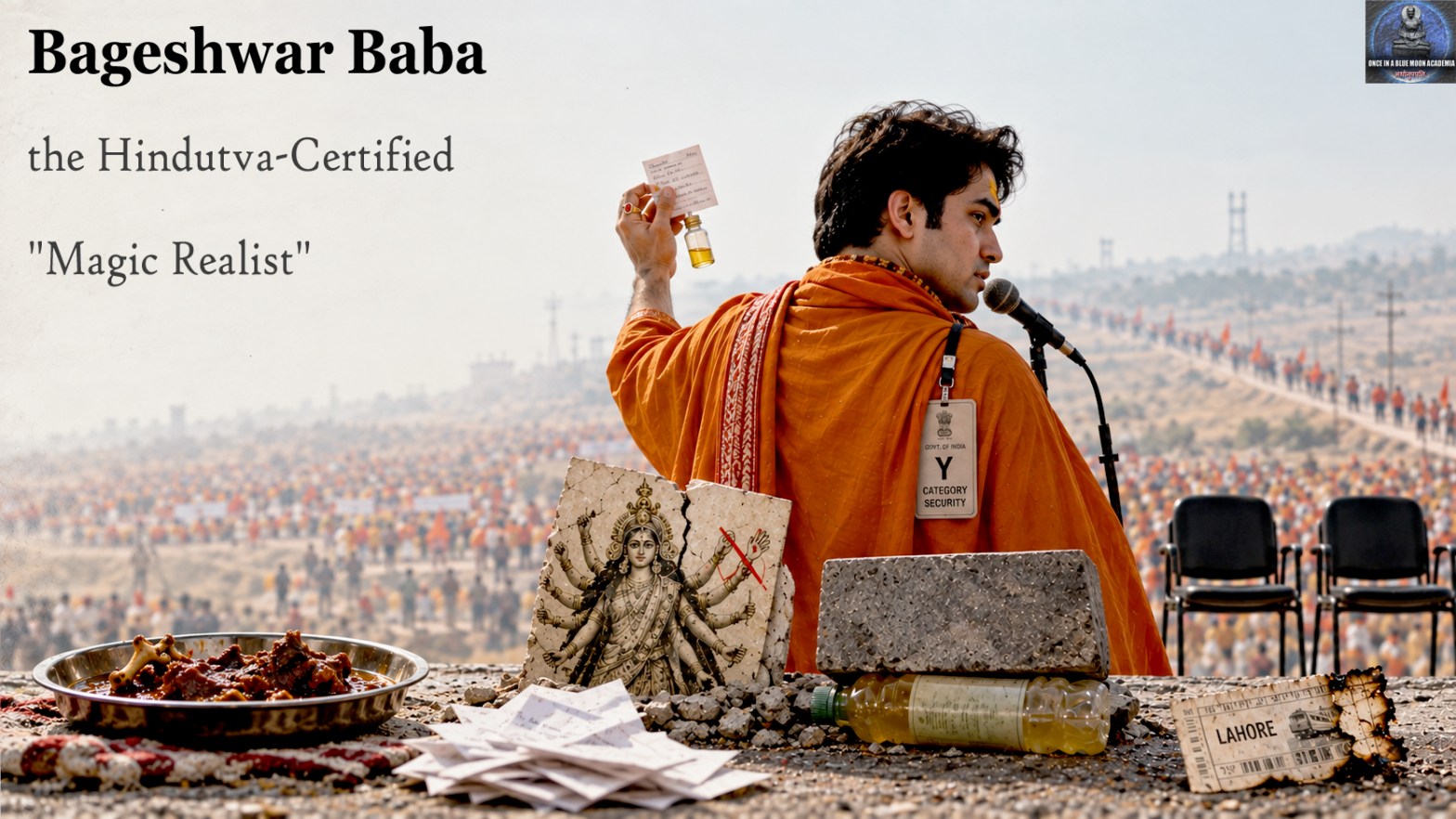
XI. Conclusion: The Godman’s “Magical Realism” (?!), The State, And The Bengal Limit
Dhirendra Krishna Shastri is twenty-nine years old — younger than the bureaucrats who guard him, younger than the rationalist movement he is helping to bury, younger by decades than the constitutional commitment to secularism he demands be abolished, and younger than the medical ethics he violates every time he tells a dying woman to drink cow urine. His newness is the point. He did not rise through the old order of senior godmen with their long legitimacies. He was produced — out of an inherited village throne, an extraordinary talent for cold-reading performed as clairvoyance, expert cross-party and then decisively BJP patronage, a broadcast reach of millions, and the specific electoral hunger of a ruling party for a mobiliser who could speak to the OBC Hindu of the Hindi belt in his own idiom and against a Muslim other. He is a creature of the political moment, optimised for it, and consecrated by its highest authority.
The rational challenge to guru-fraud has existed in India for a century, and it has produced giants — Kovoor, Premanand, Narasimhaiah, Dabholkar, Pansare. It has been answered with hushing, with obstruction, and, three times over, with murder. What is new in the 2025–2026 period is not the godman or the rationalist but the open deployment of the state — the Prime Minister’s office, two chief ministers on a march, a third on a Kolkata stage — on the side of the miracle and against the people who ask it to prove itself. When the head of government tells a guru’s followers that the guru’s critics are foreign-sponsored enemies of the nation, in a country where such critics have been shot dead, he is not making an argument. He is drawing a target.
And yet the essay must end not in 2025 but in September 2026, on the note the machine’s own trajectory forced upon it. In Bengal the instrument met its limit — not the limit of conscience, law, or reason, all of which it had already overrun, but the limit of its own homogenising fiction, enforced by a regional Hindu culture that will not be told that the mutton it offers its Goddess makes it heretical, and by a ruling-party state president who understood that this particular sermon insulted the very voters his landslide had just delivered. The godman who could not be checked by the Constitution was checked by a plate of Navami mutton and the ten arms of the dashabhuja his allies could not correctly draw.
That limit is not a reassurance. It is a diagnosis. It tells us that the only force in contemporary India currently capable of halting this machine, even briefly, is not the courts, not the press, not the rationalist tradition, and not the Constitution — but the machine’s own internal contradiction, the moment its manufactured, uniform, cow-belt Hindutva collides with a real Hinduism that predates it and outnumbers it on its own ground. Under the miracle there is harmful medicine; under the medicine, communal hatred; under the hatred, a constitutional project to remake India as a Hindu state; and over all of it, until Bengal, a state that called this unity and called its critics traitors. Bengal did not defeat the machine. It only showed, for one week in Kolkata, that the machine can be made to stop — and that the sole authority so far able to stop it was a plate of food the Goddess herself is offered.
The task of the reason-follower, the activist, the scholar, and the citizen is to widen that fracture — to insist, everywhere, that the miracle be tested, that the medicine be evidence, that the trust’s accounts be opened, that the incitement be prosecuted by the same law that jails its victims, and that a republic which laid a foundation stone over its own reason can still choose to dig the record back out. That the first crack came from within the machine, and for the wrong reasons, does not make the crack less useful. It makes the work of prying it open more urgent.
A Stubborn Addendum: The Kolkata Gita Path, 7 December 2025 — Read Again From The Other(-ed) Side Of The Election
The first draft of this essay closed on the December 2025 Kolkata Gita Path and the assault on a Muslim vendor in its shadow, read as an act of saffron assertion on hostile TMC ground. Everything in §V and §VIII now requires that the episode be read again — because between that December and this September, the ground it was staged on became the machine’s own.
A.1 The Event
On 7 December 2025, Shastri joined a mass gathering at Kolkata’s Brigade Parade Ground titled “Panch Lakkho Konthe Gita Path” — Five Hundred Thousand Voices Reciting the Gita — organised by the Sanatan Sanskriti Sansad, a collective of Hindu monasteries and institutions, and drawing an estimated five lakh devotees reciting the Bhagavad Gita in unison. Co-participants included Baba Ramdev and Sadhvi Ritambhara — the latter carrying one of the most documented records of communal incitement in post-Independence India, from the campaign that culminated in the 1992 Babri Masjid demolition.
The choice of the Brigade Parade Ground — historically the stage of the Left Front and later of Trinamool’s mass rallies — was, under a still-TMC government, a deliberate assertion of saffron presence in a space coded secular, in a city the BJP had repeatedly targeted and never held. Shastri’s line at the event — “Ghazwa-e-Hind nahin, Bhagwa-e-Hind” (“not the Islamic conquest of India, but its saffronisation”) — was the standard Ghazwa-e-Hind conspiracy-frame, deployed in a state where the BJP’s central electoral strategy was, precisely, the polarisation the line performs.
A.2 The Assault On Sheikh Riyajul
Outside the ground, while the recitation proceeded, a group of saffron-clad men approached Sheikh Riyajul, a Muslim street vendor selling chicken puffs and patties near the venue, questioned him about his name, identified him as Muslim, objected to his selling non-vegetarian food near the event, kicked over his food box, destroyed stock worth about ₹3,000, and forced him to do sit-ups while holding his ears. A second Muslim vendor was reportedly assaulted the same day. Kolkata Police — then under a TMC government — arrested three men: Soumik Golder, Swarnendu Chakraborty, and Tarun Bhattacharya. They were subsequently released on bail.
A.3 The Structural Reading — And The New Bookend
The three arrested men were not organisers, not Shastri’s associates, and acted under no proven instruction from the stage; the assault cannot be pinned on Shastri as direct incitement, and honesty requires saying so. But structure does not require an order. An event platforming a man who has told lakhs that Muslims are civilisational enemies, alongside Sadhvi Ritambhara, produces — as its ambient output — followers who enforce a saffron exclusion zone around it, expelling Muslim livelihood and non-vegetarian food by force. The specific grammar of the assault (the name demanded, the religion identified, the meat objected to, the ear-holding humiliation) is the behavioural enactment of the ideology the platform cultivates. It did not spring from three private psyches; it was authored by a political culture built through exactly the events, sermons, and endorsements this essay documents.
Two things transform the episode when read from September 2026. First, note the content of the December assault: Muslim vendors beaten for selling non-vegetarian food near a Hindu religious event. Nine months later, from a Chief Minister’s stage, Shastri would demand that Bengal stop selling non-vegetarian food near Durga idols — the same diktat the December mob enforced with sticks, now issued as policy from a platform of state. The street violence of 2025 and the platform politics of 2026 are the same instruction at two volumes. Second, note the state’s posture. In December 2025, under a TMC government, the police at least arrested the attackers. By September 2026 the government in that state is the BJP, whose Chief Minister invites Shastri to “open a centre here.” The single variable that decides whether an assault on a Muslim vendor is prosecuted at all is not police capacity; it is which party holds the state — the precise asymmetry §V and §6.4 describe.
A.4 The Silence, And Its Meaning
Shastri issued no statement on the assault on Sheikh Riyajul: no condemnation, no institutional accountability, no commitment to Muslim vendors’ safety at future events, no acknowledgement that his platform’s content might have shaped the climate. The silence is not passive. A man who tells five lakh people that Muslims are the enemies of Hinduism, and then says nothing when his followers beat a Muslim vendor outside the gate, has communicated more clearly than any sermon could: the violence is acceptable. The silence is the endorsement.
The Kolkata Gita Path of December 2025 was, in its ceremonial face, five lakh voices reciting a sacred text. In its political body, it was an early assertion of a saffron future that the April–May 2026 election would install. And in its shadow, a Muslim boy selling chicken puffs was made to do sit-ups by his ears while the Prime Minister’s “younger brother” said nothing — nine months before that same “younger brother” would stand on the new government’s stage and demand, as piety, exactly what the mob had demanded with its fists. The connection between the recitation, the assault, the election, and the diktat is not incidental. It is the political logic of the moment, laid out in sequence.
References
Primary and secondary sources consulted. Web sources accessed September 2026; datelines as published.
- Alt News. “Hate, Hindu supremacy, occultism: The legacy of Dhirendra Shastri, Modi’s ‘younger brother’ from Bageshwar Dham.” 25 February 2025. https://www.altnews.in/hate-hindu-supremacy-occultism-the-legacy-of-dhirendra-shastri-modis-younger-brother-from-bageshwar-dham/
- Prime Minister of India. “PM’s address at the laying of foundation stone of Bageshwar Dham Medical & Science Research Institute.” 23 February 2025. https://www.pmindia.gov.in/en/news_updates/pms-address-at-the-laying-of-foundation-stone-of-bageshwar-dham-medical-science-research-institute/
- Press Information Bureau. Hindi original text of the same address. 23 February 2025. https://www.pib.gov.in/PressReleasePage.aspx?PRID=2105657
- The Print (Sagrika Kissu). “Dhirendra Shastri, miracle-maker of MP, is only getting bigger after rationalist challenge.” 3 February 2023. https://theprint.in/feature/dhirendra-shastri-is-miracle-maker-of-mp-rationalist-challenge-is-only-feeding-the-frenzy/1351260/
- The Print (Purva Chitnis). “‘Hindu Rashtra’ dream, BJP leaders at his satsangs — how an MP ‘baba’ is gaining ground in Maharashtra.” 7 December 2023. https://theprint.in/india/hindu-rashtra-dream-bjp-leaders-at-his-satsangs-how-an-mp-baba-is-gaining-ground-in-maharashtra/1873990/
- Scroll.in (Divya Aslesha). “Bageshwar Dham: Meet the rationalist who challenged the controversial priest.” 17 February 2023. https://scroll.in/article/1043960/meet-the-rationalist-who-challenged-the-controversial-priest-of-bageshwar-dham
- Aban Usmani / Newslaundry, syndicated. “How ABP’s crusade against superstition turned into mythmaking.” 21 January 2023. https://www.inkl.com/news/how-abp-s-crusade-against-superstition-turned-into-mythmaking
- BOOM (Anmol Alphonso). “How ABP Extolled Bageshwar Dham Shastri’s Superstitions As A Miracle.” 21 January 2023. https://www.boomlive.in/news/dhirendra-krishna-shastri-bageshwar-dham-sarkar-self-styled-godman-raipur-divya-darbar-abp-news-reporter-superstition-20809
- The News Minute (Shardool Katyayan). “Ekta Kapoor, Shilpa Shetty and a queue of netas: The great suck-up at Baba Bageshwar’s yatra.” 19 November 2025. https://www.thenewsminute.com/news/ekta-kapoor-shilpa-shetty-and-a-queue-of-netas-the-great-suck-up-at-baba-bageshwars-yatra
- SabrangIndia / CJP Team. “The Politics of Processions: How the Sanatan Ekta Padyatra amplified hate speech in plain sight.” 3 December 2025. https://sabrangindia.in/the-politics-of-processions-how-the-sanatan-ekta-padyatra-amplified-hate-speech-in-plain-sight/
- Citizens for Justice and Peace. “CJP moves NCM against surge in Hate Speech at Hindu Sanatan Ekta Padyatra.” 9 December 2025. https://cjp.org.in/cjp-moves-ncm-against-surge-in-hate-speech-at-hindu-sanatan-ekta-padyatra/
- Hindutva Watch (CJP reprint). “Sanatan Ekta Padyatra – Unmasking the March of Majoritarianism.” November 2025. https://www.hindutvawatch.org/sanatan-ekta-padyatra-unmasking-the-march-of-majoritarianism-cjp/
- FACTLY. “Old and unrelated video shared as visuals of Dhirendra Krishna Shastri’s November 2025 ‘Sanatan Ekta Padyatra.’” 13 November 2025. https://factly.in/old-and-unrelated-video-shared-as-visuals-of-dhirendra-krishna-shastris-november-2025-sanatan-ekta-padyatra/
- The Quint. “Mission Hindu Rashtra: Inside Story of the Sudden Spike in Hindutva Sammelans.” 11 February 2026. https://www.thequint.com/news/politics/hindu-rashtra-sammelan-hindutva-hate-speech-muslims
- Alt News. “The long march to Hindu Rashtra: From meat ban to ‘Mandir Wahi Banega’ — Bageshwar Baba’s padyatra had it all.” 5 December 2025. https://www.altnews.in/the-long-march-to-hindu-rashtra-from-meat-ban-to-mandir-wahi-banega-bageshwar-babas-padyatra-had-it-all/
- The Federal / PTI. “Bengal BJP chief rejects Bageshwar Baba’s call to shun non-veg during Durga Puja.” 7 September 2026. https://thefederal.com/category/states/east/west-bengal/bengal-bjp-chief-rejects-bageshwar-babas-call-to-shun-non-veg-during-durga-puja-255982
- The Statesman. “Bengal snubs Baba Bageshwar, reject vegetarian call during Durga Puja.” 7 September 2026. https://www.thestatesman.com/cities/kolkata/bengal-snubs-baba-bageshwar-reject-vegetarian-call-during-durga-puja-1503635675.html
- Times of India. “‘Let me live the way I want to’: Bengal BJP chief rejects Bageshwar Baba’s meat diktat.” 7 September 2026. https://timesofindia.indiatimes.com/india/let-me-live-the-way-i-want-to-bengal-bjp-chief-rejects-bageshwar-babas-meat-diktat/articleshow/133879135.cms
- Hindustan Times. “Bengal BJP chief rejects Bageshwar Baba’s ‘non-veg’ appeal: ‘No one can tell Bengalis what to eat.’” 7 September 2026. https://www.hindustantimes.com/india-news/west-bengal-bjp-chief-rejects-bageshwar-babas-non-veg-appeal-durga-puja-no-one-can-tell-bengalis-what-to-eat-101788785455953.html
- India Today. “No non-veg near Durga Puja: Dhirendra Shastri’s sermon raises Bengali Hindu storm.” 7 September 2026. https://www.indiatoday.in/india/story/dhirendra-shastri-durga-puja-non-veg-appeal-bageshwar-dham-bengali-hindu-backlash-vhp-advisory-2988773-2026-09-07
- LatestLY. “Dhirendra Shastri vs Samik Bhattacharya: West Bengal BJP Chief Rejects Meat Ban Call During Durga Puja.” 7 September 2026. https://www.latestly.com/india/news/dhirendra-shastri-vs-samik-bhattacharya-west-bengal-bjp-chief-rejects-meat-ban-call-during-durga-puja-video-7594192.html
- News18. “‘Meat Is Core To Shakta Hinduism’: Sanjeev Sanyal After Baba Bageshwar’s Vegetarian Call For Durga Puja.” 7 September 2026. https://www.news18.com/india/meat-is-core-to-shakta-hinduism-sanjeev-sanyal-after-baba-bageshwars-vegetarian-call-during-durga-puja-10314945.html
- The Tribune. “Nagpur police give ‘clean chit’ to Bageshwar Dham chief Dhirendra Shastri in complaint lodged by anti-superstition crusader.” 25 January 2023. https://www.tribuneindia.com/news/nation/nagpur-police-give-clean-chit-to-bageshwar-dham-chief-dhirendra-shastri-in-complaint-lodged-by-anti-superstition-crusader-473693/
- National Herald. “MP Govt gives Y-category security to ‘godman’ Dhirendra Shastri.” 25 May 2023. https://www.nationalheraldindia.com/national/mp-govt-gives-y-category-security-to-godman-dhirendra-shastri
- BBC News (Geeta Pandey). “Bageshwar Dham Sarkar: The Indian guru making headlines over ‘miracle’ cures.” 5 February 2023. https://www.bbc.com/news/world-asia-india-64480726
- India Today topic page (Surat “Hindu nation” / Pakistan remark; Nitish Kumar response). https://www.indiatoday.in/topic/dhirendra-shastri
- Wikipedia. “Dhirendra Krishna Shastri.” https://en.wikipedia.org/wiki/Dhirendra_Krishna_Shastri
- Wikipedia. “Narendra Dabholkar.” https://en.wikipedia.org/wiki/Narendra_Dabholkar
- Wikipedia. “Abraham Kovoor.” https://en.wikipedia.org/wiki/Abraham_Kovoor
- India Today. “P.C. Sorcar: Baba’s a bad trickster.” 4 December 2000. https://www.indiatoday.in/magazine/cover-story/story/20001204-magician-pc-sorcar-demonstrates-how-sai-baba-performs-his-miracles-778547-2000-12-03
- Lallantop, Tarikh E343. “क्या हुआ जब Sathya Sai Baba की मुलाकात हुई जादूगर PC Sorcar से?” 23 November 2022. https://www.youtube.com/watch?v=-tzCo5w0wwc
- B. Premanand, BBC clip. “Indian Yogi’s Sitting In The Air Secret.” https://www.youtube.com/watch?v=ta4R2xoKSB4
- Basava Premanand interviewed by Steven Hassan (1995). https://www.youtube.com/watch?v=7LS8GSfO9I0
Theoretical works and statute
Maharashtra Prevention and Eradication of Human Sacrifice and other Inhuman, Evil and Aghori Practices and Black Magic Act, 2013.
Gramsci, Antonio. Selections from the Prison Notebooks. International Publishers, 1971.
Debord, Guy. The Society of the Spectacle. Trans. Donald Nicholson-Smith. Zone Books, 1995.
Lifton, Robert Jay. Thought Reform and the Psychology of Totalism. University of North Carolina Press, 1961.

