
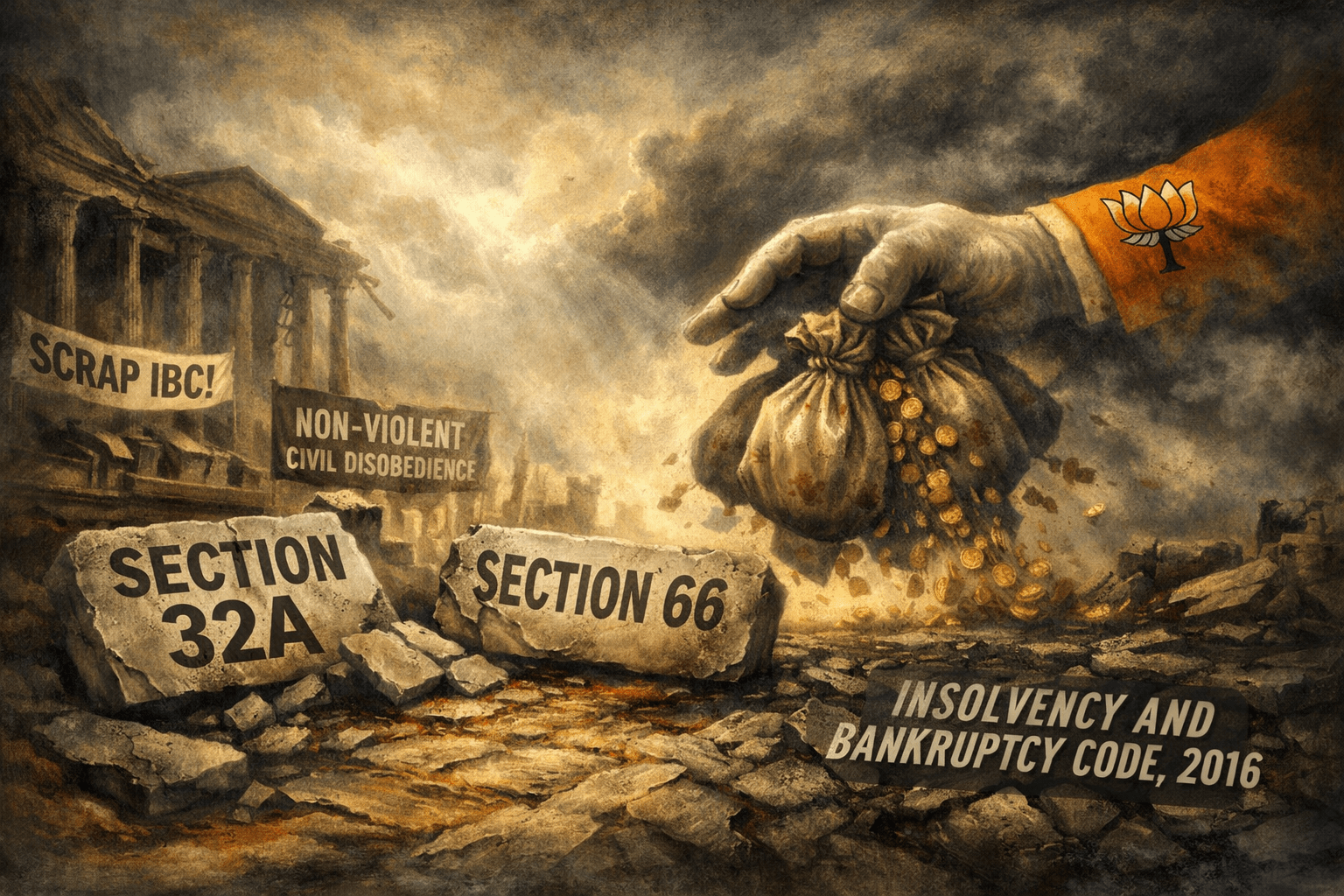
Posted on 21st March, 2026 (GMT 01:55 hrs)
ABSTRACT
This dossier argues that the Insolvency and Bankruptcy Code, 2016 has evolved from a reform tool into a system of impunity, exemplified by the Dewan Housing Finance Corporation Ltd collapse, where depositors suffered massive losses while Section 32A IBC erased corporate liability for the “new owner” Mr. Ajay Piramal; highlighting repeated amendments and creditor dominance, it calls for repeal—especially of Section 32A in relation to its contradictory relationship to Section 66—and urges non-violent resistance inspired by Gandhiji to restore accountability.
I. Executive Summary
This dossier advances a rigorous, activist-oriented critique of the Insolvency and Bankruptcy Code, 2016 (IBC), arguing that what was once projected as a techno-solutionist solution to India’s non-performing asset crisis has, in practice, evolved into a juridical architecture of structural impunity, crony capitalism, and redistributive injustice.
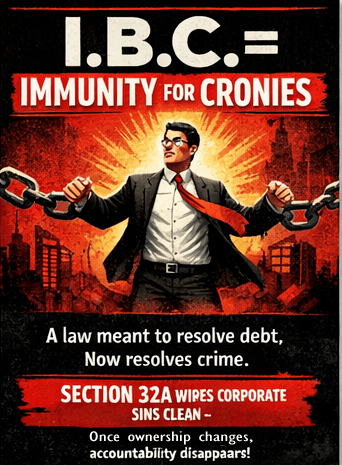
Anchored in the Dewan Housing Finance Corporation Ltd (DHFL) collapse as its emblematic case, it demonstrates how lakhs of depositors—particularly middle-class families and senior citizens—and other vulnerable stakeholders bore devastating losses while tainted assets were transferred under steep haircuts to new acquirers shielded by Section 32A IBC, a retrospective “clean slate” clause that extinguishes prior criminal liability, prosecutions, attachments, and confiscations upon resolution.
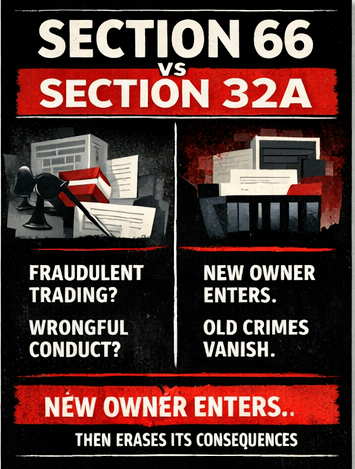
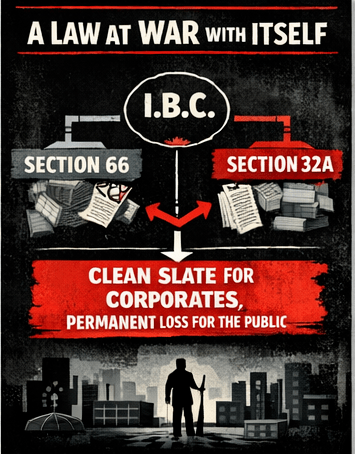
This mechanism thereby directly undermines accountability provisions such as Section 66 IBC and produces a deliberate internal contradiction wherein fraud is formally recognized only to be legally erased the moment ownership shifts. Compounded by opaque Committee of Creditors dominance, judicial deference to “commercial wisdom,” and the systematic marginalization of depositors, employees, and communities, this design reflects a broader neoliberal political economy in which insolvency functions as a mechanism of accumulation by dispossession.
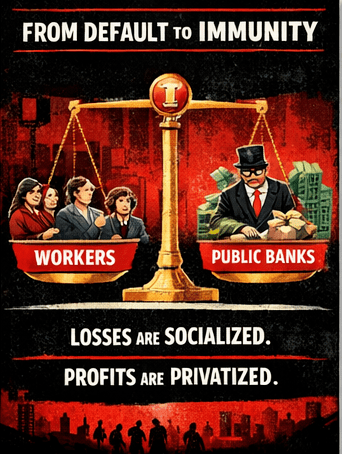
In this framework, distressed or even illicitly accumulated assets are recycled into concentrated private ownership while losses are socialized downward. Far from being an isolated failure, this tendency has been entrenched through successive amendments—including the proposed Insolvency and Bankruptcy Code Amendment Bill 2025—that reinforce fast-track resolutions, creditor primacy, and immunity frameworks while further sidelining fraud accountability.
The result is not genuine resolution but a profound moral inversion in which corporate wrongdoing is converted into a temporary inconvenience, laundered through procedural mechanisms; perpetrators exit unscathed, new owners inherit sanitized assets, and victims are left with irrecoverable losses.
Consequently, the dossier rejects incremental reform as complicit in perpetuating this system and instead calls for the outright repeal of the IBC in its current form—particularly the abolition of Section 32A—as an essential step to dismantle legalized corporate amnesia, restore accountability and stakeholder justice, protect vulnerable constituencies, and resist a politics of engineered forgetting. It insists that the central question is no longer whether the system “works,” but whom it serves—and at whose unbearable cost.
II. Core Indictment: From Promised Reform to Instrument of Impunity
The IBC was sold as a technocratic fix to India’s NPA crisis, replacing slow, fragmented pre-2016 regimes (SICA, DRTs, SARFAESI) with time-bound resolution, creditor empowerment, and business continuity. Yet the Code has evolved into a juridical tool for upward asset consolidation and downward loss socialization. It accelerates “closure” at the expense of justice, normalizing massive haircuts, opacity in CoC decisions, judicial deference to “commercial wisdom,” and the marginalization of small depositors, employees, and communities.
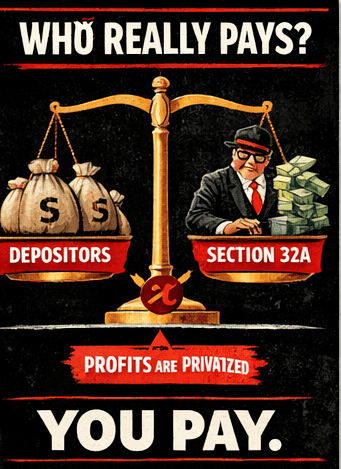
At the heart of this critique lies Section 32A—the “clean slate” provision inserted post-enactment with retrospective effect. It grants sweeping immunity to approved resolution applicants and new management from all prior criminal liabilities, prosecutions, attachments, or confiscations. Officially justified as incentivizing bids and business revival, it is condemned here as the legalization of corporate amnesia: fraud is acknowledged (via provisions like Section 66 on fraudulent/wrongful trading) but deliberately neutralized once ownership changes. This creates an irreconcilable contradiction within the same statute—Section 66 demands accountability for misconduct and how the insolvency must accrue to the benefit of all the creditors, while Section 32A forecloses it—rendering anti-fraud mechanisms performative and toothless.
III. The DHFL Case as Litmus Test Case for Justifying the IBC
The Dewan Housing Finance Limited (DHFL) collapse exemplifies this logic in its purest, most damning form: alleged massive irregularities and fraud victimized public banks and lakhs of small fixed-deposit holders. Resolution delivered steep haircuts and asset transfer under IBC protection. Section 32A insulated criminal liabilities, “sanitizing” tainted assets for new owners (e.g., Piramal). Perpetrators exited unscathed; victims absorbed irrecoverable losses. This is portrayed not as resolution but as moral inversion—a state-enabled transfer of public wealth to private hands, facilitated by opaque CoC dominance and judicial abdication. Hence, the DHFL case was called as the “litmus test case” for validating, justifying and/or legitimizing the otherwise ill-conceived, internally inconsistent IBC framework, structurally speaking.
IV. The Code’s Fatal Fragility: Six Major Statutory Amendments Already Prove It Was Born Defective
The IBC’s inherent fragility screams through its short history. Since enactment in May 2016 (core corporate insolvency provisions effective December 2016), Parliament has already enacted six major statutory amendments, plus over 122 regulatory tweaks by the IBBI. Each patch was a desperate attempt to fix a fundamentally broken framework. The chronological list of these six major statutory amendments is as follows:
- Insolvency and Bankruptcy Code (Amendment) Act, 2018 (following the 2017 Ordinance) – Introduced Section 29A disqualifications for resolution applicants to prevent back-door entry by promoters.
- Insolvency and Bankruptcy Code (Second Amendment) Act, 2018 – Gave homebuyers the status of financial creditors and brought other critical clarifications.
- Insolvency and Bankruptcy Code (Amendment) Act, 2019 – Extended the overall resolution timeline to 330 days, made approved resolution plans binding on all stakeholders, and introduced priority clarifications.
- Insolvency and Bankruptcy Code (Amendment) Act, 2020 – Suspended the filing of fresh insolvency applications during the COVID-19 pandemic and raised the minimum default threshold.
- Insolvency and Bankruptcy Code (Second Amendment) Act, 2020 – Introduced further refinements, laying the groundwork for pre-packaged elements.
- Insolvency and Bankruptcy Code (Amendment) Act, 2021 – Formally introduced the pre-packaged insolvency resolution process (PPIRP) for MSMEs and related definitions.
This repeated need for patching—six times in less than a decade—proves beyond any doubt that the IBC was ill-conceived from birth: an empty vessel that sounds louder with every amendment while delivering nothing but haircuts, delays, and daylight robbery for ordinary citizens.
V. The Insolvency and Bankruptcy Code (Amendment) Bill, 2025: Now the Seventh Overhaul!
Introduced in the Lok Sabha on 12 August 2025 by Finance Minister Nirmala Sitharaman, the Bill was immediately referred to a Select Committee chaired by Baijayant Panda. The Select Committee submitted its report on 17 December 2025 after extensive stakeholder consultations. The Union Cabinet cleared the revised amendments—incorporating many of the Select Committee’s recommendations with only minor adjustments—on 10 March 2026. As of today (21 March 2026), the Bill is poised for introduction and potential enactment in the ongoing Budget Session of Parliament. This rapid Cabinet clearance just days into the Budget Session exposes the government’s urgency to push through yet another pro-corporate package.
This is India’s most sweeping overhaul since 2016—the seventh major statutory intervention. It entrenches CoC supremacy, introduces fast-track out-of-court processes for big notified lenders, reinforces the clean-slate doctrine, and further sidelines accountability for fraud. Here is the detailed, clause-by-clause breakdown of the key provisions:
- Mandatory and Time-Bound Admission of Insolvency Applications The Bill removes much of the judicial discretion in admitting CIRP applications under Sections 7, 9, and 10. The Adjudicating Authority (NCLT) must admit or reject an application within 14 days if default is proven (especially via Information Utility records, now treated as conclusive evidence), no disciplinary issues exist against the proposed resolution professional, and procedural requirements are met. Reasons for any delay must be recorded in writing. This directly counters earlier judicial interpretations such as the Vidarbha Industries case.
- Stricter Restrictions on Withdrawal of Admitted Applications Withdrawal of admitted applications is now heavily restricted to prevent misuse. It is permitted only after the Committee of Creditors (CoC) is formed, requires 90% CoC approval, and must occur before the first invitation for resolution plans. The Adjudicating Authority must decide within 30 days (with reasons recorded for delays). Early out-of-court settlements are now severely discouraged.
- Enhanced Role of the Committee of Creditors in Liquidation The CoC gains sweeping supervisory powers over the entire liquidation process. It can propose and appoint the liquidator (an insolvency professional, excluding the prior resolution professional to avoid conflicts), replace the liquidator with a 66% vote, and oversee all commercial decisions using insights from the CIRP phase. The liquidator’s quasi-judicial powers to admit or reject claims are removed and shifted to CoC oversight. Liquidation must be ordered within 30 days of initiation and completed ideally in 180 days (extendable by up to 90 days). Voluntary liquidation must finish within one year.
- Introduction of Creditor-Initiated Insolvency Resolution Process (CIIRP) A new out-of-court, fast-track alternative to standard CIRP is created exclusively for notified financial institutions or creditors (to be specified by the government—clearly favouring large banks and NBFCs). It requires 51% approval by debt value, allows the debtor to remain in possession under resolution professional oversight, and targets completion in 150 days (extendable by 45 days). The process can convert to regular CIRP if needed. The existing fast-track insolvency process is abolished entirely.
- Enabling Frameworks for Group and Cross-Border Insolvency The Central Government is empowered to frame detailed rules for group insolvency (common NCLT bench, joint CoC, coordination mechanisms for conglomerates) and cross-border insolvency (recognition of foreign proceedings, relief measures, judicial cooperation). These provisions address complexities in multi-entity or international cases.
- Clarifications on Security Interests, Government Dues, and Clean Slate Principle The definition of “security interest” is tightened to include only those created by consensual agreement or arrangement, explicitly excluding interests arising by operation of law or statute. Statutory/government dues are clarified as not qualifying as secured creditor claims. Most critically, the Bill codifies and reinforces the “clean slate” principle under Section 32A, ensuring resolution applicants receive full immunity from prior liabilities, offences, and prosecutions upon plan approval.
- Other Key Reforms and Procedural Enhancements Penalties for frivolous or vexatious filings are increased from ₹1 lakh to up to ₹2 crore. Guarantor assets (corporate or personal) can be transferred into the principal debtor’s CIRP under safeguards. Timelines for NCLAT appeals are fixed at 3 months. Look-back periods for avoidance transactions are aligned from the initiation date. Creditors gain direct recourse for avoidance actions if the resolution professional or liquidator fails to act. The CoC can set its own standards and timelines via IBBI regulations.
These amendments collectively prioritize speed, creditor empowerment (especially for large notified lenders), and reduced judicial intervention—while further entrenching protections for successful resolution applicants and deliberately weakening fraud accountability.
VI. The Intellectual Armoury – 16 Unassailable Exposés
To equip every DHFL victim with the unassailable arsenal of facts, here is the complete intellectual armoury—every article meticulously exposing the internal inconsistencies of the IBC, the incommensurability between Sections 32A and 66, the corporate shield that is enabled, and the utter fragility of this rotten Code. Share them far and wide. Print them. Discuss in every WhatsApp group, every mohalla, every temple and gurudwara:
1. IBC’s Clean Slate and the Unpaid Sin: Section 32A, Section 66 and the Corporate Metamorphosis of Liability: Brutal dissection of how Section 32A transmogrifies criminal/fraudulent liability into a “new birth” for corporates, deliberately burying Section 66 accountability – the core unpaid sin in every DHFL-type scam.
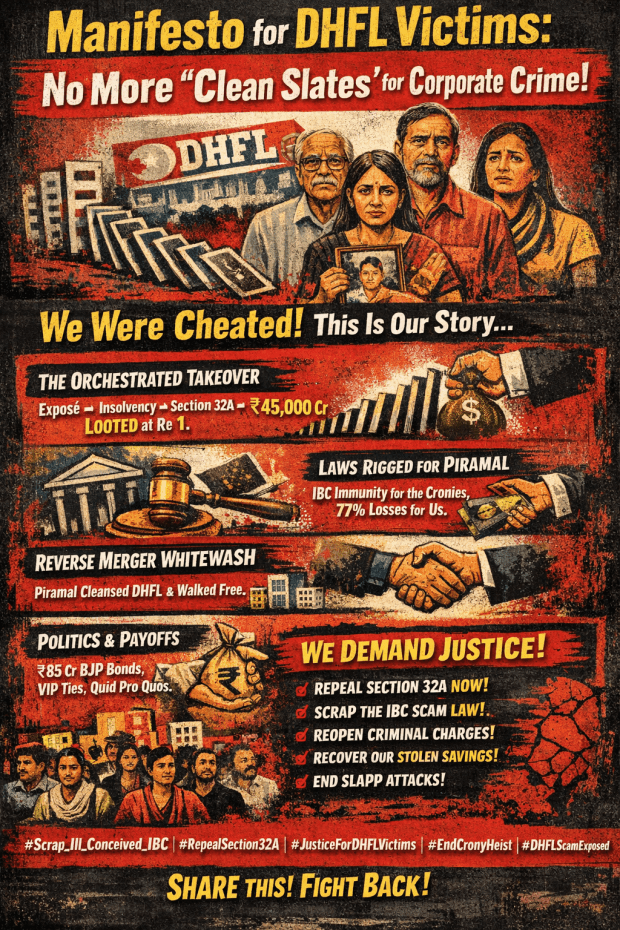
2. Manifesto for DHFL Victims: No More Clean Slates for IBC – Proof of Crony Capitalism: A fiery political manifesto proving IBC is a crony tool, demanding immediate scrapping of the clean-slate doctrine and full enforcement of fraud provisions.
3. The Clean Slate That Was Engineered: How IBC’s Section 32A Enabled the DHFL-Piramal Takeover: Step-by-step exposé of the engineered legal coup where retrospective Section 32A gifted Piramal a fraud-free, liability-free empire while depositors were wiped out.
4. Manifesto for Scrapping the Ill-Conceived Insolvency and Bankruptcy Code (IBC) 2016: Comprehensive call-to-arms manifesto outlining why the entire IBC framework is constitutionally and morally bankrupt and must be abolished.
5. The Bankruptcy Bazaar: How India’s Ill-Conceived IBC Turns Public Money into Private Profits: Vivid marketplace analogy exposing how IBC auctioneers systematically transfer public deposits into private hands under the guise of “resolution”.
6. If CoC under IBC is the King, is Justice Just a Ritual? Scathing critique of the omnipotent, unaccountable Committee of Creditors acting as extra-constitutional monarchs while justice is reduced to empty courtroom theatre.
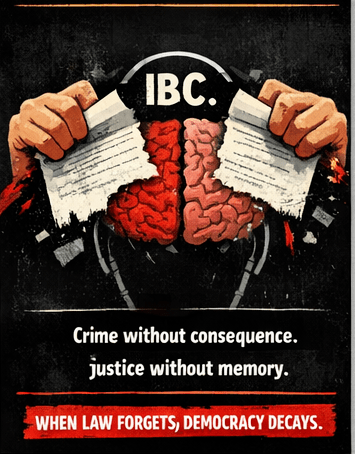
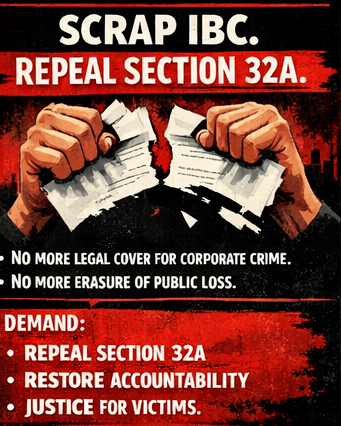
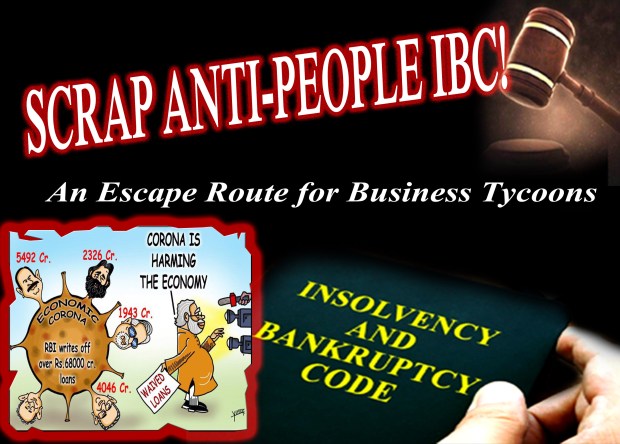
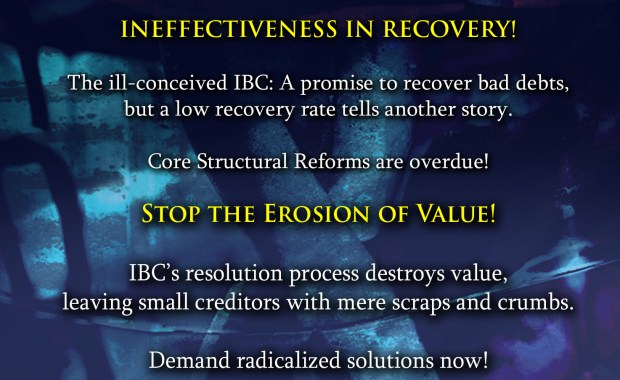
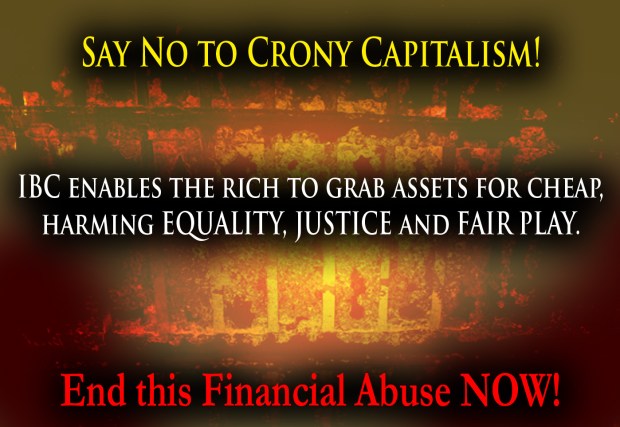
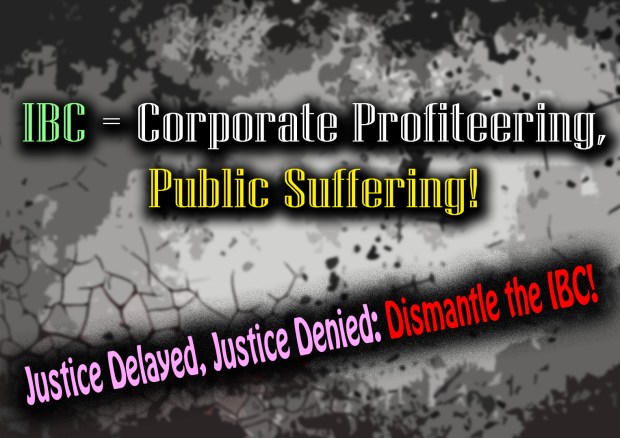
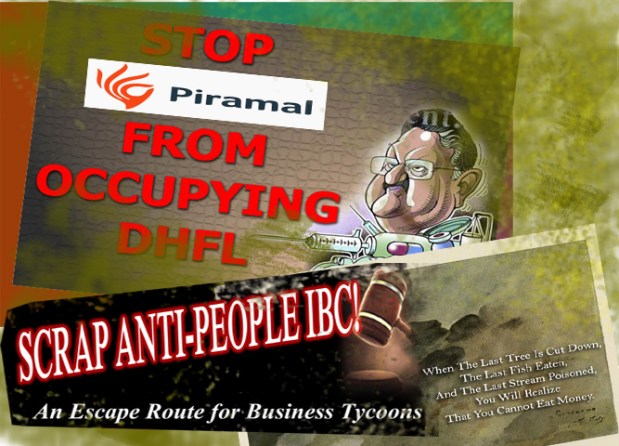
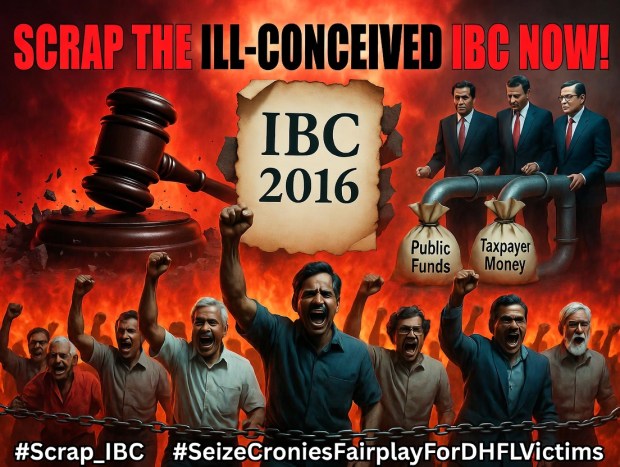
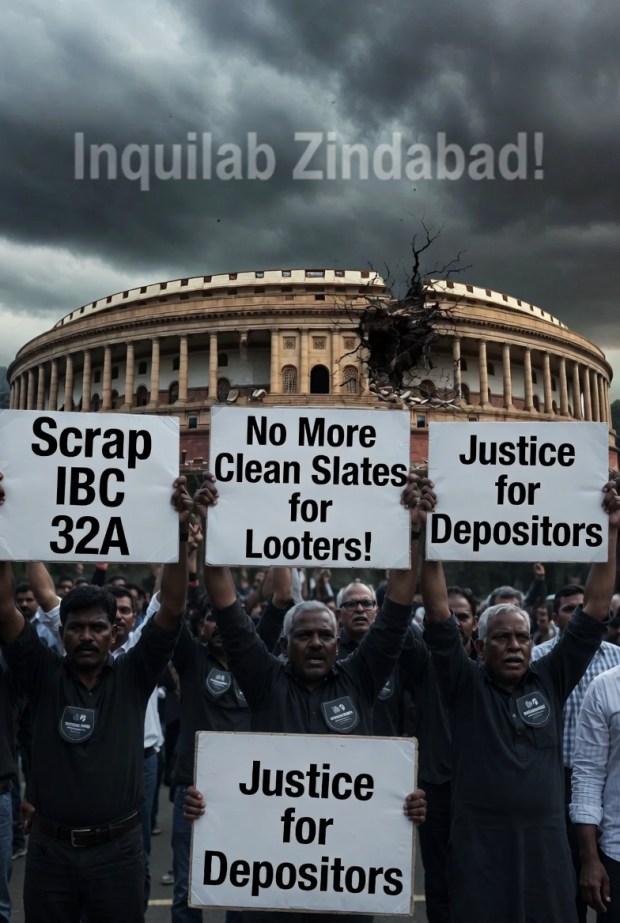
7. Challenging the IBC: No Shortcuts, No Surrenders – Digital Posters: Ready-to-use visual ammunition and slogans for the civil disobedience campaign – share, print, protest!
8. The Post-Budget Scenario and the IBC: Empty Vessel Sounds Much: Post-budget takedown proving every “reform” announcement is hollow noise that further entrenches the pro-corporate bias.
9. Scrap Ill-Conceived Insolvency and Bankruptcy Code (IBC) 2016: Direct, uncompromising demand for total repeal, backed by irrefutable evidence of systemic loot. The most comprehensive take on the IBC as a whole.
10. Analyzing Diverging Judgements in BPSL and DHFL Cases: Victim Perspectives and the Fragility of the IBC: Comparative study exposing how contradictory court rulings reveal the IBC’s structural collapse and selective injustice against DHFL victims.
11. Incommensurability Amidst PMLA and IBC in the Context of the DHFL Scam: Masterclass on the irreconcilable clash between anti-money-laundering laws and IBC’s immunity shield – pure legal dynamite.
12. DHFL Victims in the Laboratory State of IBC: Litmus Test: Positions DHFL as the ultimate failed experiment proving IBC is a laboratory of corporate impunity.
13. IBC Section 66 Overlooked by the DHFL CoC – A Big Conspiracy: Damning evidence of deliberate sabotage: how the CoC illegally buried Section 66 fraud proceedings to protect the takeover.
14. If SARFAESI 2002 is There, Why Fluid IBC 2016 is Applied to the DHFL? Questions the selective, opportunistic application of the ever-changing IBC over more stable existing laws.
15. Subsequent Clash Between Sanatana Dharma and Governmental Praxis (IBC & NHB Act) in the Context of DHFL FD Holders’ Misery – Reference to Arthasastra Philosophical and ethical indictment contrasting ancient Indian principles of righteous governance with modern IBC betrayal.
16. Smelling the Rat in the DHFL CoC Resolution Process – A Letter to the President of India Historic open letter exposing the stench of manipulation and demanding highest constitutional intervention.
THE CALL TO ACTION – NON-VIOLENT CIVIL DISOBEDIENCE BEGINS NOW
DHFL victims, depositors, senior citizens, middle-class families—
THIS IS YOUR WAKE-UP CALL! ENOUGH IS ENOUGH!
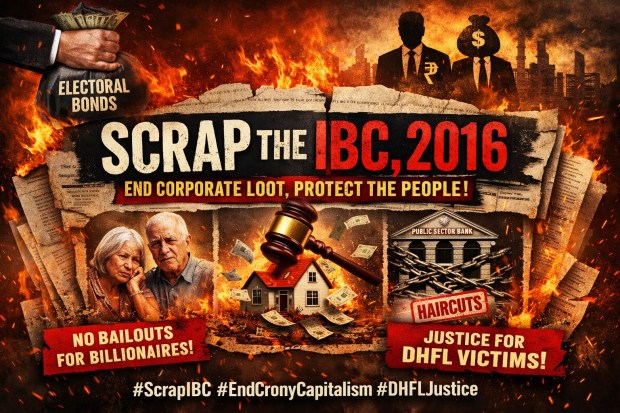
The so-called Insolvency and Bankruptcy Code, 2016—this ill-conceived, pro-corporate Frankenstein—has bled lakhs of innocent DHFL FD holders dry. It was never designed to deliver justice; it was engineered as a legal laundering machine where cronies seize assets at throwaway prices while every trace of fraud, liability, and public money is wiped clean under Section 32A IBC.
32A SHIELDS LOOT – 66 BURIED IN SILENCE – RISE UP!
NO MORE “CLEAN SLATE” FOR DIRTY CRIMES!
IBC = INSTITUTIONALIZED BETRAYAL OF CITIZENS!
YOUR LOSS, THEIR PROFIT – END THIS FRAUD!
No more clean slates. No more forced silence. No more surrender.
NOW is the moment. NOW is the movement.
We call for immediate, disciplined, nationwide NON-VIOLENT CIVIL DISOBEDIENCE:
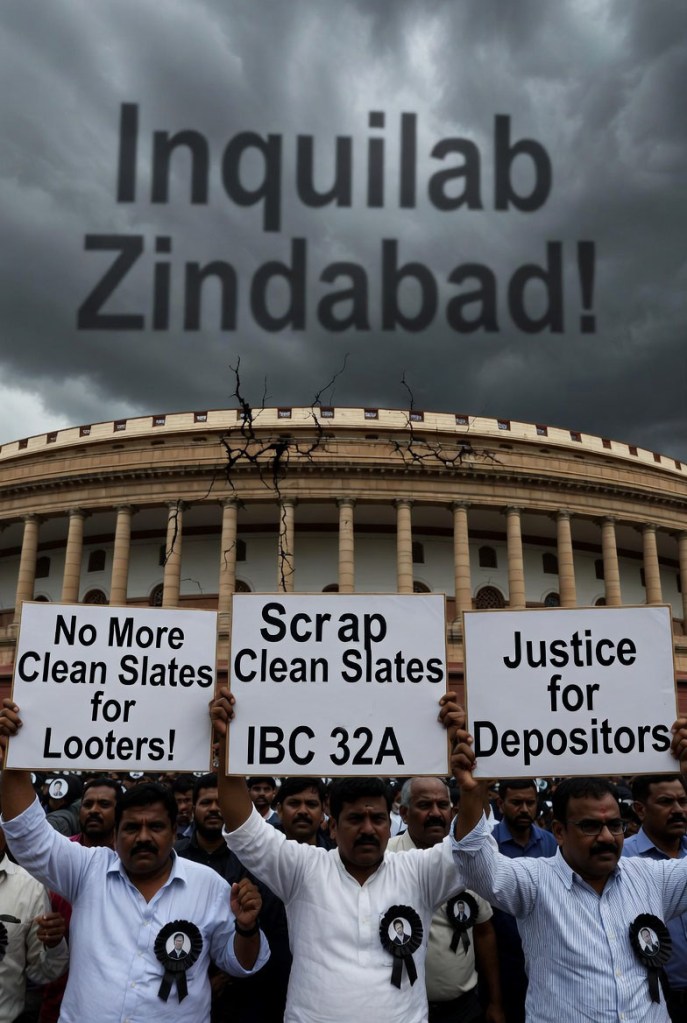
Black badges on every chest.
Human chains at every gate.
Voices rising at every institution.
Outside RBI. Outside IBBI. Outside NCLT benches. Outside Parliament.
Let truth stand where silence once stood.
SCRAP SECTION 32A – END THE SHIELD OF IMPUNITY!
ENFORCE Section 66 IBC – LET FRAUD FACE JUSTICE!
REPEAL THE IBC 2016 – END THIS MACHINERY OF DISPOSSESSION!
Mahatma Gandhi defeated an empire through Satyagraha—truth, courage, and moral force. We will confront this corporate-political nexus the same way: with unity, with truth, with unbreakable non-violence.
THE BATTLEFIELD IS TRUTH.
THE WEAPON IS UNITY.
THE GOAL IS JUSTICE.
Share the truth. Print the exposés. Speak about this in every Telegram or Signal or WhatsApp group. Organize in every neighbourhood, complex. Discuss in every temple, mosque, church, and gurudwara. Let the silence break everywhere at once.
SCRAP THE ILL-CONCEIVED IBC 2016. ABOLISH SECTION 32A. RESTORE JUSTICE FOR EVERY DHFL VICTIM.
Justice for every rupee stolen. Justice for every life disrupted. Justice for every voice ignored.
INQUILAB ZINDABAD!
SATYAGRAHA AMAR RAHE!
JAI SATYAGRAHA!
The roar has begun. The resistance has begun. The reckoning has begun.
RISE UP.
 Once in a Blue Moon Academia
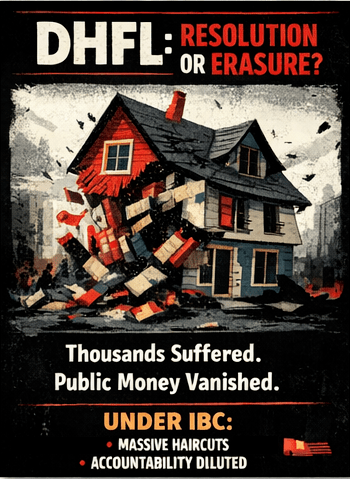
What if the system designed to resolve financial distress is actually protecting those responsible for it? What if “resolution” has become a shield for erasure—of accountability, of fraud, of justice?
This piece uncovers how structural loopholes are enabling powerful actors to walk away clean, while victims are left to absorb devastating losses. It challenges the narrative of efficiency around insolvency and asks a harder question: who really benefits from this system?
💥 From legal contradictions to systemic design flaws, this is not just about one case—it’s about a pattern.
💥 A pattern where accountability is diluted and public trust is quietly dismantled.
If you believe in transparency, fairness, and the rule of law, this is a conversation we cannot ignore.
👉 Read, reflect, and raise your voice. Silence only strengthens impunity.
#IBCReformNow, #FinancialGovernanceCrisis, #PublicPolicyFailure, #CorporateAccountability, #RegulatoryFailureIndia, #TransparencyInBankruptcy, #EthicalGovernanceIndia, #FinancialJusticeIndia, #DHFLScam, #AccountableAuditors, #RatingAgencyReform, #PublicInterestFirst, #RuleOfLawMatters, #DemocraticOversight, #PoliticalEconomy, #Seize_Cronies_Fairplay_for_DHFL_Victims, #Alleged_Dawood_Mirchi_RKW_DHFL_BJP_Collusion, #Scrap_IBC, #Scrap_RBI_appointed_COC_for_DHFL, #ScrapIllConceivedIBC,
LikeLiked by 3 people