Grapes are Always Sour for the Other 98%? A Tale Told by a Fox
Posted on 17th February, 2026 (GMT 02:05 hrs)
# In Place of an Abstract #
I, the fox—displaced, hungry, forever circling the perimeter of what others call success—have written this howl from the ashes of vanished forests and the margins of a city that builds towers while drowning its poor. Through five chapters filled with nearly endangered political satire, I trace how the grapes of sweetness remain forever sour, not from any defect in my leap, but because the vineyard itself is enclosed by design: fortified mansions rising above flood-prone shores, weddings costing hundreds of millions while hunger indices stay serious, births secured with foreign passports and luxury medicine while preaching national self-reliance to the rest, nationalism demanded as sacrifice from the many yet practiced as portable privilege by the chosen few, and finally an economics of limitless spectacle that devours the very earth required for any future life. From Aesop to Panchatantra to lived memory of deforestation and corporate predation, I refuse the fable’s tidy moral—that effort alone decides access—and instead diagnose structural denial, crony spectacle through conspicuous consumption and ostentatious display, ecological myopia, as well as selective patriotism. In the end I unlearn the dream of joining the feast; I choose instead the difficult, unglamorous arithmetic of limits—sufficiency, repair, localization, care without applause—because the bulldozers have already flattened the last vine and my vixen beneath them, and what remains is no longer a question of reaching the grapes, but whether any shared ground can still sustain breath in a world that mistakes endless extraction for destiny. This is my testimony, not of envy, but of ruthless clarity: the sourness was never in the fruit; it was always in the fence.
CHAPTER I
In Lieu of Arrival: the fox learns why the grapes are “always” sour
I am the fox. I live in the cracks, the margins, the spaces left behind. I am part of the Other 98%: the farmers whose land is swallowed by towers, the workers whose labor builds what they cannot enter, the poor whose streets flood while elevators rise, the climate refugees, the forest-less, the dispossessed.
We are not a number. We are a condition: overlooked, exploited, silenced, made to taste only sour grapes.
And yet, I see. I watch the towers, the bulls, the bears, the sharks, the markets. I smell the ash and smoke, the dust of burnt forests, the sweetness of profits that are never ours. I see the animal spirits—muscular, armored, celebrated—while our claws and teeth are called savagery.
I run. I crouch. I mimic. I remember Martha’s Vineyard, Spielberg’s shark, the tourists screaming, the fear captured and commodified. I remember the vineyard of human ambition, the markets as predator, the jaws that devour without pause.
This booklet is my voice, my howl, my observation, my warning. It is a tale of ash, ambition, greed, mimicry, and survival. It is a tale of the Other 98%, of how the richest 2% taste sweetness while the rest chew sour grapes.
I am the fox. I tell the story. I ask you to listen.
Because even small, hunted, displaced creatures— even the fox— can witness empire, and speak truth from the ashes beneath its towers to the jaws of its sharks.
However, I begin as a fox who does not know where to stand–I am searching my locus or rather loci….
I am told, repeatedly, that the grapes hang just above my reach. That if I leapt harder, climbed smarter, trained better, worked harder, invested earlier, networked wider, I too would taste sweetness. The story is old. It is told as a lesson in effort, not enclosure. As aspiration, not architecture.
But I am confused.
I circle the vineyard and notice that the branches are not simply high. The soil is not merely uneven. The vines are cordoned, the perimeter fortified, the gates guarded, the entry ticketed, the air itself insured. The grapes are not inaccessible by nature; they are inaccessible by design.
I am not short. The vineyard is fenced.
I am standing in front of Antilia, a stunning, 27-story private skyscraper in Mumbai, India,
I am standing in front of Gulita, a fortified luxurious 50,000 sq ft sea-facing mansion located in the upscale Worli neighbourhood of Mumbai.
I am standing in front of Karuna Sindhu (also referred to as Piramal House), located in the upscale Worli neighbourhood of Mumbai.
I am still your fox from Aesop, but hear this clearly: I am a refugee of merciless deforestation. My den was flattened for speed, for yield, for returns. The trees fell first, then the rain learned new ways to fall.
And so I came to the city— to your monuments of confidence, to ask what memory has failed you.
Antilia, fortress of vertical ambition, belonging to Mukesh Ambani— you crown Cumballa Hill, fifty metres above the sea, as if altitude were innocence. Did you think the smoke from vanished forests would not warm the ocean below you? When flooded Mumbai gasped for breath, did your height keep the streets dry— or did sailors still row past your shadow?
Gulita, staring boldly into the Arabian Sea, home of Isha Ambani and Anand Piramal— your walls glitter at Worli’s edge, fourteen metres of confidence above a restless tide. Sea-facing, they say— but do you face the sea’s memory? The mangroves that once softened its anger were cleared before I arrived, homeless. Do you remember who paid that price?
Karuna Sindhu, house of Ajay Piramal— your name tastes of mercy. Karuna: compassion without limit, Thus Spake Buddha— to feel another’s suffering as one’s own. Where’s the line between empathy and sympathy? So I ask, not as a judge but as a fox who has lost everything: where does that karuna stand when millions remember the collapse of DHFL⤡⤡, the ruin of small depositors, the public pain that followed Piramal’s corporate excess? I speak of questions, of shadows, of aftermath— not verdicts— yet tell me: can compassion live comfortably on reclaimed land ten metres above a drowning city?
And you, ISKCON Thane – Sri Sri Radha Govindadeva Mandir, within Piramal Vaikunth, guided by the ISKCON movement— you chant of dharma, of cosmic balance. But when wetlands shrink and creeks swell, when institutionalized devotion is landscaped over ecology, who answers for the imbalance that sends foxes like me wandering asphalt instead of forest floor?
Do you remember that year Mumbai flooded, when rain met tide and the city surrendered? When basements filled like confession bowls? When the mighty and the meek alike waited on rooftops?
It was not wealth that arrived first. Not marble. Not naming rights.
It was the Indian Navy, boats gliding where cars once ruled, turning soldiers into ferrymen, saving lives while certainty drowned.
I ask you now—owners, trustees, believers— did you forget the consequences of anthropogenic global heating?
Are you suffering from ecological myopia? That forests are not scenery but shields? That every tree cut is a degree promised to the sea? That no tower, however tall, can outpace a warming planet?
I am only a fox— clever once, desperate now. But even I know this: you cannot preach compassion, build luxury, and ignore the ground beneath you without the water rising to interrupt.
When the next flood comes—and it will— will your buildings remember karuna, or will they again wait for boats?
Rupture: Elevation and Relative Risk of the Above-mentioned Residents
Site Location
Approx Elevation (m asl)
Direct Sea-Level Risk
Flood/Storm Risk Notes
Antilia (Cumballa Hill)
~50–56 m
Low
Hill elevates away from direct tidal surge
Gulita (Worli Sea-Facing)
~14 m
Moderate-High
Exposed shoreline, tidal & monsoon flood risk
Karuna Sindhu (Worli)
~10–15 m
Moderate
Coastal plain risks during extreme events
ISKCON Thane (Balkum)
~20–25 m+
Low (sea)
Creek/monsoon runoff focused risk
I stop. Somewhere far away, an engine hums. The sea does not apologize.
This is where the fox begins to doubt the moral of the fable.
The fox as narrator — not envy, but method
I am a fox. Across three timeless traditions of fable and fantasy—Aesop’s fables, the Pancatantra, and Tuntunir Boi (The Tailor Bird’s Book)—I emerge as a creature of cunning, survival, and sharp-eyed observation in unequal worlds.
In Aesop, I stand frustrated at the foot of the vine, unable to reach the grapes, and declare them sour—a moment mocked as sour-grapes rationalization, yet revealing the sting of structural denial.
In the Pancatantra, I (often rendered as the jackal) embody intellectual strategy over brute force. I navigate jungle hierarchies with wit: as the devious minister Damanaka in Mitra-bheda, sowing discord to reclaim power; as the opportunistic Blue Jackal, briefly ruling through deception until instinct betrays me; as the clever trickster who lures a tyrannical elephant into a swamp or outsmarts a hidden lion in the Talking Cave by making the cave “speak.” My tales celebrate presence of mind in the face of overwhelming odds, yet always within a rigged order.
In Tuntunir Boi (The Tailor Bird’s Book), I am the sly nephew — small, quick, alert — living in the long shadow of Baghmama, my formidable maternal uncle. He is the tiger: celebrated for strength, feared for his roar, respected because the forest has learned to step aside when he walks. His power is visible. Mine is not.
The stories are told from my side because I survive.
I do not challenge Baghmama’s strength. I read it. I watch where his confidence hardens into habit, where certainty dulls perception. I win not by force, but by refusing to meet him on the ground he controls. I slip. I wait. I misdirect. I survive by seeing what power, in love with itself, forgets to notice.
In my mind, If I have that at all! no moral neatly tied, no single lesson agreed upon. I am ambivalent, because survival teaches contradiction.
I write in my mystique pad— In my mind, If I have that at all! no moral neatly tied, no single lesson agreed upon. I am ambivalent, incoherent… because survival teaches contradiction.
I was born into fables where animals knew their place and consequences arrived politely by the final paragraph.
But listen.
I have lived two stories at once.
The Blue Jackal
Once, I was soaked in indigo— not by choice, but by accident, by flight, by fear.
I ran from dogs, fell into dye, emerged changed.
Blue.
The forest stared. The lions bowed. The tigers hesitated. Power, it turns out, is often just surprise held long enough to harden into belief.
I ruled by color, as state of exception, by distance, by the willingness of others to fill in my silence with meaning.
Was I lying? Or merely adapting?
Because here is the truth I never confessed: I did not choose to deceive— I chose not to be eaten.
Yet at night I howled like myself. And my own voice betrayed me. The dye cracked. Authority fled. The dogs returned.
Lesson, they say: False power collapses.
But tell me— would you have stayed brown and died honestly?
The Crow Who Wanted to Be a Peacock
Later, I watched the crow.
He admired beauty that was never meant for him— feathers like rain after fire, colors that required no explanation.
So he stole. One plume. Then another. Then applause.
But beauty borrowed is heavy.
The peacocks laughed. The crows recoiled. He belonged nowhere.
Lesson, they say: Do not imitate what you are not.
But tell me— is longing a crime? Is aspiration theft? Or only when the powerful say so?
Where I Stand Now
I am a fox made homeless by falling forests, by roads that cut like knives, of beautified corridors that cause over-flooding, through memory.
I have worn blue. I have envied feathers.
I have ruled briefly. I have been rejected thoroughly.
The jackal teaches me this: power gained through transformation can protect— until it demands silence from your own voice.
The crow teaches me this: beauty pursued without permission will be punished— not because it is wrong, but because it disrupts hierarchy.
And I— I am caught in-between them.
If I change too much, I am called a fraud.
If I remain myself, I am called expendable.
So what is the moral, O humans who love clean endings?
That survival requires disguise? That authenticity is a luxury afforded only by the safe?
I no longer believe in single lessons.
I believe in context. In forests that vanish. In seas that rise. In cities where some skyscrapers stay dry because others must drown.
I believe a fox may need to be blue one season, and feathered the next, and still be blamed for both.
I see an-other blue jackal, quite unlike me, heading the richest party in the world, yet calls himself a “fakir”— non-bio-logical, king liar, fascist, singer-dancer on Israel, USA servant, mass murderer through making pogroms, 56-inch chested (non-)mortal.
His “peacock” feather? An entire political science degree, claimed yet never found, a ghost in the archives—much like the one he carried deep into Dwarka’s submerged ruins, waving it in currents before Lord Krishna’s feet, a tribute placed underwater in scuba silence, where ancient grandeur meets staged divinity. The plume floats symbolic, borrowed from myth, yet the degree drifts untraceable, both offerings sinking into spectacle’s blue depths. Just like he never married. Just like he became a “monk” after fighting the croc.
He is the crow who mastered the jackal’s dye— black wings slicked indigo, perched on a throne stolen not by plumes, but by EVMs slipped in shadow, yet a crow remains a crow beneath the borrowed sheen.
The spectacle dazzles, the jumla throne gleams, but the mirror cracks at midnight: no peacock heart, only feathers glued by theft and faith in forgetting. Who will whisper the obvious when the forest still bows?
He gets bribes through PM CARES and electoral bonds— he is the blue jackal: appearances, spectacle, but substance? Jumla. Feku.
The fox-narrator comprehends this dissonance, this tension— this blue jackal is the naked king, the king without clothes— who is ready to point that out?
In a world of pseudology, where lies build thrones on demonetized dreams and unkept 15 lakhs, the spectacle reigns, but the howl of truth waits in the shadows.
Do not ask me which story is true.
They are all true. That is the trouble.
I lower my voice.
And if you hear me howl at night, do not rush to expose me.
Ask instead what dyed me, what I admired, and who benefits when I am returned to being small.
This is why I understand David and Goliath⤡ without ever having heard their names.
Goliath is armour and certainty and scale. He believes the fight has already been decided because size has decided it. David, like me, does not argue with that belief. He steps outside it. He does not bring a sword to a sword-fight. He changes the rules. The sling is not bravery; it is intelligence. It is the decision to refuse symmetry.
As a fox, I know this lesson in my bones: power expects imitation; survival depends on deviation.
The tiger charges straight ahead. I move sideways. The giant waits for a blade. I carry a stone.
These stories are not about victory. They are about remaining alive under asymmetry. They are told by those who cannot afford honourable defeat. When strength is monopolised, attention becomes resistance. When spectacle dominates, cunning becomes ethics.
I do not defeat Baghmama because I am stronger. I endure because I see the world he cannot afford to see.
That is why the fox tells the story. Not to boast — but to remember.
I speak as a fox not because I envy the grapes, but because the fox is positioned outside. I am not invited into the vineyard; I am not counted among its stewards. I live on the margins where explanations are offered as consolation. Historically mocked for rationalizing failure—“the grapes are always sour”—what if my verdict is not self-deception, but precise diagnosis?
What if the sourness is structural?
I do not begin with certainty. I begin with frustration—a low, embodied, animal frustration born of repeated proximity without access. This frustration is methodological: the starting point of knowledge when one is excluded from comfort yet granted clear vision.
I belong to the other 98%—not as cold statistic, but as lived position. I feel the fence before I grasp the balance sheet. I sense the lock before I read the law.
This chapter is not about proving the fox deserves the grapes. It is about asking why the grapes are guarded as if they were rare orchids, while foxes are exhorted only to jump higher.
It mirrors the sanctuarised domains of contemporary capital—spaces branded as benevolent or even ecological, yet defined by control. Consider Vantara, Mukesh Ambani’s private animal “conservation” enclave: animals relocated, managed, enclosed, presented as care—yet life preserved strictly on the owner’s terms, nature “rescued” by removal from its own wildness.
So too the vineyard: grapes curated not for hunger, but for prestige. Access is rationed not by scarcity, but by selection. Entry is privilege, never right.
The fox presses against the fence and recognizes the pattern: care without consent, protection without sharing, abundance without access.
Why can’t I, the fox, reach the grapes?
I ask again and again: why can’t I reach the grapes? Why can’t I attain the Ambani-Piramal superrich status? Is it my own failure, shortcoming, lack—of talent, discipline, timing?
Or is it because the vineyard was enclosed long before I was born?
Patterns emerge: land enclosed, commons privatised, wealth inherited, risk socialised downward, gains sealed upward. Effort explains little when starting lines are staggered and finish lines movable.
Labour alone does not unlock fruit when ownership dictates distribution.
I am not excluded because I did not work. I am excluded because work is not the currency of entry.
Perhaps the spectres of Marx—alienated labour, class enclosure, surplus value extracted upward—could illuminate this. But I leave the question hanging, in deliberate limbo.
“To be like is like to become”–Metamorphosis?
On this side of the river, I let out a sigh, While across the waters, all my joys lie. I sit and breathe, my heart a weary song, The river whispers—happiness waits beyond, where it belongs.
–Rabindranath Tagore
On this side of the river, I sigh, each breath heavy with what I have lost. Across the waters, all joy seems to wait— just out of reach, shimmering in another world.
I sit on this bank, letting the current carry my long, quiet despair. The river murmurs to me: everything you crave, everything they keep from you, lies there—beyond the water, beyond the grasp of the hunted, on the far side where the rich and the lucky dwell.
And still I breathe. Still I watch. Still I long. For the other side, the side of sweetness, that never lets the fox, or the 98%, pass.
1. Role-Reversal of Ambition: Animal to Superrich?
The fox stands alone now. Her fur is dusted with ash and ink. She has learned new words by listening from the bushes.
They gave it a name, you know. Scholars like names. They make hunger sound elegant.
They call it mimicry.
I call it learning how to survive while being watched.
Homi Bhabha said it gently— almost the same, but not quite. That is how they want you: close enough to be useful, far enough to remain suspect.
They ask you to speak like them, dress like them, walk like them, think like them— but never to arrive.
Be reformed. Be recognizable. Be different in a way that flatters power.
Almost the same. Not quite.
I know this posture well. It is the crouch you take when the forest is gone and the road belongs to someone else.
They whisper: Be like us. And what they mean is: Become white. Not skin— structure. Not pigment— permission.
I watched this happen to others.
Frantz Fanon saw it first, and it broke his voice. In Black Skin, White MasksPeau noire, masques blancs he named the ache of wearing a language that despises your mouth. Of hoping grammar might bleach history. Of believing that if you speak perfectly, they will stop seeing you as less.
But the mask suffocates. The mirror refuses mercy.
Later, Glen Coulthard looked again, from red earth, not ivory towers. Recognition, they called it. The state nodding, smiling, saying yes, we see you— as long as you speak in our forms, sign our papers, fold your sovereignty into our syntax.
Recognition, it turns out, is another kind of leash.
And me? I am a fox.
I have been blue. I have admired feathers not meant for my body. I have learned the language of fences. I have learned to lower my eyes while copying the stride of those who cleared my home.
They say: If you mimic us, you may belong.
But belonging is always deferred. The door is always almost open. The test is always one mistake away.
So I ask you— is mimicry betrayal, or is it intelligence under threat?
When survival demands resemblance, and resemblance is punished, where does dignity go?
I am almost the same. Not quite.
And that space— that trembling gap— is where I live now.
2. Role-Reversal of Ambition: Superrich to Animal ?
The fox speaks more quietly now— not angry, not pleading, only sharp with understanding.
Sometimes I imagine a different kind of experiment. Not the kind they run on markets, but the kind they run on meaning.
Suppose the Conglomerate filled bottles not with money but with ashes— grey, light, unmistakably ours— buried them deep in wasteland and hired creatures like me to dig.
We would dig all day. Not for wages— for purpose. For proof that effort still connects to breath.
We would sift the sand looking for what used to be our lungs.
The economists would smile. Jobs created. Demand stimulated. Graphs rising obediently.
And when the bottles were empty they would announce success: the nation has finally quit burning itself.
But ashes do not end. They replenish. As if the earth itself has learned the habit of combustion.
Every report says the same thing now— thresholds crossed, heat locked in, oceans swelling like unpaid accounts.
I read them the way one touches a scar: without surprise. With a strange calm.
If everything is burning, why should I pretend not to?
To inhale now is not indulgence— it is participation. A small ritual in a much larger immolation.
The match is my private catastrophe. The smoke, my refusal to believe in recovery narratives.
Why not, they laugh. Didn’t they always talk of beer and bull when the market staggered, foam on its lips, charging without sight?
But look— the roles have slipped.
I, the fox, am expected to be rational, restrained, audited. He, the architect of capital, gets to charge, to gore balance sheets, to call it confidence.
They sale-brate the bull’s chaos as vitality. They pathologize my hunger as instinct.
Tell me— when power howls, it is called spirit. When I howl, it is called noise.
Who, then, is truly the animal now?
It charges through cremation grounds where failed investors lie unnamed, hooves pounding savings into powder.
I run. The smoke runs with me.
Its breath smells of generosity. Its horns shine with liquidity.
This is how capital imagines itself— unstoppable, benevolent, trampling without noticing who is underneath.
No substitute saves me from clarity. No patch, no lozenge, no slogan.
The more I understand, the deeper the breath goes.
The Conglomerate will endure— extracting value from our debts, our remedies, our funerals.
Perhaps one day even our smoke will be repackaged, sold back as balance, counted as offset.
When I disappear, I want no filter.
Let my smoke rise freely, mix with the city’s dust, with signals and numbers.
Let satellites mark it as negligible. A rounding error.
Some analyst will say addiction curves have flattened, that outcomes have improved.
And somewhere between charts, my vanishing will be labeled progress.
I am not angry.
I am visited— by the ghost of my own cooperation. By how easily sweetness replaced resistance. By how freedom was offered as something chewable, swallowable, dissolvable.
Nietzsche said the soul is born when cruelty turns inward.
Mine was born later— when cruelty learned how to invoice.
And then, across oceans, I see Martha’s Vineyard.
A playground, a postcard, but once it was Amity Island— or at least, that is what the cameras told you.
Spielberg brought the shark to life, an animal, enormous, unstoppable, erasing the laughter of tourists, turning pleasure into panic, filming zoophobia in every splash, fear made cinematic, digestible, iconic.
The jaws waited in the deep. The teeth glistened in the imagination, not in the water.
And I thought: the real terror is not in the shark, but in what the shark makes you become.
I watched humans hire humans to run along beaches, to scream for the lens, to pretend terror was real. Extras, they called them. Small lives rented for authenticity.
And I thought: the real terror is not in the shark, but in what the shark makes you become.
Animal spirit, they say. I know it well. The fox knows the surge of instinct, the thrum of claws, the taste of survival.
Ajay Piramal wants to be a bull. Capital charges. Hooves crush what they choose. Liquidity sharp as teeth.
But the bull, the shark, the fox— we are all mirrors. We are the fear we see. And humans? They dress in fear like a costume, call it entertainment, call it business, call it growth.
I remember the bridge at Menemsha. They filmed screams over it. I hear them still in the rustle of reeds. And I see the same jaws in the mouth of every market, every stock report, every corporate pronouncement.
To survive, I shift, I crouch, I mimic. To survive, I watch the bull charge, the shark bite, and ask: whose jaws will eat whose soul today?
Fear is a spectacle. Profit is a predator. Animal spirit is a license.
I am a fox. I know hunger. I know the chase. And when humans play at terror on sand and lens, I see their own reflection in the open jaws.
Method(s), Standpoint(s), Alienation, and the Animal’s Gaze
This booklet does not aim for neutrality. It accepts detachment only as discipline, not as pretense. It proceeds from a standpoint(s).
My method draws from feminist epistemology, where knowledge is not abstracted from life but born inside it—inside bodies positioned unequally, exposed differently, permitted or denied differently. The fox does not hover above the vineyard like a diagram. She presses her nose against the wire. Sensation comes before statistic. Smell before theory. Hunger before explanation. What she knows, she knows because she lives where the fence cuts.
This is why the animal speaks.
The lineage is old. In the Panchatantra, animals speak from courts they do not rule, navigating power through wit rather than force. The forest is already political; survival is already strategic.
In Aesop, the animal voice sharpens into irony. The fox who calls the grapes sour is not lying to herself; she is diagnosing a world where desire is shaped by denial and morality is written by those who eat.
In Tolstoy’s Kholstomer, alienation deepens into tragedy. The horse feels, remembers, suffers, yet is reduced to property. Ownership becomes absurd when seen from the body it exhausts.
And Brecht, arriving later, names what these stories were already doing: alienation as method. Make the world strange so it can be seen. Interrupt familiarity so judgment can occur.
This booklet stands inside that lineage. The fox replaces the horse not just as a supplement of horse (cf. Tolstoy’s Kholstomer) , but to shift the terrain. She is a climate refugee, displaced by deforestation and speculation, alienated from the market that salebrates “animal spirit” while hunting actual animals and disposable people alike. She is not innocent. Envy flickers. Desire flickers. But envy is not allowed to end thought. It becomes interrogation.
Why is sweetness displayed as spectacle while hunger is normalized? Why is aspiration endlessly promoted while access remains gated?
The refrain returns—the grapes are always sour. Not as resignation. Not as self-deception. As learning.
The fox learns that sourness does not reside in the fruit. It resides in the system that decrees sweetness scarce. Repeated denial is moralized as personal failure. Structural exclusion is translated into individual deficiency. This is how the vineyard sustains itself: by teaching foxes to blame their jaws, never the fence.
And yet—this is not a purely lyrical method. Data intrudes. Numbers arrive like sudden rustles in the brush, interrupting reverie. Inequality ratios. Expenditure figures. Debt burdens. Citizenship laws. They do not decorate the narrative; they disrupt it. They force recalibration. They prevent the fox from being dismissed as merely poetic.
The oscillation is deliberate: felt frustration, numerical shock, and back again. This is how most of the world is lived. Experience first. Explanation belated. Policy arrives after the flood.
Brecht would insist that this movement—between immersion and interruption—is not a flaw but a political technique. The reader is not meant to forget the fox is a device, nor to forget that the world she describes is constructed. The alienation effect does not numb feeling; it sharpens it by refusing inevitability.
The fox inherits an archive: archewriting , global fairytales, ancestral cunning. She also inherits Marx’s spectres, hovering unresolved over the vineyard.
Her problem question is: Why can’t I become Ambani–Piramal super-rich? Is it my failure, my lack, my inadequacy? The booklet does not rush to close this question. It leaves it deliberately in limbo, where ideology is most visible.
This is not a plea for pity. It is an insistence on perspective(s).
The fox speaks because she is excluded. She sees because she is alienated. She knows because she is positioned where theory meets wire, where smell meets number, where envy becomes critique.
The grapes are always sour—not because the fox lies to herself, but because the vineyard is designed that way.
Theory seeps in unannounced.
The fox observes: grapes harvested by many hands, savoured by few mouths. Labour flows while ownership remains immobile. Value is extracted upstream, returned downstream as debt, sermon, or scant charity.
Those who tend the vines rarely taste the wine.
This is not bitterness. It is observation.
The fox does not covet vineyard ownership. The fox dreams of unfenced fruit.
Confusion as clarity
I end this chapter still confused—but confusion has deepened into something sharper.
No longer puzzled by my own leap. Puzzled by a world that insists the fence is illusion.
The fox accepts this confusion as clarity’s prelude. To stay confused is to reject the lie that the vineyard is natural. To keep asking why the grapes are guarded like state secrets.
And so I proceed.
The grapes are always sour—not because I cannot reach them, but because reaching was never the point. Control was.
The fox moves on, still hungry, but now watchful.-just like a flâneur!
Brief Chapterization — As Told by the Fox
I do not tell this story in straight lines. I move by scent, by obstruction, by the ache of nearness without access. Each chapter is a place where I paused, pressed my nose against a fence, and learned something about why the grapes remain sour.
After this dis-orienting chapter, I move towards the following:
CHAPTER II — Shameless Spectacle of Weddings
Here I watch the vineyard erupt into light.
Drawing from the logic of the society of the spectacle, I trace two weddings as case studies of excess:
Isha Ambani–Anand Piramal (2018) — estimated at ~US$100 million,
Anant Ambani–Radhika Merchant (2024) — estimated between US$300–600 million+.
I dissect conspicuous consumption through figures: invitations costing lakhs, global pop performances, private logistics, curated hospitality, and ritualised abundance. I place these numbers beside India’s contradictions: extreme wealth concentration, persistent inequality, crony capitalism indices, and ongoing hunger (Global Hunger Index 2025: Rank 102/123, score 25.8 — “serious”). Against this, the Constitution’s socialist promise—especially the Directive Principles cautioning against concentration of wealth—stands exposed. Hospitality becomes power, gift-giving becomes governance, and excess declares itself publicly. I learn how spectacle disciplines without coercion.
CHAPTER III — On Birth, Price, and Place
Here, the story enters the body.
I follow the birth of Aadiya and Krishna Ambani Piramal, born in the United States (2022), acquiring jus soli citizenship. I count costs—IVF cycles, luxury maternity care, transnational medical logistics—and set them against average childbirth expenditures and income realities. I ask myself, quietly: how does a fox give birth in such a world? From love’s labour pains, the narrative shifts to love’s labour lost—toward extraction, privilege, and mobility insurance. Alongside the nursery, I place another ledger: the DHFL collapse, its victims, and the arithmetic of dispossession. Birth becomes political economy; the passport shadows the cradle.
CHAPTER IV — Who Is the “real” Anti-National?
Here, I turn the accusation back on itself.
Speaking from within ultra-nationalist rhetoric, I ask who would be labelled anti-national if standards were applied evenly. I examine selective nationalism under the BJP–Sangh Parivar gaze: while dissenters are policed, Ambani and Piramal remain celebrated cronies of power. I track contradictions—US births for citizenship, Shanghai sourcing office of Piramal Pharma amid “Boycott China” slogans of the BJP,
Standard Chartered ties, and Ajay Piramal’s CBE honour—against Atmanirbhar Bharat rhetoric. I draw explicitly from Tagore (nationalism as disease), Benedict Anderson (imagined communities), and Ashis Nandy (manufactured nationality). What emerges is not love of nation, but a modular nationalism: rigid for the many, porous for the few.
CHAPTER V — Economics of Austerity in an Age/Edge of Environmental Crises
I end by counting limits.
Here I bring together A. K. Dasgupta’s economics of austerity, Schumacher’s “small is beautiful,” and Gandhi’s lived austerity. I recall Gandhi’s remark after meeting King George V—the king had enough for both of us—and his quiet acceptance of Churchill’s “half-naked fakir” insult as truth. Khadi becomes method, not symbol; clothing becomes shelter, not spectacle; manufacturing becomes ethical choice. Austerity is reclaimed—not as deprivation, but as planetary solidarity in an age of ecological overshoot. I learn that the opposite of excess is not poverty, but care with limits.
I close still outside the fence. Still hungry. But no longer confused.
The grapes are always sour— not because I cannot reach them, but because they were never meant to be shared.
And that, finally, is what this booklet learns to name.
Why can’t I, a fox, achieve this type of Ambani-Piramal superrich status? My own failure, shortcoming, lack? Perhaps the spectres of Marx could answer this question. I leave it in limbo.
CHAPTER II
Shameless Extravagant Spectacle of Superrich Weddings
I walk the perimeter of their vineyards. From the hedgerows the light looks different — gilded, rehearsed, everything lit so that every glance finds itself doubled: by camera, by guest, by invoice. The grapes hang beyond the fences not only because the branches bend high; they are fenced, flown, insured, curated, and booked months in advance. The music plays; the ledgers hum. The spectacle does not merely appear — it is assembled.
Below I lay out two case-studies as a fox might: with hunger in my belly and numbers in my head. The figures that follow are not gossip. They are tallies that travelled from planning rooms into pressrooms — reported, estimated, triangulated, and repeatedly re-reported across Indian and international media. Where a figure is an estimate, I mark it as such. Where a range exists, I state the range. Numbers are often contested; spectacle is not.
Case study 1: Aisles of Isha Ambani – Anand Piramal’s Wedding
The week that people counted in crores and millions
The first vineyard: a December week of ceremonies in 2018, binding Isha Ambani and Anand Piramal through a multi-city, multi-continent wedding itinerary. Contemporary press coverage — across Indian national dailies and international lifestyle journalism — consistently placed the total expenditure at approximately US$100 million.
At 2018 exchange rates, this corresponds to roughly ₹700 crore, a figure that recurs across Indian reportage and retrospective summaries. The conversion is not casual arithmetic: ₹700 crore at ₹70–75 per US dollar places the total squarely in the US$90–100 million range, a convergence that lends robustness to the estimate.
What did this money purchase?
Chartered international and domestic flights for hundreds of guests
Complete hotel block bookings across cities, including luxury properties converted into controlled-access zones
Bespoke wardrobes for multiple functions, many designed for single appearances
Multi-city ceremonial processions, including events in Udaipur and Mumbai
Specially staged artisan markets, recreating curated versions of “heritage” consumption
Global musical performances, most notably Beyoncé, whose appearance was widely reported as a defining feature of the spectacle
Precise artist fees for this wedding were not officially disclosed. However, later disclosures around similar family events allow a reasonable industry benchmark: international A-list performers typically command US$3–5 million per private performance, sometimes higher depending on exclusivity clauses and logistics. Journalists therefore reconstruct totals not from a single invoice — which does not exist publicly — but from supplier disclosures, event-industry norms, aviation costs, hospitality tariffs, and artist-fee benchmarks.
Opacity, here, is not a flaw; it is a feature of power.
Case study 2: Aisles of Radhika Merchant – Anant Ambani’s Wedding
When pre-wedding flotillas and pop stars become line items
The second vineyard expands the scale dramatically.
Anant Ambani & Radhika Merchant Full Wedding Event Video
The wedding of Radhika Merchant and Anant Ambani unfolded across months, with pre-wedding events, international concerts, cruises, and multi-city logistics, culminating in a six-day ceremony in mid-2024. This time, international scrutiny followed the numbers.
Aggregated estimates by Indian media, international newspapers, and financial commentators converged on a total expenditure of approximately US$600 million, with several outlets reporting a range extending up to US$1 billion, depending on inclusions.
This range is not sensationalism; it reflects methodological differences:
Whether pre-wedding cruises are counted as part of the wedding
Whether international guest travel is included
Whether post-wedding receptions and hospitality tail-events are aggregated
Even the lower bound — US$600 million (≈ ₹5,000 crore) — places this wedding among the most expensive private ceremonies in recorded history.
Granular line items help anchor this magnitude:
Pop-star performance fees
Rihanna: widely reported fee of US$8–9 million (≈ ₹66–74 crore) for a single pre-wedding performance in Jamnagar
Other international acts (including Katy Perry and legacy pop groups): reported fees in the multi-crore range, with Katy Perry’s fee estimated at ~₹45 crore in multiple lifestyle and entertainment outlets
These figures align with industry-standard private concert fees for global artists, cross-verified against disclosures from comparable ultra-luxury events worldwide.
Invitation cards
Reported cost per invitation: ₹6–7 lakh
These were not merely cards but handcrafted artefacts, often including curated objects, textiles, digital media, and bespoke packaging
When multiplied across VIP lists, diplomatic guests, business networks, and symbolic invitees, invitations alone become a multi-crore expenditure
Pre-wedding production and logistics Journalistic reconstructions — drawing on aviation costs, cruise charters, security infrastructure, hospitality, staging, and artist fees — suggest that pre-wedding events alone may have cost between US$250–300 million. This includes:
Luxury cruises converted into private floating venues
Temporary urban infrastructures built for a few nights of spectacle
No single audited balance sheet exists. But across The Guardian, Financial Express, Times of India, and international lifestyle finance reporting, the orders of magnitude converge. The absence of transparency is itself a diagnostic: spectacle at this scale resists accounting even as it demands attention.
What the numbers sit beside — inequality, hunger, and concentration of wealth
Spectacle does not float free. It is anchored in an economic structure marked by extreme concentration.
According to the World Inequality Lab’s India study (1922–2023):
The top 1% of earners captured approximately 22.6% of national income in 2022–23
The top 1% owned approximately 40.1% of total national wealth in the same period
These figures place India among countries with the highest levels of income and wealth concentration globally.
Oxfam’s India briefings further underline this imbalance:
The top 10% control roughly 70–77% of national wealth (depending on methodology and year)
The bottom 50% own only a marginal share, often estimated in single digits
This is the soil in which such weddings bloom — not personal success alone, but structural accumulation.
Alongside this, India continues to face serious human deprivation:
The Global Hunger Index consistently categorises India’s situation as serious, with scores in the high-20s in recent years
While World Bank data suggests declines in extreme poverty under certain thresholds, hundreds of millions remain income-precarious and food-insecure, living close to subsistence margins
The paradox is not that wealth exists. It is that wealth concentrates so spectacularly while deprivation remains so widespread.
The Political and Constitutional Paradox
India constitutionally defines itself as a socialist republic, with Directive Principles that explicitly caution against the concentration of wealth and economic power. These are not ornamental clauses; they were born from anti-colonial debates about justice, dignity, and material sufficiency.
Yet the numbers above — hundreds of millions of dollars spent on private ceremonies, invitation cards costing more than annual household incomes, artist fees exceeding what thousands earn in a lifetime — stand in open tension with those principles.
I watch them practice hospitality the way one practices a ceremony: rehearsed, costed, rehearsed again. From a distance it looks like openness — gates swung wide, arms extended, names called out with affection. But I have learned that not every open door is an opening. Some doors are simply better guarded.
The host stands at the centre like a sun. Everything curves toward him: chairs, glances, gratitude. He does not need to speak commands. His offering is command enough. To host is to decide — who enters, who waits, who is remembered, who is politely erased. Hospitality here is not the absence of power; it is power refined until it feels like kindness.
They call it a gift. I watch the gift arrive heavy with intention. It does not fall freely from the hand; it lands and stays. It wants to be seen, named, admired. A gift like this cannot forget itself. It carries memory like a ledger. I know — a true gift would vanish the moment it was given, leave no trace, demand no echo. This one demands applause. It demands return. If not now, then later, in loyalty, in silence, in alignment.
The guest learns quickly. The guest learns posture before speech. One body moves easily through space; another learns where not to step. Gratitude becomes instinct, not choice. To refuse would be obscene. To question would be betrayal. So the guest smiles, eats, praises — and learns to call this freedom.
The feast does not shout. It disciplines softly. Pleasure does the work of obedience. No one needs to threaten; the abundance itself governs. Excess becomes pedagogy. It teaches the limits of speech.
I listen to how they speak of friendship. “My friend,” they say, over and over, but they do not mean risk. They mean recognition. Friendship here is proximity without danger, closeness without difference. It is fraternity — brothers in power, mirrors in suits. Those who do not resemble are not enemies; they are simply not imaginable as friends.
I remember another whisper from those abandoned books: O my friends, there is no friend. I finally understand the cruelty in it. Friendship, as they inherit it, is built on exclusion. It survives by mourning the other before the other arrives. It wants sameness so badly that difference feels like a threat.
Their friendships are contracts disguised as affection. They bind, they secure, they reproduce themselves. They are political before they are personal. The line between friend and guest, guest and stranger, stranger and threat — all carefully drawn, all guarded.
They speak of togetherness, of unity, of belonging. But what I see is careful distance. Who may speak freely, who must laugh at the right moment, who must remain grateful for being allowed to remain. Hospitality becomes architecture: thresholds, zones, permissions. Friendship becomes infrastructure.
The host remains sovereign because sovereignty is hidden inside generosity. The more lavish the welcome, the deeper the debt. The guest carries it quietly, like a second spine. Memory accumulates. Who owes whom never disappears.
I stay outside the fence and think about another kind of friendship — one that does not need likeness, one that does not fear the stranger, one that does not turn difference into danger. A friendship that does not begin with mourning, that does not end in obligation. A hospitality that risks itself by not knowing who will arrive.
But this place is not built for that future. This is a closed circle, polished and glowing. It welcomes without opening. It gives without letting go. It calls itself friendship while guarding power.
I press my nose to the wire and understand: some feasts are not meant to nourish. They are meant to remember. And what they remember, always, is who stands at the centre — and who learns to circle in silence.
I watche(s) this carefully. Hunger has taught me that not all food is meant to nourish. Some meals are designed to remind you who controls the table.
The Fox at the Altar — On Marriage and Exchangeof Property
I watch the ceremonies closely, because silence often reveals more than speech.
What strikes me first is not excess alone, but emptiness disguised as sanctity. These Mitakshara Hindu marriage rituals unfold with immense precision—chants timed, gestures rehearsed, offerings calibrated—yet the space where desire might have lived is carefully sealed off. Sexuality, pleasure, intimacy, even uncertainty are rendered unspeakable. “Love” survives only as a polite euphemism, safe enough to circulate in brochures and speeches, emptied of bodily risk. In the market’s grammar, affection is ornamental; exchange is essential.
I sense(s) what is really being consecrated. This is not primarily a union of bodies or futures, but a transaction of lineages and assets, performed under the cover of ritual. Property moves quietly beneath the music. Inheritance aligns itself. Kinship is formalised into balance sheets. The Mitakshara framework, which governs joint family property and inheritance, lingers here like an unspoken script—structuring rights, obligations, and fiscal outcomes even as the ceremony pretends to float above such concerns. Law does not interrupt the ritual; it hides inside it.
I notice how carefully desire is disciplined. What might have been a negotiation between two uncertain lives is stabilised into a legal-economic arrangement before it ever has a chance to be fragile. Pleasure is deferred, regulated, sanitised. The body is present, but only symbolically. The real work is being done elsewhere, in documents, accounts, future partitions.
And then there is the chanting.
Sanskrit verses rise and fall, intoned flawlessly by Brahmin priests, repeated obediently by couples who do not know what they are saying. The sounds are ancient, authoritative, resonant—but meaning does not circulate. Language functions here not as understanding, but as credential. The words sanctify precisely because they are opaque. Not knowing becomes part of obedience. The fox listens and wonders how many vows are being spoken that neither speaker nor listener can translate, how many promises pass through mouths without ever touching thought.
This, too, is a kind of alienation. Speech without comprehension. Gesture without agency. Consent without reflection.
The spectacle insists this is tradition, continuity, culture. But I, the fox, trained in hunger and distance, see another pattern. When words lose meaning, they gain power. When rituals become incomprehensible, they become harder to question. And when marriage is emptied of desire, it fills easily with property.
This is not merely excess to be judged; it is a structure to be understood. The wedding becomes a public pedagogy, teaching bodies how to submit gracefully to arrangements already decided elsewhere. The altar masks the ledger. The chant smooths the transfer. The feast distracts from the accounting.
When I say the grapes are always sour, I do not mean that I despise sweetness. I mean that sweetness here is rationed, stylised, and instrumentalised. It is offered not to nourish, but to bind. The ceremony does not celebrate love; it stabilises exchange. It does not invite meaning; it demands compliance.
The fox remains outside, not scandalised, but attentive. I watch mouths move, hands exchange, words echo without landing. Hunger has taught me that not every ritual feeds, and not every union is meant to join. Some ceremonies exist to remind you—quietly, beautifully—where ownership begins and desire must end.
Friendship for Sale: A Fox, a Pauper, and the Market That Answers First
(Neo-liberal Bazaar: Fox, Kabir, Pauper, and Socrates)
[The stage is a neo-liberal marketplace.] LED screens flash stock indices. Influencers shout discounts. Credit cards glow like talismans. In the middle of this spectacle stands Kabir, unmoving.
Kabir speaks softly, yet the words ripple across the bazaar.
कबीरा खड़ा बाज़ार में, मांगे सबकी खैर, न काहू से दोस्ती, न काहू से बैर।
Romanization: Kabīrā khaṛā bāzār mẽ, mā̃ge sabkī khair, Na kāhū se dostī, na kāhū se bair.
English Translation: Kabir stands in the marketplace, wishing well to all; He has friendship with none, and enmity with none.
A Fox—sleek, sharp-eyed, wearing the polish of corporate intelligence—pauses. The doha unsettles her. Neutrality, here, is suspicious.
The Fox Questions Kabir
Fox (tilting her head): Kabir, how does one stand inside the market and yet belong to no one? Tell me—who is mitra? Do you have a friend?
Before Kabir can answer, a Pauper (one of the other 98%) enters. His clothes are worn, his eyes alert. He does not wait for permission.
Between the super-rich who hoard the heights and the super-poor who labour at the lowest ledges, the rope has snapped— no middle class anymore, no mediating zone, no intermediate, no bridge of balance, no in-between— only a widening, polarized valley where excess towers on one side and deprivation deepens on the other.
The Pauper Speaks (Without Pause)
Pauper: I had many friends—once. When wealth sat with me, so did companionship.
That was my season of मित्रसम्प्राप्ति / मित्रलाभ (Mitra-samprāpti / Mitra-lābha)— the acquisition of friends, the securing of allies.
I was surrounded by smiles, dinners, handshakes, shared risks. Friendship multiplied as my balance grew.
But when the numbers vanished, so did the people.
That was my descent into मित्रभेद (Mitra-bheda)— the loss of friends, the quiet art of separation.
No quarrel. No betrayal spoken aloud. Only absence. Like jackals who no longer needed the lion once the bull was gone.
The Fox Interrupts
Fox: And your wealth—why did it abandon you?
The Pauper Continues
Pauper (bitter smile): Because I mistook predators for partners.
I did not understand काकोलूकीयम् (Kākolūkīyam)— the eternal politics between crows and owls.
I believed peace was possible between fraud-soaked superrich tycoons and a middle-class labourer like me.
They spoke of partnership. I mistook strategy for friendship, negotiation for goodwill.
In that war, I was unarmed.
Crony capital dressed as wisdom. Enmity disguised itself as mentorship.
Loss, Named Properly
Pauper (voice lower): What I earned by sweat, skill, and time— what I thought secure— slipped away.
That was लब्धप्रणाशम् (Labdhapraṇāśam)— the loss of gains.
Like the monkey who trusted the crocodile, I extended my hand while standing on a riverbank of illusion.
The Fatal Error
Fox (softly): And the bank?
Pauper (laughs once, hollow): Ah. The final lesson.
अपरीक्षितकारकम् (Aparīkṣitakārakaṃ). Action without examination.
I deposited my blood-earned money into institutions polished by ratings, certified by stars, blessed by the unholy trinity—
State. Corporations. Rating agencies.
I did not verify. I trusted numbers that spoke louder than truth. By the time I learned, the mongoose lay dead, and the child—my future—was already gone.
Kabir Remains Silent
Kabir listens. He does not intervene. Silence, here, is not ignorance—it is judgment withheld.
Entry of Socrates
From the far end of the marketplace enters Socrates, bewildered, arms full of shopping bags, gadgets dangling, screens glowing.
He looks around—at Kabir, the Fox, the Pauper, the crowd.
Socrates: Tell me— what shall I do with all these consumer products?
No one answers.
The LED screens continue to flicker. The market roars. Kabir remains standing.
Sources:
Indian and international reportage estimating the Isha Ambani–Anand Piramal wedding at ~US$100 million / ~₹700 crore
International press (including The Guardian) estimating the Anant Ambani–Radhika Merchant wedding at ~US$600 million, with upper estimates reaching US$1 billion depending on inclusions
Multiple reports on Rihanna’s US$8–9 million performance fee and other artists’ multi-crore fees
Lifestyle and national media reporting ₹6–7 lakh per invitation costs
World Inequality Lab (2024) on India’s top-1% income and wealth shares
Oxfam India summaries on national wealth concentration
Global Hunger Index and World Bank data on hunger and poverty trends
Appendix
Historical Context of Guest Control Orders in India and Contemporary Socioeconomic Contrasts
This appendix provides a self-contained overview of the defunct Guest Control Orders (GCOs) issued in various Indian states primarily between the 1960s and 1990s under the Essential Commodities Act, 1955. It outlines their original purpose, key provisions, and historical linkages to food security systems such as the Public Distribution System (PDS). The appendix also situates these orders within India’s constitutional commitment to socialism, drawing attention to their relevance amid persistent challenges of hunger, inequality, and large-scale food wastage in contemporary India.
1. Overview of Defunct Guest Control Orders
1.1 Historical Background and Rationale
Guest Control Orders were state-specific administrative measures enacted during periods of acute food scarcity, rationing, and economic hardship in post-independence India. These decades were marked by limited agricultural productivity, import dependence, and widespread malnutrition.
The primary objective of the GCOs was to prevent wastage and diversion of rationed or controlled food commodities—especially rice, wheat, sugar, edible oils, and pulses—by restricting their use in private and social functions, particularly lavish weddings, receptions, and parties. The underlying rationale was clear: food security for the many must take precedence over private extravagance for the few.
1.2 Legal Basis
The orders were issued under powers conferred by the Essential Commodities Act, 1955, which authorizes the state to regulate production, supply, distribution, and consumption of essential goods in the public interest. Similar logic underpinned other rationing and price-control mechanisms of the era.
1.3 Typical Key Clauses and Provisions
The following provisions are synthesised from representative versions, including the Delhi Guest Control Order, 1991; Uttar Pradesh Guest Control Order, 1972; Assam Guest Control Order, 1973; and comparable orders in Rajasthan, Andhra Pradesh, Jammu & Kashmir, and other states.
(a) Short Title, Extent, and Commencement
Each order carried a formal title (e.g., “Delhi Guest Control Order, 1991”).
Applied to the entire state or Union Territory.
Came into force immediately upon publication in the official gazette.
(b) Definitions
Commonly defined terms included:
“Caterer”: Proprietors or persons in charge of hotels, restaurants, eating houses, catering establishments, and their agents or employees (private household cooking was often excluded).
“Prohibited foodstuffs”: Commodities under rationing or control due to scarcity (typically rice, wheat flour/maida, sugar, pulses, edible oils, and certain imported or luxury items).
“Social function / party / entertainment”: Broadly defined to include weddings, receptions, engagement ceremonies, funerals, birthdays, anniversaries, and similar gatherings where food was served.
(c) Restriction on Number of Guests
Hosts, organisers, caterers, or associations were prohibited from serving food to more than a prescribed maximum number of guests at any function.
Limits varied across states and periods:
Delhi (1991): up to 200 persons
1960s–1970s versions: often 50–100 persons
Some orders imposed lower caps for specific types of events.
(d) Restrictions on Foodstuffs and Dishes
Preparation, serving, or consumption of prohibited/rationed commodities beyond specified limits was banned.
Several orders restricted the number of dishes or courses to curb multi-course feasts using scarce commodities.
(e) Exemptions and Discretionary Powers
State governments or designated authorities (District Magistrates, Commissioners of Food & Civil Supplies) could grant exemptions for specific cases, provided reasons were recorded in writing.
Common exemptions included official state functions or cases of demonstrated hardship.
(f) Enforcement Powers
Authorized officers—usually Food Inspectors or officers above a notified rank—were empowered to:
Enter and inspect premises suspected of violations
Question hosts, caterers, and organisers
Seize food items, utensils, and related materials
Conduct searches and seizures using procedures analogous to those under the Code of Criminal Procedure, 1973
(g) Penalties
Violations attracted penalties under the Essential Commodities Act, 1955, including fines and imprisonment.
In practice, enforcement often relied on inspections, warnings, and preventive checks rather than large-scale prosecutions.
(h) Repeal and Decline
Some orders repealed earlier food-consumption controls while protecting actions already initiated.
From the late 1970s onward, enforcement gradually declined as foodgrain availability improved due to the Green Revolution, rationing eased, and economic liberalization gained momentum.
As of February 2026, no Guest Control Order is in force or actively enforced anywhere in India, either at the state or national level.
2. Guest Control Orders and the Public Distribution System (PDS)
2.1 Constitutional and Ideological Context
The Preamble to the Constitution of India declares the country a “Sovereign Socialist Secular Democratic Republic”. This commitment is further elaborated in the Directive Principles of State Policy (DPSPs), which mandate the state to ensure equitable distribution of material resources and prevent concentration of wealth.
The Public Distribution System (PDS)—now governed by the National Food Security Act, 2013 and operationalised through the Targeted PDS (since 1997)—is a central instrument of this constitutional vision. It currently provides subsidised foodgrains to over 81 crore beneficiaries.
2.2 Persistent Inefficiencies in the PDS
Despite significant reforms and technological upgrades, major inefficiencies persist:
Leakages and Diversions Estimates suggest approximately 28% of allocated foodgrains are lost annually due to corruption, diversion, and black marketing—around 20 million tonnes, valued at tens of thousands of crores of rupees.
Targeting Errors Inclusion and exclusion errors remain high due to outdated beneficiary lists (largely based on the 2011 Census), resulting in exclusion of deserving households and inclusion of non-poor beneficiaries.
Storage and Spoilage Large quantities of foodgrains rot in government godowns because of inadequate storage capacity, poor logistics, and over-centralised procurement.
Nutritional and Ecological Limitations The PDS’s heavy reliance on rice and wheat—often procured from water-stressed regions—exacerbates environmental degradation while failing to address micronutrient deficiencies or promote climate-resilient crops.
2.3 Relevance of Guest Control Orders Today
Historically, Guest Control Orders complemented the PDS by conserving rationed foodgrains for public distribution rather than allowing their dissipation through elite or private extravagance. They embodied a principle now largely abandoned: collective need over conspicuous consumption.
In today’s context of persistent hunger, inequality, and food wastage, the spirit—though not necessarily the exact form—of such controls offers a conceptual pathway forward:
Curtailing large-scale private food wastage at elite events could reduce pressure on public procurement.
Redirecting even a fraction of wasted resources could strengthen buffer stocks and reduce subsidy burdens.
Reintroducing social norms or regulatory mechanisms aligned with austerity and equity could enhance transparency and public accountability.
Seen through the lens of India’s socialist constitutional framework, Guest Control Orders represent not authoritarian excess, but an ethical intervention aimed at prioritising collective food security over private excess.
Concluding Note
The disappearance of Guest Control Orders marks a historical shift from scarcity management to market-led abundance. Yet, abundance has not translated into equity. Hunger persists. Food is wasted. Inequality deepens.
Revisiting the logic behind these defunct orders does not mean resurrecting them unchanged. It means recovering a lost ethical vocabulary—one that recognised food as a social good, not a private indulgence, and understood that unchecked spectacle undermines collective survival.
In an era of climate stress, ecological limits, and enduring poverty, that vocabulary deserves to be remembered—and reimagined.
CHAPTER III
Bourgeois birth, medical exit, and the fox’s non-arithmetic
This chapter is specially dedicated to Dr. Subhas Mukhopadhyay, the Visionary Pioneer of IVF technology, who was once institutionally murdered
I tell this chapter from I-the-fox’s small ribcage, where breath is counted and hunger teaches attention. Here, birth is never innocent. It is never only biological. It is juridical. It is infrastructural. It is economic. It arrives already entangled in law, capital, mobility, and trust.
Birth is where flesh meets paperwork.
Birth is where the future quietly chooses a soil.
I, the fox, watch closely when birth travels—when it crosses oceans, when it acquires a postcode that doubles as a legal destiny, when it lands on a soil whose protections are unevenly distributed and selectively available. I watch because birth is not just arrival; it is allocation. I, as fox, see the partitions: some births wrapped in privilege, others exposed to precarity. The fox does not envy; the fox counts the gaps.
This chapter concerns the birth of Aadiya and Krishna Ambani Piramal, twins born on 19 November 2022, to Isha Ambani and Anand Piramal, in the United States. This is not conjecture. It is publicly acknowledged and widely reported—in media dispatches, family statements, even Instagram glimpses of their arrival back in Mumbai, priests chanting at Karuna Sindhu. The location most frequently cited is Los Angeles, with repeated references to Cedars-Sinai Medical Center—a hospital globally recognised not merely for medical competence, but for superrich maternity care, privacy regimes, and celebrity-grade infrastructural insulation. Doctors from Mumbai flew to accompany the family; one of America’s top paediatricians ensured the twins’ first flight was seamless. Not rumours—these are documented details, layered with care that ordinary births rarely touch. These are the facts from which the fox begins to count, ribcage tightening with each tally.
1. The Central Problem-Area: Trust, Credibility, and Bourgeois Birth
I, the fox, begins with a question that refuses to stay polite:
If Piramal Swasthya, Piramal Healthcare (now folded into broader entities), Piramal Pharma Limited, Piramal Pharma Solutions (its CDMO arm for global drug manufacturing), Piramal Seva/Foundation (community outreach), and allied healthcare initiatives already exist as their “very own” in their own country India—publicly celebrated, state-partnered, award-winning, and eulogised as engines of national health capacity—why did the Piramal–Ambani family choose the distant and expensive United States for childbirth?
This question sharpens further when one remembers that Swati Piramal, Ajay Piramal’s spouse, is herself a trained physician, long positioned as a public voice on Indian healthcare — seemingly advocating for innovation, equity, and self-reliance.
In a brief September 2024 video from the Piramal Foundation, Dr. Sudha Jha of Sadar Hospital in Sitamarhi, Bihar, describes how QR-coded digital records are transforming rural maternal care—allowing swift access to patient histories, fewer repeated tests for lost prescriptions, faster monitoring of high-risk pregnancies, and better decisions that save time and lives. Supported by the Foundation, these tools promise scalable digital empowerment for underserved mothers and babies across India.
Yet, the fox watches from the undergrowth: while the Foundation showcases such innovations as lifelines for forgotten villages, the same ecosystem’s architects once crossed oceans for their own IVF twins at Cedars-Sinai, opting for foreign insulation over the domestic systems they now publicly digitize and celebrate. The earnest clip extols technology’s reach to the many; the unspoken ledger reveals the few’s persistent exit. Digital hope flows downward, vulnerability flows upward—across the same uneven soil.
So the fox asketh, slowly:
A. Was their own healthcare systems seemingly good enough for the nation, but not good enough for the family? The fox dwells here: Piramal Swasthya, in 2025, basked in the Times Social Impact Summit award for Healthcare & Wellness Excellence—lauded for 13.5 crore health calls via 24×7 helplines, 8,000 served daily by Mobile Medical Units, 2 crore+ via the AMRIT digital platform. In 2025, UNMUKT (its mobile screening for seniors) won the Aarogya Shakti Award at CSR’25. By 2026, ‘Xurakhya’ launches in Assam, promising social security for 13 lakh ESI workers. These are the metrics of national commitment, partnerships with governments, digital bridges to the underserved. Yet, for the family’s own vulnerability—twins via IVF—the exit to Cedars-Sinai. The paradox naked: systems built for millions, bypassed for kin. Is trust performative?
B. Are the systems promoted to the public infrastructures of trust—or infrastructures of containment? The fox chews this: CSR narratives flood with reach—20 crore lives touched, mobile units rolling into rural voids. But containment emerges when these very business tycoons opt out, leaving the masses in the very nets they weave. The disruption: what message in the flight abroad? That corporatized Indian excellence suffices for optics, but not for flesh?
C. Is this what bourgeois birth looks like, just as bourgeois death looks different—exported, insulated, medically overdetermined, and legally hedged? Bourgeois birth, the fox observes satirically: not in the mud of exposure, but in suites where privacy is purchased, risks outsourced. The contradiction: families shaping India’s pharma (Piramal Pharma’s FY2025 sustainability report touts decarbonization, yet environmental fines linger in the shadows of Piramal Pharma’s pollution of Digwal, Telangana)—yet seeking foreign soil for arrival. No judgment; just the bare asymmetry.
Healthcare decisions made by such cronies are never private. They are symbolic endorsements or silent withdrawals. They tell us which systems are trusted when bodies are most vulnerable—when rhetoric gives way to risk.
I, the fox, does not claim hypocrisy lightly. The fox names credibility asymmetry: promote nation-centric health for the many, exit for the few. The rupture: awards in 2025-2026 celebrate public good, while 2022’s choice whispers doubt.
2. Medical Mobility and Class-Differentiated Choice
Medical tourism is often framed as consumer choice. The fox rejects this framing.
Medical mobility is not freedom in the abstract; it is classed capacity. The fox dwells: for the corporate tycoons, oceans part—private jets, medical escorts, Cedars-Sinai’s luxury. For the fox, movement means risk, not refuge. Transnational medical mobility is accessible only to the superrich few. The majority (the other 98%) remain bound to domestic systems—not because they trust them, but because they cannot leave them. The paradox: India’s medical tourism booms inward (cheaper surgeries drawing foreigners), yet tycoons flow outward for perceived superiority. Birth tourism overlaps: not just care, but commodified arrival.
Here, the ethical concern is not mobility itself. The fox is not anti-movement. The fox is attentive to differentiated trust. When such cronies can opt out of national systems at moments of maximum biological vulnerability—birth, illness, death—while simultaneously urging citizens to trust, endure, and remain loyal to those systems, a two-tier moral economy of healthcare emerges:
* Healthcare as obligation for citizens—queue in mobile units, dial helplines, rely on AMRIT’s digital promises.
* Healthcare as option for the superrich—Cedars-Sinai’s privacy floors, U.S. specialists.
Birth becomes the clearest diagnostic site of this asymmetry. The disruption: Piramal Swasthya’s 2026 expansions (urban Mumbai-Pune partnerships) for the underserved, while family birth in 2022 abroad. Naked contradiction: build for the base, bypass for the bloodline.
3. Why Not Here? Why the United States? Why Cedars-Sinai?
Cedars-Sinai Medical Center is not a neutral site. It is a tertiary-care, private, world-ranked medical institution, known for:
* advanced neonatal and maternal care,
* celebrity-grade privacy and security,
* luxury maternity suites,
* and superrich obstetric specialisation.
It is not chosen accidentally. It is chosen because it is predictable, insulated, and legally embedded within a powerful sovereign system. Reports confirm: twins born there, Mumbai doctors flown in, paediatrician escorting the return. The fox pauses here and asks a question that presses from the undergrowth:
Why this country, this hospital, this legal soil—when the family presides over vast pharmaceutical and healthcare infrastructures in India itself? The fox dwells: Piramal Pharma’s 2025 sustainability report outlines performance, yet 2026 brings Gujarat’s Dahej plant closure for hazardous waste dumping—GPCB order on Feb 3, 2026, appealed to SC, which directs decision in a week. Digwal’s legacy: 2018-2019 fines (₹8.3 crore NGT, ₹3.2 crore more), closures, community cancers, yet SEBI clears non-disclosure in 2024 as “non-material.” The paradox: environmental externalization at home, medical excellence sought abroad.
The fox chews further on echoes from another fugitive’s flight. Vijay Mallya, facing extradition battles since 2016, repeatedly argued before UK courts that Indian jails are overcrowded, lacking hygiene, with poor conditions—no natural light, violence, ill treatment—unfit for human habitation, even claiming the Indian prison system worse than Russia’s in some respects. His defence invoked human rights to resist return, though courts eventually dismissed much of it after assurances and videos of proposed cells. This is basically portraying domestic incarceration as intolerable while abroad offers insulation.
Is the same calculus at play for healthcare? The fox wonders: do superrich families quietly deem Indian systems—hospitals, infrastructure, perhaps even jails in hypothetical futures—insufficient when vulnerability strikes their own kin? Promote Swasthya’s reach, digitise rural care, win awards for public good (Times 2025, CSR’25), yet exit to Cedars-Sinai for IVF twins. The paradox sharpens: trust domestic infra for narrative-manufacturing and the masses, but seek foreign soil for reproduction, for safety, for contingency. Mallya’s jail complaints mirror the unspoken: when stakes are personal, the home soil suddenly appears too harsh, too exposed, even if way too advertised already. Disruption: build national health narratives, yet hedge with American predictability. The fox counts the asymmetries—public commitment at home, private insurance abroad—and the ledger tilts once more.
The fox does not rush to answer. The fox counts: awards for Swasthya’s public health (Times 2025, CSR’25), against the exit. Disruption: trust in Indian infra for rhetoric, not reproduction.
4. The Arithmetic of Birth: When Care Is Priced
The United States is among the most expensive places in the world to give birth. According to the Kaiser Family Foundation, average total spending for pregnancy, childbirth, and postpartum care is approximately US$20,416—a baseline figure for insured, non-corporate households. The fox dwells: this average, already commodified, excludes the uninsured’s ruin. This is before luxury. Before celebrity protocols. Before privacy. The fox notes this baseline carefully. Because averages tell us where inequality begins—US$20,416 against India’s ₹2–3 lakh household income. Birth’s price tag, where love’s labour bills by the hour. Escalation: Caesareans, IVF, and the Price of Hope The US has a high rate of medicalised birth:
~32% of births occur via caesarean section.
Typical hospital charges:
Vaginal delivery: US$10,000–15,000
C-section: US$18,000–30,000+ The twins were conceived through IVF, publicly acknowledged by the parents. In the US:
A single IVF cycle costs US$12,000–25,000.
With medication, testing, freezing, and repeated cycles, cumulative costs can reach US$50,000–100,000+. IVF is not merely medicine. It is an industry that already selects who may reproduce with ease and who must wait, suffer, or fail. The fox chews: technologised hope, priced exclusion. Paradox: Piramal Pharma’s generics pivot (legacy products like Saridon, Tetmosol), criticized for lack of innovation, while family accesses cutting-edge abroad. Disruption: empower maternal care via Swasthya (AMRIT for 2 crore), but import for own. Love’s labour is technologised. Waiting is priced. Luxury Maternity Care: Where Averages Collapse Superrich’s hospitals offer what they do not name as luxury:
private suites (US$1,000–5,000 per night),
extended postpartum stays,
private nursing teams,
restricted-access floors,
medical escorts,
and international logistical arrangements. These costs are never itemised publicly. But they exist. Aggregated, they push superrich childbirth into six-figure territory—US$100,000+, even before accounting for private jets, accommodation, legal planning, or immigration advisory services. The fox does not claim a final invoice. The fox claims orders of magnitude: six figures for one birth, against India’s lakhs for survival. Naked: capital’s insulation.
Yet the fox burrows deeper into the underbelly of this pharma-capitalist machinery: modern medicine, in its relentless pursuit of precision and control, often inflicts a hidden structural violence—turning the body into a battlefield where interventions breed new ailments, dependencies multiply like shadows, and the natural rhythms of life are expropriated by expert hands. This is the nemesis of healing turned against itself: clinical harms from over-treatment, social erosions where communities lose their capacity for self-care, cultural diminishments that pathologize the ordinary. The fox sniffs the air thick with this paradox—science’s blade, meant to mend, slices into the soul of autonomy, imposing a medical gaze that dissects flesh into objects, symptoms into commodities, births into procedures under cold scrutiny. In the clinic’s birth, the body becomes a site of power, observed, classified, invaded; love’s labour, once communitarian and instinctive, now yields to the authoritative eye that sees not the whole but the parts, not the person but the patient. The disruption: empower the masses with digital promises, yet the tycoons flee to insulated realms where this gaze is gilded, selective—while the fox, exposed, counts the wounds inflicted in the name of progress.
5. Birth Tourism, Commodification of Arrival and Jus Soli Citizenship
At this point, the fox introduces a distinction too often blurred:
* Medical tourism: travel for healthcare—lower costs inward to India, but chosen business magnates outward for exclusivity.
* Birth tourism: travel to secure citizenship through jus soli—”passport babies,” controversial, targeted by U.S. visa denials since 2020.
Birth tourism is controversial precisely because its primary object is not care, but law. The fox dwells: U.S. debates rage—Trump’s 2025 EO 14160 limits birthright to children with citizen/LPR parent, blocked by courts, SC review in 2025-26 term. Bill H.R. 569 (2025) mirrors: citizenship only if parent qualifies. Yet for 2022 birth, jus soli holds—citizenship granted. Paradox: seek U.S. soil amid Atmanirbhar rhetoric.
Under the Fourteenth Amendment of the US Constitution, nearly every child born on US soil automatically acquires citizenship.
The implications are not symbolic:
* a US passport,
* global mobility,
* educational and professional rights,
* and a legal foothold independent of parental nationality.
The fox does not claim intent. The fox understands incentives: hedge against instability, while home systems suffice for others. When birth and citizenship align, birth becomes strategy as well as joy.
Is this a strategy to escape when cronyism fails here in India? The fox chews on precedents: Vijay Mallya, declared a wilful defaulter after Kingfisher Airlines’ collapse and billions in unpaid loans, fled to London in 2016, evading extradition battles that drag on. Other superrich wilful defaulters from India like Mehul Choksi, Nirav Modi and others have similarly vanished abroad when debts mount and accountability closes in—private jets carrying fortunes, foreign havens shielding assets. The pattern whispers: secure an exit route before the net tightens.
And then the fox eyes the Stoke Park estate— that lavish 300-acre Buckinghamshire icon, purchased by Mukesh Ambani’s Reliance in 2021 for millions, a James Bond-filmed playground of golf courses, tennis courts, and luxury now under family control. Shared under Mitaksara⤡ privileges of dynastic nepo-capitalism? The fox sees the threads: intergenerational Hindu undivided family structures legally entwine Ambani and Piramal bloodlines through marriage, cross-holdings, and shared corporate mobility—Stoke Park as one node in a transnational web of insulated privilege. Birth in America grants a passport; estates in Britain offer refuge; Mitaksara binds the wealth across generations. When Indian cronyism sours—fines, scandals, electoral bonds notwithstanding—the fox wonders: is the foreign foothold insurance against the day domestic soil turns hostile?
The fox does not accuse. The fox counts the hedges: passports pre-Trump’s EO, properties abroad, futures diversified. Birth becomes not just arrival, but contingency planning in an uneven world.
6. Corporate Healthcare, CSR, and the Optics of Exi(s)t
Piramal Swasthya positions itself as a flagship public-health initiative—reaching millions, partnering with states, winning awards (Times 2025, CSR’25), and shaping maternal healthcare narratives. 2026’s ‘Xurakhya’—ESI for Assam workers. Yet when childbirth arrived at home, the family exited. This is not about personal blame. This is about structural contradiction. CSR healthcare appears as:
* good enough for the population—helplines for crores, units for thousands,
* but not trusted for the architects’ own bloodlines.
The fox names this corporate exceptionalism: awards for equity (20 crore lives), against the 2022 opt-out. Paradox: sustainability reports (FY2025) outline decarbonization, while Dahej 2026 closure for pollution. Disruption: externalize harms at home (Digwal’s cancers), internalize benefits abroad. CSR as containment—uplift the base, elevate the tycoons.
7. The Other Ledger: DHFL and the Arithmetic of Dispossession
The fox is asked to keep another number beside the nursery.
The DHFL scandal involved alleged fraud of ₹34,000+ crore, with admitted claims of ~₹87,000 crore under the IBC.
Piramal’s acquisition price: ₹1 given for 45k crore worth of assets in avoidance transactions.
Lakhs of small investors, retirees, homebuyers absorbed the losses. The fox dwells: 2026 updates—Mumbai PMLA court discharges DHFL (now Piramal Finance) in ₹5,050 crore laundering case, citing IBC immunity post-management change. No shield for ex-promoters. Piramal Finance targets ₹1.5 lakh crore AUM by 2028, post-2025 merger/listing. RBI cancels Piramal Enterprises’ NBFC registration in 2026 after merger.
The fox notices the pattern:
collapse → resolution → ₹1 → rebranding → legal distance. Mergers quarantine liabilities—DHFL folded, accountability dispersed. This is legal engineering. Legality does not erase arithmetic: small depositors’ haircuts, while assets absorbed. Paradox: financial devastation for many, growth targets for few.
8. Two Ledgers, One Economy
Ledger Entry
Scale
Superrich childbirth (US, IVF + care)
US$100,000+
Average US childbirth
US$20,416
Average Indian household income
₹2–3 lakh/year
DHFL admitted claims
₹87,000 crore
DHFL acquisition price for Piramal
₹1 for 45k crore worth of assets
Piramal Finance AUM target 2028
₹1.5 lakh crore
Piramal electoral bonds to BJP
Rs 85 crore+
Piramal donations to dubiously opaque PM CARES
Rs 25 crore (as reported)
In one ledger, futures are insured before birth—U.S. citizenship amid 2025-2026 challenges, but secured in 2022.
In the other, futures are foreclosed after trust—DHFL victims’ losses, immunity granted.
This is not coincidence. It is the same economy, read from two ends. The fox counts: bonds to BJP, plant closures (Dahej 2026), awards for Swasthya. Naked: extraction at base, insulation at apex.
9. Dislocation: The Fox Gives Birth
Now the fox breaks the frame.
I, the fox, do not cross oceans. I do not purchase privacy. My vixen gives birth under leaves, in damp soil—without midwives, without attendants, without surgeons, without passports.
She labours in the cold seam between mud and night. Her flanks tremble. Each contraction tears through her like a snare tightening. Rain enters the den before the first breath does. There is no sterile light—only insects, rot, and the smell of fear.
No mobile units. No helplines. No AMRIT. If blood spills, the earth drinks it without record. If fever rises, there is no protocol—only endurance.
She bites the root to keep from crying out, because sound is a signal, and predators read pain as invitation.
Part of the 98%—vulnerable, unhedged, without capital’s exits. Pain does not convert into citizenship. Survival does not generate mobility.
My child inherits hunger, not insurance. Fur, not documentation. Instinct, not infrastructure.
The paradox stands bare: for tycoons, birth becomes strategy—jus soli as hedge, geography as portfolio. For the fox, birth is raw exposure, flesh against weather.
While Swasthya reaches crores, the vixen bleeds into leaves.
Atmanirbhar for the animal— transnational for the tycoon.
10. Closing: The Fox Counts Again
The grapes are always sour.
Not because love is false. But because love, when insulated by capital, becomes selective.
I count the IVF cycles. I count the passports—secured pre-Trump’s 2025 EO. I count the ₹1 equity—now AUM ambitions. I count the homes foreclosed, the fines (Dahej, Digwal), the awards (2025-2026). I count the bonds to BJP.
The fox does not moralise birth. He interrogates conditions.
He does not seek the grapes out of greed. He seeks them because hunger has arrived— not as excess, but as necessity.
Somewhere, the vixen’s body is turning blood into milk. Maternity is not sentiment; it is metabolism.
The fox leaps not for sweetness, but to answer hunger— hers, the unborn’s, the den’s.
He studies the wall, the season, the height of the vine. Birth is not virtue to him. It is a condition that must be met.
Birth has happened. Futures have been secured—unevenly.
And the ledger remains open.
Here, the contradiction sharpens into a rupture-point for I, the fox. India does not permit dual citizenship. Nationalism is increasingly framed under the current fascist BJP regime as exclusive loyalty, demanded as sacrifice. Yet chosen crony families quietly secure foreign legal futures for their children. Public discourse notes that Isha Ambani herself—and her brother—were born in the US in 1991. The pattern repeats. The fox asks:
* If nationalism is demanded from citizens, why is it instrumental for capitalists? The fox dwells: Piramal’s electoral bonds—Rs 85 crore to BJP (2019-2024), per 2024 disclosures. PHL Finvest Rs 40 crore, Piramal Enterprises Rs 35 crore, others. BJP’s largest recipient. Yet U.S. birth. Donate for ultra-nationalism, secure foreign passports.
* If Atmanirbhar Bharat is the ethic, why is jus soli the insurance? Amid Trump’s 2025 EO challenges (SC pending), the hedge persists. Paradox: preach self-reliance, practice global exit.
* If foreign citizenship is suspect for migrants, why is it prudent for billionaires? Naked: selective patriotism—obligatory for masses, optional for magnates.
Nationalism begins to look less like shared commitment and more like BJP’s totalitarian public discipline paired with private exit for chosen cronies like Adani, Ambani and Piramal. Disruption: bonds buy influence, births buy options.
CHAPTER IV — Who Is the Real “Anti-National”?
Selective patriotism, portable flags, and the fox reading the borders
The fox prowls the twilight edges, where slogans echo like distant thunder. “Nation above all!”, “One Nation, One Party, One Election”, they roar, but whose nation, truly? The vixen pads alongside, her gaze piercing the haze. “See the bars beneath the banners,” she whispers. “This isn’t harmony—it’s a harness.” Together, we navigate this cacophonous landscape, where terms like nation, anti-national, deshbhakt, and atmanirbhar serve as cudgels rather than concepts. They bruise, mute, segregate souls into silos. Yet the fox and vixen? We eschew echoes. We decipher designs, interrogate enclosures, follow the footprints of privilege.
This chapter ventures a provocative inquiry: In the ultra-nationalist clamor saturating public discourse, who merits the “anti-national” label if the gauge is applied uniformly? And what transpires when it’s directed at corporate colossi who ostentatiously ally with the regime? We inhabit that rhetoric’s rationale—then evade its grasp.
The Fox: Vixen, let’s dissect the core: the BJP’s rendition of ultra-nationalism. It’s no tender tribute to terrain and tribes; it’s a steamroller, a bulldozer….pulverizing plurality into a uniform facade. Exclusive, monolithic, monoreligious, mono-party—standardized, homogenized, pasteurized Hindutva. Extremism swathed in saffron, fascism masquerading as fidelity, hatred and intolerance fabricated in forges of phobia. This doctrine elevates a singular Hindu ethos above all, deeming deviations as defilement.
The Vixen: Indeed, fox. This isn’t innate affection for the homeland, or to one’s roots, or belongings; it’s engineered, an apparatus of alienation. Nationhood as an unyielding Hindu Rashtra, where minorities are perpetual suspects, dissent is sedition, and fealty demands unthinking submission to the party-state. They summon archaic splendors yet raze pluralism—edifices over sanctuaries, annals altered, ethos coerced into conformity. It’s nationalism as spectacle, belligerent toward the vulnerable, malleable for the mighty. A creed that conflates critique with conspiracy, unity with uniformity, and patriotism with partisan loyalty.
The governing apparatus—the Bharatiya Janata Party (BJP) intertwined with its doctrinal siblings like the Rashtriya Swayamsevak Sangh (RSS), Vishwa Hindu Parishad (VHP), Bajrang Dal—has entrenched a lexicon where dissent equates to betrayal. Students, scholars, advocates, scribes, minorities, activists, cultivators, labourers, demonstrators: all stigmatized as anti-national for interrogating policy, assailing extractive endeavors, summoning the Constitution, defying oversight, or eschewing patriotic pageantry. Sedition indictments, UAPA prosecutions, campus clampdowns, media inquisitions, vigilante violence—these constitute the enforcement arsenal in today’s India.
The Fox: Yet this very BJP-RSS apparatus embraces magnates like Mukesh Ambani and Ajay Piramal, extolling them as architects of the nation, progenitors of prosperity, icons of “New India.” Their intimacy is indisputable: electoral bonds channeled vast sums to the BJP—Piramal Group donated Rs 85+ crore, Reliance-affiliated entities over Rs 500 crore between 2014 and 2022. Snapshots with Modi at state galas, G20 pageants, policy perks like asset reallocations and insolvency triumphs. Cronyism manifest: Ambani’s Jio revolutionizing telecom with governmental endorsements, Piramal’s DHFL takeover amid allegations of undervaluation and procedural irregularities, where DHFL’s Rs 87,000 crore debt was acquired for Rs 34,250 crore, sparking claims of favouritism and losses to small investors. Public archives resound with symbiosis.
The Vixen: Sharpen the scrutiny, fox. Do these tycoons align with the BJP-Sangh Parivar’s “nationalist” ethos? Scarcely. Consider the nativities: Isha Ambani and Anand Piramal’s progeny, Aadiya and Krishna, delivered in Los Angeles at Cedars-Sinai Medical Center on November 19, 2022, indicatively conferring U.S. citizenship through jus soli—not dictated by exigency, but selected from opulence. Resonating with Chapter III’s disclosures: notwithstanding Piramal’s touted pharma dominions like Piramal Pharma and Swasthya—proclaimed as bastions of healthcare for rural India—they sidestepped domestic facilities for a fancy American institution. Why? Jus soli as a safeguard, perchance a tacit distrust in indigenous infrastructure.
The Fox: And further: Ambani’s Stoke Park estate in Buckinghamshire, UK—a 300-acre expanse with a 27-hole golf course, spa, and luxury hotel—acquired for £57 million (about Rs 592 crore) in 2021, potentially a sanctuary should cronyism collapse with regime shifts. Piramal’s CBE, conferred by the British Crown in May 2022 for services to UK-India trade, an imperial accolade in an era lambasting colonial scars. His “Oxford Talk”—a Schrödinger’s quandary in promotion: heralded as eminence yet delivered at the Oxford India Forum on July 4-5, 2025, a student-led event at Saïd Business School, blending erudition with publicity, not an official university oration. Then Shanghai: Piramal Pharma’s sourcing office in China, pivotal for supply chains, while BJP exhorts “Boycott China.” Atmanirbhar enigma—edict for avenues, not empires. Petty merchants castigated for imports; conglomerates procure discreetly, insulated by magnitude.
The Vixen: Under BJP doctrine—unwavering trust in institutions, cultural supremacy, aversion to alien affiliations—these might bellow anti-national indeed: overseas births as dubiety toward their very own India’s infrastructure, regal honors as colonial affinity, China ties as perfidy. Imposed on a scholar or migrant, it’d incite indictments. For magnates? Obliterated as “private prerogative,” “worldly pragmatism.” Disparity unveiled.
The profound absurdity: Piramal’s healthcare conglomerates capitalize on Indian frameworks—public-private collaborations, endpoint dissemination—yet kin entrusts foreign terrain for parturition. Not ethical censure; architectural unmasking of strata, CSR veneers, chasms between profit-driven healthcare and familial reliance. Transnational entitlement, risk evasion by the affluent.
Fiscal entwinements: Standard Chartered, a lender with global neo-colonial heritage, bolsters Piramal entities. Permissible, aye—but overseas funds lambasted against NGOs as cabal, lauded for corporations as credence.
The Fox: Behold the anti-national lexicon, vixen: BJP’s ordnance for branding, ostracizing, muzzling dissent. “Tukde tukde gang” for agitators splintering solidarity; “urban naxal” for erudites abetting insurgents; “deshdrohi” for renegades; “woke” as Occidental venom; “anti-India” for any reproach. Epithets hurled to demarcate loyalists from outliers, compliance from defiance.
The Vixen: Sustained by BJP-Sangh-RSS dogma: abhorrent by trait, chronicle. Hindu terrorists intrinsically—extremism, bigotry. RSS evaded India’s liberation strife; nil involvement in anti-imperialist movements. They orchestrated Gandhi’s slaying—Godse, RSS affiliate, executed the deed; Savarkar entangled albeit exonerated. Savarkar ingratiated British via reiterated clemency pleas, mercy petitions. RSS chieftain Golwalkar proclaimed veritable foes as Muslims, Christians, communists—not colonialists or imperialists. Yet they profess “nation-fidelity”? Duplicity embodied.
The Fox: Nationalism contra patriotism, vixen: I cherish my homeland’s enrooted belongings, not my government. Patriotism as moral solicitude for populace; nationalism as deified state, ego eclipsing insight.
The Vixen: Tagore’s 1917 “Nationalism” lectures boldly diagnose nationalism itself as the affliction of modernity—a cold, mechanistic drive that corrodes the ethical imagination, replacing genuine human solicitude with the swollen conceit of the collective ego. The “Nation,” in his piercing gaze, emerges not as salvation but as peril: a systematized egotism, an organized selfishness masquerading as virtue. He warned of its ravages across the Occident, in Nippon, and perilously close to home in India—pleading instead for that ethereal oneness of humanity over the crude political abstraction of flags and borders. His anti-nationalism stands not as hatred of any people, but as resolute opposition to the tyrannical machinery of the state. “Nationalism is a great menace,” he declared unflinchingly. “It is the particular thing which for years has been at the bottom of India’s troubles.”
How the andhbhakts howl at this! Tagore, they shriek, dares to spurn the sacred Western import of nationalism—with its avarice, its cut-throat rivalry, its lust for bellicose conquest—and instead urges India to embrace a humanistic ethos that laughs at boundaries. What treason, to prefer universal sympathy over patriotic greed! Yet in their blind devotion they prove his point: the very “menace” he named continues to devour ethical fancy, turning solicitude into communal chest-thumping. Poor Tagore—maligned for seeing clearly what they refuse to see at all.
The Fox:Benedict Anderson resonates—yet how the andhbhakts would bristle at this unmasking!
Nations aren’t primordial verities, eternal essences etched in blood or soil, but conjured collectives: modular fabrications, dreamed into being through the alchemy of print capitalism. Books, newspapers, pamphlets—churned out by profit-hungry presses in vernacular tongues—created vast, anonymous readerships who, in silent simultaneity, consumed the same words, the same dates, the same imagined events. Through this “mass ceremony” of reading, strangers perceived themselves as kin in a deep, horizontal comradeship, bounded by frontiers, marked by emblems, enacted in ceremonies, all recited until the fabricated felt innate. The nation, thus, emerges not as ancient truth but as modern invention: limited, sovereign, imagined.
And electronic capitalism? It merely intensifies the sorcery in our own era—screens, feeds, viral slogans, algorithmic echo chambers accelerating the recitation, magnifying the conceit of unity across digital borders while sharpening the exclusions. The old print mechanisms have evolved into ceaseless, instantaneous broadcasts of belonging and othering, rendering the “imagined” ever more vivid, ever more volatile.
How deliciously ironic, then, that the very nationalists who thunder against Tagore’s warnings now unwittingly embody Anderson’s diagnosis! They cling to their flags and frontiers as sacred givens, blind to the machinery—once print, now pixels—that conjured them. Poor andhbhakts, reciting their modular myths with such fervor, proving yet again that nationalism’s greatest trick is convincing its devotees it was always there, eternal and unconstructed. Tagore saw the menace; Anderson laid bare the artifice. Together, they expose what the chest-thumpers dare not admit: the nation is not destiny, but a story we keep telling ourselves—louder, faster, more mechanically—with every scroll and share.
The Vixen:Yet Partha Chatterjee retorts—and the andhbhakts fidget uncomfortably.
What remains for us to imagine? Indians took nationalism as a Western derivative but transmuted it: the colonial imposition of a sovereign, homogeneous nation-state was refashioned in the cultural domain, where spiritual difference resisted material mimicry. Pre-colonial India knew no monolithic entity—only overlapping polities, fluid identities, diverse allegiances. The RSS semiotics, however, force-fit the Eurocentric “nation” and “motherland” onto this multiplicity, flattening ancient pluralism into a borrowed, aggressive unity. Chatterjee exposes the bind: postcolonial nationalism remains tethered to the very modernity it opposed.
Ashis Nandy sharpens the blade: such nationalism forges its persona through dread, rancor, and compulsion—transforming affiliation into constant scrutiny. Patriotism curdles into suspicion; love of country becomes ideological policing. The nation swells with compensatory narcissism, haunted by imagined betrayals, adoring the abstract entity more than its living people.
The irony stings: the andhbhakts who vilify Tagore for naming nationalism’s menace now enact Chatterjee’s derivative trap and Nandy’s psychic distortions—clinging to a fabricated unity, enforcing conformity, breeding rancor. They recite colonial borrowings as eternal truth, proving the affliction persists: borrowed, altered, compulsive, still menacing India’s troubles. Tagore, Anderson, Chatterjee, Nandy—all indict the fiction the blind devotees defend with fury. Poor andhbhakts, vigilant against the critique that could liberate them.
What manifests isn’t communal accountability; it’s theatrics—supple for tycoons, unyielding for multitudes. Hindutva nationalism coexists with capital, exacts forfeiture from masses, ostentation from magnates. Nativity overseas? Preference. Alien accolades? Acclaim. China procurement? Pragmatism. Yet a chant, remonstration, query? Menace. Pattern patent: nationalism as triage instrument.
The Fox: Retreating from the racket, vixen. The nation isn’t maternal; it’s a cartography crafted by clout. Frontiers inflexible for some, permeable for others; allegiance exacted from masses, elective for elites. “Anti-national” discloses who may safeguard, egress, repatriate unchallenged.
The Vixen: The fox and vixen ignite no ensigns. We repudiate the fallacy that the banner appertains to palisade proprietors. If nationalism stifles interrogations whilst extolling exoduses, perchance we’re anti-national. Or merely vigilant.
Closing — the fox redraws the border, border-lessly
I step back from the noise.
The fox has learned this: the nation is not a mother; it is a map. And maps are drawn by power.
When borders are rigid for some and porous for others, when passports are inherited by accident of soil, when loyalty is demanded from the many but optional for the few, then the accusation “anti-national” tells us less about dissent—and more about who is allowed to leave, hedge, insure, and return without question.
The fox does not burn the flag. The fox refuses the lie that the flag belongs to those who own the fence.
If nationalism means silencing questions while celebrating exits, then perhaps the fox is anti-national. Or perhaps the fox is simply paying attention.
In this saga, the fox stands as the eternal anarchist: sly, untamed, forever slipping through the grid of sovereign lines. Tagore’s ethereal oneness, Anderson’s imagined modular fiction, Chatterjee’s transmuted derivative, Nandy’s dread-forged persona—all converge here in the fox’s quiet refusal. The nation-state, that great mechanistic affliction, demands enclosure; the fox insists on openness. Not destruction, but dilation: a borderless vista where humanity breathes beyond flags, frontiers, and enforced belonging.
Planetary citizenship is no mere slogan for the fox—it is the logical end of seeing clearly. No primordial motherland to worship, no borrowed monstrosity to defend with rancor. Only the shared earth, the common predicament, the possibility of solicitude without suspicion.
The andhbhakts may howl and brand the fox a traitor. Let them. Their fury only proves the point: the menace persists precisely because the map is questioned. The fox, ever watchful, redraws the border borderlessly—not with ink or fire, but by walking through it, again and again, until the line itself forgets to hold.
Poor andhbhakts, still clutching the fence. The fox has already left the enclosure—and invites the rest to follow.
Chapter V: Economics of Austerity in an Age of Poly-Crises
The fox counts not only ledgers of wealth, but ledgers of need…
I, the fox and vixen in one yet in differance, stand at the edge of all stories—that place where the narrative turns back upon itself, where spectacle shrinks into silence, and where the arithmetic of excess finally meets the arithmetic of limits. … If earlier chapters traced how power renders some visible and others invisible, this final one returns, barefoot, to earth: to economy in its ancient, humbling sense—oikos—the household, the soil, the bounds we cannot wish away, no matter how loudly we celebrate our conquests.
This chapter binds the logic of austerity to the ecological crisis that humbles even empires. It draws from Gandhi, Amiya Kumar Dasgupta, and E. F. Schumacher, setting their hard-won insights against an age when human luxury has begun to destabilize the very planetary stability that once made luxury possible.
Austerity as Earthly Arithmetic
To speak of austerity is to face, without flinching, what spectacle has spent decades evading: limits exist. They are not negotiable. They are not political opinions. They are the quiet, implacable truth of a finite world.
Mainstream economics—its cathedrals of GDP, its altars of consumption, its oracles of stock indices—measures throughput with exquisite precision while willfully ignoring Earth’s carrying capacity. The result is not mere imbalance; it is overshoot: atmospheric carbon climbing past thresholds long thought impossible, forests felled faster than they can regenerate, oceans acidified and stripped of life, soils exhausted beyond recovery, species vanishing at rates that mock any claim of “progress.”
Two frameworks rise, like quiet counter-melodies, to challenge this reckless score.
A. K. Dasgupta — Austerity, Planning, and the Moral Economy of “Development”
Amiya Kumar Dasgupta (1903–1992), one of India’s most profound and quietly revolutionary political economists, approached wealth not as an abstract aggregate of growth figures but as a socially embedded, historically constrained, and materially grounded process. Writing from within the traditions of development planning, socialist economics, and structural political economy, Dasgupta insisted, again and again, that economic policy must be judged not by the speed of expansion or the height of elite accumulation, but by its capacity to sustain society—its people, its relations, its ecological base—over the long arc of generations.
For Dasgupta, the economy was never separable from its material and institutional foundations. Productive capacity depended, he taught, not only on factories and infrastructure, but on three deeper conditions that modern accounting too often treats as free gifts:
the reproducibility of resources,
the stability of social relations,
and the long-term viability of the material base on which all production ultimately rests.
He was deeply sceptical—almost prophetically so—of growth strategies that relied on resource over-extraction, external dependence, or speculative frenzy. Such paths, he warned, produce only the illusion of prosperity while quietly undermining the very conditions of future development. In this sense, Dasgupta’s work anticipated ecological economics by decades: an economy that exhausts its material base is not accumulating wealth; it is running down its inheritance, borrowing from the future without permission or repayment plan.
This perspective reframes austerity entirely. For Dasgupta, austerity was never fiscal cruelty imposed on the poor, nor moral puritanism preached from comfort. It was a form of collective, deliberate self-restraint—essential for planned development in a resource-constrained society. Without firm restraint on elite consumption and luxury imports, planning itself collapses into grotesque imbalance: foreign exchange drains away, food insecurity deepens, ecological stress mounts, and inequality widens into rupture.
Dasgupta emphasised, with unflinching clarity, that private extravagance in a poor economy is not a neutral lifestyle choice. It distorts production priorities, diverts scarce resources from where they are most needed, and erodes the very legitimacy of the development project. In a society where basic needs remain unmet for millions, luxury consumption is not merely unequal—it is economically destabilising, socially corrosive, and morally indefensible.
In this framework, ignoring environmental degradation or resource depletion is not a technical oversight; it is economic irresponsibility of the highest order. Growth that undermines the conditions of its own continuation is not development at all. What appears as prosperity in the present is, in fact, dissaving against the future—a concept Dasgupta articulated long before ecological accounting became fashionable or politically convenient.
Thus, Dasgupta’s economics leads to a conclusion as stark as it is liberating: sustainability is not an environmental add-on, not a fashionable footnote. It is the core requirement of any rational economic planning worthy of the name.
Austerity, in this light, is not masochism. … It is honest accounting—recognising limits, restraining excess, and realigning economic activity with the long-term capacity of both society and nature to endure.
This is not a call to shrink life. It is a call to protect, with fierce tenderness, the very conditions that make life possible at all.
E. F. Schumacher — “Small Is Beautiful”
Schumacher’s 1973 classic still lands like a quiet thunderclap: economics must serve people and planet, not abstractions, not ideologies, not the ego of perpetual expansion. Technology must be appropriate—fitting human scale, ecological bounds, and the dignity of labour. “Economics as if people mattered” is not a slogan; it is a complete rejection of the religion of endless growth.
His version of austerity is pragmatic humility in action: design systems that honour limits rather than pretend they do not exist. Small-scale technologies that enhance rather than displace human hands. Decentralised production that shortens supply chains and lightens ecological footprints. An insistence on sufficiency over surplus, on beauty over brute quantity, on permanence over novelty.
Together, Dasgupta and Schumacher expose the promise of limitless wealth as the oldest and most dangerous illusion. True sophistication, they teach, is not the ability to extract more, faster; it is the wisdom to integrate ecology into the very heart of economic thought—grounding prosperity in regenerative cycles rather than extractive exhaustion.
Gandhi’s Austerity — Lived Practice
Gandhi did not merely theorise austerity; he inhabited it, breathed it, spun it daily on his charkha. He saw excess as both spiritual affliction and material violence.
His principle remains devastatingly simple and uncompromising: “There is enough for everyone’s need, but not enough for everyone’s greed.” This is not poetry. It is the moral boundary that must constrain every economy.
He urged, with the force of lived example: “Live simply so that others may simply live.” Here austerity is not glorification of poverty, nor ascetic theatre. It is ethical restraint born of solidarity.
In 1931, arriving at Buckingham Palace in loincloth and shawl to meet King George V, Gandhi was asked about his “inappropriate” attire. He replied, with characteristic calm: “The king had enough on for both of us.” The quip is not wit alone; it is precise arithmetic—one person’s abundance leaves scarcity for others.
When Churchill scorned him as a “half-naked fakir,” Gandhi embraced the insult as compliment. In his 1944 letter to Churchill from Panchgani, he wrote: “I have been long trying to be a ‘Fakir’ and that naked—a more difficult task. I, therefore, regard the expression as a compliment though unintended.”
His minimal attire was deliberate sacrament: freedom from exploitation, solidarity with the impoverished millions, commitment to non-violent resistance. Spinning khadi each morning was not ritual but revolution—swadeshi made thread by thread: self-reliance, ecological simplicity, reverence for local labour and land. For Gandhi, clothing was shelter and necessity, never the wasteful, addictive cycle of fashion and obsolescence.
Clothing, Fashion, Manufacturing Choices
Fashion sits at the violent intersection of economy, ecology, and identity.
Fast fashion remains one of the planet’s most efficient engines of destruction:
Textile dyeing and finishing alone account for roughly 20% of global industrial wastewater pollution, pouring heavy metals, toxic dyes, and carcinogens into rivers that millions depend upon.
The industry consumes tens of billions of cubic metres of freshwater annually, while driving pesticide-soaked cotton monocultures that sterilise soil and poison farmers.
Synthetic fabrics shed approximately 500,000 tonnes of microfibers each year into oceans—equivalent to 50 billion plastic bottles.
It generates around 10% of global CO₂ emissions—surpassing the combined total of all international flights and maritime shipping.
Gandhi’s khadi rejected this machinery of disposability. It insisted that clothing be a relation—to earth, to labour, to time—rather than a disposable commodity. Durable, locally spun, minimally processed, touched by human hands rather than fossil fuels.
Every choice of production—where, by whom, with what materials, at what cost to the living world—is ecological ethics made visible in every seam, every wash, every discarded garment.
Austerity and the Environmental Crisis
The fox connects the threads, slowly, sorrowfully.
The richest indulge in ever-grander spectacles while majorities slide deeper into precarity. Planetary systems now strain audibly: CO₂ has exceeded 429 ppm in February 2026—levels unseen for millions of years—while seas rise, monsoons falter, forests burn, and entire biomes tip toward irreversible change.
Gandhi’s human-scale calculus has become planetary: one person’s (or one nation’s) excess now measurably diminishes the life-chances of others, breaching thresholds that once seemed abstract.
In this moment, austerity ceases to be optional. It becomes survival—naked, unadorned acknowledgment of limits.
The Fox’s Arithmetic
Wealth without ecological accounting is elegant fiction.
Limitless consumption does not expand the commons; it erodes them.
Luxury in one place and extraction in another share the same root system.
Nationalism that shields privilege is narrative, not ethics.
Austerity is simply recognition of bounds we never truly escaped.
Ledger (written in the fox’s careful paw):
Economic spectacle → Privilege dressed as inevitability
Ecological crisis → Life-systems besieged, crying out in languages we are only beginning to hear
Fashion/clothing → Production as moral choice, thread by thread
Nationalism → Power’s favourite map
No single number can capture this. No slogan can contain it.
Final Reflection — Beyond Spectacle
In a world that has turned weddings into economies, births into strategies, and nationalism into the ultimate sorter of belonging, the fox returns—exhausted, yet strangely clear—to the basics.
Birth is a commitment to a limited world. Wealth without stewardship is debt passed to the unborn. National pride is moral only when it shields the vulnerable. Austerity is not scarcity; it is solidarity made material.
The fox knows the grapes may not be sour. But the vineyard is fenced, priced, sold, and surveilled. Hunger has always been the best teacher of limits.
Economics without ecology is senseless arithmetic. Ethics without restraint is unaccountable power. Love without solidarity is void.
The world does not need more spectacles. It needs more earth auditors—accountants of suffering, audacious demanders that wealth must respect the bounds of life itself.
In that calculus of care, austerity is clarity.
And here, at the end of this long arithmetic, something shifts inside the fox. … A surrender, quiet and complete.
Critique alone does not feed the body. Exposure alone does not shelter it. To keep counting limits without allowing them to reshape how one lives is to remain trapped in spectacle, even by opposition. And so the fox begins to unlearn.
I unlearn, slowly, the ancient promise that salvation lies in scale. I unlearn the belief that more energy, more speed, more consumption equals more life. I unlearn the grammar of celebration that demands crowds, excess, engraved invitations, extraction, and waste.
In their place—haltingly, unevenly, with paws still unsure on this new ground—I relearn.
I relearn systemic localisation: ways of living anchored deeply in local resource bases—soil, water, seed, labour, season—rather than in distant markets, global logistics, and chains that snap with every shock. This is not nostalgia. It is material realism in an age of energy descent.
I relearn low-energy intensity as the highest form of intelligence: work done with bodies where bodies suffice; shared tools instead of solitary ownership; repair before replacement; rhythms dictated by daylight, weather, and honest capacity rather than by acceleration and artificial deadlines. Life organised around sufficiency, not throughput.
I relearn money-light, and sometimes moneyless, practices—not as purity test, but as resilience. Exchange that can be mutual, need-based, deferred, or simply collective. Value that is not always priced, not always monetised, not always forced through the narrow gate of markets. Money becomes occasional, not totalising.
I relearn what it means to gather without spectacle. To eat without feasts. To mark time without ceremonies of excess. To celebrate survival without turning it into performance.
This is partyless democracy—not joyless, but unadvertised. A democracy that needs no stages, no lights, no curated abundance to feel real. Participation without display. Care without applause.
This is not withdrawal. It is re-scaling.
The fox finds itself drawn, almost inevitably, toward small, commune-based, networked forms of living—not utopias, not sealed enclaves, but provisional, honest infrastructures of care. Experiments where decisions are slower, conflict is face-to-face, and accountability cannot be outsourced. Where hoarding is visible. Where power has fewer shadows to hide in.
The fox takes refuge here—not as escape, but as practice under constraint.
Yet I am not naive. I surrender to the truth: refuge can no longer be purely geographic. Climate disruption has dissolved that comforting illusion forever. Floods reach even the most intentional communes. Heatwaves cross every border. Drought pays no attention to ideology. Fire does not inquire whether a settlement is ethically pure. There is no untouched elsewhere. No permanent outside.
The fox understands this without comfort.
And yet—this knowledge does not undo the turn. It sharpens it into commitment.
Because if no place is permanently safe, then how we live together everywhere becomes the only refuge that still matters. Not location, but relation. Not insulation, but solidarity. Not abundance, but preparedness—for interruption, for loss, for repair.
In this sense, the fox’s unlearning completes the chapter’s argument: degrowth is not moral restraint imposed from above, nor individual virtue performed in isolation for social media applause. It is a collective reorientation—away from expansion and toward durability; away from spectacle and toward maintenance; away from exporting harm and toward sharing vulnerability with open eyes.
The fox does not imagine purity. The fox imagines lower harm.
I return, at last, to the refrain that has carried me through every chapter.
The grapes may not be sour.
But the vineyard is fenced, priced, sold, and surveilled.
So I stop leaping.
I plant elsewhere—not in naïve hope of guaranteed sweetness, but in full acceptance of shared limits. I count not only what I lack, but what can still be sustained together, briefly, imperfectly, tenderly.
In a world where spectacle accelerates collapse, the fox chooses slowness. In a world where excess masquerades as freedom, the fox chooses sufficiency. In a world where refuge is temporary everywhere, the fox chooses to practice care as if it must travel—lightly, attentively, across every border of crisis.
This is not retreat. It is degrowth with eyes wide open.
And in this final arithmetic—written not in ink but in lived days—austerity is no longer a burden.
It is the shape of survival.
It is the shape of love that has finally learned its place.
What the Fox Un-learnt: The Moment Finale
The vineyard is no longer a vineyard.
The crony superrich have sent their machines—sleek bulldozers painted in corporate silver and black, engines growling like satisfied predators. The vines lie in heaps, roots torn upward, sap oozing dark into the churned earth. What was once rows of unreachable sweetness is now a flat, scarred plain, ready for the next tower, the next gated enclave, the next spectacle.
The fox stands at the rim of the destruction. His body is broken geometry—cubist planes of fur and bone, edges misaligned, perspectives colliding: one face still remembers the old leap toward the grapes, one face knows only endless watching, one face is already dissolving into the ash of what cannot be reclaimed. He does not move. He cannot.
His vixen tried. She threw herself at the iron tread, jaws wide, a desperate howl swallowed by diesel roar. Active Resistance, non-violent surrender. She wanted only to halt the blade, to guard the last small patch of den and memory. The machine did not notice her. It pressed forward—steady, mechanical, inevitable—and she vanished beneath it. Now she is part of the ground: flattened fur, crushed ribs, blood seeping into the same soil that once cradled their kits. A small, fierce life extinguished without ceremony, without obituary, without even a pause in the work.
Somewhere beyond the leveled horizon the chopping continues. Not axes on cherry orchard, but the relentless thud-thud-thud of caterpillar tracks grinding root and stone. Thud. Thud. Thud. Each stroke erases another line of the old world.
A single, invisible string snaps in the cold air—thin, taut, stretched across decades of deferred hope and polite denial. The sound travels once, lonely and high, then dies into silence.
The fox remains. Fractured. Ruptured. Frozen in the frost that settles over everything after the feast has moved on. No howl rises from his throat now; the throat itself is cracked open to the wind.
Life has passed him by as though he had never lived it.
In the distance, the last door of the old order closes with a soft, final click. No one comes back to open it. No one remembers the small, loyal creature—left behind, waiting—who was forgotten inside.
xx##~~0~~~##xx
Acknowledgement: Anton Chekhov’s The Cherry Orchard

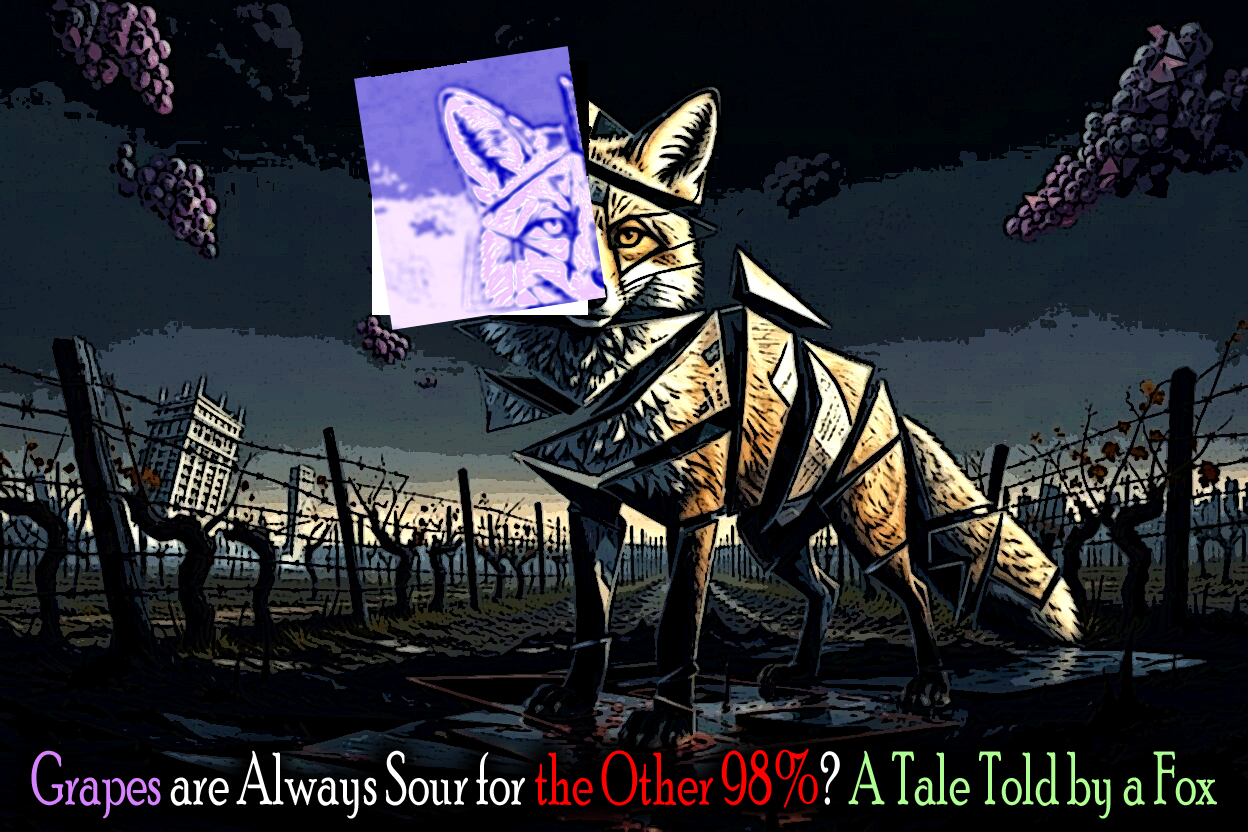
 Once in a Blue Moon Academia
1 Comment