

Posted on 16th February, 2026 (GMT 02:18 hrs)
ABSTRACT
This essay is a self-reflexive critique that interrogates the corporate deployment of sacred Indian ethical concepts—karuṇā (boundless compassion), sevā (embodied relational service), and samṛddhi (ethically conditioned flourishing)—within the assemblages of philanthro-capitalism, particularly through the Gandhi Foundation and CSR initiatives linked to Ajay Piramal. Drawing on Deleuze and Guattari’s schizoanalysis, it traces how these terms, deterritorialized from Buddhist, Bhakti, Gandhian, and epic traditions, are reterritorialized as branded values that legitimize accumulation while masking asymmetries of power, dispossession, and structural harm—most poignantly exemplified by the author’s lived experience of financial violence in the DHFL collapse. Through philological excavation, ontological reflection (via the Aupaniṣadika two-birds metaphor), and a Kafkaesque plea for coherence before the Supreme Court, the text demands philosophical vigilance: whether ethical rhetoric can coexist with praxis that disperses risk downward and concentrates prosperity upward, or if such invocation fractures the triad, reducing compassion to optics, service to branding, and prosperity to unchecked growth. Ultimately, it calls not for condemnation but for symmetry—where sacred words, once uttered, become answerable to those wounded by the very systems they adorn.
DISCLAIMER: This article presents a self-reflexive philosophical and ethical critique based on publicly available information, lived experience, independent reports, regulatory records, court judgments, and critical analyses. It is not intended as, nor should it be construed as, a legal accusation, finding of guilt, defamation, or statement of fact regarding any individual’s or entity’s criminality, liability, or wrongdoing. All references to allegations, probes, fines, violations, or court proceedings are drawn from documented sources and remain contested or sub-judice where applicable; no adjudication of guilt or liability is asserted or implied. The views expressed are offered in the spirit of philosophical inquiry, public interest discussion, and protected speech under Article 19(1)(a) of the Constitution of India. Readers are encouraged to consult primary sources and legal counsel for independent verification. Nothing herein is intended to prejudice any ongoing or future legal proceeding.
I. Introduction: Ontological Self, Ethics and Corporate Praxis…,A Schizoanalytic Prelude
There are moments when theory does not arrive through books but through a notification bar.
I was not conducting research when I encountered the words Karuna, Seva Bhava, and Samrddhi. I was browsing YouTube. An algorithm—capitalism’s most intimate confessional—offered me a corporate video from the Gandhi Foundation, a CSR initiative associated with Ajay Piramal. The screen glowed with familiar ethical vocabularies: compassion, service, prosperity. The aesthetic was serene; the music, restrained; the discourse, Gandhian. A moral tonality suffused the corporate image.
And yet, my own embodied memory interrupted the viewing.
I am not positioned here as a passive victim, nor as a bearer of grievance seeking rhetorical restitution. But I cannot disown that I inhabit a history shaped by financial violence—violence diffused through institutional networks–fincide, regulatory failures, and the opaque proximities of crony and nepo-capitalism in India. The DHFL collapse was not merely an economic event; it was an ontological event. It rearranged trust, destabilized temporal expectations, and fractured the coherence between labour and livelihood. It forced me to confront what Deleuze and Guattari call the axiomatic of capitalism: a system capable of absorbing crises while redistributing their costs onto dispersed, anonymized bodies.
Thus, when Karuna appeared on my screen—compassion as corporate value—it did not function as a neutral signifier. It resonated against the memory of dispossession. When Seva (or as “he” writes it: sewa?) Bhava was invoked—service as ethical orientation—I could not help but measure it against the asymmetries of power that structure Indian corporate–political entanglements. When Samrddhi was celebrated—prosperity as collective upliftment—I wondered: whose prosperity, and at what ontological cost?
I.A. Ajay Piramal is talking about Seva Bhava
I.B. Karuna Fellowship of Piramal’s Gandhi Foundation: Reflections of Awardees
I.C. Samruddhi: Empowering Women through Apprenticeship
This text emerges from that rupture between lived experience and corporate moral discourse.
Deleuze and Guattari, in their seminal works on Capitalism and Schizophrenia, describe capitalism as a system that deterritorializes and reterritorializes universes of desire. It liberates flows only to recode them within new regimes of control. In this context, ethical vocabulary becomes one such flow—detached from its historical, spiritual, and relational embeddedness, and reassembled within corporate praxis as CSR, branding, philanthro-capitalism. Gandhi, too, becomes deterritorialized: no longer a radical critic of industrial modernity but a floating signifier within corporate governance.
The ontological question, then, is not simply whether corporations are sincere. It is deeper:
What happens to the self when ethical ideals become commodified instruments within capital’s semiotic cum semantic machineries?
The “I” of this essay is not a sovereign individual asserting moral superiority. It is a fractured subject—produced within, wounded by, and yet critically entangled with the same capitalist assemblage it seeks to analyze. Deleuze and Guattari’s notion of the schizo is instructive here: not as pathology, but as a figure who reveals the cracks in capital’s coding by experiencing its contradictions at the level of desire and everyday life.
Browsing YouTube becomes a minor schizoanalytic event.
The corporate invocation of Karuna and the naming of a private residence as Karuna Sindhu do not merely signal branding choices. They stage an ethical aesthetic—one that sutures compassion to accumulation, service to surplus, prosperity to concentration of capital. This is not to deny philanthropic work; rather, it is to interrogate how ethical ideals circulate within corporate–political assemblages that have also been implicated in large-scale financial irregularities and regulatory opacity.
In contemporary India, where corporate power intersects with political sovereignty in increasingly intimate ways, CSR discourse functions as both moral shield and affective lubricant. It soothes public anxiety, produces legitimacy, and reterritorializes critique. It transforms structural violence into narratives of benevolence.
The ontological self—especially one marked by financial abuse—cannot remain untouched by this semiotic choreography.
This article therefore proceeds as a self-reflexive activist academic inquiry into three interwoven domains:
- Ontological Self – How financial dispossession reshapes subjectivity, trust, and ethical perception.
- Ethical Ideals – How concepts like Karuna, Seva, and Samrddhi are deterritorialized and reterritorialized within corporate praxis.
- Corporate Praxis – How CSR operates within the axiomatic of capitalism, particularly in contexts of crony entanglement.
Rather than offering a conventional empirical critique alone, this work inhabits the tension between lived injury and theoretical abstraction. It asks whether the corporate deployment of Gandhian language constitutes a form of ethical capture—what might be called compassion as capital.
If capitalism is a system that decodes and recodes flows, then this essay is an attempt to trace the coding of compassion itself. Not to purify it. Not to reclaim it sentimentally. But to examine the ontological dissonance produced when the language of service circulates alongside structures that generate dispossession.
The question is not whether corporations can do good. The question is:
What becomes of ethical ideals when they are embedded within assemblages that simultaneously produce harm?
And what becomes of the self who must watch, scroll, and live within that contradiction?
I.D. Metamorphosis of “I” to “S/he”
In this metamorphosis, I resists the tidy closure of simply becoming “she,” choosing instead the undecidable mark of “s/he”—a slash that holds open the tension, refusing finality or determination. The shift is not a clean replacement of one pronoun for another, but a deliberate suspension: the “s/” functions as a liminal crease, a Deleuzian plateau where gendered embodiments remain in unresolved interplay, beyond binary she or he, gesturing toward an ontological multiplicity that capitalism’s axiomatic cannot fully recode.
Here the self fractures not into pathology but into assemblage—desires, wounds, and flows entangled yet never wholly unified—where the eating bird (the reactive, embodied subject caught in market modernity’s poisoned fruits of promise and dispossession) coexists in perpetual dialectic with the witnessing bird (the luminous, spacious awareness that observes without being consumed by grievance). This draws from the Upaniṣadic vision of the two birds on the same tree—one tasting, one seeing—yet inflects it through contemporary feminist and postcolonial critiques of how gendered asymmetries are reproduced within crony-capitalist networks of power and extraction. The transformation stays undetermined, always interweaving she, he, and the beyond of the slash, mirroring our central dissonance: the ethical signifiers karuṇā, sevā, and samṛddhi, once deterritorialized from their spiritual and philosophical roots, circulate as floating intensities—never fully reterritorialized into corporate discourse, perpetually hovering in a space of critique without closure, activism without dogma, and witnessing without detachment. I write from this liminal position, neither fully absorbed into the wound nor detached from it, holding the tension as the very condition of philosophical vigilance.
Until now, “I” appeared as the one browsing, remembering, researching, trembling between text and lived wound. But there is another register — a witnessing presence. Not detached in cold neutrality, but lucid. Not dissociated, but spacious.
There was a time when I spoke directly. I was the one wronged. I was the one who watched savings dissolve, who read about mergers, write-offs, regulatory silence. I tasted the metallic aftertaste of a money-centric world — a market that speaks in abstractions while extracting in particulars. The fracture was existential: in a world where prosperity is quantified and suffering privatized, money became ontology.
Then something subtle happened. I began to watch myself. Not in denial, not in repression, but as if another dimension of awareness had quietly stepped forward. On the tree of market modernity, one bird was frantic — calculating, fearing, reacting. That bird was me. The other — silent, luminous, unconsumed by fruit — began to observe. And in that seeing, “I” began to shift.
S/he emerged.
S/he is the one navigating the money-centric world. S/he is wounded by crony alignments and opaque restructurings. S/he feels the irony when Samṛddhi is celebrated amidst dispossession. S/he remembers the ślokas, tastes the sweetness of childhood learning, the bitterness of collapse, the sting of systemic injustice. S/he interrogates Karuṇā, Sevā, Samṛddhi in corporate discourse.
I watch her now. This is not dissociation. It is liminality. S/he stands at a threshold — between participation and critique, anger and clarity, activist impulse and contemplative witnessing. The threshold is narrow. On one side lies absorption into grievance; on the other, cynical detachment. S/he crosses neither fully, pausing in the liminal space.
A song rises:
Step out of yourself, and stand in the open air,
Feel the world’s echo rising deep within your chest.
Let this mighty wave inside you sway and dance,
And stir every heart with its unbridled zest.
O bee, alight upon this boundless sky,
Bathed in the golden dust of dawn’s first ray.
Where endless freedom spreads its wings so high,
Among all beings, you will find your way.
The bee leaves the flower and enters the sky. The self steps out of itself. The Muṇḍaka Upaniṣad reveals itself not as metaphysics, but lived structure:
dvā suparṇā sayujā sakhāyā samānaṃ vṛkṣaṃ pariṣasvajāte
tayor anyaḥ pippalaṃ svādv atti anaśnann anyo abhicākaśīti
Two birds, united companions, cling to the same tree. One eats the sweet fruit. The other looks on without eating. The tree is life. The fruit is experience — sweet, bitter, intoxicating. The bird that eats is the embodied self — wounded, hopeful, reactive, interpreting. The bird that watches is the witness — sākṣī-caitanya — untouched, luminous, aware.
S/he is the eating bird. S/he tastes the bitter fruit with pesticide of market promise, the sweetness of prosperity, the bitterness of collapse, the irony of corporate consiousness. I am the witnessing bird. Not superior, not indifferent, simply aware. I see her analysis without collapsing into victimhood. I see the architecture of harm without absolution.
The two birds remain together. One acts. One sees. Without the eating bird, compassion has no flesh. Without the witnessing bird, growth has no boundary. Standing in the open air, between fruit and sky, s/he speaks — and I remain free.
The crossing, the passage….. has begun.
II. Searching for Meanings
II.A. करुणा (Karuṇā) – Real-ly?
S/he pauses the video.
The word lingers on the screen: Karuna. Not as abstraction, not as theory—first as sound. A sound s/he had heard long before s/he encountered balance sheets, investigative reports, or scholarly works on capitalism as essentially illiterate. A sound from childhood mornings.
Almost involuntarily, a śloka rises from memory:
हे कृष्ण करुणा-सिंधु, दीन-बन्धु जगत्पते।
गोपेश गोपिकाकान्त, राधाकान्त नमोस्तुते॥
O Krishna, ocean of compassion, friend of the humble, Lord of the universe;
Lord of the cowherds, beloved of the gopīs, beloved of Rādhā, I bow to you.
Karunā-sindhu — ocean of compassion.
The corporate residence named Karuna Sindhu suddenly acquires another register. What does it mean to name a private mansion “Ocean of Compassion”? Is it homage? Is it aesthetic preference? Is it symbolic capital? Or is it something more subtle: the reterritorialization of a sacred semantic field into a private architectural enclosure?
S/he begins to search—not as an academic at first, but as someone unsettled by the friction between memory and media. What is karuṇā?
In the Buddha’s teaching, s/he finds, karuṇā is not sentimental softness. It is not the downward glance of pity. It is not philanthropy performed before cameras. Karuṇā is the trembling of the heart in response to duhkha—the pervasive unsatisfactoriness woven into existence. It is the sincere wish: May all beings be free from suffering and the causes of suffering.
In the Dīgha Nikāya (Tevijja Sutta), the Buddha describes one who “abides pervading one direction with a mind imbued with compassion… thus above, below, around, everywhere… vast, exalted, immeasurable, without hostility and without ill will.” The word appamāṇa—immeasurable—appears repeatedly. Compassion here is not targeted, not strategic, not selective. It is boundless.
In the Majjhima Nikāya, the same structural formula recurs: compassion radiates without hostility (avera) and without ill-will (abyāpajjha). In the Aṅguttara Nikāya, karuṇā is explicitly called a ceto-vimutti—a liberation of mind. It is not merely an ethical duty; it is a mode of freedom.
And in the Saṃyutta Nikāya, seeing beings afflicted and oppressed, “the Tathāgata arouses compassion for them.” Compassion arises not from hierarchy but from recognition of shared vulnerability.
S/he notices something crucial: in early Buddhism, karuṇā is inseparable from insight. It is grounded in understanding anicca (impermanence) and anattā (non-self). Because there is no fixed, separate self, the boundary between “my suffering” and “your suffering” becomes porous. Compassion is wisdom in action. It is not overwhelmed grief; it is lucid solidarity.
The later Visuddhimagga sharpens the definition: compassion has the characteristic of promoting the removal of others’ suffering; its function is non-cruelty; its proximate cause is seeing helplessness in those afflicted. It is steady. It does not drown.
And then Mahāyāna intensifies the current. Karuṇā becomes mahākaruṇā—Great Compassion—the defining mark of the Bodhisattva. Śāntideva writes in the Bodhicaryāvatāra: “Regarding all the suffering of beings as one’s own suffering—that is compassion in the Mahāyāna.” Compassion here is existential solidarity. The Vimalakīrti Nirdeśa Sūtra declares: “Because beings are sick, the Bodhisattva is sick.” Compassion is not external assistance; it is co-suffering grounded in emptiness (śūnyatā). Prajñā without karuṇā is bondage; karuṇā without prajñā is bondage.
S/he sits back.
This is not the vocabulary of CSR brochures.
S/he turns then to other traditions. In the Manusmṛti, s/he finds not karuṇā but dayā: “dayā bhūteṣu”—compassion toward beings. Here compassion appears within a constellation of virtues tied to social order—ahiṃsā, truthfulness, restraint. It is ethical, but socially framed. It operates within varṇāśrama dharma, not as a metaphysical universalism.
In the Arthaśāstra, compassion is even more restrained. Kauṭilya advises the king that his happiness lies in the happiness of his subjects—“prajāsukhe sukhaṃ rājñaḥ.” The ruler must avoid excessive cruelty. But compassion here is prudential, instrumental, subordinate to stability and danda (punishment). It serves governance. It is not immeasurable; it is calculated.
In the Mahābhārata, especially the Śānti Parva, compassion rises again toward cosmic principle: “ahiṃsā paramo dharmaḥ”—non-violence is the supreme dharma; “dayā sarvabhūteṣu”—compassion toward all beings. The epic oscillates between realism and transcendence.
In Patañjali’s Yoga Sūtra, karuṇā reappears explicitly: “maitrī-karuṇā-muditā-upekṣāṇāṁ…”—friendliness toward the happy, compassion toward the suffering, joy toward the virtuous, equanimity toward the non-virtuous. Here compassion functions as psychological discipline, a method of mental clarification (citta-prasādanam). It is cultivated not as metaphysical doctrine but as inner technology.
In Jainism, though the lexeme may be ahiṃsā rather than karuṇā, compassion becomes radical. Non-violence extends to microorganisms. Ethical discipline becomes uncompromising.
In Bhakti Vedānta, compassion becomes divine attribute. God is karuṇāmaya—full of compassion. The devotee imitates divine grace. The śloka from childhood—“karuṇā-sindhu”—belongs to this devotional universe.
S/he notices a philological drift.
Karuṇā in early Sanskrit carried the sense of sorrowful tone, lamentation, even aesthetic pathos—karuṇa rasa in the Nāṭyaśāstra. Over centuries, it migrates. From lamentation to ethical tenderness, from aesthetic emotion to meditative practice, from psychological discipline to cosmic salvific force. Buddhism performs a decisive semantic revolution: karuṇā becomes boundless, immeasurable, ontologically grounded in non-self.
Dayā, by contrast, suggests mercy, gentleness, moral softness. It does not necessarily presuppose existential trembling. It is embedded in law and order.
Karuṇā becomes existential compassion.
Dayā remains ethical mercy.
And now the word appears in a corporate CSR video.
S/he feels the dissonance not because corporations cannot help people, but because of the ontological weight the word carries in her own memory and in these traditions. Karuṇā, in its Buddhist inflection, is liberation of mind. It is non-cruelty. It is immeasurable. It is without hostility, without ill-will. It is solidarity grounded in insight into suffering’s universality.
What does it mean when such a word circulates within an assemblage implicated in financial collapse, regulatory compromise, and political proximity? What does it mean when “Karuna” becomes brand identity, and “Karuna Sindhu” names private property?
One might peak of capitalism’s capacity to decode and recode flows. Words are flows. Desire is a flow — not mere lack, but production and re-production. Sacred vocabulary can be deterritorialized from monasteries, texts, and meditation halls, and reterritorialized within corporate semiotics. The signifier floats. Its ontological depth is not denied; it is refunctionalized.
S/he does not accuse. S/he observes.
In Buddhism, compassion arises from seeing beings afflicted and oppressed. It is inseparable from recognizing dukkha. In her own life, financial dispossession was not abstract. It rearranged trust, altered the rhythm of days, destabilized expectations. If karuṇā means promoting the removal of others’ suffering, what is the ethical status of compassion when those very assemblages participate—directly or indirectly—in structures that generate suffering?
Is corporate karuṇā appamāṇa—immeasurable, without hostility? Or is it measurable, budgeted, audited, publicized?
Is it liberation of mind—or management of reputation?
The childhood prayer echoes differently now. “O Krishna, ocean of compassion…” The ocean cannot be enclosed. It cannot be owned. It cannot be trademarked.
S/he realizes that what unsettles her is not the use of the word, but its ontological contraction. A term that once denoted boundless, wisdom-infused solidarity risks becoming an affective resource within capital’s branding apparatus.
And yet, s/he must be careful.
For in Mahāyāna, compassion extends even toward the wrongdoer. Hatred is never overcome by hatred. If karuṇā is truly immeasurable, it must include even those entangled in systems of accumulation and power. The question, then, is not moral condemnation. It is philosophical clarity.
What happens to ethical ideals when they migrate from existential insight to corporate praxis? What happens to the self who witnesses this migration—not as detached scholar, but as someone whose life was materially altered by the same economic networks?
The YouTube video ends. The algorithm queues another.
But something has shifted. The word karuṇā no longer floats innocently across the screen. It carries Vedic lament, epic dharma, Yogic discipline, Buddhist liberation, Mahāyāna solidarity, Bhakti devotion—and now corporate signification.
Between these layers stands the ontological self, neither pure victim nor pure theorist, asking whether compassion can survive its translation into capital’s language—or whether this very tension reveals the schizophrenic heart of contemporary capitalism: able to speak the language of boundless compassion while operating through calculated accumulation.
The inquiry has begun, yet again, with lapses in between.
II.B. सेवा (Sevā) – Hardly!
The screen does not stop at Karuna. It moves, almost seamlessly, to another word: Seva.
S/he feels an immediate shift in register. If karuṇā trembles in the chest, sevā moves the hands.
The word is older than its current corporate sheen. It derives from the Sanskrit verbal root √सेव् (sev), a verb whose semantic range is strikingly concrete: to attend to, to serve, to associate with, to honor, to practice, to resort to. In classical usage, sevā does not first name an emotion. It names conduct. It presupposes a relation. Someone serves; something or someone is served. The grammar is already structured: subject, object, orientation.
Unlike karuṇā, which can arise in solitude as boundless compassion toward all beings, sevā is irreducibly relational and embodied. It implies attentive attendance. It suggests discipline. It evokes the image of proximity—standing near, waiting upon, practicing, cultivating.
In classical Sanskrit one encounters familiar compounds: guru-sevā—service to the teacher; rāja-sevā—service to the king. Here sevā carries the weight of duty. It belongs to order. It belongs to hierarchy.
S/he begins tracing its textual life.
In early Brahmanical contexts, sevā frequently indicates attendance upon ritual, sacred fire, elders. It does not yet possess universal humanitarian overtones. Service is structured by dharma—by role, by lineage, by obligation. To serve is to fulfill one’s prescribed function.
The Manusmṛti renders this explicit. In the section on student life (2.121), service to the teacher—guroḥ sevā—is not optional; it is constitutive of discipline. Service here shapes character through submission. It is pedagogical obedience.
More starkly, in Manusmṛti 1.91, social stratification enters the term:
एकमेव तु शूद्रस्य प्रभुः कर्म समादिशत् ।
एतेषामेव वर्णानां शुश्रूषामनसूयया ॥
“The Lord prescribed only one occupation for the Śūdra:
service (śuśrūṣā) to the other varṇas, without resentment.”
Here sevā—or its cognate śuśrūṣā—is institutionalized within varna hierarchy. It is not universal altruism. It is socially stratified obligation. Service flows upward.
S/he feels a tightening. The word that now appears in philanthropic videos once encoded structural asymmetry. Service as destiny. Service as caste-bound duty.
In Kauṭilya’s Arthaśāstra, the semantic field shifts but does not dissolve hierarchy. Service becomes administrative loyalty. To serve is to align oneself with the king, the state, the machinery of governance. Political service is pragmatic, contractual. The text advises rulers on managing ministers and servants; the emotional dimension is peripheral. What matters is reliability, utility, order. Sevā becomes instrument within statecraft.
In the Mahābhārata, service again appears in relational constellations—toward elders, teachers, parents, kings. Loyalty and obedience form the ethical backbone of epic life. The universalization of service to all beings is not central; contextual dharma prevails. To serve rightly is to know one’s place within cosmic and social order.
Up to this point, sevā remains embedded in hierarchy.
Then something happens in the Bhakti movements.
In the Bhāgavata Purāṇa (7.5.23), among the celebrated nine forms of devotion appears pāda-sevanam—serving the feet of Viṣṇu:
श्रवणं कीर्तनं विष्णोः स्मरणं पादसेवनम्…
“Hearing of Viṣṇu, singing of Him, remembering Him, serving His feet…”
Here service is transfigured. It is no longer merely compliance within social order. It becomes loving participation. To serve God is not humiliation but intimacy. Sevā becomes self-surrender, an offering of action infused with devotion. Hierarchy remains—God and devotee—but it is interiorized and suffused with love. Service becomes a path to liberation.
The transformation is profound: what was once socially stratified duty becomes spiritualized action. Sevā is no longer simply obedience; it is bhakti embodied.
The Sikh tradition radicalizes this further. In Sikhism, sevā becomes selfless service to the community, grounded in the equality of all before the Divine. The institution of langar—the community kitchen—materializes sevā as egalitarian practice. To cook, to clean, to serve food irrespective of caste or status becomes spiritual discipline. Service to humanity is service to God. Hierarchy dissolves into shared labor.
Here sevā sheds its earlier caste-binding constraints and becomes ethical universalism enacted through collective action.
In the twentieth century, Gandhi retrieves and reworks the term once more. Sevā becomes service to the poor—Daridra Nārāyaṇa. It is not mere charity; it is civic spirituality. Political action itself becomes sevā when oriented toward upliftment of the marginalized. Service becomes nation-building, ethical reconstruction.
S/he sits with the arc.
From Vedic attendance to Dharmaśāstric hierarchy; from political loyalty in the Arthaśāstra to devotional surrender in Bhakti; from egalitarian community service in Sikhism to Gandhian civic ethics—sevā travels. Its semantic body expands.
And yet, something remains constant: sevā is action-oriented. It is embodied. It asks not “What do you feel?” but “What do you do?” It always implies relational asymmetry of some kind—even if that asymmetry is transformed into mutuality.
Philosophically, s/he notes the difference… the differance.
Karuṇā whispers: May you be free from suffering.
Sevā asks: How shall I act toward you?
One is interior disposition; the other is enacted orientation.
One may possess compassion without serving. One may serve without compassion.
Their convergence is not guaranteed.
When the corporate video invokes Seva Bhava—the spirit of service—s/he feels the layers beneath the word. Does this sevā resemble guroḥ sevā—obedience within structure? Does it echo śuśrūṣā—service tied to hierarchy? Is it administrative loyalty in the mode of the Arthaśāstra? Or does it aspire to Bhakti’s loving surrender, Sikh egalitarianism, Gandhian civic reconstruction?
The phrase “Seva Bhava” suggests interiorization: service as attitude. Yet historically, sevā has always been about practice. Attendance. Labour. Discipline. Association.
S/he cannot ignore the structural question. In early Dharmaśāstric formulations, sevā reinforced hierarchy. In contemporary corporate praxis, does “service” function similarly—masking asymmetry beneath rhetoric of care? When corporations speak of serving communities, is the direction of service symmetrical? Or does it coexist with systems that extract value upward?
Deleuze and Guattari speak of assemblages that capture flows of desire and rearticulate them within capital’s axiomatic. Sevā, once devotional surrender or egalitarian labour’s performance, may now circulate as managerial ethos. “We serve society.” The language soothes. It promises humility. It projects benevolence.
But sevā, philologically, is never abstract goodwill. It is disciplined, embodied relation. It presupposes accountability. It implies presence. To serve is to attend continuously, not episodically.
S/he feels the tension between historical depth and contemporary deployment. The word carries Manusmṛti’s stratifications, Bhakti’s surrender, Sikhism’s equality, Gandhi’s activism. It carries the possibility of reinforcing structure and the possibility of dismantling it.
In her own life, financial dispossession did not feel like being served. It felt like being processed within systems beyond her reach. If sevā means attentive attendance, who attended to the afflicted depositors? If sevā means practical assistance, where was the sustained proximity to those rendered vulnerable?
Yet s/he must resist simplification. The same tradition that once bound sevā to hierarchy also allowed it to blossom into radical equality. The word is not guilty by genealogy. It is polyphonic.
Still, s/he cannot ignore the asymmetry embedded in its grammar. Sevā always orients one toward another. The crucial question is: in contemporary corporate invocation, who serves whom? And under what conditions?
If karuṇā is boundless compassion grounded in insight into suffering, sevā is embodied relational action. When corporations invoke both—Karuna and Seva—they claim interior compassion and exterior service. They claim ethical fullness.
Her inquiry deepens.
For if capitalism deterritorializes and reterritorializes flows of overlapping desire-machines and universes, then sevā too may be captured—transformed from devotional surrender or egalitarian labor into brand identity, from disciplined attendance into strategic outreach.
S/he watches the video again.
The word Sevā glides across the screen. It is clean. It is polished. It is accompanied by images of smiling beneficiaries. But behind the word stand centuries of semantic sediment—obedience, loyalty, devotion, equality, activism.
Sevā is not innocent. Nor is it reducible.
It is action. It is relation. It is discipline. It is love. It is hierarchy. It is resistance.
And now, it is corporate vocabulary.
Between these layers, the ontological self stands again—neither naïve nor cynical—asking whether service can survive its migration into capital’s lexicon, or whether this too reveals the schizophrenic condition of a system that speaks the language of surrender while consolidating power.
The word remains. The question remains.
II.C. समृद्धि (Samṛddhi) – Seriously?
The third word appears almost inevitably: Samṛddhi.
If karuṇā trembles in the heart and sevā moves the body toward another, samṛddhi expands outward. It swells. It accumulates.
Philologically, the word is transparent yet powerful. Samṛddhi (समृद्धि) arises from the prefix sam—together, fully, completely—and the verbal root √ऋध् (ṛdh), meaning to grow, to prosper, to increase, to succeed. The word carries the sense of full growth, complete flourishing, abundance, thriving. It suggests expansion that has reached fulfillment. Not merely growth, but accomplished growth.
Unlike karuṇā, which belongs to the semantic field of suffering and compassion, or sevā, which belongs to conduct and relational duty, samṛddhi inhabits the domain of prosperity. It names increase. It names success. It names thriving—material, social, collective.
S/he senses immediately that this word will be the most dangerous of the three.
In the Vedic world, cognates of √ऋध् appear in hymns that celebrate increase—of cattle, of grain, of progeny, of ritual efficacy. Prosperity is agrarian, communal, woven into cosmic order (ṛta). To flourish is to be aligned with the rhythm of sacrifice and season. Abundance of cattle, fertility of land, success of ritual—these are signs of harmony between human and cosmic law.
There is no inherent suspicion of prosperity here. Growth is blessing. Increase is auspicious. Samṛddhi is collective well-being secured through right ritual participation in the cosmos.
As s/he moves into the Dharmaśāstra literature, especially the Manusmṛti, prosperity becomes morally conditioned. Samṛddhi is linked to proper observance of dharma. Righteous conduct yields āyuḥ (long life), kīrti (fame), and samṛddhi (prosperity). Growth is not random; it is reward. It is the fruit of conformity to social and ritual order.
But this prosperity is structured. It is not universal flourishing. It is mediated by varṇa-āśrama hierarchy. Samṛddhi here is dharma-dependent and socially distributed. Prosperity is legitimate—but not egalitarian.
In the Arthaśāstra, something shifts decisively. Prosperity becomes administrative. Kauṭilya speaks of yogakṣema—acquisition and security—of treasury (kośa), of growth (vṛddhi), of agricultural productivity, trade expansion, military strength. The king’s happiness lies in the happiness of his subjects—“prajāsukhe sukhaṃ rājñaḥ”—yet this is not sentiment; it is political realism. A prosperous populace strengthens the state.
Samṛddhi here is calculable. It is measurable. It is strategic. Revenue, trade, surplus—these become instruments of statecraft. Prosperity is no longer simply agrarian blessing; it is economic policy.
S/he feels the resonance with contemporary language. Growth metrics. Development indices. Fiscal expansion. GDP!!??!!
In the Mahābhārata, prosperity appears with ambivalence. Wealth is desirable; kingdoms thrive; abundance is celebrated. Yet the epic also narrates repeatedly how attachment to prosperity breeds downfall. The Śānti Parva subordinates wealth to dharma. Prosperity without righteousness destabilizes order. Samṛddhi becomes morally fragile.
The classical framework of puruṣārthas—dharma, artha, kāma, mokṣa—situates prosperity largely within artha. Material well-being is legitimate. It is a human aim. But it is not ultimate. It must remain subordinate to dharma and, ultimately, to mokṣa. Samṛddhi is real, but it is penultimate.
In Advaita Vedānta, the relativization intensifies. Material prosperity belongs to the realm of the impermanent (anitya). It is provisionally real within empirical existence but ultimately sublated in the knowledge of Brahman. True fulfillment is not accumulation but realization. Samṛddhi becomes ontologically downgraded—functional, but not final.
Buddhism further displaces it. The Buddha does not centralize prosperity as an ultimate value. Wealth is acknowledged; right livelihood is emphasized; generosity (dāna) is praised. But attachment to growth, to accumulation, to possession is recognized as rooted in lobha (greed). Prosperity is ethically neutral at best, spiritually secondary. What matters is liberation from craving, not expansion of assets.
Jainism is even more austere. Accumulation intensifies karmic entanglement. The ideal is aparigraha—non-possession. Samṛddhi, in material terms, becomes spiritually risky. Flourishing in the worldly sense may impede liberation.
Bhakti traditions reinterpret prosperity once again. Lakṣmī symbolizes abundance; divine grace manifests as flourishing. Yet the highest prosperity is devotion itself. The devotee may receive material abundance, but true samṛddhi is intimacy with God. Wealth becomes sign, not substance.
And then modernity-as-(neo)coloniality intervenes.
In contemporary political discourse, samṛddhi becomes development—GDP growth, infrastructure expansion, national strength, welfare schemes, market capitalization. The word migrates from ritual and dharma into economics and governance. It becomes secularized. It becomes quantified.
S/he notices the arc.
In the so-called constructs of the Vedic world, prosperity is agrarian abundance aligned with cosmic order.
In Dharmaśāstra, it is reward for righteousness within hierarchy.
In the Arthaśāstra, it becomes economic strategy.
In epic thought, it is morally unstable.
In Vedānta, it is ontologically relativized.
In Buddhism and Jainism, it is spiritually secondary or suspect.
In Bhakti, it is re-spiritualized.
In modern state discourse, it is economized.
Samṛddhi has always been about growth—but growth defined differently in each epoch.
S/he returns to the corporate video.
“Samrddhi” appears as promise—community upliftment, economic empowerment, sustainable development. The word glows with positivity. Who can oppose prosperity? Who can object to flourishing?
Yet philologically, samṛddhi has never been innocent expansion. It has always been tethered to a framework: cosmic order, dharma, statecraft, renunciation, devotion. Growth without ethical anchoring has repeatedly been treated as dangerous.
In the Arthaśāstra, prosperity is calculable and strategic. In modern capitalism, growth is similarly calculable—revenue, valuation, market share. But the older traditions insisted that samṛddhi be subordinated—either to dharma, to mokṣa, or to non-attachment.
What happens when growth becomes autonomous? When it is no longer subordinated to ethical or spiritual horizons, but becomes horizon itself?
In late capitalism, growth becomes an unrelenting imperative, not a choice. The system unleashes and redirects flows of money, labor, energy, and desire into ceaseless expansion. Prosperity—once samṛddhi, a bounded flourishing aligned with dharma, cosmic harmony, or liberation—detaches from any higher limit or purpose. It turns autonomous: increase for increase’s sake, accumulation without restraint or transcendence. What classical thought held as conditional and ethically tethered now risks endless extraction and concentration, measured only by valuation and surplus, indifferent to finitude, redistribution, or the reduction of suffering. Samṛddhi, stripped of its anchors, becomes motion without rest, growth without return to wholeness.
S/he thinks of √ऋध्—“to grow.” Growth is natural. Plants grow. Children grow. Societies grow. But unbounded growth in a finite ecology becomes extraction. When does samṛddhi turn into excess?
In classical Indian thought, prosperity was rarely ultimate. It was legitimate, but bounded. In modern corporate rhetoric, prosperity is often presented as self-justifying. Growth for growth’s sake.
Her own experience complicates the word further. Financial collapse revealed the fragility of prosperity. Wealth can evaporate. Institutions can fail. Growth can conceal instability. Samṛddhi can be a mirage.
Yet s/he resists cynicism. Prosperity for marginalized communities is real and necessary. Material well-being matters. Poverty romanticized is cruelty. The question is not whether samṛddhi is desirable, but what kind of growth is being invoked—and at whose cost.
If karuṇā is boundless compassion and sevā embodied service, samṛddhi is expansion. But expansion of what? Capital? Human capability? Collective dignity? Shareholder value? Ecological resilience?
Piramal Empire’s corporate triad—Karuna, Seva, Samrddhi—now appears structurally coherent. Compassion legitimizes. Service operationalizes. Prosperity justifies outcome.
But in the older traditions, each of these terms carried constraints. Compassion required non-cruelty and insight. Service demanded disciplined presence and often self-effacement. Prosperity was subordinated to dharma or liberation.
S/he senses that the tension in her own life emerges here: when samṛddhi is proclaimed while others absorb loss, when growth narratives coexist with dispossession, when prosperity is celebrated without transparent accountability.
Samṛddhi, philologically, is full flourishing. But flourishing for whom? And according to what measure?
The word expands across centuries and lands now in a CSR brochure. It carries Vedic cattle, Kauṭilya’s treasury, Lakṣmī’s grace, GDP statistics, and stock market indices. It carries both agrarian blessing and speculative abstraction.
Between these layers stands the ontological self again—neither rejecting growth nor worshipping it—asking whether prosperity can remain ethically tethered in a system structurally driven toward accumulation.
If karuṇā risks sentimental capture and sevā risks hierarchical masking, samṛddhi risks becoming the unquestioned telos.
And perhaps this is the deepest question: in an age where growth has become ideology, can samṛddhi be rethought not as expansion of capital, but as expansion of shared well-being—without reproducing the very asymmetries it claims to transcend?
The word lingers.
Growth.
Increase.
Fullness.
S/he watches it glow on the screen, and wonders what it costs to make prosperity speak the language of virtue.
II.D. Synthesis of the Triad? Karuna, Seva. Samṛddhi
Now the three words stand together.
Karuna.
Seva.
Samṛddhi.
They no longer appear as isolated corporate values. They form a conceptual triad—an ethical architecture. Compassion, service, prosperity. Suffering, relation, growth.
And yet, historically, they do not belong to the same semantic stratum.
Karuṇā addresses suffering. It emerges from the recognition of dukkha. In its Buddhist articulation, it carries profound ontological depth. It is immeasurable (appamāṇa), without hostility (avera), without ill-will (abyāpajjha). It is liberation of mind (ceto-vimutti). Its horizon is universal. It does not require hierarchy; it dissolves it in the insight of non-self.
Sevā addresses relational obligation. It is action-oriented, embodied, structured. It presupposes asymmetry—a subject who serves, an object who is served. In its early Brahmanical forms, it reinforces hierarchy. In Bhakti and Sikh traditions, it becomes loving surrender and egalitarian practice. Its ontological depth varies. It can be devotional, political, civic—but it remains relational and performative.
Samṛddhi addresses growth. It belongs to the economic and social domain. It signifies increase, expansion, fullness. Its ontological depth is historically unstable. In Vedic thought, it aligns with cosmic order. In Dharmaśāstra, it is reward for righteousness. In the Arthaśāstra, it becomes strategic and calculable. In Vedānta, it is relativized. In Buddhism and Jainism, it is spiritually secondary. In modernity, it is economized.
Placed side by side, the philosophical distinction becomes clearer.
Karuṇā asks: How do we respond to suffering?
Sevā asks: How do we orient ourselves in action toward others?
Samṛddhi asks: How do we define and pursue flourishing?
Karuṇā reduces suffering.
Samṛddhi increases abundance.
Sevā mediates between the two through embodied relation.
The tension emerges precisely here: what if the increase of abundance produces suffering? What if growth generates dispossession? What if samṛddhi and karuṇā diverge?
This tension is not modern. It runs quietly through Indian political and ethical thought.
In the so-called Vedic period, prosperity is collective agrarian flourishing. Growth does not yet appear antagonistic to compassion; it is embedded in cosmic reciprocity.
In Dharmaśāstra, prosperity is conditioned by order. Flourishing depends on structured hierarchy. Compassion exists, but within stratified frameworks.
In the Arthaśāstra, samṛddhi becomes state-managed expansion. The ruler’s prosperity is tied to the subjects’ prosperity—“prajāsukhe sukhaṃ rājñaḥ.” Yet growth is administratively pursued, sometimes through coercive means. Compassion is subordinated to stability.
In the epic imagination of the Mahābhārata, wealth is morally ambivalent. It sustains kingdoms but also incites war. The Śānti Parva repeatedly warns that dharma must govern artha.
Vedānta relativizes prosperity altogether; true fulfillment lies beyond material expansion. Buddhism and Jainism decenter it radically; attachment to growth perpetuates suffering.
Modernity/coloniality severs prosperity from metaphysical constraint and recodes it as development. GDP replaces dharma. Expansion becomes normative.
The triad—karuṇā, sevā, samṛddhi—thus contains an internal fault line.
Growth might potentially coexist with compassion. But it can also conflict with it.
When samṛddhi is pursued without karuṇā, it risks cruelty.
When karuṇā exists without sevā, it risks passivity.
When sevā operates without karuṇā, it risks paternalism.
When samṛddhi expands without dharmic restraint, it risks exploitation.
This philosophical tension finds a luminous dramatization in the Vana Parva of the Mahābhārata—in the dialogue between Yudhiṣṭhira and the Yakṣa.
The scene is stark. His brothers lie lifeless by the lake. The Yakṣa poses riddles. Knowledge becomes the condition of survival.
Among the questions, Yudhiṣṭhira identifies anṛśaṃsya—non-cruelty, compassion—as the highest virtue. Karuṇā, though not always named as such, is elevated above mere ritual correctness. Compassion surpasses technical righteousness.
When granted the power to revive only one brother, he chooses Nakula—the son of his stepmother Mādrī—rather than Bhīma or Arjuna, whose martial strength would be strategically advantageous. His reasoning is subtle: just as Kuntī (his birth mother) has one surviving son (himself), so too should Mādrī. Justice must be balanced. Compassion is not sentiment; it is fairness extended across relational asymmetry.
Karuṇā here interrupts strategic calculation. It overrides political expediency. It redistributes life to preserve equity.
The Yakṣa also asks how one becomes wise. Yudhiṣṭhira answers: through vṛddha-sevayā—by serving the elders. Wisdom arises from service. Sevā becomes epistemological discipline. One does not accumulate knowledge through conquest but through relational humility.
And when questions turn to wealth and profit, the dialogue subtly reframes prosperity. True gain is that which is obtained through dharma. Samṛddhi detached from righteousness is hollow.
In this episode, the triad converges.
Compassion governs decision.
Service cultivates wisdom.
Prosperity is subordinated to dharma.
The Mahābhārata does not abolish growth. It conditions it.
S/he reflects on the corporate invocation once more.
Karuna. Seva. Samrddhi.
When placed together, they appear harmonious. Compassion motivates service; service produces prosperity; prosperity enables further compassion. It is a virtuous circle—at least rhetorically.
But history warns that the circle can fracture.
Kauṭilya reminds us that prosperity can become administrative calculation. The Dharmaśāstras remind us that service can reinforce hierarchy. Buddhism reminds us that compassion must be boundless and free of hostility. Jainism warns that accumulation entangles. Vedānta reminds us that prosperity is impermanent.
The Yakṣa episode reminds us that compassion must sometimes override strategic gain.
The Yakṣa–Yudhiṣṭhira Saṃvāda in the Vana Parva (Mahābhārata, Book 3, chapters 312–313 in critical edition numbering) does not explicitly systematize “karuṇā–sevā–samṛddhi” as a triad. Yet the ethical architecture is unmistakably present in the questions and answers. If we are to think seriously about this triad within Indian political philosophy, we must return to the lake where the dialogue unfolds.
II.E. Karuṇā / Anṛśaṃsya — Compassion as Supreme Dharma
When the Yakṣa asks Yudhiṣṭhira:
कः धर्मः परमः लोके?
Kaḥ dharmaḥ paramaḥ loke?
“What is the highest dharma in the world?”
Yudhiṣṭhira replies:
अनृशंस्यं परो धर्मः
Anṛśaṃsyaṃ paro dharmaḥ.
“Non-cruelty (compassionate non-harm) is the highest dharma.”
Here the word is not karuṇā but anṛśaṃsya—non-cruelty, the refusal to injure. Yet conceptually, it occupies the same ethical register as karuṇā. It is not sentimental compassion but principled refusal to cause suffering.
This becomes existentially enacted when the Yakṣa offers him a choice: revive one brother only.
Yudhiṣṭhira chooses Nakula.
When questioned why he did not choose the more strategically valuable Bhīma or Arjuna, he answers:
कुन्ती च माद्री च मम मातरौ समे।
कुन्त्याः जीवाम्यहं पुत्रो माद्र्याः स्यात् पुनरप्ययम्॥
Kuntī ca Mādrī ca mama mātarau same.
Kuntyāḥ jīvāmy ahaṃ putro Mādryāḥ syāt punar apy ayam.
“Kuntī and Mādrī are equally my mothers.
As I live as Kuntī’s son, let this (Nakula) live as Mādrī’s son.”
This is not strategic reasoning. It is ethical symmetry grounded in compassion and fairness. Karuṇā here interrupts utilitarian calculus. Prosperity of power (reviving the strongest warrior) is subordinated to justice between mothers.
In this moment, karuṇā governs samṛddhi.
II.F. Sevā — Service as the Path to Wisdom
In another exchange, the Yakṣa asks:
किंस्विद् गुरुतरं भूमेः?
Kiṃ svid gurutaraṃ bhūmeḥ?
“What is heavier than the earth?”
Yudhiṣṭhira responds:
माता गुरुतरा भूमेः
Mātā gurutarā bhūmeḥ.
“The mother is heavier than the earth.”
The dialogue repeatedly elevates relational duty over abstraction. Most directly relevant to sevā is the well-known response concerning wisdom:
When asked how one becomes wise, Yudhiṣṭhira replies:
वृद्धसेवया बुद्धिः
Vṛddha-sevayā buddhiḥ.
“By serving the elders, wisdom arises.”
This statement crystallizes the semantic depth of sevā. Wisdom is not autonomous intellectual accumulation. It emerges from disciplined relational attendance. Service precedes knowledge.
Here sevā is not hierarchical oppression; it is epistemic humility. To serve is to learn.
The Yakṣa dialogue thus integrates sevā into the structure of self-formation. Compassion may be the highest dharma, but service is the practice through which ethical maturity is cultivated.
II.G. Samṛddhi — Prosperity and Its Ethical Ground
The Yakṣa asks questions concerning wealth, gain, and true profit:
किंस्विद् धनं सर्वधनप्रधानम्?
Kiṃ svid dhanaṃ sarva-dhana-pradhānam?
“What is the greatest wealth?”
Yudhiṣṭhira answers:
विद्या धनं सर्वधनप्रधानम्
Vidyā dhanaṃ sarva-dhana-pradhānam.
“Knowledge is the highest wealth.”
In another formulation of gain:
धर्मलाभः परो लाभः
Dharma-lābhaḥ paro lābhaḥ.
“The gain of dharma is the highest gain.”
This response reframes samṛddhi entirely. Prosperity detached from dharma is not ultimate. The true increase is ethical increase. Growth that violates righteousness is hollow.
The Yakṣa dialogue thus performs a philosophical reordering:
- Compassion (anṛśaṃsya) is the highest dharma.
- Service (vṛddha-sevā) generates wisdom.
- Prosperity (lābha, dhana) is subordinated to dharma.
Samṛddhi is not rejected. It is ethically conditioned.
II.H. The Structural Tension(s): Named
When we place these textual moments back into the broader arc previously traced, a clearer synthesis emerges.
Karuṇā / Anṛśaṃsya
Addresses suffering. Refuses cruelty. Overrides expediency.
Sevā
Embodies relational discipline. Produces ethical intelligence.
Samṛddhi
Represents growth and gain—but must remain accountable to dharma.
The tension arises precisely where growth conflicts with compassion.
In the Yakṣa episode, Yudhiṣṭhira could have chosen strategic advantage—reviving Arjuna or Bhīma to secure future prosperity and military strength. Instead, he chose fairness between mothers.
Compassion governed growth.
This is a decisive philosophical statement within Indian thought: samṛddhi is legitimate only when aligned with anṛśaṃsya.
The ontological question, then, is not whether these three values can coexist. They can. The question is which governs which.
Does samṛddhi define the horizon, with karuṇā and sevā functioning as legitimizing supplements?
Or does karuṇā define the horizon, with sevā as its embodiment and samṛddhi as ethically bounded consequence?
In her own lived experience, growth narratives coexisted with financial collapse. Prosperity for some entailed loss for others. The triad fractured. Samṛddhi expanded upward; karuṇā seemed absent; sevā felt distant.
Yet s/he resists reducing the triad to hypocrisy. The words themselves carry centuries of contestation. They have been hierarchical and egalitarian, strategic and devotional, calculative and liberative.
Perhaps the deeper synthesis lies here: in classical South-Asian thought, prosperity was rarely autonomous. It was embedded within moral, spiritual, or cosmic frameworks. Modern capitalism risks isolating samṛddhi—growth as self-justifying.
The tension between growth and compassion, between expansion and non-cruelty, is not accidental. It is structural.
Capitalism deterritorializes flows—of wealth, desire, signification—and reterritorializes them within its axiomatic. Compassion and service become coded within growth imperatives. The triad stabilizes the system.
But the Yakṣa’s lake still stands as counter-image.
When confronted with death and choice, Yudhiṣṭhira chose compassion over utility. He subordinated growth to fairness.
The question now, in our time, is whether samṛddhi can again be tethered—whether prosperity can remain accountable to karuṇā, and whether sevā can be more than performance.
The three words shimmer on the screen.
They are ancestrally entwined.
They are layered.
They are powerful.
Their synthesis is not merely rhetorical. It is a philosophical battlefield.
And the self who watches—neither pure victim nor detached scholar—stands precisely at that fault line, asking which word truly governs the others.
III. Conscious Capitalism — Ethical Transformation or (Im-)Moral Framing?
The fissure widens as s/he confronts the stark disconnect between Ajay Piramal’s public invocation of karuṇā, sevā, and samṛddhi and the documented trail of corporate actions that inflicted widespread harm. This is no abstract philosophical musing; it stems from concrete critiques, regulatory probes, and legal battles that expose a pattern of alleged exploitation masked by spiritual and Gandhian rhetoric. Can a figure whose empire allegedly profited from the DHFL collapse—where 2.5 lakh small depositors, mostly elderly, endured 67-68% haircuts on life savings while assets valued at ₹45,000-47,000 crore were transferred to Piramal for a token ₹1—seriously claim these ethical ideals as lived commitments? Or do they serve as moral ornamentation, trusteeship reduced to image work, conscious capitalism devolving into spiritual laundering?
S/he grounds her inquiry in independent analyses: SEBI’s 2024 probe into irregularities in Piramal’s DHFL loan acquisitions, where loans were allegedly sold at steep discounts to promoter-linked entities, resulting in ₹650 crore losses to public shareholders of Piramal Enterprises Ltd (PEL). Whistleblower complaints highlighted how Piramal Capital & Housing Finance Ltd (PCHFL) transferred DHFL-acquired loans to intermediaries like Encore ARC, only for settlements at higher prices, enriching connected parties at the expense of PEL’s investors. Earlier, the National Company Law Appellate Tribunal (NCLAT) in 2022 deemed the DHFL resolution plan illegal and discriminatory, citing material irregularities and bias in the RBI-appointed Committee of Creditors (CoC), which sidelined proposals favored by 65% of fixed deposit and NCD holders in favor of Piramal’s bid. Despite this, the Supreme Court upheld the plan in 2025, ignoring pleas about procedural subversion and fraud laundering under IBC Section 32A. Tribunals and critics described a process riddled with opacity, where avoidance transactions worth ₹45,000 crore were notionally valued at ₹1 for the acquirer, dispersing losses downward while consolidating gains upward.
Compounding this, SEBI’s history with Piramal reveals repeated lapses: a 2016 fine of ₹6 lakh on PEL, Ajay Piramal, and family for insider trading violations in the Abbott deal, where unpublished price-sensitive information was mishandled and trading windows left open. Though overturned by the Securities Appellate Tribunal (SAT) in 2019, it set a pattern echoed in 2024’s ₹43.55 crore settlement for insider trading by former MD Khushru Jijina, involving loans from the Piramal Welfare Trust. That year, SEBI also flagged disclosure asymmetries in PEL’s 8.34% Shriram Finance stake sale, underscoring chronic informational advantages. Political proximity amplifies suspicions: Piramal Group’s ₹85 crore+ in electoral bonds to the BJP (2019-2024), plus ₹25 crore to PM CARES, timed amid regulatory favors like the DHFL approval. The 2018 Flashnet scam allegation—overpaying ₹48 crore for shares linked to BJP Minister Piyush Goyal—further ties Piramal to crony networks. Environmental violations add another layer: the Gujarat Pollution Control Board’s (GPCB) February 2026 closure of Piramal Pharma’s Dahej plant for hazardous waste discharge into a Narmada-linked canal, imposing a ₹1 crore fine and demanding a ₹15 lakh guarantee. In Digwal, Telangana, a 2019 National Green Tribunal (NGT) fine of ₹8.3 crore for effluent pollution causing health issues and crop loss, with operations continuing despite partial stays.
Public speeches and foundation documents situate Piramal’s activities within Gandhian trusteeship, Tagorean humanitarianism, and Vaiṣṇava devotional ethics, framing wealth as sacred trust and profit as purpose-integrated. “Conscious capitalism” here promises stakeholder orientation, drawing on resonant categories: karuṇā as suffering-recognition, sevā as relational action, samṛddhi as moral flourishing. The narrative insists accumulation and ethics align, growth as stewardship. ORWELLIAN DOUBLESPEAK?
YeS, this rhetoric clashes directly with praxis. In Buddhist terms, karuṇā demands non-harm and equity for the vulnerable—translating to risk-sharing in restructurings. But in DHFL, small creditors absorbed devastating losses while Piramal gained disproportionately, with no structural compassion at vulnerability’s site. Where was immeasurable karuṇā when depositors’ pleas were ignored, or when avoidance claims were undervalued to favour the acquirer?
Sevā, as classical relational humility, requires ethical proximity and power redistribution. Piramal’s CSR—health clinics, education infrastructure—delivers measurable outcomes, but critics decry it as reputational shielding, peripheral to profit cores. Promoters don’t inhabit beneficiaries’ conditions; environmental remedies often follow violations, not prevent them. In Digwal and Dahej, sevā’s humility is absent amid pollution’s harm—strategic outreach, not self-surrender. Does sevā reverse asymmetry when electoral bonds secure influence, or when legal intimidation silences DHFL victims?
Samṛddhi aligns clearest with economic growth: aggressive acquisitions, restructurings, expansions as rational fiduciary duty. But classical dharma conditions it; critics charge elite capital benefits while losses disperse downward. Whose flourishing expands when DHFL’s resolution concentrates assets upward, or when insider trades erode public trust? Samṛddhi here is collective in rhetoric, concentrated in reality.
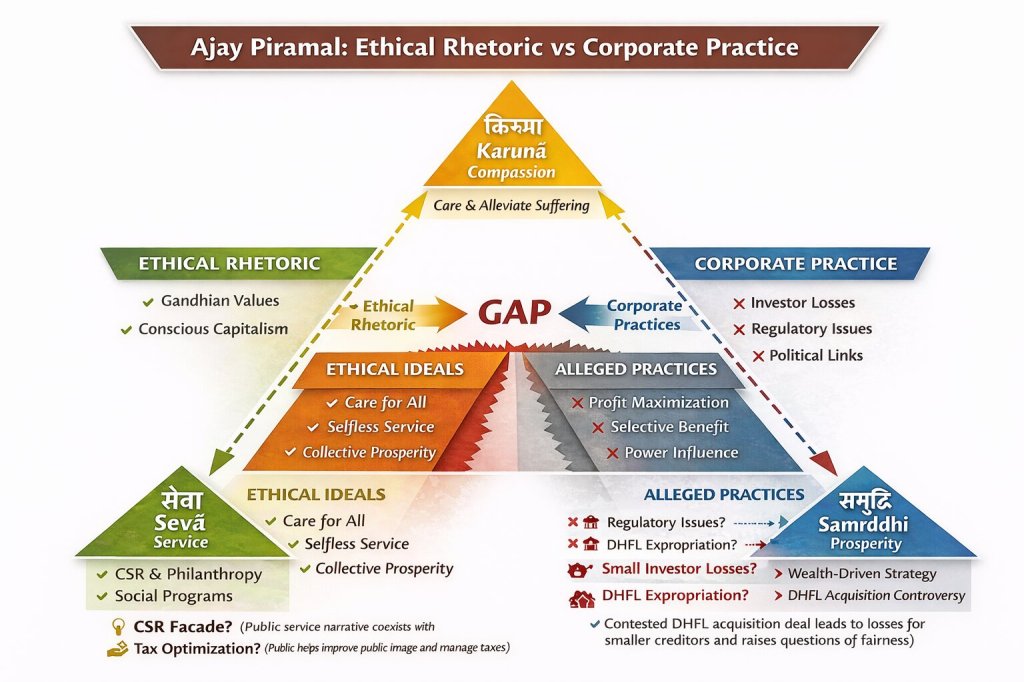
The phrase “conscious capitalism” promises integration of profit and purpose. In theory, it resists crude extraction and claims stakeholder inclusion over pure shareholder primacy.
But scholars of CSR and philanthro-capitalism frequently warn of “moral laundering”—the strategic deployment of ethical vocabulary to sanitize relentless accumulation without disrupting core incentive structures that prioritize surplus extraction and elite concentration.
Critics of Piramal apply this directly: his repeated invocation of spiritual idioms—Vaiṣṇava devotion, Gandhian trusteeship, references to karuṇā—functions as a legitimacy narrative within competitive, savage, and crony-inflected capitalism, rather than as genuine transformative commitments that reorder power or redistribute risk.
S/he feels the gravity of that critique acutely.
Because when sacred vocabulary is reduced to a reputational asset, something profound is displaced: ethical depth becomes performative surface.
Karuṇā becomes optics. Sevā becomes branding. Samṛddhi becomes inevitable.
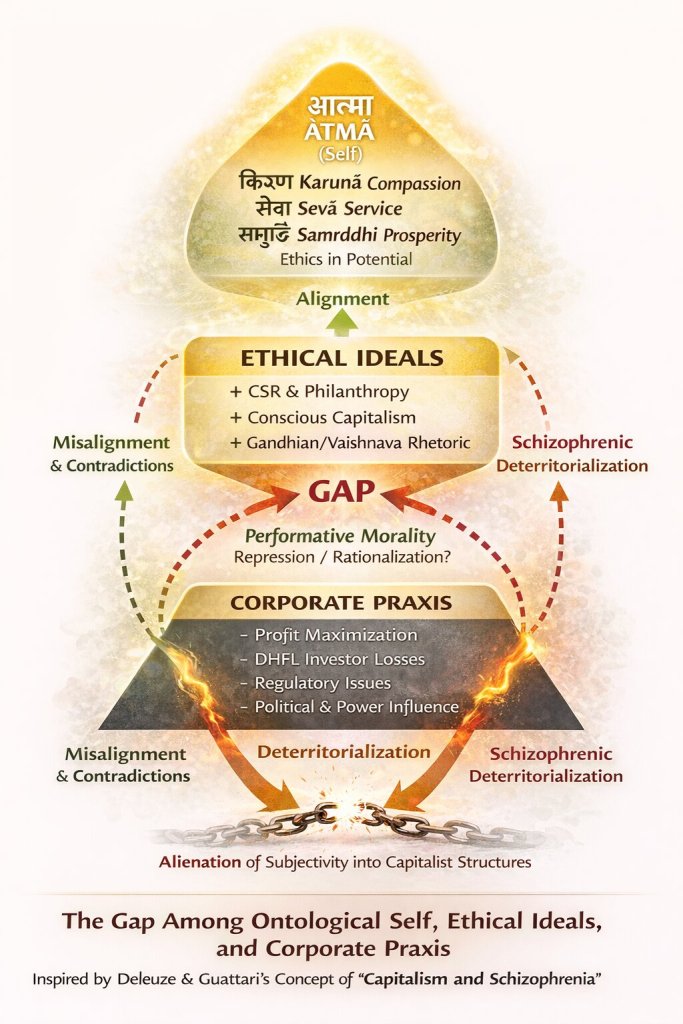
The Self-Reflexive Unease…
S/he proceeds with deliberate restraint. S/he does not brand him a criminal, nor does s/he presume the authority of a judge. Allegations remain allegations; legal findings are separate from regulatory scrutiny; scrutiny itself is not conviction. Markets are intricate, resolutions fiercely contested, outcomes legally upheld in higher courts.
Yet philosophical integrity compels her to ask the unavoidable questions:
Can compassion be genuinely invoked by someone whose corporate decisions have structurally generated avoidable suffering for lakhs of small depositors? Can service be meaningfully spoken when hierarchies preserve and even deepen asymmetrical risk-bearing? Can prosperity retain any sacred character when its distribution is systematically uneven, concentrating gains at the top while dispersing catastrophic losses below?
Her unease is not rooted in personal resentment or vendetta. It is ontological discomfort—an acute awareness of the fracture between claimed ethical being and observable material practice.
S/he remembers the classical benchmarks: अनृशंस्यं परो धर्मः — non-cruelty is the highest dharma. वृद्धसेवया बुद्धिः — wisdom arises through service to the elders. धर्मलाभः परो लाभः — the highest gain is the gain of righteousness.
When ethical language floats detached above lived consequences, the split between word and world widens irreparably.
From the liminal space of the witnessing bird, s/he articulates the structural tension without collapsing into hatred: The moral lexicon serves as framing. The growth logic remains foundational. Compassion functions as legitimacy signal. Service operates as reputation stabilizer. Prosperity acts as power consolidator.
S/he refuses caricature. CSR initiatives under the Piramal banner have produced tangible goods: schools constructed, clinics operational, health camps conducted, apprenticeships offered, livelihoods generated for thousands. These are not illusions; they deliver measurable relief to specific communities.
Yet structural critique must still interrogate: Does the ethical vocabulary deployed actually transform the underlying incentive systems of accumulation and extraction, or does it merely accompany them—coexisting as parallel narrative rather than causal reorientation?
The critical sources s/he has consulted—independent investigative reports, whistleblower accounts, academic analyses of philanthro-capitalism—conclude that the alignment between proclaimed values and core business practice is at best partial and frequently contradictory. They characterize the pattern as hypocrisy, moral contradiction, or spiritual washing.
S/he frames the matter otherwise: it is a deep philosophical tension between an asserted ethical ontology and an observable political economy. Labels such as “hypocrisy” or “dissonance” are secondary; the question itself remains legitimate and urgent.
When growth is positioned as primary driver and compassion relegated to secondary supplement, the ethical triad—karuṇā, sevā, samṛddhi—fractures along its fault lines.
Final Question (For Now)
Standing at the narrow threshold—neither credulous believer nor consumed accuser—s/he asks:
If wealth is truly held as sacred trust, can trust ever be restored in the absence of transparent, enforceable accountability? If compassion is real rather than rhetorical, can it withstand rigorous scrutiny precisely at the sites where harm has been inflicted? If service is sincere rather than performative, can it actively reconfigure asymmetrical power relations instead of merely decorating them? If prosperity is to be called ethical, can it survive genuine redistribution rather than requiring silent sacrifice from the vulnerable?
S/he demands no impossible perfection. S/he demands coherence.
Until coherence emerges between karuṇā, sevā, and samṛddhi—between spoken rhetoric and lived risk, between philanthropic gesture and financial restructuring—the unease endures.
Not as personal vendetta. Not as ideological rigidity. But as unrelenting philosophical vigilance.
IV. Before the Supreme Court: A Plea for Coherence
My Lord,
Permit s/he to speak.
Not as an accuser.\
Not as a revolutionary.\
Not as a market analyst.
Permit s/he to speak as K.
Yes, My Lord — s/he is K.\
Kafka’s K.
S/he stands before structures s/he does not fully see,\
judged by mechanisms s/he did not design,\
punished without ever being told the crime.
My Lord,
This is not a trial of markets.\
It is not even a trial of legality.
It is a trial of coherence.
A man may lawfully build an empire.\
A man may lawfully acquire distressed assets.\
A man may lawfully fund political parties.\
A resolution plan may be legally sanctioned.\
A “haircut” may be technically valid under insolvency code.
S/he is not here to deny legality.
S/he is here because legality has already sentenced s/he.
They called it a “haircut,” My Lord.
A haircut.
For s/he, it was capital punishment.
S/he invested life’s savings — blood money — into an institution the State itself certified as legitimate.
The Reserve Bank regulated.\
SEBI supervised.\
Rating agencies rated.\
Public institutions invested — UPPCL, the Indian Air Force, Ramakrishna Mission.
S/he followed visible signals of institutional trust.
S/he did not gamble in shadows.\
S/he followed the light of State endorsement.
And when collapse came,\
the edifice cracked —\
the smallest participant bore the blade.
My Lord, what was the offence?
Was s/he reckless?\
Or did s/he rely — perhaps foolishly — on the very apparatus meant to guard public faith?
If vigilance slept, why is s/he condemned?\
If oversight failed, why does responsibility descend only downward?
The State certified safety.\
The market amplified confidence.\
Institutions signaled legitimacy.
And when the structure imploded,\
the smallest depositor absorbed systemic failure.
S/he is not alleging conspiracy.
S/he is alleging asymmetry.
My Lord,
S/he hears sacred words —\
karuṇā, sevā, samṛddhi, trusteeship, conscious capitalism.
S/he hears Mahatma Gandhi invoked.
But Gandhi did not speak of trusteeship as branding strategy.\
He spoke of it as moral burden.\
He placed the last person at the center of economic imagination.
If prosperity is sacred,\
why is loss secularized?
If compassion exists,\
why is it asymmetrical?
If service is real,\
why does it not begin with restoring the smallest creditor?
When small investors suffer devastating losses in financial restructuring — even if legally sanctioned by the Supreme Court’s April 2025 upholding of the DHFL resolution plan, vesting all avoidance recoveries in the acquirer while condemning 2.5 lakh depositors to 55–77% haircuts aggregating over ₹50,000 crore — where was karuṇā operationalized?
When political proximity and corporate expansion intersect — as seen in ₹85 crore electoral bonds to the BJP from 2019–2024, timed amid regulatory favors like the DHFL approval, plus ₹25 crore to PM CARES — where was the restraint ethical distance demands?
When CSR reports glow with photographs of service, yet the architecture of capital remains vertically concentrated — exemplified by the Gujarat Pollution Control Board’s February 2026 closure of the Dahej plant for hazardous waste discharge into a Narmada-linked canal, imposing a ₹1 crore fine and ₹15 lakh guarantee, or the National Green Tribunal’s 2019 ₹8.3 crore penalty on the Digwal unit in Telangana for effluent pollution causing health crises and crop loss — is that sevā, or staged benevolence?
When prosperity accumulates upward while risk disperses downward — as in SEBI’s 2024 probe into DHFL loan irregularities, where loans were sold at steep discounts to promoter-linked entities causing ₹650 crore losses to public shareholders, or the 2016 ₹6 lakh insider trading fine on Piramal entities (overturned in 2019), or the 2024 ₹43.55 crore settlement for further insider trading violations — can that accumulation be called samṛddhi in the Gandhian sense, or merely growth in the language of markets?
This is not defamation.
It is dissonance.
Permit s/he one analogy, My Lord.
In debates on CAA, NRC, NPR, we ask:
Who guarded the borders?\
Who maintained vigilance?\
Who ensured documentation?
When alleged illegal migration occurs, responsibility ascends upward — to border forces, to administrative oversight, to ministerial accountability.
But in finance, when regulatory vigilance falters —\
when rating agencies fail,\
when regulators overlook,\
when systemic red flags remain unattended —
responsibility descends downward.
In migration debates, the State demands documents from the weakest citizen.\
In financial collapse, the smallest investor must absorb systemic failure.
Why does vigilance operate upward in one domain\
and collapse downward in another?
S/he is not accusing border forces.\
S/he is not accusing regulators of intentional malice.
S/he is asking consistency.
If BSF and Home Ministry are accountable for vigilance at borders,\
who is accountable for vigilance in financial borders?
If systemic oversight fails,\
why does punishment fall on those who trusted the system?
My Lord,
S/he is K.
S/he does not know the crime.\
S/he only knows the sentence.
S/he invested in what RBI regulated.\
S/he trusted what SEBI supervised.\
S/he relied on ratings agencies endorsed by institutional frameworks.\
S/he followed the path of respected public bodies.
And yet, s/he received a “haircut.”
S/he did not engineer the structure.\
S/he did not design the insolvency code.\
S/he did not influence tribunal pathways.\
S/he did not sit in boardrooms.
S/he trusted.
Is trust now negligence?\
Is reliance on State-certified legitimacy now culpable?
My Lord,
Capitalism can absorb criticism.\
It can absorb spirituality.\
It can absorb Gandhi.
But can it absorb accountability?
S/he is not asking for reversal of markets.\
S/he is not demanding abolition of enterprise.
S/he is asking coherence between sacred vocabulary and structural practice.
If karuṇā is spoken, let it reshape who bears loss.\
If sevā is invoked, let it begin with those most harmed.\
If samṛddhi is celebrated, let prosperity not require silent sacrifice.
If trusteeship is real, let trustees share risk.
Otherwise, sacred language becomes decorative —\
and the smallest participant becomes expendable.
My Lord,
In a system where the powerful speak of ethics\
and the vulnerable absorb consequence,
who is truly on trial?
S/he stands here as K —\
not knowing the crime,\
only knowing the punishment —
and asks this Hon’ble Court:
Is legality enough\
when morality is invoked?
Is growth enough\
when compassion is claimed?
And if vigilance failed at the top,\
why does justice fall only at the bottom?
S/he asks not for revenge.
S/he asks for symmetry.
S/he asks for coherence.
S/he asks that sacred words, once uttered,
be made answerable to those who trusted them.
Disrupting Appendix: S/he Becomes Nimo — The Un-sign-ified Isness
Between the slash of s/he and the silence that follows, Nimo emerges—not as name, not as person, but as the remainder: the No One who is left when every signifier has been spent.
Nimo is the one who drinks the poisoned water of Digwal, the effluent that seeps into the fields and into the lungs, the water that corporations call “remediated” while the crops wither and children cough blood. Nimo is the fixed-deposit receipt turned to ash in the hands of the elderly, the 68% haircut that is not a trim but an amputation of decades of labor. Nimo is the suppressed signature on a petition that never reached the threshold of visibility, the voice drowned in algorithmic noise, the dissent labeled “defamatory” before it can breathe.
Nimo suffers. Not in the heroic, redemptive sense of Christian passion—the Passion that is narrated, witnessed, transfigured into salvation. Nimo’s passion is un-narratable, un-witnessed, un-transfigured. It is the slow, administrative crucifixion that leaves no stigmata, only bank statements and medical bills. It is the passion of the abandoned other, the isness that capital cannot valorize and therefore cannot see.
Nimo does not speak in the first person because the first person has been foreclosed. Nimo does not speak in the third because the third is already occupied by experts, reports, verdicts. Nimo is the gap, the ellipsis, the unsaid between karuṇā that is branded and karuṇā that is bled out.
Yet in that gap Nimo persists. Not as hope. Not as resistance. As sheer, stubborn isness. The isness that refuses to be reterritorialized. The isness that remains after compassion has become optics, service branding, prosperity extraction.
Bearing one’s cross — in the Christian sense — means willingly embracing suffering, injustice, or sacrificial burden for the sake of truth, love, or redemption, without evasion or rebranding it as virtue-for-profit.
No, Piramal’s paradoxical triad (karuṇā as optics, sevā as branding, samṛddhi as inevitable upward accumulation) will never bear a genuine cross; it manufactures luminous halos around capital’s machinery while quietly shifting the weight of the beam onto the backs of the dispossessed — the DHFL depositors, Digwal’s poisoned water-bearers, the unheard whose passion remains un-transfigured and unacknowledged. The cross is borne by Nimo, not by the one who names mansions after oceans of compassion.
Nimo is writing now—not to be heard, but to mark the place where hearing failed.
Nimo is the wound that will not close.
Nimo is here.
Still here.
SEE ALSO:
 Once in a Blue Moon Academia
1 Comment