
Posted on 16th February, 2026 (GMT 06:35 hrs)
Authored by Ecotopians of Alternity⤡
ABSTRACT
This essay argues that the Piramal Group’s pharmaceutical and real-estate operations exemplify a systemic model of accumulation by dispossession in contemporary capitalism, wherein ecological harm, public-health burdens, and climate vulnerability are externalized onto marginalized communities while profits are privatized and reputational risk is managed through regulatory reprieves, corporate restructuring, and CSR spectacle. Through the long-running groundwater contamination crisis at Digwal, the very recent February 2026 hazardous discharge episode at Dahej affecting the Narmada-linked canal system, and the development of ultra-luxury coastal real estate in flood-prone zones of Mumbai, the text demonstrates a recurring pattern: violation, brief enforcement theatre, rapid operational normalization, and uninterrupted high-margin expansion. It situates these cases within theoretical frameworks of slow violence, ecological surplus extraction, and philanthropic greenwashing, arguing that fines function as licensing fees rather than deterrents and that dynastic corporate networks convert environmental risk into both profit and spectacle. The essay concludes by demanding a materially enforced Polluter Pays regime—extending beyond monetary penalties to full ecological restoration, community restitution, structural limits on expansion, and legally binding accountability—insisting that environmental justice cannot be offset through philanthropy, CSR branding, or procedural compliance while the biosphere itself absorbs irreversible damage.
I. Introduction: Setting the Stage
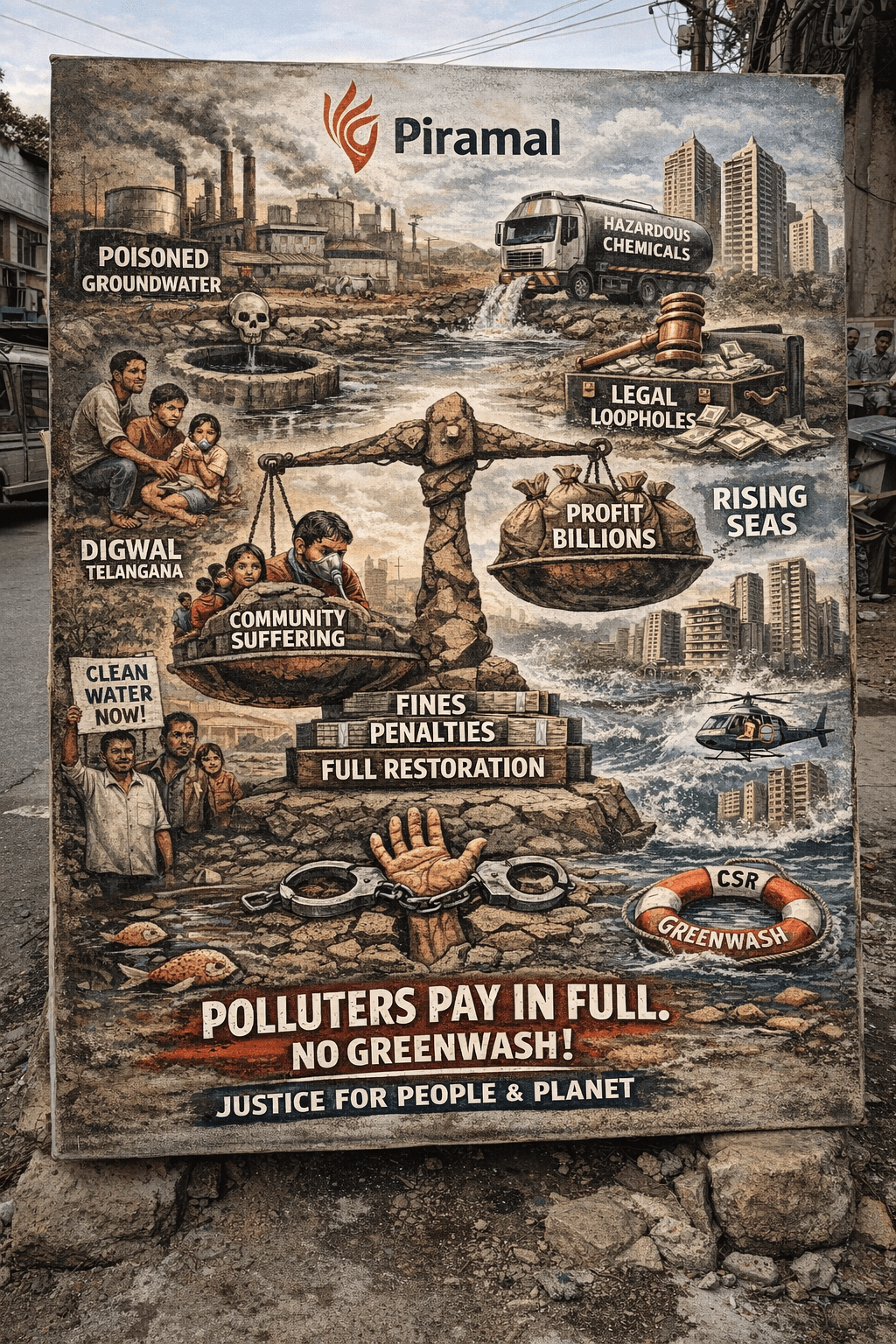
The Piramal Group—pharma powerhouse pivoting to luxury real-estate, sealed by the 2018 marriage of Anand Piramal to Isha Ambani—embodies a stark pathology in contemporary capitalism: accumulation by dispossession (David Harvey, 2003). It systematically externalizes ecological devastation and human suffering onto marginalized communities—villagers in Telangana, inhabitants along Mumbai’s coasts, future generations facing climate collapse—while privatizing profits and laundering the fallout through CSR optics, corporate demergers, and swift regulatory reprieves. Digwal’s chronically poisoned aquifers, Dahej’s January-February 2026 hazardous-waste breach, and Mumbai’s perilously low-elevation luxury towers are not isolated lapses. They form the core operating logic: pollute, contest, resume, monetize vulnerability, extract profits, repeat.
II. Digwal: Four Decades of Slow Violence and Institutional Impunity
The Digwal facility in Sangareddy district, Telangana (population ~4,300), began operations in the early 1990s as Global Drugs Ltd., later Nicholas Piramal, then Piramal Enterprises, and now Piramal Pharma’s flagship API and anaesthesia manufacturing site (USFDA, MHRA, PMDA approved). Court records from 1998–1999 already declared the effluents a “cesspool” rendering groundwater unfit for drinking or irrigation. A district judge inspected the site and termed it “highly polluting,” with villagers reporting barrels of toxic waste buried on farmland.
The crisis escalated into measurable catastrophe. From March 2015 to January 2019—1,386 days of chronic violations—unlined rainwater collection pits allowed toxic leachate (solvents, pharmaceutical residues, heavy metals) to percolate directly into aquifers. A 2019 joint committee (CPCB + TSPCB + NEERI + IIT Madras) inspected multiple times, confirming groundwater and soil contamination, ruined crops, and non-compliance with effluent norms. The NGT imposed ₹8.32–8.34 crore in environmental compensation under the polluter pays principle (November 2019 order in OA 688/2018). TSPCB ordered closure on 29 November 2018; the plant idled for just 44 days. NGT proceedings (2019–2021) forced partial payment: after forfeiting bank guarantees (₹0.99 lakh) and adjusting the 50% deposit (₹4.1 crore), Piramal paid a net ₹3.2 crore in July 2021.
Data on human cost is damning. Residents report sharp spikes in dermatological disorders, respiratory illnesses, cardiac issues, kidney failures, and cancers—classic slow violence (Rob Nixon, 2011). Groundwater has remained unfit since the late 1990s; crops fail; wells are abandoned. A December 2024 NGT case (OA 1032/2024, filed by resident Nikhil Gargubai) alleges ongoing untreated effluent discharge contaminating surface and groundwater—proving the 2019 “resolution” was cosmetic.
Piramal’s response? Water ATMs and a token “Piramal Arogya Seva Kendra” medical kiosk—rent-seeking on its own disaster, as the same conglomerate profits from reverse-osmosis systems sold to the very communities it poisoned. Contrast this with financials: the ₹8.3 crore fine equals ~0.09% of FY25 revenue (₹9,151 crore) and negligible EBITDA impact (17% margin, ₹1,580 crore). SEBI’s 2024 adjudication cleared non-disclosure post-2022 demerger, deeming the brief closure and fine “immaterial” to investors despite explicit liability transfer in the scheme (clauses 4 and 12.2). Restructuring quarantined reputational risk while operations resumed and expanded (API capacities scaled for global sevoflurane supply).
Despite fierce local resistance, repeated complaints, and regulatory orders, the facility not only resumed but expanded. In June 2022 Piramal Pharma Solutions announced enhanced API capabilities at Digwal, applying “operational excellence tools to release capacity.” New Sevoflurane manufacturing lines were added, with further scaling projected to drive growth from FY2026. This occurred amid suggestive political patronage: the Piramal Group’s ₹85 crore electoral bond donations to the BJP (2019–2024) coincided with swift operational restarts and capacity additions, while enforcement remained lenient.
Piramal has repeatedly highlighted installation of “state-of-the-art” effluent treatment systems and, in 2025, converted the coal-fired boiler at Digwal to biomass briquettes as a decarbonization showcase. Yet violations persist, as confirmed by the 2024 NGT case and the USFDA’s February 2026 Form 483 observations at the same site.
This is not remediation; it is calculated impunity sustained by weak enforcement and political access. It is the Summersian Plan in action: externalize toxic burdens onto the poorest rural soils and bodies (echoing Lawrence Summers’ 1991 memo that the economic logic of dumping waste in low-wage countries is “impeccable”), then monetize the resulting scarcity through branded “solutions.” The fox sniffs the same air the villagers breathe—sweet corporate press releases on one side of the fence, poisoned wells on the other. Four decades on, the ledger remains open.
III. Dahej 2026: The Pattern Repeats in Real Time – Acute Violation!
On 30 January 2026, a tanker (GJ 27 TG 6676) allegedly discharged spent hydrochloric acid—a highly corrosive hazardous waste—from Piramal Pharma’s zero-liquid-discharge Dahej facility (specialty fluorochemicals and hexafluoro-methoxypropane intermediate for sevoflurane anaesthesia) into a canal feeding the Narmada River, Gujarat’s lifeline and primary source of drinking water, irrigation, and industrial supply for millions.
Gujarat Pollution Control Board (GPCB) issued an immediate closure order on 3 February 2026 under Section 33A of the Water (Prevention and Control of Pollution) Act, 1974, prohibiting manufacturing activity with immediate effect, directing disconnection of electricity, and imposing a ₹1 crore environmental compensation notice. The order cited the tanker’s deviation from the approved route to a licensed treatment facility in Surendranagar, surreptitious disposal into the Vayna village canal linked to the Narmada system, and grave risk to a vital public water source.
The Gujarat High Court, on 5 February 2026, refused interim stay, holding that the GPCB was empowered to act urgently in cases of serious environmental harm and that alternative remedies (including appeal to the National Green Tribunal) existed.
Piramal Pharma escalated to the Supreme Court. On 9 February 2026, a bench led by Chief Justice Surya Kant declined interim relief, emphatically observing: “This is about alleged dumping of hazardous waste in the Narmada River… this is a source of water for the state and its people.” The Court directed GPCB to decide the company’s revocation plea within one week but advised pursuing statutory remedies before the NGT if dissatisfied.
Interim revocation was granted on 13 February 2026 via GPCB letter, authorizing immediate resumption of operations. The plant restarted within days.
Compounding the pressure on Piramal Pharma’s operations during this exact period, the US Food and Drug Administration (USFDA) conducted a separate general Good Manufacturing Practices (GMP) inspection at the company’s Digwal facility (Sangareddy district, Telangana—the same site central to the long-running pollution saga) from February 9 to February 13, 2026. At the conclusion of the inspection, the USFDA issued a Form-483 citing four observations, all related to enhancements in procedures and explicitly not involving data integrity issues. The observations were classified as Voluntary Action Indicated (VAI), meaning no immediate production halt or import alert, but requiring a formal response within stipulated timelines. Piramal Pharma stated it is preparing a detailed reply and remains committed to compliance standards.
The timing is striking: the FDA observations landed just days after the Dahej closure drama peaked (Supreme Court hearing on February 9, interim revocation on February 13). While the USFDA matter pertains to manufacturing quality controls (procedural refinements) rather than environmental discharge, it underscores a broader pattern of intensified scrutiny across Piramal’s key production hubs—Digwal (API/anaesthesia intermediates) and Dahej (fluorochemicals feeding the same chain)—precisely when domestic pollution enforcement appeared to soften rapidly. This convergence of international GMP flags and domestic pollution reprieves illustrates how regulatory heat can be managed episodically: address procedural notes voluntarily, secure swift revocation on environmental orders, and maintain uninterrupted high-margin output for global markets. The Form-483, reported widely on February 14, 2026, adds another layer to the impunity narrative—token procedural nudges that rarely disrupt operations or investor confidence.
The choreography mirrors Digwal precisely: allegation of acute violation → regulatory shutdown spectacle → immediate legal escalation → swift political-administrative reprieve. The plant’s output feeds Digwal’s anaesthesia chain, safeguarding high-margin vertical integration (sevoflurane remains a global blockbuster for Piramal, underpinning its hospital generics vertical). Profit margins remain pristine; the Narmada’s dilution capacity absorbs the externality once more. Fines and closures last days, not decades—textbook licensing fee, not deterrent.
The pattern is unmistakable: acute discharge triggers visible enforcement theatre, judicial scrutiny underscores gravity, yet reprieve arrives with extraordinary speed—here, full cycle from closure (3 Feb) to restart authorisation (13 Feb) in just ten days. Suggestive political access echoes Digwal: Piramal Group’s ₹85+ crore electoral bond donations to BJP (2019–2024), 25 crores in opaque PM CARES etc., align with lenient timelines, while enforcement softens post-representation. State-of-the-art zero-liquid-discharge claims and sustainability rhetoric (biomass boiler conversions elsewhere) once again fail to prevent recurrence, yet suffice to secure quick normalisation.
The Narmada, like Digwal’s aquifers, bears the burden; the ledger stays clean for shareholders. The pattern repeats because the system permits it.
IV. Mumbai’s Piramal Realty Projects: Spectacular Affluence at Extinction Elevation – Monetizing Climate Suicide Zones
While the pharma arm externalizes poison, Piramal Realty (led by Anand Piramal, Mukesh Ambani’s son-in-law) monetizes vulnerability at premium prices by developing ultra-luxury residential towers in Mumbai’s lowest-lying, flood-prone coastal and creek-adjacent zones — zones already scarred by recurrent inundation and now accelerating under the climate crisis.
While Piramal Realty touts the successful delivery of over 4,200 homes across 21 towers and six projects (as announced in January 2026), translating “design intent into lived-in communities” with emphasis on “biophilic living,” harmonious integration of nature, greenery, spaciousness, and community connection, the underlying topography and flood-risk realities remain unchanged and unaddressed. These boasts of disciplined execution and “lived-in” neighbourhoods mask the precarious elevations and climate projections that threaten long-term habitability.
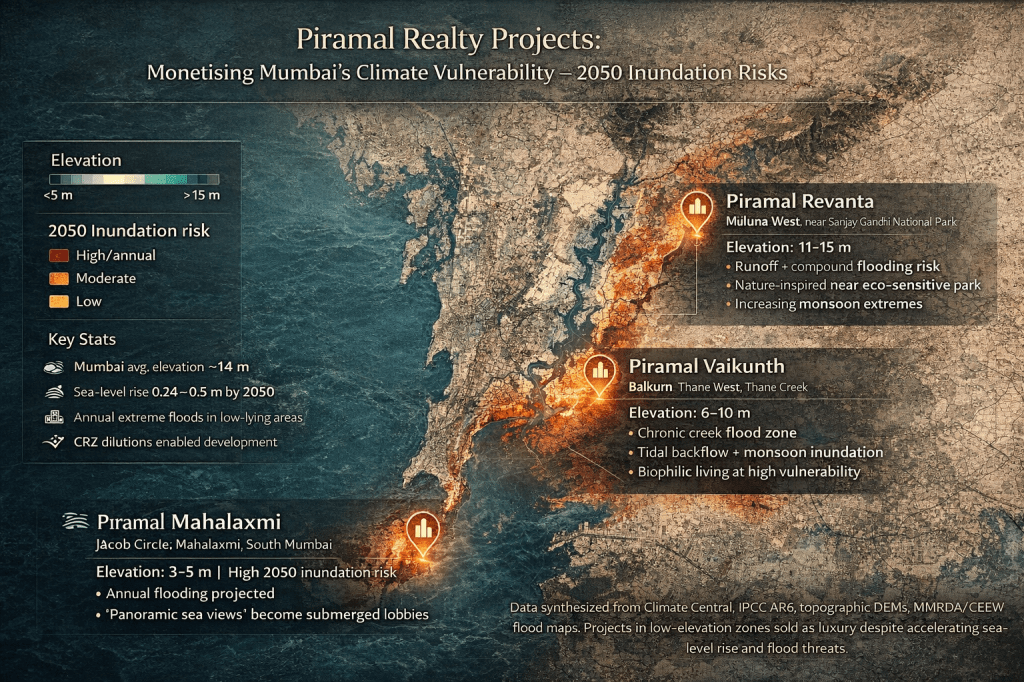
Mumbai, one of the world’s most climate-vulnerable megacities, sits on reclaimed land with an average elevation of only ~14 m above mean sea level. Large parts of the city already experience chronic flooding from intensified monsoons, tidal surges, and poor drainage — the 2005 deluge (944 mm rain in 24 hours) killed nearly 1,000 and caused losses exceeding ₹5,000 crore. Climate Central and IPCC-aligned projections show the crisis deepening: under mid-to-high emissions scenarios, global mean sea-level rise of 0.24–0.5 m by 2050 will combine with stronger storm surges and extreme rainfall events (now 35 % more frequent) to make annual coastal flooding routine. Significant portions of South Mumbai and Thane Creek areas face direct inundation, with ground floors, basements, and access roads at risk of permanent or near-annual flooding by mid-century. CRZ dilutions (2011 notification and 2018–2019 amendments) reduced mangrove and creek buffers from 100 m to 50 m, opening these high-risk zones for high-rise development despite documented mangrove loss and heightened flood vulnerability.
Piramal Mahalaxmi (Jacob Circle, Mahalaxmi, South Mumbai) This flagship project comprises 49–66-storey twin towers marketed for “uninterrupted panoramic Arabian Sea and racecourse views.” The site lies at approximately 3–5 metres above mean sea level in one of Mumbai’s lowest coastal pockets. This exact topography was severely inundated during the 2005 floods and remains in Climate Central’s high-risk zone for 2050 annual flooding under mid-to-high scenarios. Even modest sea-level rise of 0.3 m will push king tides and storm surges into ground-level lobbies and basement parking, turning today’s “lifetime views” into submerged infrastructure within decades. Taxpayers and insurers will ultimately bear the rescue, pumping, and abandonment costs.
Piramal Vaikunth (Balkum, Thane West) Sprawling across 32 acres of mangrove-fringed marshland along Thane Creek, this township is marketed as “biophilic living” with creek views. The site sits in a chronic high-vulnerability flood zone classified by MMRDA and CEEW, with ground elevations ranging 6–10 metres above mean sea level (many creek-adjacent parcels below 8 m). Thane already sees 5 % of its area inundated during single rainfall events; tidal backflow and monsoon overflow regularly submerge low-lying sections. Under 2050 projections, intensified rainfall and sea-level rise will make seasonal flooding of lower floors and roads routine, despite the project’s claims of resilience. Mangrove loss from earlier clearances has already amplified these risks.
Piramal Revanta (Mulund West) This 12-acre, six-tower development (up to 48 storeys) is sold as “nature-inspired living” beside Sanjay Gandhi National Park. Site elevation is approximately 11–15 metres above mean sea level, with lower podiums and approach roads closer to 11 m. While higher than purely coastal sites, it lies in a transition zone where heavy runoff from the eco-sensitive park combines with urban drainage failures. Extreme rainfall events — now more intense due to climate change — already cause moderate-to-high flooding here during monsoons. By 2050, compound flooding (rain + downstream creek backflow exacerbated by sea-level rise) will increase vulnerability for basements, roads, and amenities.
These projects deliberately target Mumbai’s most exposed pockets, converting climate-vulnerable land into high-ticket real estate sold as “forever luxury.” Buyers are offered panoramic views today; tomorrow they inherit inundation risks that successive CRZ dilutions have only worsened. The elite retain private evacuation options (helicopters, second homes); the broader costs — rescue operations, infrastructure repair, insurance bailouts — are socialised onto taxpayers and the city’s already strained systems. The pattern is consistent: poison externalised upstream in pharma plants, vulnerability profitably monetised downstream in realty. In an age of accelerating climate crisis, these are not homes — they are premium climate time-bombs.
V. The Dynastic Greenwash Nexus: Coastal Gardens as PR Offset
The 2018 Anand–Isha marriage fuses the empires. While Piramal Realty erects sea-level-risk towers, Nita Ambani (via Reliance Infrastructure and Reliance Foundation CSR) oversees the ₹400-crore “Coastal Road Gardens”—130 acres (70 hectares open space) along the reclaimed Mumbai Coastal Road (Breach Candy–Worli). Announced at RIL’s August 2025 AGM and under development as of late 2025, it is marketed as Mumbai’s new “green lung”: walkways, plazas, cycling tracks, curated greenery managed for 30 years. This is the perfect parallel—displace inhabitants and mangroves for superrich infrastructure and reclamation, then plant performative offsets metres from private luxury towers. Spatial injustice perfected: destroy habitat, monetize the wreckage view, brand mitigation as spectacular philanthropy.
Jason Moore’s Capitalism in the Web of Life and Amitav Ghosh’s writings on climate unreadiness diagnose this precisely: nature is not an externality but the condition of production being cannibalized for yielding surplus value. CSR here functions as reputation management—tax-deductible optics that never internalize the full cost.
VI. The Rigorous, Non-Negotiable Demand: Polluter Pays – Enforce It Fully
Data is unequivocal and damning. Cumulative fines (₹8.3 crore + ₹1 crore) represent fractions of one quarter’s profit. Closures last days. Coastal projects erode the precautionary principle embedded in CRZ norms and the NGT Act, 2010. The Supreme Court has repeatedly ruled that environmental compensation must be deterrent, restorative, and proportionate — not a routine cost of doing business.
Therefore, the demands, grounded in evidence, are given as follows:
Full lifetime remediation for Digwal: Independent, community-led health census (covering dermatological, renal, oncological, and cardiac spikes since the 1990s), complete aquifer restoration, and a perpetual, community-controlled compensation fund scaled to generational harm — not token crores calibrated to balance sheets.
Permanent moratorium on new coastal real-estate: No approvals below 10 metres elevation or within 100 metres of creeks and mangroves until 2050 IPCC projections are statutorily internalised into CRZ and planning law.
Mandatory public audit of all Piramal–Ambani-linked CSR: Every tree, garden, or water ATM must correspond to independently verified ecological regeneration and measurable public-health repair — not branding exercises or 30-year maintenance contracts masquerading as philanthropy.
Pierce the corporate veil: Demergers and restructurings cannot quarantine liabilities when the same families control boards, strategy, capital flows, and political access.
Prior, informed, and binding community consent: Mandatory for every project in eco-sensitive or flood-prone zones. No technocratic override of villagers, fishers, wetlands, or scientific consensus.
Deterrent penalties scaled to revenue: Minimum 5–10% of annual turnover for repeat violations, automatic multi-year expansion bans, and director disqualification.
But this must go further.
Polluter Pays cannot mean mere monetary settlement. Nature is not a commodity to be priced and replaced. Aquifers are not ledger entries. Mangroves are not compensatory saplings in ornamental gardens. Rivers are not dilution channels. People are not collateral damage amortised across quarterly reports.
Environmental justice is not a transaction — it is restoration of conditions of life.
The sea does not negotiate. It does not read SEBI orders, partial NGT stays, or CSR brochures. When the next 944 mm deluge meets a 0.5 m higher baseline and intensified monsoon extremes, the arithmetic changes from EBITDA to existence.
This is not anti-business. It is pro-civilisation.
Corporations that treat the biosphere as sewer and showroom — externalising generational harm while internalising profit — must be compelled to internalise the full, compounded cost: financial, ecological, legal, and moral. And where restoration is impossible, liability must extend beyond money into structural restraint, operational limits, and enforceable bans.
Crucially, this obligation cannot be diluted, deferred, or cosmetically offset through corporate “philanthropy,” CSR showcases, sustainability summits, or curated panel discussions. This is often done through Mr. Piramal’s philanthro-capitalist wing: “Piramal Foundation”. However, charity does not annul extraction. Sponsoring climate conferences, funding research chairs, planting symbolic saplings, or convening superrich dialogues on “green futures” cannot revoke structural harm embedded in supply chains, land dispossession, toxic discharge, or atmospheric violence. On the contrary, such philanthropic performances often function as systemic alibis — laundering legitimacy while leaving the underlying model of accumulation intact. They transform accountability into spectacle, critique into branding, and ecological debt into reputational capital.
If holistic justice with equity is to be meaningful, it must pierce these facades. The measure of responsibility lies not in narrated intent but in materially altered practice — in reduced extraction, reparative redistribution, community restitution, and legally binding constraints. Anything less risks perpetuating the very structural conditions that made the harm profitable in the first place.
Polluters pay.
In full.
With interest.
Not only in rupees — but in restoration, accountability, and limits.
No corporate greenwash.
No exceptions.
The villages of Digwal are still drinking poison.
The Narmada remembers the acid.
Mumbai’s tides are rising — three metres is not a marketing slogan; it is a warning line.
The evidence is overwhelming.
The window is closing.
Enforce it — now.
References
Digwal’s Defiance: Resisting Big Pharma VIEW HERE ⤡ @Fridays For Future International Newsletter
La rébellion de Digwal : résister aux géants pharmaceutiques VIEW HERE ⤡ @Fridays For Future International Newsletter (French Edition)
I. Introduction and Context
- Piramal Pharma Limited Q4 & FY25 Results (Revenue ₹9,151 Cr, +12% YoY; CDMO ₹5,447 Cr, +15% YoY; EBITDA ₹1,580 Cr at 17% margin). Official Press Release, 14 May 2025. https://www.prnewswire.com/news-releases/piramal-pharma-limited-announces-results-for-q4-and-fy2025-302455718.html Full PDF: https://www.piramal.com/assets/downloads/Piramal%20Pharma/PressRelease/Q4FY25%20Press%20Release.pdf
- David Harvey, The New Imperialism (Oxford University Press, 2003) – core theoretical text on accumulation by dispossession.
II. Digwal Section
- NGT OA No. 688/2018: Joint Committee Report (CPCB + TSPCB + NEERI + IIT Madras), groundwater/soil contamination, ₹8.32–8.34 crore compensation recommendation, TSPCB closure order 29 Nov 2018 (44-day shutdown). https://www.greentribunal.gov.in/sites/default/files/all_documents/Final%20Report%20in%20OA%20no%20688%20of%202018.pdf
- NGT directs net ₹3.2 crore payment (July 2021) after bank guarantees & deposits. https://timesofindia.indiatimes.com/city/hyderabad/ngt-directs-piramal-to-pay-rs-3-2-cr-fine-in-a-mth/articleshow/84535510.cms
- SEBI adjudication clearing non-disclosure of NGT fine & plant closure as “immaterial” (Nov 2024). https://regstreetlaw.com/news/sebi-clears-piramal-pharma-in-non-disclosure-case/
- USFDA GMP inspection Digwal facility (9–13 Feb 2026): Form-483 with 4 observations (procedural, Voluntary Action Indicated). https://www.moneycontrol.com/world/usfda-issues-form-483-with-4-observations-to-piramal-pharma-s-telangana-unit-article-13828369.htmlhttps://www.thehindu.com/business/us-fda-issues-four-observations-to-piramal-pharmas-facility-in-near-hyderabad/article70632830.ece
- Piramal Group electoral bond donations to BJP (₹85 crore total via group entities, 2019–2024). https://onceinabluemoon2021.in/2024/03/17/ajay-piramals-contributions-to-the-electoral-bonds/ Cross-reference: Economic Times reporting on group companies. https://m.economictimes.com/news/politics-and-nation/kotak-family-owned-infina-finance-gives-rs-60-cr-to-bjp-via-electoral-bonds/articleshow/108712165.cms
III. Dahej 2026 Section
- GPCB closure order (3 Feb 2026), tanker GJ 27 TG 6676, spent HCl discharge into Narmada-linked canal, ₹1 crore compensation. Gujarat High Court refusal of stay (5 Feb 2026). https://indiankanoon.org/doc/117783090/
- Supreme Court observations (9 Feb 2026, bench led by CJI Surya Kant): “threat to a vital water source”; directed GPCB decision within one week. https://www.hindustantimes.com/business/supreme-court-asks-gujarat-pollution-body-to-decide-pharma-firm-plea-in-1-week-101770630527125.html
- GPCB interim revocation (13 Feb 2026), immediate resumption authorised. https://scanx.trade/stock-market-news/stocks/piramal-pharma-receives-rs-1-crore-environmental-damage-compensation-notice-from-gujarat-pollution-control-board/32365586
IV. Mumbai Realty and Elevation/Flood Risk
- Mumbai average elevation ~14 m; many coastal/low-lying pockets 2–10 m (topographic data). https://en-ph.topographic-map.com/map-sqlgt/Mumbai/
- CRZ Notification 2011 vs 2019: Creek buffer reduced from 100 m to 50 m (or width of creek, whichever less). Official 2019 Notification: https://crz.elaw.in/crz2019.htmlhttps://keralaczma.gov.in/images/pdf/Notifications/CRZ%20Notification%202019%20with%20Amendments.pdf
- Thane Creek / Vaikunth flood vulnerability: CEEW Thane City Flood Risk Management Plan 2024 (5% area inundated in single events; chronic tidal & monsoon risk). https://www.ceew.in/sites/default/files/flood-risk-management-to-make-thane-city-flood-resilient.pdf
- General Mumbai 2050 sea-level & flood projections (IPCC AR6-aligned, Climate Central data referenced in multiple studies).
V. Dynastic Greenwash – Coastal Road Gardens
- Reliance Infrastructure / Nita Ambani ₹400-crore, 130-acre Coastal Road Gardens (Breach Candy–Worli), announced Aug 2025 AGM, “green lung” managed 30 years. https://indianexpress.com/article/cities/mumbai/green-lung-mumbai-reliance-develop-130-acre-coastal-road-garden-10220148/ (30 Aug 2025) https://www.bloomberg.com/news/features/2025-11-20/ambani-s-reliance-builds-coastal-road-garden-in-push-for-mumbai-green-space (20 Nov 2025)
VI. Theoretical and Conceptual References
- Rob Nixon, Slow Violence and the Environmentalism of the Poor (Harvard University Press, 2011).
- Jason W. Moore, Capitalism in the Web of Life: Ecology and the Accumulation of Capital (Verso, 2015).
- Amitav Ghosh writings on climate unreadiness (various; e.g., The Great Derangement, 2016).
- Lawrence Summers 1991 World Bank memo (“economic logic behind dumping a load of toxic waste in the lowest wage country is impeccable”). https://en.wikipedia.org/wiki/Summers_memo Full text PDF: https://eml.berkeley.edu/~webfac/harrison/e181_s04/181s04summers.pdf
 Once in a Blue Moon Academia
3 Comments