
Posted on 16th January, 2026 (GMT 01:48 hrs)
Authored by Ecotopians of Alternity (EOA)⤡ under the Once in a Blue Moon Academia (OBMA) Platform
ABSTRACT
Piramal Pharma Limited (PPL), demerged from Piramal Enterprises in 2022, enjoys high investment-grade credit ratings (e.g., CARE AA; Stable upgraded July 2025) under the issuer-pays model, which critics claim manufactures trust to enable cheap borrowing despite severe financial strain—Q2 FY26 revenue down ~9% to ₹2,044 crore, EBITDA crashed 44%, net loss ₹99 crore, high leverage (~3x net debt-to-EBITDA), weak interest coverage, and share price falling ~19% from ₹204 (July 2025) to ~₹166 (mid-January 2026). This rating resilience contrasts sharply with the alleged “Digwal massacre” at its Telangana plant: repeated effluent dumping (comprehensively reported by 2018) contaminating water/soil, devastating farmland, and linked to spikes in kidney failures, respiratory issues, and cancers among villagers; despite NGT’s ₹8.3 crore polluter-pays fine (2019), TSPCB closure orders, and weak enforcement, SEBI deemed events non-material post-demerger, reportedly shielded by Ajay Piramal’s substantial BJP donations and crony ties. Echoing the Piramal Finance rating controversy, PPL’s playbook—restructurings to quarantine liabilities, OTC pivot to mask industrial risks, and paid-for “stable” ratings—externalizes financial, environmental, and human costs onto investors and poisoned communities, highlighting the urgent need to dismantle the ratings oligopoly and opaque political funding that sustain such systemic expropriation.
In Continuation With
0. Introduction
In the intricate web of India’s corporate landscape, few entities exemplify the stark contradictions between financial facades and real-world impacts as vividly as Piramal Pharma Limited (PPL). At one end lies the “issuer pays” model—a system where companies like PPL hire and compensate credit rating agencies to evaluate their debt, often manufacturing an aura of trustworthiness that enables access to capital despite underlying alleged frailties. At the other end is the “polluter pays” principle, invoked by environmental regulators to hold big corporations accountable for ecological devastation, yet frequently undermined by evasion tactics and crony political connections.
This short article delves into PPL’s credit ratings— their what, why, and how—while cross-checking them against critiques of systemic biases in India’s rating ecosystem. It then connects these financial maneuvers to the harrowing environmental “massacre” at Digwal, Telangana, where PPL’s operations have reportedly poisoned communities, all allegedly shielded by shameless cronyism with the BJP-led regime. Drawing from detailed analyses, regulatory rebukes, and villager testimonies, we expose how high ratings persist amid financial stress and ethical lapses, risking investor and public expropriation.
1. Piramal Pharma’s Credit Ratings: Overview
Piramal Pharma Limited (PPL), a demerged entity from Piramal Enterprises since 2022, operates in the pharmaceutical sector with segments like Contract Development and Manufacturing Organization (CDMO), complex hospital generics, and consumer healthcare. Unlike Piramal Finance, which is heavily scrutinized for its NBFC operations and DHFL acquisition, PPL’s credit ratings primarily relate to its bank facilities and debt instruments used for funding operations, expansions (e.g., its 17 global facilities), and working capital. These ratings are issued by SEBI-registered agencies under the issuer-pays model, where PPL appoints and compensates the agencies for evaluations.
1.1. What Are the Ratings?
Based on the latest available data (as of mid-2025; no major updates in early 2026 per searches):
- CARE Ratings: Upgraded to ‘CARE AA; Stable’ for long-term bank facilities (amount: ~₹2,500–3,000 crore) and issuer rating in July 2025. Short-term facilities rated ‘CARE A1+’. This reflects an improvement from prior ‘A+’ levels, citing stable financial profile, improved coverage indicators, and accredited manufacturing facilities.
- ICRA (Affiliate of Moody’s): Withdrew ratings for proposed commercial paper program in October 2025, previously at investment-grade levels. No active long-term ratings mentioned post-withdrawal, possibly due to reduced short-term borrowing needs.
- CRISIL: No specific active ratings for PPL’s debt instruments in recent records, though general mentions of CRISIL assessments exist for group entities. PPL’s overall financial stability is referenced in CRISIL reports for related entities, but not directly rated for PPL’s standalone debt.
No downgrades directly tied to ratings in 2026, but PPL’s financial metrics show stress: Q2 FY26 revenue down 8.8% YoY to ₹2,044 crore, EBITDA down 44%, net loss of ₹99 crore, high leverage (net debt-to-EBITDA ~3x), and interest coverage below 1x. Solvency score is moderate at 45/100, with insufficient profitability and high debt relative to EBITDA. This has directly affected their share price.
1.2. Piramal Pharma Limited (PPLPHARMA) Share Price Trend: July 2025 to January 2026
Based on historical data from reliable financial sources, Piramal Pharma’s share price has shown an overall downward trajectory over the past several months, with some minor fluctuations (e.g., slight recoveries in September and November 2025). It is not “constantly falling” without interruption, but the net trend is a significant decline, dropping approximately 18-20% from July 2025 to mid-January 2026. This aligns with the financial stress mentioned, including revenue drops, EBITDA declines, and high leverage.
The prices below are closing prices on the last trading day of each month (NSE data, in ₹). For January 2026, the latest available closing price as of January 16, 2026, is used, showing further decline.
| Month | Closing Price (₹) | Change from Previous Month (%) | Notes |
|---|---|---|---|
| July 2025 | 204.40 | – | End-of-month close; peak in this period. |
| August 2025 | 189.35 | -7.35% | Significant drop amid operational volatility. |
| September 2025 | 191.85 | +1.32% | Minor recovery, possibly due to positive pharma sector news. |
| October 2025 | 184.60 | -3.78% | Continued decline, reflecting Q2 FY26 stresses. |
| November 2025 | 187.16 | +1.39% | Slight uptick, but still below July levels. |
| December 2025 | 172.21 | -8.01% | Sharp fall, coinciding with reported net losses and EBITDA drop. |
| January 2026 (as of Jan 16) | 166.28 | -3.44% (from Dec end) | Ongoing decline; hit 52-week low around ₹163.64 earlier in the month. |
Key Observations:
- Overall Decline: From ₹204.40 in July 2025 to ₹166.28 in mid-January 2026, representing a ~18.7% drop. This supports the narrative of financial strain, with the stock underperforming due to factors like CDMO volatility, high debt, and negative profitability metrics.
- Recent Acceleration: The fall intensified in December 2025 and January 2026, with weekly drops exceeding 4-5% in some periods (e.g., early January saw a dip below ₹164).
- Market Context: Over the past 6 months, the share price has decreased by ~23.41%, and year-to-date (2026) it’s down ~3.75%. The 52-week high was ₹251.95 (likely earlier in 2025), and the low is ₹163.64 (January 2026). Analysts note persistent selling pressure amid broader pharma sector challenges.
While the falling share price signals market doubts about Piramal Pharma’s near-term prospects and ability to generate sustainable returns, credit rating agencies—operating under the issuer-pays model—continue to assign relatively high investment-grade ratings that emphasize long-term stability and asset quality over these immediate headwinds. This apparent disconnect raises questions about how ratings are assigned and whether they fully incorporate the same market signals that have driven the stock lower.
1.3. Why Are Ratings Assigned?
- Purpose: Ratings evaluate PPL’s creditworthiness for lenders and investors, focusing on repayment ability for bank loans, debentures, and commercial paper. They help PPL access cheaper funding (e.g., lower interest rates post-upgrade) amid capex needs (~₹1,000 crore in recent years) and operational volatility in CDMO (e.g., inventory destocking, U.S. biopharma funding issues).
- Regulatory Context: As a listed entity, PPL must comply with SEBI norms for debt issuances. Ratings signal stability to stakeholders, especially given global regulatory inspections (e.g., USFDA’s December 2025 VAI observations at Lexington facility, leading to procedural tweaks). They also support PPL’s “pure-play” pharma focus post-demerger, aiding growth projections despite losses.
1.4. How Are Ratings Conducted?
- Process: PPL appoints agencies like CARE, ICRA, or CRISIL (issuer-pays model). Agencies analyze financials (e.g., net worth ~₹5,000–6,000 crore, gearing), operations (e.g., 36 regulatory inspections + 165 voluntary audits yearly), and risks using issuer-provided data, site visits, and models. Ratings are periodic, with upgrades/downgrades based on metrics like interest coverage and asset quality.
- Appointment: Similar to Piramal Finance, PPL selects from SEBI/RBI-regulated agencies. No conclusive evidence of “ratings shopping,” but the model inherently ties agency revenue (75–100% from issuers) to favourable outcomes within the structures of entrenched interests.
Just as Ajay Piramal’s companies seem to exploit the “issuer pays” model to secure favourable credit ratings—like CARE’s ‘AA; Stable’ upgrade in 2025—that project financial strength and enable cheaper borrowing despite underlying weaknesses, he similarly acquires the aura of intellectual prestige through a carefully promoted “Oxford Talk” at the 2025 Oxford India Forum.
Held at Saïd Business School but organized independently by students without official University of Oxford endorsement or vetting, the event is branded and shared as an Oxford platform, creating a Schrödinger’s dilemma: it both exists (in location, sponsorship, and self-promotion) and doesn’t (lacking institutional authority or sanction).
In both cases, payment, networks, and selective framing manufacture an elevated status—high creditworthiness in one, scholarly gravitas in the other—converting financial or reputational capital into unearned credibility while masking real vulnerabilities, ultimately externalizing scrutiny and costs onto others.
2. Critical Analysis: Manufactured Ratings, Polluter Pays and Crony Impunity – The Piramal Pharma Playbook
The Indian credit rating oligopoly – CRISIL, ICRA, CARE – does not rate companies; it manufactures trust for a fee. Under the issuer-pays model, these agencies are structurally incentivized to be lapdogs, not watchdogs. Their revenue (75–100% from issuers) guarantees that bad news is delayed, governance rot is whitewashed, and politically connected conglomerates are kept on life-support ratings until the inevitable collapse externalizes losses onto retail investors, pension funds, and the public. The recently listed (through a cunning reverse merger, without an IPO) Piramal Finance nailed this racket perfectly: AA+/Stable ratings for a wholesale lending book built on the corpse of DHFL’s fraud (along with insider trading allegations, crony “donations”, Flashnet dealings, loan probes and so on), sustained only because Ajay Piramal appears to be too connected with the BJP to fail.
Piramal Pharma Limited (PPL) is the pharma arm of the same empire, and it is running the identical playbook – only with the added stench of actual human suffering in Digwal. But let’s dissect the corporate acrobatics that got us here: a dizzying sequence of mergers, demergers, and reverse mergers designed not just for “value unlocking” but to strategically disown or quarantine past legal liabilities while pivoting to less scrutinized segments like over-the-counter (OTC) products – which, paradoxically, are pharmacologically tame “non-pharma” consumer goods masquerading as healthcare (think Saridon painkillers or Lacto Calamine lotions, more FMCG than cutting-edge medicine).
The saga starts with Piramal Enterprises Ltd (PEL) selling its domestic formulations business to Abbott in 2010 for a whopping $3.7 billion – a massive cash infusion that funded diversification into finance and realty. But pharma wasn’t abandoned; it was rebuilt through acquisitions like Hemmo Pharmaceuticals (2021 for peptide APIs) and a stake in Yapan Bio (biologics CDMO). Then came the 2022 demerger: PEL spun off its entire pharma undertaking into PPL as a separate listed entity (effective August 2022, appointed date April 1, 2022), with shareholders getting 4 PPL shares for every PEL share. Simultaneously, subsidiaries like Convergence Chemicals and Hemmo were amalgamated into PPL to “simplify structure.” Officially, this was to create “pure-play” entities, unlock value, and allow focused growth – pharma under PPL, finance under PEL (which later reverse-merged with Piramal Capital & Housing Finance in 2024-2025 to become Piramal Finance Ltd).
But scratch the surface, and it reeks of liability laundering. The Digwal violations – untreated effluents poisoning water and soil since 2018 – occurred under PEL, leading to TSPCB’s plant closure order and NGT’s Rs 8.3 crore fine. Post-demerger, the scheme explicitly transferred all pharma-related assets and liabilities to PPL (per clauses like 4 and 12.2, making PPL inherit legal proceedings). Yet, critics argue this restructuring distanced the Piramal empire’s core from fallout: PEL could pivot to finance unburdened, while PPL – now a “new” entity – faced scrutiny but with plausible deniability (it “didn’t exist” during the violations). SEBI’s 2023-2024 probe into non-disclosure of Digwal events hammered this: Initially, the adjudicating officer exonerated PPL, but the whole-time member insisted the scheme’s liability transfer imposed disclosure duties on PPL too – only for SEBI to ultimately clear both as “not material” (fine <1% net worth). This flip-flop exposes how restructurings create regulatory gray zones, allowing conglomerates to evade accountability while claiming “simplification.”
And the OTC pivot? PPL’s India Consumer Healthcare segment (10-15% revenue) dominates with OTC brands – non-prescription “pharma” that’s pharmacologically lightweight, more consumer staple than innovative drug (e.g., i-pill contraceptives, Tetmosol soaps). This shift post-2010 Abbott sale and 2022 demerger lets PPL lean on low-risk, high-margin consumer goods (less FDA/NGT scrutiny than CDMO or generics) while downplaying Digwal-like industrial risks in core manufacturing. It’s a paradox: a “pharma” company profiting from non-pharma-lite products, using demergers to shed the baggage of past environmental sins without truly owning them.
CARE Ratings upgraded PPL to AA; Stable in July 2025 and has stubbornly kept it there even as the company hemorrhages cash and its share price collapses. Q2 FY26: revenue down 8.8% YoY to ₹2,044 crore, EBITDA down 44%, net loss ₹99 crore, interest coverage below 1x, net debt-to-EBITDA ~3x, solvency score 45/100, P/E ~622x, market price ₹166–168 against fair value estimates of ₹173 (and falling). The share price has crashed from ₹204 in July 2025 to ₹166.28 by mid-January 2026 – a brutal 18.7% wipeout in six months, with the December–January leg alone shaving off >11%. MarketsMojo downgraded it to Strong Sell. Yet CARE sees “stable profile and improved coverage indicators”. Translation: we got paid, so we looked the other way.
This is not oversight. This is deliberate blindness enabled by the issuer-pays conflict. The same agencies that ignored wholesale evergreening and DHFL’s corpse in Piramal Finance now ignore recurring losses, negative ROE, and a toxic factory killing villagers in Digwal – because acknowledging any of it would force a downgrade, and downgrades mean the issuer walks away and hires the next agency in the oligopoly.
The “Digwal Massacre” refers to a prolonged environmental disaster caused by Piramal Pharma’s Digwal facility in Telangana, where repeated violations since at least 2018 have included dumping untreated effluents, contaminating groundwater and soil, and releasing toxic emissions. These actions have severely impacted local villagers, rendering water unfit for drinking or irrigation, degrading farmland into barren land, and triggering sharp increases in kidney failures, respiratory diseases, and cancers—turning a once-vibrant rural community into a toxic wasteland. Protests against the plant’s expansion began as early as 2018, with residents chanting “Piramal go back” amid fears of escalating harm. Complaints and reports of unchecked emissions have persisted into 2025, with locals citing some of the highest rates of kidney and lung issues in the area.
In contrast, Piramal continues to highlight its “state-of-the-art” effluent treatment infrastructure and “impeccable” standards in quality reports, investor materials, and rating rationales—a blatant disconnect from the ground reality. The National Green Tribunal (NGT) imposed an ₹8.3 crore environmental compensation fine in 2019 under the “polluter pays” principle. When Piramal sought a stay, the NGT rebuked the company in 2021, allowing only partial relief and ordering ₹3.2 crore to be paid within a month, while criticizing its conflict-of-interest tactics. The Telangana State Pollution Control Board (TSPCB) issued a closure order in 2018, though operations resumed through subsequent appeals.
This pattern of violations and weak enforcement is sustained by Ajay Piramal’s entrenched crony connections with the BJP: ₹85+ crore funneled through electoral bonds (2019–2024), contributions to BJP-aligned trusts (Prudent, Satya, PM CARES: 25 crores), the controversial 2018 Flashnet acquisition (a shell company linked to BJP minister Piyush Goyal bought at 1,000× premium), and familial ties to the crony Ambani family. These relationships create a “too connected to fail” shield. SEBI’s 2024 decision to deem the Digwal fine and closure order “not material” for disclosure purposes exemplifies this protection, despite clear governance and reputational red flags.
The outcome is a tragic farce: minimal fines (or partial evasion), ongoing suffering for villagers, and Piramal’s polished “philanthropic” image—invoking Gandhi-inspired “Vaisnava” capitalism—masking profiteering at the expense of the vulnerable.
This is the real Piramal model:
- Pay rating agencies → get AA despite bleeding cash
- Poison villages → pay BJP → get NGT/SEBI leniency
- Externalize every cost – financial, environmental, human – onto the weakest stakeholders
The credit rating is not a judgment of creditworthiness; it is a license to expropriate. It lets Piramal Pharma borrow at rates its fundamentals do not justify, while villagers drink chemical water and mutual funds hold a ticking time bomb rated “stable”.
We already reflected deeply on the credit ratings trap of Piramal Finance. It is even more damning when applied to Piramal Pharma, because here the victims are not just gullible small investors – they are dying farmers whose only crime was living next to a “state-of-the-art” factory owned by a Gandhi-quoting, Vaishnava-posturing crony billionaire.
Until India scraps the issuer-pays model, breaks the CRISIL-ICRA-CARE oligopoly, and starts treating electoral bonds as the bribery conduit they are, companies like Piramal will keep getting AAA trust ratings for C-grade governance and F-grade ethics.
The share price is telling the truth the rating agencies are paid to suppress. Listen to the market. Ignore the ratings. And never forget Digwal.
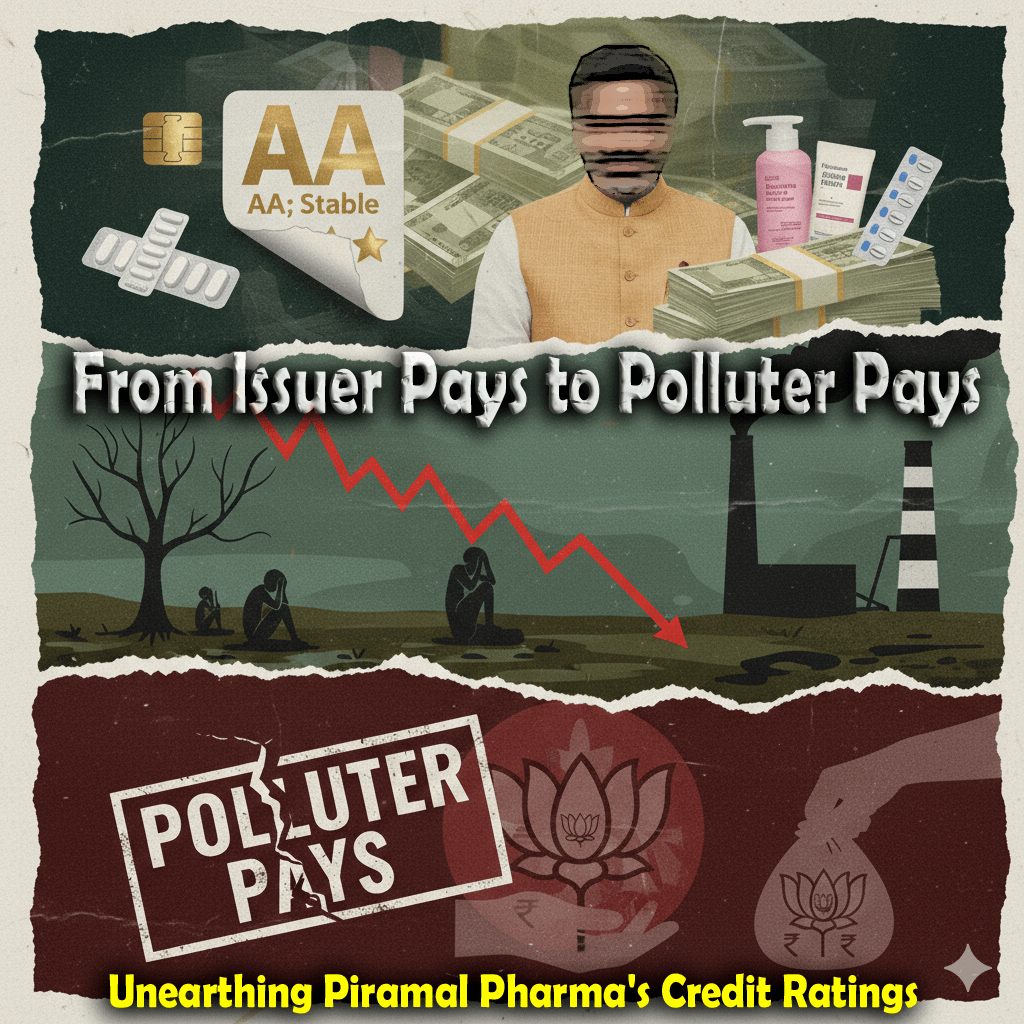
3. Tying It All Together: The Issuer-Pays to Polluter-Pays Continuum
The issuer-pays model in credit ratings and the polluter-pays principle in environmental law represent two sides of corporate accountability—or the lack thereof. For PPL, high ratings under issuer-pays gloss over financial vulnerabilities and governance failures, much like how crony protections dilute polluter-pays enforcement in Digwal. This continuum enables systemic expropriation: investors fund shaky debts, villagers endure health crises, and the Piramal empire thrives on connections. Reforms—such as investor-funded ratings and stricter political donation transparency—are urgently needed to dismantle this hypocrisy.
| Feature | Piramal Pharma Ratings | Alignment with Blog Critique & Digwal Context |
|---|---|---|
| Strengths Factored | Stable profile, global facilities, improved coverage. | Emphasizes metrics over risks, manufacturing trust—while ignoring Digwal’s pollution as “immaterial.” |
| Weaknesses Overlooked | Losses, high debt, low ROE; environmental fines, health crises. | Conflicts enable delayed recognition of fragility; crony BJP ties (Rs 85 cr donations) ensure impunity. |
| Systemic Risk | Enables borrowing amid stress and pollution. | Facilitates potential expropriation via crony ties—villagers’ “massacre” as collateral for Piramal’s gains. |
This table distills the core hypocrisy at the heart of Piramal Pharma’s story: credit ratings engineered to project strength while deliberately blind to both financial decay and environmental carnage, all sustained by the same crony networks that turn “polluter pays” into a slogan and “issuer pays” into a license for expropriation.
In the end, the real rating that matters isn’t coming from CARE, CRISIL, or ICRA—it’s the one written in the poisoned wells of Digwal, the crashing share price, and the silent suffering of villagers who never asked to be collateral damage in a billionaire’s empire-building game. Until the system is fundamentally reformed, the cycle will continue: high ratings for the connected, high costs for everyone else.
SEE ALSO:
Mouthshut Review: Piramal Pharma
https://m.mouthshut.com/review/tri-activ-triple-protection-really-review-qrmqtqoqpop
https://m.mouthshut.com/review/a-dangerous-product-with-corporate-legitimacy-review-usomrqoqpophttps://m.mouthshut.com/review/shangh-ai-secrets-of-a-crony-giant-review-omupurpppop
https://m.mouthshut.com/review/piramal-pharma-false-relief-review-trunronnpop
https://m.mouthshut.com/review/tetmosol-and-lacto-calamine-otc-dangers-review-mnlmponnpop
https://m.mouthshut.com/review/saridon-quick-fix-deep-concerns-review-orotuosmpop
https://m.mouthshut.com/review/expensive-urine-nothing-more-review-qpnpuqompop
https://m.mouthshut.com/review/heritage-brand-or-hidden-hazard-review-rutptqompop
 Once in a Blue Moon Academia
3 Comments