

Posted on 17th September, 2024 (GMT 16:09 hrs)
Updated on 24th November, 2024 (GMT 15:40 hrs)
ABSTRACT
The article “The Modani Saga: The Failed State of India” critiques the state of financial as well as political governance in India, focusing on political corruption, financial mismanagement, growing crony-monopoly practices, and the over-polarization between the wealthy and the poor (1% versus the other 99%). It highlights the influence of powerful business figures, focusing particularly on Mr. Gautam Adani in terms of his questionable as well as controversiable business deals in and outside India, whereof it could be seen that Adani is running after shaping policies for personal profits at the cost of nature’s rights and people’s rights. The piece argues that India’s democratic and financial institutions such as the SEBI are eroding, and the country is spiraling into a “failed state” due to a lack of accountability and governance failures as revealed through reports released by Hindenburg Research Team.
I. Unwinding the Crony Connections: What’s Up With the Hindenburg Reports?

The Adani Group headed by Gautam Adani is long known for its close ‘quid-pro-quo‘ (‘you scratch my back, I scratch yours’ policy) ties with the present ruling party of India, i.e., the Bharatiya Janata Party (BJP), along with Mukesh Ambani. Altogether, they are the infamous “Gang of Four”, the “Hum Do Humare Do” in Indian state-corporate nexus that is constantly moving towards the goal of complete privatization through disinvestment of all public sectors, thereof increasing the frequency of bankruptcies in the PSUs in the past decades, leading to the huge loss of public money at the cost of enriching the Adani-Ambani duo’s profiteering interests. This burning issue centering on Adani (who hails from the same state as the Indian PM: Gujarat; without being parochial, this is an interesting occurrence to be noted: most of the superrich wilful defaulters, who are roaming around scot-free, are Gujaratis! Coincidence?) came to the forefront of the Indian politico-economic spectrum with the release of the much-controversial Hindenburg Report in 2023, followed by the political opposition’s rallying protests inside and outside the legislature, alleging (with justified evidence) the rise of crony capitalist oligarchy in India that makes the rich richer at the cost of making the poor poorer. Let us revisit the background once again, for the sake of reminding and sounding the warning-calls.
a) The First Report: On January 24, 2023, Hindenburg Research, a US-based forensic financial research firm, released a bombshell report accusing the Adani Group of orchestrating the “largest con in corporate history.” The report followed a two-year long investigation and was published just days before Adani Enterprises’ $2.5 billion public offering.
The report claimed that Gautam Adani, the group’s chairman, accumulated over $100 billion in wealth largely due to an 819% spike in stock prices across the group’s seven key companies. Hindenburg alleged that this growth was built on stock manipulation, accounting fraud, and excessive debt, with shares of inflated stock pledged for loans, putting the group at risk of financial instability.
Key figures in the allegations also include Gautam Adani’s brothers, Rajesh and Vinod Adani. Rajesh Adani was accused of involvement in a diamond trading scheme and has faced arrests for forgery and tax fraud. Vinod Adani allegedly controls a complex network of (at least) 38 offshore shell companies used for stock manipulation and money laundering purposes.
The report concluded with 88 pointed questions for the Adani Group to answer, challenging its transparency and hinting that the conglomerate’s operations may have gone unscrutinized due to fear of reprisals. Hindenburg opined that the group’s practices amount to a “flagrant fraud in broad daylight.”
SOURCE: What is Hindenburg Report? VIEW HERE ⤡ (©Business Standard)
Hindenburg Research’s report set off an over $150 billion selloff in the Adani conglomerate’s stocks despite the company’s denials of wrongdoing. The Adani group designated the report as entirely baseless and called the allegations as mere “unsubstantiated speculations”.
b) The Second Report: The latest Hindenburg report in August 2024 has sparked another controversy (being called the Hindenburg 2.0) by raising questions about potential conflicts of interest in the investigations into the Adani group’s fraudulent activities. The report specifically alleges that Madhabi Puri Buch, the chairperson of the Securities and Exchange Board of India (SEBI), had previously invested in the offshore funds linked to Vinod Adani, along with her husband Dhaval Buch (having stakes in the obscure Bermuda and Mauritius funds). By citing certain whistleblower documents, Hindenburg alleged in this second report that Buch and her husband invested in one of these sub-funds in 2015 and exited in 2018. This accusation has gained credibility due to prior concerns raised by a Supreme Court-appointed panel in March 2023, which noted the SEBI’s struggles in tracking offshore funds associated with the Adani group.
SOURCE: Who is Madhabi Puri Buch? The SEBI chief allegedly embroiled in Hindenburg’s latest Adani report VIEW HERE ⤡ (As reported on 11th August, 2024 ©The Economic Times)
SEE MORE: India’s Adani vs Hindenburg Research: What you need to know VIEW HERE ⤡ (As reported on August 12, 2024 ©Reuters)
In each case, the ruling group of India headed by the BJP came to tag the Hindenburg Team’s efforts as nothing more than an “anti-India” campaign to tarnish India’s image on a global forum, being funded by the “controversial” George Soros and his associates. However, the central questions have remained and were somewhat ignored by the agencies held accountable. In January 2024, India’s Supreme Court announced that the Adani Group would not face additional investigations beyond the ongoing review by the market regulator SEBI. This decision brought relief to the Adani conglomerate in the aftermath of the first Hindenburg report.
SOURCE: India’s Adani wins court relief on scrutiny after Hindenburg attack VIEW HERE ⤡ (As reported on 3rd January, 2024 ©Reuters)
In July 2024, i.e., just before the second Hindenburg report that linked SEBI’s chairperson to Adani, the Supreme Court of India dismissed a petition seeking a review of its aforementioned January ruling, which had upheld the SEBI’s investigation into allegations of stock manipulation and fraud against the Adani Group. The court reaffirmed that the SEBI probe found “no evidence” of a systemic market-level threat due to Adani’s activities. The review petition argued against the efficacy of SEBI’s findings but the same was rejected by the court.
SOURCE: SC rejects plea to review its January verdict upholding SEBI probe into Adani-Hindenburg case VIEW HERE ⤡ (As reported on 15th July, 2024 ©The Hindu)
Why is the BJP and the Supreme Court of India so eager to defend this Adani conglomerate? Why is there such a drive within the ruling oligarchy to equate Adani with India, as pointed by the political opposition of India? The answer to these was given in a nutshell in the introductory paragraph— but further crucial inquiries are necessitated in this regard.
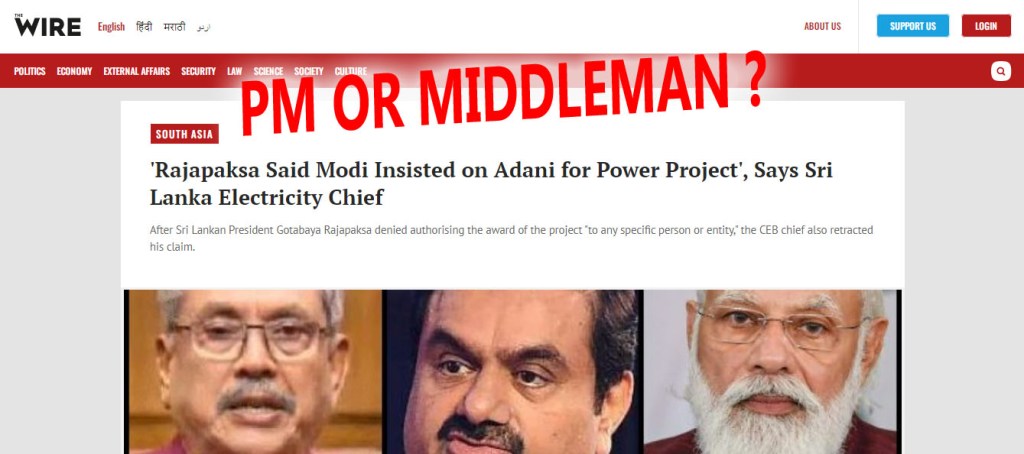
One remembers how Modi himself helped Adani to push a corporate deal in Sri Lanka in 2021:
Furthermore, these crony connections are seen in many similar respects over the past decade or so, and the correlations-as-causations can be drawn quite easily where the PM figures as nothing more than a middleman for Adani-Ambani and their family members:
PM Modi gave several infra projects to Adani in last 10 years: Rahul Gandhi VIEW HERE ⤡ (As reported on 10th May, 2024 ©Hindustan Times)
India’s Adani Group rallies on infrastructure bets as Modi seen retaining power VIEW HERE ⤡ (As reported on 3rd June, 2024 ©Reuters)
Furthermore, lending large tracts of governmental lands for Adani’s projects such as SEZ and/or ports has also been done by the BJP government in the “home-state” of Gujarat:
Adani Group got land at cheapest rates in Modi’s Gujarat VIEW HERE ⤡ (As reported on 26th April, 2014 ©Business Standard)
Was PM Modi lobbying for an Adani port in Greece? VIEW HERE ⤡ (As reported on 27th August, 2023 ©National Herald)
However,
108 Hectares of Land Allotted to Adani Ports to be Retrieved For Cattle Grazing: Gujarat Govt to HC VIEW HERE ⤡ (As reported on 9th July, 2024 ©The Wire)
Do not we remember what these ports are primarily being used for? Let us remind you all once again:
Heroin Seizures at Adani’s Mundra Remain a Source of Worry for Indian Authorities VIEW HERE ⤡ (As reported on 3rd August, 2022 ©The Wire)
India’s highest-ever drug bust: 3,300 kg narcotics seized off Gujarat coast VIEW HERE ⤡ (As reported on 28th February, 2024 ©Business Standard)
Interestingly enough, the Adani Group walked away from the Tajpur port project in West Bengal primarily due to “economic unviability”. The nearby Dhamra and Paradip ports could handle the traffic the Tajpur port was meant for, reducing its greedy profitability. Other concerns as reported by the Adani Group included Bengal’s poor industrial climate, inefficient land acquisition policies, and “political interference”. Additionally, Adani was put off by the political allegations from Trinamool MP Mahua Moitra, which the CM Mamata Banerjee did not address, leading to the decision to exit the project.
Explained: Why Adani Group Decided To Walk Away From The Proposed Tajpur Port Project In West Bengal VIEW HERE ⤡ (As reported on 23rd November, 2023 ©India Infrahub)
Despite that, Adani Ports and Special Economic Zone (APSEZ) has secured a five-year contract to operate and maintain the Kolkata Port. The deal involves managing the port’s operations, including cargo handling and logistics.
Adani Ports bags 5-year operation and maintenance contract at Kolkata port VIEW HERE ⤡ (As reported on 7th June, 2024 ©The Economic Times)
The mega-dam Farakka in Murshidabad, West Bengal, India, was established in 1972 to enhance Kolkata Port’s water-supply. However, this single-purpose dam causes massive over-flooding as well as large-scale sedimentation in the geo-political areas of Jharkhand, Bihar, West Bengal and Bangladesh.
Let us now move towards a particular area of focus, i.e., the SEBI’s role.
II. SEBI’s Involvements: A Further Glance
After the second-report by Hindenburg Research, Buch clarified that her investments in the IPE-Plus Fund 1 (a fund allegedly involved in money laundering schemes) were made personally before her role as the SEBI chief, and that all relevant disclosures were made. It was said by her that the fund itself confirmed that it had not invested in Adani Group shares. SEBI’s spokesperson backed Buch’s statement and urged investors to stay calm and diligent, particularly in light of the Hindenburg report. SEBI has allegedly/reportedly completed its investigation into 23 of 24 issues related to the Adani Group, and six Adani companies have received show cause notices, indicating potential disciplinary action unless adequate responses are given. Additionally, SEBI issued a show cause notice to Hindenburg for violating Indian regulations, which Hindenburg disclosed in July.
SOURCE: EXPLAINER-Adani vs Hindenburg Research: What you need to know VIEW HERE ⤡ (As reported on 12th August, 2024 ©The Economic Times)
However, it cannot be forgotten that Hindenburg’s report accused Buch of transferring control of these offshore investments to her husband shortly before her appointment to SEBI, suggesting potential conflicts of interest in the regulator’s probe into the Adani Group. Dhaval Buch wrote to the Mauritius fund administrator (Trident Trust) in March 2017 and sought to become the “sole person authorised” to operate the said accounts. The development came just weeks ahead of his wife’s appointment as a ‘whole time member’ of the SEBI. Why is this the case? Between April 2017 and March 2022, Madhabi Puri Buch (by then a whole time employee of SEBI) had reportedly held “a 100% interest in an offshore Singaporean consulting firm called Agora Partners. Her shares were transferred to her husband two weeks after her appointment as the SEBI chief. The offshore Singaporean entity still remains exempt from disclosing its financial statements.
The Hindenburg Report stated: “Documents show SEBI Chairperson Madhabi Buch and her husband had stakes in a multi-layered offshore fund structure with miniscule assets, traversing known high-risk jurisdictions, overseen by a company with reported ties to the Wirecard scandal, in the same entity run by an Adani director and significantly used by Vinod Adani in the alleged Adani cash siphoning scandal.”
SOURCE: Explosive new Hindenburg report links Sebi chief Madhabi Puri Buch to ’offshore funds used in Adani scandal’ | 10 points VIEW HERE ⤡ (As reported on 11th August, 2024 ©Mint)
The earlier Panama Papers investigation, led by the International Consortium of Investigative Journalists (ICIJ), exposed a vast global network offshore companies and secret financial dealings involving politicians, celebrities, and business leaders. The leaked documents revealed how the wealthy use offshore tax havens to conceal assets, evade taxes, and, in some cases, launder money. This has led to significant legal and political consequences worldwide, including resignations and reforms. However, did those reforms ever materialize? If they did, these Adani-SEBI connections would not have come to the forefront like this! (SOURCE: The Panama Papers Exposing the Rogue Offshore Finance Industry VIEW HERE ⤡). The same agency also came up with the “Pandora Papers“. The said papers reveal secret financial dealings of global elites, including politicians, billionaires, and celebrities, through offshore companies and tax havens. The investigation highlights how these individuals use such systems to hide assets, evade taxes, and shield their immense wealth. (SOURCE: Pandora Papers VIEW HERE ⤡ ⤡) The Buch couple, like many other superrich persons, seems to be looking after such “tax havens” after all!
The Buch couple has denied these allegations of Hindenburg, stating that their investment was unrelated to Adani Group companies and was made while they were private citizens in Singapore. They have also labeled the report as an attempt at character assassination.
Investment cited by Hindenburg made two years before Madhabi joined Sebi: Buchs VIEW HERE ⤡ (As reported on 11th August, 2024 ©India Today)
The Adani Group said that Hindenburg’s allegations were red herrings and that the short-seller was attempting to violate Indian securities laws.
Even after such express denials and attacks, it has to be kept in mind that the second Hindenburg report highlighted potential regulatory leniency or partiality by the SEBI toward the Adani Group, specifically questioning whether Buch’s ties to these offshore funds influenced the regulator’s stance in not taking any meaningful or significant long-term actions against the Adani Group from 2023 to 2024, over and above what appears to be its lip-service “probes”.
Should not the Supreme Court of India look further into whether SEBI is in fact meeting its duties as an “independent” regulatory authority or is merely whitewashing the “sins” of the Adani Group, because of the said conflict of interest so disclosed?
Moreover, The Indian National Congress has recently accused the SEBI chief Madhabi Puri Buch of earning crores through consultancy firms linked to companies like Mahindra & Mahindra and ICICI Bank, allegedly in violation of conflict-of-interest rules and illegally holding parallel offices of profit simultaneously. Pawan Khera highlighted that Buch’s firm, Agora Advisory, continued to generate revenue even after she took office at SEBI. Congress is pushing for a further investigation, claiming ethical breaches and undisclosed financial ties during her leadership. Buch has denied the allegations, stating that her firm’s operations became dormant after her SEBI appointment, which, however, seems quite insubstantial given the evidential records.
Cong says Sebi chief Madhabi Puri earned crores from Mahindra & Mahindra, ICICI, others. Check 5 top details VIEW HERE ⤡ (As reported on 10th September, 2024 ©Business Today)
Where lies the SEBI’s financial accountability, given these conditions?
III. Adani’s Global Reputation: Far From Being an MNC?!
Going back to the controversial crony business-tycoon, Adani, let us now move a little beyond what the Hindenburg Reports alleged and try to assess Adani’s global image or reputation as a businessperson.
We will not be taking all instances into consideration, but only a few that raise the utmost concerns about the state of Indian political economy.
The Stop Adani Campaign (2012-2022) was a significant movement aimed at halting the Adani Group’s Carmichael coal mine project in Queensland, Australia. The campaign’s efforts centered around preventing new coal infrastructure and mitigating its climate impacts, such as allowing coal sludge to pollute the Great Barrier Reef and failing to prepare for flooding. The Adani Carmichael mine was also expected to increase Australia’s contribution to international carbon emissions. Adani was also convicted for providing misleading information to the Queensland Government about land-clearing.
Activists of #StopAdani employed various strategies drawing on ecological sensitivity, including grassroots mobilization, offline and online protests, divestment campaigns, and courtroom challenges. The campaign succeeded in generating widespread public awareness, delaying the mine’s development, and securing commitments from many institutions to divest from fossil fuels, though the mine eventually proceeded at a much smaller scale.
Australian Campaign Case Study: Stop Adani, 2012 – 2022 VIEW HERE ⤡ (©The Commons)
Even the protesting farmers in India joined their hands with #StopAdani, given the fact that the repealed farm laws (and other intended legislations previously) were formulated to give the entire farming industry into the hands of Adani and Ambani for yielding their profits in negation of the minimum interests of life and livelihood of the tillers of the land.
Farmers join fight against Adani coalmine over environmental concerns VIEW HERE ⤡ (As reported on 29th June, 2017 ©The Guardian)
How two of India’s richest men became the target of farmer boycotts VIEW HERE ⤡ (As reported on 23rd January, 2021 ©Fortune)
The #StopAdani Movement was thereby connected to the resistance via web-based tools by one of our OBMA activists against Adani’s Deucha-Panchami Open-Pit Coal Mine Project in Birbhum, West Bengal, India, as the same infringes ecological entitlements through biodiversity loss, groundwater depletion, increased pollution etc., and also promotes resource extractivist motives at the time of anthropogenic climate catastrophe as well as implies the displacement of over 21,000 people, mainly Adivasis, Dalit, and Muslim communities as “climate or ecological refugees”. In this case, Project Affected People’s Association (PAPA)⤡ ⤡ is instrumental enough in catalyzing the #StopAdani campaign.
No to the Deucha-Panchami Coal Block in West Bengal! VIEW HERE ⤡ (As reported on 27th March, 2024 ©International Socialist Alternative)
Previously, Adani’s Rampal electricity project in Bangladesh involved the import of coal from Australia to power a plant that will generate non-renewable electricity for Bangladesh. The deal has raised concerns due to the high costs associated with purchasing power from Adani’s coal-based plant in India. The contract includes expensive capacity charges, which make electricity pricier for Bangladesh even when power is not fully utilized, increasing the overall burden on consumers.
How questionable Adani deal makes electricity costlier VIEW HERE ⤡ (As reported on 20th August, 2024 ©The Business Standard)
A large scale resistance emerged against this power-plant project as well, who declared: The (সুন্দরবন ধ্বংস করে রামপাল বিদ্যুৎকেন্দ্র চাই না/ We don’t want Rampal thermal power plant by destroying Sundarban in Bangladesh!) ⤡ against this project under the governance of Sheikh Hasina (who is now a political refugee in India) was in vein in as early as 2o23. The protesters highlighted similar environmental concerns whereby it was argued that relying on imported coal power, especially from a foreign entity, exacerbates Bangladesh’s dependency on fossil fuels and increases energy costs, further burdening the ecology and economy. Even the contract signed for this project was done with proper review, many have alleged.
More importantly, the environmental activists involved in this movement against Rampal Project have warned the authorities and concerned agencies about the risk of losing the Sundarbans due to coal-based power plants being developed nearby and gave the slogan: “Save Sundarbans, Save Bangladesh“. They highlighted concerns about the potential negative impacts on the already dilapidated ecosystems, wildlife, and indigenous human communities. Despite legal battles and opposition, the projects are moving forward, putting the world’s largest mangrove forest and a UNESCO World Heritage Site in severe danger.
Risk of losing Sundarbans VIEW HERE ⤡ (As reported on 3rd September, 2016 ©The Daily Star)
However, the movement did not have that much of an impact in so far as Adani’s domination over the area was concerned.
Why the Movement Against the Rampal Power Plant in Bangladesh Failed VIEW HERE ⤡ (As reported on 3rd March, 2023 ©The Wire)
After the recently changed political landscape in Bangladesh, the Adani Group is reportedly pressuring Bangladesh’s interim government to settle an $800 million debt for electricity. However, instead of ending the contract abruptly, the government should hold off on payment and bring in international experts to review the controversial deal. The current administration has said that it is not obliged to uphold agreements made by the previous government, especially one elected through a supposedly “disputed” election, according to their perception.
How should Bangladesh deal with Adani’s $800m outstanding bill? VIEW HERE ⤡ (As reported on 14th September, 2024 ©The Daily Star)
Adani’s anti-environmental, anti-green projects are rampant, widespread and ever-continuing. Even so, resistance is also contagiously constant and never subservient to the environmental terrorist (in the negative/ derogatory understanding) mega-plans of cronies such as Adani.
Adani has a worldwide track-record for violating human rights and environmental rights, the details of which can be found on the following links, which were brought to the fore with the #StopAdani campaign, years before the Hindenburg revelations:
Dossier exposes Adani Group’s appalling record VIEW HERE ⤡ (As reported on 19th November, 2020 ©Adani Watch)
It is time to move on again without essentially deviating from this very context…
IV. “Re-developing” Dharavi (?)
Given his global past career in trampling upon nature’s rights and people’s rights, Adani’s recent attempt to bring forth the “Dharavi Redevelopment Project” rises fresh burning concerns regarding this crony and monopoly capitalist’s destructive plans in “transforming”, or rather, corporatizing Asia’s biggest slum situated at Mumbai, Maharashtra, India.
Let’s see what the said project is all about:
The Dharavi Redevelopment Project, led by Adani Realty under the Dharavi Redevelopment Project Private Limited (DRPPL), has started work to relocate eligible residents to new housing in Matunga. The plan involves constructing 20-25 storey buildings on six acres of land, with five levels of basement parking. Residents whose homes were built before January 2000 will receive free housing, while others will be relocated. The redevelopment aims to transform Dharavi’s 240-hectare slum area with modern amenities and housing “for those who qualify”.
SOURCE: Dharavi Redevelopment: What You Need To Know About The New Housing Plans VIEW HERE ⤡ (As reported on 16th September, 2024 ©OneIndia)
It has been reported that the construction has begun on housing buildings in Matunga for the relocation of Dharavi residents as part of this Project. These buildings will provide housing for residents whose homes are impacted by the massive redevelopment initiative. This marks a key step in transforming Dharavi, one of Mumbai’s largest slum areas, into a so-called “modern residential and commercial hub” (?).
SOURCE: Dharavi redevelopment: Work begins on moving residents to Matunga VIEW HERE ⤡ (As reported on 16th September, 2024 ©Hindustan Times)
However, this move has been largely criticized by conscious political activists in pointing out the fact that the same is a deliberate attempt to have monopolized corporate control-dominance over people’s lives in a purportedly “Adani City”, thus deviating again from the socialist underpinning of the Indian nation-state that has aimed to avoid the concentration of wealth in fewer hands. Adani is simply aiming to profit more at the cost of this resituating initiative of projecting himself as the metaphorical feudal lord of this contemporary “Manor Farm”!
Earlier, the Congress party has alleged political favoritism or crony partnership with “undue incentives” regarding the Dharavi Project. Congress had accused the Eknath Shinde-led, NDA-member Maharashtra government of particularly favoring Adani in awarding the contract, but the Adani Group (as usual) stated that the project was secured through a transparent, competitive bidding process.
One of the parties in the I.N.D.I.A. coalition, i.e., Shiv Sena (UBT), has argued that the state government has given Adani favorable terms in the use of Transferable Development Rights (TDR), which could significantly benefit the company in advancing its narrow vested interests. The government also reduced the mandatory TDR purchase requirement from 80% to 40%, which critics see as a major concession.
The Maharashtra government’s decision to award the 259-hectare Dharavi redevelopment project to the Adani Group alone has raised significant concerns among even the residents of Dharavi. Many are worried about the uncertainty surrounding their homes and livelihoods. A key issue is the potential displacement of residents who rely on local businesses for their survival. Since many structures house both tenants and owners, some fear that if these buildings are demolished, residents might receive only a single replacement room, which would be inadequate for multi-family households.
The local economy, consisting of small businesses such as food vendors, leather makers, and imitation jewelry producers, could also be severely impacted due to this project. Over 80% of Dharavi’s residents are involved in local industries, and the fear is that redevelopment will result in the permanent termination or closure of these small-scale units, threatening the livelihoods of thousands at once.
These residents have also expressed concerns that the project is primarily designed to benefit the developer rather than the community. They criticize the top-down approach of the project, which does not consider their needs or livelihoods. Residents argue that the redevelopment prioritizes profit over community welfare, with a lack of consultation, risking their homes, jobs, and social ties. Adani Group is expected to profit significantly from this project especially through the sale of a large portion of the redeveloped land. Many believe that a fresh survey, with a more recent cut-off date for eligibility, is a much-needed step to ensure that all residents are fairly compensated.
SOURCES:
Why Are Dharavi’s Residents Protesting Adani’s Redevelopment Plan? VIEW HERE ⤡ (As reported on 18th January, 2023 ©The Swaddle)
Dharavi residents fear uncertainty about houses, livelihood after Maha govt’s nod to Adani firm for redevelopment project VIEW HERE ⤡ (As reported on 15th July, 2023 ©The Economic Times)
Adani Group’s Dharavi Redevelopment Project refutes Congress’s allegations of favouritism VIEW HERE ⤡ (As reported on 19th November, 2023 ©The Hindu)
Why non-starter Dharavi revamp is embroiled in a political battle over ‘incentives’ to Adani VIEW HERE ⤡ (As reported on 9th December, 2023 ©The Print)
V. Connecting, Coordinating, Associating the Resistance Against Crony Private Capital
In Conclusion, it can be said that all the above instances reflect the crony, monopoly, cannibalistic, savage, pre-debt-or face(s) of capitalism. In the very case of the geo-political area of India or in other countries, where the Modani (Modi+Adani) gang is operating, the political economies as well as natural geographies are seriously at stake. The call of the hour is to coordinate amongst the resistance movements that fire up against the free flow of private capital within the foreclosed zone of market fundamentalism through both online and offline means of mobilization. In that way, the sterile dystopia of capitalist “realism” (?) shall suffers great blows in the face of people’s resistance.
SEE ALSO:
ENDNOTES
1. It is to be kept in mind that it was once alleged a couple of years back that a certain “Himalayan Yogi” was controlling the National Stock Exchange (NSE) in India for years. What was the SEBI doing throughout all that time in meeting its regulatory duties?
Himalaya yogi ran India’s top bourse NSE as puppet master, SEBI says VIEW HERE ⤡ (As reported on 14th February, 2022 ©Mint)
2. Mr. Ajay Piramal (who is also Mr. Mukesh Ambani’s Secondary Kin), the alleged adverse possessor of the DHFL, was previously accused of insider trading by the SEBI⤡. Recently, the SEBI has again targeted Piramal for the following:
The Securities and Exchange Board of India (SEBI) issued an administrative warning to Piramal Enterprises regarding its June 2023 sale of a 8.34% stake in Shriram Finance. SEBI flagged that the company did not treat the transaction as unpublished price sensitive information (UPSI), a requirement under Regulation 30 for material disclosures. Piramal had previously communicated its intent to divest in Shriram publicly, but SEBI sought clarification on the handling of this information.
SOURCE: ‘Administrative warning’ for Ajay Piramal’s company – What’s behind SEBI’s action? Impact on share price VIEW HERE ⤡ (As reported on 4th April, 2024 ©ET Now Digital)
Please note that Adani Capital was possibly a “dummy bidder” in the DHFL resolution process!
UPDATE (24/11/2024): THE CRONY BRIBING SCENARIO
Quite recently, Indian billionaire Gautam Adani has faced a U.S. indictment for orchestrating a $250–265 million bribery scheme to secure renewable energy contracts in India between 2020 and 2024. Federal prosecutors allege that Mr. Adani and associates bribed officials, falsified records, and violated the U.S. Foreign Corrupt Practices Act, raising $3 billion under false pretenses. Financial Journalist Sucheta Dalal noted that Mr. Adani concealed an FBI raid and DOJ probe in 2023. The growing controversy has impacted Adani Group’s market value and prompted calls for investigations into his close crony ties with Prime Minister Modi, though (expectedly) Mr. Adani denies all these allegations.
For more information, view the following:
 Once in a Blue Moon Academia
7 Comments