
Posted on 06/12/2022
Updated on 23rd September, 2024 (GMT 17:55 hrs)
- License: CC BY 4.0
- DOI: 10.13140/RG.2.2.24656.58884/2
INTRODUCTORY REMARKS
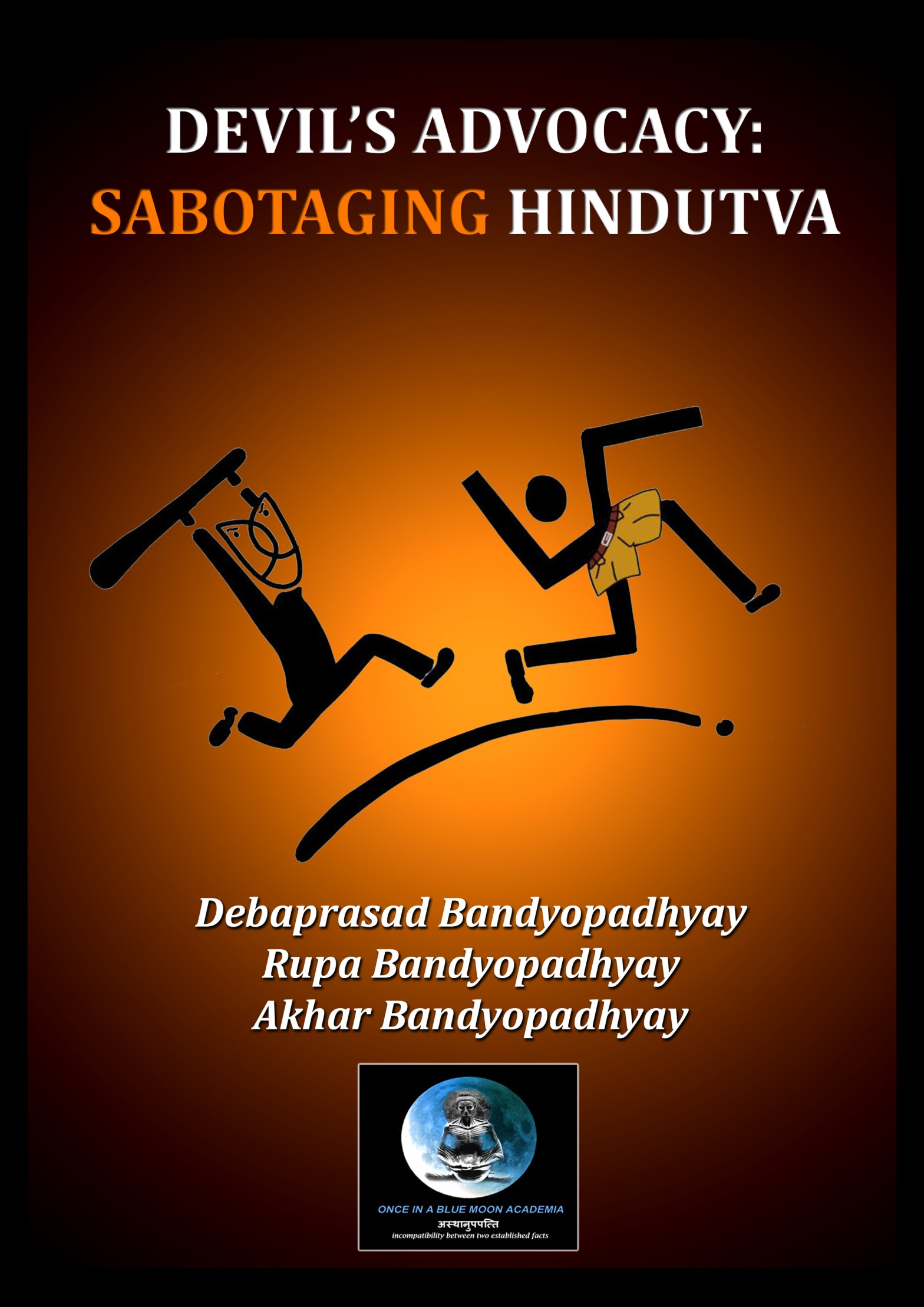
Devil’s Advocacy: Sabotaging Hindutva is an anti-fascist critique of the ideological and political underpinnings of Hindutva, the extremist nationalist ideology in India. The authors critically examine the contradictions inherent in Hindutva, which attempts to impose a uniform Hindu identity despite India’s immense religious, linguistic, and cultural diversity.
Key Themes:
- The Construction of Hindutva: Hindutva, propagated by the Sangh Parivar, is shown as an attempt to emulate and mirror Judeo-Abrahamic religions by creating a monolithic Hindu identity. The book highlights that the term “Hindu” itself is relatively modern and does not represent an ancient unified religious or cultural identity, countering the claim that Hindutva is historically rooted.
- Contradictions within Hindutva: The authors emphasize the self-contradictory nature of Hindutva. While presenting itself as a unified ideology, it simultaneously incorporates polytheistic, idolatrous elements that conflict with its aim of homogenization. The book delves into how Hindutva advocates often contradict their own religious texts and practices, selectively appropriating aspects to support a political agenda.
- Critique of the Uniform Civil Code (UCC): A significant focus is placed on the push for a Uniform Civil Code in India, primarily targeting Muslim communities, while ignoring the heterogeneity within Hindu society itself. The authors argue that Hindutva’s demand for UCC is a tool for imposing cultural and religious uniformity, undermining India’s pluralistic fabric.
- Capitalism and Hindutva: The book critiques the economic policies of the Bharatiya Janata Party (BJP), arguing that their alliance with Hindutva ideology is driven more by capitalist interests than religious motivations. The authors label BJP as “capitalist schizophrenics,” highlighting their internal contradictions between their religious rhetoric and their capitalist practices.
- Theocratic Pseudo-Science: The authors mock the pseudo-scientific claims promoted by Hindutva proponents, suggesting their ideas are not based on scientific rigor but rather ideological posturing. The book humorously nominates Hindutva ideologues for the Ig Nobel Prize, criticizing their irrational beliefs being presented as fact.
- Religious Fundamentalism as a Distraction: The ruling party is accused of using religious fundamentalism to divert attention from critical issues such as unemployment, inflation, and corruption. Through temple-building campaigns and other symbolic gestures, Hindutva attempts to mask deeper economic and social crises.
- Suppression of Dissent: The book discusses the increasing authoritarianism of the Hindutva regime, which suppresses free speech, imprisons dissenters, and perpetuates an atmosphere of fear. It draws parallels between the current government’s methods and historical fascist regimes, critiquing the rise of illiberal democracy in India.
- Caste and Gender in Hindutva: Hindutva’s treatment of caste and gender is examined critically. Despite its claims of promoting a unified Hindu society, Hindutva reinforces caste hierarchies and patriarchal structures, marginalizing lower castes and women.
The authors position their critique within a broader anti-fascist, anti-capitalist framework, advocating for pluralism, resistance to authoritarianism, and intellectual rigor in opposing Hindutva. The book mixes satire, critical theory, and empirical analysis to dismantle the ideological foundations of Hindutva and call for political action against its rise.
Abstract
In the course of confronting members of the Hindutvavadins’ ruling party in India, we have faced a great problem while conversing with the members of the Sangh Parivar. We were confused with a paradox: The Hindutvavadins do not know what Hindutva is. What are the distinctive features of the Hindutva as preached by the sangh parivar? This question has haunted us as there are many contradictory features within the exonym (the naming of other community by another other) The ruling party is trying to impose a phantasmic Hindutvavada as a legally codified ruling ideology for governing the nation state of India. It is needless to say that India is nothing more than a geo-political entity with variations or diversities. To legalize all these heterogeneities under one umbrella of “Hindutva” is a difficult task to pursue. Especially, in terms of the legal codification of Hindutva, i.e., it is a cherished (as indoctrinated by Hindutvavadins) yet impossible uniformity when it comes to the decision-making of the lawmakers. This book is an attempt to provide the counter-cultural tool to evolve an art of resistance against the all-pervading Saffron Fascism by exposing its inner contradictions across different modules such as caste, gender, food habits, regionalism, property distribution etc.
DEVIL’S ADVOCACY: SABOTAGING HINDUTVA VIEW HERE ⤡ @academia.edu
DEVIL’S ADVOCACY: SABOTAGING HINDUTVA VIEW HERE ⤡ @researchgate
 Once in a Blue Moon Academia
Reblogged this on debaprasad and commented:
#Down_With_Saffron_Fascism
LikeLiked by 4 people
Reblogged this on Rupa Sanyal and commented:
#Down_With_Saffron_Fascism
LikeLiked by 4 people
Reblogged this on DHFL Scam and commented:
#Down_With_Saffron_Fascism
LikeLiked by 4 people
Reblogged this on Partyless Society and commented:
#Down_With_Saffron_Fascism
LikeLiked by 3 people
Reblogged this on Akhar Bandyopadhyay and commented:
#Down_With_Saffron_Fascism
LikeLiked by 2 people
Reblogged this on Occupy Dalal Street and commented:
#art_of_resistance_against_autocracy
#BJP_towards__irrational_pseudo_science
#Article_ 51A(h)
LikeLiked by 1 person