
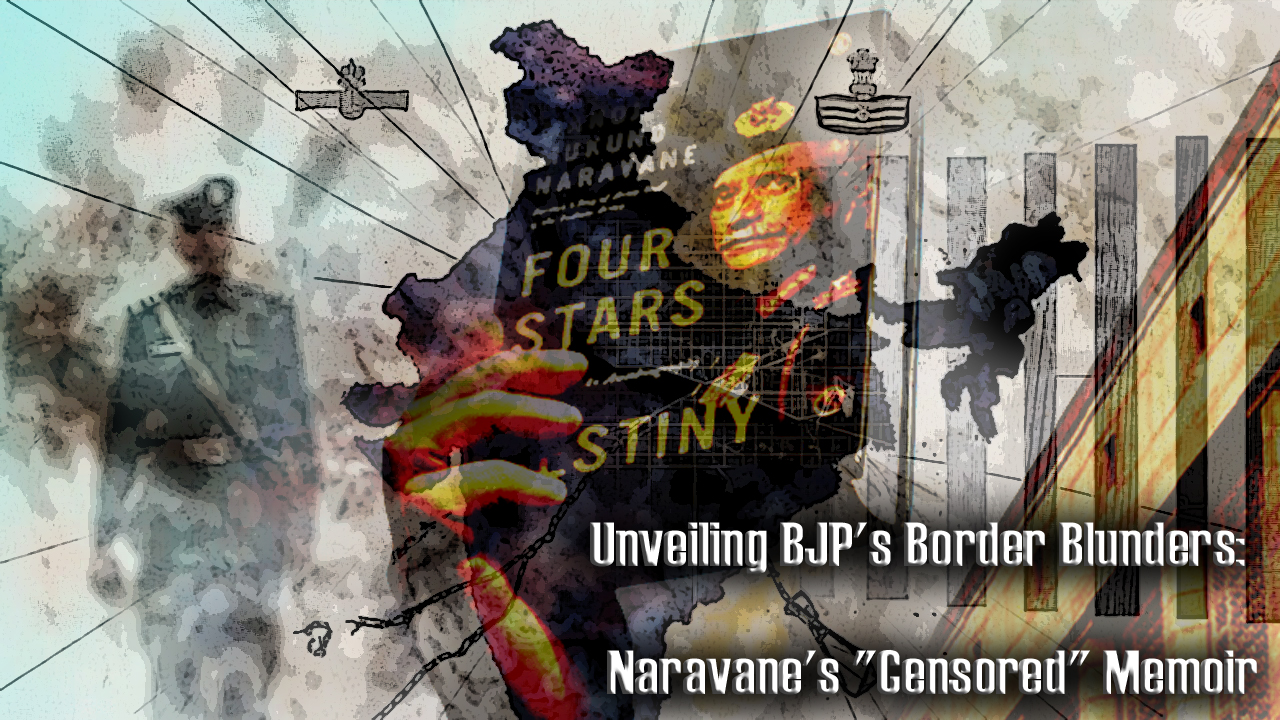
The review examines the “unpublished” (?) book Four Stars of Destiny: An Autobiography by General M.M. Naravane (retd.), former Chief of the Indian Army (2019–2022), in comparative dialogue with three major critical interventions on contemporary Indian state power: the BBC documentary India: The Modi Question, Rakesh Sharma’s Final Solution (2003), and Rana Ayyub’s Gujarat Files: Anatomy of a Cover-Up. While differing in form—military memoir, investigative journalism, and documentary cinema—all four works converge in unsettling dominant state narratives through documented, insider or evidentiary accounts of crisis, violence, and political accountability. The review argues that the prolonged suppression of Naravane’s memoir through bureaucratic delay constitutes a form of de facto censorship analogous to the formal banning, blocking, or marginalization faced by the other works. Read together, these texts reveal a patterned architecture of control in contemporary India, where power manages inconvenient truths not primarily through overt prohibition, but via procedural stalling, digital blocking, market denial, and epistemic delegitimization. The review situates this pattern within broader debates on civil–military relations, communal violence, and the politics of memory, suggesting that the real threat posed by these works lies in their capacity to reinsert ambiguity, failure, and hesitation into an official narrative built on certainty and spectacle.
Tag Archives: BJP
End of Year Bombshell: How BJP-NDA-Hindutva Failed India – A Scathing 2014-2025 Indictment
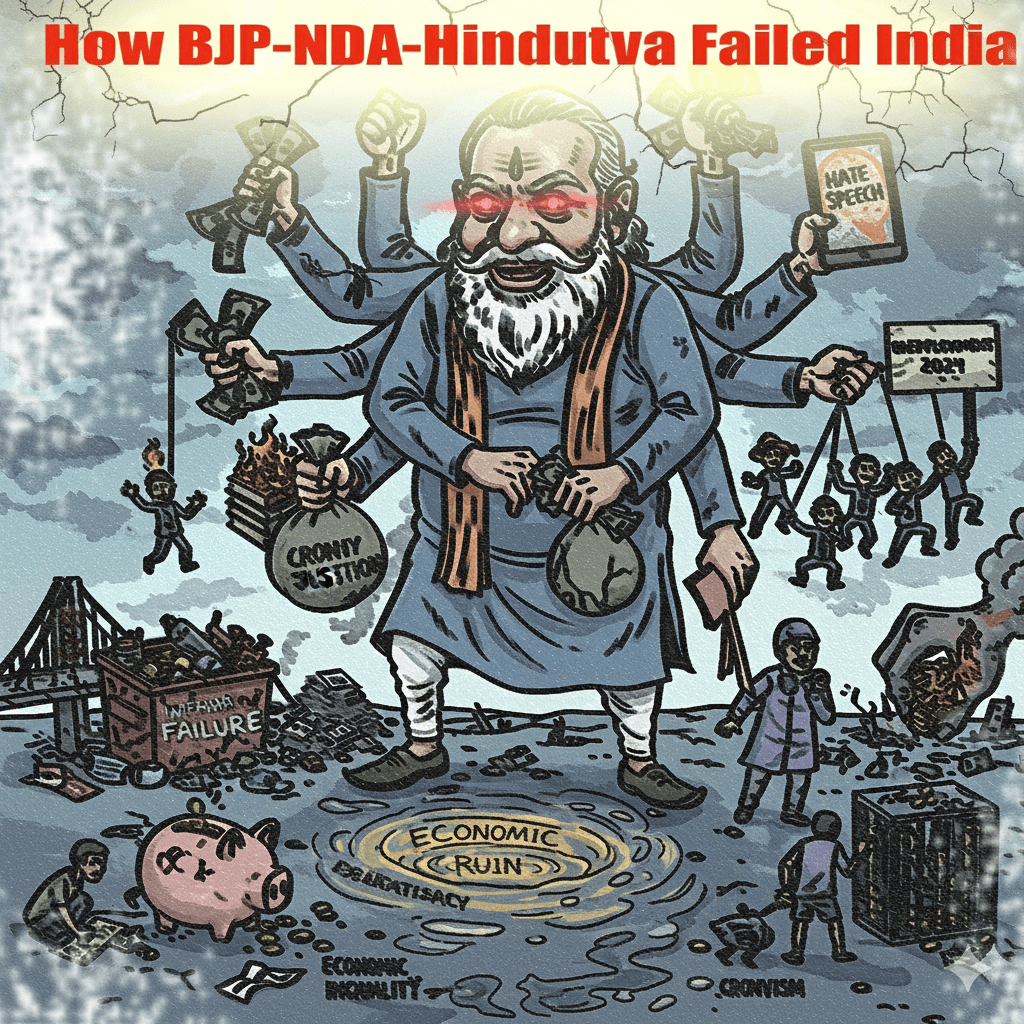
As 2025 draws to a close, this comprehensive dossier documents not a series of discrete policy missteps, but a systemic transformation of governance in India (2014–2025): a shift from democratic accountability to political executive dominance; from evidence-based policymaking to manufactured narrative control; from social protection to structural precarity. Spanning the economy, federalism, data integrity, labour, the natural environment, digital freedoms, education, public health, cultural institutions, civil liberties, and fundamental rights, the record reveals enduring patterns of power centralization, calibrated opacity, selective enforcement, and institutional hollowing—accompanied by crony consolidation and the routinized criminalization of dissent. Democratic indicators decline as surveillance infrastructures expand, grassroots welfare erodes, and truth itself is rendered an object of administrative management. This is not a partisan ledger, but a counter-archive: an evidence-grounded indictment that affirms accountability as the necessary cost of power. In closing the year, it calls for a civic reckoning—not to foreclose debate, but to reclaim and restore it.
Unmasking Electoral Fraud in India: Patterns of Voter Roll Manipulation and Institutional Complicity

This article investigates the phenomenon popularly termed Vote Chori (“vote theft”) in contemporary India, revealing a systemic pattern of voter roll manipulation that challenges the credibility of the world’s largest electoral democracy. Drawing upon verified evidence from Rahul Gandhi’s disclosures, Ajit Anjum’s field investigations, voter testimonies such as that of Punam Kumari, and journalistic reporting from The Wire, the study identifies recurring techniques of disenfranchisement—including bulk deletions, forged Form-7 entries, and centralized, software-enabled tampering. Evidence from Karnataka, Bihar, and Maharashtra demonstrates how digital governance infrastructures, designed for efficiency, have become instruments of exclusion and partisan control. The Karnataka Special Investigation Team’s findings of call-centre operations and monetary inducements (₹80 per deletion) corroborate the allegations of industrial-scale roll manipulation. The Election Commission of India’s opacity and resistance to external audits reveal deeper institutional complicity and democratic erosion. By situating these developments within theoretical frameworks of algorithmic governance and bureaucratic authoritarianism, the paper argues that India’s electoral crisis marks not a failure of democracy per se, but its mutation into a technocratic apparatus of managed consent. The conclusion calls for independent digital audits, legislative oversight, and citizen-led verification systems as urgent correctives to restore electoral legitimacy.
The “Waqf” Controversy and the Silence on “Debutter” Property: A Case of Majoritarianism?

The article critiques the asymmetrical treatment of religious endowments in India, highlighting how Waqf properties—Muslim charitable endowments used for mosques, madrasas, graveyards, and other community purposes—have faced intense scrutiny, legal reforms, and public debates, while Hindu Debutter (or Devottara) properties, which serve similar religious functions and are fraught with similar disputes as Waqf, remain largely untouched. The article discusses the recent Waqf (Amendment) Act of 2025, renamed as the Unified Waqf Management, Empowerment, Efficiency, and Development (UWMEED) Act, which supposedly seeks to modernize and centralize the administration of over 870,000 Waqf properties under state-level Waqf Boards. Although issues like mismanagement, encroachments, and undervaluation plague both Waqf and Debutter assets, legislative attention has been disproportionately focused on Waqf properties. This selective focus raises concerns about majoritarian bias, as it appears to shield Hindu institutions from equivalent scrutiny. The article ultimately argues for equitable and secular governance that holds all religious endowments to the same standards of transparency, accountability, and reform, warning that the current approach may be influenced more by communal politics than by genuine administrative concerns.
DHFL “Scam”? Unmasking Truths Behind BJP’s Political Vendettas

The article examines the closure of the CBI case against DHFL and its erstwhile directors regarding fraudulent home loan accounts, highlighting insufficient evidence to prove criminal conspiracy. Despite allegations of money laundering through fake accounts, the CBI investigation didn’t uncover any conclusive proof. The article also questions the extant political motivations behind DHFL’s forced bankruptcy and explores the broader implications of corporate fraud investigations in India’s political landscape by bringing in parallel instances of consummating political vendetta through the manipulation of governmental agencies such as the CBI, ED and IT Department by the present ruling party of India.
Seeking the “Truths” about Indian Geopolitical Boundaries: Massacres of Cartography

The article critiques discrepancies in India’s geopolitical maps, particularly concerning border disputes with China and Pakistan. It discusses how different countries’ maps depict these boundaries and examines India’s struggle to assert territorial integrity amidst international disputes. The piece also explores the ideological conflict between national sovereignty and the push for a homogenized Hindu identity, as advocated by the BJP, amid tensions over territorial control. The article highlights both diplomatic issues and internal political challenges.
Call for an In-Depth Probe into Alleged Underworld-BJP Ties in the DHFL Scam: An Open Letter to Shri Ajit Doval

An open letter dated January 1, 2025, addressed to India’s National Security Advisor, Shri Ajit Doval, calls for a thorough investigation into alleged connections between the underworld, the Bharatiya Janata Party (BJP), and the Dewan Housing Finance Corporation Limited (DHFL) scam. The letter references media reports, including a 2019 exposé by Cobrapost titled “DHFL: The Anatomy of India’s Biggest Financial Scam,” which suggest links between figures such as Dawood Ibrahim, the late Iqbal Mirchi, Chhota Shakeel, RKW Developers (Dheeraj Realty), DHFL, and the BJP. The authors express concern over the lack of response to Right to Information (RTI) requests on the matter and note the BJP’s silence regarding these serious allegations. They urge Shri Doval to investigate the issue to uncover the truth and deliver justice to the numerous victims of the DHFL scam, including senior citizens, widows of retired Indian army personnel, physically challenged individuals, and employees of the Uttar Pradesh Power Corporation Limited (UPPCL), who have suffered significant financial losses.
Manipulation Allegations in DHFL CIRP: Echoes of Electoral Malpractices and Erosion of Trust

The article highlights allegations of manipulation in DHFL’s Corporate Insolvency Resolution Process (CIRP), drawing parallels to alleged electoral malpractices in recent Indian elections. Concerns include voting irregularities, procedural flaws, lack of transparency, and compromised fairness, allegedly benefiting politically connected entities. Victims have raised doubts about the integrity of the process, linking it to systemic issues in governance, such as restricted RTI access and opaque financial audits. The narrative underscores fears of institutional erosion and the undermining of public trust in democratic and financial systems.
The Paramavaiṣṇava At Stake: Unwinding Piramal, “Thy Name is Controversy!”

The article exposes Ajay Piramal’s controversies, particularly his alleged misconduct during DHFL’s acquisition, insider trading accusations, environmental violations, and BJP-linked political shielding. It highlights whistleblower claims of financial harm from discounted loans post-DHFL acquisition and critiques SEBI’s impartiality, suggesting regulatory bias favoring crony capitalism. Broader issues, including the Adani-Hindenburg dispute and SEBI’s lack of transparency, underscore governance concerns. The piece questions the role of watchdogs and judiciary in India’s oligarchic system while advocating vigilance against corporate-political collusion.
The Gujarat Gavelkind: Being Parochial, Being Partisan?

This blog post from OBMA critiques the BJP’s alleged “Gujarat-centric” favouritism, discussing the state’s influence in judicial and economic matters, especially in cases like the DHFL scam involving prominent Gujaratis in positions of judicial authority. It points to instances of Gujarat singlehandedly predominating the list of superrich Wilful Defaulters, Gujarati Companies donating astronomical figures through the opaque electoral bonds, tax benefits specific to Gujarat’s Hindu Undivided Families (HUF) system, and recent investment redirections that seems to prioritize Gujarat at the expense of other states. The post argues that these practices uses politically filtered terminologies such as “Gujarat Model” and “Gujarat Pride” to favour Gujarat’s elites, thereby aligning with BJP’s broader Hindutva and crony corporatist agendas, raising concerns over equitable and inclusive governance in India.
 Once in a Blue Moon Academia