
Posted on 1st October, 2024 (GMT 20:30 hrs) CARTOON COURTESY: SATISH ACHARYA ABSTRACT The article critiques political and religious hypocrisy in India, focusing on the controversy surrounding the sacred Tirupati laddoos. Allegations arose that these laddoos contained animal fats, triggering a political debate between the YSR Congress Party and opposition leader Chandrababu Naidu. The SupremeContinue reading “Tirupati Ka Laddoo Jo Khaya Woh Pachtaya, Jo Na Khaya Woh Bhi Pachtaya!”
Category Archives: Journal
CONVERGENCE TO PRAXIS
This journal tries to demolish the administrative boundaries of academic disciplinary technology by amalgamating all the so-called “subjects” by condemning the objectification, subjectification and subjection.
It strives to reach the vanishing point of theory and praxis. Thus, instead of so-called “inter-disciplinary studies”, it emphasizes on the convergence of earthian knowledges and praxiologies. The journal attempts to achieve this end by means of dialogue without manipulation in the context of a participatory, local-resource based, low-energy efficient, small-scale, self-reliant, partyless, moneyless, decentralized democracy. As this journal is against the academiocratic elitism and patron-client relationship, it maintains the Copyleft Writers’ Movement and follows the Creative Commons License.
Autopsy of RTI in the Police Universe of the Indian Polity

The article critiques the weakening of the Right to Information (RTI) Act (2005) in the context of politico-economic policing in India involving the rapid censorship or suppression of democratic spaces for dissent by means such as the Digital Personal Data Protection Act, 2023. It highlights how crony oligarchical forces of exclusion often resist transparency, using legal loopholes or claiming exemptions under the guise of national security or privacy. Despite RTI’s intent to empower citizens and ensure accountable communicative competence, it is frequently undermined by bureaucratic hurdles, delaying tactics, and increased threats on RTI Activists. The piece underscores how this undermines democratic engagement and public trust in the various law enforcement institutions in India.
Metamorphosis of Gaṇeśas: From the Catastrophe Incarnate to the Bestower of Success?

The sarcastic as well as satirical paper-letter is an in-depth examination of the evolution of Lord Gaṇeśa in Hindu traditions, addressing the contradictions between ancient texts and contemporary worship practices. The authors write to the President of India, calling for the cessation of Gaṇeśa worship, arguing that it contradicts the Sanātana Dharma. The paper traces Gaṇeśa’s transformation from an anti-god symbolizing obstacles and calamities to a revered deity associated with success. It critically analyzes historical, mythological, and socio-political shifts that contributed to this metamorphosis. The letter questions the legitimacy of modern Gaṇeśa worship, linking it to political and ideological agendas within India’s current political landscape. Ultimately, it proposes halting this idol worship to align religious practices with the ancient Sanātana codes. The authors intentionally mask themselves as “Hindutvavadins” in order to expose the violent religious extremism of the Saffron Fascist forces and the utter fruitlessness of their agenda.
The Sceptic’s Spectre: Henry Derozio

The narrative “The Sceptic’s Spectre: Henry Derozio” provides a detailed examination of radical humanist and cosmopolitan thinker Henry Louis Vivian Derozio’s ideas through the lens of contemporaneity. It discusses his role as an uncompromising educator and poet, focusing on his advocacy for free thought, anti-establishment rationalism, and his challenge to orthodox Hindu beliefs. Derozio’s influence on his students, known as the Young Bengal group, and his progressive ideas, which contributed to the shaping of modern Indian intellectualism, are central themes with special reference to the recent degeneration of this argumentative spirit in the context of plutocratic, theocratic Saffron Fascism. The article also reflects on his literary contributions, particularly his poetry, which embodies his revolutionary spirit that decries all authoritarian structures in favour of the eternal spirit of liberational praxis.
Terminating Embryo, Extinguishing Sanātana Hindutva?

The paper-letter critically examines the Hindutva ideology’s stance on abortion, using satire and sarcasm to highlight the contradictions in its rigid, “pro-life” views. The authors argue that Hindutva selectively interprets Hindu scriptures to enforce anti-abortion and anti-women policies, undermining women’s autonomy and agency. Through references to ancient texts, the paper critiques the ideological imposition of Hindutva, showing how it manipulates religious doctrines to control women’s reproductive rights while exposing its broader patriarchal and theocratic agenda.
বাবাতন্ত্রের প্রতিনিধির আন্দোলিত ও নিষিদ্ধ হলফনামা

The article discusses the concept of “Babatantra”, focusing on a critique of patriarchal authority in the context of rape culture in India and the author’s first-personal self-reflexivity on their complicity in such systems. The author uses biblical references, particularly the story of Jesus and the adulterous woman, to explore themes of confession and gendered violence such as rape. The piece also touches on political activism and the infiltration of movements by installed harmful elements. The author emphasizes the importance of recognizing one’s own flaws through self-criticism and maintaining vigilance against internalized forms of dominance.
Alcoholism and Herbal Narcotics in Sanātana Bhārat

Posted on 21st July, 2024 (GMT 15:35 hrs) ABSTRACT The paper-letter deals with different types of intoxication (alcoholic drinks, wet/dry drugs/narcotics etc.) in the “ancient” South-East Asia as practiced by the “Hindus” (?). The perception of contemporary ethnographic Hindutva is suffering from a different kind of non-contradictory contradiction, at a time when the deep stateContinue reading “Alcoholism and Herbal Narcotics in Sanātana Bhārat”
The “New” (?) Criminal Laws in India from the Shaheed-e-Azam’s Perspective

Posted on 29th June, 2024 (GMT 16:20 hrs) AKHAR BANDYOPADHYAY ⤡ This post is dedicated to all those undefeated Indian revolutionaries, whose sacrifice we have betrayed in broad daylight… What if Shaheed-e-Azam Bhagat Singh (1907-1931) was alive today, witnessing all that has been happening in India right now? How would he have felt? Those ofContinue reading “The “New” (?) Criminal Laws in India from the Shaheed-e-Azam’s Perspective”
The New Criminal Laws in India: Old Wine in a New Bottle?
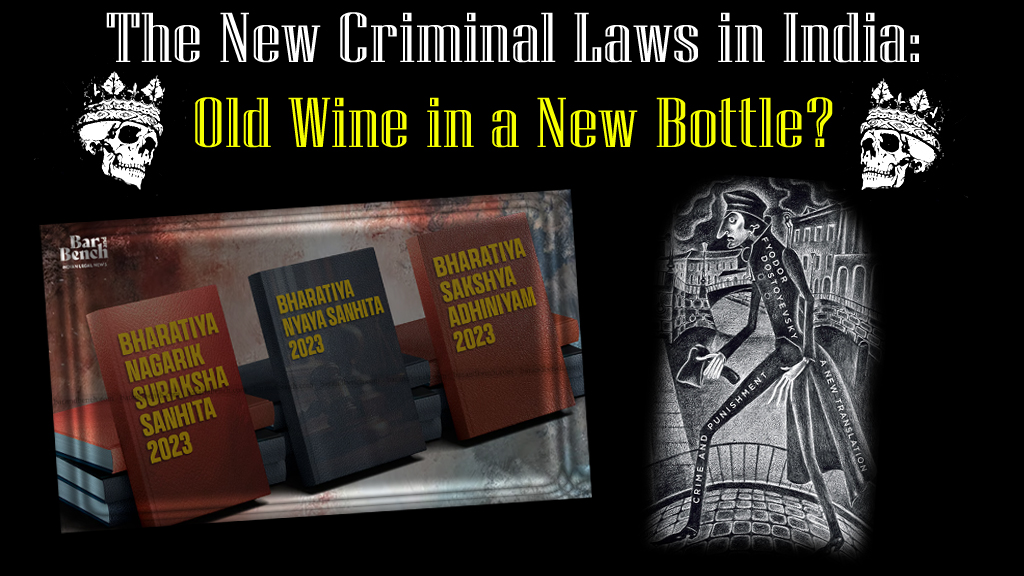
Posted on 25th June, 2024 (GMT 19:50 hrs) With the beginning of the 18th Lok Sabha and the formation of a new, fragile coalition government that appears to have lost all of its previous show-off of tyranny and terror, it is time for three new criminal laws to take effect, viz., the Bharatiya Nyaya SanhitaContinue reading “The New Criminal Laws in India: Old Wine in a New Bottle?”
Who are the Money-Mongers in India: Hindutvavadins or Muslims?
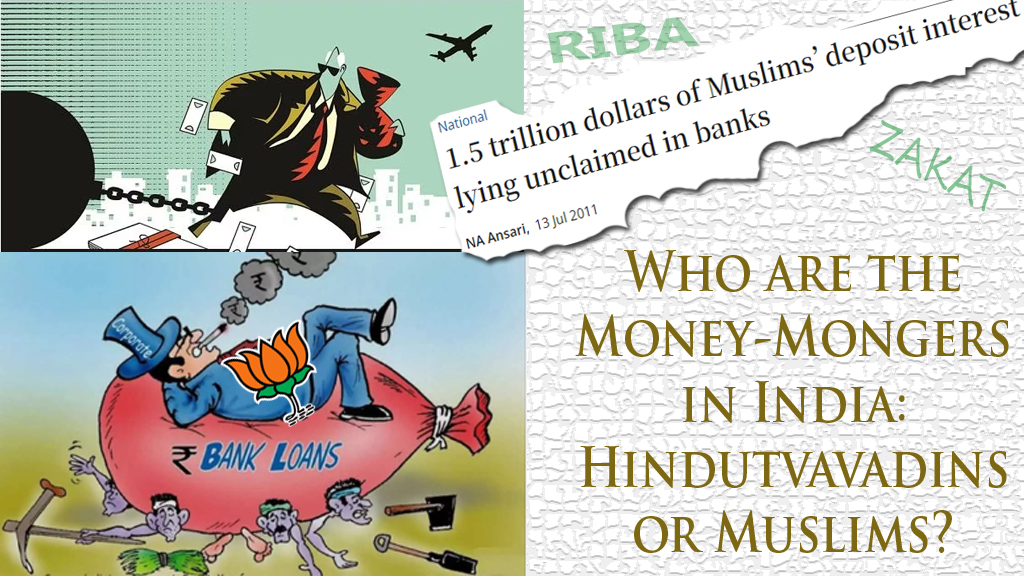
The article investigates the economic dimensions of communal narratives in India, specifically challenging the Hindutva-driven stereotype of Muslims as “money-mongers” or economic threats. Employing a socio-economic and historical analysis, the author debunks myths of Muslim wealth accumulation, tracing such tropes to colonial-era policies and post-independence Hindutva propaganda. The article contrasts the economic marginalization of Muslims—evidenced by their underrepresentation in formal employment, lower per capita income, and exclusion from financial systems—with the significant corporate and political wealth amassed by Hindutva-aligned elites, including RSS-affiliated organizations and BJP-linked business tycoons. It argues that Hindutva’s economic nationalism masks crony capitalism and diverts attention from systemic inequities. The piece calls for dismantling communal stereotypes through data-driven discourse and equitable economic policies to foster social cohesion.
 Once in a Blue Moon Academia