
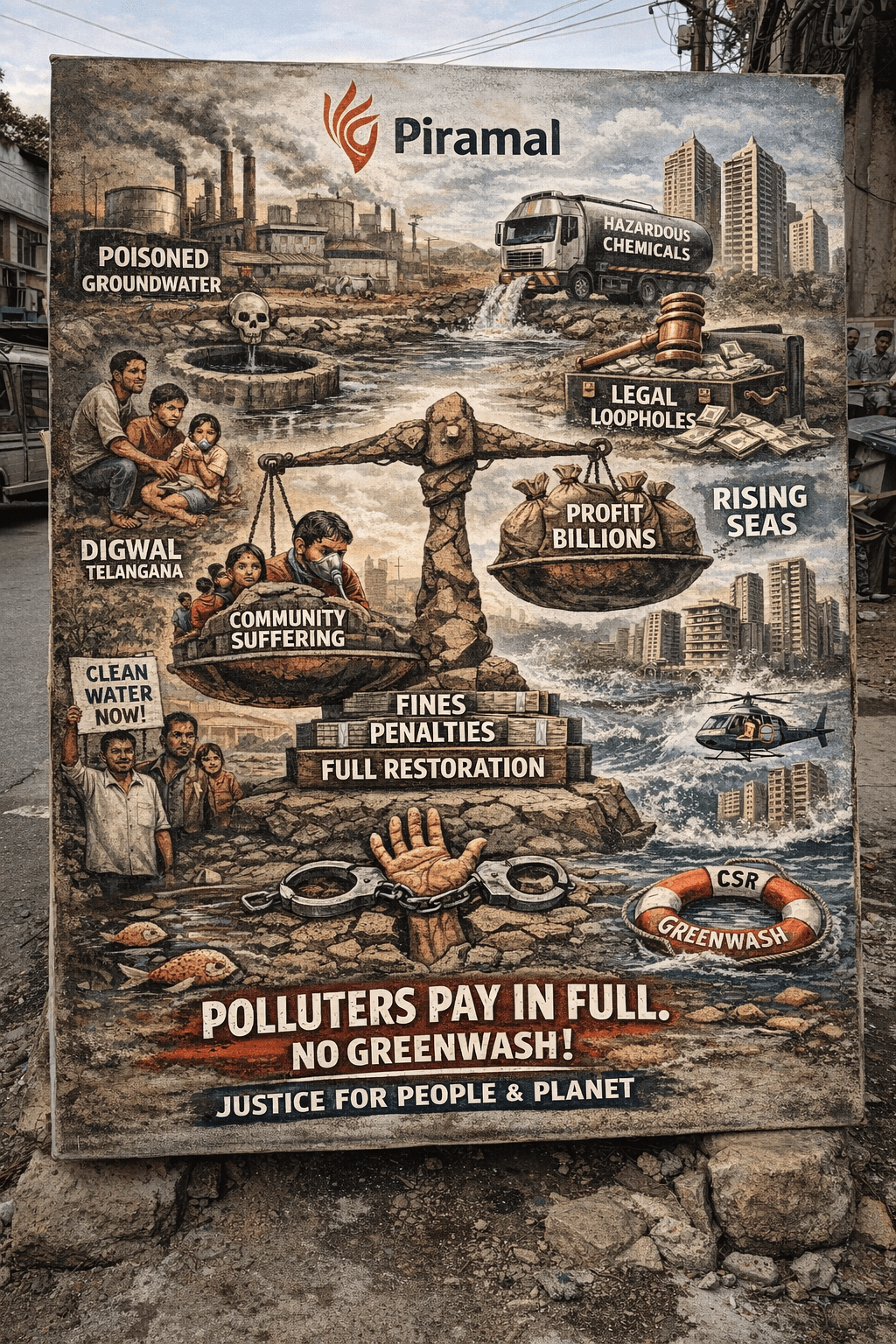
This essay argues that the Piramal Group’s pharmaceutical and real-estate operations exemplify a systemic model of accumulation by dispossession in contemporary capitalism, wherein ecological harm, public-health burdens, and climate vulnerability are externalized onto marginalized communities while profits are privatized and reputational risk is managed through regulatory reprieves, corporate restructuring, and CSR spectacle. Through the long-running groundwater contamination crisis at Digwal, the very recent February 2026 hazardous discharge episode at Dahej affecting the Narmada-linked canal system, and the development of ultra-luxury coastal real estate in flood-prone zones of Mumbai, the text demonstrates a recurring pattern: violation, brief enforcement theatre, rapid operational normalization, and uninterrupted high-margin expansion. It situates these cases within theoretical frameworks of slow violence, ecological surplus extraction, and philanthropic greenwashing, arguing that fines function as licensing fees rather than deterrents and that dynastic corporate networks convert environmental risk into both profit and spectacle. The essay concludes by demanding a materially enforced Polluter Pays regime—extending beyond monetary penalties to full ecological restoration, community restitution, structural limits on expansion, and legally binding accountability—insisting that environmental justice cannot be offset through philanthropy, CSR branding, or procedural compliance while the biosphere itself absorbs irreversible damage.
Category Archives: Journal
CONVERGENCE TO PRAXIS
This journal tries to demolish the administrative boundaries of academic disciplinary technology by amalgamating all the so-called “subjects” by condemning the objectification, subjectification and subjection.
It strives to reach the vanishing point of theory and praxis. Thus, instead of so-called “inter-disciplinary studies”, it emphasizes on the convergence of earthian knowledges and praxiologies. The journal attempts to achieve this end by means of dialogue without manipulation in the context of a participatory, local-resource based, low-energy efficient, small-scale, self-reliant, partyless, moneyless, decentralized democracy. As this journal is against the academiocratic elitism and patron-client relationship, it maintains the Copyleft Writers’ Movement and follows the Creative Commons License.
The Piramal Paradox: Karuṇā–Sevā–Samṛddhi as Valourized Capital?

This essay is a self-reflexive critique that interrogates the corporate deployment of sacred Indian ethical concepts—karuṇā (boundless compassion), sevā (embodied relational service), and samṛddhi (ethically conditioned flourishing)—within the assemblages of philanthro-capitalism, particularly through the Gandhi Foundation and CSR initiatives linked to Ajay Piramal. Drawing on Deleuze and Guattari’s schizoanalysis, it traces how these terms, deterritorialized from Buddhist, Bhakti, Gandhian, and epic traditions, are reterritorialized as branded values that legitimize accumulation while masking asymmetries of power, dispossession, and structural harm—most poignantly exemplified by the author’s lived experience of financial violence in the DHFL collapse. Through philological excavation, ontological reflection (via the Aupaniṣadika two-birds metaphor), and a Kafkaesque plea for coherence before the Supreme Court, the text demands philosophical vigilance: whether ethical rhetoric can coexist with praxis that disperses risk downward and concentrates prosperity upward, or if such invocation fractures the triad, reducing compassion to optics, service to branding, and prosperity to unchecked growth. Ultimately, it calls not for condemnation but for symmetry—where sacred words, once uttered, become answerable to those wounded by the very systems they adorn.
Rana Ayyub’s Gujarat Files and the Politics of the Counter-Archive
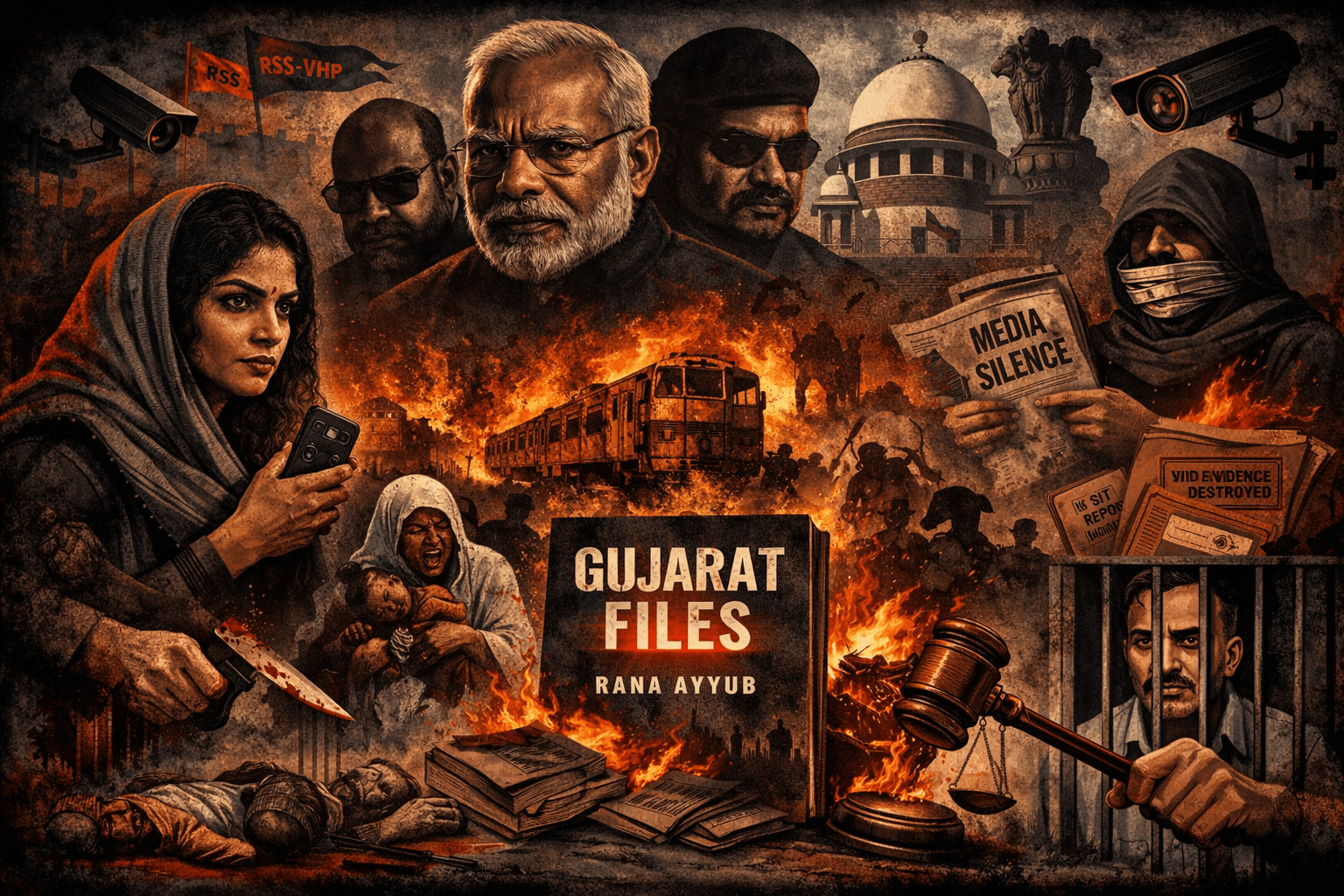
Gujarat Files: Anatomy of a Cover Up by Rana Ayyub is a hard-hitting, self-published investigative book (2016) based on an eight-month undercover sting operation she conducted in 2010–2011 while working for Tehelka, posing as “Maithili Tyagi,” a fictional Hindu-American filmmaker sympathetic to RSS ideology. Through covert recordings of candid conversations with senior Gujarat police officers, bureaucrats, politicians, and insiders—including a direct meeting with then-Chief Minister Narendra Modi—the book presents verbatim transcripts alleging state complicity in the 2002 Gujarat riots (an anti-Muslim pogrom killing over 1,000), orchestrated inaction during the violence, evidence tampering, fake encounters (such as those involving Ishrat Jahan, Sohrabuddin Sheikh, and others), extrajudicial killings used for political gain, caste-based exploitation in law enforcement, and broader cover-ups tied to the rise of Modi and Amit Shah. Rejected by mainstream publishers and media amid fears of reprisal, Ayyub self-funded and released it, selling hundreds of thousands of copies despite blackouts, threats, and criticisms over ethical concerns, lack of forensic tape verification, and sparse analysis; supporters hail it as brave evidentiary journalism exposing systemic impunity and majoritarian consolidation, while critics (including a 2019 Supreme Court dismissal in a related case) view it as conjectural or procedurally flawed, yet no implicated officials have sued or directly refuted the statements, underscoring its enduring, polarizing impact on debates about accountability, press freedom, and Indian democracy.
Unveiling BJP’s Border Blunders: Naravane’s “Censored” Memoir
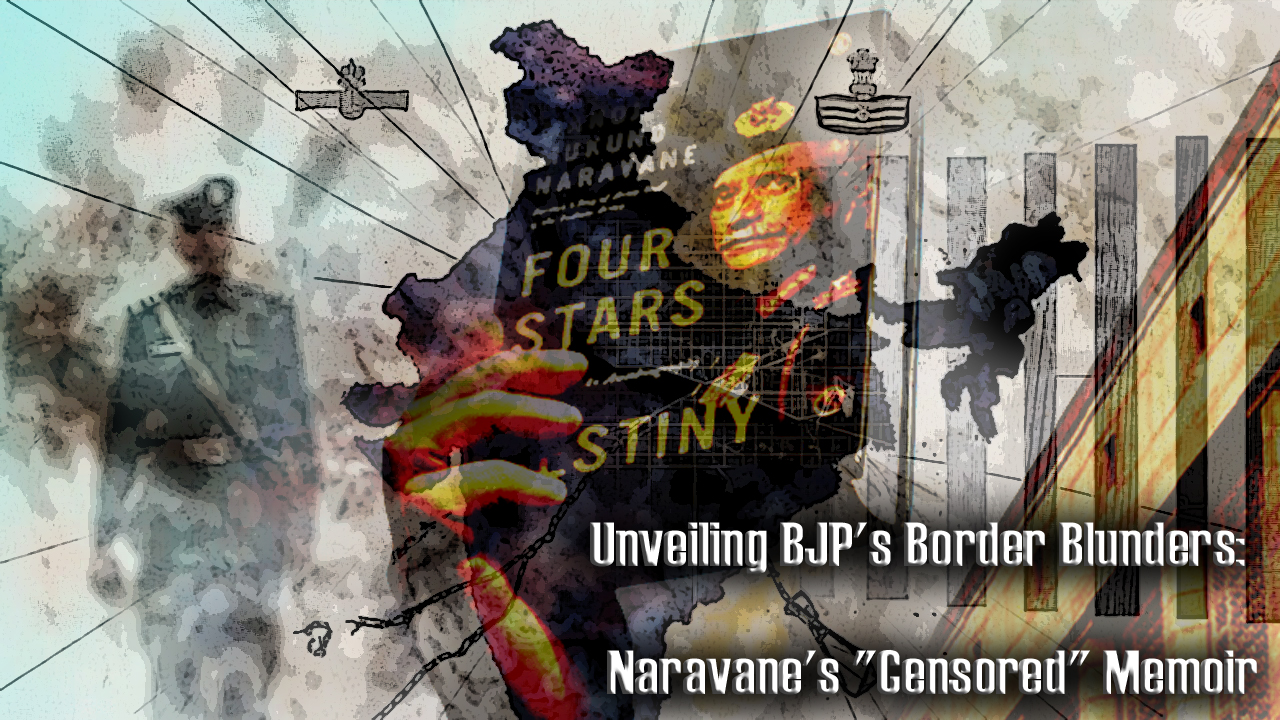
The review examines the “unpublished” (?) book Four Stars of Destiny: An Autobiography by General M.M. Naravane (retd.), former Chief of the Indian Army (2019–2022), in comparative dialogue with three major critical interventions on contemporary Indian state power: the BBC documentary India: The Modi Question, Rakesh Sharma’s Final Solution (2003), and Rana Ayyub’s Gujarat Files: Anatomy of a Cover-Up. While differing in form—military memoir, investigative journalism, and documentary cinema—all four works converge in unsettling dominant state narratives through documented, insider or evidentiary accounts of crisis, violence, and political accountability. The review argues that the prolonged suppression of Naravane’s memoir through bureaucratic delay constitutes a form of de facto censorship analogous to the formal banning, blocking, or marginalization faced by the other works. Read together, these texts reveal a patterned architecture of control in contemporary India, where power manages inconvenient truths not primarily through overt prohibition, but via procedural stalling, digital blocking, market denial, and epistemic delegitimization. The review situates this pattern within broader debates on civil–military relations, communal violence, and the politics of memory, suggesting that the real threat posed by these works lies in their capacity to reinsert ambiguity, failure, and hesitation into an official narrative built on certainty and spectacle.
Pollute, Pay, and Profit: Post-Facto Penalties and the Crisis of Environmental Governance in India
India’s environmental legal framework relies heavily on post-facto penalties—fines, compensation, and retrospective clearances—that fail to deter ecological crimes and often enable corporate violators to commodify the very resources they degrade in the first place. This article critiques the systemic flaws in post-facto approaches through case studies of Piramal Sarvajal (a CSR water purification venture following groundwater pollution in Digwal, Telangana) and Reliance’s Campa Cola revival under Isha Ambani Piramal (a beverage expansion exacerbating water scarcity). Linked by dynastic ties and philanthro-capitalist logic, these ventures illustrate how polluters repackage harm as opportunity, turning natural components like water into “Any Time Money” while evading true accountability. Drawing further on Jairam Ramesh’s 2026 Supreme Court challenge to ex post facto clearances and international calls for ecocide criminalization, the analysis condemns reactive penalties as counterproductive, violating precautionary principles and fostering moral hazard. It advocates for stricter preventive measures, criminal recognition of ecocide, and a shift toward ecocentric justice to protect ecosystems and human rights.
Blooded Waters, Dirty Hands: An Elegy for Puṇyodaka

This text is an elegy for puṇyodaka—not as a lost ritual substance, but as a shattered moral condition. Moving across Kalidasa’s Meghadūta, the Vana Parva’s Yaksha-prashna, biblical plague, Macbeth’s indelible blood, and Sartre’s Dirty Hands, it traces how water—river, sea, confluence—has been converted into spectacle, alibi, and instrument of power. Empirical poisonings (heavy metals, fecal coliforms, ecological collapse) coexist with choreographed immersions, artificial ghats, and submarine devotions, revealing a regime of simulation where sanctity is performed while rivers rot and silences are enforced. The work argues that contemporary governmentality no longer seeks purity but stages it, laundering violence through ritual, nationalism, and necessity. Against Hoederer’s calculus and Macbeth’s despair, the Yaksha’s ancient answer—manomalatyāga, the renunciation of inner stain—returns as an indictment: when minds remain polluted by greed, vanity, and commanded quiet, no river can cleanse. Puṇyodaka vanishes not because water fails, but because power poisons meaning itself. What remains is refusal: the withdrawal of consent from any politics that needs blood to function, spectacle to survive, and dirty hands to rule.
Water, Water Everywhere, Nor Any Drop to Drink? An Essay on Hydro-Politics

This paper examines the enduring paradox of Earth’s vast water resources contrasted with the severe scarcity of safe, drinkable freshwater, encapsulated in Samuel Taylor Coleridge’s line from “The Rime of the Ancient Mariner”: “Water, water everywhere, but not a drop to drink.” Drawing on foundational hydrological data and recent 2026 UN assessments declaring an era of “global water bankruptcy”—marked by irreversible depletion, pollution, and over-allocation of water systems—the study analyzes the mismatch between total water volume (primarily saline oceans) and accessible potable supplies. It investigates key research questions: the drivers of drinkable water scarcity (natural inaccessibility compounded by human-induced over-extraction, climate change, and contamination) and the primary anthropogenic sources of pollution (groundwater overuse without recharge, industrialization and acid rain, military activities, domestic and urban waste mismanagement, maritime pollution, sea mining, vanishing glaciers, agriculture, mining, deforestation, pharmaceuticals, and more). The analysis critiques “green capitalist” interventions—such as bottled water, alcoholic beverages, RO purifiers, desalination, privatization, virtual water trade, and green tech manufacturing—as often exacerbating waste through resource-intensive processes and greenwashing. Through India-focused case studies of Piramal Sarvajal (as compensatory CSR amid corporate pollution) and Reliance’s Campa Cola revival (as “Ambani-Cola capitalism” embodying Derrida’s pharmakon of thirst commodification), the paper highlights how profit-driven models mask structural harms while perpetuating dependency. It concludes with the looming threat of “water wars” amid surging conflicts and projections of widespread displacement, advocating systemic shifts toward community-led regeneration (e.g., Rajendra Singh’s johad-based river rejuvenation), equitable governance, transboundary cooperation, and de-commodification of water as a shared commons to avert irreversible crises.
From Immunity to Impunity: India’s Predatory Insolvency Regime, Electoral Autocracy, and DHFL Scam
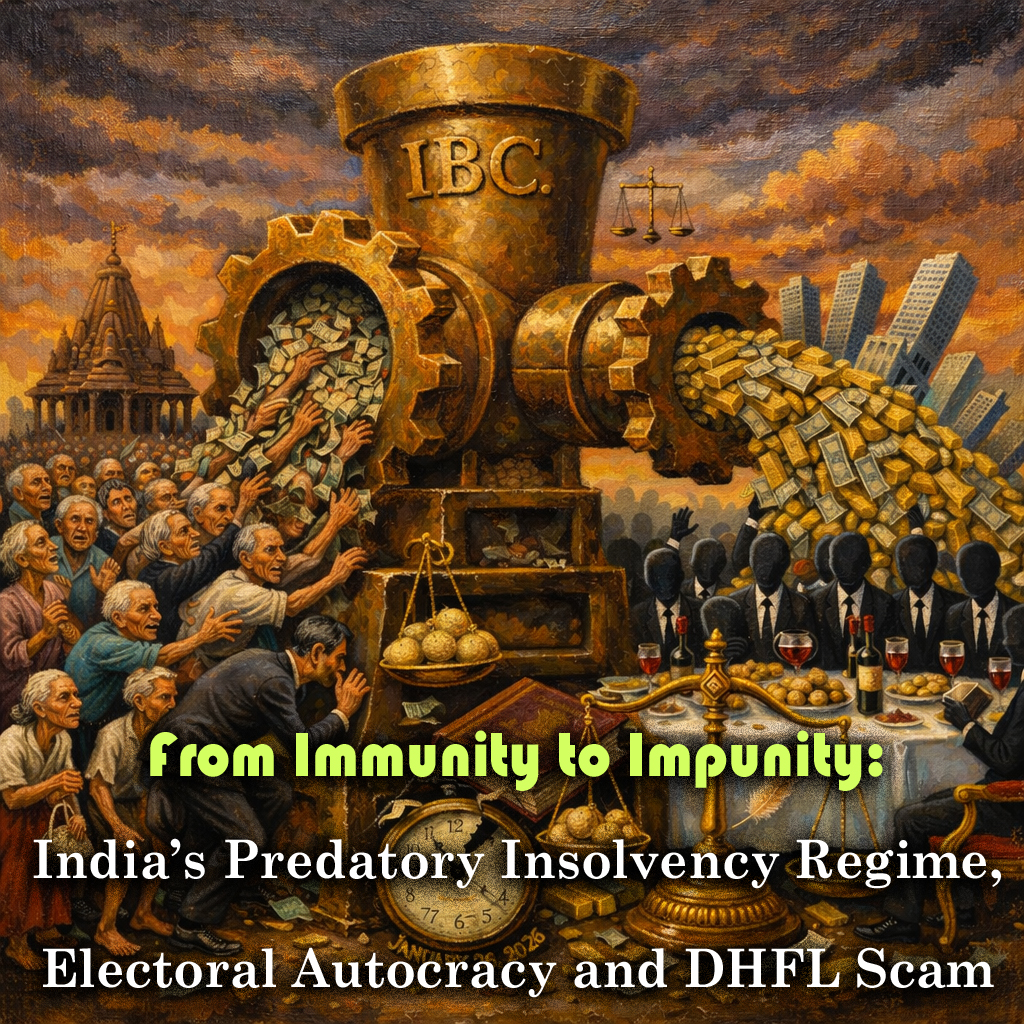
This article critically examines the Insolvency and Bankruptcy Code (IBC), 2016, arguing that it has evolved into a structurally predatory regime enabling the systematic transfer of public, depositor, and taxpayer-backed wealth to politically connected private entities. Through the lens of the DHFL resolution, it analyzes key judicial rulings—including the Delhi High Court’s holding that Insolvency Professionals are not “public servants” under the Prevention of Corruption Act, 1988, and the Supreme Court’s 2025 affirmation of the Piramal plan—revealing chronic delays, 67–68% average haircuts, fraud laundering via Section 32A, and unchecked Committee of Creditors (CoC) dominance. Situating DHFL within India’s declining Corruption Perceptions Index (96th/180, score 38/100 in 2024), the study highlights premature occupation by Ajay Piramal, enabled by his secondary kinship to Mukesh Ambani and BJP-linked patronage. It concludes that incremental amendments are insufficient and advocates complete repeal in favour of a transparent, constitutionally compliant framework prioritizing public interest, restitution, and accountability under Articles 14 and 21.
অঘোষিত জরুরি অবস্থার (দুঃ-)সময়ে না-রাষ্ট্রের বি-কল্প-না (Imagining No-State Alternities Amidst the Horrors of Undeclared Emergency)
এখানে সময়ের প্রয়োজনে, না-রাষ্ট্রের আশায়, অঘোষিত জরুরি অবস্থার মধ্যে দুটো লেখা সংকলিত করা হলো। বলা বাহুল্য, দুটো লেখাই বর্তমান ভারতবর্ষের রাজনৈতিক পরিস্থিতি আর দুরাশা নিয়ে সুরাশা করা হয়েছে। ভাজপার আইটি সেল মিথ্যে প্রোপাগাণ্ডা করে। উৎপল দত্ত উল্টে বলতেন, “আমি প্রোপাগান্ডিস্ট”। আমরা তাঁকে অনুসরণ করেই আরেকটু বাড়িয়ে বলছিঃ আমরা কাউন্টার-প্রোপাগান্ডিস্ট। ধরে নিন এই গোটাটাই একখানা রাজনৈতিক ইস্তেহারমাত্র, যেখানে ভেন্ন ধাঁচের আকাদেমিয়া সেঁধিয়ে আছে।Here, compelled by the urgency of the moment and sustained by the hope of a no-state imagination, two pieces have been brought together amid an undeclared emergency. Needless to say, both writings engage with the present political condition of India and attempt to wrest hope out of despair. The BJP’s IT cell manufactures false propaganda. Utpal Dutt, by contrast, would turn the charge on its head and declare, “I am a propagandist.” Following his lead—and pushing it a step further—we say: we are counter-propagandists. Consider this entire exercise as nothing more (and nothing less) than a political manifesto, into which a distinctly non-mainstream strand of academia has quietly seeped in.
OBMA Statement on Neo-Imperialist Violence: Iran, Venezuela, Palestine
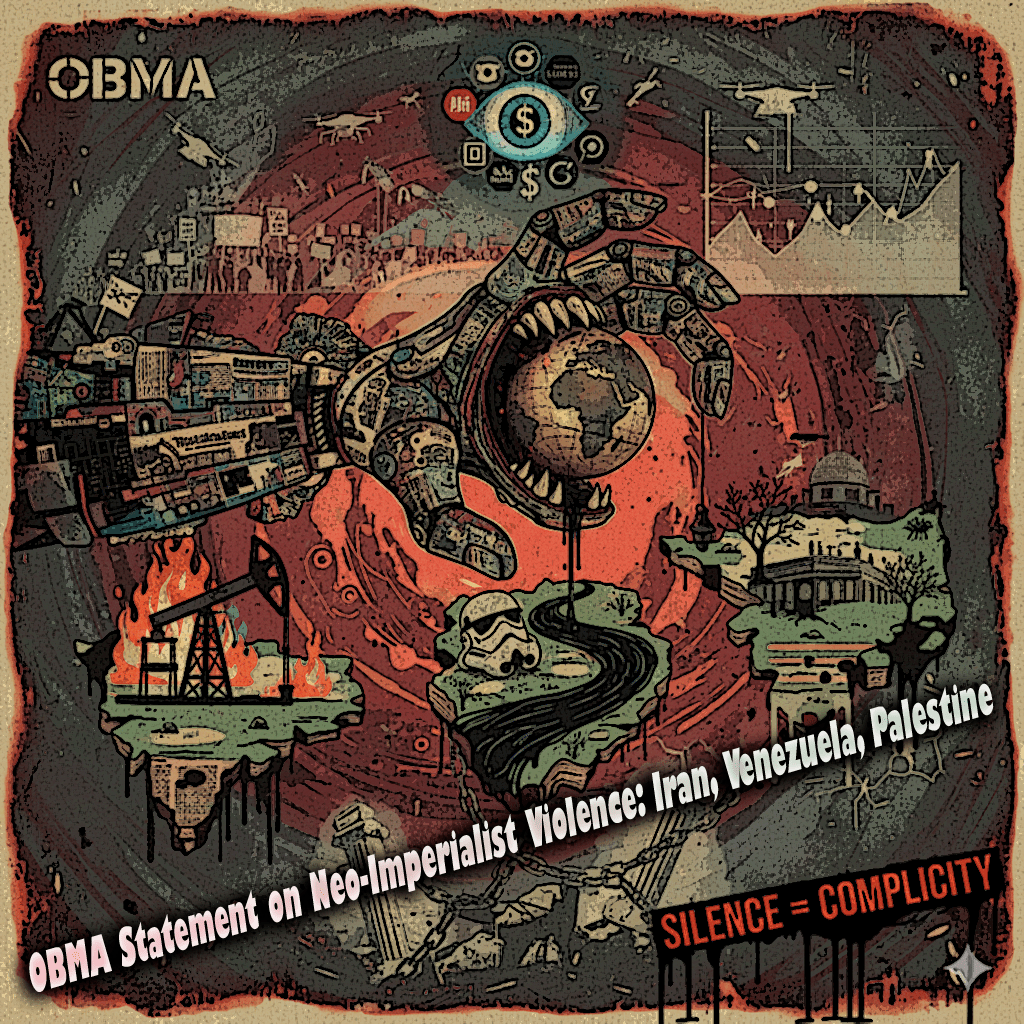
This statement asserts OBMA’s condemnation of neo-imperialist violence in Iran, Venezuela, and occupied Palestine, framing these crises as interconnected expressions of cannibalistic capitalism. It exposes how state repression, militarization, sanctions, and fossil-fuel geopolitics enable genocide, ecocide, and resource plunder. Rejecting technocratic and reformist fixes, OBMA affirms planetary justice, anti-imperialist solidarity, and life-centred transformation through collective struggle and ecological ethics.
 Once in a Blue Moon Academia