

This article, published on June 8, 2024, conducts a critical examination of parliamentary democracy, with a likely focus on India’s post-2024 election landscape. It dissects systemic challenges, such as institutional erosion, political polarization, or governance inefficiencies, that undermine democratic processes. The analysis highlights key events or policies contributing to these issues. Proposing a path forward, the article outlines actionable reforms to strengthen democracy, including enhancing transparency, fostering inclusive dialogue, and reinforcing institutional checks. It underscores the urgency of collective action to revitalize parliamentary democracy’s efficacy and resilience.
Category Archives: Journal
CONVERGENCE TO PRAXIS
This journal tries to demolish the administrative boundaries of academic disciplinary technology by amalgamating all the so-called “subjects” by condemning the objectification, subjectification and subjection.
It strives to reach the vanishing point of theory and praxis. Thus, instead of so-called “inter-disciplinary studies”, it emphasizes on the convergence of earthian knowledges and praxiologies. The journal attempts to achieve this end by means of dialogue without manipulation in the context of a participatory, local-resource based, low-energy efficient, small-scale, self-reliant, partyless, moneyless, decentralized democracy. As this journal is against the academiocratic elitism and patron-client relationship, it maintains the Copyleft Writers’ Movement and follows the Creative Commons License.
TAGORE MALIGNED BY ANDHBHAKTS: A PARODY TEXT

Posted on 08/05/2024 (GMT 08:55 hrs) This sarcastic paper-letter shows Rabindranath Tagore’s ideology of no-nation, his dedication towards pluralism and tolerance as well as his stand as an internationalist humanitarian beyond the postulation of the commercial “man” (sic). The authors of this paper-letter try to show the Hindutva lensing of Tagore in a sort ofContinue reading “TAGORE MALIGNED BY ANDHBHAKTS: A PARODY TEXT”
Piramal Group’s Anthem-Songs and the “Commercial” Appropriation of Tagore

The blog criticizes Piramal Group’s use of Tagore’s work for corporate promotions, arguing it commercializes his legacy in ways that clash with his ideals of anti-materialism and cultural autonomy. It suggests that by framing corporate goals with Tagore’s ethos, the company reduces his cultural symbolism to mere marketing, overlooking his deeper philosophical intentions. This co-opting of Tagore’s work for business purposes is seen as disrespectful and a commodification of his intellectual heritage.
Wither Leather-Feather from Gaming and Musicking?

Posted on 16/03/2024 (GMT 13: 21 hrs) In continuation to our sarcastic, satirical portrayal (by intentionally playing the devil’s advocate through the masking process) of the Hindutvavadin by targeting certain modules of Saffron Fascism, the following letter was sent regarding the use of leather in Sports and Music industries in India in contradistinction to theContinue reading “Wither Leather-Feather from Gaming and Musicking?”
The Pharmacological Garden of Paramavaiṣṇava Ajay Piramal: A Case Study

The paper engages itself with the question of the predominance of Pharmaceutical industries in over-medicalizing the health of human and non-human populations as well as the supposed “nature”. It focuses on a specific case-study from a village named Digwal, Telangana, India, and performs a Foucauldian investigative discourse analysis on the text in relation to an environmental terrorist big-Pharma headed by business tycoon Mr. Ajay Piramal. The very legitimacy of the medical space and gaze is thoroughly critiqued in the course of the paper by bringing into attention the inevitable failure of the simulated Summersian project of “Let them eat pollution”.
Pradhan Mantri Awas Yojana (PMAY): A Deliberate Systematic Structural Failure?

Posted on 17/02/2024 (GMT 16:22 hrs) Updated on 19/02/2024 (GMT 17:07 hrs) In 1985, the then Prime Minister of India, Mr. Rajiv Gandhi of the Indian National Congress (INC), remarked in a public speech that out of every 1 rupee spent by the government administration for the welfare or the benefit of the downtrodden orContinue reading “Pradhan Mantri Awas Yojana (PMAY): A Deliberate Systematic Structural Failure?”
Obituary of M. S. Swaminathan: The Proliferation of Death Industry

The article critiques the legacy of M. S. Swaminathan, highlighting his role in promoting chemical-intensive agriculture during the Green Revolution. It draws parallels between post-World War II repurposing of wartime chemicals into pesticides and fertilizers, suggesting that such practices have commodified life and contributed to environmental degradation. The authors argue that this approach to agriculture has transformed seeds into mere commodities, undermining their natural essence, and liken this to broader themes of exploitation and depersonalization in modern industrial practices.
THE ARCHAEOLOGY OF THE ARCHAEOLOGY OF HINDUTVAVADI POLITIK: THE POVERTY OF EPISTEMOLOGY

Posted on 13/02/2024 (GMT 17:15 hrs) Abstract The paper deals with the empirical evidences cum analyses of manufacturing anti-historical as well as ahistorical narratives of the Sangh Parivar in India. In doing so, it follows the Foucauldian method of “archaeological digging” in the given discursive formation. The paper aims to repudiate the Islamophobic, Expansionist, HinduContinue reading “THE ARCHAEOLOGY OF THE ARCHAEOLOGY OF HINDUTVAVADI POLITIK: THE POVERTY OF EPISTEMOLOGY”
An Incessant Struggle for Being a Homogenized, Pasteurized, Essentialist and Standardized Akhanḍa Hindu Rāṣṭra: Bharatiya Janata Party

The paper titled “An Incessant Struggle for Being a Homogenized, Pasteurized, Essentialist and Standardized Akhanḍa Hindu Rāṣṭra: Bharatiya Janata Party” examines the Bharatiya Janata Party’s (BJP) efforts to establish a unified Hindu identity within India. It focuses on the contentious Ram Temple issue, highlighting the differing narratives between the BJP and Hindu saints. The authors argue that the term “Hindutva” encompasses a diverse range of beliefs, which complicates the BJP’s attempts to homogenize Hindu identity. The paper also critiques the influence of neoliberal economic policies in India, suggesting that since the early 1990s, successive governments, including the BJP, have adhered to models dictated by international financial institutions like the World Bank, International Monetary Fund, and World Trade Organization. This adherence has led to increased conflicts and a regime of totalitarian control, necessitating suppression of dissent and perpetuating violence. In summary, the paper contends that the BJP’s pursuit of a standardized Hindu nation is challenged by the inherent diversity within Hinduism and is further complicated by the socio-economic impacts of neoliberal policies.
Saffronization of Judiciary: An Open-Letter to the Chief Justice of India
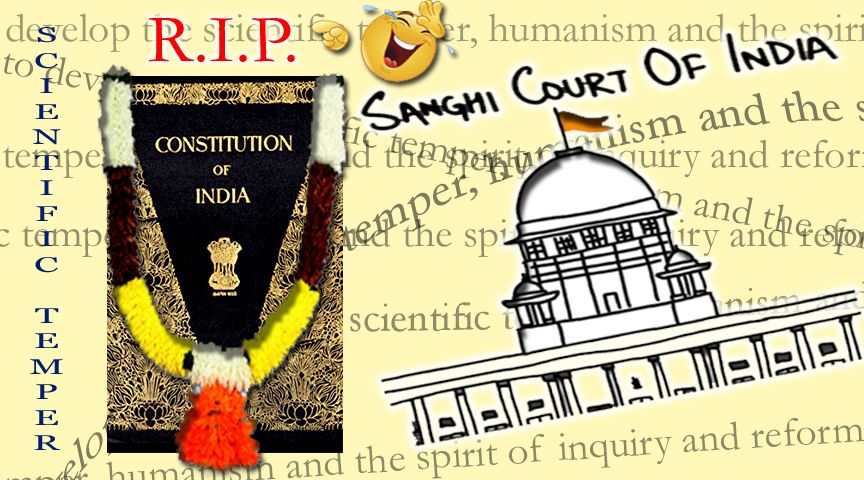
The article, framed as an open letter to the Chief Justice of India, raises concerns about the growing influence of Hindutva ideology in the judiciary. It critiques decisions perceived as biased toward militant Hindu nationalist interests and warns against the erosion of judicial independence. The letter stresses the need for an impartial judiciary to uphold the secular values of the Indian Constitution, urging the Chief Justice to ensure transparency and fairness in the justice system.
 Once in a Blue Moon Academia