
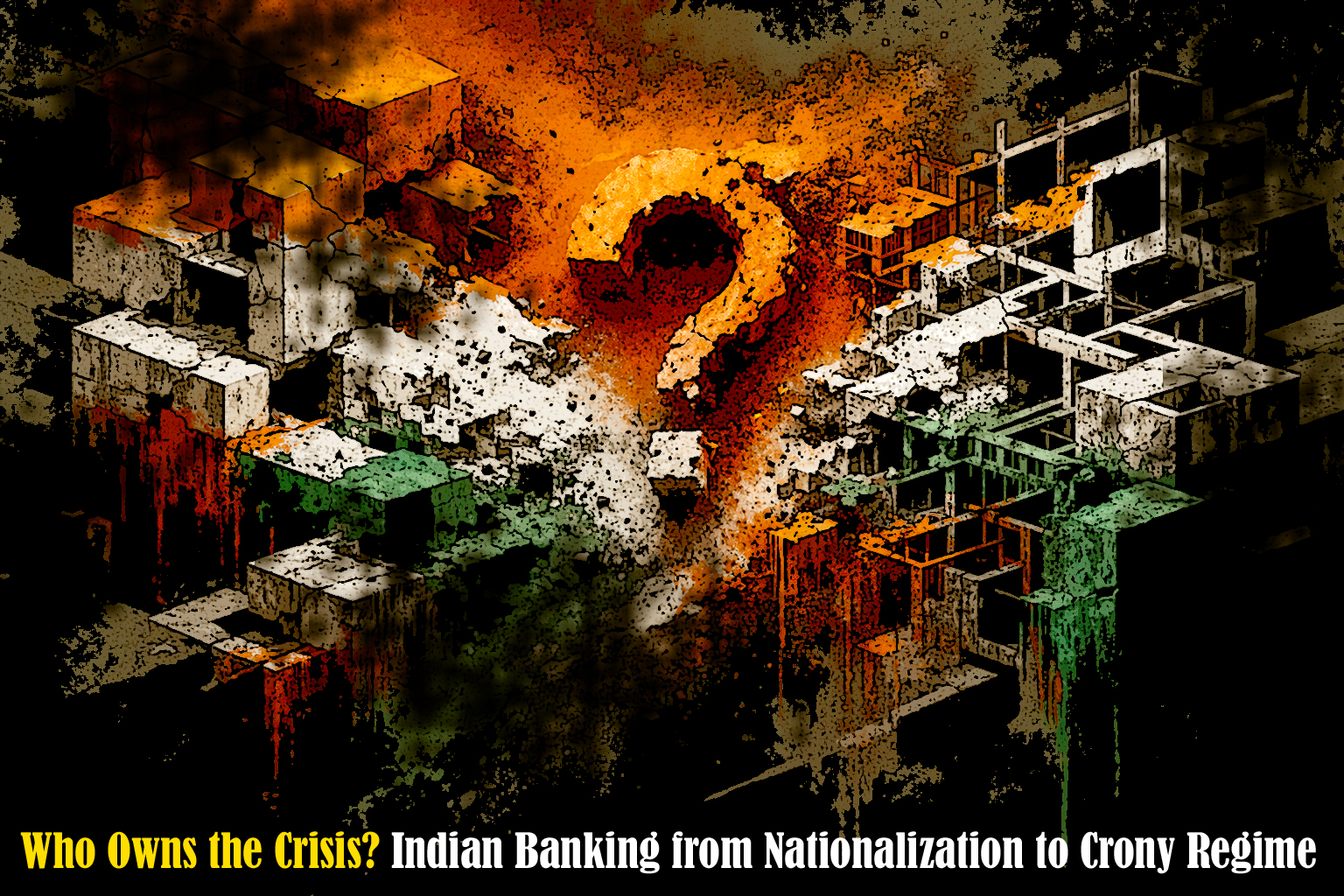
Posted on 1st April, 2026 (GMT 07:50 hrs) ABSTRACT This article traces the historical transformation of Indian banking from postcolonial state-led social banking to the contemporary regime of what it terms “resolution capitalism,” foregrounding the shifting configurations of power, distribution, and knowledge. Beginning with the pre-1969 era of private concentration and systemic fragility, it examinesContinue reading “Who Owns the Crisis? Indian Banking from Nationalization to Crony Regime”
Category Archives: Journal
CONVERGENCE TO PRAXIS
This journal tries to demolish the administrative boundaries of academic disciplinary technology by amalgamating all the so-called “subjects” by condemning the objectification, subjectification and subjection.
It strives to reach the vanishing point of theory and praxis. Thus, instead of so-called “inter-disciplinary studies”, it emphasizes on the convergence of earthian knowledges and praxiologies. The journal attempts to achieve this end by means of dialogue without manipulation in the context of a participatory, local-resource based, low-energy efficient, small-scale, self-reliant, partyless, moneyless, decentralized democracy. As this journal is against the academiocratic elitism and patron-client relationship, it maintains the Copyleft Writers’ Movement and follows the Creative Commons License.
Pressing Repeat: A Tragi-Comedy of DHFL Ruin, Viraha, and Satyagraha through Dilemma
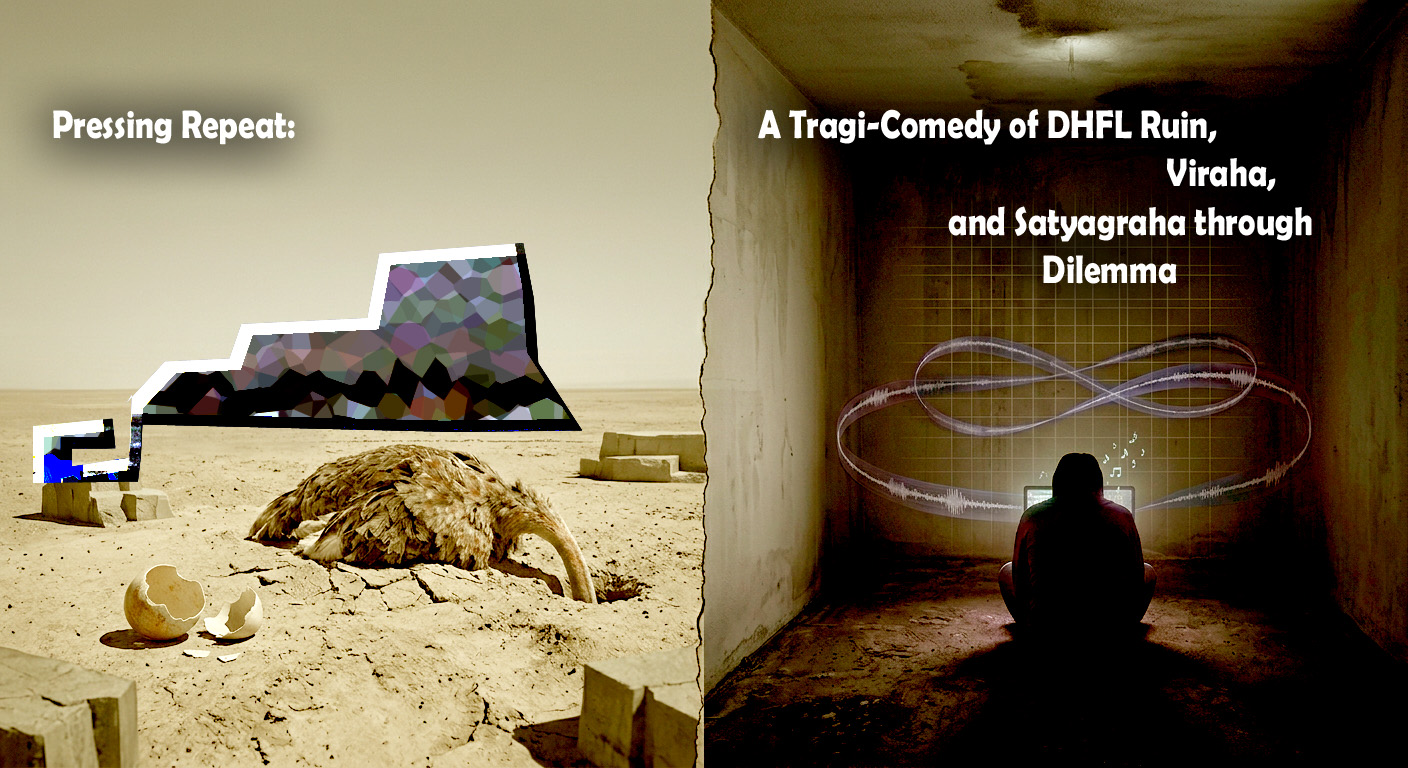
In this darkly comic, self-reflexive monologue, a financially devastated DHFL victim—robbed of her life savings and hounded by a 100-crore SLAPP suit under an undeclared emergency—chronicles her solitary existence through obsessive loops of Rabindrasangeet. Trapped between paralyzing fear and compulsive repetition, she navigates aesthetic intimate separation anxiety (biraha), confronts the absence of any divine or human companion, and mercilessly dissects the selective “divine intervention” granted to the powerful while she receives only silence. Weaving Tagore’s melodies, Sudhindranath Dutta’s merciless “Ostrich,” Socrates’ Euthyphro Dilemma, Nietzsche’s amor fati, and Gandhi’s faith in truth, she transforms personal malady into a weapon of creative resistance. Refusing fatalism or piety, she reclaims the pharmakon of crisis, turning her suffering into non-violent digital satyagraha against the state-corporate apparatus. The result is a haunting, non-conclusive testament: a lone whistleblower who, though penniless and abandoned, continues to press “send” — pressing repeat no longer as surrender, but as quiet, unrelenting war.
Retrospective Truths: Valmiki, Ayodhya, IBC 32A, and the Stake of Constitutional Secularism

This short article explores a striking parallel between poetic creation and state-sanctioned reality-making in contemporary India. Drawing from Rabindranath Tagore’s poetic dialogue with Narada in the context of Valmiki’s Ramayana—where the poet’s imaginative mind-realm is declared Rama’s truer birthplace than historical Ayodhya—the discussion extends to two landmark institutional acts: the Supreme Court’s 2019 Ayodhya verdict (with Justice D.Y. Chandrachud’s later confession of seeking divine guidance) and Section 32A of the Insolvency and Bankruptcy Code (IBC), which retrospectively absolves corporate debtors of pre-insolvency offences upon plan approval, as vividly illustrated in the DHFL-Piramal takeover. Both instances represent exercises in retrospective ontological surgery: the poet erases or reconfigures the past through fiction for ecstatic delight (jouissance), while the judiciary and legislature do so through unsigned judgments infused with faith-based inspiration and statutory “clean-slate” mechanisms that shield economic continuity at the expense of accountability. The article argues that such sovereign rewritings—whether sacralising faith in a title suit or engineering corporate rebirth—breach the thick wall of separation between powers, subordinate evidence-based adjudication to revelation or expediency, and inflict profound injury on constitutional secularism. By collapsing the distinction between objective historical/legal truth and creatively decreed higher truth, these developments risk transforming the secular Republic into a palimpsest open to majoritarian or crony capture, where Article 51A(h)’s mandate of scientific temper yields to engineered absolution and divine endorsement. Ultimately, while the poet may harmlessly invent birthplaces, when the State borrows that crown, the stake is nothing less than the integrity of constitutional secularism itself.
The Archaeology of Architecture in the Piramal Archipelago

This article examines the ecological contradictions embedded in contemporary corporate development through a critical analysis of four interconnected cases linked to the activities of the Piramal Group. Situated within the broader environmental context of Mumbai—one of the world’s most climate-vulnerable coastal megacities—the study explores how industrial production, urban real-estate expansion, and superrich architectural consumption intersect with fragile ecosystems and emerging climate risks. The first case investigates allegations of groundwater contamination linked to pharmaceutical manufacturing in Digwal village in Telangana, where proceedings before the National Green Tribunal raised concerns about impacts on aquifers and agricultural landscapes. The second examines controversy surrounding a chemical manufacturing facility in Dahej in Gujarat, where the Gujarat Pollution Control Board ordered a plant shutdown after allegations that hazardous industrial waste had been discharged into a canal connected to the Narmada River system. The analysis then turns to Mumbai’s coastal urban landscape, where luxury developments by Piramal Realty illustrate the commodification of waterfront environments marketed through narratives of sustainability and “biophilic living.” Finally, the study examines the sea-facing residence Gulita as a symbolic expression of wealth concentration along a climate-exposed coastline. Drawing on environmental reports, regulatory proceedings, and urban climate research, the article situates these cases within a broader framework of coastal capitalism and urban ecological transformation, arguing that corporate sustainability narratives often coexist with environmental risks displaced onto rural landscapes, industrial waterways, and vulnerable urban coastlines.
Piramal’s “Green” Smokescreen: Reports and Radical Reflections
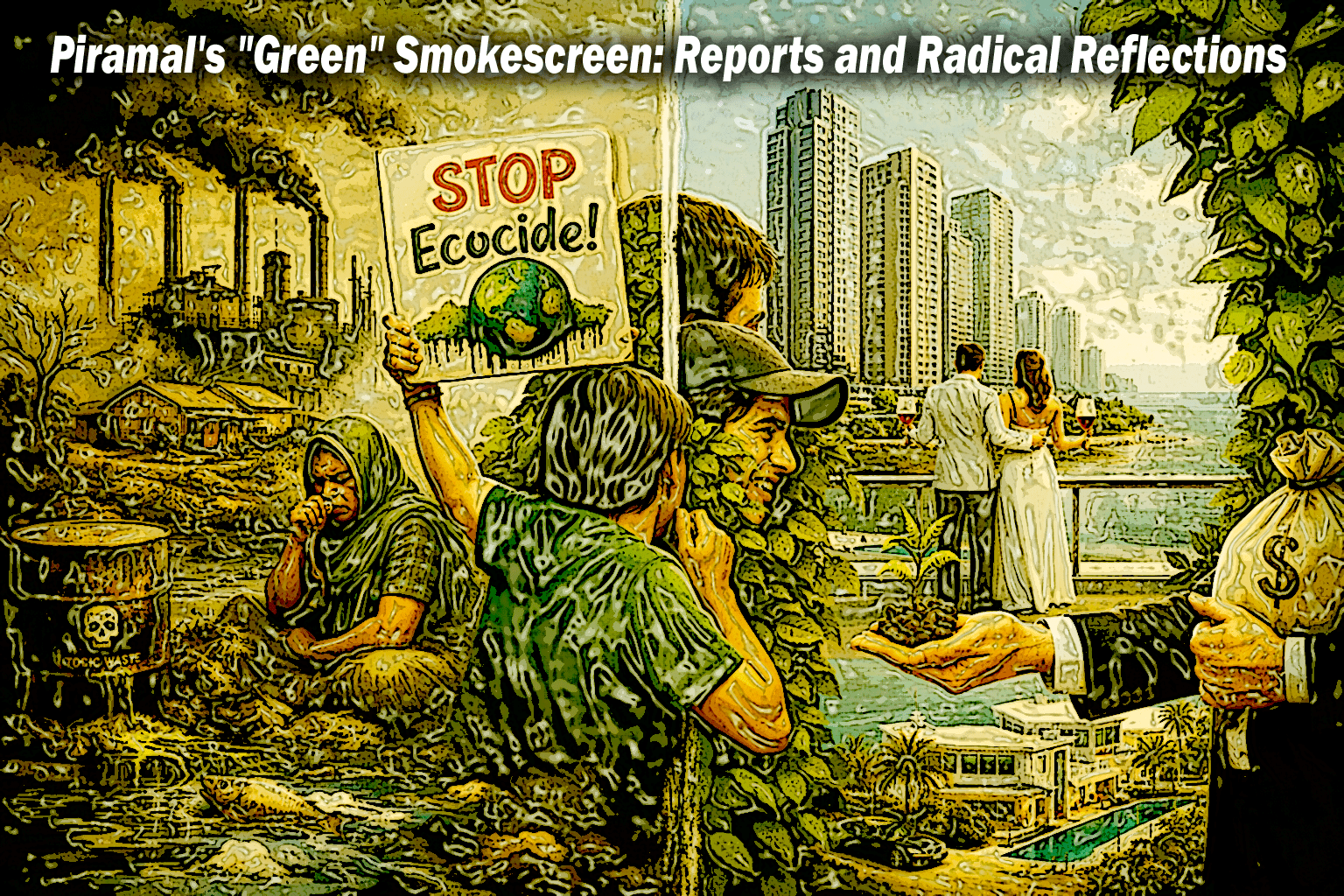
In a scathing indictment of 21st-century Indian philanthro-capitalism, billionaire Ajay Piramal’s empire exemplifies hegemonic subsumption of radical ecology: while Piramal Pharma faces verified allegations of chronic ecocide—groundwater poisoning in Digwal, Telangana (NGT ₹8.3 crore fine, net ₹3.2 crore paid as 0.09% of FY25 revenue; ongoing NGT case OA 1032/2024) and hydrochloric acid dumping in Dahej, Gujarat (GPCB closure, ₹1 crore fine, Supreme Court scrutiny in February 2026, swift interim resumption)—Piramal Realty markets ultra-luxury towers in Mumbai’s IPCC/CRZ high-risk flood zones (e.g., Piramal Mahalaxmi at ~3 m elevation) as “biophilic living” paradises with curated greenery, passive ventilation, and token sapling drives. The family’s own Worli sea-facing mansions (Gulita’s 50,000 sq ft diamond-glass palace) flaunt imported opulence with minimal genuine sustainability, embodying Lewis Mumford’s critique of architectural imperialism. Meanwhile, the Piramal School of Leadership’s Jaipur “walled garden” campus—shortlisted for the 2025 World Architecture Festival—parades biophilic design, passive cooling, and reduced concrete use while branding itself as the future “Piramal University” (a UGC violation) and indoctrinating 50,000–150,000 officials annually in appropriated radical terms like “regenerative agriculture” (Rodale/Shiva lineage), “One Water,” and “systems change” (Macy/Capra/Norberg-Hodge). Through Foucauldian selving, Piramal constitutes itself as “compassionate” and “regenerative” precisely by emptying anti-capitalist vocabularies. Backed by ₹85–88 crore in BJP electoral bonds (2019–2024), this discursive capture enables regulatory impunity amid slow violence on marginalized communities. The article calls for radical rupture: revenue-proportionate penalties, ecological restoration, de-subsumption of language, and militant reclamation by grassroots movements—exposing eco-extortionism where ecocide funds the performance of planetary salvation. Even the Department of Consumer Affairs’ February 2026 anti-greenwashing poster rings hollow when tycoons like Piramal and Adani greenwash unchecked.
The Mirage of “Piramal University”: Philanthropism, Prestige Branding, and the Crisis of the University in Contemporary India
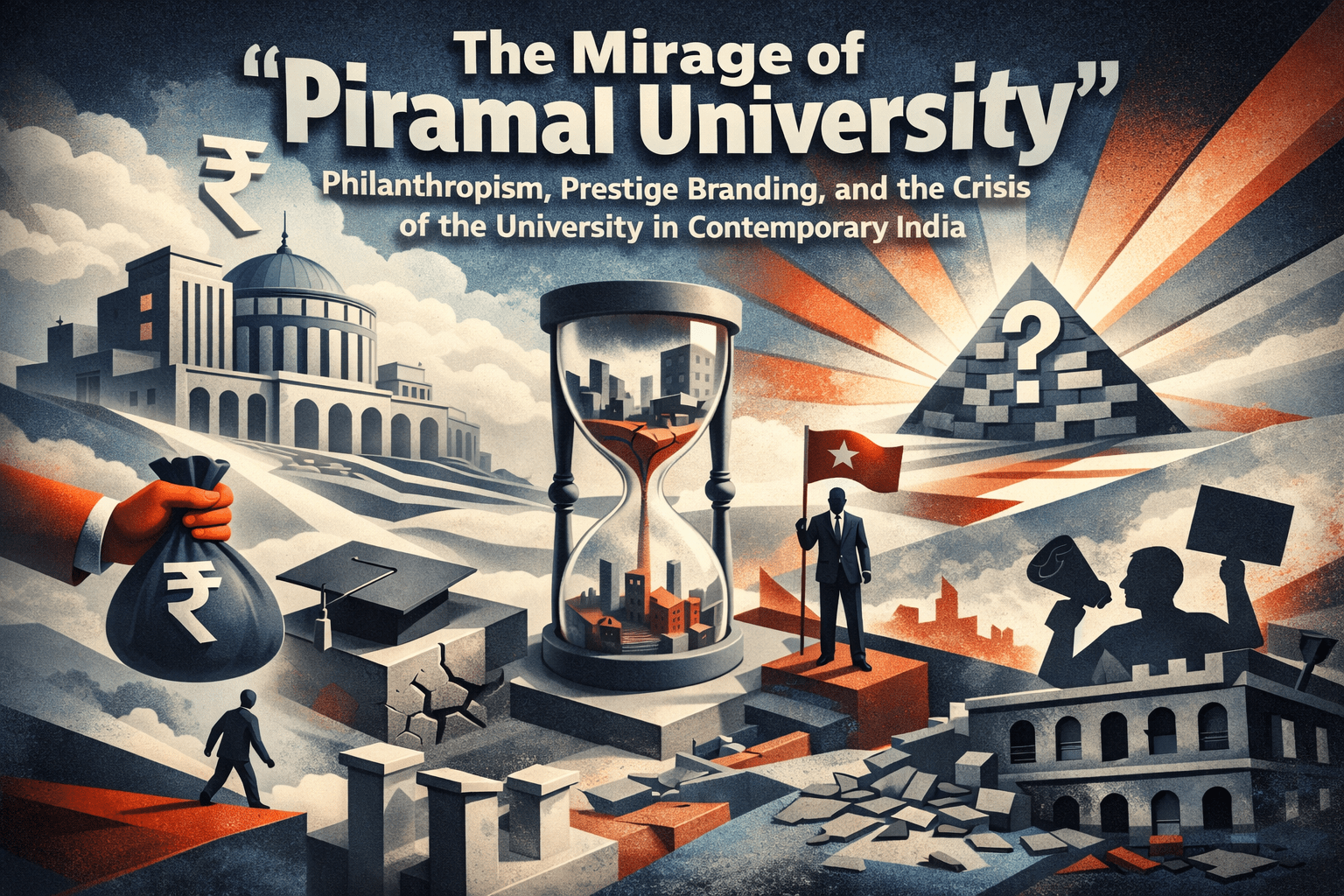
This essay critically interrogates the ambiguous phenomenon popularly referred to as “Piramal University,” situating it within the broader transformation of higher education in contemporary India. Beginning from a radical critique of institutionalized education inspired by thinkers such as Louis Althusser, Ivan Illich, Paulo Freire, and the pedagogical experiments of Rabindranath Tagore and Mahatma Gandhi, the article argues that modern academia increasingly operates as an “academiocracy” — a technocratic regime where knowledge production is subordinated to bureaucratic management, market rationality, and reputational metrics. Through an empirical examination of the Piramal School of Leadership and the sporadic appearance of the term “Piramal University” in corporate documents, CSR narratives, and public discourse, the essay reveals a striking disjunction between operational reality and symbolic branding. While no UGC-recognized university exists under this name, the label circulates widely in digital media, real-estate promotion, and philanthropic storytelling, generating an aura of academic legitimacy without corresponding institutional substance. By comparing this pattern with earlier cases such as the IIPM controversy and with prestige-borrowing strategies like Ajay Piramal’s widely publicized “Oxford Talk,” the essay develops the concept of “Schrödinger’s legitimacy”—a condition in which institutional prestige simultaneously exists and does not exist, sustained through strategic ambiguity and symbolic capital. Ultimately, the case is interpreted not as an isolated anomaly but as a symptom of a wider crisis in which universities are increasingly transformed from communities of inquiry into reputational assets within networks of corporate power, philanthropic branding, and knowledge commodification.
Piramal’s Fixated Obsession with Re 1: Documentation, Con-figured Equivocation and the Facade
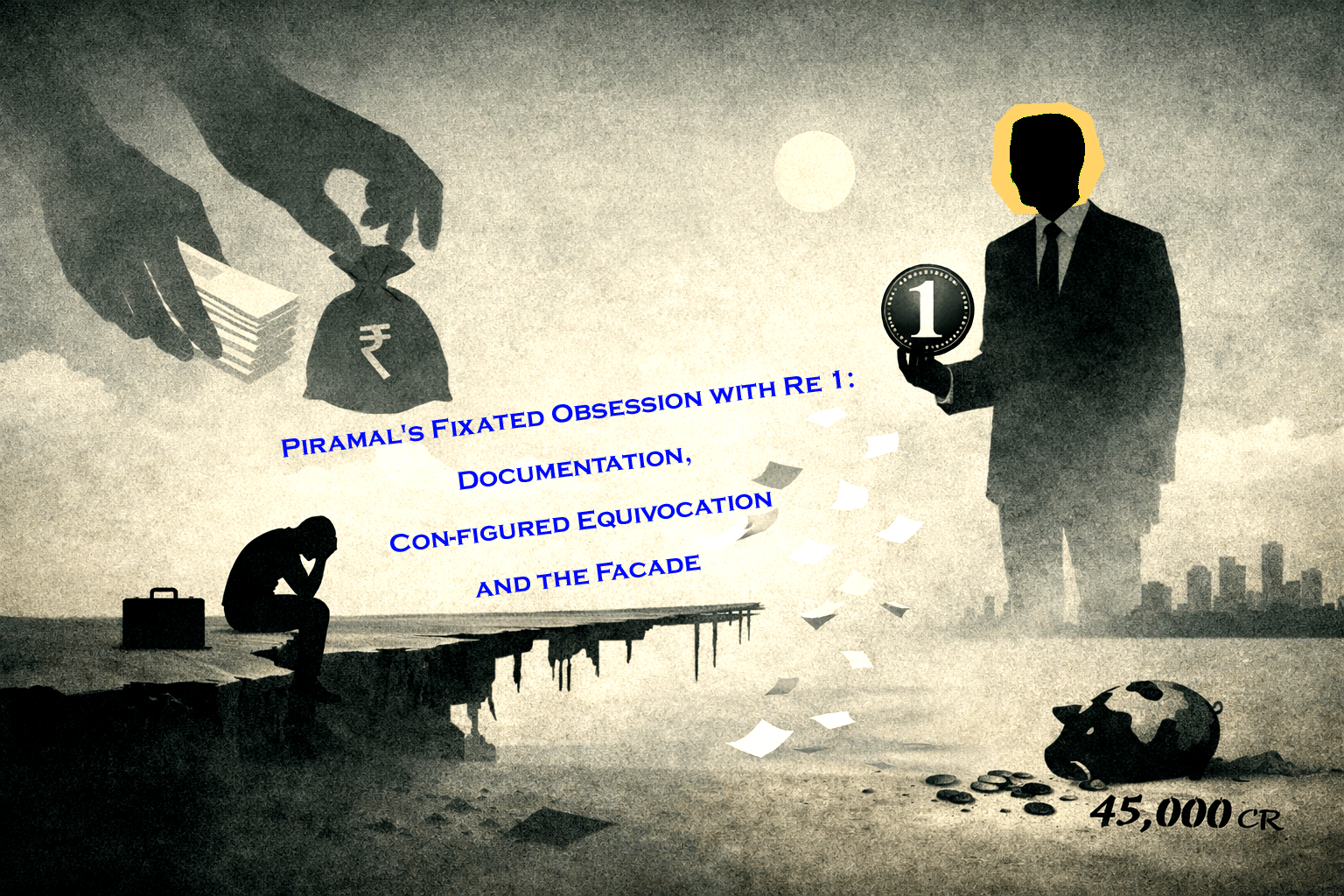
Written from the standpoint of one pauperised by the DHFL collapse—once a trusting fixed-deposit holder, now among the dispossessed—this essay interrogates Piramal Finance’s “Neeyat” campaign as an apparatus of aggressive linguistic marketing that weaponizes micro-honesty to legitimize macro-consolidation. Through semiotic, Marxian, psychoanalytic, and political-economic analysis, it traces how the repeated invocation of Re 1—returned in scenes of everyday virtue (a coin handed back, a packet retrieved, kinship invoked)—operates as myth: at the level of denotation, simple integrity; at the level of connotation, character over paperwork; at the level of ideology, ethical finance naturalized precisely after an insolvency process in which avoidance claims worth approximately ₹45,000 crore were assigned a notional value of Re 1 and retail creditors absorbed devastating haircuts under the shelter of IBC jurisprudence and Section 32A immunity. The same rupee circulates across regimes—as legal token, advertising prop, and ideological shield—while high-yield lending, SARFAESI enforcement, ratings upgrades, and judicial deference to “commercial wisdom” consolidate capital. Self-reflexively acknowledging its wounded vantage, the essay reads the compulsive return of Re 1 not as branding ingenuity but as symptomatic spectacle: a coin endlessly restored on screen while restitution remains foreclosed in law, revealing how moral minimalism at the micro level masks structural dispossession at the macro level.
Beyond the $55 Trillion Dream: A Diary of Doubt on India@100’s Vision for “Viksit Bharat”
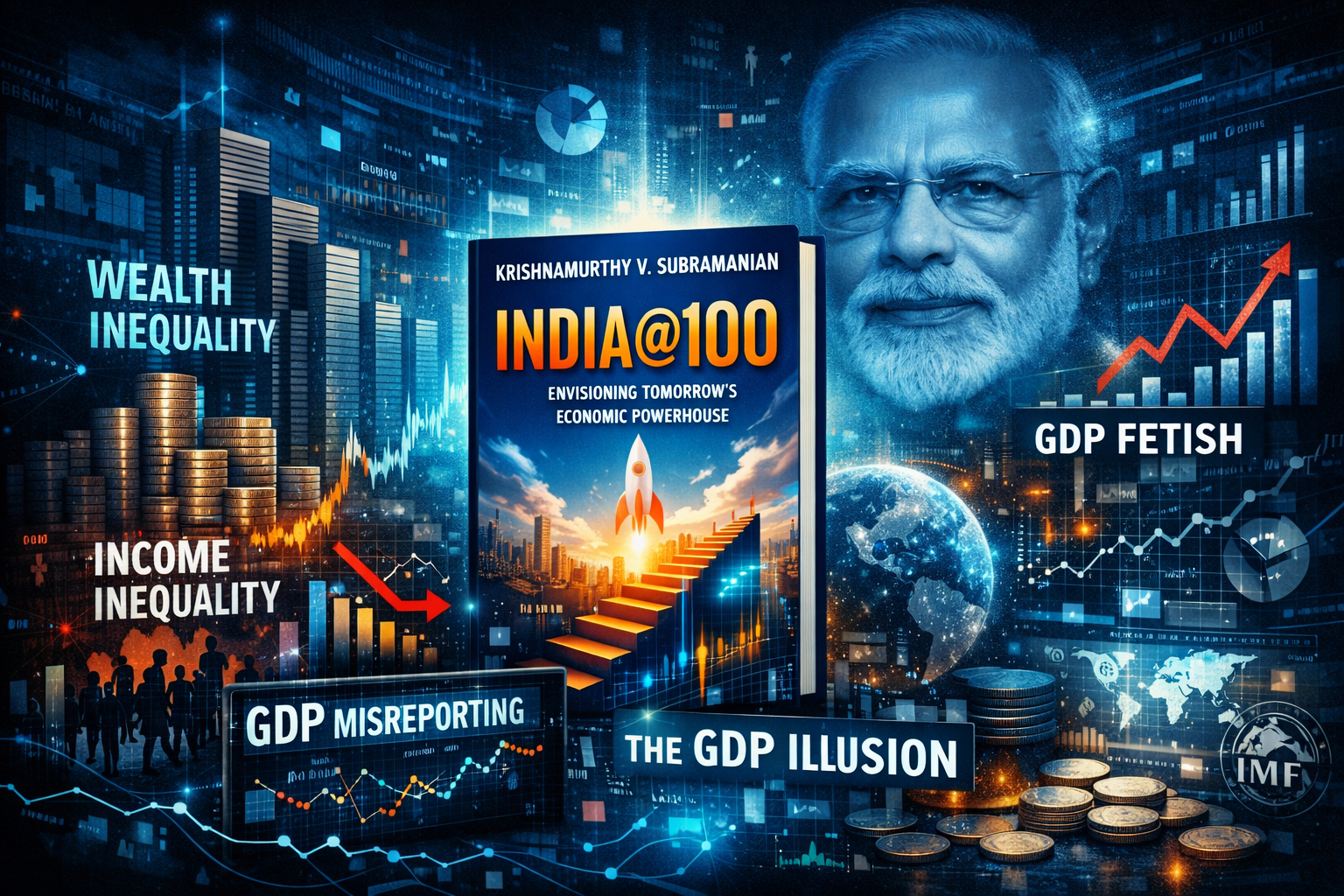
This diary, spanning February 21–23, 2026, offers a multifaceted critique of Krishnamurthy V. Subramanian’s book India@100: Envisioning Tomorrow’s Economic Powerhouse (2024). Through personal reflections, it dissects the bulk purchase controversy involving Union Bank of India, the book’s promotional events and political alignments, pricing anomalies, and core economic projections for a $55 trillion economy by 2047. Interwoven are broader analyses challenging GDP as a fetishized metric, exposing structural misrepresentations in India’s national accounts, rising external debt amid IMF concerns, unaddressed inequality and crony capitalism, and superficial treatment of climate crises. Contrasting Subramanian’s optimistic, growth-oriented “ethical capitalism” with Gandhian austerity and deep ecological alternatives, the entries highlight potential democratic backsliding (per Freedom House and V-Dem reports) and polycrisis risks. Ultimately, it questions whether India@100 serves as pro-BJP propaganda with social myopia, urging a nuanced separation of policy insights from ideological biases in an era of profound global inequalities.
Stones, Frogs, and Divine Dividends: Piramal’s Philanthro-Capitalist Lila
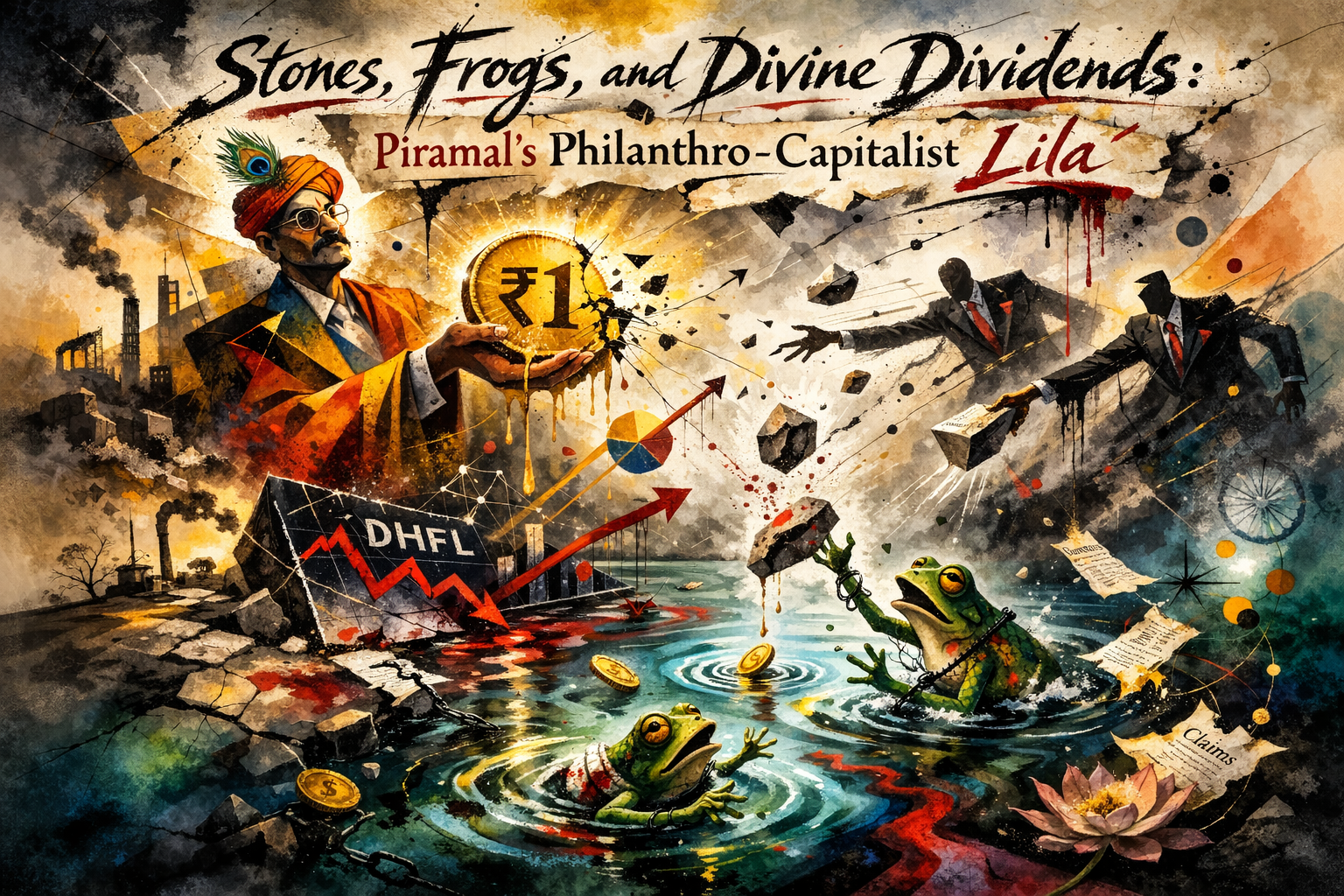
In this delightfully biting exposé, we reimagine Aesop’s timeless fable of boys hurling stones at hapless frogs as a metaphor for the Piramal Group’s “doing well by doing good” empire-building antics. Through sarcastic lenses, we link the innocent cruelty of playground games to corporate resolutions that crush small investors, pollute environments, and silence critics—all while cloaking it in Vaishnava philosophy and Gandhi-branded CSR. Prepare for a romp through divine “lila,” chaotic casinos of capitalism, and a conclusion that leaves you pondering: is this sport, spirituality, or just splendid self-interest?
Grapes are Always Sour for the Other 98%? A Tale Told by a Fox

I, the fox—displaced, hungry, forever circling the perimeter of what others call success—have written this howl from the ashes of vanished forests and the margins of a city that builds towers while drowning its poor. Through five chapters I trace how the grapes of sweetness remain forever sour, not from any defect in my leap, but because the vineyard itself is enclosed by design: fortified mansions rising above flood-prone shores, weddings costing hundreds of millions while hunger indices stay serious, births secured with foreign passports and luxury medicine while preaching national self-reliance to the rest, nationalism demanded as sacrifice from the many yet practiced as portable privilege by the chosen few, and finally an economics of limitless spectacle that devours the very earth required for any future life. From Aesop to Panchatantra to lived memory of deforestation and corporate predation, I refuse the fable’s tidy moral—that effort alone decides access—and instead diagnose structural denial, crony spectacle through conspicuous consumption and ostentatious display, ecological myopia, as well as selective patriotism. In the end I unlearn the dream of joining the feast; I choose instead the difficult, unglamorous arithmetic of limits—sufficiency, repair, localisation, care without applause—because the bulldozers have already flattened the last vine and my vixen beneath them, and what remains is no longer a question of reaching the grapes, but whether any shared ground can still sustain breath in a world that mistakes endless extraction for destiny. This is my testimony, not of envy, but of ruthless clarity: the sourness was never in the fruit; it was always in the fence.
 Once in a Blue Moon Academia