

This article examines the ecological contradictions embedded in contemporary corporate development through a critical analysis of four interconnected cases linked to the activities of the Piramal Group. Situated within the broader environmental context of Mumbai—one of the world’s most climate-vulnerable coastal megacities—the study explores how industrial production, urban real-estate expansion, and superrich architectural consumption intersect with fragile ecosystems and emerging climate risks. The first case investigates allegations of groundwater contamination linked to pharmaceutical manufacturing in Digwal village in Telangana, where proceedings before the National Green Tribunal raised concerns about impacts on aquifers and agricultural landscapes. The second examines controversy surrounding a chemical manufacturing facility in Dahej in Gujarat, where the Gujarat Pollution Control Board ordered a plant shutdown after allegations that hazardous industrial waste had been discharged into a canal connected to the Narmada River system. The analysis then turns to Mumbai’s coastal urban landscape, where luxury developments by Piramal Realty illustrate the commodification of waterfront environments marketed through narratives of sustainability and “biophilic living.” Finally, the study examines the sea-facing residence Gulita as a symbolic expression of wealth concentration along a climate-exposed coastline. Drawing on environmental reports, regulatory proceedings, and urban climate research, the article situates these cases within a broader framework of coastal capitalism and urban ecological transformation, arguing that corporate sustainability narratives often coexist with environmental risks displaced onto rural landscapes, industrial waterways, and vulnerable urban coastlines.
Category Archives: Ecosophy
Piramal’s “Green” Smokescreen: Reports and Radical Reflections
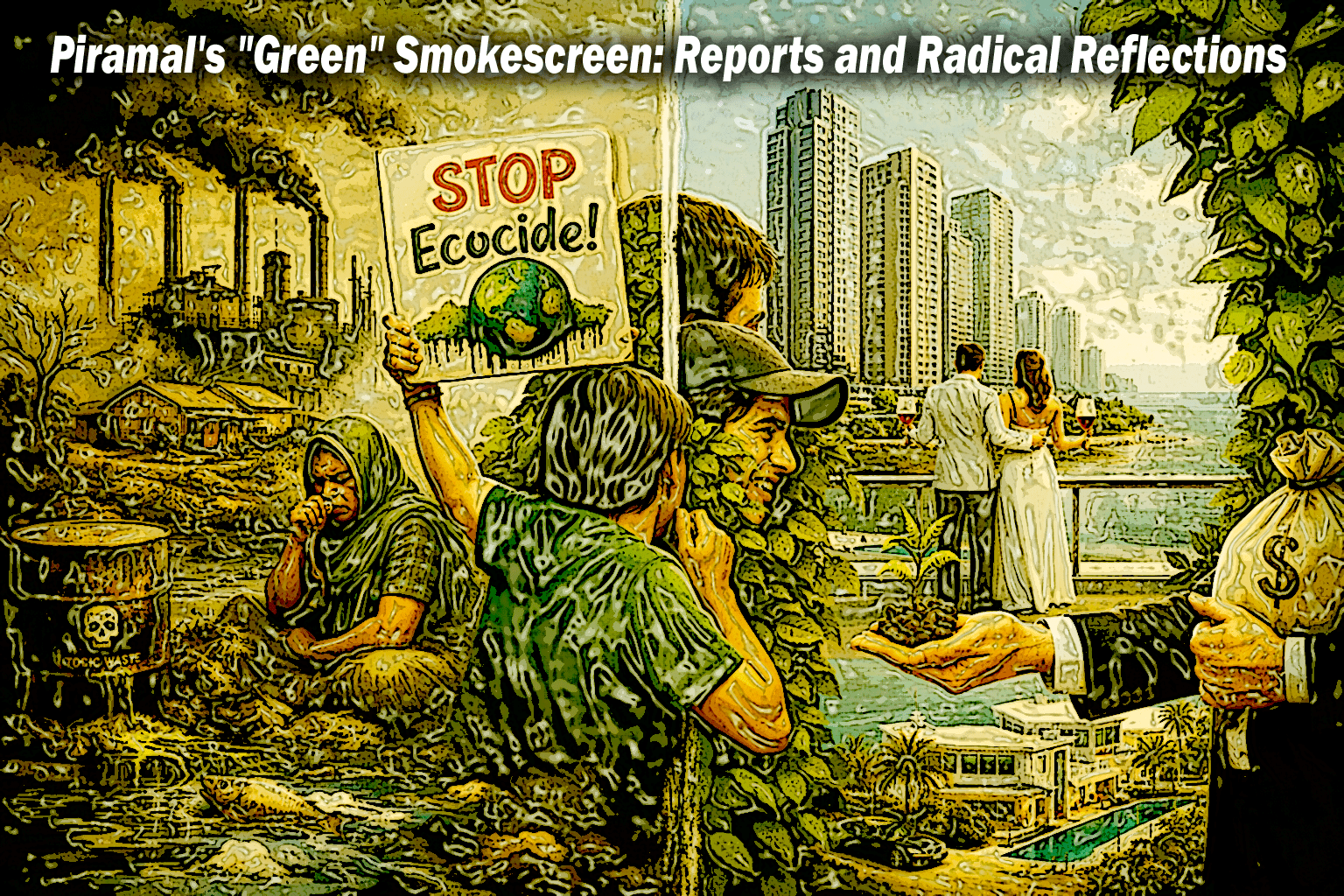
In a scathing indictment of 21st-century Indian philanthro-capitalism, billionaire Ajay Piramal’s empire exemplifies hegemonic subsumption of radical ecology: while Piramal Pharma faces verified allegations of chronic ecocide—groundwater poisoning in Digwal, Telangana (NGT ₹8.3 crore fine, net ₹3.2 crore paid as 0.09% of FY25 revenue; ongoing NGT case OA 1032/2024) and hydrochloric acid dumping in Dahej, Gujarat (GPCB closure, ₹1 crore fine, Supreme Court scrutiny in February 2026, swift interim resumption)—Piramal Realty markets ultra-luxury towers in Mumbai’s IPCC/CRZ high-risk flood zones (e.g., Piramal Mahalaxmi at ~3 m elevation) as “biophilic living” paradises with curated greenery, passive ventilation, and token sapling drives. The family’s own Worli sea-facing mansions (Gulita’s 50,000 sq ft diamond-glass palace) flaunt imported opulence with minimal genuine sustainability, embodying Lewis Mumford’s critique of architectural imperialism. Meanwhile, the Piramal School of Leadership’s Jaipur “walled garden” campus—shortlisted for the 2025 World Architecture Festival—parades biophilic design, passive cooling, and reduced concrete use while branding itself as the future “Piramal University” (a UGC violation) and indoctrinating 50,000–150,000 officials annually in appropriated radical terms like “regenerative agriculture” (Rodale/Shiva lineage), “One Water,” and “systems change” (Macy/Capra/Norberg-Hodge). Through Foucauldian selving, Piramal constitutes itself as “compassionate” and “regenerative” precisely by emptying anti-capitalist vocabularies. Backed by ₹85–88 crore in BJP electoral bonds (2019–2024), this discursive capture enables regulatory impunity amid slow violence on marginalized communities. The article calls for radical rupture: revenue-proportionate penalties, ecological restoration, de-subsumption of language, and militant reclamation by grassroots movements—exposing eco-extortionism where ecocide funds the performance of planetary salvation. Even the Department of Consumer Affairs’ February 2026 anti-greenwashing poster rings hollow when tycoons like Piramal and Adani greenwash unchecked.
The Mirage of “Piramal University”: Philanthropism, Prestige Branding, and the Crisis of the University in Contemporary India
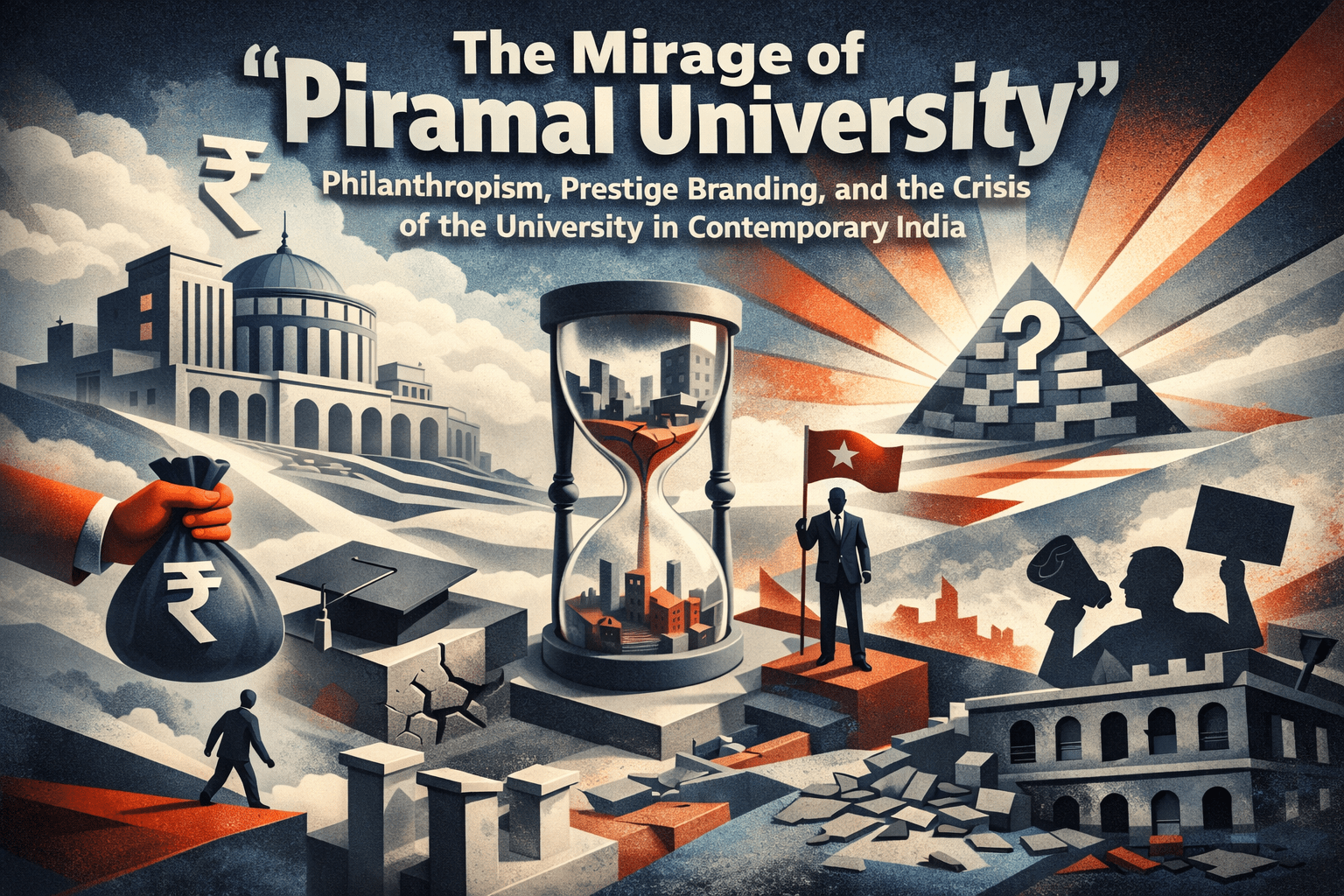
This essay critically interrogates the ambiguous phenomenon popularly referred to as “Piramal University,” situating it within the broader transformation of higher education in contemporary India. Beginning from a radical critique of institutionalized education inspired by thinkers such as Louis Althusser, Ivan Illich, Paulo Freire, and the pedagogical experiments of Rabindranath Tagore and Mahatma Gandhi, the article argues that modern academia increasingly operates as an “academiocracy” — a technocratic regime where knowledge production is subordinated to bureaucratic management, market rationality, and reputational metrics. Through an empirical examination of the Piramal School of Leadership and the sporadic appearance of the term “Piramal University” in corporate documents, CSR narratives, and public discourse, the essay reveals a striking disjunction between operational reality and symbolic branding. While no UGC-recognized university exists under this name, the label circulates widely in digital media, real-estate promotion, and philanthropic storytelling, generating an aura of academic legitimacy without corresponding institutional substance. By comparing this pattern with earlier cases such as the IIPM controversy and with prestige-borrowing strategies like Ajay Piramal’s widely publicized “Oxford Talk,” the essay develops the concept of “Schrödinger’s legitimacy”—a condition in which institutional prestige simultaneously exists and does not exist, sustained through strategic ambiguity and symbolic capital. Ultimately, the case is interpreted not as an isolated anomaly but as a symptom of a wider crisis in which universities are increasingly transformed from communities of inquiry into reputational assets within networks of corporate power, philanthropic branding, and knowledge commodification.
Beyond the $55 Trillion Dream: A Diary of Doubt on India@100’s Vision for “Viksit Bharat”
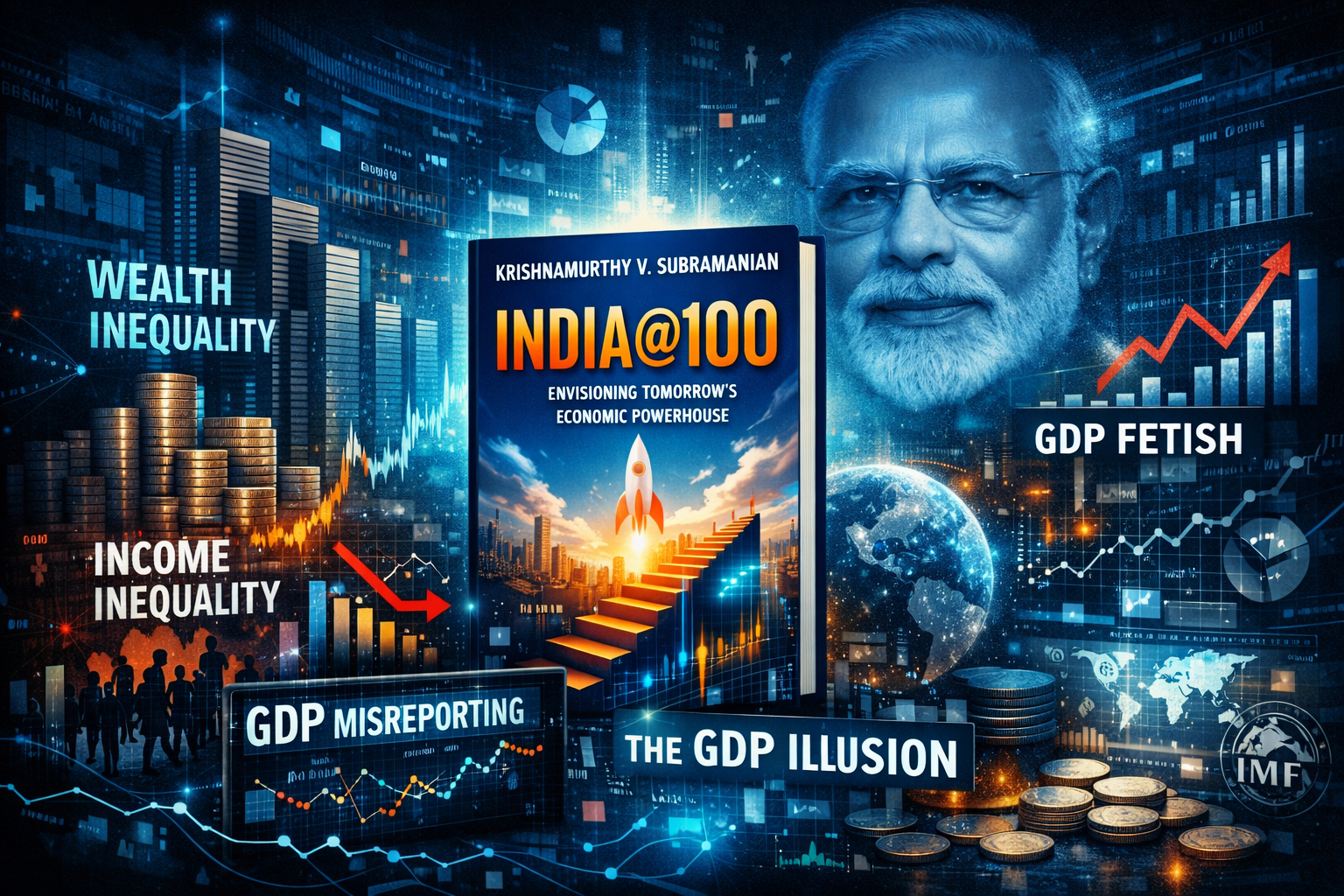
This diary, spanning February 21–23, 2026, offers a multifaceted critique of Krishnamurthy V. Subramanian’s book India@100: Envisioning Tomorrow’s Economic Powerhouse (2024). Through personal reflections, it dissects the bulk purchase controversy involving Union Bank of India, the book’s promotional events and political alignments, pricing anomalies, and core economic projections for a $55 trillion economy by 2047. Interwoven are broader analyses challenging GDP as a fetishized metric, exposing structural misrepresentations in India’s national accounts, rising external debt amid IMF concerns, unaddressed inequality and crony capitalism, and superficial treatment of climate crises. Contrasting Subramanian’s optimistic, growth-oriented “ethical capitalism” with Gandhian austerity and deep ecological alternatives, the entries highlight potential democratic backsliding (per Freedom House and V-Dem reports) and polycrisis risks. Ultimately, it questions whether India@100 serves as pro-BJP propaganda with social myopia, urging a nuanced separation of policy insights from ideological biases in an era of profound global inequalities.
Stones, Frogs, and Divine Dividends: Piramal’s Philanthro-Capitalist Lila
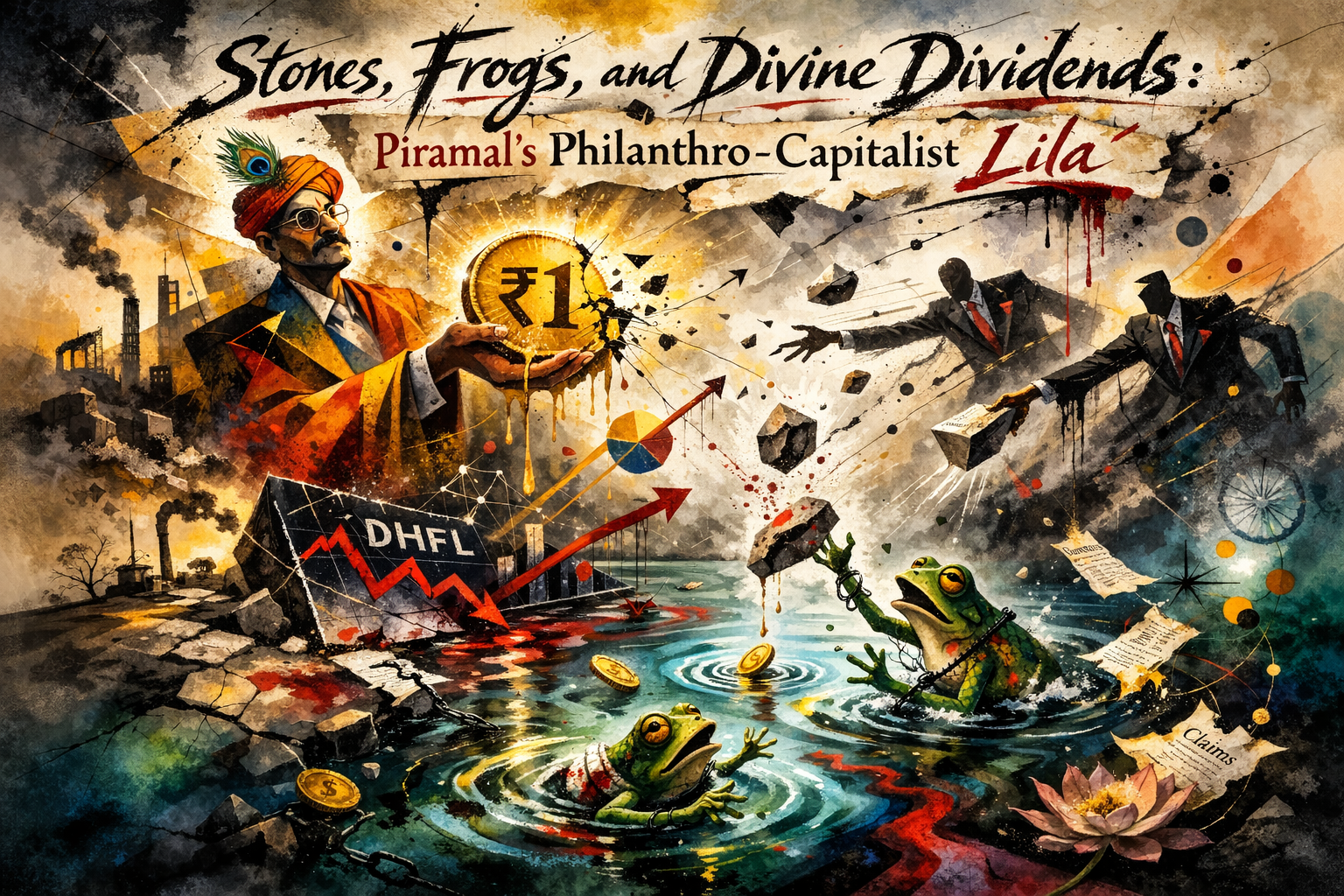
In this delightfully biting exposé, we reimagine Aesop’s timeless fable of boys hurling stones at hapless frogs as a metaphor for the Piramal Group’s “doing well by doing good” empire-building antics. Through sarcastic lenses, we link the innocent cruelty of playground games to corporate resolutions that crush small investors, pollute environments, and silence critics—all while cloaking it in Vaishnava philosophy and Gandhi-branded CSR. Prepare for a romp through divine “lila,” chaotic casinos of capitalism, and a conclusion that leaves you pondering: is this sport, spirituality, or just splendid self-interest?
Grapes are Always Sour for the Other 98%? A Tale Told by a Fox

I, the fox—displaced, hungry, forever circling the perimeter of what others call success—have written this howl from the ashes of vanished forests and the margins of a city that builds towers while drowning its poor. Through five chapters I trace how the grapes of sweetness remain forever sour, not from any defect in my leap, but because the vineyard itself is enclosed by design: fortified mansions rising above flood-prone shores, weddings costing hundreds of millions while hunger indices stay serious, births secured with foreign passports and luxury medicine while preaching national self-reliance to the rest, nationalism demanded as sacrifice from the many yet practiced as portable privilege by the chosen few, and finally an economics of limitless spectacle that devours the very earth required for any future life. From Aesop to Panchatantra to lived memory of deforestation and corporate predation, I refuse the fable’s tidy moral—that effort alone decides access—and instead diagnose structural denial, crony spectacle through conspicuous consumption and ostentatious display, ecological myopia, as well as selective patriotism. In the end I unlearn the dream of joining the feast; I choose instead the difficult, unglamorous arithmetic of limits—sufficiency, repair, localisation, care without applause—because the bulldozers have already flattened the last vine and my vixen beneath them, and what remains is no longer a question of reaching the grapes, but whether any shared ground can still sustain breath in a world that mistakes endless extraction for destiny. This is my testimony, not of envy, but of ruthless clarity: the sourness was never in the fruit; it was always in the fence.
Digwal’s Poison, Dahej’s Acid, Mumbai’s Climate Time-Bombs: Mr. Piramal’s Toxic Trails
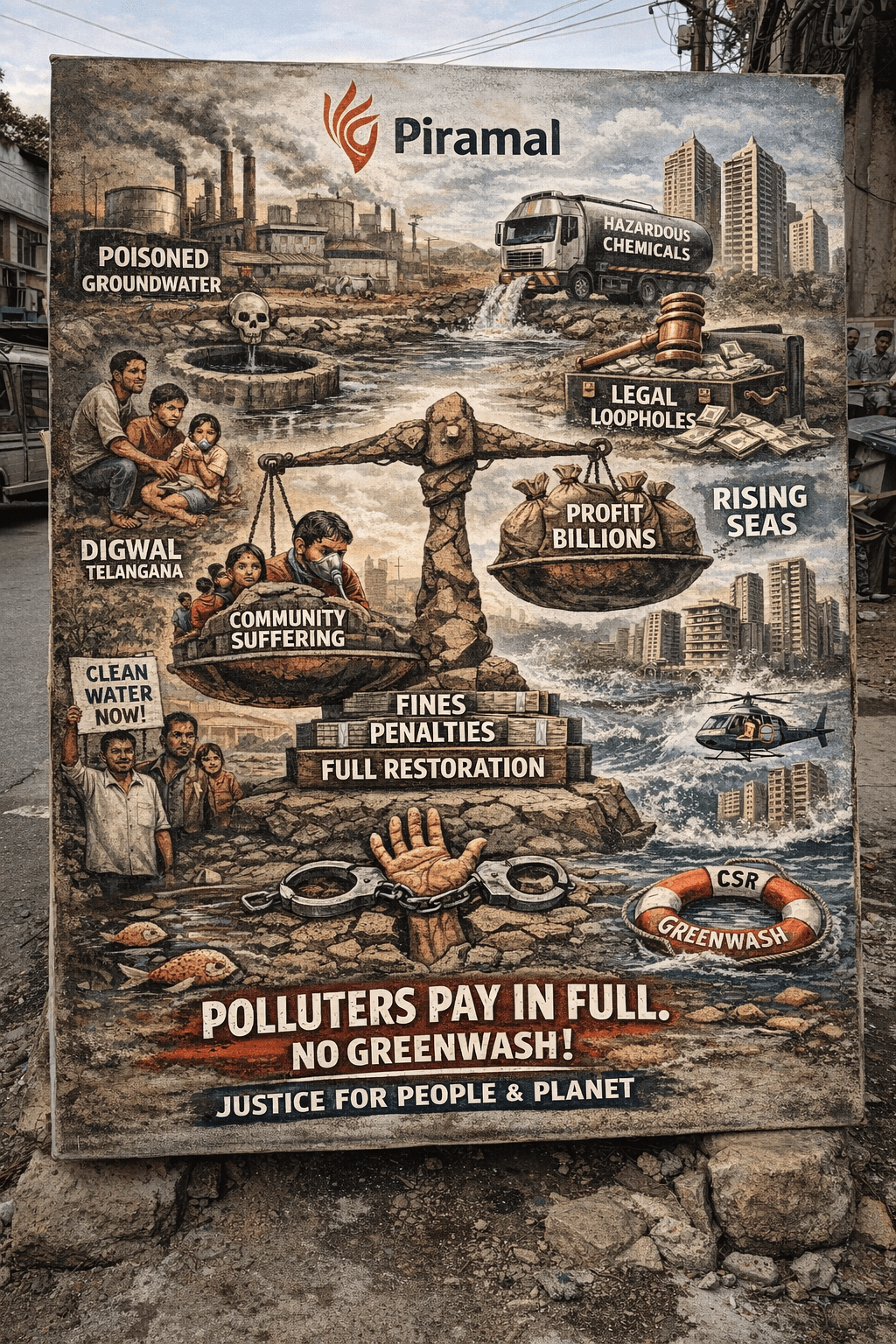
This essay argues that the Piramal Group’s pharmaceutical and real-estate operations exemplify a systemic model of accumulation by dispossession in contemporary capitalism, wherein ecological harm, public-health burdens, and climate vulnerability are externalized onto marginalized communities while profits are privatized and reputational risk is managed through regulatory reprieves, corporate restructuring, and CSR spectacle. Through the long-running groundwater contamination crisis at Digwal, the very recent February 2026 hazardous discharge episode at Dahej affecting the Narmada-linked canal system, and the development of ultra-luxury coastal real estate in flood-prone zones of Mumbai, the text demonstrates a recurring pattern: violation, brief enforcement theatre, rapid operational normalization, and uninterrupted high-margin expansion. It situates these cases within theoretical frameworks of slow violence, ecological surplus extraction, and philanthropic greenwashing, arguing that fines function as licensing fees rather than deterrents and that dynastic corporate networks convert environmental risk into both profit and spectacle. The essay concludes by demanding a materially enforced Polluter Pays regime—extending beyond monetary penalties to full ecological restoration, community restitution, structural limits on expansion, and legally binding accountability—insisting that environmental justice cannot be offset through philanthropy, CSR branding, or procedural compliance while the biosphere itself absorbs irreversible damage.
Pollute, Pay, and Profit: Post-Facto Penalties and the Crisis of Environmental Governance in India
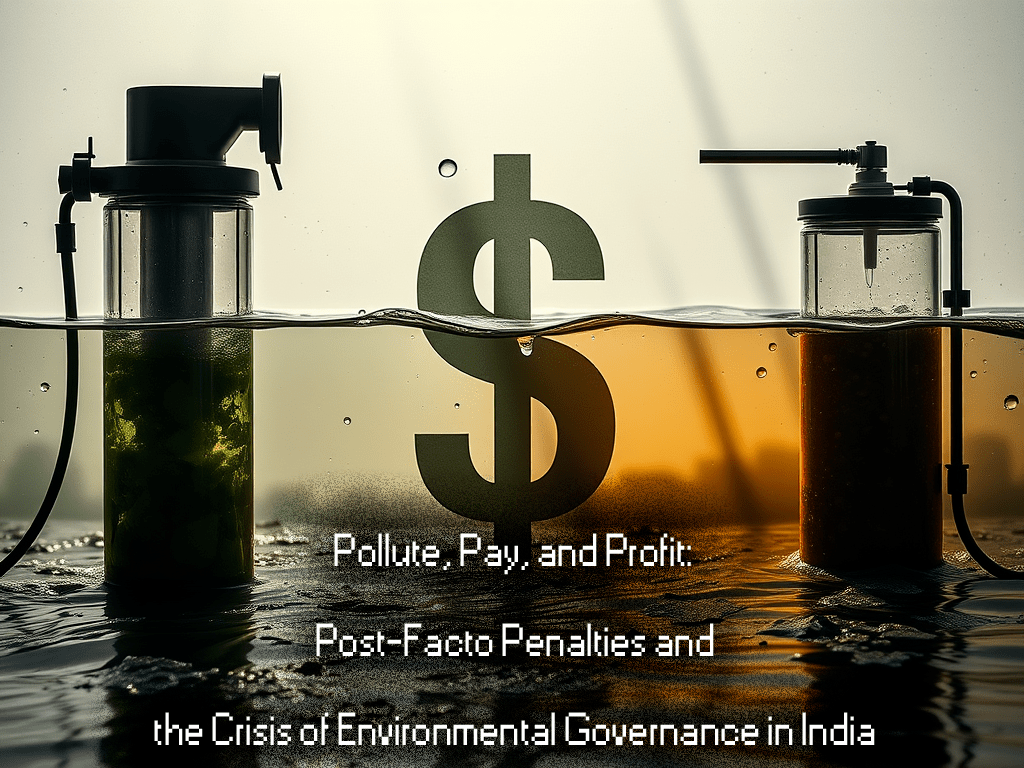
India’s environmental legal framework relies heavily on post-facto penalties—fines, compensation, and retrospective clearances—that fail to deter ecological crimes and often enable corporate violators to commodify the very resources they degrade in the first place. This article critiques the systemic flaws in post-facto approaches through case studies of Piramal Sarvajal (a CSR water purification venture following groundwater pollution in Digwal, Telangana) and Reliance’s Campa Cola revival under Isha Ambani Piramal (a beverage expansion exacerbating water scarcity). Linked by dynastic ties and philanthro-capitalist logic, these ventures illustrate how polluters repackage harm as opportunity, turning natural components like water into “Any Time Money” while evading true accountability. Drawing further on Jairam Ramesh’s 2026 Supreme Court challenge to ex post facto clearances and international calls for ecocide criminalization, the analysis condemns reactive penalties as counterproductive, violating precautionary principles and fostering moral hazard. It advocates for stricter preventive measures, criminal recognition of ecocide, and a shift toward ecocentric justice to protect ecosystems and human rights.
Blooded Waters, Dirty Hands: An Elegy for Puṇyodaka

This text is an elegy for puṇyodaka—not as a lost ritual substance, but as a shattered moral condition. Moving across Kalidasa’s Meghadūta, the Vana Parva’s Yaksha-prashna, biblical plague, Macbeth’s indelible blood, and Sartre’s Dirty Hands, it traces how water—river, sea, confluence—has been converted into spectacle, alibi, and instrument of power. Empirical poisonings (heavy metals, fecal coliforms, ecological collapse) coexist with choreographed immersions, artificial ghats, and submarine devotions, revealing a regime of simulation where sanctity is performed while rivers rot and silences are enforced. The work argues that contemporary governmentality no longer seeks purity but stages it, laundering violence through ritual, nationalism, and necessity. Against Hoederer’s calculus and Macbeth’s despair, the Yaksha’s ancient answer—manomalatyāga, the renunciation of inner stain—returns as an indictment: when minds remain polluted by greed, vanity, and commanded quiet, no river can cleanse. Puṇyodaka vanishes not because water fails, but because power poisons meaning itself. What remains is refusal: the withdrawal of consent from any politics that needs blood to function, spectacle to survive, and dirty hands to rule.
Water, Water Everywhere, Nor Any Drop to Drink? An Essay on Hydro-Politics

This paper examines the enduring paradox of Earth’s vast water resources contrasted with the severe scarcity of safe, drinkable freshwater, encapsulated in Samuel Taylor Coleridge’s line from “The Rime of the Ancient Mariner”: “Water, water everywhere, but not a drop to drink.” Drawing on foundational hydrological data and recent 2026 UN assessments declaring an era of “global water bankruptcy”—marked by irreversible depletion, pollution, and over-allocation of water systems—the study analyzes the mismatch between total water volume (primarily saline oceans) and accessible potable supplies. It investigates key research questions: the drivers of drinkable water scarcity (natural inaccessibility compounded by human-induced over-extraction, climate change, and contamination) and the primary anthropogenic sources of pollution (groundwater overuse without recharge, industrialization and acid rain, military activities, domestic and urban waste mismanagement, maritime pollution, sea mining, vanishing glaciers, agriculture, mining, deforestation, pharmaceuticals, and more). The analysis critiques “green capitalist” interventions—such as bottled water, alcoholic beverages, RO purifiers, desalination, privatization, virtual water trade, and green tech manufacturing—as often exacerbating waste through resource-intensive processes and greenwashing. Through India-focused case studies of Piramal Sarvajal (as compensatory CSR amid corporate pollution) and Reliance’s Campa Cola revival (as “Ambani-Cola capitalism” embodying Derrida’s pharmakon of thirst commodification), the paper highlights how profit-driven models mask structural harms while perpetuating dependency. It concludes with the looming threat of “water wars” amid surging conflicts and projections of widespread displacement, advocating systemic shifts toward community-led regeneration (e.g., Rajendra Singh’s johad-based river rejuvenation), equitable governance, transboundary cooperation, and de-commodification of water as a shared commons to avert irreversible crises.
 Once in a Blue Moon Academia