
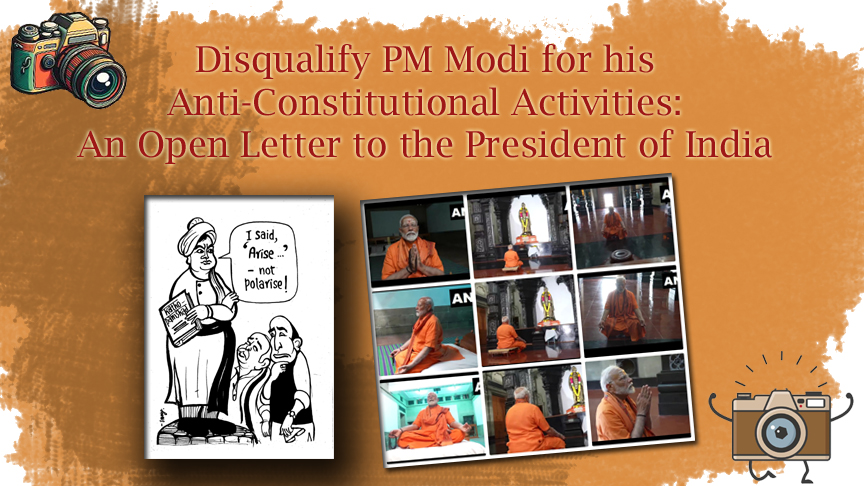
Posted on 31/05/2024 (GMT 19:18 hrs) To The Hon’ble President, The Republic of India Sub: Disqualify PM Modi for his anti-Constitutional activities Dear Madam, With reference to our RTI dated 28.01.2024 to the Prime Minister’s Office (PMO) just after the heinous inauguration of the Ram Temple in Ayodhya on the demolished, vandalized ruins of theContinue reading “Disqualify PM Modi for his Anti-Constitutional Activities: An Open Letter to the President of India”
Category Archives: Activities
Our current activities concentrate on the case of Dewan Housing Finance Corporation Limited (DHFL), India. While exploring and investigating this particular case, we have found that India’s crony ruling party, gangsters, banksters as well as religious gurus and institutions are involved in the same. Therefore, to break such collusion, we have decided to deploy an “all out attack” on the existing paradigm of neoliberal market economy as well as market fundamentalism. ***DISCLAIMER: We have collected all the data from available sources on the internet as given on the official portals of media houses, websites and institutions and organizations. We are not first-hand reporters and hence, we are not liable for any inadvertent error or value-loaded statements made on those portals. All propositions have to be viewed as descriptive assertions on the given point of concern.***
Indian General Election 2024: A Farce?!
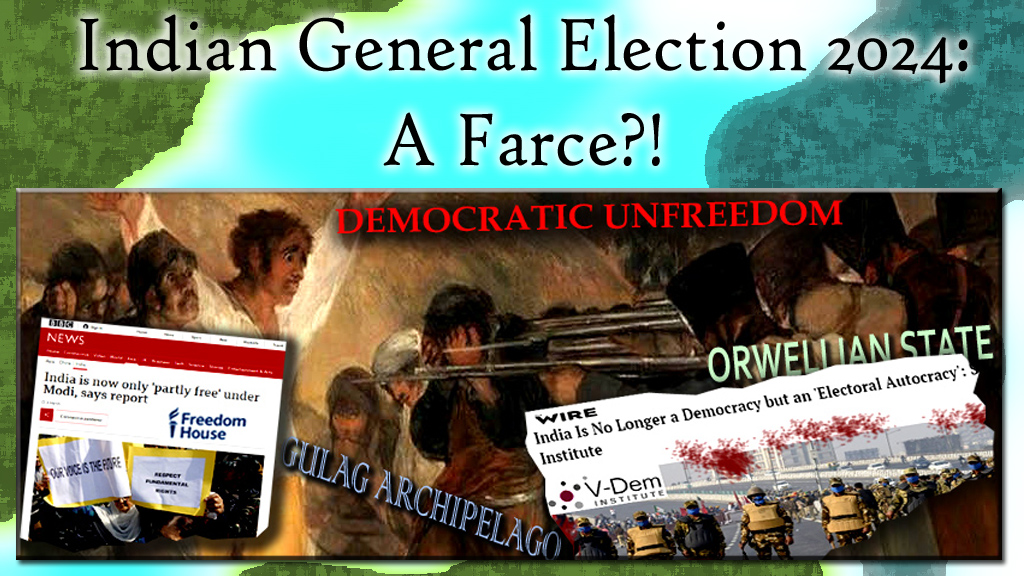
Posted on 23/05/2024 (GMT 12:28 hrs) Updated on 28/05/2024 (GMT 17:58 hrs) An Overview: The following collage deals with the present scenario of Indian politics, with the ongoing General Election (2024), which suffers from the legitimation crisis (Habermas) due to various facts of manipulation, encroachment and atrocities. The post also talks about the role ofContinue reading “Indian General Election 2024: A Farce?!”
Modiji’s Guarantee and the DHFL Victims: A Letter to PM Modi

Posted on 19/05/2024 (GMT 14:50 hrs) Sub: Modiji’s Guarantee and the DHFL Victims Dear Modiji, Hope that you are managing your stress well, given the grave conditions that confront your party at the moment. With your yogic corporeal, we are sure that you will be able to lead a balanced life after 4th June, 2024. Anyway, we,Continue reading “Modiji’s Guarantee and the DHFL Victims: A Letter to PM Modi”
The DHFL Case and the Contradictory Verdicts of the NCLAT
The article examines the contradictory verdicts from the National Company Law Appellate Tribunal (NCLAT) regarding the DHFL case, highlighting four judgments issued in January and February 2022. It questions whether these inconsistencies arose from political pressure, inadequate judicial reasoning, or flaws in the Insolvency and Bankruptcy Code (IBC). The piece argues that the NCLAT favors non-convertible debenture (NCD) holders over fixed deposit (FD) holders, calling for a reassessment of the IBC to ensure equitable treatment for all creditors.
Beyond Pretensions: Narendra Modi and Ajay Piramal

The piece offers a trenchant critique of the symbiotic relationship between Narendra Modi’s BJP-led government and Ajay Piramal, framing it as emblematic of how politico-economic power is consolidated in contemporary India by means of moral-symbolic pretension and regulatory capture. The authors open with two speeches by Modi — one on the Congress manifesto, the other on the Ambani-Adani “scandal” — which they characterise as emblematic of his “habitual … web of pseudology” and the anxieties facing his regime. They then turn to Piramal, noting his declared allegiance to Gaudiya Vaishnava spirituality (via his association with ISKCON) and yet contrasting that with the multiple controversies surrounding him: alleged environmental violations (e.g., Digwal), insider trading reliefs, his acquisition of Dewan Housing Finance Corporation Limited (DHFL) via the insolvency regime, substantial electoral-bond donations to the BJP, and his positioning as a “friendly oligarch”. The article thus argues that Piramal’s spiritual-philanthropic branding and Modi’s populist entrepreneurial discourse function together to legitimise a regime of “more equal than others” capitalism in which dissent is sidelined, regulatory checks are bypassed, and unscrutinised mass suffering persists (illustrated through farmers, Manipuri communities and FD-holders). The tone is sharply condemnatory: Piramal is depicted as a “pretentious monster” unwilling to “look in the mirror”; Modi and the BJP are argued to be on the cusp of losing power as their contradictions mount. In sum, the article frames this duo as a case-study in how political-economic power cloaks itself in spirituality, populism and development slogans to evade accountability and maintain elite rule.
Occupying DHFL without Apex Legal Sanction
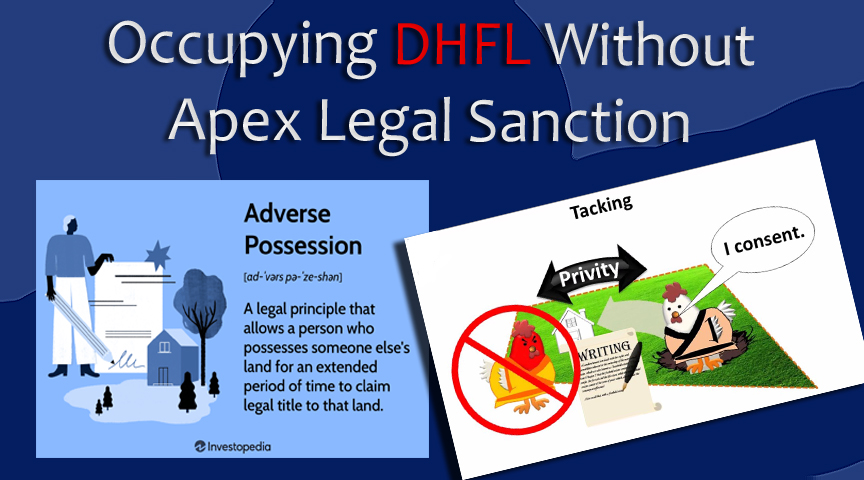
Posted on 05/05/2024 (GMT 06:33 hrs) One person is trying to get hold of my house. However, the whole subject of ANYONE occupying my house is under adjudication or sub judice or awaiting final verdict in the court of law. I have a single question in such a situation: can that person manage to bypassContinue reading “Occupying DHFL without Apex Legal Sanction”
The Gang of Rapists: The Bharatiya Janata Party

Posted on 05/05/2024 (GMT 05:54 hrs) Updated on 12th September, 2024 (GMT 19:49 hrs) When we were reading the following shocking article, we noticed that there is a paradigm shift in the ethico-cultural domain of a geo-political area called “India/Bharat” in the South-East Asian Continent. India has travelled from ‘hang the rapists’ to ‘garland theContinue reading “The Gang of Rapists: The Bharatiya Janata Party”
BJP’s Report Card and the Manipulation of Government Agencies
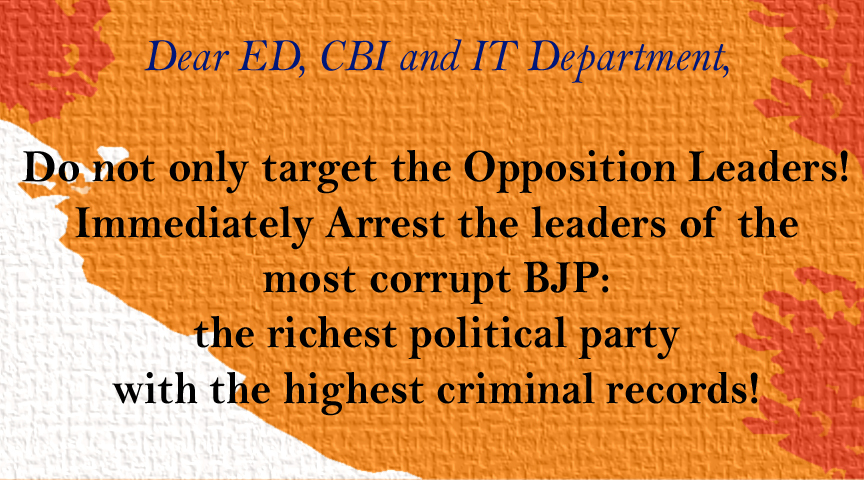
Posted on 20/04/2024 (GMT 19: 06 hrs) In Continuation With: We have seen in the recent times that the government surveillance agencies and statutory bodies such as the ED, CBI, NIA, IT Department, CVC and the ECI are all working in ways which are evidently biased, prejudiced, one-sided, favouritist and partial towards the political oppositionContinue reading “BJP’s Report Card and the Manipulation of Government Agencies”
Violations of Law by PM Narendra Modi: A Few Instances
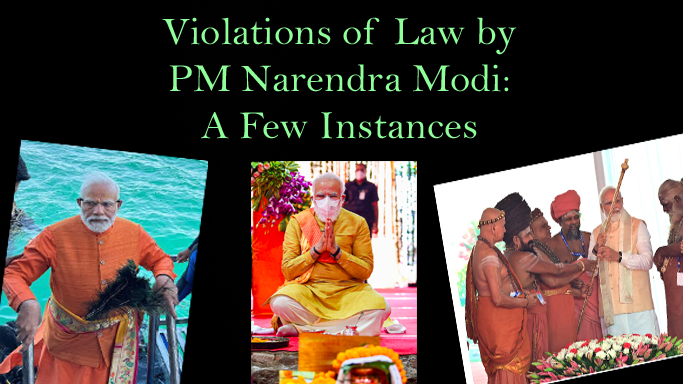
Posted on 20/04/2024 (GMT 16:00 hrs) In Continuation With: OBMA wants to put forth the following few observations about our incumbent PM: If the Prime Minister is always on duty, why was he unavailable at the time of the Pulwama attack in February, 2019? Even telephonic communication with the PM was not available at thatContinue reading “Violations of Law by PM Narendra Modi: A Few Instances”
If Ponzi Customers Get Their Money Back, Why Not DHFL?
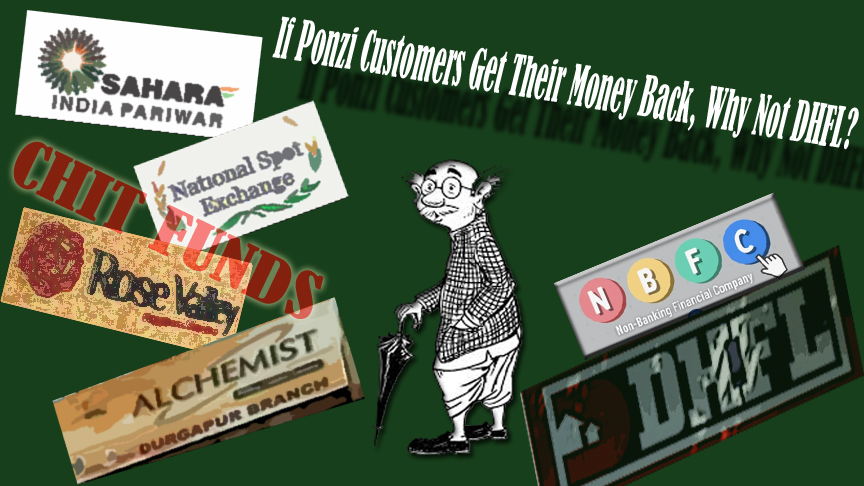
Posted on 13/04/2024 (GMT 20:05 hrs) Updated on 8th September, 2024 (GMT 19:19 hrs) ABSTRACT The article questions why customers of Ponzi schemes, like Sahara and Rose Valley, receive refunds while depositors of DHFL (a non-banking financial company) do not. It suggests that political factors, particularly the role of the BJP and its connections withContinue reading “If Ponzi Customers Get Their Money Back, Why Not DHFL?”
 Once in a Blue Moon Academia