

This affidavit opposes the 2025 Special Intensive Revision (SIR) of electoral rolls as an unconstitutional and discriminatory exercise that extends the exclusionary logic of the NRC–CAA–NPR regime. Framed as an administrative update, the SIR reproduces a politics of fear, surveillance, communal polarization and bureaucratic coercion—already driving marginalized citizens to despair and suicide. It exposes the State’s transformation of citizenship from birthright to conditional privilege, mediated by data and documents. Against this, the affidavit invokes planetary citizenship—an ethical-ecological vision affirming belonging beyond paper, religion, nation, or algorithm.
Unmasking Electoral Fraud in India: Patterns of Voter Roll Manipulation and Institutional Complicity

This article investigates the phenomenon popularly termed Vote Chori (“vote theft”) in contemporary India, revealing a systemic pattern of voter roll manipulation that challenges the credibility of the world’s largest electoral democracy. Drawing upon verified evidence from Rahul Gandhi’s disclosures, Ajit Anjum’s field investigations, voter testimonies such as that of Punam Kumari, and journalistic reporting from The Wire, the study identifies recurring techniques of disenfranchisement—including bulk deletions, forged Form-7 entries, and centralized, software-enabled tampering. Evidence from Karnataka, Bihar, and Maharashtra demonstrates how digital governance infrastructures, designed for efficiency, have become instruments of exclusion and partisan control. The Karnataka Special Investigation Team’s findings of call-centre operations and monetary inducements (₹80 per deletion) corroborate the allegations of industrial-scale roll manipulation. The Election Commission of India’s opacity and resistance to external audits reveal deeper institutional complicity and democratic erosion. By situating these developments within theoretical frameworks of algorithmic governance and bureaucratic authoritarianism, the paper argues that India’s electoral crisis marks not a failure of democracy per se, but its mutation into a technocratic apparatus of managed consent. The conclusion calls for independent digital audits, legislative oversight, and citizen-led verification systems as urgent correctives to restore electoral legitimacy.
Why Indian Political Parties Are Ecologically Indifferent

This article examines the deep-rooted ecological indifference of Indian political parties across the ideological spectrum. Despite unprecedented environmental degradation—from the destruction of forests in Hasdeo and Nicobar to toxic urban air and vanishing rivers—ecology remains absent from India’s political grammar. The essay argues that this neglect is not accidental but structural: born of a development myth that equates progress with extraction and nationalism with industrial expansion. In a corporatized democracy, parties serve capital before climate, leaving the earth unrepresented in the republic’s moral imagination.
Why India Needs a No Kings Movement: From Fascist Corporatocracy to Partyless Democracy

This essay traces the global and Indian convergences of authoritarian populism, corporate capture, and digital surveillance through the metaphor of kingship. Beginning with the “No Kings” movement in the U.S., it reinterprets democracy as an anti-monarchical ethic — a practice of shared sovereignty rather than submission to personality cults. Through Modi’s curated spectacle of power, the text exposes India’s descent into corporatocracy, pseudology, and ecological tyranny. It ultimately envisions a “partyless democracy” rooted in decentralization, mutual care, and invisible leadership — a republic without kings, parties, or masters.
“Who’s Got the Paper? I’ve Got the Match”: Osibisa and the Politics of Documentation
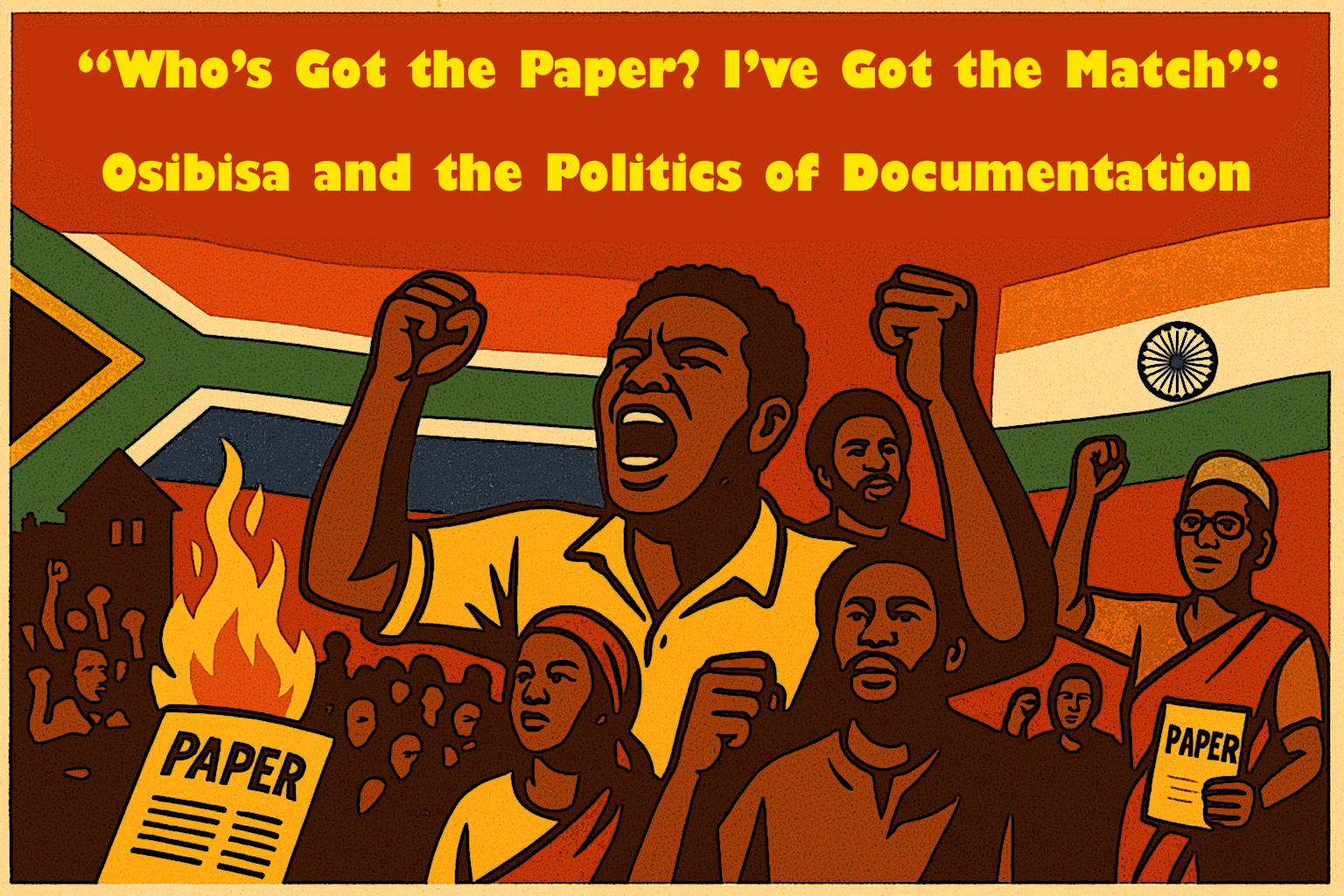
This paper offers an interpretive and historical reading of Osibisa’s 1970s Afro-rock track Who’s Got the Paper? as a sonic meditation on the politics of documentation, identity, and resistance. Beneath its surface as a jubilant “party anthem,” the song encodes a global genealogy of documentary surveillance—from colonial pass laws and apartheid bureaucracies to postcolonial citizenship registers and digital data regimes. The refrain’s dialectical call and response—“Who’s got the paper?” / “I’ve got the match”—stage an encounter between state surveillance and insurgent agency, between the archive’s demand for verification and the people’s capacity for ignition. Combining lyrical analysis with postcolonial, Foucauldian, and musicological frameworks, the paper interprets sound as a mode of political imagination that exceeds textual control. Extending this argument to the Indian context, it situates the song’s critique within contemporary regimes of legibility exemplified by the Citizenship Amendment Act (CAA), National Register of Citizens (NRC), National Population Register (NPR), the Special Intensive Revision (SIR) of electoral rolls, and the Digital Personal Data Protection Act (DPDPA)—each reiterating the colonial “paper logic” of inclusion through exclusion. Drawing upon Michel Foucault’s concept of governmentality, James C. Scott’s notion of legibility, Giorgio Agamben’s “state of exception,” and Achille Mbembe’s necropolitics, the essay argues that Who’s Got the Paper? performs the political imagination of music as resistance—where rhythm becomes revolt and dance becomes dissent. Through the contrapuntal readings of Edward Said, Ngũgĩ wa Thiong’o, and Frantz Fanon, Osibisa’s sound emerges as a postcolonial act of re-signification: transmuting the colonizer’s documentary order into an emancipatory rhythm of decolonial speech.
The Skin Remembers Capital: Piramal Pharma, Dermatological Capitalism, and the Pharmakon of Neoliberal Care

This essay interlaces embodied testimony, regulatory critique, and philosophical reflection to examine the moral and epistemological crises surrounding Piramal Pharma’s Lacto Calamine and Tetmosol. Framed as a confession of corporeal and existential disillusionment, it argues that these consumer products—marketed as instruments of care—operate as pharmakon in Derrida’s sense: both remedy and poison, soothing and subjugating. Drawing on psychodermatology, Foucault’s biopolitics, Derrida’s deconstruction, Nancy’s ontology of exposure, Levinas’s ethics of touch, and Kleinman’s illness narratives, the essay situates dermatological suffering as both symptom and allegory of late-capitalist pathology. Through this fusion of narrative and critique, it proposes the concept of dermatological capitalism—a regime that commodifies distress, aestheticizes anxiety, and monetizes the epidermis as both site and symbol of neoliberal discipline. Engaging theoretical lenses such as moral contagion, the theology of touch, and economic penance, it exposes how regulatory loopholes, celebrity endorsements, and psychosomatic commodification sustain a moral economy of the skin. Ultimately, it reclaims the epidermis as a moral archive of neoliberal harm, urging re-sensitization of ethics, regulation, and embodied care in an age where wellness itself has been corporatized. This essay forms the third part of an ongoing inquiry into the ethics of exposure within India’s pharmaceutical-industrial landscape.
Nixit and the Pharmaco-Capitalist Soul: Hauntings Under Piramal Pharma

This essay interrogates Nixit—a nicotine lozenge produced by Piramal Pharma—as an artifact of contemporary bio-political control. By examining its chemical composition, rhetoric of health, and psychopolitical subtext, the paper situates Nixit within the neoliberal economy of purification, where addiction is not eliminated but reformatted for consumption. Drawing on Freud’s psychoanalysis and Foucault’s biopolitics, alongside the cinematic allegory of Anurag Kashyap’s No Smoking (2007), the article reveals how the pharmaco-industrial complex transforms rebellion into obedience, recoding the smoker’s desire into a commodified act of self-regulation. Incorporating Nietzsche’s genealogy of internalized violence and Derrida’s notion of hauntology, it further argues that the lozenge embodies the spectral persistence of repression under the guise of care. In the age of “managed freedom,” even the act of quitting becomes a performance of compliance—sweetened, packaged, and sold as virtue.
RTI Under Siege: The Deadly Costs of Transparency in BJP-Run India

The Right to Information Act (RTI), once hailed as a revolutionary tool empowering citizens to hold power accountable, now stands at a critical crossroads. Two decades after its enactment, the law that once illuminated corruption, exposed scams, and strengthened democracy has been systematically hollowed out through political interference, bureaucratic evasion, and legislative dilution. From the 2019 amendments weakening Information Commissions to the Digital Personal Data Protection Act’s Section 443 shielding the government under the guise of privacy, transparency has been recast as a threat. India today suffers from data opacity, manipulation, and denial—where evidence is replaced by erasure and secrecy becomes governance. Institutions once devoted to public integrity—the NSSO, CAG, and Indian Statistical Institute—face interference, delayed data releases, and censorship of inconvenient truths. Activists who dared to ask questions have been attacked or killed, while citizens encounter silence and obstruction. The RTI’s decline mirrors a deeper democratic crisis: the transformation of a people’s right to know into the state’s right to conceal. Yet amid suppression, citizens continue to resist—filing mass RTIs, exposing institutional failures, and demanding reform. The fight to save RTI is no longer just about access to information; it is a struggle to reclaim the soul of Indian democracy itself.
Between Cosmetic Grooming, Pharmacology and DHFL Haircut: Ambiguities in the Case of Bohem by Piramal Pharma Limited

This paper investigates the regulatory and ethical positioning of Bohem, a men’s grooming product line launched by Piramal Pharma Limited (PPL), within the Indian cosmetic–drug regulatory framework. Drawing upon publicly available documents from the Central Drugs Standard Control Organisation (CDSCO), Piramal Pharma’s corporate communications, and state regulatory norms, the study demonstrates that Bohem—while branded under a major pharmaceutical conglomerate—is not a pharmacologically approved medicine. Rather, it is classified as a cosmetic or personal-care product, subject to the relatively lenient provisions of the Cosmetics Rules 2020.
The analysis underscores how blurred categorizations between cosmetics and therapeutics enable large corporations to exploit brand trust associated with pharmaceutical credibility while avoiding the rigor of clinical testing and drug regulation. The paper situates this within broader debates on consumer safety, regulatory opacity, and corporate ethics in India’s post-liberalization health-industrial economy. A parallel case study juxtaposes the cosmetic “haircut” of Bohem with the financial “haircut” suffered by DHFL investors, illustrating how governance and grooming converge in the moral economy of neoliberal India.
(W)holistic Resistance and the Courage to Stand Alone: OBMA’s Call for Justice and Dissent in India

This statement reflects OBMA’s introspection and reaffirmation of purpose amid ongoing struggles for justice, accountability, and ecological integrity in India’s increasingly oligarchic and censored environment. Drawing inspiration from Gandhi’s satyagraha, Tagore’s “Ekla Chalo Re,” and the resilience of figures like Umar Khalid, it underscores the moral necessity of walking alone when truth demands it. Acknowledging internal hesitations, systemic suppression, and self-censorship, OBMA calls for renewed ethical persistence, strategic communication, and collective courage — bearing one’s own cross with conscience, foresight, and faith in transformative action.
 Once in a Blue Moon Academia