

On 11 September 2025 (the DHFL Victims’ 9/11!!!), a phone conversation between Dr. Debaprasad Bandyopadhyay (OBMA) and Mr. Jitendra Wagh (Piramal Finance Ltd.) laid bare the unresolved moral and legal contradictions of the DHFL resolution. While Wagh reiterated corporate apologies and deferred responsibility to court rulings, Bandyopadhyay challenged the moral legitimacy of Ajay Piramal’s acquisitions—juxtaposing philanthropy, political donations, and lavish displays of wealth against the dispossession of DHFL victims. The dialogue exposed how legal frameworks and symbolic appropriations of Gandhi, Tagore, and the Gita serve to shield systemic financial abuse and crony capitalism under the BJP regime. By forcing Piramal Finance into reluctant acknowledgment, OBMA pierced corporate silence, reframing the DHFL struggle as a broader reckoning with India’s oligarchic order.
Non-Godi Media, This Is Your Wake-Up Call: The DHFL Scam
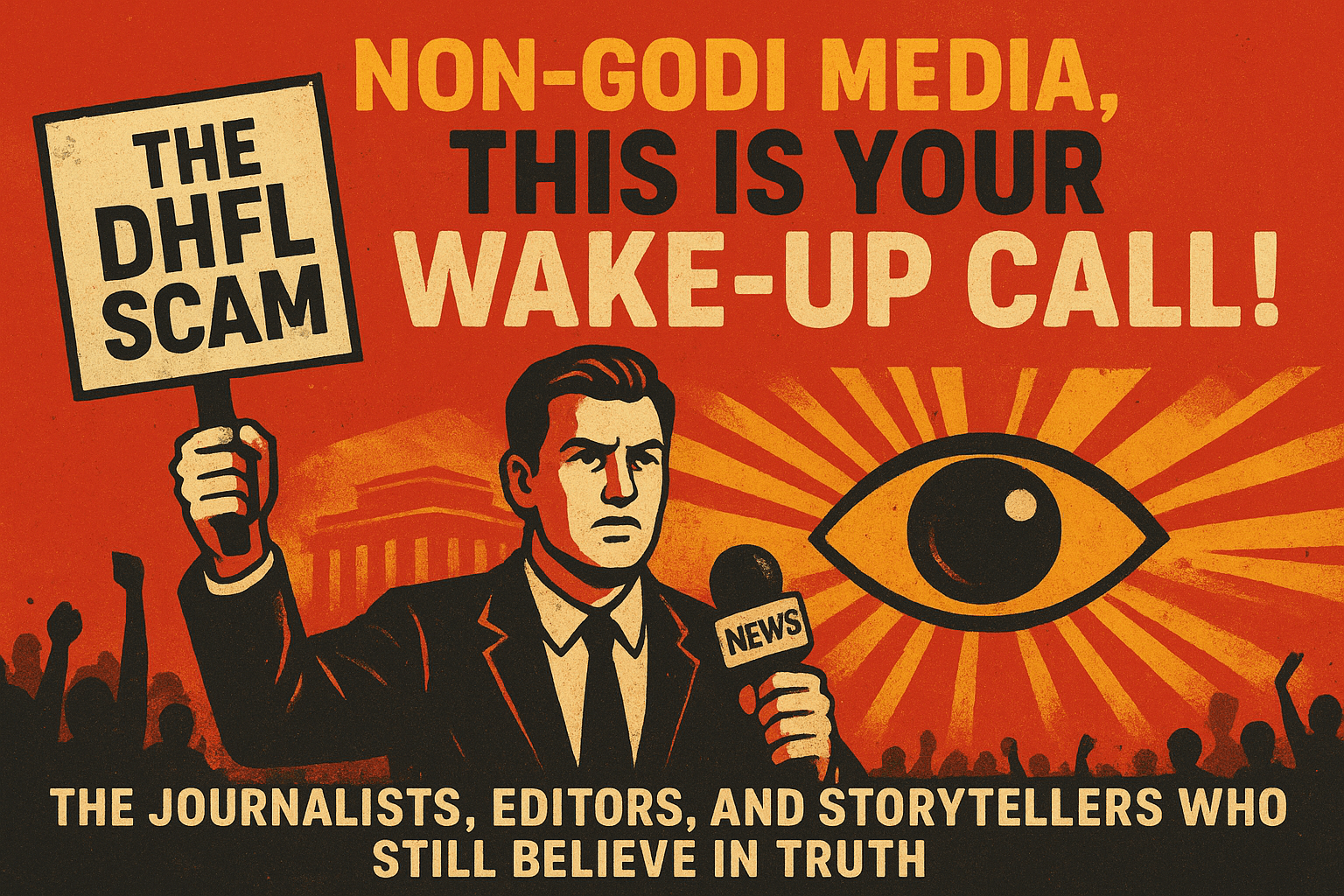
This video is a direct appeal to India’s non-Godi media to break their silence on the DHFL scam—a financial catastrophe that destroyed the savings of pensioners, defence families, employees, and small investors while powerful corporations, auditors, rating agencies, and regulators escaped accountability. It exposes how political donations, celebrity endorsements, fraudulent credit ratings, judicial opacity, and sweetheart deals under the Insolvency and Bankruptcy Code enabled the systematic looting of public wealth and its transfer to oligarchs like Ajay Piramal. By demanding fearless reporting, a Judicial Truth and Accountability Commission, real penalties for gatekeepers, anti-SLAPP protections, and restitution for victims, the video insists that silence from independent media is not neutrality but complicity in state-corporate betrayal.
Why Today’s India Cannot Deny Its Undeclared Emergency

This article examines the concept of an “undeclared emergency” in contemporary India under Narendra Modi’s regime, situating it against the backdrop of declared Emergency (1975–77). While declared Emergency was openly authoritarian and time-bound, today’s context is marked by a much more diffuse and insidious erosion of democratic institutions, legal safeguards, and civil liberties—achieved without formal proclamation. The article highlights continuities and ruptures across political, economic, and social dimensions: from the manipulation of electoral processes, enabling economic bankruptcies to enrich a select few, the subversion of the judiciary to the deployment of majoritarian nationalism and the criminalization of dissent. Unlike the past, the current phase relies on bureaucratic coercion, surveillance, and ideological consolidation to create a climate of permanent insecurity. The article argues that this “undeclared emergency” represents not merely a suspension of democracy but its reconstitution into a new authoritarian normal, where legality, legitimacy, and violence intertwine to foreclose dissent while maintaining the simulated facade of popular consent.
Open Press Release: An Urgent Appeal to India’s Non-Godi Media on Press Freedom, Censorship, and the DHFL Scam

The DHFL scam is not merely a financial fraud but a glaring testament to India’s descent into crony oligarchy, where state-corporate collusion, regulatory failure, and alleged judicial bias have enabled systemic looting of public wealth, leaving millions of ordinary citizens—senior citizens, employees, NRIs, and middle-class investors—silenced and dispossessed. Alongside IL&FS, PMC Bank, and Yes Bank, DHFL exemplifies a decade-long pattern of engineered bankruptcies that enrich tycoons like Adani, Ambani, and Piramal while gatekeepers—auditors, credit rating agencies, and celebrity endorsers—escape accountability. Victims face SLAPP suits, denied justice, and deliberate erasure from mainstream and even non-mainstream media narratives. We, the Once in a Blue Moon Academia (OBMA), on behalf of the DHFL victims, urgently call upon India’s non-“Godi” media—the last remaining torchbearers of truth and justice—to expose this state-corporate nexus, hold all perpetrators accountable, amplify the voices of the long-silenced victims, and pressure authorities to deliver genuine financial justice before public trust and constitutional values are irreparably eroded.
Press Freedom In India: A Declining Trajectory

This paper traces the sharp decline of press freedom in India under the Modi government (2014–2025), situating it within a broader democratic backslide marked by surveillance, censorship, impunity, and institutional capture. Drawing on global indices such as RSF’s World Press Freedom Index, CPJ’s Impunity Index, and the Atlas of Impunity, it highlights how violence against journalists, draconian laws like the UAPA, ownership consolidation, internet shutdowns, and defamation SLAPPs have reshaped India’s media landscape. Through emblematic cases—from the murders of Gauri Lankesh and Shujaat Bukhari to the arrests of Aasif Sultan, Fahad Shah, and Prabir Purkayastha, as well as the harassment of comedians like Munawar Faruqui—the study shows how dissent is criminalized. The paper also examines digital censorship, such as the blocking of BBC’s Modi documentary, Poonam Agarwal’s YouTube ban, and Ajit Anjum’s harassment, alongside the NewsClick raids and Elon Musk’s lawsuit against India’s censorship regime. It argues that the erosion of press freedom mirrors larger systemic crises of impunity, corporate-state nexus, and authoritarian populism, threatening not only media independence but India’s democratic ethos itself.
Shut Down Arms Factories to Stop Wars: Dismantling the Global War Profiteering Machine

The global arms industry—worth nearly $95 billion annually—is both a driver of human suffering and a silent engine of ecological collapse. Wars claim over 2,000 lives daily, displace millions, and shatter societies, while leaving behind poisoned aquifers, fragmented habitats, and toxic soils contaminated by unexploded ordnance and chemical residues. Arms manufacturers like Lockheed Martin and RTX thrive on this devastation, rewarded by soaring stock prices whenever conflict erupts, while shadowy brokers such as Viktor Bout and Aboubakar Hima profit from prolonging wars that ravage both communities and ecosystems. India exemplifies this global dilemma, channeling vast sums into defense while underfunding water, health, education, and environmental resilience. The campaign “Shut Down Arms Factories to Stop Wars” demands dismantling this war economy by halting weapons production, regulating brokers with ecological due diligence, mandating transparency of emissions and toxic legacies, and reallocating resources toward human well-being and planetary stewardship. Peace cannot be defined as the mere absence of war—it must mean fertile soils, clean water, healthy bodies, and thriving ecosystems within Earth’s limits. Yet even the green transition carries risks: critical mineral extraction for renewables, if pursued without justice, threatens to replicate the violence and exploitation of fossil fuel regimes. A just future requires confronting militarism, curbing extractivism, and investing in life over destruction. Only by linking disarmament with ecological restoration can humanity secure genuine peace within planetary boundaries.
Paramavaiṣṇava The Capitalist (A Play)

Paramavaiṣṇava The Capitalist is a neon-charged, satirical spectacle blending Bollywood masala, Bharatanatyam, and Afrobeat to expose corporate hypocrisy and political cronyism in India. Inspired by critiques of corporate malfeasance, it follows Atheist (AT), a Gully Boy-style skeptic, and Vaiṣṇava Bard, a melodramatic poet, confronting Paramavaiṣṇava, a smug oligarch masking scams like the ₹45,000 crore CHFL heist with Gauḍiya Vaiṣṇava piety and show-off Gandhian rhetoric, abetted by Saffron Supremo’s “Gandhigiri Murdabad” political regime, accused of electoral chori (fraud), and Judge SLAPPavati’s SLAPP suits. Set frequently in a cyberpunk courtroom and surreal Mumbai street, it features Gandhi and Tagore’s spectral critiques, a Chorus of Ghosts with inflatable Gītās, and props like rubber ducks and selfie-stick bazookas. Through frenetic dance, biting rap, and a Jaane Bhi Do Yaaro-inspired hanging gesture finale, it indicts corporatized hypocrisy, electoral bonds, ecological ruin, and judicial complicity, urging audiences to reclaim dharma from corporate and saffron hegemony.
When Institutions Dodge Responsibility, Who Answers to the DHFL Victims?

On 30th July 2025, OBMA submitted a detailed appeal to India’s top regulatory and judicial authorities, calling for institutional accountability, independent inquiry, and restitution for thousands of DHFL depositors whose savings were wiped out. Despite detailed evidence of auditing failures, flawed credit ratings, and regulatory lapses, SEBI’s response was allegedly a bureaucratic deflection, refusing responsibility. To highlight this stark contrast, we designed a poster juxtaposing the plea for justice with SEBI’s mechanical reply, exposing systemic evasions and the erosion of public trust. Download, share, and spread this poster—because when regulators dodge responsibility, ordinary citizens pay the price.
We Love You SRK, But You Must Answer for DHFL!

This statement calls on Shah Rukh Khan to take accountability for endorsing DHFL between 2015 and 2018, a period when lakhs of small depositors were persuaded to trust the company before its collapse in 2019, which wiped out over thousands of crores of rupees. Citing the Consumer Protection Act, it argues that Khan failed in his duty as a celebrity endorser to exercise due diligence, and demands a public apology, disgorgement of his endorsement fees, penalties under law, and a temporary ban on financial product endorsements. Drawing on his iconic film roles, the appeal frames accountability not as hostility but as an act of love and justice, urging Khan to stand with victims as the true hero he portrays on screen. It ends with a call for public action—signatures, solidarity, and collective pressure for justice.
DHFL Scam: Who Audited and Rated Our Trust?

Between 2010 and 2019, DHFL projected itself as a secure, AAA-rated housing finance company, yet it concealed one of India’s largest financial frauds involving shell companies, fictitious loans, and alleged political collusion with the BJP. Despite glaring irregularities, auditors and credit rating agencies continued to endorse its credibility, betraying the trust of lakhs of ordinary small depositors. The collapse left vulnerable groups—senior citizens, widows, pensioners, and salaried professionals—with devastating losses, while the resolution process (reportedly) disproportionately benefitted one chosen corporate acquirer. This appeal demands disciplinary action against negligent auditors and rating agencies, restitution for depositors, transparency in insolvency proceedings, and systemic reforms to restore accountability in financial governance.
 Once in a Blue Moon Academia