

The OBMA article provides an overview of Justice Bela M. Trivedi, currently presiding over the DHFL case in India’s Supreme Court. It highlights her judicial background, significant rulings, and perceived alignment with the ruling government, sparking concerns over her impartiality. The article details past controversial case assignments and suggests a pattern of favoring government interests, raising doubts about her stance on justice for DHFL victims amid allegations of corporate and political influence.
Author Archives: Once In A Blue Moon Academia
We are concentrating on two problems:
1. Devastating financial ecosystem
2. Catastrophic natural ecosystem
OUR OBJECTIVES
The objects of the Society shall be :
1. to promote and to protect human and animal rights in all parts of the world, study and dissemination of promotion knowledge of International Human Right related issues along with convergences of different disciplinary studies in accordance with the Philosophy of Science(s), to solve the problems related to anthropogenic global heating, to develop theory and methods, and their utilities in research and practical applications (e.g., in case of litigation related to financial abuse; psychiatric problems due to unemployment neurosis and financial abuses etc.; problems of climate change-related issues) generally, with special reference to natural and social welfare through non-violent means.
2. to undertake research in various fields of legal and psycho-social sciences, with a goal to the reduce human suffering as far as possible in a non-violent manner with a special emphasis on the United Nations Guiding Principles on Business and Human Rights, especially on the third pillar in this context, “Access to remedy for victims of business-related abuses”. That is, “Protect, Respect and Remedy” (one of the 31 principles implemented by the United Nations) for all on the issues of human rights and transnational corporations and other business enterprises.
3. to provide for, and undertake, the collection of information, investigations, projects and operational researches for purposes of planning and the improvement of efficient legislature as well as humane societal norms for the welfare of suffering human and non-human beings.
Human Rights in India and the DHFL Scam: Knowing through Negations

The article highlights the DHFL scam as a case study in India’s human rights landscape, focusing on the misuse of state mechanisms to silence victims and activists. By examining patterns of harassment, it reveals a troubling trend where dissent against financial misconduct meets state repression. The author argues that this tactic of “knowing through negations” helps illuminate power structures at work in stifling justice. Overall, it’s a critique of how human rights violations often intersect with financial scandals in India.
পুং-তান্ত্রিকের নারীবাদচর্চা ও মানবীবিদ্যার আদ্যছেরাদ্দ

The article critiques the misuse of the term “feminism” in political and societal contexts, particularly in South East Asia, arguing that it is often reduced to superficial appeasement rather than genuine advocacy for gender egalitarianism. The piece also discusses the cultural complexity of the gender question, the superficial use of statistics as such, and the real challenges that Indian women face, such as malnutrition and gender-based violence. Emphasizing philosophical rigor, it highlights issues with binary gender norms in the context of discussing “gender neutral law” and advocates for nuanced, intersectional gender studies.
Do You Want Speedy Justice in Indian Judiciary? Ufff!

The article criticizes delays and inequalities in India’s judicial system, highlighting case backlogs, vacant judicial positions, and alleged biases favoring influential figures. Examples include stalled justice for financial fraud victims and the “culture of adjournments” that worsens case backlogs, with some dating back decades. There are allegations of political interference, judicial corruption, and manipulation in high-profile cases. The article calls for accountability, infrastructure improvements, and a reform of judicial appointments to restore public trust.
“Gods” (or Deities?) as Juristic Persons: Critiquing the Hindutva Idolatry

The article critiques the legal recognition of Hindu deities as juristic persons, a concept used to grant Hindu idols legal rights similar to those of humans or corporations. It argues that this practice, which began under British colonial law, has been appropriated by Hindutva forces to reinforce idolatry and elevate religious sentiments over secular law. By treating deities as legal entities, the article suggests that Hindutva ideology gains leverage in the Indian judicial system, promoting a particular brand of religious identity that influences political and social dynamics. The author calls for a critical examination of this conflation of religion and legal identity, questioning its compatibility with India’s secular framework.
চন্দ্রাহত চন্দ্রচূড়

The Bangla blog post is a satirical critique of Justice Dhananjaya Chandrachud, the Chief Justice of India, highlighting his alleged contradictions between judicial conduct and religious involvement. It sarcastically reflects on his public participation in religious ceremonies, questioning the overlap between personal beliefs and professional duties. The article also touches on broader concerns about the fusion of politics, religion, and judiciary in India, referencing landmark cases like the Ram Mandir judgment and expressing frustration with the current socio-political landscape.
CJI Chandrachud: A “Legacy” Mired in Ambivalence(s)
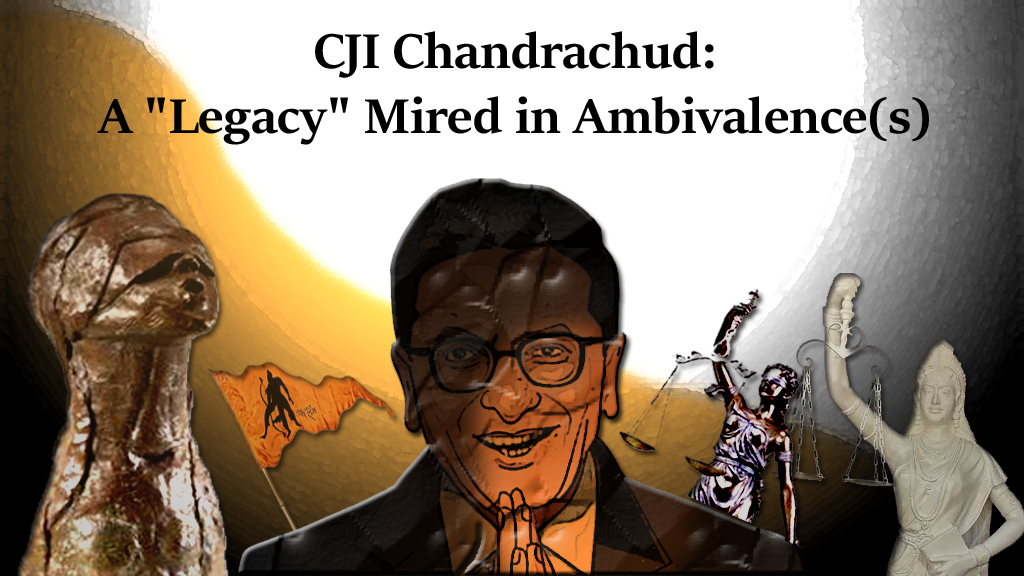
The article critically assesses Chief Justice Chandrachud’s legacy, emphasizing its contradictions. While he is praised for apparently being “progressive”, his tenure is also marred by decisions that seem to align with the present ruling party of India, the BJP. It discusses his ambivalence in upholding the secular constitutional values versus religion-oriented actions that favor the crony oligarchical as well as religious extremist establishment. The piece highlights his complex role in balancing judicial independence with executive influence, casting doubt on the long-term impact of his legacy.
RTI on RTIs: After the Autopsy…

The post discusses a Right to Information (RTI) application submitted to the Supreme Court of India regarding the accountability of various institutions like the Reserve Bank of India (RBI), Comptroller and Auditor General (CAG), and the Insolvency and Bankruptcy Board (IBBI) in the Dewan Housing Finance Corporation Limited (DHFL) case. It highlights the lack of transparency in RTI responses and issues with governmental portals, raising concerns about possible intentional obstructions and secrecy by the ruling party. The post also reflects on India’s political economy under increasing opacity.
The Curious “Dangal” of Vinesh Phogat, Nita Ambani and Jay Shah

The article critiques the contemporary influence of Nita Ambani and Jay Shah in Indian sports, highlighting Vinesh Phogat’s unjustified Olympic disqualification and accusing Ambani and Shah of benefiting from nepotism in their respective sports roles. It argues that Ambani and Shah’s powerful positions are unjustified, questioning their qualifications and linking their influence to political patronage from the ruling BJP. The piece also reflects on larger issues of crony capitalism and the state’s protection of oligarchs, framing Phogat’s struggle as part of a broader fight against corruption.
Defending Piramal: Ethical Integrity in Peril? A Call for Clarification to Dr. A. M. Singhvi

The article criticizes Dr. A. M. Singhvi for defending Ajay Piramal, a BJP-allied businessman linked to the DHFL scam, despite Singhvi’s public opposition to the BJP. The piece highlights ethical concerns, accusing Singhvi of compromising his principles for financial gain by defending Piramal, who is involved in insider trading and crony practices. The post urges DHFL victims to engage in civil disobedience on social media, targeting Singhvi and others for their roles in advocating for those who perpetuated the DHFL scandal.
 Once in a Blue Moon Academia