
Posted on 11th April, 2026 (GMT 03:58 hrs)
ABSTRACT
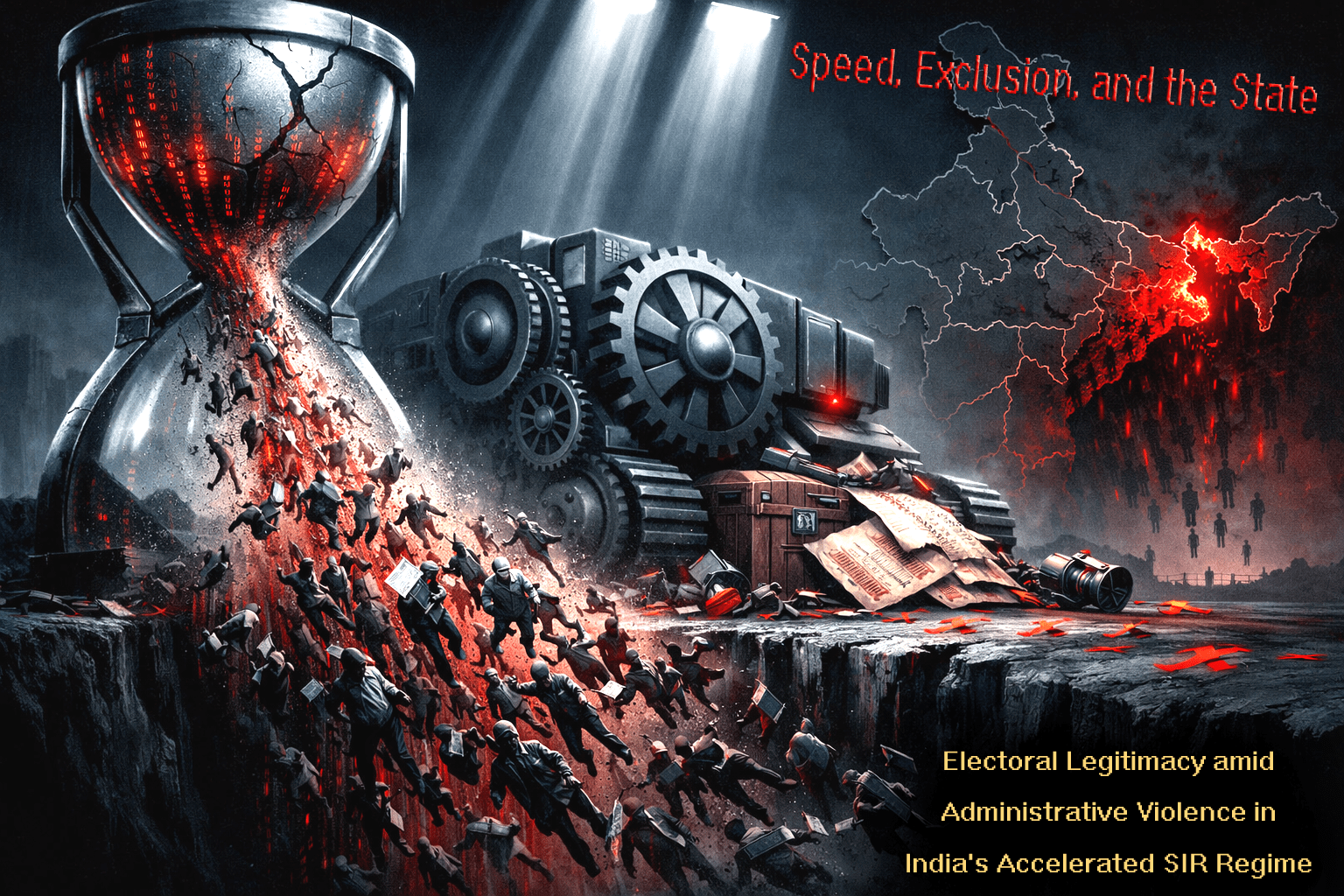
This article critically examines the 2025–26 Special Intensive Revision (SIR) of electoral rolls conducted by the Election Commission of India, arguing that it marks a decisive shift from deliberative enumeration to accelerated exclusion. In contrast to the time-intensive, de novo 2002–03 revision, the current exercise compresses verification into a high-velocity, deadline-driven regime that relies on legacy databases while shifting the burden of proof onto citizens. Drawing on emerging empirical patterns—including mass deletions (over 90 lakh in West Bengal, more than 2 crore in Uttar Pradesh, and over 65 lakh in Bihar), documented worker deaths and distress, and disproportionate impacts on migrants, minorities, and economically vulnerable populations—the article contends that the SIR functions less as administrative “cleanup” than as a system of structured electoral filtration. It further interrogates the role of the Supreme Court of India, whose limited, non-disruptive interventions have allowed the process to proceed within its compressed temporal architecture, thereby reinforcing rather than restraining its effects. Situating the SIR within broader dynamics of accelerationist governance and “speed capitalism,” the analysis demonstrates how administrative velocity, when detached from deliberation, accountability, and human-scale verification, risks transforming electoral governance into an apparatus of systemic disenfranchisement—eroding the epistemic integrity, ethical grounding, and participatory foundations of Indian democracy.
This time, we are once again discussing the so-called Special Intensive Revision of electoral rolls — or, to call a spade a bloody spade, the Special Intensive Rigging exercise being conducted by the Selection Commission of the BJP, sorry, I meant the Election Commission of India. Let’s rip into it with a brutally critical and independent lens, comparing it head-on with the far more honest and thorough 2002–03 revision, and refuse to buy the official bulls**t of “neutral cleanup” and “administrative efficiency.” Let’s do it, shall we?
As founders of Once in a Blue Moon Academia (OBMA) who belong to Bengal, though our country is the planet Earth, we are extremely shocked and deeply unsettled to witness the scale at which the BJP-ECI collusion, with active aid and tacit approval from the Supreme Court, has entered and is systematically trying to destroy what remains of the face of democracy in our India.
The brazenness is staggering. Over 90.66 lakh names deleted in Bengal alone — disproportionately — under a rushed, opaque, and heavily contested process, while the apex court offers little more than cosmetic oversight and procedural fig leaves. This is not administrative reform. This is electoral engineering on an industrial scale, enabled by institutions that were meant to protect democracy but are now actively facilitating its systemic unmaking.
I. Introduction: The Temporal Reconfiguration of Electoral Governance
The Special Intensive Revision (SIR) of Electoral Rolls remains one of the most consequential administrative acts in contemporary Indian democracy. By defining the boundaries of the electorate, it directly shapes political participation, political agency, the perceived legitimacy of elected governments as well as enforces bordered regimes of ruthless documentation.
Announced by the Election Commission of India (ECI) in late 2025 for phased implementation ahead of 2026 assembly elections in states including West Bengal, Tamil Nadu, Kerala, Assam, and Puducherry (with Bihar having undergone an earlier pilot), the ongoing SIR covers vast swathes of the electorate.
A microscopic comparison with the 2002–03 SIR reveals not mere procedural differences but a profound reconfiguration in the temporal architecture of governance.
The earlier model embodied a deliberative, time-rich approach rooted in comprehensive verification. The 2025–26 version reflects a high-velocity regime obsessed with rapid closure, database-driven validation, and harshest elimination of alleged duplicates or ineligible entries. This acceleration — framed as modernization and efficiency — raises urgent questions:
Does compressing time truly enhance the accuracy and inclusivity of rolls, or does it erode them? What are the institutional, human, and democratic costs of such haste? And does this transformation hollow out the deliberative foundations essential to electoral legitimacy?
As of April 11, 2026, withso-called final rolls published or nearing completion in key states, massive unprecedented deletions, documented distress and harassment, and ongoing phases in the remaining 22 states/UTs make these questions more acute than ever.
The SIR is not a neutral technical exercise; it is a weaponised administrative operation, executed through exhausted human bodies and calibrated within a charged nexus of temporal compression, political expediency, and ideological intent. What is presented as bureaucratic “verification” functions, in effect, as a regime of controlled erasure—where discretion is neither incidental nor benign, but systematically mobilised to redraw the boundaries of the electorate. Under these conditions, governance ceases to merely administer democracy; it engineers its exclusions, transforming the architecture of participation into an apparatus of silent, scalable disenfranchisement.
II. Time Taken and the Nature of the Exercise: From Deliberative Thoroughness to Deadline-Driven Validation
The 2002–03 Special Intensive Revision (SIR) was a substantively “de novo” exercise, conducted over an extended, multi-month period — typically exceeding six months in its core phases, and in several states stretching closer to eight months when preparatory and post-draft stages are included. Implemented across major states such as West Bengal, Bihar, Uttar Pradesh, and Maharashtra, it followed a clearly sequenced structure: preparatory mapping and training, sustained house-to-house enumeration, draft roll publication, and comparatively generous windows for claims, objections, corrections, and iterative field verification. This temporally distributed design enabled enumerators to cross-check entries, resolve discrepancies through repeated engagement, and better include mobile, undocumented, or otherwise marginalised populations. In effect, time functioned not merely as an administrative variable but as a condition of epistemic reliability — allowing the rolls to be constructed through layered, unhurried verification rather than rushed validation.
In stark contrast, the 2025–26 SIR is a brutal exercise in accelerated exclusion. Phase-II enumeration — nominally house-to-house verification — was crammed into a matter of weeks (early November to early December 2025) across 12 states/UTs covering roughly 51 crore electors. Draft rolls were pushed out almost immediately thereafter (in many areas by December 9), claims and objections were squeezed into a narrow January 2026 window, and final publication was fast-tracked for early February. Even the limited extensions granted under mounting pressure functioned as little more than cosmetic relief within an already unforgiving, pre-scripted timeline.
This is not a revision — it is a high-pressure, deadline-driven filtration regime. Instead of rebuilding the electorate from the ground up, the process defaults to legacy rolls (circa 2002–04) as a quasi-authoritative baseline, treating absence from those outdated records as presumptive illegitimacy. Citizens are forced to prove their continued existence against a two-decade-old snapshot, often under impossible time constraints. The entire exercise operates on a triage logic where categories such as “duplicates,” “dead,” “shifted,” or “absent” (ASDD) become administrative tools for rapid, target-driven deletion.
The time crunch has been merciless. BLOs — mostly school teachers and local staff already burdened with full-time duties — were subjected to extreme working hours, relentless digital reporting demands, frequent app failures, and coercive performance targets enforced through threats of disciplinary action. The compressed schedule left virtually no room for careful cross-verification or repeated field visits. What should have been a process of thoughtful enumeration was turned into a frantic race against arbitrary deadlines, producing widespread burnout, harassment, and exhaustion among those tasked with executing it.
By design, this accelerated model forecloses meaningful field engagement. Migrants, the poor, the undocumented, and those inaccurately recorded decades ago are structurally disadvantaged — forced to navigate a system that values speed over substance and documentation over lived presence. The pivot to digital tools and legacy baselines has not enhanced accuracy; it has institutionalised suspicion at scale, where bureaucratic discretion exercised under crushing temporal pressure becomes the quiet mechanism through which electoral citizenship is conditionally granted or withdrawn.
Comparative Table:
| Aspect | SIR 2002–03 | SIR 2025–26 (Current) |
|---|---|---|
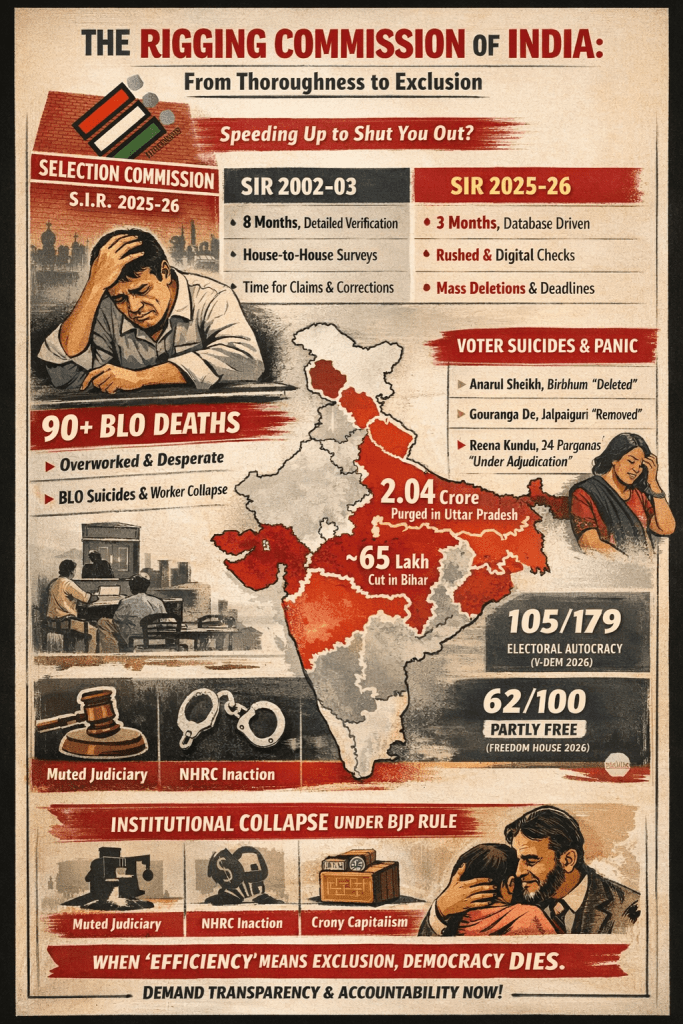
| Total Duration | ~8 months (sequential phases) | ~3 months core (overlapping, with minimal extensions) |
| Process Style | Multi-phase, iterative, time-rich | Compressed, deadline-driven, overlapping |
| Nature of Exercise | Full de novo (fresh enumeration) | Heavy baseline reliance + selective verification/documents |
| Geographical Spread | Focused intensive in key states | Broad (51 crore+ in initial 12 states/UTs; expanding to 22 more from April 2026) |
| Verification Depth | Extensive door-to-door, cross-checking | Digital/database + severely limited field time under extreme pressure |
| Administrative Tempo | Deliberate, legitimacy-focused | Accelerated, compliance- and deletion-metric-driven, with intense time crunch and burnout |
What emerges is not efficiency but a regime of forced hustle. The compressed timeline does not deliver better rolls — it delivers faster ones, at the cost of depth, fairness, and human dignity. Time, once a resource for thoroughness, has been weaponised as a tool of exclusion. In this accelerated machinery, thorough verification is sacrificed, field engagement is minimised, and the entire process runs on the logic of speed above all else — turning what should be a solemn democratic exercise into a high-velocity operation of administrative control.
III. The Human Costs: BLO Suicides, Worker Distress, and Deaths Among “Deleted” or Flagged Voters
Booth Level Officers (BLO)— typically school teachers, clerks, or local government employees already burdened with primary duties — form the fragile backbone of the SIR. In 2025–26, they faced intensified demands: door-to-door visits, form collection, document verification, digital uploading via often-glitchy apps, constant reporting, and stringent targets, all under threats of suspension, FIRs, or disciplinary action for non-compliance. This translated into 14–15+ hour days, sleepless nights, overlapping responsibilities, and minimal additional support or compensation.
Reports from Uttar Pradesh, Gujarat, Rajasthan, Madhya Pradesh, West Bengal, Kerala, Tamil Nadu, and others painted a grim picture. By mid-December 2025, at least 33 poll officials had died since the November 4 launch (per Spect Foundation report), with a significant subset (at least nine confirmed or alleged suicides) directly attributed in suicide notes and family testimonies to SIR-related pressure.
Specific cases included BLOs in Moradabad and Gonda (UP) leaving notes citing inability to meet targets despite exhaustive efforts; teachers in Gujarat collapsing or dying by suicide after “torturous” workloads; similar tragedies in Rajasthan (heart attacks linked to pressure), Kerala, and West Bengal’s Nadia district (e.g., Rinku Tarafdar’s note: “I cannot handle this inhuman work pressure… My conscience is exhausted”). State-wise tallies pointed to high numbers in Madhya Pradesh (up to nine), Uttar Pradesh (eight or more), Gujarat (six), and others. The ECI often dismissed these as “isolated” or unrelated to duties, yet the pattern — entirely absent in the protracted 2002–03 exercise — signals structural failure: temporal compression without adequate staffing, resources, mental health support, or realistic timelines transfers disproportionate burden onto frontline workers, risking both their well-being and the quality of verification (exhausted officers may prioritise speed over accuracy).
Even more harrowing were reports of distress among ordinary citizens, especially “deleted” or flagged voters. In West Bengal, families and opposition leaders linked multiple suicides and panic-induced deaths directly to terror over names appearing in deleted lists, “under adjudication” categories, or missing entirely after the SIR — fears of disenfranchisement, bureaucratic erasure, or effective statelessness that hit migrants, minorities, the elderly, and the poor hardest, often evoking NRC-like anxiety of being “thrown out of the country.”
Documented incidents include:
- Anarul Sheikh (32, Nalhati, Birbhum district, April 2026): A Muslim resident died by suicide (consumed poison) after his name was deleted from the supplementary electoral roll despite being marked “under adjudication.” He had submitted documents and visited the Rampurhat Subdivisional Office to appeal, but the stress proved overwhelming.
- Gouranga De (momo seller, Jalpaiguri town, March 2026): Took his own life after his name appeared in the “deleted” category in the final list published on February 28, despite nearly four decades of voting. His wife cited extreme anxiety and mental stress caused by the deletion.
- Rafiq Ali Gazi (44, Gholpara, South 24 Parganas, March 2026): Found hanging after his name was placed in the “under adjudication” category in the post-SIR final rolls. Family members attributed the suicide to severe mental stress following the publication of the list.
- Reena Rani Kundu (50, Paschim Chandipur, North 24 Parganas, March 2026): Died by suicide (hanged herself) after her name was marked “under adjudication” while her two sons’ names were entirely missing from the post-SIR list. The incident occurred while her sons were at the Block Development Office submitting documents.
- Safikul Gazi (South 24 Parganas, November 2025): Died by suicide fearing exclusion from the voter list due to lack of documents; family said he was terrified of being “thrown out of the country.” TMC claimed this as one of several early incidents.
Opposition parties highlighted dozens of such panic-induced cases (suicides, strokes, and stress-related deaths) since November 2025, with Chief Minister Mamata Banerjee and party leaders alleging broader tolls in Bengal — ranging from several dozen to over 100 deaths linked to SIR-related fear and anxiety (including claims of 110+ total by January 2026). This dual assault — on exhausted BLOs and terrified voters — exposes the SIR not as benign cleanup but as a site of profound humanitarian and democratic failure.
Analytical Comparison of Human and Institutional Costs:
| Dimension | 2002–03 SIR | 2025–26 SIR |
|---|---|---|
| Time Structure | Extended, breathing room | Concentrated, high-intensity deadlines |
| Workload Distribution | Spread, manageable | Overlapping with primary jobs, extreme hours |
| Field Pressure | Lower intensity, iterative | Coercive targets, digital monitoring, threats |
| Human Cost Evidence | No documented suicide/distress wave | 33+ official deaths (many suicides); citizen panic/deaths reported |
| Administrative Logic | Procedural legitimacy through thoroughness | Speed + compliance metrics at any cost |
IV. “Speed Capitalism”: The Limits of Accelerationist Governmentality
The SIR’s evolution cannot be understood in isolation. It must be situated within the wider dynamics of accelerationist governance and what critical theorists call “speed capitalism” — a systemic valorisation of rapidity, output metrics, and relentless efficiency across public spheres that treats time itself as the ultimate scarce resource to be optimised, often at the brutal expense of depth, deliberation, care, and human-scale processes.
Ivan Illich’s seminal critique in Energy and Equity (1973) provides a devastatingly relevant lens. When institutions and tools exceed humanly manageable thresholds of scale, intensity, or velocity, they turn counterproductive — iatrogenic. They begin to undermine the very purposes they claim to serve. Here, instead of producing legitimate, inclusive, and trustworthy electoral rolls, the SIR generates new harms: mass worker burnout, citizen exclusion, eroded public trust, and the quiet disenfranchisement of the vulnerable.
“Convivial” institutions, by contrast, respect human limits. They preserve autonomy, interdependence, and meaningful participation rather than subordinating people to the imperatives of the machine. The 2025–26 SIR, with its merciless deadlines, digital surveillance, and overstretched BLOs, has violently breached these limits.
Nowhere is this more brutally visible than in West Bengal — the state that has become the clearest laboratory and most damning exhibit of speed capitalism’s assault on the very foundations of Indian democracy. The compressed timeline, the obsessive push for deletion targets, the 14–15-hour workdays imposed on teachers and clerks, the constant digital reporting pressure, and the threat of disciplinary action have turned what should have been a solemn democratic exercise into a hustle-culture nightmare. BLOs were not allowed the time to verify carefully; they were ordered to deliver numbers. Citizens, especially in minority-concentrated and opposition-leaning districts, were saddled with the impossible burden of proving their existence against two-decade-old rolls. The result: 90.66 lakh deletions — most of them contested, many concentrated in areas that challenge the ruling dispensation.
This is hustle culture imported into the heart of governance. The same toxic ideology that celebrates “grinding” in the corporate world — glorifying overwork, burnout, and “no excuses” performance — has now colonised public administration. Success is no longer measured by epistemic robustness or democratic legitimacy, but by completion dates, deletion statistics, coverage percentages, and how quickly the machine can declare “mission accomplished.” Digital tools, instead of serving deliberation, have become instruments of surveillance and speed enforcement. The human cost — BLO suicides, citizen panic and suicides, exhausted officers prioritising targets over truth — is treated as collateral damage in the march toward “efficiency.”
The ideological overlay is clear: digital modernisation and administrative rationalisation, backed by tight electoral timelines set by the Centre, have externalised all the costs onto frontline workers and potentially disenfranchised citizens while the powerful reap the benefits of a “cleaner” electoral roll conveniently timed before polls. What we are witnessing in Bengal is not administrative efficiency. It is accelerationist governmentality at work — where speed becomes an end in itself, where hustle replaces care, and where the democratic ritual is reduced to a high-velocity performance of control.
The valorisation of hustle, imported from neoliberal corporate culture into the sinews of the Indian state, risks converting governance from a service-oriented endeavour into a site of permanent stress, breakdown, and democratic violence. In Bengal, this experiment has been conducted with particular ruthlessness. The pattern suggests not neutral purification but selective erasure — often in opposition strongholds and minority-concentrated districts — under the guise of “cleanup.”
When institutions begin to run on the logic of speed capitalism, conviviality dies. Deliberation dies. Democracy itself begins to die — not with a bang, but with the relentless ticking of an accelerated clock.
V. Institutional Erosion and the Crisis of Accountability Under BJP-NDA Rule (2014–2026)
The SIR controversies do not occur in a vacuum. They unfold against a deepening backdrop of institutional fragility and democratic backsliding that has intensified under BJP rule since 2014 — a period marked by the ruling party’s emergence as India’s richest political entity (declaring ₹6,769 crore in income for FY 2024–25, accounting for 85% of all national parties’ declared funds) while fielding among the highest numbers of candidates and legislators with serious criminal cases, including charges of murder, rape, and kidnapping.
International assessments document this trajectory with clinical precision.
V-Dem’s Democracy Report 2026 classifies India as an “electoral autocracy” — a status entered in 2017 and unrelieved. The country slipped five places to rank 105 out of 179 on the Liberal Democracy Index (down from 100), with component scores reflecting severe damage: 106 on Electoral Democracy, 99 on Liberal Component, and 138 on Egalitarian Component. Autocratisation has persisted since 2009, with sharp declines in judicial constraints on the executive, freedom of expression, media independence, and civil society space. India accounts for a significant share of the global population under autocratising conditions.
Freedom House’s Freedom in the World 2026 rates India “Partly Free” at 62/100 (a one-point decline; political rights 31/40, civil liberties 31/60). Over two decades, the score has fallen by 14 points, citing sustained pressures on institutions, opposition, media, and civil liberties. The country was downgraded from “Free” to “Partly Free” in 2020 with no reversal.
This macroscopic decline finds microscopic expression in key institutions, revealing a consistent, ruthless pattern: executive-influenced appointments, selective enforcement that shields the powerful (including the ruling party’s own criminal elements) while targeting critics and marginalised groups, chronic opacity designed to obscure inconvenient truths, and over-reliance on politically vulnerable ground-level bureaucracy — precisely as manifested in the SIR’s BLO crisis and deletion waves. Under this regime, institutions have not merely weakened; they have been systematically captured, hollowed out, and repurposed to legitimise majoritarian efficiency over democratic substance.
A. The Judiciary: Selective Urgency, Persistent Backlogs, and Perceived Legitimation Machine
Once hailed as the last bastion of constitutionalism and secular democracy, the higher judiciary has degenerated into a saffronised legitimisation machine under prolonged BJP rule. Massive arrears continue to plague ordinary litigants — civil, criminal, and fundamental rights cases drag on for years or decades — while politically sensitive or high-stakes matters involving the powerful receive accelerated hearings, favourable procedural outcomes, or sealed-cover jurisprudence that shields executive actions from public scrutiny.
The blurring of the wall between the executive and the judiciary has become glaring and dangerous. Public displays of bonhomie, such as Prime Minister Narendra Modi personally attending and performing aarti at Ganesh Puja celebrations at the residence of then Chief Justice DY Chandrachud, raised serious questions of propriety, secularism, and separation of powers. Such visible proximity, coupled with selective post-retirement rewards and appointments, has deepened the legitimation crisis of the Indian judiciary. The controversial elevation and appointment processes, often accused of ideological screening and saffronisation, have further eroded public faith. The 2019 Ram Mandir verdict — widely criticised for prioritising archaeological claims and majoritarian sentiment over strict property law and secular principles — remains a stark symbol of how the Court has bent to accommodate Hindutva narratives.
This ideological convergence is evident in a pattern of pro-government stances by the apex court. The Court upheld the abrogation of Article 370, endorsing the Modi government’s unilateral dismantling of Jammu and Kashmir’s special status and its bifurcation into Union Territories — a move that stripped millions of their constitutional protections with minimal judicial resistance. In the Rafale deal case, the Court swiftly dismissed petitions seeking scrutiny of the controversial fighter jet purchase, accepting the government’s sealed-cover submissions and effectively shielding potential irregularities from public accountability. Sealed-cover jurisprudence itself has become a favoured tool, allowing the executive to present secret evidence while denying citizens and the opposition any meaningful chance to contest it.
The Court’s handling of challenges to draconian laws like UAPA and CAA has often been marked by delay or deference, allowing the regime to weaponise them against dissenters, journalists, and minorities. Even in cases where the Court eventually struck down measures — such as the electoral bonds scheme that disproportionately benefited the BJP — the interventions frequently came too late, after the damage to democratic transparency had already been done. Post-retirement appointments and elevations have further fuelled suspicions of quid pro quo and ideological alignment.
In the SIR context, the Supreme Court’s role has been nothing short of shameful and complicit. Its interventions were reactive, belated, and fundamentally enabling of the BJP-ECI collusion. The Court ordered greater transparency and publication of deletion reasons in Bihar, and deployed judicial officers for adjudication in West Bengal (over 700 officers examining 60+ lakh “logical discrepancy” cases, resulting in ~27 lakh further deletions). Yet it repeatedly emphasised that the SIR had proceeded “smoothly” in other states despite comparable or higher deletions, effectively isolating West Bengal as a political outlier rather than confronting the nationwide assault on voters.
Even more damning was the Court’s cold, post-facto assurance that deleted voters could approach tribunals or courts after the electoral process was over — that their cases would be “taken care of” once the votes had already been cast and the dice rolled. After the dacoity is done, after names have been erased, after the election has been conducted on a surgically altered roll — what use is the promise of “hearing” their cases? This is not judicial oversight. This is deliberate, wilful ignorance, a studied avoidance, a calculated refusal, and ultimately a denial of timely justice. By prioritising the ECI’s aggressive timelines and the completion of the exercise over the immediate protection of voting rights, the apex court has effectively green-lit the rigging. It has told millions of citizens: “Your right to vote can wait — the schedule cannot.”
The Court refused interim relief for deleted voters, declined to halt the freezing of rolls, and prioritised the ECI’s aggressive timelines over immediate redress for the disenfranchised. In a particularly damning observation, it explicitly stated that the right to vote and right to contest are not fundamental rights, thereby stripping citizens of robust constitutional protection against arbitrary exclusion. Wow!!!! Just Wow!!!!
Even while paying lip service to the idea that deletions “cannot wipe out voting rights forever,” the Court allowed the final publication of rolls on schedule, pushing affected voters into slow, ineffective appellate processes that offered no real remedy before polling dates.
This selective approach — swift compliance with ECI deadlines across most states, minimal disruption to the overall exercise, and a deliberate reluctance to declare the compressed, baseline-dependent SIR process unconstitutional — amounts to open judicial endorsement of the BJP-ECI rigging. By framing opposition resistance (especially in Bengal) as mere political obstruction rather than a legitimate defence of universal adult suffrage, and by consistently refusing to strike down the rushed methodology that shifted the entire burden onto ordinary citizens, the apex court has actively helped legitimise a deeply flawed and exclusionary exercise. Appellate tribunals lagged or remained non-functional in places, leaving migrants, minorities, the poor, and elderly in limbo. The Court’s insistence on not delaying roll freezes effectively prioritised administrative velocity and electoral timelines set by the ECI over substantive justice for the disenfranchised.
Far from acting as a robust check on executive overreach, the higher judiciary has become a willing safety valve — offering cosmetic oversight and procedural fig leaves while the core machinery of accelerated voter erasure rolls forward unimpeded. In doing so, it has converted constitutional safeguards into instruments that facilitate, rather than prevent, the quiet unmaking of Indian democracy. This is not judicial restraint; it is judicial surrender — a betrayal of its constitutional duty that sustains the regime’s democratic façade while the substance of free and fair elections is gutted. The saffronisation and ideological convergence evident in high-profile verdicts, appointment patterns, and public symbolism have left the judiciary increasingly perceived not as an impartial arbiter, but as an extension of majoritarian power.
B. NHRC: Executive Capture, Pluralism Deficit, and Lingering GANHRI Downgrade Threat
The National Human Rights Commission (NHRC) stands as a textbook case of outright executive capture. In March 2025, GANHRI’s Sub-Committee on Accreditation (SCA) recommended downgrading it from “A” to “B” status over political interference in appointments, insufficient pluralism (especially in gender, ethnicity, and religious minority representation), inadequate autonomy, and selective inaction — particularly on economic and social rights violations, minority issues, or cases implicating state or corporate actors aligned with the ruling dispensation. The NHRC challenged the recommendation; the Bureau rejected the appeal in December 2025 and referred it back. The final decision, originally due April 2026, was postponed to November 2026 — granting breathing room but underscoring persistent, long-standing credibility gaps (concerns raised since 2011, with repeated deferrals in 2016–17, 2023–24).
Under BJP rule, the NHRC has faced accusations of chronic delays in high-profile complaints, routine reclassification of serious violations as mere “civil disputes,” and muted or absent responses to custodial deaths, farmer protests, communal incidents, and economic rights abuses. In the SIR saga, its near-total silence on BLO suicides and distress, as well as citizen panic over deletions, stands in grotesque contrast to its mandate — transforming what was once a watchdog into a toothless legitimiser of the status quo.
C. NCRB: Statistical Illusions, “Dark Figure” of Crime, and Engineered Underreporting
The National Crime Records Bureau (NCRB) compiles police-reported FIRs but explicitly disclaims responsibility for their accuracy or authenticity. It relies wholly on data supplied by state police forces, without independent ground verification or a nationwide victimisation survey (unlike the US National Crime Victimization Survey). Chronic, systemic issues include widespread “burking” (deliberate non-registration of cases to project lower crime rates), political pressure on local officers, repeated delays in report releases, and the distorting “principal offence rule” (POR) that counts only the most serious offence in multi-crime FIRs — effectively hiding the full spectrum of violations and creating a deliberate statistical illusion of law and order.
These flaws, long-standing, have not been meaningfully addressed under BJP rule. Instead, they have been weaponised to enable selective narratives that downplay inconvenient trends while amplifying others that suit the regime’s image. The absence of robust, independent cross-verification mechanisms allows the NCRB to function as a tool of perception management rather than truth-telling. The parallel with the ECI’s heavy dependence on unverified BLO reports is damning: both institutions risk turning ground-level inputs, vulnerable to local and higher political influence, into convenient administrative fictions that serve power rather than expose it.
State-wise Reality vs. Manufactured Narrative
Recent NCRB data (2022–2023 reports, the latest comprehensive figures available) expose the hollowness of the “improved law and order” claim. BJP-ruled or NDA-influenced states frequently top the charts in absolute numbers and serious crimes, yet the data is consistently massaged through burking, reclassification, and POR.
- Uttar Pradesh (BJP-ruled): Consistently records the highest or near-highest numbers in murders (over 3,300 in recent years), crimes against women (including over 65,000 cases in one reported year, topping the national tally), and overall cognisable crimes. It also leads in atrocities against Scheduled Castes.
- Rajasthan (BJP-ruled): Tops or ranks among the highest in rape cases (over 5,000 in some reports) and crimes against women.
- Madhya Pradesh (BJP-ruled): Frequently among the top in rape, crimes against women, and atrocities against Scheduled Tribes (with a reported 28.8% jump in ST cases in one year).
- Bihar (NDA-influenced): High in murders (over 2,200) and overall violent crimes.
- Other BJP/NDA states like Gujarat, Haryana, and Chhattisgarh also feature prominently in specific serious crime categories despite claims of “model governance.”
Meanwhile, the BJP as a party has the highest absolute number of sitting MPs and MLAs with declared criminal cases (including serious ones like murder, attempt to murder, rape, and kidnapping), according to multiple ADR analyses. In several state assemblies and the Union Council of Ministers, BJP representatives show disturbingly high percentages of self-declared criminal backgrounds — yet they continue to hold power, often walking scot-free or facing delayed/protracted trials.
This is the engineered illusion in action:
- Burking and underreporting: Police in many states are pressured to keep FIR numbers low to project “Saaf Sarkar” or “double-engine” success. Serious incidents are either not registered or diluted into lesser offences.
- Principal Offence Rule: A single FIR involving rape + murder is counted only as “murder,” systematically undercounting sexual violence and other crimes.
- Selective amplification: Petty crimes or incidents in opposition-ruled areas are highlighted, while large-scale violence or atrocities in BJP strongholds are minimised or reclassified.
- Political protection: BJP leaders and workers facing serious charges often enjoy delayed investigations, withdrawn cases, or favourable outcomes, while opposition voices or marginalised communities face swift FIRs under draconian laws.
The result is a grotesque statistical mirage: BJP-ruled states frequently show the highest raw crime burdens and serious offence numbers, yet the regime projects an image of control. The NCRB becomes complicit in hiding the “dark figure” of crime — the vast unreported or deliberately suppressed reality — while shielding those in power. Ground-level inputs are manipulated to serve the narrative of “improved law and order,” even as victims from minority communities, Dalits, Adivasis, women, and dissenters continue to suffer systemic denial of justice.
This is not incompetence. It is structural. The NCRB’s dependence on politicised police machinery, combined with the ruling party’s dominance in high-crime states and its own ranks filled with criminal elements who largely walk free, turns crime statistics into a propaganda tool rather than a mirror of reality. The same logic that allows selective deletion in electoral rolls enables selective reporting in crime data: inconvenient truths are buried, while the powerful remain untouched.
Both the NCRB and ECI ultimately rely on the same vulnerable ground-level bureaucracy susceptible to political pressure, intervention etc. When the ruling dispensation controls the levers, “data” becomes fiction, and accountability evaporates. This engineered underreporting is not a flaw — it is a feature of the regime’s governance model.
D. RBI and Regulatory Bodies: Opacity, Crony Facilitation, and Regulatory Vacuum
Similar patterns of systemic erosion, deliberate opacity, and outright crony facilitation define the conduct of economic regulators, with the Reserve Bank of India (RBI) — once expected to act as an independent watchdog — functioning more as a compliant enabler of oligarchic extraction during the BJP-NDA era (2014–2026).
Under Governor Shaktikanta Das (MA in History; appointed in 2018 after a controversial override of the established collegium process), the RBI presided over one of the most aggressive phases of balance-sheet cleansing that ultimately socialised massive losses onto public sector banks and taxpayers while privatising gains for a handful of politically connected corporate houses.
The post-2014 period saw an explosion of stressed assets and bankruptcies. The RBI’s Asset Quality Review (AQR) in 2015–16 exposed the true scale of NPAs (peaking at over 11.5% of advances, with PSBs bearing the brunt), triggering over ₹3 lakh crore in direct government recapitalisation of public sector banks. This was followed by unprecedented loan write-offs — cumulatively exceeding ₹16 lakh crore (with PSBs accounting for the lion’s share) between 2014 and 2025–26. These write-offs, often described as accounting adjustments that removed bad loans from balance sheets without pursuing full recovery, disproportionately benefited large corporate borrowers and wilful defaulters.
The Insolvency and Bankruptcy Code (IBC, 2016), aggressively pushed by the regime and operationalised under RBI directions (including the infamous “RBI-12” and subsequent lists of stressed accounts), was marketed as a time-bound resolution mechanism. In practice, it became a sophisticated vehicle for asset transfer at deep discounts to favoured acquirers. Recovery rates remained modest, average resolution timelines frequently breached the 270–330 day statutory limits (with many cases dragging on for years), and significant “haircuts” (nearly 80% on public money in cases like DHFL) were absorbed by public sector lenders.
High-profile collapses and resolutions under this framework include DHFL (where retail depositors suffered heavy losses while the asset moved to the Piramal Group amid allegations of undervaluation), IL&FS (₹91,000+ crore default), Yes Bank, Jet Airways, ABG Shipyard (one of India’s largest bank frauds at over ₹22,000 crore), and cases involving Essar Steel, Bhushan Power & Steel, Videocon, and others, where resolution often favoured big industrial houses with reported proximity to the ruling establishment.
Parallel to this, the BJP government pursued unprecedented disinvestment and strategic sale of Public Sector Undertakings (PSUs). Since 2014, the regime has raised over ₹4–5.8 lakh crore through disinvestment drives (with periodic targets often scaled down or missed amid political caution). This included stake sales in profitable navratnas and strategic sales that transferred control of national assets to private players, often amid accusations of undervaluation and opaque bidding processes. The drive has been criticised as a fire-sale of public wealth to fund fiscal gaps while consolidating economic power in a few hands.
Throughout, the RBI under Shaktikanta Das maintained a posture of selective opacity: limited RTI disclosures on critical insolvency details, deflection of queries regarding CoC expenditures and decision-making trails, and a consistent emphasis on “resolution speed” over substantive fairness or public accountability. Regulatory gaps allowed the socialisation of losses (via bank recapitalisation and write-offs borne by taxpayers and depositors) while privatising gains for a narrow set of crony players. This is not regulatory failure by accident — it is regulatory capture by design.
The broader pattern is unmistakable: a governance culture in which speed, compliance, majoritarian efficiency, and the protection of powerful interests consistently trump transparency, equity, and the rights of ordinary citizens, small savers, and public institutions. The RBI, meant to safeguard the financial system, has instead helped institutionalise a crony-duopoly model where public resources are recycled to enrich a select oligarchy. In this regime, bankruptcies are not misfortunes to be resolved — they are opportunities for upward wealth transfer, enabled by regulatory vacuum and shielded by procedural legality. The stench of collusion is not episodic; it is structural.
E. The ECI: Constitutional Superintendence Undermined by Rushed Execution, Opacity, and Trust Collapse
Empowered under Article 324 with sweeping superintendence over elections, the ECI historically commanded higher public trust than many peers, with structural safeguards such as public rolls, sharing of lists with political parties, claims/objections windows, and judicial scrutiny. The 2002–03 SIR was itself a major cleanup exercise. Yet in 2025–26, legitimate and damning criticisms have mounted: rushed timelines (~3 months versus ~8 in 2002–03), heavy reliance on overstretched BLOs amid extreme pressure, inadequate individual notices in many cases, and reported rejection of certain documents. Massive deletions (90.66 lakh in West Bengal, often concentrated in minority/border districts like Murshidabad and the 24 Parganas; 2.04 crore in Uttar Pradesh; ~65 lakh in Bihar) have raised serious concerns of disproportionate targeting of migrants, the poor, minorities, and voters in opposition-leaning areas under the convenient guises of “duplicates,” “logical discrepancies,” or untraceability to old rolls.
The ECI has routinely dismissed the 33+ poll official deaths since November 2025 (many linked directly to SIR pressure via family accounts and suicide notes) as “isolated” or unrelated, despite clear patterns absent in the longer 2002–03 process. Trust erosion is quantifiable and alarming: Lokniti-CSDS surveys (2025 data across Uttar Pradesh, West Bengal, Madhya Pradesh, Kerala, Assam, and Delhi) show “high/great extent” trust plummeting — for example, Uttar Pradesh from 56% in 2019 to 31%; West Bengal from 68% to 41%; overall “great extent” trust falling to ~28.6% from ~51% in 2019, with “no trust” rising sharply (to 30%+ in several states) and widespread fears of wrongful deletions or central government pressure.
While Supreme Court oversight has provided limited checks (transparency orders and adjudication in Bengal) and political parties can file objections, the net effect — an accelerated “cleanup” coinciding with cycles favourable to the ruling dispensation — deepens legitimate suspicions of institutional complicity. Like other bodies, the ECI ultimately depends on locally influenced bureaucracy; its compressed timelines and refusal to provide full granular, booth-level audits convert a constitutional safeguard into a potential instrument of selective exclusion and democratic subversion.
The Honest, Unvarnished Bottom Line: Demand Granular Scrutiny and Radical Structural Reform
NCRB, NHRC, ECI, the judiciary, and allied institutions are not magically insulated from the autocratisation trends relentlessly documented by V-Dem and Freedom House. All are administrative entities ultimately dependent on state machinery, vulnerable to underreporting, selective rigour, engineered opacity, local and executive influence, and the absence of truly independent verification mechanisms. None deserves blind trust in an era where the ruling party’s unparalleled financial muscle coexists with a disturbingly high presence of criminal elements in its ranks and legislatures.
The SIR’s “cleanup” goal — removing dead or duplicate names — may be legitimate in principle, but its execution under accelerated, under-resourced conditions — marked by documented human costs (BLO and citizen distress/suicides), contested deletion patterns disproportionately affecting vulnerable communities, and haste that systematically disadvantages the marginalised — strongly suggests that administrative discretion is being weaponised for political ends.
Citizens must insist on practical, non-negotiable safeguards:
- Cross-verification using booth-level party data, ADR reports, independent ground surveys, and court records.
- Mandatory granular, searchable public disclosure of every single deletion, with dated reasons and proof of individual notice.
- Verifiable metrics: actual disposal rates of claims and objections, booth-wise demographic impacts, and independent audits of digital trails.
- Caution with aggregates: large deletions occurred, but their net democratic effect (genuine purification versus targeted disenfranchisement) remains hotly contested and often unproven as non-systematic in judicial forums.
True structural repair demands far more radical measures: genuinely independent appointments insulated from executive dominance; rigorous, time-bound RTI enforcement with severe penalties for obstruction; realistic timelines paired with adequate frontline resourcing (staffing, training, mental health support, workload caps); nationwide independent victimisation-style surveys for both crime and electoral data; and genuine pluralism in bodies like the NHRC. In their absence, the interlocking impunity across institutions continues to externalise unbearable costs onto BLOs, deleted voters, and Indian democracy itself.
The 2025–26 SIR is no mere technical glitch or administrative overreach. It is a symptom — and a tool — of how, under prolonged BJP rule, the valorisation of speed, metrics, majoritarian efficiency, and opaque power has hollowed out the deliberative, inclusive, and accountable core of governance. Without uncompromising course correction, the very institutions meant to uphold the Republic risk engineering its quiet, systematic unmaking — one deleted name, one exhausted worker, and one eroded safeguard at a time.
VI. Conclusion and Reflections: Reconciling Efficiency with Conviviality and Collective Dignity
The stark contrast between the time-rich, deliberative 2002–03 SIR and the ruthlessly accelerated 2025–26 cycle exposes a fundamental and irreconcilable tension: between efficiency-driven modernisation and the deliberative, legitimacy-sustaining requirements of genuine electoral integrity. While rapid processes may claim to curb duplicates, they systematically jeopardise thorough verification, citizen access, worker well-being, and the very inclusiveness that sustains public trust in democracy.
The documented deaths and suicides among BLOs, coupled with the wave of citizen distress and panic-induced suicides in West Bengal, brutally underscore that electoral machinery is not a neutral technical apparatus — it is human labour enacted under specific temporal, political, and ideological conditions. A process that compresses time without commensurate support disproportionately burdens the vulnerable — both frontline workers and ordinary citizens — while prioritising administrative velocity above all else.
As of April 11, 2026, with further SIR phases launching in the remaining 22 states/UTs and crucial assembly polls looming, the ECI and the BJP-led dispensation face a reckoning they cannot evade. The brazen collusion between the BJP and the ECI, most visibly exposed in West Bengal — where over 90.66 lakh names were deleted amid heavy judicial monitoring yet with minimal real protection for voters — is not an anomaly. It is a chilling demonstration of how the regime is actively engineering electoral outcomes through administrative fiat. By rushing the exercise, burdening BLOs to the point of death, shifting the proof-burden onto citizens, and receiving judicial deference that prioritises timelines over rights, the BJP-ECI combine has laid bare the deepening erosion of Indian democracy. What is happening in Bengal today — mass deletions disproportionately affecting minority and opposition-leaning areas, suppressed voices, and a judiciary that refuses to intervene meaningfully — is a preview of what awaits the rest of the country as the SIR expands nationwide.
At stake here is not merely electoral legitimacy, but something far more existential: whether one is a citizen or not. Even if a person has lived in this land for generations, even if they have submitted every possible document, even if they have voted for decades — a single entry in a rushed digital exercise, a failure to match an outdated baseline, or a BLO’s exhausted judgement can reduce them to non-persons. This is the ultimate violence of speed capitalism: the reduction of living, breathing human beings — fellow citizens with histories, families, and rights — into mere data, governable statistics, and documented beings whose existence must be constantly re-proven to an accelerating bureaucratic machine.
Reconciling accuracy with human dignity demands far more than cosmetic tweaks. It requires extending realistic timelines, providing genuine support and protection to BLOs, diversifying verification methods beyond opaque digital baselines, ensuring transparent and individualised grievance mechanisms, and prioritising meaningful deliberation over arbitrary speed and deletion metrics. The strength of electoral rolls lies not in technical purity or statistical cleanliness, but in the ethical and temporal conditions of their creation — conditions that respect both the labour of workers and the fundamental right of every citizen to participate in the democratic process.
Without radical correction, the SIR risks completing its transformation from a pillar of democracy into a sophisticated mechanism of its quiet unmaking — eroding inclusiveness, dignity, and legitimacy in the name of “efficiency.” The events in West Bengal stand as a terrifying warning: when the Election Commission functions as an extension of the ruling party and the judiciary offers only performative oversight, universal adult suffrage itself becomes negotiable — and with it, the very idea of citizenship.
Indian democracy deserves governance that serves its citizens rather than strains them to breaking point. Citizens, political parties, and civil society must now engage critically and relentlessly — cross-verifying every deletion at the booth level, exposing patterns of selective erasure, demanding full transparency, and holding both the ECI and the judiciary accountable. If the foundations of the vote are allowed to crumble under this accelerated assault, what remains will be democracy in name only — a hollowed-out electoral autocracy dressed in the empty rituals of republicanism.
In the name of this speed fetish and energy fetish — whether it is the IBC that delivers massive haircuts to small depositors and public banks while handing distressed assets to favoured cronies, or the SIR that delivers massive unjustified deletions while burdening citizens with impossible proof-of-existence demands — the message is brutally consistent: human lives, rights, and dignities are expendable collateral in the regime’s obsession with velocity, metrics, and control. Speed has become the new ideology, and every institution is being bent to serve it.
The time for polite reform is over. The defence of genuine electoral integrity — and the very right to exist as a recognised citizen — demands uncompromising resistance.
SEE ALSO:
 Once in a Blue Moon Academia