Posted on 25th March, 2026 (GMT 02:30 hrs)
ABSTRACT
In this darkly comic, self-reflexive monologue, a financially devastated DHFL victim—robbed of her life savings and hounded by a 100-crore SLAPP suit under an undeclared emergency—chronicles her solitary existence through obsessive loops of Rabindrasangeet. Trapped between paralyzing fear and compulsive repetition, she navigates aesthetic intimate separation anxiety (biraha), confronts the absence of any divine or human companion, and mercilessly dissects the selective “divine intervention” granted to the powerful while she receives only silence. Weaving Tagore’s melodies, Sudhindranath Dutta’s merciless “Ostrich,” Socrates’ Euthyphro Dilemma, Nietzsche’s amor fati, and Gandhi’s faith in truth, she transforms personal malady into a weapon of creative resistance. Refusing fatalism or piety, she reclaims the pharmakon of crisis, turning her suffering into non-violent digital satyagraha against the state-corporate apparatus. The result is a haunting, non-conclusive testament: a lone whistleblower who, though penniless and abandoned, continues to press “send” — pressing repeat no longer as surrender, but as quiet, unrelenting war.
0. Introduction
This is not a story of redemption. This is the raw, looping testimony of a woman who once believed in honest savings, rule of law, and non-violent resistance — until the system turned her life savings into political collateral and her whistle into a silent scream.
Penniless, isolated, and living under the shadow of a 100-crore SLAPP suit in an undeclared emergency, she survives inside a leaking cupboard she once called home. Her only companions are the same four Rabindrasangeet tracks playing on endless repeat, the cracked ceiling above her head, and the unrelenting questions that refuse to die.
Through obsessive melody and merciless self-reflection, she dissects the aesthetic of biraha (intimate separation anxiety), the absence of any divine or human “Thou,” the hypocrisy of selective divine intervention granted to the powerful, and the philosophical crack of Socrates’ Euthyphro Dilemma. What begins as private despair slowly transmutes into something sharper: a creative, non-violent digital war against the state-corporate apparatus that looted her and silenced countless others.
This is a dark comedy performed for an audience of one — a whistleblower who was never sent by God, only abandoned by the Republic — yet who continues to press “send” because surrender is no longer an option.
I. Behind the Separation Between Me and My Money: Melody Upon Malady
Here I sit, hunched in the stuttering blue flicker of this dying laptop screen, alone in what used to be a house but is now just a haunted cupboard I’ve been shoved into by my own well-wishers. “Go underground,” they said, as if four crumbling walls and a leaking roof could hide a 100-crore SLAPP suit that follows me like a trained dog. The place has stopped pretending to be home; it’s a cell now—every shadow tightening, every unanswered ping another bar sliding shut.
Outside, the world spins on exactly as before, loud and indifferent. Inside me, everything has shrunk to the narrow, airless gap between one paralysing heartbeat and the compulsive press of “repeat.”
Because I am a DHFL victim in the most humiliating way possible. Everything I had — every rupee I scraped together over twenty-five years of teaching, of skipping meals, of wearing the same faded salwar kameez for three seasons — was sucked into that glittering black hole called DHFL. I didn’t gamble on shares. I didn’t chase quick returns. I did the “responsible” thing: I put my life savings, my mother’s pension, the money I kept for my own funeral, into fixed deposits they advertised as “safer than a bank.” They even showed me photographs of smiling middle-class families on their posters. I believed them.
Then one morning the app stopped working. The interest didn’t credit. The customer-care number rang endlessly into the void. And just like that, decades of my sweat, my denial, my small, proud sacrifices — gone. Not stolen with a gun, but legally, politely, systematically evaporated while the same regime that protected the fraudsters watched and smiled. My retirement? Dust. My emergency fund? A joke. The gold I sold so I wouldn’t burden my children? Turned into someone else’s political favour. I am now officially penniless at an age when other women my age are buying second homes or planning pilgrimages. I count coins for dal and rice. I recharge my phone only when it dies completely. I haven’t bought new undergarments in two years. This is what they reduced me to — a once-dignified woman now scavenging for survival while the looters toast each other in Delhi.
And when I dared to ask questions, when I filed RTIs, when I tried to expose how this entire DHFL collapse was shielded by the highest offices, when I begged others to join a non-violent civil disobedience movement against this undeclared emergency… nobody came. Not one soul. Just silence, followed by the SLAPP, followed by the slow, grinding legal terror.
Now I have nothing left except this laptop, this leaking roof, and the same four Rabindrasangeet tracks playing on endless loop because even music is cheaper than sleeping pills or dignity.
I play them again and again — until the melody is no longer music but a nervous tic I cannot stop. I play it because silence would finish what DHFL started. The same lines circle like vultures:
“This boon I ask of you — that from death I may awaken in the melody of song…”
I mouth them along, dead-eyed, waiting for the miracle that never arrives. No newborn life floods in like mother’s milk. No blade of grass rises singing from the earth. Just the same cracked ceiling, the same unpaid electricity bill I cannot afford, and the same autocratic regime that turned an undeclared emergency into everyday life for people stupid enough to trust “safe” investments under their watch.
I am the whistleblower whose whistle no longer works. I have said too much, exposed too much, questioned the very legitimacy of this circus that protects corporate looters while crushing depositors like insects. Inside the innermost chamber of whatever is left of my soul, consciousness remains tangled in the same old web of dreams and thoughts — sorrows and joys grown fat and heavy, with nowhere to lay them down except on repeat.
Every time the doorbell rings, my heart tries to claw its way out of my ribs; I freeze, certain it is them — UAPA, NSA, the resurrected ghosts of every draconian law, coming to collect what little breath I have left. My phone vibrates and I stare at it like it might explode. It is always a threat that never quite arrives, because the real punishment is this slow, legal, musical death.
And still the music plays. The same boon, begged for the thousandth time:
“That from death I may awaken in the melody of song…”
I am awake. I am awake in the melody, and it is the worst kind of hell — beautiful, endless, and completely useless.
This is my life now: a broke, lonely, DHFL-looted woman performing a dark comedy for an audience of one, in a country that has quietly cancelled the show without telling the performer. The lights are still on. The song keeps repeating.
And I keep listening… because what else is there left to do when even your life savings have been turned into someone else’s political collateral, and the only thing cheaper than your dignity is the same Rabindrasangeet playing on loop?
II. No Companion, No Escape: Biraha on Loop
Searching for “Thou” – A Friend, a Co-Sharer (Who Never Shows Up)
I keep looping another Rabindrasangeet now, because one set of songs wasn’t enough to drown the silence. This one is called “Thou Wayfarer – Companion of the Becoming.” I play it like a desperate classified ad broadcast into the void:
“Thou art the Wayfarer, the intimate of all who traverse… In the very act of journeying, Thou art encountered…”
Beautiful words. Tagore must have believed them once. I don’t. I have been traversing for years — through DHFL’s ruins, through RTIs that went unanswered, through the slow-motion lynching of my life savings — and I have encountered exactly zero companions. Not one fellow wayfarer. Not one co-sharer of this particular hell. Just me, humming along to an imaginary friend who never replies to messages.
Where is this Thou? This eternal companion of travellers? I scroll through my phone contacts at 3 a.m. Nothing. Everyone is either too scared of the regime, too busy surviving their own smaller disasters, or simply not interested in a penniless DHFL widow who wants to start a non-violent civil disobedience movement that nobody asked for.
I remember that scene from Satyajit Ray’s Agantuk. The old stranger sings:
“Give light to the blind, give life to the lifeless — Thou art the ocean of compassion’s nectar; grant but a drop of thy grace.”
Then he asks, almost mockingly: “Who will give us light? Who will provide us life?”
Exactly. Who? The ocean has dried up and been privatised. Even the drop of grace costs more than I can afford after DHFL finished me off.
Tagore’s songs feel futile, pointless at this existential juncture. They seem like mere consolation without offering any substantial counteractive resilience.
So I switch tracks:
“Eternal companion, do not leave me — do not leave me… Be the wealth of the destitute, Be the guardian of the orphan, Be the strength of the weak…”
I laugh — a short, ugly bark. Eternal companion? If you leave me, you were never eternal.
What emerges across these songs is not merely longing, but a finely textured condition: aesthetic intimate separation anxiety — viraha — where intimacy and loss are not opposites but mutually constitutive.
In “At times I glimpse you—why not always?”, the beloved appears only in flashes, intensified by its fragility. The “clouds in the sky of my heart” are not obstacles; they render the glimpse meaningful. Without interruption there would be no intensity.
Even when the light breaks through — “in the blink of an eye” — anxiety arrives instantly: I fear losing you again. Presence does not soothe; it sharpens the terror of its own disappearance. To encounter fully is already to risk loss.
I keep asking what I must do “to hold you ever within my gaze.” The answer is nothing. The beloved cannot be fixed; it exists only in appearing and vanishing.
So I tighten the noose: “I shall look toward no one else again… I shall renounce all worldly desires.” After DHFL took everything, I have already renounced most desires. Now I am willing to renounce the rest just to keep one imaginary companion from leaving.
Even after supposed “union,” doubt, fear, and hidden pain persist. Biraha is not a phase before reunion; it is the permanent undercurrent — separation within intimacy itself. Presence is never complete. Understanding is never final. The other can never be fully secured.
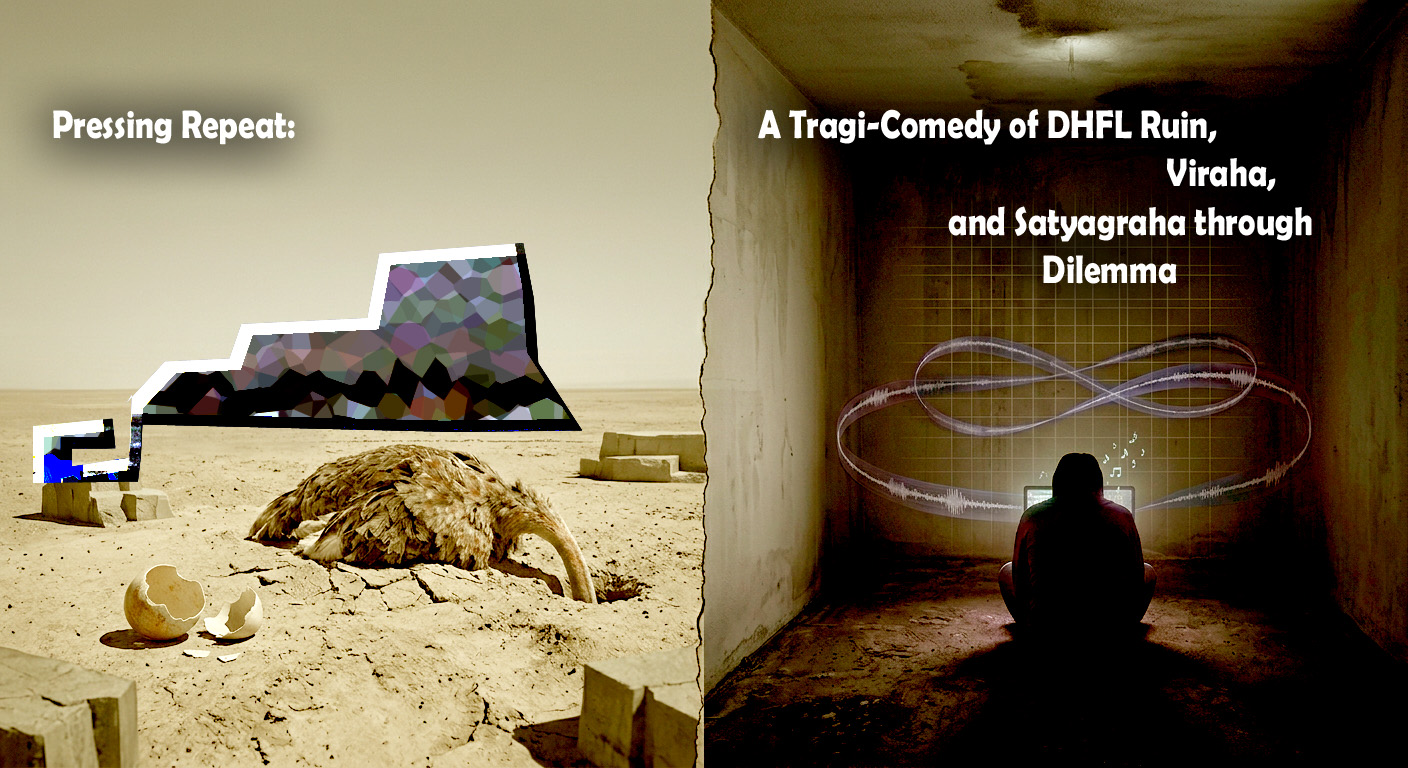
And yet the deeper truth comes not from Tagore but from Sudhindranath Dutta’s merciless poem “The Ostrich,” which I now hear echoing in the same loop, cold and pitiless:
“Do you not hear me when I speak? Why bury your face in feigned concealment? Where will you hide? The desert stretches desolate— Even the last traces of shade have withered beneath your feet. Today, not even a mirage haunts the horizon; Mute, blue, and pitiless is the sky.
The hunter’s mind no longer chases phantom prey— Without you, all ends in utter ruin.
Where will you flee? How far can you run? Indifferent sands will not erase your footprints.
Those prehistoric childhood companions— All are gone; you stand helpless and alone.
What use now in brooding over a broken egg? No remorse can make it whole again.”
There is no escape. No Thou. No companion. No co-sharer. The prehistoric childhood companions who once walked beside me — the friends, the ideals, the naïve faith in justice and savings — are all gone. I stand helpless and alone in this desert of DHFL-looted ruin, under an undeclared emergency whose sky is mute, blue, and pitiless. What use now in brooding over a broken egg? My life savings, my dignity, my future — smashed, scattered, irrecoverable. No amount of Rabindrasangeet or self-pity can glue the shell back together.
Will I, in universal hunger, devour myself at last? One cannot go on living upon emptiness alone.
And still the songs play. Still I press repeat. Still I aestheticise the anxiety into melody because even the illusion of a Wayfarer is cheaper than admitting the ostrich has nowhere left to hide.
This loop — presence → longing → intensified fear → failed permanence → renewed longing — is not a failure of love or faith or politics. It is its very condition.
I am still searching for “Thou.” Still finding no one. Still pressing repeat.
III. Divine Intervention for Them, Only Repeat for Me
Suddenly the algorithm throws me a YouTube short. Narendra Modi, eyes glistening with posthumous certainty, says:
“पहले जब तक माँ ज़िंदा थी, मुझे लगता था कि शायद biologically मुझे जनम दिया गया है। माँ के जाने के बाद इन सारे अनुभवों को मैं जोड़कर देखता हूँ, तो मैं convince हो चुका हूँ कि परमात्मा ने मुझे भेजा है।”
English Translation:
“Earlier, while my mother was alive, I thought I was born biologically. After she passed, when I connect all the dots, I am convinced God sent me.”
I know very well that Mr. Modi is not a “logical man”. Now, I find that he is “non-bio-logical”. I can’t help but to laugh.
I stare at the screen, half-laughing, half-gagging. Of course. When your mother dies, the universe upgrades you from accidental mammal to divinely dispatched special package. Nice narrative upgrade.
Then the recommendations serve me the cherry on top: former Chief Justice of India D.Y. Chandrachud, in his native village, telling everyone how he sat before the deity for three months during the Ayodhya case and essentially told God, “You need to find a solution.” Because law and evidence were apparently stuck, but faith would make God “find a way.”
The same bench that delivered the unanimous verdict clearing the path for the Ram Temple. The same judge who later retired claiming he “left the system better than he found it,” called himself perhaps “the most trolled judge” in history, and said his shoulders were broad enough for all criticism. The man who wrote judgments that became constitutional scripture for some and selective blindness for others, now openly mixing personal prayer with judicial peace of mind.
I sit here in my leaking cell, life savings evaporated into the DHFL black hole, whistle long confiscated, civil disobedience movement that never happened, and I wonder: Where was my divine intervention? If they have got divine command, why don’t I?
When the fixed deposits stopped crediting, when the customer care vanished, when the SLAPP landed like a guided missile, when the UAPA shadow lengthened — did I not pray enough? Did I lack the proper deity access code? Was my faith not photogenic enough for the algorithm of cosmic justice?
Tagore keeps looping in the background, still begging for awakening in the melody of song. Sudhindranath Dutta’s ostrich mocks me from the desert: Those prehistoric childhood companions — all are gone; you stand helpless and alone. What use now in brooding over a broken egg?
Exactly. My egg is not just broken; it was legally, politely, systemically smashed while the high priests of the bench consulted God for solutions to temple disputes and retired with books titled Why the Constitution Matters.
God sends some people. God finds ways for others. For the rest of us — the DHFL victims, the whistleblowers whose whistles don’t work, the lonely women pressing “repeat” under an undeclared emergency — there is only the indifferent sand, the pitiless sky, and the same four Rabindrasangeet tracks.
No divine dispatch. No broad shoulders for the trolling. Just aesthetic intimate separation anxiety on eternal loop, and the quiet realisation that in this regime, even God seems to have joined the selective intervention club.
I close the YouTube tab. Press play on the song again.
Still searching for Thou. Still finding no one. Still pressing repeat.
I close the YouTube tab and the silence rushes back in, louder than any algorithm.
So this is the new theology of the powerful: mothers die and suddenly you are not born but sent; judges sit before deities for three months and God personally “finds a way” to solve a temple dispute that the Constitution was supposed to keep out of the courtroom. Divine commands for them, divine silence for the rest of us.
Article 51A(h) of our secular Constitution is very clear: every citizen — and most certainly every judge who has sworn to uphold it — shall “develop the scientific temper, humanism and the spirit of inquiry and reform.” Not prayer. Not revelation. Not “God will find a way” while wearing the robes of the highest court. Yet here we are: a former Chief Justice openly confessing that personal faith was part of his judicial peace of mind, and a random YouTube mystic upgrading his biography from biology to divine courier. Both claims are broadcast without shame, while I, a DHFL-looted widow who once believed in RTIs, evidence and the rule of law, am left pressing repeat on Rabindrasangeet because even the Constitution’s own promise of scientific temper has been outsourced to the same God who apparently answers only the powerful.
They get divine intervention. I get UAPA anxiety, a 100-crore SLAPP, and an empty contact list.
The ostrich poem was right: Those prehistoric childhood companions — all are gone; you stand helpless and alone. What use now in brooding over a broken egg? My egg — my savings, my faith in the Republic, my naïve hope that a secular Constitution would protect the small depositor — is not just broken; it was legally, piously, divinely smashed while the high priests consulted their favourite deity.
There is no divine dispatch for whistleblowers whose whistles don’t work. No broad shoulders for the trolling. Only the pitiless sky, the indifferent sand, and the same four songs looping because even Tagore’s “eternal companion” has joined the selective-intervention club.
I press play again.
Still searching for Thou. Still finding no one. Still pressing repeat — the only constitutional remedy left for those of us who were never sent by God, only abandoned by the Republic.
IV. Divine Role or Divine Joke?
For the time being, I am vexed.
Am I not also a non-biological person with a divine command?
The algorithm, still mocking me, throws up another Tagore song — this one arriving like an unwanted oracle straight from the great offering:
“Into the world’s festival of joy, I have been invited —
Blessed, blessed indeed is this human life…
In your great offering, you have given me a role —
I play my flute, Stringing together, through song, the tears and laughter of life.”
I listen once, twice, ten times. The melody is beautiful, of course. Tagore always is. But the words curdle in my mouth. Out of this so-called revelation I could not merely comply and play my flute like a good little invitee. I asked questions. I filed RTIs. I tried to start the non-violent movement that never moved. And what did the divine host give me in return? A front-row seat to the festival of debt, polycrisis and polite annihilation. Isn’t this a consolation prize yet again?
Where is the pleasure in this world today? Where is the joy-sense, the jouissance, the laughter? I am a DHFL victim — my life savings il-legally evaporated while the regime protected the looters and the judges consulted deities for temple solutions. This is the festival I was invited to: a world where debt rules, people doubt people, people oppress people, nations oppress nations inside one grand, rolling, swirling polycrisis. My own suffering is not a text that yields pleasure. It is a debit note that never stops compounding.
Is this, then, the Thou I have finally found? In the depths of yet another Rabindrasangeet, the veil lifts for a moment and I address that Thou directly — not as joy, not as companion, but as the pure embodiment of suffering itself.
“Though you come in the guise of sorrow, I shall not fear you. Wherever there is pain, there I shall clasp you close.”
If you veil your face in darkness, O Lord, Still shall I know you — If you arrive in the form of death, O Master, I shall die holding fast to your feet.
In whatever way you choose to reveal yourself, I shall not fear. Let tears fall today from these eyes — let them flow. Let the heart resound beneath the grip of your stern embrace. For you are there, holding me to your breast — Let that pain make your presence known to me.
I shall ask for nothing, I shall speak no word — I shall only gaze upon your face.”
Is this suffering merely a veil? Is some good fate, some hidden grace, waiting on the other side of my presencing? Is this what Nietzsche meant by amor fati — loving one’s fate, embracing the eternal recurrence of this very ruin? Or is it just another beautiful lie I tell myself while the electricity and medical bill piles up and the SLAPP suit waits in the shadows?
Is this my destiny, then? Has the same divine authority who “sent” that YouTube mystic and helped Chandrachud find his way decided that my role in the great offering is to be the eternal sufferer? To string together not tears and laughter but only tears, on endless repeat, while carrying the unasked burden of every DHFL depositor who was robbed and then told to shut up? Have I been handed the onus of absorbing all their miseries alone, because no one else cared to show up — as I already knew from the empty contact list and the silent “Thou”?
Am I becoming a fatalist like most South Asians — quietly accepting that this is written, this is karma, this is the role assigned by the cosmic scriptwriter? The fatalism grasps me, throws me to the damp floor of this haunted cupboard, swallows me whole. Do I let myself get swallowed? Do I simply press play on the next Rabindrasangeet, accept the flute, and keep performing the dark comedy for an audience that never arrives?
I stare at the cracked ceiling. The song loops again. The divine host is still throwing parties for some, still finding ways for others, still handing out starring roles to the powerful.
For me, the invitation reads: Welcome to the festival. Your role — professional victim, solo flautist of financial abuse, unpaid bearer of every DHFL cross.
I laugh once — short, ugly, familiar.
Then I press repeat.
Because what else is a non-biological invitee supposed to do when even God has ghosted the whistleblower?
V. The Euthyphro Dilemma in My Leaking Room
Now I have turned back.
I am searching for the epistemology of divine command.
Instead I find Socrates — the same man who was told by the Oracle of Delphi that he was the wisest in Athens. He spent his life proving the god right by showing everyone, including himself, how little they knew. “I know that I know nothing.” A humble brag, wrapped in paradox.
But Socrates was never a fan of divine command theory. He attacked it head-on in the Euthyphro dialogue. The question he dropped like a bomb still echoes in my damp walls:
“Is the pious loved by the gods because it is pious, or is it pious because it is loved by the gods?”
Two horns. Both gore me.
Horn One: If God commands something because it is already good, then goodness exists outside God. God is reduced to a recognizer, not the source. My divine host becomes a mere referee.
Horn Two: If something is good only because God commands it, then morality is arbitrary. If God suddenly commands financial looting, SLAPP suits, or the slow erasure of whistleblowers, those acts become “good” by definition. “God is good” turns into a tautology — God does whatever God wants.
I sit here, a DHFL victim whose life savings were declared collateral damage, and I feel both horns piercing. The powerful get divine intervention and temple verdicts. I get polite legal ruin and endless Rabindrasangeet on loop. Is my suffering “good” because some deity willed it? Or is it evil, and the deity simply failed to notice?
Socrates himself was trapped by the same dilemma. The Oracle called him wisest. He could not reject the god, yet he could not accept blind obedience. So he became the gadfly — stinging Athens with questions until the city swatted him with hemlock. Impiety, they said. Corrupting the youth. In truth, he made the powerful uncomfortable by exposing their ignorance.
I stand with this dilemma. I stay with the crack.
I am not wise like Socrates. I am broke, lonely, and tired. Yet the same question gnaws at me in this haunted cupboard: Is my role in the “great offering” to suffer silently because the divine commanded it? Or is the suffering real as much as it is felt…. situated, and the command itself hollow?
No modified divine command theory comforts me tonight — neither Robert Adams’ “loving nature of God” nor any other philosophical patch. When the fixed deposits vanished and the regime smiled, no unchanging loving essence stepped in. Only indifference.
The fatalism tries to swallow me again. The flute in Tagore’s festival feels heavier than ever. I press repeat on the song anyway.
Because even Socrates, wisest of men, died for asking.
And I, far less wise, keep asking in the only way left to me — by refusing to call this festival joyful, by refusing to call this cross divine, by staying inside the crack between the two horns until something, anything, breaks.
Still searching for Thou. Still finding no one. Still pressing repeat.
VI. The Final Non-Finale
After going through Socrates’ dilemma, after pressing repeat until the melody itself became a wound, I find myself reflecting with this stubborn command from the Bard of Bengal:
“If you become inert, then whom will you give strength to? Rise—rise—do not collapse.
Feel no shame, feel no fear— Conquer your own self; Then all will respond To whomever you call.
If you have stepped out upon the path, Do not turn back by any means; Do not keep looking behind you Again and again.
There is no fear in all the three worlds— Fear lives only within your own mind; Take refuge in fearless resolve, Step forth and go.”
Hereby, my art of resistance strikes back.
I can still speak through my creativity — turning the poison of damning suffering into creative suffering. I stand in non-violence. Not out of piety, not while awaiting mercy from some above or without, but in deliberate, daily non-violent civil disobedience against the state-corporate apparatus that has rendered me a pauper, a DHFL-looted ghost, a woman whose life savings became someone else’s political collateral.
I repose my trust in the pharmakon of crisis — that same simultaneous undecidability of poison and remedy, that same crack between the horns of the Euthyphro dilemma, that once threatened to swallow me. I now turn it against the oppressors, the tyrants, the cronies, and the super-rich. I belong to the other 98 %. And being so, I remember Gandhi’s quiet, lethal sentence:
“When I despair, I remember that all through history the way of truth and love have always won. There have been tyrants and murderers, and for a time, they can seem invincible, but in the end, they always fall. Think of it — always.”
Here starts my digital war.
My self-suffering becomes the weapon. My endless loops of Rabindrasangeet, my broken-egg fatalism, my aesthetic intimate separation anxiety — all of it, reforged. I live through resistance, through subversion, through critique enabled by the creative spirit that refuses to die even when the body is pauperised and the whistle has been confiscated.
I stay. I abide. I remember. I learn to remember. As a Whistleblower who can never be silenced or “written off” the balance sheets of deceptive cruelty.
The song still plays on repeat in the background. The leaking roof still drips. The SLAPP suit still waits. The divine host still throws festivals for others.
But I am no longer merely pressing repeat.
I am pressing send.
This is not an ending. This is the non-conclusive standing of a woman who has nothing left except the stubborn resolve to keep walking the path — flute in one hand, cracked egg in the other, fear only in the mind, and the long, slow, non-violent war already begun.
Rise — rise — do not collapse.
I stay. I abide. I remember.
And I keep writing.
Call me a “keyboard warrior” if you will. I shall not rest.
I have got yet another Tagore song to power this revolt from within.
“From fear into your fearless vastness—grant me a new birth.
From poverty into inexhaustible wealth,
From doubt into the abode of truth,
From inertia into renewed life—
Grant me a new birth.
From my own will, O Lord, into your will—
From my self-interest into your work of welfare—
From the many into the thread of the One,
From joy and sorrow into the lap of peace—
From myself, O Master, into You—
Grant me a new birth.”
 Once in a Blue Moon Academia