
Posted on 23rd March, 2026 (GMT 01:40 hrs)
ABSTRACT
The DHFL insolvency resolution under the Insolvency and Bankruptcy Code (IBC), 2016, stands as a stark exemplar of systemic opacity, regulatory evasion, and alleged crony favoritism in India’s financial ecosystem. Initiated by the Reserve Bank of India (RBI) in November 2019 through the supersession of the DHFL Board and referral to the National Company Law Tribunal (NCLT), the Corporate Insolvency Resolution Process (CIRP) culminated in the approval of Ajay Piramal’s resolution plan by the Committee of Creditors (CoC), the NCLT (June 2021), and ultimately the Supreme Court (April 1, 2025), which upheld the plan—including the appropriation of avoidance recoveries by the successful resolution applicant—while reaffirming the primacy of the CoC’s “commercial wisdom.” The case has drawn sustained scrutiny from approximately 2.5 lakh retail fixed-deposit and NCD holders, who suffered severe haircuts (recovering around 23% of admitted claims), amid allegations of undervaluation, procedural irregularities, premature occupation by the acquirer, and the dilution of fraud-avoidance mechanisms under Sections 32A and 66 of the IBC. Persistent Right to Information (RTI) applications—filed notably by activists associated with “Once in a Blue Moon Academia”—seeking itemized disclosure of the RBI-appointed CoC’s total expenditures (including professional fees, litigation costs, and deductions from the resolution pool) have been met with uniform institutional denial, with the RBI repeatedly claiming it “has no information” and bears no responsibility to maintain or interpret such records, while the Insolvency and Bankruptcy Board of India (IBBI) and the Comptroller and Auditor General (CAG) have similarly deflected or transferred queries. This refusal to disclose even basic expenditure details—despite the RBI’s direct role in constituting the CoC—fuels concerns about a deliberate “will to hide,” potentially masking inflated costs borne by depositors, quid pro quo arrangements linked to political financing, and preferential treatment for well-connected acquirers. Critics increasingly frame the DHFL case as a “test case” for the IBC regime, wherein small savers became unwitting “guinea pigs” in a system dominated by institutional creditors, marginalizing retail stakeholders and entrenching judicial deference to CoC decisions—even in the face of documented NCLAT findings of irregularities. This analysis argues that the DHFL resolution reveals deeper structural flaws in India’s insolvency framework: the transformation of statutory immunity into structural impunity, the erosion of transparency obligations under the RTI Act, and the prioritization of private gain over public accountability. Absent independent investigation and full disclosure, the episode risks eroding trust in regulatory institutions and reinforcing perceptions of oligarchic capture under the guise of financial reform, making urgent rectification of the persistent opacity surrounding CoC expenditures essential to restoring legitimacy to the IBC process and securing justice for affected depositors.
SCAM 2019: THE DHFL MASSACRE VIEW HERE ⤡
To
The Hon’ble Governor
Reserve Bank of India
Central Office, Shahid Bhagat Singh Marg
Mumbai – 400 001
Subject: Request for Disclosure of RBI-Appointed CoC Expenditure in the DHFL Resolution Process and Clarification of Institutional Accountability
Dear Sir,
What a paradox! It is not only ridiculous – it is a full-blown tragedy-comedy of epic proportions. The Reserve Bank of India – the very institution that superseded the DHFL Board in November 2019, appointed the Administrator, and thereby constituted the Committee of Creditors (CoC) – now declares through multiple RTI replies (dated 18/07/2024, 30/08/2024, 28/11/2024 and FAA order 24/09/2024) that it “has no information”, that the CoC expenditure records are “not available”, and that it is not supposed to “create” or “interpret” such information! RBI appointed the CoC, but RBI does not know its own expenditures!
IBBI says “no data”. CAG’s office transfers and washes its hands. Even the Supreme Court turned our pleas away. Nobody – not the regulator who triggered the entire IBC process, not the Board that was supposed to oversee it, not the “independent” insolvency regulator – knows (or is willing to reveal?) a single rupee of the crores spent on lawyers, advisors, valuers, litigation reserves, travel, DA, and god-knows-what-else that were ultimately deducted from the recovery pool of lakhs of innocent fixed-deposit and NCD holders of DHFL.
This is not mere bureaucratic incompetence. This appears to be a calculated will to hide. Why this pathological “will to hide”, Sir? What is so significant in those expenditure statements that the highest financial authority of the Republic must repeatedly dodge, deflect, transfer, and ultimately claim that the “information is not held”? Such a pattern raises serious concerns about transparency and accountability, and invites comparisons to situations where responsibility is denied despite apparent proximity to the facts.
The pattern raises serious suspicions. If there were no irregularities, such persistent reluctance to disclose the facts would be difficult to justify.
We all know the widely reported truth: the DHFL case was deliberately pushed into this ill-conceived IBC as a test case – a cruel laboratory experiment where lakhs of helpless FD and NCD holders were turned into guinea pigs in the animal farm of present governmental agencies. Here, “few people are more equal than others” – exactly like Ajay Piramal, the man who satisfied the itching palms of the BJP by getting entangled in the Flashnet scam and pouring huge sums as “political charity” into the BJP’s coffers through the unconstitutional Electoral Bonds and the dubiously opaque PM CARES.
This appears to be nothing but a naked “chanda do, dhanda lo” quid pro quo regime led by the BJP– donate and get the deal, loot and get protection! The machinery might snatch the hard-earned money of small investors today, but history will condemn this manipulating behaviour in the harshest possible words. It will question the complicit silence of the regulatory, auditing and credit rating institutions.
Can you still remember the questionable statement of your own RBI-appointed CoC’s lenders? When the NCLT ordered them (19/05/2021) to consider the Wadhwan brothers’ full repayment proposal for DHFL, they haughtily declared, “It will set a bad precedent”. This was never a question of “good or bad precedent” – it was always a question of truth and ethics, which your CoC and your regulator have reportedly/allegedly abandoned.
And when the NCLAT’s second order (27/01/2022) explicitly found many grave irregularities in the entire CIRP process and in Mr. Piramal’s resolution plan, what did Mr. Piramal do? He simply avoided answering, stayed silent, and walked away with the expropriated moneybags. From where did he get such strength? How did he acquire such impunity?
Is it not crystal clear that this is a patron-client relationship between the ruling party and its favourite donor business tycoons such as Mr. Adani, Mr. Ambani and Mr. Piramal as Ambani’s secondary kin? For this very reason, the expenditure details are buried deeper than a corpse in quicksand. The stench of crony collusion, preferential treatment, undervaluation, and outright siphoning has already reached the nostrils of every DHFL victim across the country.
When the very regulator who appointed the CoC refuses to disclose how much public/depositor money was burned in that opaque process, transparency, accountability, and the very legitimacy of governmental institutions are not merely “at stake” – they are lying slaughtered in the open market square.
The RTI Act is being seriously undermined by the very institutions entrusted with upholding it. Section 2(f) appears to be increasingly invoked in ways that limit access to information, while the “commercial wisdom” of the CoC risks being interpreted in a manner that weakens accountability. In this context, the RBI, as the sentinel of the financial system, appears to have fallen short of its expected role in ensuring transparency.
Enough is enough.
We, the devastated DHFL depositors and concerned citizens who still believe in the rule of law, demand:
- Full, itemised disclosure of every single rupee spent by the RBI-appointed CoC for DHFL (from 03 December 2019 to 17 January 2021 and thereafter) – including break-up, litigation reserves, source of funds, fees paid to every professional, and exact deduction from the resolution pool – within 7 days, published on the RBI website.
- Immediate explanation under oath for every evasive RTI reply given so far.
- A high-level, time-bound independent probe (outside RBI/IBBI/CAG control) into this deliberate suppression of information and the political quid pro quo that enabled Piramal’s impunity.
If the above is not done, Sir, history will not view this as a mere “oversight,” but as a serious erosion of the RBI’s credibility under your stewardship.
The people are watching. The victims are seething. The rat is already out of the hole. Do your duty. Or step aside.
Let the light in.
Hypothetically Yours,
Concerned DHFL Victims and Citizens of a Wounded India
(On behalf of lakhs robbed by the alleged/reported DHFL-Piramal-RBI-BJP nexus)
Copy to:
- Hon’ble President of India
- Hon’ble Prime Minister of India
- Hon’ble Chief Justice of India
- The Hon’ble Central Vigilance Commission (CVC)
- The Central Bureau of Investigation (CBI)
- The Enforcement Directorate (ED)
- The Serious Fraud Investigation Office (SFIO)
- All DHFL Victim Groups
APPENDIX
Our Frustrating RTI Timeline:
Information Delayed, Information Evaded, Information Transferred, Information Denied
We filed multiple RTIs seeking the DHFL CoC’s expenditure breakdowns, minutes, voting records, litigation and travel fund sources, and related accountability documents. The responses are revealing: serial transfers between the RBI, IBBI, DFS, and CAG; uniformly phrased “no data available” replies; and repeated denials under Section 2(f), incorrectly claiming that minutes, voting records, and financial statements do not qualify as “information.” FAA responses merely echoed these evasions.
What emerges is not an administrative lapse but a patterned refusal—an entrenched bureaucratic instinct to deflect, delay, and diffuse responsibility. Transparency is thus reduced to a ritual formality, while accountability is systematically evaded.
| Filing date | RTI ID / Addressee | Key transfers / replies | Status / implication |
|---|---|---|---|
| 22/06/2024 | RBIND/R/E/24/04068 (RBI) | Transferred to IBBI; multiple “no data” replies; FAA states CPIO cannot create/interpret unavailable records. | No consolidated disclosure; institutional buck-passing begins. |
| 24/08/2024 | CAGIN/R/E/24/02309 (CAG) | CAG → DFS → RBI → IBBI; replies: data not centrally maintained. | No audit trail of CoC expenditure. |
| Sep 2024 | RBIND/R/T/24/00826 (RBI) | Standard “not under RBI jurisdiction” formulation. | RBI distances itself as if CoC oversight is external. |
| Oct–Nov 2024 | RBIND/R/T/24/01086 (RBI) | Repeats prior non-jurisdiction stance; no fresh disclosures. | Template opacity response. |
| 14/10/2024 | 1803/RTI/24-25/SCI (Supreme Court of India) | Asked: “Which authority holds the records of expenditure by the DHFL Committee of Creditors?” Reply dated 23/10/2024: SCI declines to identify responsible authority; refers procedural constraints. | Apex-level refusal to clarify responsibility. Confirms system-wide will to hide. |
| 14/10/2024 (registered after repeated failed attempts) | PRSEC/R/E/24/01171 (President’s Secretariat) | Transferred to DFS → DOFSR/R/T/24/01710 → RBI → RBIND/R/T/24/01108 | Administrative delay by engineered transfer-loop recursion. |
| 22/11/2024 | RBIND/R/T/24/01086 (Reply referenced again) | RBI repeats prior text verbatim without addressing expenditure accountability. | Circular non-response. Formal denial without denial. |
| Before 30/09/2025 | RBIND/R/E/25/05544 (RBI) | RBI states CoC constituted under IBC Sec. 21 by RP; RBI “not involved” in CoC constitution or expenditure. | Responsibility fragmented across regulatory grey zones to foreclose accountability. |
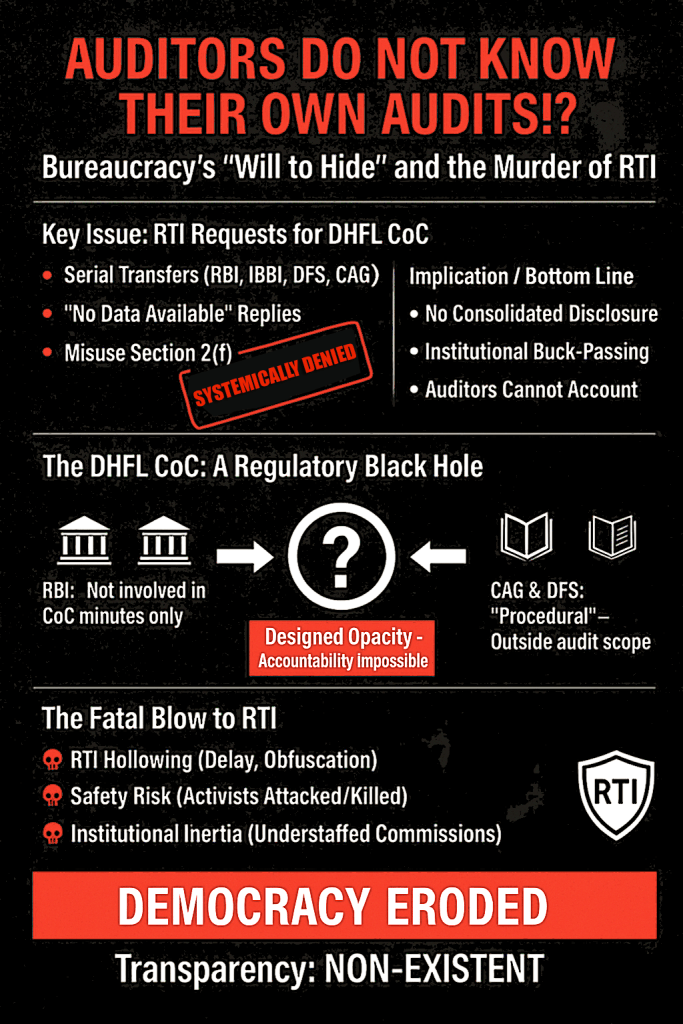
Bottom line: auditors “don’t know their own audits.” The coherence of the evasions across agencies is itself evidence of systemic secrecy.
Links to the relevant RTIs mentioned above, along with complete documentation and accompanying questions and analyses, are provided below:
Most strikingly, the RBI’s claim of non-involvement in the DHFL Committee of Creditors (CoC) collapses under scrutiny and, alongside denials by the CAG, IBBI, and DFS, reveals a carefully orchestrated vacuum of accountability. Acting under the Banking Regulation Act, 1949 and Section 45-IA of the RBI Act, the RBI superseded DHFL’s Board in 2019—directly triggering the appointment of the IRP and formation of the CoC. Though formally constituted under Section 21 of the IBC, the CoC’s structure and functioning were shaped by this prior RBI intervention. Yet, through RTIs, the RBI claims it is “not privy” to CoC records; the IBBI confines itself to procedure; and the DFS and CAG disclaim audit responsibility. This choreography of denial turns procedural boundaries into instruments of evasion, ensuring no authority is answerable for the management of thousands of crores. What emerges is not confusion but designed opacity—a regulatory black hole where statutory power and public trust dissolve into bureaucratic non-memory.
When the CAG, IBBI, and DFS each deny holding information on the RBI-triggered CoC—its expenditures, minutes, or voting records—it exposes a deliberate accountability vacuum. The CoC, born of RBI action yet operating under the IBC, occupies a grey zone where every institution disclaims jurisdiction: RBI as mere appointer, IBBI as procedural regulator, DFS and CAG as outside auditors. This fragmentation enables collective evasion, creating a regulatory void where vast public funds move without oversight—opacity by design, not accident.
In this context, the Right to Information (RTI), once central to democratic accountability, has been systematically hollowed out. Designed to expose corruption and empower citizens, it now faces obfuscation, delay, and political interference. In BJP-ruled India, filing an RTI is no longer neutral; it carries risk. Activists have been threatened or killed, while applications stagnate in weakened Information Commissions. The mechanism meant to ensure transparency has been reduced to an instrument of fear and inertia, rendering accountability effectively absent.
This collapse of RTI reflects a broader erosion of democratic infrastructure. Government agencies increasingly withhold or manipulate data under the pretexts of “privacy” and “national security,” while corporate–state collusion operates unchecked. Financial scandals, public debt resolutions, and regulatory processes are buried under procedural layers. The result is a governance landscape where secrecy is codified, evidence suppressed, and the citizen’s right to know subordinated to the state’s right to conceal—reducing democracy to a performative shell devoid of real accountability.
Under these conditions, India witnesses not only the death of RTI but a wider delegitimization of civic power. Every denial, delay, or suppression institutionalizes opacity. Citizens seeking accountability are forced into a labyrinth of evasion, where questioning power can be risky and answers remain systematically inaccessible. In the vacuum left by a neutered RTI, public money, policy decisions, and corporate privileges move without scrutiny—making the struggle for information no longer administrative, but existential: a fight to preserve the very soul of democracy itself.
Mouthshut Reviews on the RBI by Some DHFL Victims
- https://www.mouthshut.com/review/2000-note-from-bold-idea-to-silent-failure-review-rqqnqllrpop
- https://www.mouthshut.com/review/rbi-from-independent-regulator-to-govt-mouthpiece-review-qoropllrpop
- https://www.mouthshut.com/review/demonetisation-a-national-shock-therapy-review-lmnnnllrpop
- https://www.mouthshut.com/review/the-rbis-technical-truth-license-to-extinguish-review-olpqstsqpop
- https://www.mouthshut.com/review/rbi-and-the-death-of-transparency-review-mmomotsqpop
- https://www.mouthshut.com/review/rbis-role-in-the-dhfl-cirp-and-cronyism-review-luonroqqpop
- https://www.mouthshut.com/review/shaktikanta-das-rbi-autonomy-eroded-review-uqomlnqqpop
SEE ALSO:
 Once in a Blue Moon Academia