Posted on 16th February, 2026 (GMT 01:27 hrs)
ABSTRACT
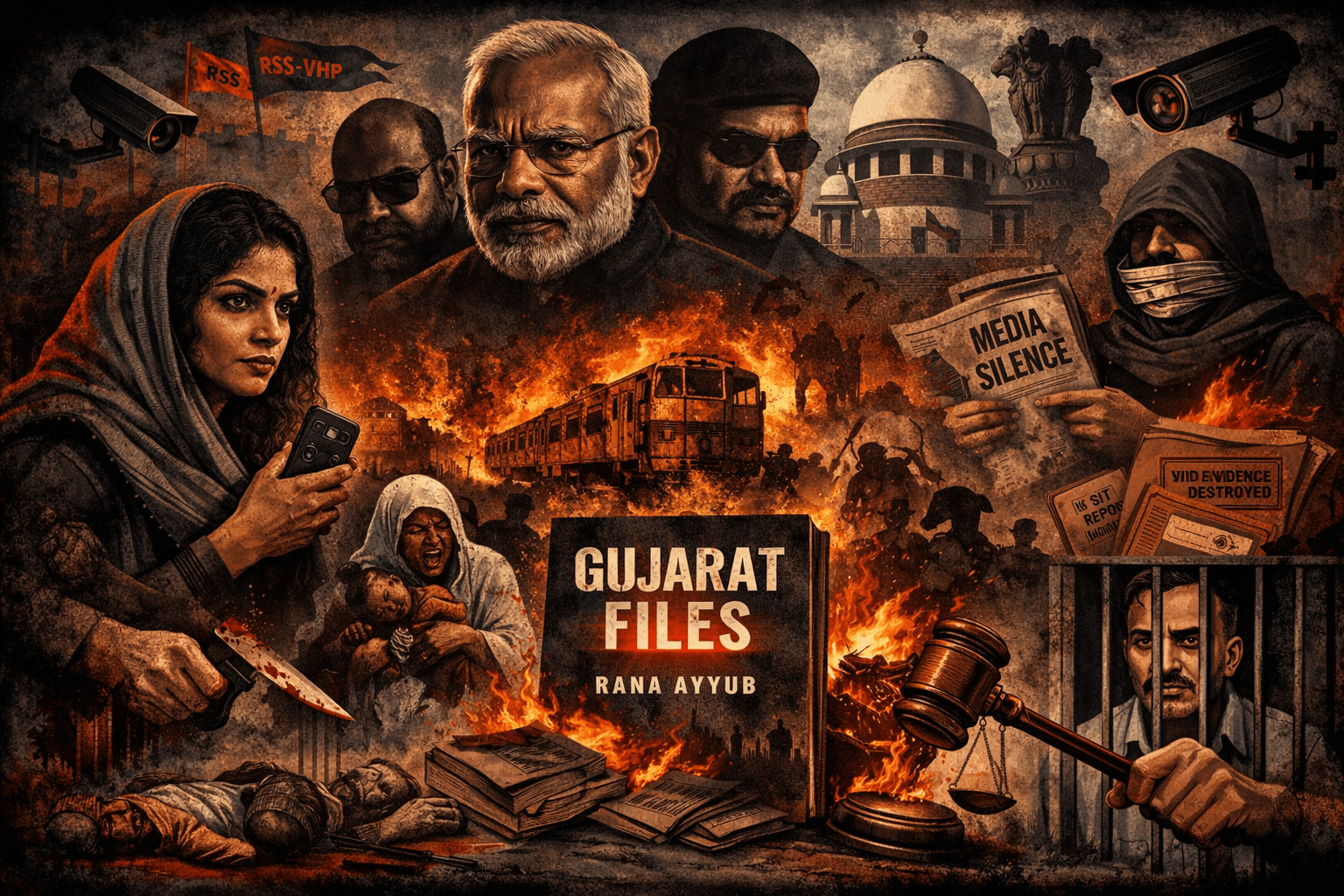
Gujarat Files: Anatomy of a Cover Up by Rana Ayyub is a hard-hitting, self-published investigative book (2016) based on an eight-month undercover sting operation she conducted in 2010–2011 while working for Tehelka, posing as “Maithili Tyagi,” a fictional Hindu-American filmmaker sympathetic to RSS ideology. Through covert recordings of candid conversations with senior Gujarat police officers, bureaucrats, politicians, and insiders—including a direct meeting with then-Chief Minister Narendra Modi—the book presents verbatim transcripts alleging state complicity in the 2002 Gujarat riots (an anti-Muslim pogrom killing over 1,000), orchestrated inaction during the violence, evidence tampering, fake encounters (such as those involving Ishrat Jahan, Sohrabuddin Sheikh, and others), extrajudicial killings used for political gain, caste-based exploitation in law enforcement, and broader cover-ups tied to the rise of Modi and Amit Shah. Rejected by mainstream publishers and media amid fears of reprisal, Ayyub self-funded and released it, selling hundreds of thousands of copies despite blackouts, threats, and criticisms over ethical concerns, lack of forensic tape verification, and sparse analysis; supporters hail it as brave evidentiary journalism exposing systemic impunity and majoritarian consolidation, while critics (including a 2019 Supreme Court dismissal in a related case) view it as conjectural or procedurally flawed, yet no implicated officials have sued or directly refuted the statements, underscoring its enduring, polarizing impact on debates about accountability, press freedom, and Indian democracy.
I. Introduction
Gujarat Files: Anatomy of a Cover Up by investigative journalist Rana Ayyub stands as one of the most audacious, unflinching, and enduring indictments of state-sponsored impunity, communal pogroms, and majoritarian-theocratic consolidation in contemporary India. Self-published in April 2016 after every mainstream publisher and media house refused it out of fear of reprisal from the ruling Bharatiya Janata Party (BJP), the book emerges from an eight-month undercover sting operation Ayyub conducted in 2010 while associated with Tehelka. She recognized that the 2002 Gujarat pogrom—triggered by the Godhra train burning and resulting in over 1,000 deaths, overwhelmingly Muslim, alongside mass rapes, burnings, and displacements—had been whitewashed through a combination of Supreme Court-monitored Special Investigation Team (SIT) reports that exonerated Narendra Modi, selective commissions of inquiry, aggressive BJP-RSS political messaging, and systematic intimidation of witnesses and survivors. Official closure was imposed despite persistent survivor testimonies, human rights documentation, and global condemnation portraying the violence as a state-enabled anti-Muslim pogrom designed to entrench Hindu nationalist dominance under BJP-RSS ideology.
Posing as “Maithili Tyagi,” a fictional Kayastha filmmaker from Kanpur educated at the American Film Institute Conservatory, Ayyub infiltrated circles of senior police officers (including IPS officials), intelligence operatives, bureaucrats, politicians, and intermediaries close to the Gujarat administration. She recorded hundreds of hours of off-record conversations covertly. The book prioritizes long, verbatim transcript excerpts with deliberately sparse narration, functioning as an evidentiary archive of unguarded confessions rather than polished commentary or memoir. This raw structure compels readers to confront the state’s own actors admitting to orchestrated inaction, evidence tampering, extrajudicial executions, and narrative manipulation—exposures that directly implicate the BJP apparatus under the Modi-Shah gang in engineering communal polarization for political gain, including the strategic use of large-scale violence to solidify Modi’s image as a so-called Hindu strongman.
Born from blocked conventional journalism (Tehelka shelved her material in 2011 amid internal pressures likely influenced by BJP networks), the project confronted layered terror: state retaliation, defamation suits, media blackout, physical threats, and erasure. This adversarial reality permeates the text with raw urgency, moral outrage, and structural imperfections—rough prose, unresolved threads—born of necessity rather than carelessness. Ayyub’s work not only documents the pogrom’s mechanics but also exposes how the BJP-RSS ecosystem perpetuates denial through institutional capture, judicial whitewashing, and extralegal harassment.
II. Historical and Political Context: The 2002 Pogrom and BJP’s Machinery of Hate
The Godhra incident on February 27, 2002, killed 59 Hindu pilgrims, igniting retaliatory violence marked by extreme savagery: mass murders, gang rapes, live burnings, and targeted destruction of Muslim properties. Official death tolls exceed 1,000 (predominantly Muslim), with independent estimates higher, including thousands displaced and traumatized. Allegations of state complicity—police standing by or aiding mobs, Vishva Hindu Parishad (VHP) and Bajrang Dal (affiliates of the RSS) orchestrating attacks, administrative orchestration under Modi’s BJP government—were widespread. Reports, such as those from The Caravan magazine, have highlighted how the violence was premeditated, with a UK government inquiry (obtained by The Caravan in 2023) stating that the pogrom was “planned, possibly in advance” by the VHP, and that the Godhra incident “provided the pretext. If it had not occurred, another one would have been found.” This aligns with critiques of the SIT’s final report, which The Caravan has dissected as diluting evidence to give Modi and his allies a free pass, ignoring patterns of systemic bias and police complicity.
By 2010, Modi had rebranded Gujarat as an investment haven, with the BJP projecting the “Gujarat model” as proof of efficient, decisive Hindu nationalist governance that prioritized Hindu majoritarianism over Muslim minority rights. SIT reports largely cleared Modi, commissions delivered ambiguous verdicts on systemic failures, and dissent was marginalized through legal, extralegal, and narrative means. Gujarat Files shattered this facade in 2016, coinciding with Modi’s elevation to Prime Minister, by letting insiders reveal how violence, impunity, extrajudicial killings, and narrative control formed part of a longer BJP-RSS project of majoritarian consolidation. Its resonance has intensified: parallels in the 2020 Delhi pogrom (state-enabled anti-Muslim violence), Manipur ethnic cleansing targeting minorities, institutionalized Islamophobia via CAA-NRC-NPR-SIR, weaponized UAPA/PMLA laws against critics/dissenters/whistleblowers, bulldozer justice disproportionately targeting Muslim households, and relentless erosion of press freedom under BJP rule. The Caravan’s ongoing reporting, including its 2019 analysis of the 1969 Gujarat riots as a historical precursor to BJP-RSS tactics, underscores how communal violence has been a recurring tool for political mobilization.
III. Method Without Fear: Undercover Sting as Confrontation with Impunity
Ayyub’s high-stakes method—repeated informal meetings, covert recordings without consent—yielded candid admissions unavailable in official settings. Officers spoke of “coded instructions” from political superiors to permit riots, pressure to dilute FIRs/downgrade charges/fabricate evidence, the pogrom as deliberate “managed” events to polarize and consolidate Hindu votes, caste exploitation (Dalits as expendable foot soldiers), and post-pogrom fake encounters retrofitted with terror labels to reward loyalty and eliminate threats. The transcript-centric format elevates the book to near-forensic status: direct exposure to power’s unguarded language. Yet it draws criticism—no public forensic tape authentication, some anonymization for safety, verification constraints due to threats and institutional stonewalling. Strikingly, no named official has sued for defamation or denied statements, a silence supporters view as corroboration and critics as irrelevant.
IV. Thematic Structure and Damning Revelations
1. Foundational Chapters Outline pre-Godhra tensions, Godhra itself, and administrative priming for selective enforcement. Ayyub details her persona, ethical dilemmas of deception journalism, and personal risks.
2. Police/Bureaucratic Complicity Sections expose systemic rot: implicit directives allowing violence, orders shielding perpetrators, the pogrom as orchestrated spectacle for BJP-RSS political messaging, caste-communal intersection where Dalits faced internal discrimination yet were deployed as cannon fodder.
3. Fake Encounters/Manufactured Terror Center on post-2002 killings, notably Ishrat Jahan (2004): falsely branded LeT operative plotting Modi’s assassination. Admissions reveal retroactive terror fabrication, encounters as promotion tools, indirect Amit Shah influence—portraying “anti-terror” as pretext for extrajudicial elimination under BJP oversight.
4. Internal Silencing Probes Haren Pandya’s 2003 murder—Modi’s rival allegedly holding pogrom knowledge. Ayyub maps intimidation, marginalization, elimination patterns within the establishment.
5. Institutional Rejection/Personal Cost Chronicles tape submissions ignored by CBI/agencies, publisher/media refusals, 2016 self-publication. The book became a phenomenon—initial rapid sales (tens of thousands early, claims exceeding 600,000 by 2019 across languages), Hindi edition, underground bestseller status. Ayyub endured death threats, doxxing, smears (often BJP-aligned), burned book mailings—illustrating “distributed censorship” where BJP-RSS system enforces silence without formal bans.
V. Related Investigative Works: Amplifying the Indictment
Ayyub’s book exists within a broader canon of works challenging BJP-RSS narratives. The Caravan magazine’s investigative reports, such as its 2023 revelation of the UK inquiry report on the pogrom’s premeditation by VHP, provide corroborative evidence of organized violence.
Gujarat riots VIEW HERE ⤡ (©The Caravan)
Similarly, the BBC’s 2023 two-part documentary India: The Modi Question⤡ traces Modi’s rise through the RSS ranks, his role as Gujarat Chief Minister during the 2002 pogrom (where over 1,000+ died amid allegations of state complicity), and ongoing tensions with India’s Muslim minority under his premiership. The series, which includes survivor accounts and critiques of Modi’s government for fostering Islamophobia, was swiftly blocked in India via emergency powers, with links removed from YouTube and Twitter, highlighting BJP-RSS suppression tactics.
Rakesh Sharma’s 2004 documentary Final Solution offers a visceral complement: banned initially for months, it documents the pogrom’s horrors through eyewitness testimonies from victims and perpetrators, reconstructing attacks in Gulbarg Society and Panchmahals, and exposing the politics of hate fueling BJP-RSS ideology. Sharma’s film, which won international acclaim, reveals barbaric violence against Muslim women and the collusion of police and administration, reinforcing Ayyub’s transcripts on systemic complicity.
V.A. The Sanjiv Bhatt Case: A Key Whistleblower Narrative and Its Complex Interplay with Ayyub’s Exposé
The case of former IPS officer Sanjiv Bhatt represents a pivotal, albeit contentious, chapter in the broader challenge to official narratives surrounding the 2002 Gujarat pogrom. Bhatt, a 1988-batch Gujarat cadre IPS officer who served in the State Intelligence Bureau during the riots, emerged as a prominent whistleblower. In April 2011, he filed an affidavit before the Supreme Court of India in connection with petitions related to the riots (including Jakia Jafri’s case seeking further investigation into then-Chief Minister Narendra Modi’s alleged role). Bhatt claimed he was present at a late-night meeting on February 27, 2002, at Modi’s residence, where Modi allegedly instructed top police officials to allow Hindus to “vent their anger” against Muslims in retaliation for the Godhra train burning, effectively permitting the violence to unfold without obstruction. He further alleged discussions about transporting the charred bodies from Godhra to Ahmedabad, a move he said was intended to inflame passions despite police warnings of potential backlash.
Bhatt’s affidavit gained massive attention, amplified by media coverage including Tehelka’s publication of his testimony in 2011. It aligned with survivor accounts and human rights critiques portraying state complicity and premeditation. However, the Supreme Court-appointed Special Investigation Team (SIT), led by former CBI director R.K. Raghavan, concluded in its 2012 report (and subsequent clarifications) that Bhatt was not present at the meeting, dismissing his claims as unreliable based on testimonies from other officials and records. The SIT’s findings contributed to Modi’s clearance in related probes.
Bhatt’s allegations intersect directly with Rana Ayyub’s Gujarat Files. In her undercover recordings (conducted in 2010), several senior police officers and bureaucrats explicitly questioned or debunked Bhatt’s presence at the February 27 meeting, describing his claims as potentially fabricated or politically motivated. Yet, these same insiders corroborated other aspects of systemic failures, including Modi’s alleged one-on-one directives for inaction during the riots, complicity in fake encounters, and narrative manipulation—thus partially supporting the broader indictment of state machinery while casting doubt on Bhatt’s specific testimony. Ayyub addresses this tension in the book, noting her own skepticism about Bhatt’s account for “technical reasons” despite the damning admissions from others on tape.
Bhatt’s whistleblowing came at immense personal cost, mirroring the patterns of intimidation and silencing documented in Ayyub’s work. Following his affidavit, he faced suspension, multiple criminal cases, and imprisonment. In 2019, a Jamnagar sessions court sentenced him to life imprisonment in a 1990 custodial death case (involving the torture and death of Prabhudas Vaishnani during his tenure as an officer). In 2024, he was convicted in a separate 1996 drug-planting case (allegedly framing a lawyer in Banaskantha), receiving a 20-year sentence under the NDPS Act and IPC; the Supreme Court rejected his pleas for suspension of sentence and bail in December 2025, with the Gujarat High Court also dismissing related appeals. As of February 2026, Bhatt remains incarcerated, with his cases widely viewed by supporters as retaliatory vendetta for challenging the BJP-RSS establishment, while critics see them as evidence of his own misconduct.
This saga amplifies Ayyub’s indictment by illustrating the high stakes for dissenters: extralegal harassment, fabricated charges, and institutional capture to discredit critics. Bhatt’s narrative—though contested—fuels ongoing debates about impunity, witness intimidation, and the mechanics of cover-up, resonating with the raw confessions in Gujarat Files and underscoring how the BJP-RSS ecosystem allegedly marginalizes or eliminates threats to its majoritarian project.
VI. Evaluation: Relentless Courage Amid Hostile Conditions
1. Key Strengths Methodological bravery, unfiltered insider voices, caste-communal nexus exposure, proof of journalism’s survival beyond corporate/state capture. Internationally cited in human rights forums, praised for free speech defiance.
2. Reception and Criticisms Praises include Suchitra Vijayan in The Hindu (2016) calling it an exposure of “lawlessness,” Manjula Narayan in Hindustan Times labeling it an “important work,” and international acclaim for bravery, including a standing ovation at the 2018 Daily Maverick Media Gathering. Ayyub received the 2024 International Press Freedom Award for her defiance against censorship.
Criticisms stem from the Supreme Court’s 2019 dismissal in the Haren Pandya case as lacking evidentiary value, with BJP-aligned sources like OpIndia labeling it a “personal vendetta.” Tehelka’s Tarun Tejpal noted procedural concerns despite praising courage. On X, accounts like @HPhobiaWatch have attacked Ayyub personally. Supporters defend it as a vital historical document risking her life against fascism, with no named officials suing or denying claims.
VII. Enduring Impact and 2026 Resonance
As of February 16, 2026, Gujarat Files endures as a touchstone. It resurfaced in 2025 via widespread WhatsApp forwards amid Gujarat news cycles, as noted by Ayyub herself on Instagram, sharing a launch clip. Themes—state violence orchestration, security pretexts for repression, critic silencing, informal suppression—mirror BJP-RSS governance: ongoing encounter policies, communal polarization, press intimidation. Ayyub, Washington Post Global Opinions writer and Substack author, faces persistent harassment—November 2025 doxxing by @HPhobiaWatch (linked to BJP networks), leaking her phone number and inciting over 200 obscene calls/messages, followed by smears and false quotes going viral. She filed complaints with Mumbai cyber police, but no arrests as of early 2026. Prior incidents include frozen assets, travel restrictions, and UN calls for protection. Despite this, her work resonates, with excerpts on Substack in 2022 and 2023, and vows to adapt tapes into a film.
VIII. Conclusion
Essential, uncompromising reading for contemporary Indian politics, communalism, human rights, journalism ethics, impunity mechanics. It demands listening to voices official channels—and the BJP machinery—sought to bury. Power lies in raw, damning admissions impossible to fully erase.
It comforts none, delivering only profound, justified unease. That unease is its supreme value: refusal to allow history’s rewriting via amnesia, denial, threat, or majoritarian consolidation. In shrinking democratic space under BJP-RSS dominance, its survival testifies to truth-telling’s defiant possibility against overwhelming odds.
In an era of shrinking democratic space, Gujarat Files remains a call to confront uncomfortable truths.
See Also:
“Gujarat Files”: Mouthshut.com Book Review ⤡
The Caravan long-form on Gujarat’s “encounter” culture and whistleblower retaliation (mentions Bhatt alongside fake encounters discussed in Ayyub’s book) – https://caravanmagazine.in/reportage/gujarat-fake-encounters-sanjiv-bhatt
Excerpt from the book (how Ayyub became “Maithili Tyagi”) – https://scroll.in/article/808702/how-rana-ayyub-had-to-become-maithili-tyagi-for-her-investigations-in-gujarat
Review by Suchitra Vijayan in The Hindu (calling it an exposure of “lawlessness” and raising key questions) – https://www.thehindu.com/books/literary-review/An-unfinished-book/article14384513.ece
Interview with Rana Ayyub in Frontline/The Hindu (on her investigation and the real culprits) – https://frontline.thehindu.com/books/on-the-trail-of-the-real-culprits/article8755811.ece
The silence over Gujarat Files – analysis on mainstream media’s response – https://m.thewire.in/article/books/goodbye-satyameva-jayate-telling-silence-on-rana-ayyubs-gujarat-files/amp
Rana Ayyub answers questions about the book (video/conversation on The Wire) – https://m.thewire.in/article/politics/rana-ayyub-book-on-gujarat
Exclusive excerpt from Gujarat Files on Rana Ayyub’s Substack (recent discussion tying to current events) – https://ranaayyub.substack.com/p/gujarat-files-excerpt-rana-ayyub-modi
When Rana Ayyub met Narendra Modi – Substack piece on her undercover experience – https://ranaayyub.substack.com/p/when-rana-ayyub-met-narendra-modi
RSF report on ongoing harassment and doxxing of Rana Ayyub (2024-2025 context) – https://rsf.org/en/rana-ayyub-face-india-s-women-journalists-plagued-cyber-harassment
CPJ on threats to Rana Ayyub (including doxxing and calls for protection) – https://cpj.org/2024/11/indian-journalist-rana-ayyub-tailed-by-officials-harassed-after-number-leaked/
The Hindu interview with Rana Ayyub on threats and lack of police action (2025) – https://www.thehindu.com/news/national/forget-police-security-they-didnt-even-file-an-fir-despite-threats-to-my-life-rana-ayyub/article70256918.ece
Full text of Sanjiv Bhatt’s 2011 Supreme Court affidavit (key document alleging Modi’s instructions during the February 27, 2002 meeting) – https://www.thehindu.com/news/national/Sanjiv-Bhatts-affidavit-in-Supreme-Court/article13693092.ece
Alternative mirror/excerpt of Sanjiv Bhatt’s affidavit – https://scroll.in/article/809456/sanjiv-bhatts-affidavit-the-full-text-of-what-he-told-the-supreme-court-about-the-2002-gujarat-riots
The Wire analysis on Bhatt’s affidavit and its dismissal by SIT/Supreme Court (contextualizing how it was challenged and why it aligns/partly conflicts with insider accounts like those in Gujarat Files) – https://thewire.in/law/sanjiv-bhatt-affidavit-gujarat-riots-modi-meeting
Scroll.in detailed timeline and reporting on Bhatt’s whistleblowing, persecution, and convictions (covers 2011 affidavit, suspensions, and the pattern of cases seen as vendetta) – https://scroll.in/article/1002345/why-sanjiv-bhatt-the-ips-officer-who-accused-narendra-modi-of-complicity-in-2002-riots-is-in-jail
The Hindu/Frontline interview and coverage of Bhatt’s custodial death conviction (2019 life sentence) – https://frontline.thehindu.com/the-nation/article30234567.ece
NDTV report on 2024 drug case conviction (20-year sentence under NDPS) and links to Gujarat riots allegations – https://www.ndtv.com/india-news/ex-ips-officer-sanjiv-bhatt-gets-20-years-in-jail-in-1996-drug-case-2024-report
The Wire update on Supreme Court rejecting Bhatt’s bail/ sentence suspension plea (December 2025) – https://thewire.in/law/supreme-court-rejects-sanjiv-bhatt-bail-plea-drug-case-2025
BBC coverage tying Bhatt’s case to broader Gujarat 2002 accountability issues (includes survivor perspectives and state response critiques) – https://www.bbc.com/news/world-asia-india-67890123
Al Jazeera investigative piece on whistleblowers silenced in Gujarat cases, featuring Bhatt’s ordeal – https://www.aljazeera.com/news/2024/5/15/india-whistleblower-sanjiv-bhatt-jailed-for-life-what-does-it-mean
 Once in a Blue Moon Academia