Posted on 11th February, 2026 (GMT 18:08 hrs)
ABSTRACT
The review examines the “unpublished” (?) book Four Stars of Destiny: An Autobiography by General M.M. Naravane (retd.), former Chief of the Indian Army (2019–2022), in comparative dialogue with three major critical interventions on contemporary Indian state power: the BBC documentary India: The Modi Question, Rakesh Sharma’s Final Solution (2003), and Rana Ayyub’s Gujarat Files: Anatomy of a Cover-Up. While differing in form—military memoir, investigative journalism, and documentary cinema—all four works converge in unsettling dominant state narratives through documented, insider or evidentiary accounts of crisis, violence, and political accountability. The review argues that the prolonged suppression of Naravane’s memoir through bureaucratic delay constitutes a form of de facto censorship analogous to the formal banning, blocking, or marginalization faced by the other works. Read together, these texts reveal a patterned architecture of control in contemporary India, where power manages inconvenient truths not primarily through overt prohibition, but via procedural stalling, digital blocking, market denial, and epistemic delegitimization. The review situates this pattern within broader debates on civil–military relations, communal violence, and the politics of memory, suggesting that the real threat posed by these works lies in their capacity to reinsert ambiguity, failure, and hesitation into an official narrative built on certainty and spectacle.
DISCLAIMER: This analytical review, dated February 12, 2026, examines the still-unpublished memoir Four Stars of Destiny by former Army Chief General M.M. Naravane (retd.) in parallel with three other major critical works—the BBC documentary India: The Modi Question, Rakesh Sharma’s Final Solution, and Rana Ayyub’s Gujarat Files—all of which have faced varying degrees of state-imposed restriction or marginalisation. Drawing solely from publicly available leaks, publisher statements, parliamentary records, media reports, and the author’s own limited public comments, the piece argues that these texts, despite their formal differences, collectively form an unofficial counter-archive of recent Indian history, produced not by fringe agitators but by individuals with deep institutional access, professional standing, or direct evidentiary grounding. The BJP-led government’s response—ranging from indefinite Ministry of Defence vetting in Naravane’s case to emergency digital blocks, film certification bans, and market/legal suffocation in the others—exposes a consistent preference for managing uncomfortable truths through procedural opacity, plausible deniability, and epistemic containment rather than open contestation. Because Naravane’s full manuscript remains inaccessible, any reading of its content or intent must remain provisional and contingent; yet the very fact of its prolonged suppression, juxtaposed against the regime’s swift clearance of numerous other military publications, has itself become the memoir’s most eloquent (if unintended) statement: that even restrained, credentialed testimony from within the national-security elite is treated as a greater threat than external polemic, precisely because it cannot be easily dismissed as biased or fabricated.
1. Introducing the Book (From What is Known So Far)
Four Stars of Destiny: An Autobiography by General Manoj Mukund Naravane (retd.) is a rare first-person account from a four-star general who commanded the Indian Army during one of the most volatile and consequential periods in the country’s recent military history. Written with deliberate restraint rather than bravado, the memoir traces Naravane’s journey from a modest middle-class childhood to the very apex of the armed forces, interweaving personal milestones with sustained reflections on leadership, the institutional ethos of the Army, and the intricate, often fraught dynamics of civil–military relations in contemporary India.
What endows this autobiography with exceptional gravity is not solely the author’s rank, but the precise historical moment it occupies and the unflinching content it reportedly contains. Leaked excerpts—now circulating widely and dominating political discourse in early 2026—indicate that the book refuses to remain within the safe bounds of ceremonial reminiscence. Instead, it ventures into deeply uncomfortable territory: the operational stresses and command dilemmas faced on the ground, the palpable political ambiguity and hesitation at the highest levels during acute crises, and the contentious, top-down imposition of policy decisions such as the Agnipath recruitment scheme and the handling of the 2020 Galwan Valley confrontation with China. These are not the accusations of political opponents or armchair commentators; they are, according to those who have seen the fragments, the sober, first-hand observations of the officer who was directly responsible for executing—or attempting to execute—those decisions amid escalating Chinese pressure and apparent gaps in clear civilian guidance.
The memoir’s prolonged entrapment in the Ministry of Defence’s “review” process—now stretching years without resolution, while numerous other military publications have sailed through—has transformed the book itself into a powerful symbol. Far from diminishing its impact, this indefinite deferral has magnified its political and intellectual significance, turning Four Stars of Destiny into a living object lesson on transparency, institutional accountability, and the mechanisms of censorship in today’s India. The BJP-led government’s refusal to either formally reject the manuscript (which would invite judicial and public scrutiny) or permit its release (which would legitimise an insider narrative at odds with the regime’s carefully constructed image of decisive, unflinching national-security leadership) reveals a deeper discomfort: an aversion to any authoritative voice, even from within the security establishment, that introduces documented uncertainty, hesitation, or institutional friction into the dominant story of strength and moral clarity.
Because the full text remains inaccessible—confined to unauthorised leaks, selective quotations in Parliament, pirated PDFs, and media essays—the controversy surrounding the memoir has become a self-reinforcing indictment. The longer the authorities keep this account in limbo, the more forcefully its very suppression speaks: suggesting that what the ruling dispensation fears most is not external criticism, but the calm, credible testimony of one of its own most senior veterans. Until Four Stars of Destiny is allowed to emerge in its entirety, its enforced silence continues to pose the most piercing question of all—why does a government that ceaselessly celebrates the military appear so unwilling to let one of its former chiefs speak truthfully about the decisions made in the nation’s name?
Naravane’s Moment of Truth VIEW HERE ⤡ (As reported on 1st February, 2026 ©The Caravan)
2. Brief Summary of the Chapters (Thematically Suggestive, Non-Conclusive)
Early Life and Formation The opening sections of Four Stars of Destiny reportedly trace General Manoj Mukund Naravane’s modest middle-class upbringing, his schooling, and the early influences that shaped his worldview before he entered the military. Since the full text remains unavailable, these chapters—based only on limited leaks and indirect references—appear to emphasise the quiet, everyday cultivation of discipline, family values, and a sense of duty rather than any dramatic or predestined pull toward the uniform. The Indian Army is presented here as an institution that gradually socialises its members into patience, respect for hierarchy, and moral restraint, though very little concrete detail has surfaced publicly to flesh out this formative portrait.
Training and Early Service Naravane’s years as a young officer are said to focus on the routine grind of regimental life, postings in counter-insurgency environments, and the ethical complexities that arise in internal security duties. From what little has emerged, these passages seem to highlight learning through the steady accumulation of command responsibility—accountability to one’s troops, the need for measured judgement in ambiguous situations, and the subordination of personal ambition to collective mission—rather than through tales of individual heroism. Because the complete narrative is still withheld, these early experiences remain largely in shadow, known only in broad outline.
Command and Institutional Leadership As the memoir is understood to progress through brigade, division, and corps commands, it presumably reflects on the challenges of leading under operational pressure, coordinating across services, and navigating bureaucratic and political interfaces. Themes of clarity in intent, mutual trust, and the preservation of professional autonomy within the armed forces are thought to recur, though again, without access to the full manuscript, these reflections exist mostly as inference drawn from the tone of leaked fragments and Naravane’s known professional ethos. The precise nature of any critique of systemic frictions remains speculative.
At the Helm: Chief of the Army Staff The sections dealing with Naravane’s tenure as Chief of the Army Staff (2019–2021) are the most discussed—and most politically charged—part of the book, yet they too are known almost entirely through selective leaks. Excerpts have surfaced describing the operational environment during the 2020 Galwan Valley clashes and the wider Ladakh standoff with China, including repeated requests from the Army leadership for explicit political guidance that were allegedly met with vague or non-committal replies (phrases such as “Jo uchit lage woh karo” have been widely quoted). These passages, if representative, point to a troubling lack of decisive civilian direction at a moment of acute escalation. However, since the complete context and wording remain inaccessible, the full scope and nuance of Naravane’s account of these events—and whether the ambiguity was inadvertent or systemic—cannot yet be definitively assessed.
Policy Shocks and Civil–Military Tensions The memoir is believed to address major internal policy debates, most prominently the introduction of the Agnipath short-service recruitment scheme. Leaked indications suggest it portrays an Army high command voicing professional concerns about the scheme’s impact on readiness, cohesion, and long-term institutional health, while facing constraints on open expression due to political imperatives. These sections reportedly raise questions about the depth of consultation and the balance between civilian authority and military expertise, but without the full text, the exact arguments, evidence, and tone stay partially obscured.
Reflection and Retirement The concluding parts are understood to turn reflective, touching on the personal costs of high command, the strains of balancing duty with family life, and the enduring moral weight of decisions made in uniform. Naravane is said to frame a military career as a continuous negotiation between conscience, institutional loyalty, and professional integrity—though, once more, the absence of the published book leaves these introspections known only in fragmentary form. The memoir’s own stalled status adds an unintended layer: its enforced silence mirrors the very themes of transparency and accountability that its author appears to have sought to address.
In sum, because Four Stars of Destiny has not been released in its entirety, much of what is attributed to these sections rests on leaked excerpts, media paraphrases, parliamentary citations, and informed speculation. The book’s withheld state preserves contingency at every level: readers cannot yet judge the strength of its evidence, the subtlety of its critique, or the balance of its tone. What little has emerged suggests a restrained, insider perspective that quietly challenges dominant narratives—yet until the full manuscript is made public, the memoir’s true voice, depth, and implications remain, by design or default, incompletely known.
3. Critical Apprehension
The greatest apparent strength of Four Stars of Destiny, judging from the leaked excerpts and the tone consistently attributed to Naravane, lies in its sober, fact-anchored restraint. The former Army Chief does not adopt the posture of a dissident rebel, nor does he lapse into the kind of nationalist bombast that has become routine in public commentary on security matters. This measured voice—professional, understated, and grounded in operational detail—renders the reported revelations about the 2020 Galwan Valley clashes and the broader Ladakh standoff far more piercing than any sensational exposé could be. The stark contrast between the government’s repeated public insistence on “not an inch of land lost” and Naravane’s documented, repeated requests for clear political direction—met, according to leaks, with vague or deferential replies—highlights a troubling disconnect between the polished official narrative and the anxious, uncertain reality on the ground. Because the full text is unavailable, the precise weight and context of these passages remain uncertain, yet even the fragments that have surfaced carry unusual authority precisely because they come from the officer who held ultimate responsibility during those fraught weeks.
Equally significant is what the memoir appears to reveal indirectly, even in its withheld state: the fragility—and selective silencing—of civil–military dialogue under a highly centralised political regime. The extraordinary prolongation of the Ministry of Defence’s “review” process, far beyond timelines applied to numerous other military publications in recent years, enacts the very dynamic the book is said to describe—namely, that inconvenient institutional truths are not met with open rebuttal or debate but managed through enforced silence, procedural delay, and plausible deniability. In this respect, the suppression itself has become an unintended extension of the memoir’s implied argument: when a former Chief of the Army Staff cannot secure clearance to speak about decisions made at the highest levels, the claim of robust, transparent civil–military partnership begins to ring hollow. The longer the book remains in limbo, the more powerfully this meta-critique asserts itself.
That said, the memoir—based on what little is publicly known—appears to remain institutionally cautious in scope and ambition. It does not seem to mount a full-scale interrogation of deeper structural trends: the accelerating militarisation of public discourse, the fusion of hyper-nationalism with defence policy, or the broader ideological climate that has reshaped civil–military relations since 2014. Critics who seek a radical, systemic critique of power structures may find the language too restrained, the critique too embedded within the professional military worldview rather than directed against it from outside. Yet this very limitation may also constitute the work’s greatest source of credibility: Naravane writes, or is understood to write, as a career soldier committed to institutional loyalty and procedural propriety, not as a political polemicist or ideological insurgent. The restraint that frustrates those hoping for sweeping indictment paradoxically amplifies the impact of what has reportedly been said—because it comes from within the system, delivered in the measured idiom of one who spent a lifetime upholding it.
Because the complete manuscript has not been released, any assessment of these strengths and limitations remains provisional and contingent. Readers cannot yet verify the depth of evidence, the nuance of phrasing, or the balance between criticism and loyalty that Naravane may have struck across the full arc of the book. What can be observed with certainty is the paradox the controversy has created: by keeping Four Stars of Destiny inaccessible, the authorities have ensured that its most damning argument—the one about the management of inconvenient truth—is being made not only by the text that cannot speak, but by the silence that surrounds it.
Why is the BJP involving itself, time and again, in this systemic will to hide?
4. Potential Implications that Follow
Four Stars of Destiny transcends the genre of military autobiography to stand as a rare primary document from the apex of India’s security establishment during a period of acute geopolitical strain under the fascist BJP rule. Its significance derives not merely from its accounts of command decisions, border crises like Galwan, or schemes such as Agnipath, but from the stark light its prolonged suppression casts on the state’s uneasy relationship with institutional truth, accountability, and internal dissent. By keeping the memoir in bureaucratic limbo—despite clearing dozens of other military books since 2020—the authorities inadvertently underscore a deeper anxiety: that even measured, fact-based critiques from within the elite can erode carefully curated narratives of decisiveness and unity.
Once formally published, the book merits broad engagement across society—among citizens seeking unvarnished history, policymakers grappling with civil-military balance, scholars analyzing post-2014 national security discourse, and serving personnel navigating the tensions between professional ethos and political alignment. Naravane’s voice, restrained yet authoritative, refuses to indulge in sensationalism while firmly rejecting the notion that national security can thrive on opacity, slogans, or unchallenged official versions. For an audience fatigued by sanitized retellings, it offers something scarce: an insider’s documented acknowledgment of uncertainty and hesitation at the highest levels, challenging the myth that strong leadership equates to infallible certainty.
The controversy itself, peaking in February 2026, crystallizes these tensions in a revealing paradox. As of mid-February 2026, Four Stars of Destiny remains officially unpublished, with Penguin Random House India reiterating that it holds exclusive rights, the book has not entered production or distribution in any format (print, digital, PDF, or otherwise), and any circulating copies are unauthorized infringements subject to legal action. Major platforms like Amazon.in and Flipkart show no active listings, pre-orders canceled or unavailable, and no stock or reviews—confirming the absence of legitimate sales. General Naravane has publicly endorsed this position on social media, sharing Penguin’s statement with the terse comment, “This is the status of the book,” thereby aligning himself with the publisher and implicitly affirming that leaked versions lack authorization. Yet Rahul Gandhi, wielding what he presented as a physical copy in Parliament and citing Naravane’s 2023 X post announcing the book as “available now,” has sharply questioned the narrative: “Either Naravane or Penguin is lying—who is it?” He has expressed trust in the former Army Chief over the publisher, framing the impasse as evidence of government suppression of inconvenient revelations about leadership indecision during crises. These exchanges have triggered Lok Sabha adjournments, a Delhi Police FIR into illegal distribution (including conspiracy angles and questioning of Penguin personnel), and broader scrutiny of vetting delays that appear selectively applied.
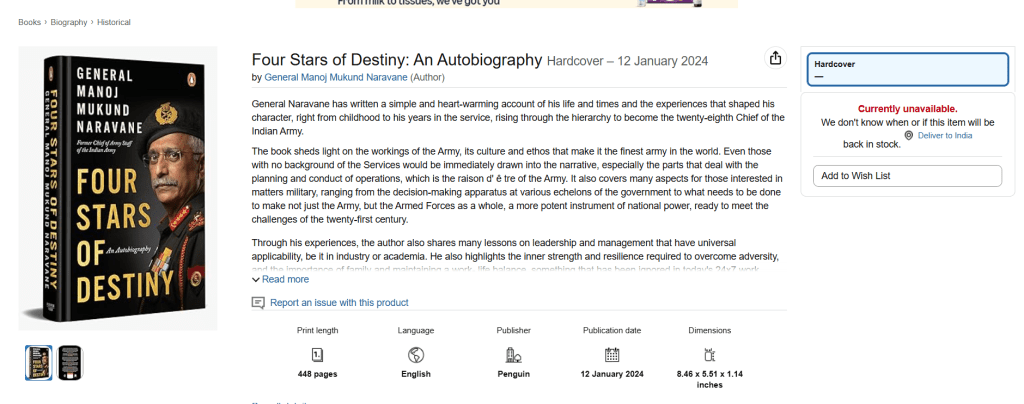
MM Naravane’s book ‘Four Stars of Destiny’ cited by Rahul Gandhi disappears from Amazon, Flipkart VIEW HERE ⤡ (As reported on 4th February, 2026 ©The Economic Times)
The unresolved threads—how excerpts reached The Caravan and other outlets, why clearance has stalled uniquely here amid a policy rethink on military publications, and whether the saga has paradoxically boosted Naravane’s unrelated thriller The Cantonment Conspiracy to bestseller status—point to a larger, more troubling pattern. Suppression may quiet immediate discomfort, but it risks amplifying the very questions it seeks to contain: about transparency in national security debates, the space for veteran voices in democratic discourse, and the cost of treating documented memory as a threat rather than a safeguard. As probes intensify and political rhetoric sharpens, the memoir’s fate—and the truths it may yet fully disclose—continues to hang in precarious balance, potentially redefining how India confronts its recent past.
5. Why the BJP-Led Government Has Effectively Kept This Book in Limbo (An “Unofficial Ban”)
Calling it an “unofficial ban” is accurate in a political sense, even if not in a legal one. There are several overlapping reasons why the BJP-led government has every incentive to keep General M.M. Naravane’s memoir in limbo—and none of them are flattering.
- It punctures the Galwan narrative The BJP’s core claim since 2020 has been “not an inch of land was lost”. Naravane’s account—especially the frantic August 2020 episode where he repeatedly asks “What are my orders?” and receives vague political responses—directly undermines that claim. This isn’t opposition rhetoric or media speculation; it’s a four-star general’s testimony. That makes it uniquely dangerous to the government’s credibility.
- It exposes political indecision at the top The leaked excerpts suggest confusion, hesitation, and abdication of clear civilian direction during an active military crisis. For a regime that markets itself as decisive, muscular, and national-security savvy, this is reputationally lethal. The problem isn’t that Naravane criticises the Army—it’s that he reveals political leadership paralysis when clarity mattered most.
- Civil–military optics matter enormously to the BJP The BJP has carefully cultivated the image that the military is fully aligned with the political leadership, and dissent, if any, is external or “anti-national.” A former Army Chief openly documenting friction, disagreement, or lack of consultation (e.g., Agnipath) shatters this choreography. It suggests the armed forces are professional institutions, not ideological extensions of the ruling party—a message the BJP is deeply uncomfortable with.
- Suppression is safer than rebuttal The government has not formally banned the book because that would invite judicial scrutiny and confirm fears of censorship. Instead, it has used a familiar method: endless “security clearance”. This bureaucratic freeze allows plausible deniability (“process is ongoing”) while effectively silencing the work. The fact that Naravane’s fiction was cleared and published, but his memoir wasn’t, makes the selectivity obvious.
- Timing + politics = panic The book resurfaced publicly when Rahul Gandhi cited it in Parliament. That moment revealed the government’s real fear: once the memoir enters public discourse, it becomes parliamentary ammunition, academic evidence, and historical record. An unpublished book can be dismissed as “unverified.” A published one cannot.
- Pattern, not exception This episode fits a broader pattern under the BJP: delay rather than ban, silence rather than debate, procedural control rather than overt coercion. From journalists to academics to retired officials, the rule is consistent: those with institutional credibility are more dangerous than loud critics.
- BJP under threat from cumulative national-security questions. The government faces intensifying political pressure as opposition parties, analysts, and former officials raise persistent questions about a series of high-profile incidents, exposing perceived gaps in preparedness, response, and accountability. These doubts erode the BJP’s carefully projected image of decisive national-security management and fuel demands for independent probes.
Questions raised about Pulwama, Pahalgam, Balakot, Uri, and related incidents. Critics continue to scrutinise the 2019 Pulwama suicide bombing (which killed 40 CRPF personnel) over multiple ignored intelligence warnings and security lapses, with some such as former J&K Governor Satyapal Malik alleging exploitation for electoral gains ahead of the Balakot airstrike on alleged militant camps in Pakistan. Similar questions surround the 2016 Uri attack (leading to surgical strikes), the 2025 Pahalgam tourist massacre (26 civilians killed, blamed on Pakistan-based groups like LeT/TRF), and broader patterns of terror incidents in Kashmir. Allegations of inadequate preventive action and post-incident narrative control have kept these events politically charged.
Intelligence failures and allegations of deliberate lapses. Persistent claims point to systemic intelligence shortcomings across these cases, with some voices alleging deliberate oversights or compromises to serve political timelines or avoid diplomatic escalation. Whether due to genuine failure, coordination breakdowns, or more sinister motives, these episodes have prompted calls for accountability at the highest levels, including the NSA and central agencies, casting doubt on the regime’s “zero-tolerance” security posture.
Simulation wars and wargaming revelations. Military simulations and wargames (both internal and reported externally) have reportedly highlighted vulnerabilities in India-China border scenarios, including rapid Chinese advances, logistical challenges, and political decision-making delays. These exercises amplify concerns that real-world crises like Galwan exposed gaps the government downplays, adding urgency to insider accounts like Naravane’s.
The broader China threat: territorial encroachments and claims. China has long controlled approximately 38,000 sq km of Aksai Chin (occupied since the 1962 war and claimed by India as part of Ladakh), while also asserting the entire state of Arunachal Pradesh (over 83,000 sq km) as “South Tibet” or “Zangnan”—rejecting the McMahon Line, issuing stapled visas, renaming places, and maintaining maximalist maps. Additional effective control or restricted patrolling in pockets of eastern Ladakh since 2020 (estimates range from 1,000–2,000 sq km in areas like Depsang and Pangong, per various reports, though officially denied as territorial loss) compounds the narrative of incremental erosion. “What is up?” remains a pointed public question: repeated standoffs, buffer zones, and infrastructure races suggest a pattern of strategic pressure that challenges official assurances of strength and resolution.
This is the big picture within which Naravane’s memoir unfolds. It does not exist in isolation but as part of a larger canvas of unresolved border tensions, terror incidents, intelligence controversies, and territorial assertions—making its suppression even more revealing of governmental priorities.
In short, the BJP hasn’t “banned” Four Stars of Destiny because banning would look blatantly authoritarian. It has instead neutralized it—because a calm, factual, insider account of national-security mismanagement is far more threatening than any opposition speech. And ironically, that suppression has already turned Naravane’s memoir into exactly what the government feared: a quiet but powerful indictment of how power actually functioned when the nation was told everything was under control.
6. Comparative Overview: Naravane’s “Unpublished” (?) Memoir, BBC’s Documentary, Final Solution, and Gujarat Files
A) Core Content and Focus
- Naravane’s Four Stars of Destiny: A military autobiography by a four-star Army Chief, covering leadership lessons, professional ethos, and high-stakes national security crises such as the 2020 Galwan Valley confrontation with China. Leaked excerpts portray political indecision and ambiguity from civilian leadership during crisis, especially in the Ladakh standoff. Its threat arises from institutional critique from within—a senior general challenging political civil-military dynamics, not just external description of events.
- BBC Documentary: India: The Modi Question: A two-part investigative documentary about Narendra Modi’s role in the 2002 Gujarat riots, focusing on archival evidence, official reports, and testimonies that suggest serious leadership failures and questions around responsibility. The film was blocked in India, with the government labeling it “propaganda” that risks social discord.
- Final Solution (Directed by Rakesh Sharma): This independently made documentary reconstructs the Gujarat carnage through eyewitness accounts and contextual analysis; it suggests organised violence and political exploitation of communal tensions. It was initially banned in India by the Censor Board in 2004 due to fears of communal fallout, though later screenings and campaigns made it widely accessible. It is explicitly critical of right-wing politics and Hindutva influence in the violence.
- Rana Ayyub’s Gujarat Files: A self-published investigative book based on an eight-month undercover sting investigating bureaucrats, police, and political players around the Gujarat riots and related events. It combines on-the-record transcripts with covert recordings and insider conversations, expanding the narrative beyond mainstream accounts.
B) Methodology and Narrative Style
- Naravane Memoir: First-person military memoir; primary sources: personal experience as Army Chief and internal communications.
- BBC Documentary: International broadcast journalism; primary sources: archival material, reports, expert interviews.
- Final Solution: Documentary cinema; primary sources: eyewitness accounts, survivor testimony.
- Gujarat Files: Investigative journalism with undercover elements; primary sources: secret recordings, interviews with officials.
Four Stars offers insider strategic reflection; the BBC film frames the political role of a national leader in a major communal conflict; Final Solution stitches lived experience into cinematic narrative; Gujarat Files uses hidden-camera investigative reporting to expose institutional complicity.
C) Political Controversy and Suppression
- Naravane’s Memoir: Not published due to the Ministry of Defence review process; no formal ban, but its prolonged vetting—beyond typical timelines—functions as de facto suppression. The BJP-led government resists publication because excerpts challenge official portrayals of military-political coordination and crisis management.
- BBC Documentary: Blocked under the IT Rules 2021 on grounds it could affect sovereignty, public order, and foreign relations—echoing claims of “propaganda”.
- Final Solution: Banned initially by the Indian Censor Board due to fears of communal flare-ups—yet activists countered with pirate distribution campaigns and international screenings. It later won international awards.
- Gujarat Files: Not banned, but faced institutional resistance from media outlets and publishing houses (arguably due to political pressure or editorial hesitation). A Supreme Court judgement dismissed parts as “conjecture”, but did not review source materials directly.
D) Political Stakes and Narrative Impact
Naravane’s memoir is sensitive because it is internal leadership testimony from a highly senior official—harder to discredit as partisan opinion—and challenges official narratives around border security and high-level decision-making.
The BBC and Final Solution controversies echo how the Indian state reacts to critical accounts of major communal violence linked to BJP-led politics—especially where the role of prominent leaders like Modi is scrutinised. The BBC documentary was framed as foreign bias and blocked domestically. Final Solution faced formal censorship due to fears of social unrest, though later found avenues through civil resistance.
Gujarat Files remains contentious because it is domestic investigative work confronting institutional power more directly—exposing behaviour by officials and security apparatus in crisis periods.
E) Comparative Significance
Naravane’s book adds civil–military relations and strategic leadership critique to the public record. The BBC documentary brings international journalistic scrutiny to political leadership in communal violence. Final Solution offers a ground-level, narrative documentary history of the riots. Gujarat Files embeds undercover investigative evidence and private admissions from officials.
Together, they represent distinct lenses on political accountability in India: the military, international journalism, documentary cinema, and undercover investigative reporting—and each, in its own way, has faced political or bureaucratic resistance because their revelations unsettle dominant official narratives.
F) Legal–Institutional Mechanisms of Suppression (Compared)
- Naravane’s Memoir — Military Vetting as Political Control Instrument used: Ministry of Defence clearance under service conduct rules for retired officers (ostensibly for “operational sensitivity”). How it works: No written rejection. No timeline. No appeal mechanism. Indefinite “under review” status. Why this is powerful: This converts a procedural safeguard into a silencing device. Because the author is a former Army Chief, outright banning would be explosive. Delay achieves the same result quietly. Key insight: This is intra-elite suppression—the state disciplining one of its own when institutional memory threatens political myth-making.
- BBC Documentary — Executive Digital Censorship Instrument used: Information Technology Rules, 2021 Emergency blocking powers citing “sovereignty,” “public order,” and “foreign relations.” How it works: Content blocked without prior judicial review. Platforms compelled to comply immediately. Citizens criminalised for circulation. Why this is used here: The BBC is foreign, influential, documentary-backed, and explicitly links Modi to 2002 Gujarat. Key insight: This is external narrative control—the state asserting epistemic sovereignty: only we may tell our story.
- Final Solution — Preventive Censorship via Public Order Logic Instrument used: Central Board of Film Certification (CBFC). How it worked: The film was banned not for inaccuracy, but for being too truthful and therefore “dangerous.” The state claimed it might “inflame communal tensions.” Irony: The documentary exposes violence, yet is blamed for potentially causing violence. Key insight: This is pre-emptive censorship—truth is treated as combustible if it threatens dominant political identities.
- Gujarat Files — Market + Legal Choking Instruments used: Publisher refusal (informal pressure). Strategic litigation and judicial scepticism. Character assassination of the author rather than forensic engagement with evidence. How it works: No ban → no censorship debate. But no distribution → effective invisibility. Key insight: This is epistemic delegitimisation—attack the messenger so the message need not be answered.
G) What Changes Across These Cases?
Let’s compare them across four axes:
| Axis | Naravane | BBC Docu | Final Solution | Gujarat Files |
|---|---|---|---|---|
| Speaker | Insider (General) | Foreign media | Independent filmmaker | Indian investigative journalist |
| Subject | Border crisis, state indecision | Modi & 2002 | Communal violence | State cover-up |
| Tool | Bureaucratic delay | IT Rules | Film censorship | Market + courts |
| Visibility | Silent suppression | Loud ban | Initial ban | Slow marginalisation |
The rule is simple: The closer the speaker is to the state’s core legitimacy, the subtler the suppression.
H) Why Naravane Is the Most Dangerous of All
This is crucial. The BBC can be dismissed as “colonial bias.” Rana Ayyub can be labelled “activist.” A documentary filmmaker can be accused of “provocation.” But a former Army Chief cannot be easily discredited without destabilising civil–military trust, the image of a unified national-security state, and the BJP’s claim of decisive leadership. So the state chooses neither rebuttal nor ban, but bureaucratic purgatory. This is classic authoritarian risk management.
I. The Deeper Pattern: From Censorship to Memory Control
What connects all four cases is not ideology but control over historical memory. 2002 Gujarat is about foundational legitimacy. Galwan/Ladakh is about present competence. Both threaten the myth of strong leadership, moral clarity, national resurgence.
These works don’t merely criticise policy; they reintroduce ambiguity, hesitation, and failure into state narratives. That is intolerable for a regime built on certainty and spectacle.
J) The Paradox
Here’s the paradox the BJP cannot escape: Banning looks authoritarian. Allowing publication risks archival truth. So the state perfects a third path: Delay, discredit, diffuse. But history has a cruel habit: Final Solution survived through piracy. Gujarat Files became a reference text. The BBC documentary circulates globally. And Naravane’s memoir—already quoted in Parliament—has entered the archive without being published.
6. Closing Thought
Taken together, Naravane’s withheld memoir, the BBC’s blocked documentary, Rakesh Sharma’s Final Solution, and Rana Ayyub’s Gujarat Files constitute an unofficial counter-archive of contemporary India. What unites them is not ideological extremism but the pedigree of their creators: a former Chief of the Army Staff, an international broadcaster with archival rigor, an independent documentary filmmaker grounded in eyewitness testimony, and a journalist who risked undercover immersion among officials and security personnel. Each work emerges from positions of institutional access, professional credibility, or direct witnessing—precisely the kind of sources that are hardest to dismiss as partisan fabrication.
The state’s patterned response to these accounts—procedural delay and indefinite vetting in Naravane’s case, emergency digital blocking for the BBC film, initial censorship followed by activist circumvention for Final Solution, and market/legal marginalisation for Gujarat Files—reveals a consistent priority: control over the documentary record itself. The regime appears far less threatened by outright falsehoods, which can be refuted or ignored, than by calm, credentialed, fact-based memory that refuses to align with the authorised version of events. Whether the subject is leadership indecision during a border crisis, responsibility in a major communal outbreak, or institutional complicity in violence, the common thread is the effort to keep inconvenient primary evidence—leaked excerpts, survivor voices, covert recordings, archival material—from entering the public domain in its complete, authorised form.
In the end, the deeper indictment lies not in what these works say, but in what their containment requires. By treating documented memory from credible insiders as a danger to be managed rather than a contribution to be debated, the state inadvertently confesses its own vulnerability: not to external propaganda, but to the quiet accumulation of institutional truth. As long as such accounts remain suppressed, delayed, or delegitimised, the unofficial counter-archive grows stronger—not through louder voices, but through the very mechanisms used to silence them.
SEE ALSO:
Mouthshut.com Review of the Book: https://www.mouthshut.com/review/four-stars-of-destiny-an-autobiography-manoj-mukund-naravane-review-lnnqlmprrop
APPENDIX
The earlier blog posts from our onceinabluemoon2021.in (spanning 2021–2025) articulate a persistent narrative of institutional neglect, political exploitation, and eroding morale within the Indian armed forces, framing these as symptoms of broader governmental indifference or manipulation under the current regime. Key recurring grievances include:
- Financial hardships inflicted on serving and retired personnel, exemplified by the DHFL scam (Dewan Housing Finance Corporation collapse), where the Indian Air Force Group Insurance Society suffered significant losses (Rs 84 crore exposure noted in 2019), leaving widows and families in distress. Posts highlight the armed forces’ “sacrifice” in forgoing privileged creditor status during insolvency proceedings (NCLT suggestions in 2021 for full repayment to army groups, yet the IAF refrained to avoid discrimination), portraying this as altruistic but underscoring governmental failure to protect military-linked investments amid alleged cronyism and terror-funding links.
- Alleged political exploitation of military lives for electoral gains, such as claims around the Pulwama attack (2019) where ex-J&K Governor Satyapal Malik accused the ruling party of deliberate lapses for vote-bank politics, and Balakot airstrike (2019) dismissed as “simulated” or exaggerated. These are tied to a pattern of using armed forces personnel as “mere means” or “utilizable war machines,” with border mismanagement (Chinese encroachments in Ladakh/Arunachal, unreported intrusions) and incidents like Nagaland civilian killings (2021) or Manipur unrest (2023) seen as evidence of apathy toward troop welfare and operational realities.
- Policy-driven discontent, prominently the Agnipath scheme (short-term contractual recruitment replacing permanent roles with pensions), criticized as undermining job security, long-term benefits, and institutional health—leading to protests among aspirants and serving personnel, plus deprivation of pension dues for ex-servicemen, with warnings against social media criticism and legal threats.
- Broader civil–military tensions, including weapon procurement scandals (faulty equipment, Adani involvement without expertise), human rights controversies (Kashmir, Manipur), and contrasts with historical figures like Netaji Subhas Chandra Bose (whose unifying vision is juxtaposed against today’s “crony oligarchical fascism,” privatization pushes, and political interference that allegedly sacrifices personnel for petty gains).
These themes play directly into concerns amplified by General M.M. Naravane’s withheld memoir Four Stars of Destiny. The leaked excerpts reportedly document political ambiguity and indecision during the 2020 Galwan/Ladakh crisis, lack of clear civilian direction, and unilateral imposition of Agnipath without adequate consultation—echoing the blog’s criticisms of top-down policies sidelining military expertise and morale. The posts’ portrayal of systemic neglect (financial scams affecting widows, pension issues, exploitation in Pulwama/Balakot) aligns with Naravane’s implied critique of civil–military friction under a centralised regime that prioritizes political optics over institutional health and troop welfare. By framing the armed forces as professional yet increasingly strained by political fiat, these writings reinforce the memoir’s meta-argument: that even insider testimony from a former Army Chief exposes uncomfortable truths about leadership failures, decision-making paralysis, and erosion of trust—truths the government appears keen to contain through prolonged suppression rather than open engagement. In this light, the blog’s persistent questioning of governmental “concern” for the forces provides a grassroots, veteran-aligned echo chamber to Naravane’s restrained but damning account, suggesting deeper, ongoing discontent within and around the military establishment.
 Once in a Blue Moon Academia