
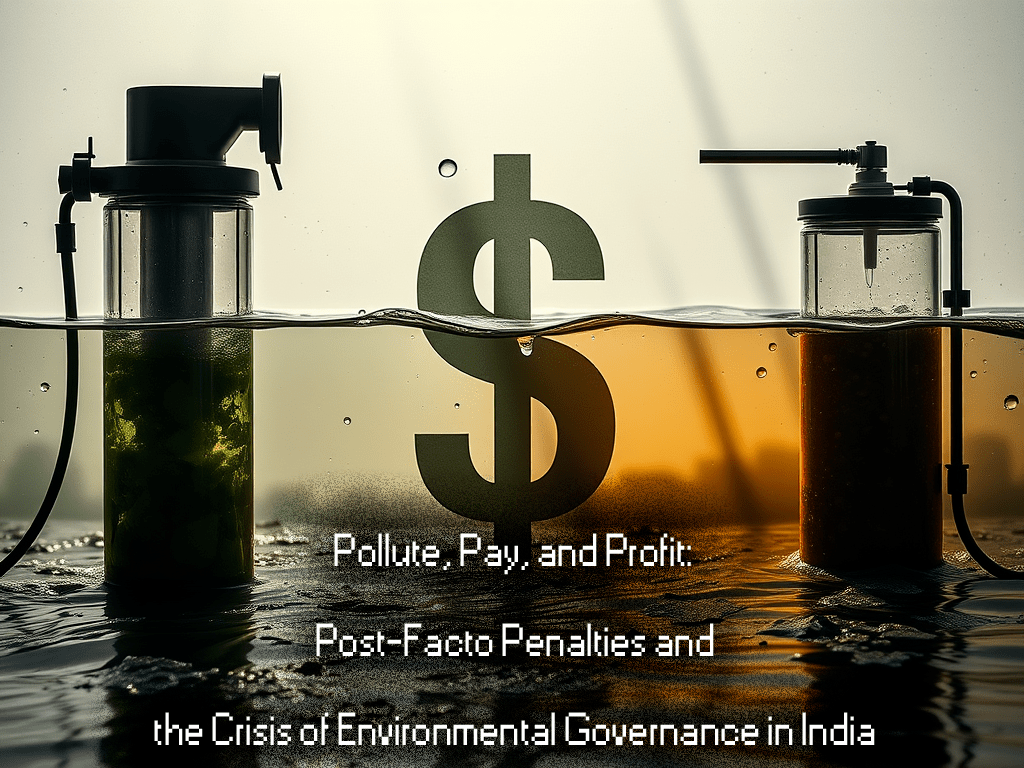
Authored by Ecotopians of Alternity (EOA)⤡ under the Once in a Blue Moon Academia (OBMA) Platform
ABSTRACT
India’s environmental legal framework relies heavily on post-facto penalties—fines, compensation, and retrospective clearances—that fail to deter ecological crimes and often enable corporate violators to commodify the very resources they degrade in the first place. This article critiques the systemic flaws in post-facto approaches through case studies of Piramal Sarvajal (a CSR water purification venture following groundwater pollution in Digwal, Telangana) and Reliance’s Campa Cola revival under Isha Ambani Piramal (a beverage expansion exacerbating water scarcity). Linked by dynastic ties and philanthro-capitalist logic, these ventures illustrate how polluters repackage harm as opportunity, turning natural components like water into “Any Time Money” while evading true accountability. Drawing further on Jairam Ramesh’s 2026 Supreme Court challenge to ex post facto clearances and international calls for ecocide criminalization, the analysis condemns reactive penalties as counterproductive, violating precautionary principles and fostering moral hazard. It advocates for stricter preventive measures, criminal recognition of ecocide, and a shift toward ecocentric justice to protect ecosystems and human rights.
I. Introduction

In an era of accelerating ecological crises, India’s environmental laws promise protection through statutes like the Environment (Protection) Act, 1986, the Water and Air Acts, and the National Green Tribunal framework. Yet, enforcement remains predominantly post-facto: violations occur, harm is inflicted, and penalties—often modest fines or “environmental compensation”—are imposed retroactively, sometimes alongside retrospective clearances that regularize illegality. This reactive paradigm, far from deterring widespread damage akin to ecocide, incentivizes corporate risk-taking, where ecological destruction becomes a calculable business cost.
The Supreme Court’s oscillating jurisprudence—striking down ex post facto clearances in May 2025 only for a majority recall later that year—highlights the tension between development imperatives and environmental safeguards. Jairam Ramesh’s January 2026 petition challenging retrospective approvals as “bad in law,” detrimental to public health, and a “mockery of governance” underscores ongoing judicial and political contestation. Meanwhile, corporate actors exploit these gaps through philanthro-capitalism: polluting industries pivot to “solutions” that monetize scarcity, commodifying essentials like water.
This article examines two intertwined case studies—the Piramal Group’s Sarvajal Water ATMs following Digwal pollution and Reliance’s Campa Cola expansion under Isha Ambani-Piramal—revealing a dynastic nexus of resource extraction, degradation, and profitable redemption. It condemns post-facto penalties as fundamentally flawed, violating precautionary principles, encouraging wilful violations, and eroding constitutional rights under Article 21. By linking domestic critiques to international momentum for ecocide criminalization (e.g., proposals before the ICC and domestic bills in India), it calls for a paradigm shift toward prevention, deterrence, and recognition of ecosystems as victims in their own right.
II. Key Existing Laws in India on Environmental Crimes and Penalties
India does not have a specific codified law criminalizing “ecocide” as a standalone offense, but several environmental statutes address ecological crimes through post-facto penalties, including fines, imprisonment, and remedial measures. These laws cover pollution, deforestation, wildlife harm, and other environmental violations, often enforced by bodies like the Central Pollution Control Board (CPCB), State Pollution Control Boards (SPCBs), and the National Green Tribunal (NGT). Penalties are typically applied after the offense (post-facto) and can include criminal liability for individuals, companies, and directors. Below is a comprehensive list of major existing laws, based on current legal frameworks as of 2026, with summaries of their scope and penalties.
1. The Environment (Protection) Act, 1986 (EPA)
- Scope: An umbrella legislation empowering the central government to protect and improve environmental quality, control pollution, and regulate hazardous substances. It addresses broad ecological crimes like unauthorized emissions, waste disposal, and environmental degradation.
- Penalties: Contraventions are punishable with imprisonment up to 5 years, a fine up to ₹1 lakh, or both. For continuing violations, an additional fine of up to ₹5,000 per day applies. If the violation persists beyond one year, imprisonment can extend to 7 years. Penalties are deposited into an Environmental Protection Fund (EPF).
- Relevance to Ecocide: Covers acts that cause widespread environmental harm, with provisions for remedial directions and compensation.
2. The Water (Prevention and Control of Pollution) Act, 1974 (WPCPA)
- Scope: Regulates water pollution from industrial, municipal, or other sources, including fouling of water bodies. It prohibits discharge of pollutants beyond prescribed standards.
- Penalties: Violations (e.g., polluting water sources) attract imprisonment of at least 1.5 years, extendable to 6 years, plus fines. For ongoing offenses, an additional fine of ₹5,000 per day; if continuing beyond one year, minimum imprisonment of 2 years up to 7 years. Auxiliary offenses like violating consent conditions carry similar sanctions.
- Relevance to Ecocide: Directly penalizes acts like corrupting public water sources, akin to ecological sabotage.
3. The Air (Prevention and Control of Pollution) Act, 1981
- Scope: Controls air pollution from industries, vehicles, and other emitters, setting emission standards and restricting operations in pollution control areas.
- Penalties: Similar to the WPCPA—imprisonment from 1.5 to 6 years and fines for basic offenses; additional daily fines for continuance, with escalation to 2-7 years if prolonged beyond a year. Includes penalties for non-compliance with directions or consent.
- Relevance to Ecocide: Targets atmospheric degradation that could lead to large-scale ecological damage.
4. The Wildlife (Protection) Act, 1972
- Scope: Protects wildlife, endangered species, and habitats by prohibiting hunting, poaching, trade in animal articles, and disturbance of protected areas.
- Penalties: For core offenses like hunting endangered species, imprisonment ranges from 3-7 years with fines up to ₹25,000 (or more for repeats). Lesser violations attract 1-3 years imprisonment and fines. Enhanced penalties for organized crime or tiger-related offenses can go up to life imprisonment.
- Relevance to Ecocide: Addresses biodiversity loss, which is a key aspect of ecological crimes.
5. The Forest (Conservation) Act, 1980
- Scope: Regulates deforestation and non-forest use of forest land, requiring central government approval for diversions.
- Penalties: Violations (e.g., unauthorized clearing) are punishable with simple imprisonment up to 15 days, but often compounded with fines or linked to other acts like the EPA for stricter sanctions.
- Relevance to Ecocide: Prevents large-scale habitat destruction.
6. The Biological Diversity Act, 2002
- Scope: Conserves biological diversity, regulates access to biological resources, and ensures fair benefit-sharing.
- Penalties: Unauthorized access or biopiracy leads to imprisonment up to 5 years and fines up to ₹10 lakh. Corporate offenses can attract higher fines.
- Relevance to Ecocide: Protects genetic resources and ecosystems from exploitation.
7. The National Green Tribunal Act, 2010
- Scope: Establishes the NGT for speedy adjudication of environmental disputes, enforcing the above laws and awarding compensation for damages.
- Penalties: Empowers the NGT to impose fines, imprisonment (up to 3 years), and order restoration. It handles civil liabilities but can refer criminal matters.
- Relevance to Ecocide: Provides a mechanism for post-facto remedies and penalties in environmental cases.
8. Relevant Provisions in the Bharatiya Nyaya Sanhita, 2023 (Formerly Indian Penal Code)
- Scope: General criminal code with specific environmental provisions, such as Section 272 (adulterating food/drink) and Section 277 (fouling public water sources).
- Penalties: For fouling water, imprisonment up to 6 months, fine, or both. Broader mischief provisions (e.g., causing damage) can apply to ecological harm with up to 1 year imprisonment.
- Relevance to Ecocide: Limited but foundational for criminalizing intentional environmental harm.
9. The Companies Act, 2013
- Scope: Imposes duties on company directors to protect the environment in corporate activities.
- Penalties: Non-compliance with environmental duties can result in fines up to ₹5 lakh per director.
- Relevance to Ecocide: Holds corporations accountable for ecological impacts.
Additionally, constitutional provisions like Article 48A (state duty to protect environment) and Article 51A(g) (citizen duty) underpin these laws, though they do not directly impose penalties. Note that a private member’s bill to criminalize ecocide was introduced in Parliament in 2025, proposing alignment with international definitions, but it is not yet enacted as law. Enforcement challenges include low conviction rates (e.g., NCRB data shows over 64,000 environment-related cases in 2021, but many unresolved). For your critical paper, consider analyzing gaps in these laws, such as decriminalization trends in recent amendments (e.g., reduced criminal liability in pollution acts) and the need for stricter ecocide-specific provisions.
III. Jairam Ramesh’s Recent Challenge to Ex-Post Facto Environmental Clearances
Jairam Ramesh, a prominent Congress leader and former Union Environment Minister, has filed a petition in the Supreme Court of India challenging the practice of granting ex-post facto (after the fact) environmental clearances (ECs) to projects that violate environmental norms. This petition, filed in early 2026, argues that such clearances undermine environmental governance and legal accountability. It was prompted by recent Supreme Court developments, including a review of prior judgments on similar issues. Below, I elaborate on the key points from his petition, based on the reported details.
1. Ex-Post Facto Clearances Are “Bad in Law” and Contrary to Jurisprudential Foundations
- Ramesh contends that retrospective approvals for environmental violations fundamentally contradict established legal principles. He argues that these clearances should “never be permitted” as they erode the preventive intent of environmental laws, which require prior assessments to mitigate harm. By allowing projects to proceed without initial compliance and then seeking forgiveness later, the system rewards non-adherence rather than enforcing proactive protection.
- This point ties into broader critiques of ecocide, where post-facto penalties (like fines or remedial orders under laws such as the Environment (Protection) Act, 1986) are seen as insufficient deterrents if they can be bypassed through retrospective nods.
2. Detrimental to Public Health and Environmental Integrity
- The petition highlights how ex-post facto clearances endanger public health by permitting irreversible ecological damage before any regulatory scrutiny. For instance, projects involving pollution, deforestation, or habitat destruction (governed by acts like the Water (Prevention and Control of Pollution) Act, 1974, or the Forest (Conservation) Act, 1980) could cause long-term harm to communities, water sources, and biodiversity. Ramesh emphasizes that such leniency mocks the constitutional duties under Article 48A (state’s obligation to protect the environment) and Article 51A(g) (citizens’ duty to safeguard it).
- In the context of ecological crimes, this argument underscores that post-facto mechanisms fail to prevent ecocide-like acts, prioritizing economic interests over health and sustainability.
3. Provides an “Easy Way Out” for Wilful Defaulters
- A core criticism is that these clearances act as a loophole for intentional violators, allowing them to flout rules and then regularize operations with minimal consequences. Ramesh asserts that “ignorance of the law cannot excuse violations,” rejecting any defense based on oversight. This enables “wilful defaulters” (e.g., industries or developers) to avoid the stringent pre-clearance processes mandated by the Environment Impact Assessment (EIA) Notification, 2006.
- Relating to post-facto penalties in Indian law, this challenges the efficacy of punitive measures in statutes like the Air (Prevention and Control of Pollution) Act, 1981, where fines and imprisonment are applied after violations but may not deter if retrospective approvals sanitize the illegality.
4. Makes a Mockery of Governance and Accountability
- Ramesh argues that permitting ex-post facto clearances diminishes the credibility of environmental governance institutions, such as the Ministry of Environment, Forest and Climate Change (MoEFCC). It creates a perception of regulatory capture, where violators can influence outcomes post-violation, undermining public trust and the rule of law.
- This point critiques the systemic gaps in enforcing laws through bodies like the National Green Tribunal (NGT), where post-facto remedies exist but are weakened if initial violations can be retroactively approved.
5. Legal Bases and References in the Petition
- Supreme Court’s May 16, 2025, Verdict: Ramesh draws heavily from this judgment by Justices A.S. Oka and Ujjal Bhuyan, which explicitly prohibited retrospective ECs by the MoEFCC for norm-violating projects. The verdict, rooted in the Vanashakti judgment, reinforced that environmental laws demand prior compliance to prevent harm.
- November 18, 2025, Review Opening: The petition references the Supreme Court’s decision to allow a review of the May 16 verdict, decided by a 2:1 majority (Chief Justice B.R. Gavai, Justices Ujjal Bhuyan, and K. Vinod Chandran). This placed the issue for fresh reconsideration, which Ramesh uses to urge a reaffirmation of the ban on ex-post facto clearances.
- December 29, 2025, Aravallis Review: Encouraged by the Court’s review of its earlier redefinition of the Aravalli hills (protecting them from mining and development), Ramesh extends similar logic to environmental clearances, arguing for consistent judicial protection against retrospective dilutions.
In essence, Ramesh’s petition seeks to strengthen India’s environmental jurisprudence by eliminating ex-post facto clearances, aligning with calls for recognizing ecocide as a distinct crime. This could influence ongoing discussions on amending laws to impose stricter, non-retrospective penalties, potentially reducing enforcement challenges like low conviction rates. If successful, it might lead to more robust preemptive measures, addressing the criticisms of current post-facto frameworks.
Source: Jairam Ramesh files petition in Supreme Court challenging ex post facto environmental clearances VIEW HERE ⤡ (As reported on January 23, 2026 03:27 pm. ©The Hindu)
Seen in continuity, Jairam Ramesh’s challenge cannot be read in isolation from the BJP government’s systematic dilution of the Environmental Impact Assessment (EIA) framework—most notably through the draft EIA Notification, 2020 and its subsequent incorporations. These amendments institutionalise precisely what Ramesh’s petition warns against: the normalisation of post-facto environmental clearances, reduced public consultation, expanded exemptions for “strategic” and extractive projects, and the reclassification of violations as administratively compoundable infractions rather than substantive crimes. By transforming environmental compliance into a negotiable, post-damage procedure, the EIA regime is recast from a preventive safeguard into a regulatory afterthought. It was this architecture of legalised impunity that provoked widespread resistance from youth-led and grassroots movements such as Fridays for Future India, with climate activist Disha Ravi becoming a prominent voice against what activists termed a “Pollute–Pay–Proceed” model of governance. The state’s response—criminalisation, surveillance, and sedition charges against dissenters—revealed a deeper contradiction: while corporations are granted retrospective forgiveness for ecological harm, citizens opposing such harm are subjected to pre-emptive repression. In this sense, ex-post facto clearances are not merely administrative lapses but form part of a broader political economy where environmental destruction is monetised, dissent is disciplined, and governance itself slides into what can be described as corporate eco-extortion—where nature and public health are held hostage to profit, later redeemed through fines, fees, and legal fictions of compliance. Ramesh’s petition thus acquires significance not only as a legal intervention, but as a counter-memory to an environmental regime increasingly structured to forgive capital while punishing resistance.
IV. Case Studies: The Piramal-Ambani Nexus – Dynastic Alliances in Water Commodification and Ecological Expropriation
In the realm of ecological crimes and post-facto penalties under Indian environmental law, the Piramal Group’s saga, intertwined with the Ambani dynasty through marriage (secondary kinship ties), offers a poignant illustration of how corporate polluters can pivot to “social responsibility” initiatives that blur the lines between atonement and opportunism. Anand Piramal, son of Ajay Piramal, wed Isha Ambani—daughter of Reliance Industries magnate Mukesh Ambani—in 2018, forging an alliance that consolidates influence across pharmaceuticals, retail, and consumer goods. This union not only amplifies economic synergies but also spotlights parallel ventures in water-intensive industries, where ecological harm is repackaged as market opportunity. Piramal’s Sarvajal initiative, ostensibly a benevolent response to water scarcity, mirrors the resource-extractive logic of Reliance’s Campa Cola revival under Isha Ambani’s oversight. Both exemplify “eco-extortionist” models: corporations degrade or deplete water resources, then profit from the resulting scarcity through commodified “solutions,” all under the guise of innovation and nationalism. Drawing from critiques of hydro-political imbalances and the deceptive allure of beverage capitalism, these cases reveal how family-tied conglomerates perpetuate a cycle of thirst—creating demand through destruction, then quenching it for a fee. Here, environmental harm is retroactively “addressed” not just through fines but via ventures that commodify the very resource they degraded, all while highlighting the inadequacies of post-facto enforcement in preventing ecocide-like acts.
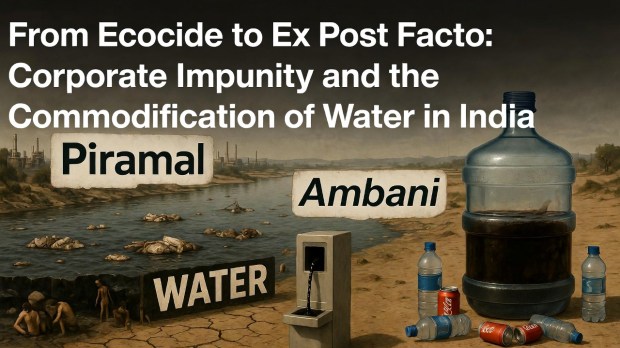
1. Case Study 1: “Water for All” – From Toxic Effluents to “Purified” Profits
Piramal Sarvajal – A Tale of Philanthro-Capitalism and “Purified” Redemption
In the realm of ecological crimes and post-facto penalties under Indian environmental law, the Piramal Group’s saga offers a poignant illustration of how corporate polluters can pivot to “social responsibility” initiatives that blur the lines between atonement and opportunism. This case study examines Piramal Enterprises Limited’s (PEL) pollution of groundwater in Digwal village, Telangana, the subsequent rebuke by the National Green Tribunal (NGT), and the group’s promotion of Sarvajal—a CSR venture peddling purified water through ATMs—framed as philanthro-capitalism. Here, environmental harm is retroactively “addressed” not just through fines but via ventures that commodify the very resource they degraded, all while highlighting the inadequacies of post-facto enforcement in preventing ecocide-like acts.
A. The Pollution Debacle in Digwal: A Pharma Giant’s Toxic Legacy
Piramal Enterprises, under the leadership of billionaire Ajay Piramal, operated a pharmaceutical manufacturing unit in Digwal, Kohir Mandal, Sangareddy District, Telangana. In a classic display of industrial disregard for environmental norms, the facility was found guilty of discharging untreated effluents, contaminating groundwater and air in the surrounding areas. Inspections revealed violations of consent conditions under the Water (Prevention and Control of Pollution) Act, 1974, and the Air (Prevention and Control of Pollution) Act, 1981, including improper handling of hazardous waste and emissions exceeding permissible limits. The Telangana State Pollution Control Board (TSPCB) issued closure orders in 2018, citing ongoing pollution that posed risks to local water sources and public health.
The NGT, stepping in as the post-facto enforcer under the National Green Tribunal Act, 2010, imposed a hefty “environmental compensation” of Rs 8.32 crore in 2019 for these violations—framed not as a criminal penalty but as a remedial fine to fund restoration efforts. This amount was later contested and partially enforced, with the tribunal directing payment of Rs 3.2 crore within a month in 2021, underscoring the protracted nature of such penalties. While the fine aligns with post-facto mechanisms in the Environment (Protection) Act, 1986—allowing for imprisonment up to 5-7 years and daily fines for continuing offenses—it exemplifies how corporations often negotiate down liabilities, delaying true accountability. PEL appealed the decision, and by 2024, even SEBI cleared its demerged pharma arm (Piramal Pharma Ltd.) of related disclosure violations under listing norms, deeming the events non-material to investors. In essence, the pollution—akin to localized ecocide through water contamination—resulted in financial slaps on the wrist rather than systemic deterrence, leaving villagers to grapple with long-term health and ecological fallout.
Digwal’s Defiance: Resisting Big Pharma VIEW HERE ⤡
La rébellion de Digwal : résister aux géants pharmaceutiques VIEW HERE ⤡
B. From Polluter to “Provider”: The Sarvajal Pivot
In a move that reeks of strategic rebranding, the Piramal Foundation— the group’s CSR arm—has championed Sarvajal (meaning “water for all”) as a flagship initiative since 2008, ostensibly to address India’s rural drinking water crisis. Post-Digwal scandal, this venture takes on a ironic sheen: after tainting water sources through industrial negligence, Piramal positions itself as the savior via decentralized water purification plants and solar-powered “Water ATMs.” These kiosks dispense RO-purified water using prepaid smart cards, ensuring 24/7 access at affordable rates (e.g., Rs 0.30-0.50 per liter) in underserved villages and slums. Powered by IoT-enabled monitoring for quality control, Sarvajal claims to serve millions, reducing waterborne diseases like diarrhea in remote areas.
Yet, this philanthro-capitalist model—blending social good with franchise-based revenue—invites scrutiny. Oh, the sheer genius of turning “Water ATM” into what could be popularly interpreted as “Any Time Money”! Because nothing says “corporate redemption” quite like equating life-sustaining water with cold, hard cash, right? Swipe your card, get your purified drop, and watch the profits flow— all while the group that once poisoned wells now monetizes the cleanup. It’s almost poetic: pollute first, purify (and profit) later.
C. The RO Conundrum: Purification or Problem Perpetuation?
At the heart of Sarvajal’s technology lies reverse osmosis (RO), a five-stage filtration process that removes 99.9% of impurities, including excess minerals like fluoride. Sounds impeccable, but RO is the problem child here. In water-scarce regions like rural India, RO systems notoriously waste 3-4 liters of water for every liter purified, exacerbating depletion in already stressed aquifers. Moreover, by stripping essential minerals, it can lead to demineralized water that’s not ideal for long-term health, potentially contributing to deficiencies. Critics argue this tech-driven “solution” ignores sustainable alternatives like bio-filtration, prioritizing scalable, tech-heavy models that align with capitalist efficiency over ecological harmony. In the Digwal context, where Piramal’s pollution degraded local water quality, pushing RO as the fix feels like prescribing the disease as the cure—post-facto penalties fund superficial restoration, while CSR ventures entrench dependency on corporate tech.
D. Implications for Ecocide and Post-Facto Penalties
This case underscores the limitations of India’s environmental regime: post-facto fines under the NGT and pollution acts provide compensation but fail to prevent recurring harm or address root causes like corporate impunity. Piramal’s ability to pay fines, appeal decisions, and reframe itself through Sarvajal highlights how philanthro-capitalism can launder ecological crimes into PR wins. For a critical lens on ecocide, it calls for preemptive regulations, criminalization of willful pollution as a standalone offense (beyond current statutes), and scrutiny of CSR as genuine remediation rather than profit disguised as philanthropy. Until then, ventures like Sarvajal might just be another ATM—dispensing not just water, but illusions of accountability.
E. Background and Initial Violations (Pre-2018)
- Plant Operations and Early Complaints: The Digwal plant, a “red category” high-polluting industry, manufactures APIs and intermediates, generating hazardous waste, effluents, and emissions. Historical issues trace back to the 1990s in nearby areas like Patancheru, where judicial findings (e.g., 1998 Supreme Court observations) noted unfit groundwater due to industrial pollution. By 2016, PPL’s expansion plans sparked local resistance, citing ongoing contamination of land, water, and air.
- Specific Violations: Inspections revealed non-compliance with consent conditions under the Water (Prevention and Control of Pollution) Act, 1974, and Air (Prevention and Control of Pollution) Act, 1981. These included discharging untreated effluents into the ground via unlined pits, improper hazardous waste storage, and emissions exceeding limits, leading to groundwater fouling with chemicals like solvents and heavy metals. The Telangana State Pollution Control Board (TSPCB) issued show-cause notices and temporary closure orders as early as 2018.
F. NGT Proceedings and Joint Committee Findings (2018-2019)
- Triggering the Case: In 2018, activist K. Lakshma Reddy filed a complaint alleging untreated effluents were contaminating groundwater, affecting agriculture and health in Digwal. The National Green Tribunal (NGT) took suo motu cognizance, registering Original Application (OA) No. 688/2018.
- Joint Committee Inspection: A committee comprising TSPCB, Central Pollution Control Board (CPCB), IIT Madras, and National Environmental Engineering Research Institute (NEERI) inspected the site on September 16, 2019. Findings confirmed violations: effluent discharge without treatment, air quality breaches, and hazardous waste mismanagement. Groundwater samples showed elevated pollutants, rendering it unfit for drinking or irrigation. The committee assessed environmental damage over 1,386 days (from the start of violations), recommending compensation at Rs 60,000 per day under the “Polluter Pays” principle.
- NGT Order (November 2019): The NGT imposed Rs 8.32-8.34 crore in environmental compensation on PEL (alongside fines on other nearby industries like Allana Exports). The tribunal directed TSPCB to recover the amount and enforce closure if non-compliant. This was part of a broader order addressing pollution in the region.
G. Appeals, Reductions, and Compliance (2020-2021)
- Appeal to NGT Southern Bench (2020): PEL appealed the order (Appeal No. 27/2020), challenging the compensation quantum and closure. On October 13, 2020, the NGT dismissed the appeal, upholding the impugned order but allowing PEL to seek review if new evidence emerged. TSPCB revoked a partial closure in September 2020 after PEL demonstrated some effluent treatment upgrades.
- Further NGT Directive (July 2021): In a hearing on PEL’s appeal for a stay, the NGT reduced the payable amount to Rs 3.2 crore after deducting forfeited bank guarantees (Rs 0.99 lakh) and a prior deposit (Rs 4.1 crore). PEL was ordered to pay within one month, with TSPCB mandated to conduct periodic inspections and initiate action for any future violations.
H. Community Impact and Resistance
- Environmental and Health Effects: Pollution has led to contaminated groundwater, ruined farmlands, crop failures, and health issues like cardiac diseases, skin conditions, and respiratory problems among villagers. Local water sources became undrinkable, forcing reliance on external supplies. The case highlights broader pharma pollution in Telangana, with Digwal near notorious hotspots like Patancheru.
- Community Actions: Led by activists like Shailaja and Lakshma Reddy, residents organized rallies, petitions, and legal challenges, pushing cases to the High Court. In 2025, community efforts were credited with pressuring authorities, though no full plant shutdown occurred. Reports of ongoing harm persist, often dismissed by the company.
I. Post-2021 Developments and Corporate Response (2022-2026)
- Expansion and Demerger: Despite penalties, PPL expanded API production at Digwal in June 2022, reportedly with political support. The 2022 demerger separated pharma operations into PPL, leading to SEBI scrutiny over non-disclosure of the NGT penalty and closure under Listing Obligations and Disclosure Requirements (LODR). In November 2024, SEBI cleared PPL, ruling the events pre-dated its listing and were non-material.
- Sustainability Claims (2025-2026): PPL’s FY2025 Sustainability Report highlights Digwal-specific initiatives, including converting coal-fired boilers to renewable biomass briquettes for decarbonization and launching a women-led skill program nearby. Company-wide, it reports saving 2.10 lakh kilolitres of freshwater through water stewardship, achieving zero hazardous waste to landfills, and targeting 90% non-hazardous waste recycling. In January 2026, PPL scored 63 on the S&P Global Corporate Sustainability Assessment, up from prior years. However, no independent verification addresses ongoing Digwal pollution claims.
- Other Regulatory Scrutiny: In February 2025, a U.S. FDA inspection at PPL’s Turbhe facility (unrelated to Digwal) yielded six observations, signaling broader compliance issues. Financially, PPL reported a Q3 FY2026 loss of Rs 136 crore, partly due to operational challenges.
This case underscores the limitations of post-facto penalties: while NGT imposed significant compensation, reductions via appeals and continued operations highlight enforcement gaps. Community resistance persists, but corporate sustainability narratives often overshadow unresolved harms, tying into broader critiques of philanthro-capitalism like Sarvajal.
The Joint Committee inspection in the Piramal Digwal pollution case (NGT Original Application No. 688/2018, K. Lakshma Reddy v. Siddi Vinayaka Oil Mill & Ors.) was a pivotal multi-disciplinary inquiry ordered by the National Green Tribunal (Principal Bench, New Delhi). It directly informed the tribunal’s November 2019 order imposing environmental compensation on Piramal Enterprises Limited (PEL) and other industries in the Sangareddy region.
J. Formation and Composition of the Joint Committee
The NGT constituted the committee on August 8, 2019, in response to activist K. Lakshma Reddy’s petition alleging untreated effluent discharge contaminating groundwater and affecting local water quality/availability. The committee comprised experts from:
- Central Pollution Control Board (CPCB)
- Telangana State Pollution Control Board (TSPCB)
- National Environmental Engineering Research Institute (NEERI), Nagpur
- Indian Institute of Technology (IIT) Madras
This multi-agency setup ensured technical rigor, combining regulatory, scientific, and academic expertise to assess violations under the Water (Prevention and Control of Pollution) Act, 1974, Air (Prevention and Control of Pollution) Act, 1981, and related norms.
K. Inspection Details
- Date and Scope: The key field inspection occurred on September 16, 2019 (afternoon session), covering the Piramal Enterprises Limited facility at Digwal village, Kohir Mandal, Sangareddy District, and surrounding areas (including village Digwal itself). The committee, accompanied by the applicant (or representatives), reviewed site conditions, effluent management, air emissions, hazardous waste handling, and groundwater impacts.
- Prior Inspections Referenced: The committee drew on earlier observations, including those by the TSPCB’s Rolling Task Force team (pre-2019), which had flagged issues like contaminated cooling tower water and unlined rainwater collection pits. The September inspection built on these, conducting fresh sampling and verification.
- Methodology: Inspections involved on-site observations, sample collection (effluents, groundwater, rainwater pits, air quality), laboratory analysis for common chemical compounds (e.g., solvents, heavy metals, and other industrial markers), and assessment of compliance with consent conditions from TSPCB.
L. Key Findings from the Joint Committee Report (Submitted October 31, 2019)
The committee’s final report (dated October 31, 2019, and available via NGT records) highlighted systemic non-compliance at Piramal’s Digwal unit, which manufactured 62 API products at the time. Major violations and observations included:
- Primary Violation – Rainwater Collection Pits: The most significant breach was the failure to line rainwater harvesting/collection pits, allowing untreated or partially treated effluents to percolate into the ground. This led to direct groundwater contamination.
- Effluent and Groundwater Contamination: Common chemical compounds were detected in:
- Industrial effluents from the plant
- Rainwater collection pits
- Nearby groundwater samples This fingerprinting indicated that the company’s discharges were the source of pollution, rendering groundwater unfit for drinking, irrigation, or domestic use in affected areas.
- Spatial Impact: Pollution extended approximately 1.5 km south of the unit, plus 500 meters each to the east and west. The committee noted potential impacts on farmland, crops, and local water sources, though exact acreage and affected farmers were to be verified by revenue officials.
- Other Non-Compliances:
- Contaminated cooling tower water
- Improper hazardous waste storage/handling
- Possible air quality breaches (though water/groundwater was the dominant concern)
- Duration of Violation: The committee traced non-compliance back to March 2015 (first detection) through January 2019, totaling 1,386 days.
M. Assessment and Recommendations
- Environmental Compensation Calculation: Applying the CPCB’s “Polluter Pays” formula, the committee recommended the maximum rate of ₹60,000 per day for the violation period, resulting in ₹8,31,60,000 (approximately ₹8.32 crore) for Piramal Enterprises.
- Additional Actions: Forfeiture of existing bank guarantees (₹99 lakh noted in some records), closure enforcement if non-compliant, and remedial measures (e.g., lining pits, effluent treatment upgrades).
- Broader Context: The report covered multiple industries (e.g., Frigerio Conserva Allana Ltd., Sri Siddhi Vinayaka Oil Mill), but Piramal’s case stood out for groundwater linkage via chemical matching.
N. Subsequent Use in NGT Proceedings
The NGT Principal Bench considered the report in its November 13, 2019, order, directing TSPCB to recover the compensation and take further action. This led to appeals, partial reductions (e.g., to ₹3.2 crore net after deductions in 2021), and ongoing enforcement debates. The findings remain central to critiques of post-facto penalties, as they documented preventable, long-term harm that fines could not fully reverse.
These details are drawn from NGT orders, committee report summaries (e.g., final report in OA 688/2018), and contemporaneous media coverage. The case illustrates how joint inspections can substantiate pollution causation but often face delays in full remediation. If you’d like excerpts from specific NGT documents or further linkages to Sarvajal/CSR aspects, let me know!
2. Case Study 2: Campa Cola – Reliance’s Thirst-Quenching Revival as Ecocidal Enterprise
Enter the Ambani side of the equation, where Isha Ambani spearheads Reliance Retail’s aggressive foray into beverages, reviving the nostalgic Indian brand Campa Cola after its 2022 acquisition for ₹22 crore. Positioned as a “swadeshi” alternative to global giants like Coca-Cola and Pepsi, Campa has rapidly expanded with flavors like cola, lemon, and orange, backed by massive investments (₹6,000-8,000 crore in bottling infrastructure) and distribution through Reliance’s vast network of 18,900 stores and JioMart. By 2025, it captured a 14% market share in key urban pockets, exporting to markets like the UAE and Nepal, all under the banner of affordable, homegrown refreshment.
Yet, this revival harbors an ecocidal underbelly, echoing historical grievances against beverage multinationals. Producing soft drinks demands 3-4 liters of freshwater per liter of final product, drawing heavily from groundwater in arid or semi-arid zones like Gujarat and Maharashtra—regions already grappling with aquifer depletion at rates of 46 cm per year in places like Punjab. Campa’s facilities, such as those in Vijayapura and Begusarai, generate wastewater laced with chemicals, heavy metals, and sugars, contributing to soil salinization, eutrophication of water bodies, and biodiversity loss through monoculture sourcing of sugarcane and corn. Parallels to Coca-Cola’s infamous Plachimada shutdown in Kerala (2004), where extraction lowered water tables by 10 meters and sparked community protests, are stark: Campa perpetuates a “paradigm of thirst,” promising hydration while dehydrating ecosystems and communities. The pharmakon duality—remedy (refreshment) and poison (depletion)—is amplified here, as sugary drinks fuel health crises like obesity and diabetes, conveniently looping back to pharmaceutical profits within the Piramal-Ambani fold. Under Isha’s leadership, this venture greenwashes extraction with nationalist branding, displacing local water needs for export-oriented gains and entrenching a cycle where scarcity begets market dominance.
V. Symbiotic Implications: Eco-Extortion and the Limitations of Post-Facto Penalties
Together, Sarvajal and Campa Cola form a symbiotic eco-extortionist duo: one pollutes and then purifies for profit, the other extracts and packages scarcity as a fizzy indulgence. Linked through familial ties, they illustrate how conglomerates exploit hydro-political vulnerabilities—over-drafting shared resources, wasting through inefficient processes, and commodifying access—while evading true restitution. This isn’t mere capitalism; it’s an engineered drought, where corporate kinship alliances blur lines between pollution, philanthropy, and profiteering, leaving ecosystems and marginalized communities parched. These cases underscore the limitations of India’s environmental regime: post-facto fines under the NGT and pollution acts provide compensation but fail to prevent recurring harm or address root causes like corporate impunity. Piramal’s ability to pay fines, appeal decisions, and reframe itself through Sarvajal highlights how philanthro-capitalism can launder ecological crimes into PR wins. For a critical lens on ecocide, it calls for preemptive regulations, criminalization of willful pollution as a standalone offense (beyond current statutes), and scrutiny of CSR as genuine remediation rather than profit disguised as philanthropy. Until then, ventures like Sarvajal might just be another ATM—dispensing not just water, but illusions of accountability.
5.1. Beyond These Ventures: Legal and Ethical Dimensions in International Law
Ventures like Sarvajal and Campa Cola highlight glaring gaps in global governance, where corporate water exploitation often escapes stringent penalties, bordering on unrecognized ecocide. Internationally, ecocide—defined broadly as mass damage or destruction to ecosystems with knowledge of risks—remains uncriminalized as a standalone offense under the Rome Statute of the International Criminal Court (ICC), though momentum builds for its inclusion as a fifth core crime alongside genocide, war crimes, crimes against humanity, and crimes of aggression. The closest provision is Article 8(2)(b)(iv), which prohibits wartime attacks causing “widespread, long-term and severe damage to the natural environment” if disproportionate to military gains, but this excludes peacetime corporate acts like aquifer depletion or pollution. Proposals, such as those from Vanuatu, Fiji, and Samoa in 2024, seek to amend the Rome Statute with a definition: “unlawful or wanton acts committed with knowledge that there is a substantial likelihood of severe and either widespread or long-term damage to the environment.” If adopted (requiring two-thirds of 124 member states’ approval), it could impose personal criminal liability on CEOs and executives, with penalties up to life imprisonment, piercing corporate veils that currently absorb fines as business costs.
Domestically, over a dozen countries have codified ecocide-like crimes: Russia’s Article 358 mandates 12-20 years’ imprisonment for actions causing ecological catastrophes, including water contamination; France’s 2021 Climate & Resilience Act imposes up to 10 years for severe damage to water quality; and Belgium’s 2023 amendment targets environmental destruction with fines up to €1.6 million for corporations. Emerging frameworks, like the EU’s 2024 Environmental Crime Directive, criminalize transnational harms such as illegal water extraction, with penalties including 8-20 years’ imprisonment and corporate fines. For water-specific exploitation, the UN General Assembly’s 2010 resolution recognizes safe drinking water as a human right, binding states to prevent corporate infringements, though enforcement relies on soft law like the UN Guiding Principles on Business and Human Rights, which emphasize due diligence but lack punitive teeth.
Ethically, these projects violate principles of environmental justice, treating water as a commodity rather than a commons, exacerbating inequities for the 2.2 billion lacking safe access. The “polluter pays” doctrine, embedded in treaties like the Paris Agreement, demands restitution, yet corporate models like RO waste or beverage extraction embody “slow violence”—insidious, long-term harm to vulnerable populations. Proposals for ecocide law aim to deter such impunity, fostering accountability over greenwashing, and aligning with ethical imperatives for intergenerational equity and free, prior, informed consent in resource governance. In sum, international law’s evolution toward criminalizing ecocide could transform eco-extortion from a profitable norm to a prosecutable peril, holding dynastic empires like Piramal-Ambani accountable for their hydro-political sins.
VI. Why Post-Facto Penalties Fail as Deterrents
Post-facto penalties in the context of ecological crimes and ecocide represent a fundamentally flawed and dangerous approach to environmental protection. They embody a reactive, remedial mindset that prioritizes economic expediency and corporate convenience over genuine prevention, deterrence, and ecological integrity. Far from safeguarding the environment, such mechanisms often legalize illegality, reward violators, and perpetuate irreversible harm—turning environmental law into a mere “pollute-and-pay” regime that mocks the very principles it claims to uphold.
1. Core Criticisms
- Violation of the Precautionary Principle
The cornerstone of modern environmental jurisprudence—embedded in India’s Environment (Protection) Act, 1986, the EIA Notification, 2006, and international frameworks like the Rio Declaration—is that harm must be anticipated and prevented, not repaired after the fact. Post-facto penalties allow projects to commence without prior environmental impact assessments (EIAs), public consultations, or mitigation planning. Once damage occurs (e.g., groundwater contamination, habitat destruction, or biodiversity loss), it is often irreversible. Retrospective fines or “environmental compensation” cannot undo aquifer depletion, species extinction, or long-term health impacts on communities. As the Supreme Court has repeatedly held in cases like Common Cause v. Union of India (2017) and Alembic Pharmaceuticals v. Rohit Prajapati (2020), ex post facto clearances (and their accompanying penalties) are “alien” and “an anathema” to environmental law, as they bypass proactive safeguards and assume damage can be monetized away. - Encouragement of Wilful Violations and Moral Hazard
Post-facto mechanisms create perverse incentives: corporations can deliberately flout prior clearance requirements, proceed with operations, cause harm, and later “regularize” through fines. This fosters a culture of impunity where penalties become a calculable cost of doing business—often negligible compared to profits. In cases like Piramal’s Digwal pollution or Reliance’s Campa Cola revival, polluters pivot to CSR “solutions” (e.g., water purification ventures) after degradation, externalizing costs onto society while internalizing gains. Critics, including Jairam Ramesh in his 2026 Supreme Court petition, argue this provides an “easy way out” for wilful defaulters, undermining governance and public trust. The Supreme Court’s May 2025 Vanashakti verdict explicitly warned that such approaches signal that compliance is optional, leading to irreparable degradation. - Inadequate Deterrence and Low Conviction/Impact
Penalties under statutes like the Environment (Protection) Act (up to ₹1 lakh fine plus imprisonment) or NGT-imposed compensation are frequently too low to deter large corporations. Enforcement is weak, with protracted litigation, low conviction rates, and negotiated reductions. Post-facto fines rarely match the scale of harm—e.g., ecological restoration costs or long-term public health burdens—and fail to address systemic issues like cumulative pollution from multiple violators. This renders them ineffective against ecocide-like acts, where widespread, long-term damage (e.g., aquifer exhaustion or river contamination) demands prevention, not after-the-fact compensation. - Erosion of Constitutional and Human Rights Protections
Under Article 21 of the Indian Constitution (right to life in a pollution-free environment) and Article 51A(g) (citizen duty to protect nature), the state must prioritize prevention. Retrospective penalties compromise this by allowing violations that endanger public health—e.g., waterborne diseases from polluted sources or respiratory issues from unchecked emissions. They also sideline public participation in EIAs, violating procedural justice and exacerbating environmental injustice against marginalized communities.
2. International Parallels and the Case for Stronger Alternatives
Globally, post-facto approaches face similar condemnation for undermining the precautionary principle and enabling “slow violence” against ecosystems. Proposals to criminalize ecocide as a standalone international crime (e.g., amendments to the Rome Statute) emphasize prior prevention over remedial fines, with definitions focusing on “unlawful or wanton acts” causing severe, widespread, or long-term damage. Countries like France (2021 Climate & Resilience Act) and Belgium (2023 amendments) impose severe penalties (up to 10-20 years imprisonment) for serious environmental destruction, rejecting retrospective regularization. The UN’s recognition of safe water as a human right further critiques commodification models that profit from scarcity created by prior harm.
In contrast, India’s oscillating judicial stance—e.g., the Supreme Court’s recall of the 2025 Vanashakti ban in November 2025, allowing limited retrospective ECs with penalties—risks hollowing out preventive safeguards. Jairam Ramesh’s ongoing challenge underscores that such flexibility prioritizes short-term economic interests over long-term sustainability.
Ultimately, post-facto penalties must be condemned as insufficient and counterproductive. True accountability demands strict prior compliance, criminal liability for willful ecological crimes, higher deterrents, and recognition of ecocide as a grave offense. Anything less perpetuates a system where the environment pays the price, and violators buy redemption.
VI. CPCB “Polluter Pays” formula
The CPCB Polluter Pays formula refers to the methodology developed by the Central Pollution Control Board (CPCB) for calculating Environmental Compensation (EC), grounded in the Polluter Pays Principle. This principle holds that the entity responsible for pollution must bear the costs of prevention, remediation, and compensation for environmental harm, ensuring polluters do not externalize costs onto society or ecosystems.
CPCB’s framework, first outlined in its July 15, 2019, in-house committee report (“Methodology for Assessing Environmental Compensation and Action Plan to Utilize the Fund”), provides a standardized formula for many cases involving violations under the Environment (Protection) Act, 1986, Water Act, Air Act, and related rules. It has been adopted (with variations) by the National Green Tribunal (NGT), State Pollution Control Boards (SPCBs), and in specific guidelines (e.g., for plastic waste, battery waste, hazardous waste, and industrial violations). The formula is facilitative and indicative rather than exhaustive—NGT can adjust it or use alternatives (e.g., based on project cost/turnover) in complex cases, as affirmed by the Supreme Court.
1. Core Formula for Environmental Compensation (EC)
The primary formula, widely used for industrial violations (e.g., unauthorized effluent discharge, non-compliance with consent conditions, or groundwater pollution), is:
EC = PI × N × R × S × LF
Where:
- EC = Environmental Compensation (in ₹)
- PI = Pollution Index of the industrial sector (a measure of pollution potential, derived from CPCB’s Red/Orange/Green/White categorization):
- Red category (highly polluting): Average PI = 80
- Orange category: Average PI = 50
- Green category: Average PI = 30
- White category (non-polluting): Often 0 or minimal, but not typically penalized under this formula
- N = Number of days the violation persisted (from date of detection or start of non-compliance; often backdated up to 5 years if exact start unknown, per NGT guidance)
- R = Compensation factor (in ₹ per day per unit of PI; typically ₹100–₹500 depending on severity, but often set at ₹100 or calibrated to harm type; CPCB guidelines suggest values reflecting daily damage)
- S = Scale of operation factor (based on industry size):
- Large-scale: Higher multiplier (e.g., 1.5–2)
- Medium-scale: 1
- Small-scale: Lower (e.g., 0.5–0.8)
- LF = Location factor (based on proximity to populated areas or sensitive zones; higher near cities/human settlements):
- Example tiers (from CPCB sample):
- Population >10 million: LF = 2.0–3.0
- Population 1–10 million: LF = 1.5–2.0
- Population <1 million or >10 km from municipal boundary: LF = 1.0
- Example tiers (from CPCB sample):
This formula yields a daily rate multiplied by violation duration, scaled for pollution intensity, size, and location to reflect proportional harm.
2. Application in Practice
- In the Piramal Digwal case (NGT OA No. 688/2018), the Joint Committee applied this methodology:
- Violation duration: 1,386 days
- Recommended rate: ₹60,000 per day (derived from PI × R × S × LF, calibrated to severe groundwater contamination in a rural/semi-sensitive area)
- Result: ≈ ₹8.32 crore (later partially reduced to ₹3.2 crore net after deductions)
- For other violations (e.g., plastic waste mismanagement, battery rules), CPCB issues sector-specific guidelines with adjusted multipliers or flat rates (e.g., ₹500–₹5,000 per ton of non-recycled plastic, with deterrents up to 2.5×).
- General Framework (2022 onwards): For broader environmental damage (EDC), compensation includes assessment costs + remediation + restitution for direct/indirect liabilities (soil, groundwater, air, ecosystems). This is case-specific, often requiring expert studies, and not strictly formula-bound.
3. Key Notes and Evolutions
- The formula is not statutory but CPCB-derived and NGT-endorsed for uniformity and deterrence.
- Supreme Court rulings (e.g., 2020–2023 cases) affirm NGT’s discretion: It can use turnover/project cost as a yardstick if the CPCB formula is unsuitable (e.g., non-industrial cases), emphasizing proportionality and Polluter Pays.
- Funds collected go toward remediation/restoration (e.g., environmental funds), though utilization has faced criticism for delays.
- Recent updates (2024–2025) include revised guidelines for specific rules (e.g., Plastic Waste Management, Battery Waste), with exponential increases for repeated violations and interest on delayed payments.
This approach aims to deter non-compliance while funding restoration, but critics argue it remains reactive (post-facto) and sometimes insufficient for irreversible harm like ecocide-scale damage. For the most current sector-specific applications, refer to CPCB’s official reports or NGT orders.
VII. Conclusion
Oh, bravo, India’s environmental regime—truly a masterpiece of modern ingenuity. When a corporation decides to treat groundwater like its personal chemical toilet, or turns aquifers into profit-extraction vending machines, the brilliant solution is, of course, to let them do it first… and then politely ask for a cheque. Post-facto penalties: the ultimate corporate hall pass. Pollute with impunity, degrade ecosystems beyond repair, watch communities choke on tainted water or watch their fields turn to dust—and when the National Green Tribunal finally wakes up, simply write a number on a piece of paper, call it “environmental compensation,” and pretend the planet has been made whole again.
Because nothing says “ecological justice” quite like reducing centuries-old aquifers, vanishing biodiversity, poisoned rivers, and generations of poisoned health to a line item in the balance sheet. ₹8.32 crore here, ₹3.2 crore there—pocket change for conglomerates that turn water into “Any Time Money” via Sarvajal ATMs or fizzy nostalgia via Campa Cola. It’s almost touching: the same hands that foul the source now sell the purification, and when caught, they simply pay the fine like it’s parking ticket remorse. Problem solved. Ecosystem healed. Everyone’s conscience spotless.
Except, of course, money cannot be equated with environmental loss. You cannot Venmo an extinct species back into existence. You cannot wire-transfer a dead river. You cannot Paytm your way out of ecocide.
Yet here we are, still treating the gravest form of planetary violence as a transactional inconvenience—slap on a belated fine, greenwash it with CSR brochures, and move on to the next quarterly profit. Post-facto penalties aren’t justice; they’re corporate insurance. A get-out-of-jail-free card dipped in green ink. Until India stops monetizing slow-motion ecocide and starts treating deliberate, widespread, long-term ecological destruction as the crime it is—rather than a negotiable expense—the law will remain little more than a polite suggestion whispered to billionaires while the rest of us drink the consequences.
So here’s to the polluter-pays principle: may it one day actually mean something beyond “pay later, pollute forever.” Until then, the cheque clears, the wells stay dry, and the planet keeps losing.
Addendum
Let us now remember “Let Them Eat Pollution”
The “Let Them Eat Pollution” memo refers to a controversial 1991 internal World Bank memo, signed by then-Chief Economist Lawrence Summers, which suggested on purely economic grounds that it made sense to dump toxic waste or locate polluting industries in less developed countries.
The phrase “Let them eat pollution” was the title used by the British publication The Economist when it leaked and published part of the memo in 1992, referencing the historical quote
Key Arguments and Context
- Economic Logic: The memo argued that the cost of health-impairing pollution is related to the “forgone earnings from increased morbidity and mortality”. Since wages are lower in the lowest-wage countries, the economic “cost” of a given amount of pollution would be lower there than in a high-wage country. Summers wrote, “I think the economic logic behind dumping a load of toxic waste in the lowest-wage country is impeccable and we should face up to that”.
- Controversy and Intent: The memo caused a significant public furor among environmentalists and developing nations, who saw it as a reflection of a cynical, purely utilitarian approach to economics that devalued human life in poorer countries. In response, Summers stated that the memo was meant to be a sarcastic and “strongly worded” thought experiment intended to provoke debate among his colleagues, not an official position or advocacy for such actions.
- Impact: Despite the explanation of sarcasm, the memo became infamous and is frequently cited as an example of an orthodox economic viewpoint that prioritizes capital accumulation and growth over environmental and social justice. It highlighted the real-world practice of hazardous waste trade, where waste was (and sometimes still is) exported to developing countries with less stringent environmental regulations.
See Also:
THE SUMMERSIAN FATE: READING THE DISEASE OF DIGWAL VIEW HERE ⤡
Appendix
Marx’s Critique of Private Ownership of Natural Resources and Its Relevance to Ecological Crimes
Authored by Occupy Dalal Street⤡ under the Once in a Blue Moon Academia (OBMA) Platform
This appendix reproduces two key analytical responses grounded in Karl Marx’s Capital, Volume III (particularly Chapter 46, “Building Site Rent. Rent in Mining. Price of Land,” and related discussions in Chapters 38–43 on differential rent, Chapter 47 on the genesis of capitalist ground-rent, and the concept of the metabolic rift). These responses directly address the article’s themes of corporate appropriation of water and other natural resources as commodities, post-facto penalties that monetize harm, and the philanthro-capitalist laundering of ecological destruction. Marx’s framework—emphasizing usufruct over ownership, the absurdity of private monopoly on the globe, ground-rent as parasitic tribute, differential rent driving intensified extraction, and the “irreparable rift” (unheilbarer Riß) in social metabolism (Stoffwechsel)—provides a foundational critique of treating nature as a “free gift” for profit or equating it with money.
Question 1: Can Anyone Take “Natural Resources” as a “Free Gift” for One’s Profit?
No — not legitimately, and certainly not without profound absurdity when viewed from a higher perspective.
In Chapter 46 of Capital, Volume III, Marx explicitly rejects the idea that natural resources (the globe itself, land, minerals, water, etc.) can be privately appropriated as a “free gift” for individual profit-making. He writes:
“From the standpoint of a higher economic form of society, private ownership of the globe by single individuals will appear quite as absurd as private ownership of one man by another. Even a whole society, a nation, or even all simultaneously existing societies taken together, are not the owners of the globe. They are only its possessors, its usufructuaries, and, like boni patres familias, they must hand it down to succeeding generations in an improved condition.”
Here, Marx draws a sharp distinction between ownership and usufruct (the right to use and enjoy the fruits of something without destroying or fundamentally altering its substance). Private individuals (or even entire contemporary societies) have no rightful claim to absolute ownership of the Earth or its natural resources. Treating them as a private “free gift” for personal enrichment—extracting profit while degrading or depleting them—violates the intergenerational stewardship duty. Humanity acts merely as temporary possessors and usufructuaries (good family fathers, in the Roman legal sense), obligated to preserve and improve the planet for future generations.
Marx further critiques landed property as a monopoly that allows individuals to charge rent for the mere use of the earth, concealing the fact that this “tribute” appropriates a portion of society’s surplus-labor. Just as slavery became historically obsolete and absurd, private ownership of land and resources will eventually be seen as equally irrational. In capitalist society, however, this obligation is systematically inverted: private owners treat land and resources as alienable commodities, appropriating rent or surplus-value derived from them as tribute on society’s labor. Marx sees this as a historical absurdity—akin to slavery—that a more advanced (post-capitalist) society will view with the same contempt.
Thus, no one can morally or rationally claim natural resources as a “free gift” for private profit; such appropriation is parasitic extraction that future societies will condemn. This directly condemns corporate models (e.g., Piramal’s pollution followed by Sarvajal commodification, or Reliance’s Campa Cola extraction) that treat water as a free input for profit, then monetize scarcity through “solutions.”
Question 2: Can Natural Resources Be Equated with Money-Signifier?
No — emphatically not, and doing so represents a profound mystification of value and social relations under capitalism.
Marx’s critique in Volume III (particularly Chapters 38–43 on differential rent and Chapter 47 on the genesis of capitalist ground-rent) dismantles the bourgeois illusion that land/natural resources generate value independently, like capital or labor. In capitalism, land appears to yield rent “naturally,” just as capital yields profit and labor yields wages—the famous “Trinity Formula” (land-rent, capital-profit, labor-wages) that Marx calls a vulgar economic fiction concealing the true source of surplus-value (exploited labor).
Natural resources themselves are not value-creating; they are conditions of production. Their privatization allows owners to extract rent (a share of surplus-labor) by monopolizing access, but this is not because the resources “equal” money or produce value autonomously. Rent is a social relation—tribute paid to landowners from the surplus produced by labor—disguised as a natural property of the land itself.
In Chapters 38–43, Marx explains differential rent in mining and fossil fuels (analogous to water-intensive industries):
- Market price is set by the “worst” (most costly) site needed to meet demand (e.g., deep-sea oil or fracking), inflating prices overall.
- Owners of “better” (cheaper) sites capture massive surplus profits as Differential Rent I.
- Intensive capital investment (e.g., advanced drilling) sustains output as natural productivity declines, generating Differential Rent II—delaying transition to sustainable alternatives.
- Absolute Rent adds a floor price for mere access permission, incentivizing exploitation of every “portion of earth.”
This mechanism rewards depletion: the more difficult extraction becomes, the higher prices rise, enriching owners of remaining easy resources. Marx’s “metabolic rift” (from Chapter 47 and earlier works) provides the physical counterpart: capitalism disrupts natural cycles (extraction without return), creating an “irreparable rift” in social metabolism—soil robbery, nutrient loss, urban pollution instead of return to land—manifesting as modern issues like aquifer depletion, deforestation, and the “carbon rift” (burning fossil fuels disrupting atmospheric balance).
The quoted passage in Chapter 46 drives this home: even society as a whole is not the owner of the globe, let alone able to treat it as a monetary asset or infinite source of private wealth. Equating natural resources with money (commodifying them fully, capitalizing rent into prices, selling access for profit) is part of the same absurd private-ownership logic that Marx predicts will be rejected in a higher society. Resources are for use and stewardship, not for accumulation as exchange-value or monetary equivalents. Treating them as interchangeable with money degrades their role as the material basis of human life and turns intergenerational inheritance into speculative plunder.
In ecosocialist terms (e.g., John Bellamy Foster’s extensions), this rent-driven rift explains why capitalist systems prioritize short-term profit over preservation, forcing expansion into fragile ecosystems and creating barriers to rational regulation. Marx’s vision of “associated producers” rationally governing metabolism with nature—restoring cycles without rent barriers—offers a blueprint for overcoming these rifts, far beyond post-facto fines or CSR veneers.
These responses underscore that corporate impunity in commodifying water (as in the Piramal-Ambani cases) is not merely unethical but historically absurd and ecologically destructive under Marx’s lens—demanding a shift from private monopoly to collective stewardship.
References and Further Readings
India’s Environmental Laws and Frameworks
- Environment (Protection) Act, 1986 – Ministry of Environment, Forest and Climate Change (MoEFCC), Government of India. Official text of the umbrella legislation for environmental protection. URL: https://moef.gov.in/wp-content/uploads/2018/03/Environment_Protection_Act_1986.pdf
- Water (Prevention and Control of Pollution) Act, 1974 – Central Pollution Control Board (CPCB). Full text including amendments up to 2024. URL: https://cpcb.nic.in/water-act/
- Air (Prevention and Control of Pollution) Act, 1981 – Central Pollution Control Board (CPCB). Official act with penalties for air pollution violations. URL: https://cpcb.nic.in/air-act/
- Wildlife (Protection) Act, 1972 – Ministry of Environment, Forest and Climate Change (MoEFCC). Amended version as of 2026, focusing on biodiversity protection. URL: https://moef.gov.in/wildlife-protection-act-1972/
- Forest (Conservation) Act, 1980 – Ministry of Environment, Forest and Climate Change (MoEFCC). Regulations on forest land use. URL: https://moef.gov.in/forest-conservation-act-1980/
- Biological Diversity Act, 2002 – National Biodiversity Authority (NBA). Act for conservation and benefit-sharing of biological resources. URL: https://nbaindia.org/biological-diversity-act-2002/
- National Green Tribunal Act, 2010 – National Green Tribunal (NGT). Establishment and powers of the NGT for environmental adjudication. URL: https://greentribunal.gov.in/ngt-act-2010
- Bharatiya Nyaya Sanhita, 2023 (formerly Indian Penal Code) – Ministry of Law and Justice. Relevant sections on environmental offenses like fouling water sources. URL: https://www.indiacode.nic.in/bitstream/123456789/19338/1/A2023-45.pdf
- Companies Act, 2013 – Ministry of Corporate Affairs. Provisions on corporate environmental duties. URL: https://www.mca.gov.in/Ministry/pdf/CompaniesAct2013.pdf
- Parliament Question: Key Laws, Rules and Regulations for Environmental Protection – Press Information Bureau (PIB), Government of India. Updated list of major environmental statutes as of 2026. URL: https://pib.gov.in/PressReleseDetailm.aspx?PRID=2223753
- Environment & Climate Change Laws and Regulations Report 2025-2026 India – International Comparative Legal Guides (ICLG). Comprehensive overview of Indian environmental policies and enforcement. URL: https://iclg.com/practice-areas/environment-and-climate-change-laws-and-regulations/india
- Environmental (Protection) Fund Rules, 2026 – Ministry of Environment, Forest and Climate Change (MoEFCC). New rules for utilizing penalties under the polluter-pays principle. URL: https://moef.gov.in/environmental-protection-fund-rules-2026/
Jairam Ramesh’s 2026 Supreme Court Petition on Ex-Post Facto Clearances
- Jairam Ramesh Files Petition in Supreme Court Challenging Ex Post Facto Environmental Clearances – The Hindu. Report dated January 23, 2026, detailing the petition’s arguments against retrospective approvals. URL: https://www.thehindu.com/news/national/jairam-ramesh-files-petition-in-supreme-court-challenging-ex-post-facto-environmental-clearances/article70541927.ece
Piramal Digwal Pollution Case and NGT Proceedings
- NGT Order in OA No. 688/2018 (K. Lakshma Reddy v. Siddi Vinayaka Oil Mill & Ors.) – National Green Tribunal (NGT). November 13, 2019 order imposing ₹8.32 crore compensation on Piramal Enterprises for groundwater pollution. URL: https://greentribunal.gov.in/sites/default/files/all_documents/OA688of2018.pdf
- Joint Committee Report in OA No. 688/2018 – National Green Tribunal (NGT). October 31, 2019 report on inspections and findings of effluent discharge and contamination. URL: https://greentribunal.gov.in/sites/default/files/all_documents/Final%20Report%20in%20OA%20no%20688%20of%202018.pdf
- Orders Dated 08.08.2019 – Action Taken Report Called For – National Green Tribunal (NGT). Formation of Joint Committee for Digwal inspection. URL: https://greentribunal.gov.in/sites/default/files/all_documents/10292019165631.pdf
- Piramal Enterprises Limited v. Telangana Pollution Control Board – World Wildlife Fund (WWF) India. Appeal and related documents from 2020. URL: https://wwfin.awsassets.panda.org/downloads/21-07-2020-piramal-enterprises-limited-v–telangana-pollution-control-board-_-ors—a.pdf
- SEBI Discharges Piramal Pharma of Listing and Disclosure Violations – Moneylife. November 11, 2024 report on SEBI’s clearance related to non-disclosure of NGT penalty. URL: https://www.moneylife.in/article/sebi-discharges-piramal-pharma-of-listing-and-disclosure-violations/75586.html
- SEBI Order WTM/AS/CFD/CFD-SEC-4/30959/2024-25 – Securities and Exchange Board of India (SEBI). November 8, 2024 order on Piramal Pharma’s non-disclosure of Digwal events. URL: https://images.assettype.com/barandbench/2024-11-09/cenyn3qk/Piramal_Pharma_order.pdf
- Piramal Pharma Case: Stretching LODR Obligations? – Indian Review of Corporate and Commercial Laws (IRCCL). January 11, 2025 analysis of regulatory scrutiny post-demerger. URL: https://www.irccl.in/post/piramal-pharma-case-stretching-lodr-obligations
- SEBI Clears Piramal Pharma Limited of Alleged Violations of LODR Regulations – SCC Online. November 11, 2024 legal summary of SEBI’s decision. URL: https://www.scconline.com/blog/post/2024/11-11/sebi-clears-piramal-pharma-limited-violations-lodr-regulations-material-disclosures-legal-news
Piramal Sarvajal Initiative
- Safe Water for Village in India, Adopt A Village Now – Piramal Sarvajal Official Website. Description of Water ATMs and CSR model. URL: https://www.sarvajal.com/adopt-village.php
- Sarvajal Water ATM – Technology Exchange Lab. Overview of the mission-driven enterprise for water purification. URL: https://techxlab.org/solutions/sarvajal-water-atm
- Piramal Sarvajal Marks World Water Day with Launch of ‘Safe Drinking Water’ Awareness Drive – Piramal Foundation. March 22, 2018 press release on community initiatives. URL: https://www.piramal.com/wp-content/uploads/2020/04/Piramal-Sarvajal-World-Water-Day-Press-Release-1-1.pdf
- Water ATMs Create a Splash – World Intellectual Property Organization (WIPO). September 23, 2013 article on Sarvajal’s solar-powered vending machines. URL: https://www.wipo.int/en/web/wipo-magazine/articles/water-atms-create-a-splash-38605
- Piramal Sarvajal: Water ATMs Making a Splash in India – Project Breakthrough (UN Global Compact). February 5, 2017 case study on franchise model. URL: http://breakthrough.unglobalcompact.org/briefs/piramal-sarvajal-water-atms-making-a-splash-in-india
Reliance’s Campa Cola Revival under Isha Ambani
- India’s Richest Man Adds Fizz to Country’s Cola Market with Relaunch of Iconic Brand – Forbes. October 8, 2025 article on Reliance’s revival and market share gains. URL: https://www.forbes.com/sites/yessarrosendar/2025/10/08/indias-richest-man-adds-fizz-to-countrys-cola-market-with-relaunch-of-iconic-brand
- Ambani’s 12-Cent Cola Is Eroding Coke, Pepsi Dominance in India – Bloomberg. May 6, 2025 report on pricing strategy and Isha Ambani’s role. URL: https://www.bloomberg.com/news/articles/2025-05-06/mukesh-ambani-takes-on-coke-pepsi-with-reliance-s-cheaper-campa-cola-in-india
- Reliance Extends Indian Consumer Push with Revived Brands, Price Cuts – Nikkei Asia. January 14, 2026 overview of beverage expansion. URL: https://asia.nikkei.com/business/consumer/reliance-extends-indian-consumer-push-with-revived-brands-price-cuts
- The Comeback of Campa Cola: How Mukesh Ambani’s Desi Brand Is Taking on Coca-Cola and Pepsi – Times Now. October 9, 2025 article on revival strategy. URL: https://www.timesnownews.com/business-economy/companies/the-comeback-of-campa-cola-how-mukesh-ambanis-desi-brand-is-taking-on-coca-cola-and-pepsi-article-152967336
- Reliance Takes Campa Cola Global: Why the Giant is Eyeing West Asia Market – Outlook Business. January 16, 2025 on international expansion plans. URL: https://www.outlookbusiness.com/corporate/reliance-takes-campa-cola-global-why-the-giant-is-eyeing-west-asia-market
- Reliance Industries’ New Business Gets Fizz from Campa Cola – The Economic Times. April 22, 2024 early report on acquisition and revival. URL: https://m.economictimes.com/industry/cons-products/fmcg/reliance-industries-new-business-gets-fizz-from-campa-cola/articleshow/109506952.cms
- The Pharmakon of Coca Cola Capitalism: Paradigm of Thirst – Once in a Blue Moon Academia. September 21, 2025 critical analysis linking to Ambani-Piramal nexus. URL: https://onceinabluemoon2021.in/2025/09/21/the-pharmakon-of-coca-cola-capitalism-paradigm-of-thirst
CPCB Polluter Pays Formula
- In-House Committee on Methodology for Assessing Environmental Compensation and Action Plan to Utilize the Fund – Central Pollution Control Board (CPCB). July 15, 2019 report detailing the EC formula (EC = PI × N × R × S × LF). URL: https://www.cpcb.nic.in/uploads/report-15.07.2019.pdf
- NGT Has Power to Determine Proportionate Environmental Compensation Based on Project Turnover: Supreme Court – SCC Online. February 4, 2026 judgment affirming CPCB formula’s application. URL: https://www.scconline.com/blog/post/2026/02/04/sc-environmental-compensation-based-on-project-turnover
- Environmental Compensation and Its Relation with the Polluter Pays Principle – LinkedIn (Puneet Bhardwaj). Analysis of CPCB’s framework. URL: https://www.linkedin.com/pulse/environmental-compensation-its-relation-polluter-pay-puneet-bhardwaj
- What Is the Cost of Environmental Breaches? A Look at the Evolving Jurisprudence of Environmental Compensation – Cyril Amarchand Mangaldas Blog. June 29, 2023 legal overview of CPCB methodology. URL: https://disputeresolution.cyrilamarchandblogs.com/2023/06/what-is-the-cost-of-environmental-breaches-a-look-at-the-evolving-jurisprudence-of-environmental-compensation
International Ecocide Criminalization Proposals
- Ecocide: A New Avenue for Climate Justice? – World Youth for Climate Justice (WY4CJ). January 16, 2026 article on Vanuatu, Fiji, and Samoa’s 2024 ICC proposal. URL: https://www.wy4cj.org/legal-blog/ecocide-a-new-avenue-for-climate-justice
- Ecocide – UCLA School of Law Promise Institute. Overview of the 2024 proposal to amend the Rome Statute. URL: https://law.ucla.edu/academics/centers/promise-institute-europe/ecocide
- ICC Considers Ecocide as an International Crime Against Humanity – Waterborne Environmental. January 28, 2025 report on Pacific Islands’ submission. URL: https://waterborne-env.com/climate-change/icc-considers-ecocide-as-an-international-crime-against-humanity
- Ecocide in the Future Through the New EU Environmental Crime Directive – Völkerrechtsblog. Analysis of EU’s 2024 directive and links to ICC efforts. URL: https://voelkerrechtsblog.org/ecocide-in-the-future-through-the-new-eu-environmental-crime-directive
- Ecocide Law Officially Proposed at the International Criminal Court – LinkedIn (Léa Weimann). Summary of September 2024 proposal. URL: https://www.linkedin.com/pulse/ecocide-law-officially-proposed-international-court-l%C3%A9a-weimann-ll-m-gch4f
- Vanuatu, Fiji, and Samoa Proposal: Ecocide Amendment to the Rome Statute – Eco Jurisprudence Monitor. Details of the 2024 amendment submission. URL: https://ecojurisprudence.org/initiatives/vanuatu-fiji-and-samoa-proposed-amendment-to-the-rome-statute-to-include-a-crime-of-ecocide
- Ecocide, Environmental Harm and Framework Integration at the International Criminal Court – Taylor & Francis Online. Academic article on ICC’s evolving focus (open access). URL: https://www.tandfonline.com/doi/full/10.1080/13642987.2024.2433660
- The First Ecocide Treaty? – EJIL: Talk! June 4, 2025 blog on Council of Europe’s reference to ecocide. URL: https://www.ejiltalk.org/the-first-ecocide-treaty
- ICC-ASP/23/26 Assembly of States Parties – International Criminal Court (ICC). December 1, 2024 document on ecocide discussions. URL: https://asp.icc-cpi.int/sites/default/files/asp_docs/ICC-ASP-23-26-ENG.pdf
Karl Marx’s Critiques in Capital, Volume III (Chapter 46 and Related)
- Capital, Volume III, Chapter 46: Building Site Rent. Rent in Mining. Price of Land – Marxists Internet Archive. Full text critiquing private ownership of natural resources. URL: https://www.marxists.org/archive/marx/works/1894-c3/ch46.htm
- Capital, Volume III – Marxists Internet Archive. Complete volume including Chapters 38–47 on differential rent and metabolic rift. URL: https://www.marxists.org/archive/marx/works/1894-c3/index.htm
- Capital, Volume III (PDF Download) – Marxists Internet Archive. Full downloadable text edited by Friedrich Engels. URL: https://www.marxists.org/archive/marx/works/download/pdf/Capital-Volume-III.pdf
- Capital, Volume III – Architexturez (Marxists.org Mirror). Online edition with Chapter 46 on land as a “free gift” and absurdity of private ownership. URL: https://marxists.architexturez.net/archive/marx/works/cw/volume37/index.htm
 Once in a Blue Moon Academia
3 Comments