
Posted on 16th January, 2026 (GMT 08:32 hrs)
ABSTRACT
This statement asserts OBMA’s condemnation of neo-imperialist violence in Iran, Venezuela, and occupied Palestine, framing these crises as interconnected expressions of cannibalistic capitalism. It exposes how state repression, militarization, sanctions, and fossil-fuel geopolitics enable genocide, ecocide, and overall resource plunder. Rejecting reformist quick-fixes, OBMA affirms planetary justice, anti-imperialist solidarity, and life-centred transformation through collective struggle and ecological ethics.
I. Where We Stand: Our Loci
As an activist platform committed to exposing and dismantling the interlocking crises of financial implosion (fincide), ecological devastation (ecocide), and structural exploitation, Once in a Blue Moon Academia (OBMA) extends unwavering solidarity to the peoples of Iran, Venezuela, Palestine, and all communities worldwide resisting the structurally violent machinery of neo-imperialist capitalism.
In this moment of intensifying global upheaval, we categorically denounce the brutal state repression in Iran and the U.S.-orchestrated seizure of Venezuela under the fascist Trump administration as stark expressions of a cannibalistic capitalist order—a system that consumes human lives, devastates ecosystems, and sacrifices collective futures on the altar of profit, domination, and geopolitical control. These events are not anomalies; they are continuations of long histories of imperial violence, manifesting as state terrorism that terrorizes populations through systematic violence, surveillance, and psycho-social warfare to maintain hegemony. They demand not reformist lamentation, but radical, critical, and uncompromising confrontation with the structures that enable them.
II. Iran: Repression, Extraction, Counter-Revolution, and State Terrorism
In Iran, a nationwide uprising ignited in late December 2025 amid catastrophic economic collapse—marked by hyperinflation, the freefall of the rial, mass unemployment, and widespread impoverishment—has evolved into a profound revolutionary challenge to the “Islamic” (?!) Republic. By mid-January 2026, protests had spread across more than 200 cities in all 31 provinces, including regime strongholds such as Qom and Mashhad. Demonstrators toppled statues, occupied public spaces, torched symbols of state authority, and confronted armed security forces with extraordinary courage.
The regime’s response has been lethal and unprecedented, embodying state terrorism at its core: the deliberate use of institutionalized violence and fear to suppress dissent and preserve power. Official figures acknowledge over 2,000 deaths, while human rights organizations including HRANA and Amnesty International estimate 2,400–3,000 killings, with activist networks fearing totals exceeding 12,000 amid the ongoing blackout and eyewitness accounts suggesting far higher numbers—possibly up to 20,000—amid mass shootings, machine-gun fire on crowds, enforced disappearances, and summary executions. Between 10,000 and 50,000 arrests have been documented; prisons are overflowing, torture is routine, and legal process has collapsed. Since 8 January 2026, a near-total internet blackout has concealed the scale of violence, enabling what Amnesty has described as “mass unlawful killings on an unprecedented scale.”
Compounding this terror, a flood of deepfake and AI-edited videos has surfaced across global media and social platforms, purporting to show protesters as violent insurgents or foreign agents. These fabrications—often traced to state-linked actors or amplified by U.S. intelligence proxies—manufacture consent for repression by distorting public opinion, justifying international inaction, and sowing division among global solidarity movements. By framing seemingly organic uprisings (though in post-democratic scenario during the so-called post-truth age, funded “revolutions” take place so often that it becomes difficult to distinguish) as orchestrated chaos, they erode empathy, normalize atrocities, and bolster narratives of “stability” that serve imperial interests, echoing Edward Said’s critiques of Orientalism in manufacturing the “other” as a threat.
By branding protesters as “terrorists” and framing popular resistance as an “internal war,” the regime exposes the fragility of its theocratic façade—one that masks a deeply corrupt political economy dependent on oil and gas extraction, sanctions profiteering, and authoritarian control. The Khomeini regime’s intricacies—rooted in the 1979 revolution’s anti-imperialist origins but evolved into a hybrid of clerical capitalism and cronyism—reveal its entanglement with the global economy. Despite U.S. sanctions, Iran navigates illicit trade networks, crypto-evading oil exports to China, and proxy alliances in the Middle East, sustaining a system where Revolutionary Guards (IRGC) control vast economic empires while the masses endure forced austerity. This duality underscores how even “anti-imperialist” states sometimes become complicit in global capitalist circuits, prioritizing resource extraction over human and other-than-human needs. Iran’s strategic position in the global energy order—holding 10% of the world’s oil reserves and 17% of its natural gas—invites relentless external interference. Trump’s threats of military strikes, cynically couched as concern for Iranian protesters, reveal the real priorities at stake: energy dominance, regional control, and imperial leverage, not human freedom.
III. Venezuela: Military Seizure and Neo-Colonial Plunder
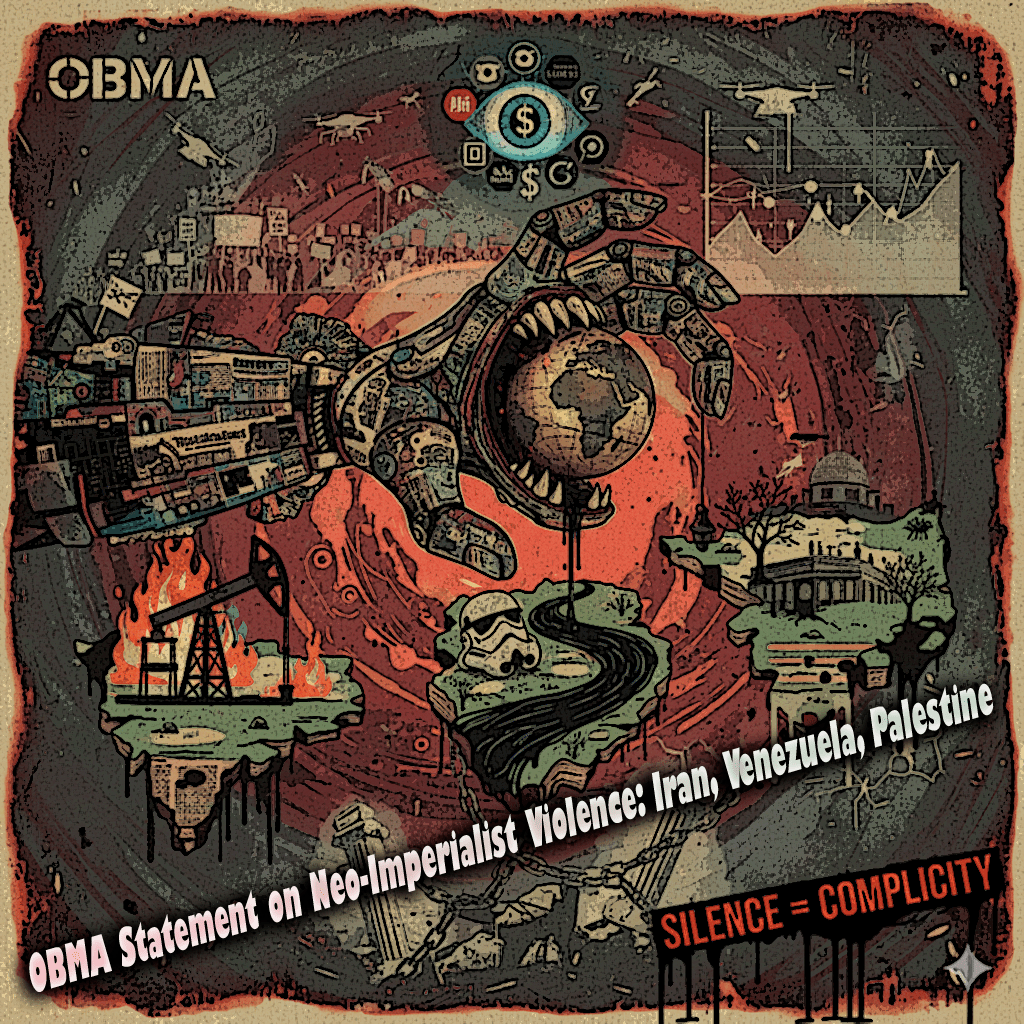
Simultaneously, on 3 January 2026, the Trump administration launched “Operation Absolute Resolve”—a unilateral military assault on Caracas that resulted in the capture of Venezuelan President Nicolás Maduro and Cilia Flores, and the killing of at least 80 people, including Venezuelan forces and Cuban guards. Under the cover of narcoterrorism charges and “restoring order,” the United States imposed a naval blockade, escalated sanctions, and announced plans to deploy private military contractors—including Blackwater—to secure oil infrastructure.
The objective is unmistakable: the Orinoco Belt, home to the world’s largest proven oil reserves—303 billion barrels. Trump’s declaration that the U.S. will “run” Venezuela until its oil infrastructure is rebuilt, with revenues channelled into U.S. Treasury accounts, lays bare this operation as neo-colonial expropriation. Executive orders have blocked Venezuelan immigration, targeted so-called “malign influences” such as China and Russia (to whom Venezuela owes $60–100 billion), and opened the door for U.S. corporations like ExxonMobil to resume extraction.
By mid-January 2026, U.S. forces had seized six Venezuelan oil tankers, generating $500 million, with plans for $2.8 billion more—funds framed as reconstruction aid but in practice offsetting U.S. military costs while sidelining $150–170 billion in creditor claims. This mirrors a long imperial pattern in Latin America, where democratic aspirations are repeatedly subordinated to the imperatives of extractive capitalism, now extending to the Arctic through the brazen Greenland Grab. Reviving Trump’s 2019 fixation—and escalating threats of force since early January 2026—the administration has pressured Denmark with economic ultimatums and discussed “a range of options” (including military) to seize control over the island’s vast rare-earth minerals, uranium, lithium, and strategic positioning amid accelerating ice melt and new shipping routes. While European NATO allies deploy small contingents for joint exercises to bolster Denmark’s defense and signal resistance, this neo-colonial push—framed as countering China/Russia—exposes the rapacious hunger for planetary dominance, commodifying sovereign territories in the “green” transition that greenwashes ecocide. This scramble for “critical minerals” fuels the very climate catastrophe it pretends to mitigate, displacing Inuit communities and hastening polar tipping points.
Compounding this, the deployment of U.S. stormtroopers—paramilitary shock troops drawn from special forces and private contractors like Blackwater, clad in tactical gear that evokes Nazi SS iconography and operating with unchecked brutality—has intensified in both Venezuela and Greenland. These units, resonant with historical fascist resonances in their hierarchical obedience, racialized targeting of Indigenous resistors (such as Inuit communities in Greenland and Warao in Venezuela), and use of advanced psyops to manufacture compliance, embody the fascist underbelly of U.S. imperialism, where state terrorism dons the mask of “order restoration” to crush dissent and secure extractive frontiers.
IV. Palestine: Settler Colonialism and Resource Geo-Politics
These violences are inseparable from settler colonialism in occupied Palestine, where Israel—armed, financed, and diplomatically shielded by the United States—continues to dispossess Palestinians under religious-nationalist pretexts that conceal material objectives: control of water aquifers, fertile land, and offshore gas reserves. As historian Rashid Khalidi has documented in The Hundred Years’ War on Palestine, this occupation spans over 108 years of systematic dispossession, from the Balfour Declaration in 1917 through waves of ethnic cleansing, land grabs, and apartheid policies that entrench imperial control.
By January 2026, settler violence in the West Bank had forcibly displaced Bedouin communities through coordinated attacks, while plans for 9,000 illegal settlement units at Atarot airport sought to sever East Jerusalem from the West Bank. In Gaza, an ongoing genocide—marked by 27 months of bombardment, scholasticide, and over 100,000 deaths—forms part of the same imperial continuum as Iran’s repression and Venezuela’s occupation.
Just as Venezuela’s Orinoco is plundered outright and Palestine’s resources securitized through settlerism, Greenland’s Arctic wealth is targeted to sustain the fossil-to-“green” mineral pipeline—ensuring endless extraction under the guise of energy security. These scenarios are holistically linked in the big picture of neo-imperialist capitalism: Iran’s energy reserves fuel proxy conflicts that intersect with Israel’s gas ambitions in the Levant Basin, while U.S. sanctions on Venezuela and Iran create economic vacuums that exacerbate Palestinian displacement through regional instability and arms flows. Together, they sustain a global fossil-fuel hegemony where state terrorism in Iran suppresses internal resistance to extraction, U.S. occupation in Venezuela plunders resources outright, and Israeli settlerism in Palestine secures strategic chokepoints—all reinforcing a planetary order of debt, dependency, and devastation that prioritizes profit over people and ecosystems.
V. Capital, State Power, and the War on Life
Together, these crises expose the state as capital’s enforcer—mobilising borders, sanctions, debt, and militarised violence to dispossess peoples of land, labour, and sovereignty. Imperialism, as the apex of capitalism, functions through dependency, indebtedness, and coercion. Venezuela’s oil-dependent economy, strangled by sanctions and now under foreign custodianship, exemplifies cannibalistic capitalism: a self-devouring system that commodifies everything it touches, dissolves social bonds, and accelerates ecological collapse in the pursuit of endless accumulation.
This is pre-debtor capitalism, where indebtedness becomes the condition for exploitation itself—binding nations to austerity, repression, and ecological sacrifice. Iran’s sanction-induced economic asphyxiation, marked by a 90% currency collapse since 2025, follows the same logic. Globally, neoliberalism’s familiar triad—deregulation, privatisation, and market absolutism—normalises enrichment of business moguls while deepening inequality, provoking uprisings that are then crushed in the name of “stability.”
VI. Genocide, Ecocide, and the Collapse of Species-Being
These processes threaten not only human survival but the species-being of humans and other-than-humans alike. In Iran, genocide unfolds through state-orchestrated massacres on streets and within prisons, transforming collective resistance into a struggle for sheer survival. In Venezuela, ecocide ravages the Orinoco Basin as intensified oil extraction contaminates rivers, destroys biodiversity, displaces Indigenous communities such as the Warao, and accelerates climate catastrophe—particularly egregious amid global warming thresholds already being breached. In Palestine, this ecocide-genocide nexus is evident in the poisoning of water sources and destruction of olive groves, linking resource wars across these regions in a holistic assault on life itself.
Religion and ideology function as masks, obscuring fossil-fuel geopolitics and extractive ambitions that sustain endless proxy wars and planetary destruction.
VII. Our Position
OBMA unequivocally condemns these crimes. We reject U.S. neo-imperialism, theocratic authoritarianism, and settler colonialism in all their forms. We stand in solidarity with Iranian revolutionaries confronting bullets with courage, Venezuelan communities resisting occupation, Palestinian resisters enduring apartheid and genocide, and all Indigenous, labour, and ecological defenders across the world.
True liberation will not emerge from top-down negotiations or quick fixes. It demands the abolition of systems built on extraction, hierarchy, and domination, through collective struggle, non-hierarchical organisation, critical education, and transdisciplinary alliances. We affirm planetary justice over plunder, mutual aid over militarism, and life over capital-relations.
In defiance and in hope,
Once in a Blue Moon Academia (OBMA)
SEE ALSO:
Stand against Trump: No more wars for oil VIEW HERE ⤡ (Greenpeace)
 Once in a Blue Moon Academia