
Posted on 9th January, 2026 (GMT 03:55 hrs)
ABSTRACT
This open letter to Ajay Piramal interrogates the moral dissonance between Piramal Finance’s “Neeyat” advertising campaign, which celebrates honesty through the return of a single rupee, and the lived reality of DHFL depositors whose life savings were erased through a deeply contested insolvency process. By juxtaposing corporate virtue-signalling with the transfer of nearly ₹45,000 crore of DHFL assets for ₹1, the text argues that legality has been deployed to eclipse legitimacy, and branding to obscure accountability. Situating the DHFL resolution within a wider system of crony capitalism, opaque political financing, captured institutions, and manufactured consent, the letter frames the episode as part of a broader legitimation crisis in BJP-ruled India, where ethics are subordinated to power and proximity. At its core, the piece demands that “conscious capitalism” be measured not by advertisements or philanthropy, but by what is returned to those who trusted, funded, and were dispossessed.
“Complain again and again, complain till you are heard. Aye! and until you are answered!”
— Henry Louis Vivian Derozio (1809-1831), one of the pioneers of the great Bengal Renaissance
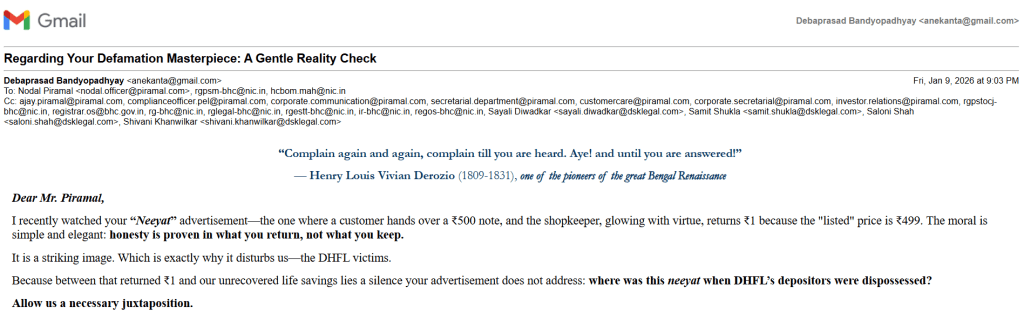
Dear Mr. Piramal,
I recently watched your “Neeyat” advertisement—the one where a customer hands over a ₹500 note, and the shopkeeper, glowing with virtue, returns ₹1 because the “listed” price is ₹499. The moral is simple and elegant: honesty is proven in what you return, not what you keep.
It is a striking image. Which is exactly why it disturbs us—the DHFL victims.
Because between that returned ₹1 and our unrecovered life savings lies a silence your advertisement does not address: where was this neeyat when DHFL’s depositors were dispossessed?
Allow us a necessary juxtaposition.
In your campaign, Piramal Finance performs a morality play—exact change returned, conscience clean.
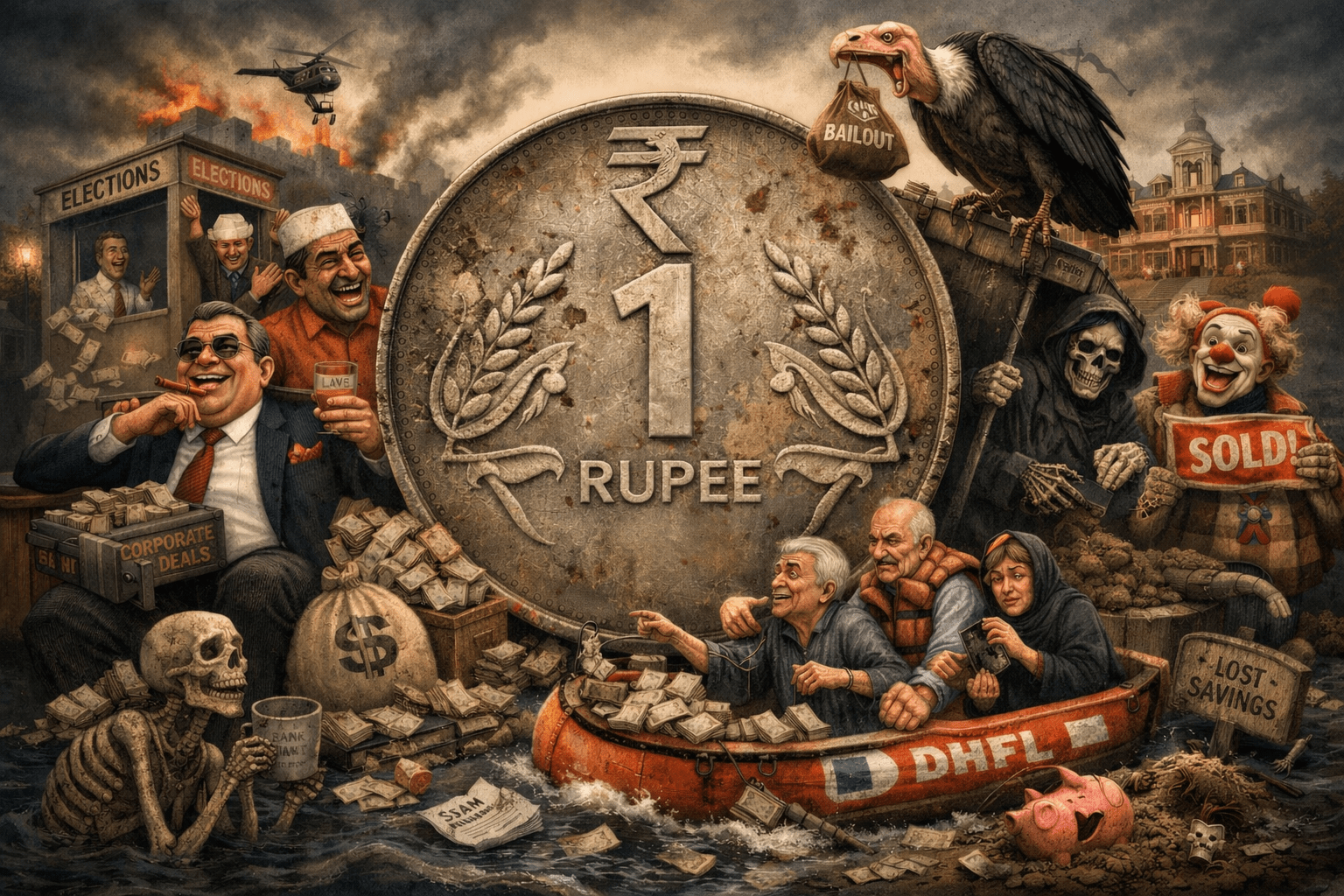
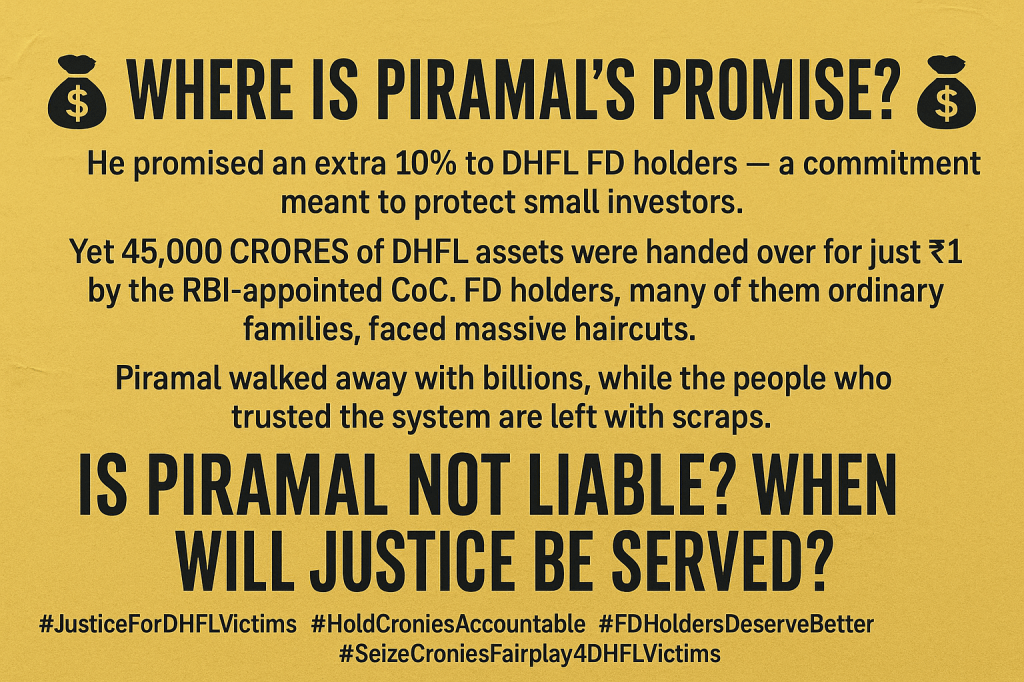
In reality, nearly ₹45,000 crore worth of DHFL assets in the form of avoidance transactions were transferred for ₹1 through a resolution process (which, notably, was full of irregularities and illegalities as noted by the Hon’ble NCLAT’s order dated 27-01-2022) that lakhs of small investors experienced not as “revival,” but as financial erasure. How could this ever be achieved, Mr. Piramal? In a wounded India saturated with corporate political financing—through electoral bonds, opaque vehicles such as PM CARES, and controversial transaction networks that have repeatedly surfaced in the public domain, including those involving Flashnet and “known” political figures—how did your corporate past become so effortlessly weightless? When these relationships and flows are a matter of public record and investigative reporting, how was your own history so cleanly “written off,” even as the loans of super-rich wilful defaulters and the losses of ordinary depositors remain permanently inscribed? These are not private allegations but questions grounded in material available across public filings, investigative reports, and open databases, and raising them is not defamation—it is democratic accountability.
We are repeatedly told this was lawful, court-approved, and procedurally sound. Perhaps it was.
But apparent lawfulness is not the same as ethical legitimacy. Compliance is not the same as conscience.
Your group acquired DHFL through a suspiciously conducted (as has been widely reported) insolvency process and later reverse-merged Piramal Capital & Housing Finance into Piramal Enterprises, re-emerging as Piramal Finance—without an IPO, though now it enjoys an AA+ credit rating (many seem to know how these ratings are projected to manufacture consent⤡). To those who lost their savings, this did not look like innovation. It looked like corporate reincarnation without karmic memory—assets reborn, liabilities conveniently forgotten, victims left holding silence.

In your advertisement, the shopkeeper does not say: “The system allowed me to keep your ₹1, so I did.”
He returns it—because, as you insist, neeyat matters.
So we ask—plainly, directly, and without theatrics:
- When lakhs of retirees, widows, and middle-class families absorbed 60–80% haircuts on their fixed deposits, was that also a matter of neeyat?
- When DHFL’s asset base—once estimated at around ₹90,000 crore—was fragmented, written down, and transferred at a fraction of its value, was the moral ledger ever examined? Mr. Piramal, you acquired a ready-made, operating financial infrastructure not through the slow labour of institution-building but through an insolvency process whose outcomes have been widely questioned—and whose proximity to political power has been the subject of persistent public allegation.
- When branding or philanthropy narratives flourished after losses were socialized, who exactly received the returned change?
Your philanthropic (or philanthro-capitalist?) initiatives speak frequently of “conscious capitalism.”
Yet to those of us who lost decades of savings, this consciousness feels strangely selective—meticulously visible in advertisements, conspicuously absent in outcomes. This, in turn, points to a deeper legitimation crisis in BJP-ruled India—one in which the accountability, integrity, and credibility of core institutions and dominant economic-political actors are increasingly obscured, managed through narrative, and insulated from meaningful scrutiny.
Let us be clear:
Many might not deny that the ill-conceived and internally incoherent Insolvency Code, i.e., IBC, allows such “resolutions”. One might also draw a disturbing parallel between the functioning of the RBI-appointed Committee of Creditors in the DHFL resolution and the Election Commission under the BJP rule⤡: in both cases, institutions formally entrusted with neutrality have been widely accused of procedural manipulation, selective rule-application, and outcome-engineering (through evident vote chori, yes), serving not democratic or fiduciary integrity but the deeper logics of crony power and political capture.
In this context, we categorically deny that ethics end where statutes begin.
The ₹1 in your advertisement is symbolic.
So is the ₹1 paid for assets built partly on public trust and household savings.
One rupee returned signals integrity.
One rupee paid signals something else entirely.
So, Mr. Piramal, we ask you—not as litigants, not as activists, but as citizens:
Where is your neeyat toward those who funded, trusted, and lost?
Is philanthropy meant to cleanse balance sheets—or consciences?
And can a capitalism that brands itself “conscious” remain so while its victims are expected to quietly forget?
We do not ask for slogans.
We ask for acknowledgement.
We do not ask for advertisements.
We ask for accountability.
Until then, every returned ₹1 in your campaigns will continue to echo—with uncomfortable clarity—against the crores that were never returned to us.
Hypothetically yours—again, and again, and again,
लड़ेंगे या मरेंगे!
इंक़लाब ज़िंदाबाद!
No Pasaran!
Debeprasad (sic) Sadhan (patriarchal insertion?!) Bandopadhyay (sic)
(One among many who noticed the missing change.)
See also:
COPY TO:
1. Shri A.H. Laddhad, The Hon’ble Prothonotary and Senior Master, Bombay High Court (Case No. S/42/2025)
References (for context):
- Piramal’s “Neeyat” campaign: https://www.piramalfinance.com/neeyat
- Advertisement clip referenced: https://youtube.com/shorts/sn2IG9ht0GU?si=VOAmF8TXDGd5205f
 Once in a Blue Moon Academia
3 Comments