
Posted on 6th January, 2026 (GMT 01:36 hrs)
Authored by DHFL Victim⤡
ABSTRACT
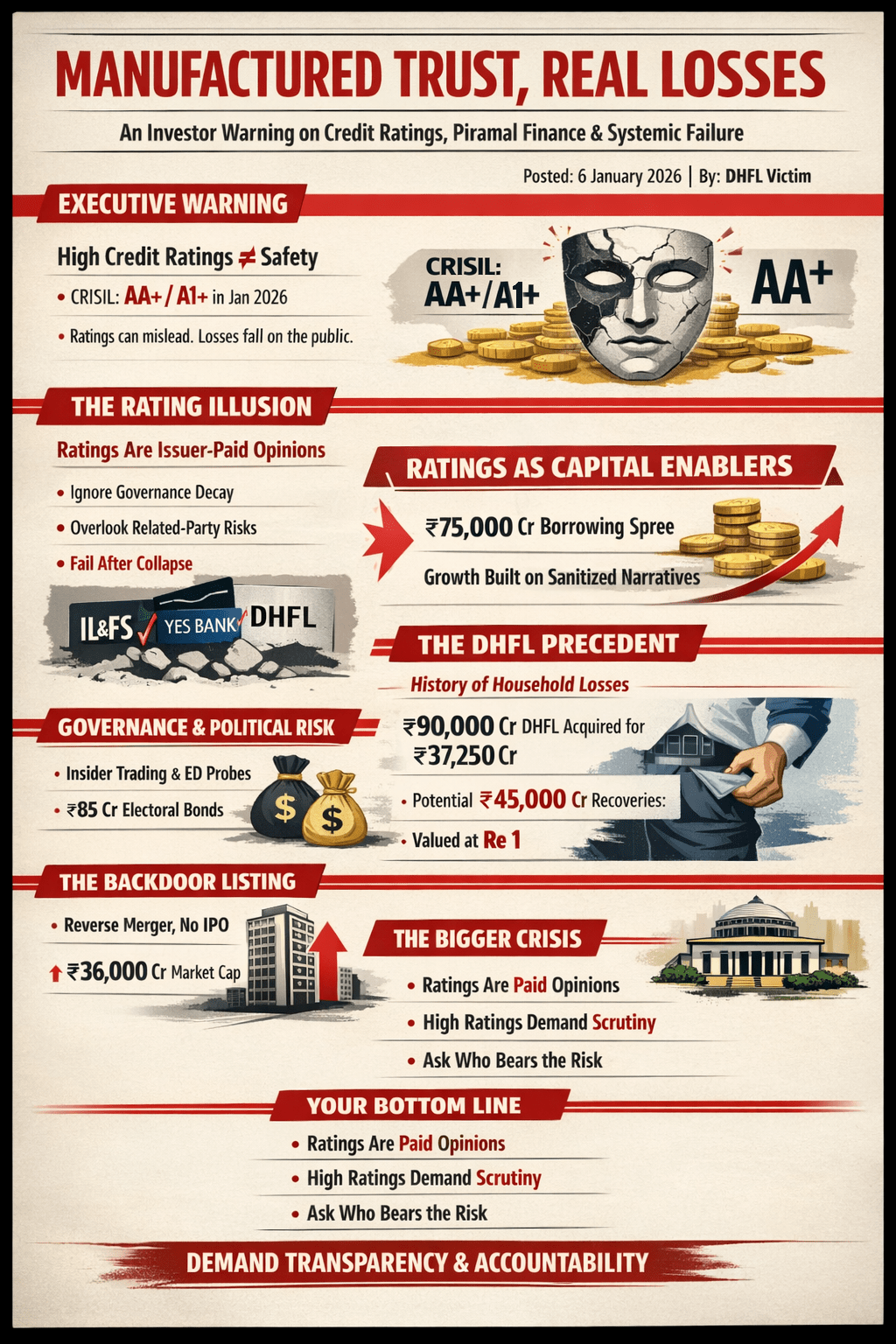
Despite glowing CRISIL AA+/Stable ratings, Piramal Finance’s strength is an illusion built on conflicted issuer-paid ratings, legacy DHFL fraud asymmetries (₹45,000 Cr recoveries valued at Re 1, massive retail haircuts), governance controversies, political proximity, and a backdoor listing that bypassed scrutiny. High ratings enable cheap funding and retail mobilisation—while systematically ignoring forensic risks, related-party issues, and resolution inequities seen in IL&FS, Yes Bank, DHFL. This is systemic: manufactured trust, socialised losses, privatised gains. Ratings are opinions, not guarantees. Demand truth before investing.
A Call to Investors, Depositors, and Market Participants
Executive Warning – Piramal Finance:
High Ratings ≠ Safety
Investor Alert – January 2026
Piramal Finance currently enjoys CRISIL AA+/Stable (long-term) & A1+ (short-term) ratings — widely seen as a sign of strength. Yet this polished narrative hides a troubling reality: manufactured trust, socialised losses, privatised gains.
Core Message in 12 Key Points
- Ratings are not independent Issuer-pays model + oligopoly (CRISIL, ICRA, CARE) creates inherent conflict of interest.
- Ratings heavily rely on Management narrative, issuer disclosures, short-term metrics → while systematically under-weighting governance issues, related-party exposure, forensic red flags, political proximity & retail vulnerability.
- Piramal Finance ratings ignore
- Legacy DHFL asset quality concerns
- Large wholesale/structured credit exposures
- Persistent governance & recovery opacity
- History repeats pattern IL&FS, Yes Bank, DHFL — all retained investment-grade ratings almost until collapse → massive public losses.
- High ratings = powerful enabler → lower borrowing costs (50–80 bps advantage) → rapid debt growth (~₹75,000 Cr borrowings) → aggressive retail deposit mobilisation → wider participation by mutual funds, insurers & retail investors
- DHFL acquisition – the original sin
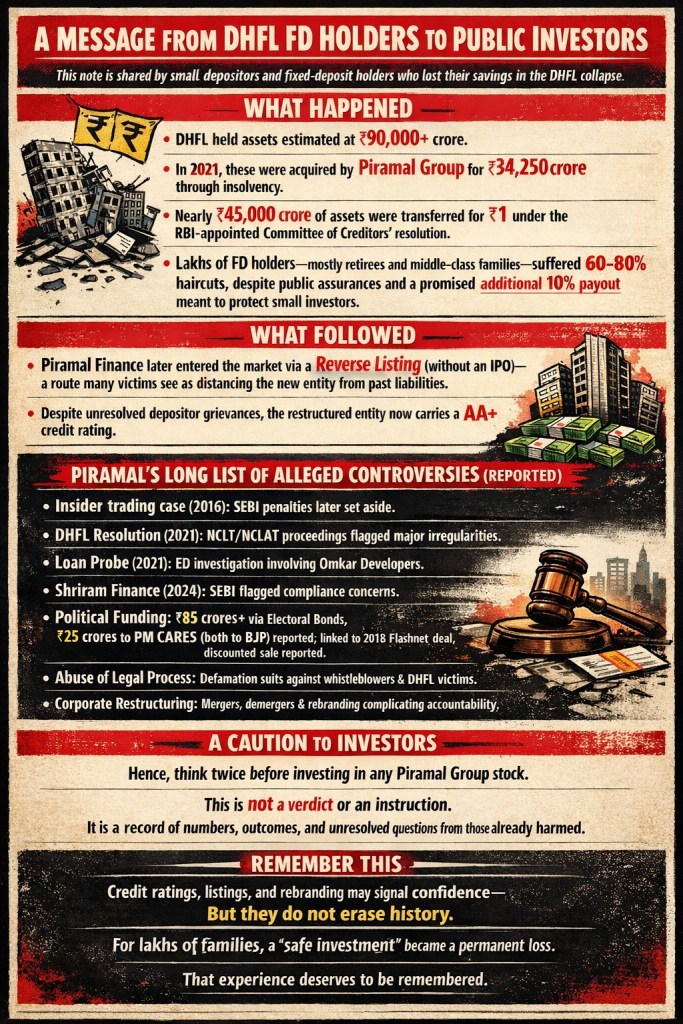
- Acquired ₹90,000+ Cr loan book for ₹37,250 Cr
- Alleged ₹45,000 Cr fraud recoveries valued at Re 1
- Supreme Court upheld resolution plan despite serious NCLAT criticism, allegedly due to Piramal’s crony proximity to the BJP
- ~2.5 lakh retail FD holders (mostly senior citizens) suffered 55–77% haircuts
- Massive asymmetric risk transfer Losses → households & retail depositors Upside & future recoveries → Piramal Group
- Wider governance & controversy red flags (routinely ignored by agencies)
- Multiple SEBI insider trading actions & settlements
- NGT pollution notices
- ED probe (₹2,000 Cr Omkar loan)
- Alleged one-sided real-estate contracts
- Frequent mergers/demergers criticised for liability obfuscation
- Very high political proximity (electoral bonds ~₹85 Cr+ to the BJP, ₹25 Cr opaque PM CARES donations, highly controversial Flashnet deal linked to BJP Minister Piyush Goyal family, also secondary kin of Mukesh Ambani, BJP’s favoured corporate magnate)
- Backdoor listing (Nov 2025) Reverse merger of Piramal Enterprises into Piramal Finance → avoided rigorous IPO scrutiny & fresh disclosures → absorbed contested DHFL legacy into listed entity while disowning past liabilities through shrewd rebranding→ quickly achieved ₹36,000+ Cr market cap on momentum
- What ratings structurally miss Related-party evergreening • fraud/forensic risk • political/regulatory proximity • cyclical wholesale credit risk • severe retail depositor impact in resolution
- Risk exposure by investor type
- Shareholders → provisioning, regulatory & reputational shocks ahead
- Bondholders/institutions → principal not assured in downturns
- Fixed deposit holders → high-yield trap; history shows depositors bear maximum loss
- Mutual fund investors → hidden contagion risk through debt & structured products
- Systemic failure, not one-off case When rating agencies defer to issuers, regulators prioritise continuity, and markets treat ratings as truth → trust becomes a commercial product, losses get socialised, gains privatised.
Bottom Line & Call to Action
Ratings are a paid opinion — not a safety guarantee.
Before investing in Piramal Finance instruments, you must:
- Study the DHFL resolution & retail haircuts
- Examine the full governance controversy list
- Review independent forensic & investigative reports
- Question whether real risks are actually priced in
- Ask: whose interests do these ratings really serve?
Demand now:
- Full transparency on legacy assets, fraud recoveries & stress tests
- Real reform of credit rating industry (end issuer-pays, mandate forensic audits)
- Much higher regulatory scepticism towards legacy-heavy NBFCs
Your money deserves truth — not engineered confidence.
Scepticism in such an environment is not cynicism. It is investor responsibility.
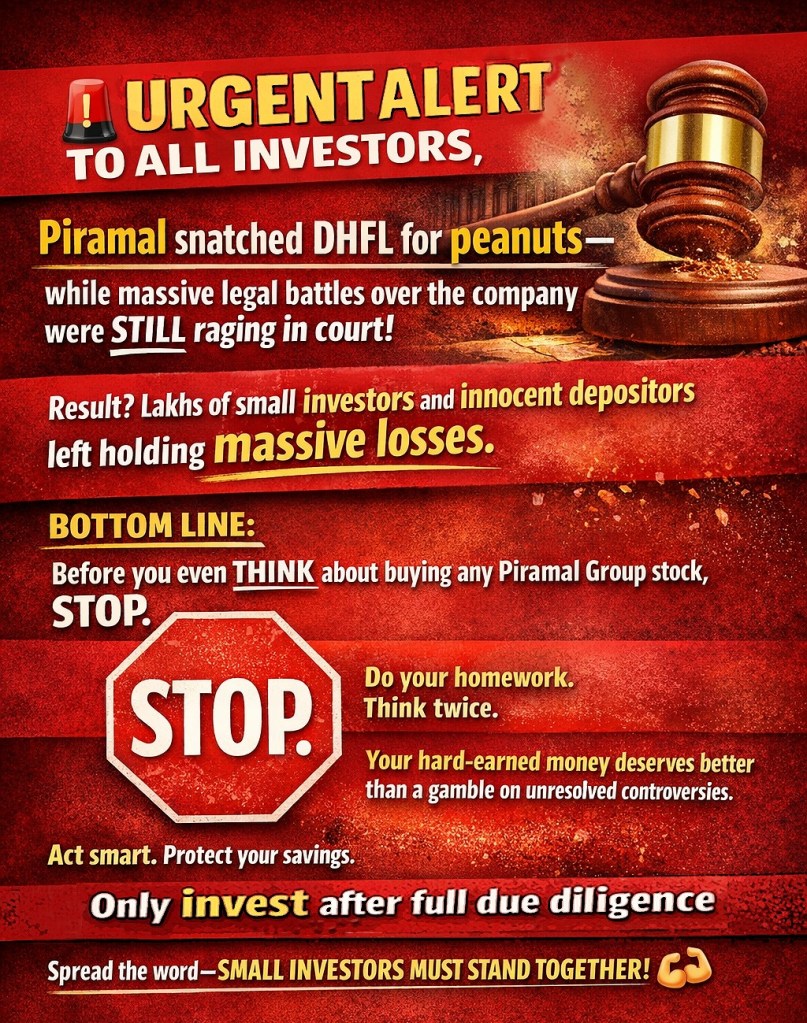
Spread awareness. Protect your savings. Demand better before the next DHFL happens.
Public Interest Directive to Investors and Market Participants
This document is not meant to be read in silence.
If you are a shareholder, bondholder, fixed-deposit holder, mutual fund investor, pensioner, or concerned citizen, you are urged to circulate, archive, and amplify this analysis across the fifth pillar of contemporary democracy: digital media.
In a system where institutional gatekeepers have failed, public memory and digital dissemination are acts of market self-defence. Transparency today does not emerge from regulators alone; it survives through collective vigilance, networked scrutiny, and refusal to forget.
Read. Verify. Share. Question. Preserve.
Do not allow manufactured trust to outpace public truth.
SEE MORE:
 Once in a Blue Moon Academia
4 Comments