
Posted on 31st December, 2025 (GMT 02:37 hrs)
Executive Abstract: The Accountability Deficit—India’s Governance Under Audit (2014–2025)
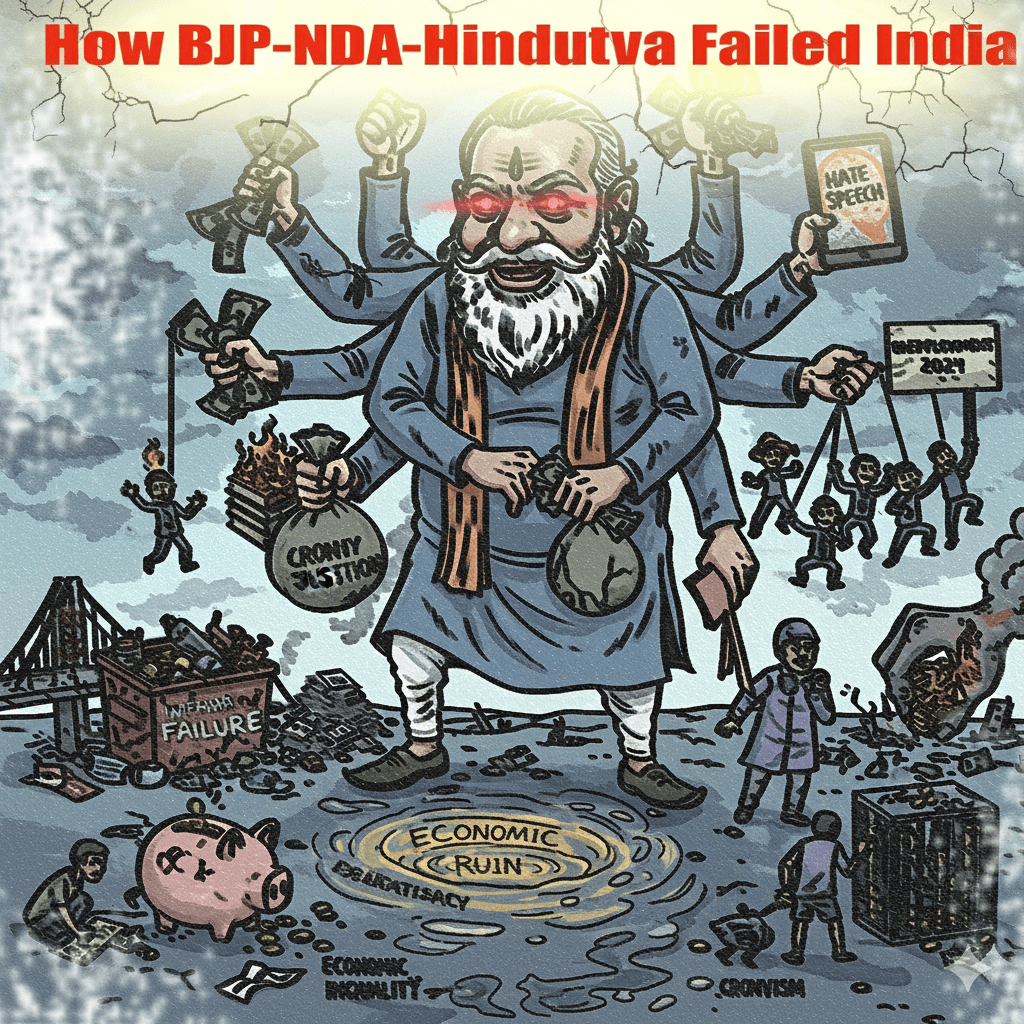
As 2025 draws to a close, this comprehensive dossier documents not a series of discrete policy missteps, but a systemic transformation of governance in India (2014–2025): a shift from democratic accountability to political executive dominance; from evidence-based policymaking to manufactured narrative control; from social protection to structural precarity. Spanning the economy, federalism, data integrity, labour, the natural environment, digital freedoms, education, public health, cultural institutions, civil liberties, and fundamental rights, the record reveals enduring patterns of power centralization, calibrated opacity, selective enforcement, and institutional hollowing—accompanied by crony consolidation and the routinized criminalization of dissent. Democratic indicators decline as surveillance infrastructures expand, grassroots welfare erodes, and truth itself is rendered an object of administrative management. This is not a partisan ledger, but a counter-archive: an evidence-grounded indictment that affirms accountability as the necessary cost of power. In closing the year, it calls for a civic reckoning—not to foreclose debate, but to reclaim and restore it.
I. Reading a Decade: Sources, Limits, and Accountability
As 2025 draws to a close, the Once in a Blue Moon Academia (OBMA) platform undertakes a retrospective examination of governance under the Bharatiya Janata Party (BJP)–led National Democratic Alliance (NDA) from 2014 onward. This expanded analysis synthesizes a wide corpus of publicly available material—investigative journalism, peer-reviewed academic research, parliamentary records, audit reports, human rights documentation, court proceedings, and official statistics—to trace reported systemic failures, policy shortcomings, structural challenges, controversies, and sustained waves of protest or arts of resistance. While the government has consistently highlighted achievements in infrastructure expansion, digital payments, and select renewable energy initiatives, a broad spectrum of critics—including opposition parties, civil society organizations, economists, public-health experts, jurists, and international watchdogs such as Human Rights Watch and Amnesty International—have persistently identified deep well-substantiated deficiencies in economic equity, social justice, institutional autonomy, public health preparedness, environmental protection, media freedom, and foreign-policy credibility. The sections that follow provide a factual, evidence-anchored, and analytically grounded overview rather than an episodic catalogue of events. They integrate additional domains—including pandemic response, unemployment and labour precarity, media suppression, human-rights violations, environmental degradation, education and knowledge governance, public health, and foreign policy—drawing exclusively on documented critiques and verifiable sources. The purpose is not to impose a singular conclusion, but to enable informed, evidence-based public discourse on the cumulative and structural impacts of governance across a full decade.
This document does not claim exhaustiveness, neutrality, or false symmetry. Instead, it explicitly acknowledges asymmetries of power and responsibility intrinsic to constitutional governance. By foregrounding patterns of harm, concentration of authority, and accountability failure, it treats state power as structurally answerable to higher standards of transparency, legality, and democratic restraint. In doing so, it positions itself as a counter-archival record—one that insists that critique is not opposition to democracy, but a condition of its survival.
II. Economic Precarities and Crises
Demonetization (2016): The abrupt invalidation of high-denomination currency notes was officially justified as a decisive strike against black money, terror financing, and counterfeit currency. Subsequent evidence, however, has widely characterized the move as a monumental policy blunder that inflicted severe economic disruption without achieving its stated objectives. Reserve Bank of India disclosures later confirmed that nearly all demonetized currency—approximately 99.3%—returned to the banking system, undermining claims of unearthing illicit wealth. The policy precipitated acute hardship, including over 100 reported deaths linked to cash shortages, large-scale dislocation in the informal economy with estimated job losses of 1.5–3 million, and a GDP contraction of roughly 1–2% in subsequent quarters. Critics argue that demonetization exemplified opaque and hasty executive decision-making, disproportionately burdening the poor, informal workers, farmers, and small enterprises. The moral rhetoric of combating terror finance was further complicated by subsequent investigative disclosures and allegations in major financial fraud cases—most notably the DHFL scam—where filings and media reports pointed to political donation flows to the BJP itself allegedly linked to networks associated with Dawood Ibrahim and Iqbal Mirchi, amounting to ₹27.5 crore or more, raising troubling questions about selective enforcement and the instrumentalization of anti-terror narratives. Taken together, demonetization is increasingly viewed as a policy that delivered political optics of anti-corruption and national security while leaving enduring economic scars and unresolved contradictions at the heart of India’s financial governance.
Goods and Services Tax (GST, 2017): Hailed as a landmark tax reform for unifying India’s fragmented system, GST’s implementation has been lambasted for its arbitrary complexity, frequent amendments (over 1,000 changes by 2025), and regressive impact on low-income groups through high rates on essentials. It led to compliance nightmares for micro, small, and medium enterprises (MSMEs), widespread fraud in input tax credits (estimated at Rs 1 lakh crore annually), and revenue shortfalls that strained state finances. Analytical reports note it exacerbated inequality by favouring organized sectors and large corporations, contributing to business closures and informal economy shrinkage, with critics viewing it as evidence of poor planning and inadequate stakeholder consultation.
Insolvency and Bankruptcy Code (IBC, 2016): Conceived as a time-bound framework to resolve corporate distress and strengthen creditor discipline, the IBC has reconfigured India’s insolvency regime but with deeply problematic outcomes. While it has formally improved creditor priority, its operational record is marked by persistently low recovery rates (averaging 32–40%), systematic delays that routinely breach the statutory 330-day ceiling, and a structural bias toward liquidation rather than revival, leading to asset erosion, employment loss, and long-term economic damage. These outcomes are not accidental but flow from an increasingly over-amended, internally incoherent framework, shaped by regulatory fragmentation, judicial backlogs, and policy improvisation. At the core of the IBC’s distortion lies the “haircut” mechanism, which has evolved into one of the most consequential loopholes in India’s financial architecture. Under the Code, resolution applicants are not required to repay the full value of outstanding dues. Instead, they negotiate settlements at steep discounts, compelling banks—predominantly public sector institutions—to absorb substantial losses in the name of balance-sheet repair. This technical language conceals a substantive reality: private defaults are legally converted into public losses. When banks recover only a small fraction of the amount owed, the unrecovered balance is written off as a haircut—an accounting construct that ultimately transfers the burden to the public through weakened banks, recapitalization demands, and foregone developmental credit. Over time, this has normalized a system in which large corporate defaulters exit insolvency by paying only a fraction of their obligations, while new buyers acquire assets at depressed valuations, insulated from historical liabilities. In effect, the IBC has increasingly functioned less as a resolution mechanism and more as a state-sanctioned redistribution device, enabling profit-mongering through distressed asset acquisition while socializing loss across the public banking system. The cumulative result is a moral hazard regime: default is de-risked for the powerful, accountability is diluted, and systemic fragility is entrenched, with the Indian public bearing the ultimate cost of corporate failure under the formal legality of insolvency resolution.
Public Sector Banks (PSBs), NPAs, Write Offs and Financial Frauds: Non-performing assets (NPAs) in India’s banking system rose sharply from approximately ₹2.3 lakh crore in 2014 to over ₹10 lakh crore by 2018, constituting one of the most severe banking crises since nationalisation. RBI data shows that public sector banks accounted for nearly 85% of stressed assets at the peak, highlighting the concentration of risk within publicly owned institutions. Between 2014 and 2024, Indian banks—primarily PSBs—wrote off more than ₹12 lakh crore in bad loans, with over ₹10 lakh crore written off after 2017, officially framed as balance-sheet cleanup but marked by poor recoveries. The write-off mechanism reveals the real burden. When a loan turns non-performing and recovery fails, it is removed from the bank’s books. Although the government maintains in Parliament that write-offs do not waive borrower liability, RBI figures show that only about 13% of written-off amounts have been recovered over the past decade. In effect, write-offs function as permanent loss absorption by public banks, weakening credit capacity and driving repeated taxpayer-funded recapitalisation. Parliamentary replies further indicate that wilful defaulters owed over ₹2.5 lakh crore by 2023, with both the number and value of such defaults nearly doubling over the decade, while enforcement and recoveries lagged sharply. The top 12 corporate defaulters alone accounted for stressed assets exceeding ₹3.4 lakh crore, underscoring extreme concentration among large borrowers rather than systemic retail failure. The government’s response—forced PSB mergers, aggressive write-offs, and recapitalisation—has drawn sustained criticism. Between 2017 and 2023, approximately ₹3.2 lakh crore in public funds was injected into PSBs to offset losses from NPAs and haircuts, effectively socialising private credit risk. Critics argue mergers often transferred toxic assets to healthier banks, weakened regional banking, and constrained credit to MSMEs and agriculture. Repeated RBI and CAG observations have flagged failures in credit appraisal, post-sanction monitoring, and accountability, while convictions and recoveries have remained disproportionately low. Taken together, these trends reveal a systemic failure of banking governance: large borrowers default with relative impunity, losses are absorbed by public banks, and the costs are borne by taxpayers and depositors—eroding trust and subordinating prudential discipline to the protection of concentrated capital.
DHFL Bankruptcy Scandal (2019-ongoing): The collapse of Dewan Housing Finance Corporation Limited (DHFL) exposed one of the gravest failures in India’s non-banking financial sector, involving alleged fraud estimated at ₹34,000 crore+ through systematic fund diversion to shell entities and related parties. Investigative findings and court records pointed to prolonged regulatory blind spots, weak supervisory action, and delayed intervention by both the RBI and the central government, despite multiple warning signals, credit rating downgrades, and whistleblower disclosures. The 2021 insolvency resolution, which awarded (more or less gifted) DHFL to the politically favoured, BJP-aligned Piramal Group, resulted in recoveries of only around 45% for financial creditors, translating into massive haircuts borne largely by DHFL FD and NCD Holders. Critics argue that the resolution process prioritized speed and asset transfer over forensic accountability, with limited progress on criminal investigations, asset tracing, or proportional recovery from those responsible for the alleged diversion. Beyond the immediate case, DHFL became a systemic stress test for India’s NBFC framework, revealing structural weaknesses in governance, regulatory coordination, and risk oversight across shadow banking institutions. The episode highlighted how large-scale financial misconduct could persist under regulatory forbearance, be resolved through discounted asset acquisition, and ultimately have losses socialised through the public financial system. As such, the DHFL collapse stands not as an aberration but as a symptom of deeper financial-sector mismanagement, where enforcement lags, accountability dissipates, and the costs of failure are transferred from corporate actors to the public at large.
This pattern has intensified under the BJP regime since 2014, with a surge in similar high-profile bankruptcy cases marked by fraud, regulatory lapses, massive haircuts, and alleged favoritism, including: IL&FS Crisis (2018), involving over ₹90,000 crore in defaults through opaque lending and fund diversion, resolved with government intervention and public bailouts absorbing losses while insiders escaped accountability; Yes Bank Collapse (2020), triggered by ₹22,000 crore+ in bad loans and fraud allegations, leading to a RBI-imposed moratorium and reconstruction via SBI-led infusion of public funds, with minimal recoveries and depositors’ hardships; Videocon Industries Insolvency (2019-2021), featuring ₹64,000 crore debts settled at a 96% haircut, acquired by Vedanta’s affiliate amid cronyism accusations favoring politically connected entities; and SREI Group Bankruptcy (2021-ongoing), an NBFC duo with ₹32,000 crore defaults due to alleged mismanagement, undergoing IBC resolution with low recoveries and persistent enforcement delays, further exposing systemic vulnerabilities in shadow banking.
Electoral Bonds (2018-2024): Ruled unconstitutional by the Supreme Court in 2024 for violating citizens’ right to information and the principle of electoral transparency, the Electoral Bonds scheme institutionalised anonymity in political financing on an unprecedented scale. Between 2018 and 2024, bonds worth approximately ₹16,000 crore were issued, with the Bharatiya Janata Party receiving an estimated 55–60% of the total value, according to disclosures released following the Court’s judgment. Subsequent analysis of donation patterns revealed systemic quid pro quo risks: corporations facing regulatory scrutiny, tax investigations, or policy approvals frequently emerged as major donors shortly before enforcement actions were diluted, delayed, or dropped. By routing political funding through opaque banking instruments shielded from public and parliamentary scrutiny, the scheme effectively converted state power into a fundraising advantage, eroding the level playing field essential to electoral democracy. Critics argue that the design of the scheme—backed by amendments to the Companies Act, RBI Act, and Income Tax Act—weakened institutional checks, sidelined the Election Commission’s objections, and normalised policy capture through financial opacity. Rather than curbing black money, Electoral Bonds entrenched institutionalised corruption, undermined voter sovereignty, and hollowed out democratic accountability by severing the link between political finance, public disclosure, and informed consent of the electorate.
Unemployment and Job Crisis: Despite promises of 2 crore jobs annually, unemployment rates hovered at 6-8% (peaking at 45% during COVID lockdowns), with youth unemployment reaching 23% in 2024-25. Critics point to skill mismatches, stagnant manufacturing growth, and schemes like Agnipath (short-term military recruitment) that offered temporary roles without long-term security, exacerbating social unrest and inequality, as per PLFS data showing 28 million chronically unemployed by 2017-18.
Income and Wealth Inequality: Recent disclosures from the World Inequality Report 2026 underscore India’s position as one of the most unequal societies globally, with the top 10% capturing approximately 58% of national income—higher than levels observed during the British colonial era—while the bottom 50% receive only 15%. Wealth concentration is even more pronounced: the top 1% hold about 40% of total wealth, and the top 10% control around 65%, reflecting a persistent structural divide where economic growth disproportionately benefits elites. This extreme disparity, exacerbated by low progressive taxation, crony connections, and policy frameworks that enable asset concentration among the affluent, has widened since the early 2000s, hollowing out the middle class (whose income share lags behind more equitable economies) and entrenching intergenerational inequality. Critics highlight how such trends—coupled with gender gaps where women earn far less labor income and caste-based exclusions—amplify social fractures, undermine inclusive development, and perpetuate a system where the costs of economic crises are borne by the poor while gains accrue to the powerful, marking a profound failure to translate rapid GDP expansion into broad-based prosperity. This proves that GDP fetishism is faulty in itself.
Rupee Depreciation and All-Time Low (2025–2026): The Indian rupee plunged to a historic low of over ₹91 per US dollar in late 2025, marking its steepest annual decline in three years with a roughly 5–6% drop from levels around ₹85 at the start of the year, before a partial recovery to around ₹89–90 entering 2026 amid RBI interventions. This sustained weakness stemmed primarily from record foreign portfolio investor outflows exceeding $18 billion from Indian equities, subdued inflows in debt and FDI, a widening current account deficit projected to exceed 2% in 2026, and prolonged uncertainty over a US-India trade deal amid steep US tariffs impacting exports. The Reserve Bank of India adopted a more tolerant stance toward depreciation under new leadership, intervening selectively to curb speculation rather than rigidly defending levels, allowing the real effective exchange rate to fall into undervalued territory—potentially aiding exporters but amplifying imported inflation pressures on fuel, electronics, and commodities. Critics contend this episode exemplifies broader macroeconomic vulnerabilities: despite robust GDP growth claims, persistent capital flight, trade disruptions, and policy delays have eroded currency stability, inflated import costs burdening consumers and industries, constrained monetary policy flexibility, and heightened risks of further volatility into 2026 without swift trade resolutions or inflow reversals. Ultimately, the rupee’s plunge has transferred economic adjustment costs disproportionately to households and import-dependent sectors, while underscoring unresolved structural imbalances in external finances and global integration under prevailing governance frameworks.
Rafale Deal Corruption Allegations (2016-Ongoing): The ₹59,000 crore purchase of 36 Rafale jets faced persistent accusations of cronyism, with offsets favoring Anil Ambani’s inexperienced Reliance Defence over HAL, inflated pricing, and removal of anti-corruption clauses. French probes into alleged kickbacks and favouritism continued into 2025, with critics decrying opaque dealings and non-cooperation from Indian authorities, symbolizing defense sector graft benefiting allies.
III. Unfulfilled Promises and Political Jumlas
Rs 15 Lakh in Every Indian’s Bank Account (2014 Campaign Promise): Modi infamously pledged to recover black money stashed abroad and deposit Rs 15 lakh per citizen, framing it as a windfall from anti-corruption efforts. This turned out to be a blatant jumla, with no such deposits made; instead, demonetization (2016) failed to unearth significant black money, and the government later dismissed it as mere “election rhetoric.” Critics label it as deliberate deception to woo voters, resulting in zero recovery of the promised Rs 80 lakh crore.
2 Crore Jobs Per Year (2014 Manifesto): The BJP vowed to create 20 million jobs annually to tackle unemployment, positioning itself as a pro-youth government. In reality, unemployment hit a 45-year high by 2019 (per NSSO data), with net job losses estimated at 4.7 crore in key sectors like manufacturing and agriculture. This promise exemplifies Modi’s feku narrative, as schemes like Skill India fell 64% short of targets, leaving youth disillusioned and fueling protests.
Doubling Farmers’ Income by 2022 (2016 Announcement, Reiterated in 2019 Manifesto): Modi promised to double agricultural incomes through modernization and MSP reforms, but by 2022, real incomes stagnated or declined amid rising input costs and debt. Reports show only a marginal increase (far short of doubling), with over 10,000 farmer suicides annually and repealed farm laws exposing corporate favoritism. This jumla betrayed rural India, leading to massive protests and highlighting BJP’s anti-farmer bias.
Acche Din Aayenge (Good Days Will Come, 2014 Slogan): The iconic campaign catchphrase promised prosperity, reduced inflation, and better living standards. Instead, inflation persisted (food prices up 50-100% in key items), inequality widened (top 1% holding 40% wealth), and economic growth slowed post-demonetization and COVID. Critics call it the ultimate feku, as “acche din” became a meme for unfulfilled hype amid rising poverty and joblessness.
Bring Back Black Money in 100 Days (2014 Promise): The BJP committed to repatriating illicit funds stashed abroad via a task force and international agreements. Five years later, the task force report remained unreleased, and only minimal recoveries occurred (far below Rs 80 lakh crore estimate). This promise was dismissed as a “jumla” by BJP leaders themselves, underscoring institutional hypocrisy and failure to curb corruption.
Smart Cities Mission (2014 Manifesto, Launched 2015): Pledged to develop 100 smart cities with modern infrastructure by 2022. By 2025, only a fraction (e.g., 20-30 cities) saw partial progress, with funds underutilized (e.g., AMRUT at 19.8%) and projects mired in delays/corruption. This jumla symbolized urban neglect, favouring symbolic announcements over actual livable cities in the face of the escalating climate emergency.
Bullet Train by 2022 (2014 Promise, Ahmedabad-Mumbai Project): Touted as a high-speed rail symbol of development, the project faced massive delays, cost overruns (from Rs 1.1 lakh crore to over Rs 1.6 lakh crore), and land acquisition issues as well as great amount of ecological damages. By 2025, it’s still incomplete, criticized as a vanity project draining resources from essential rail safety upgrades.
Clean Ganga by 2020 (2014 Manifesto, Namami Gange): Vowed to purify the Ganges River through sewage treatment and pollution control. Despite Rs 20,000 crore spent, the river remains highly polluted (fecal coliform levels unchanged in many stretches), with audits revealing inefficiency and corruption. This promise epitomizes environmental jumla, prioritizing photo-ops over ecological restoration.
Minimum Government, Maximum Governance (2014 Slogan): Promised streamlined bureaucracy and reduced interference. Contrarily, centralization increased (e.g., misuse of ED/CBI/IT Dept. against opposition), with over 142 flagship schemes announced but many drifting or failing due to poor execution. This feku rhetoric masked authoritarian overreach and institutional erosion.
Eradicate Corruption and Nepotism (2014-2019 Promises): The Bharatiya Janata Party (BJP) positioned itself in 2014 and 2019 as a fierce opponent of corruption and nepotism, promising in its manifesto to establish systems eliminating corruption’s scope through e-governance, black money recovery, and transparent administration while decrying “parivarvad” in rivals. Yet, scandals like the Electoral Bonds scheme—struck down as unconstitutional in 2024, with bonds worth over ₹16,000 crore issued and the BJP receiving 55-57% of donations—fueled quid pro quo allegations; persistent favoritism toward conglomerates like Adani (amid US bribery indictments and airport/port concessions), Ambani (telecom/retail dominance), and Piramal (DHFL resolution windfalls); and PM CARES Fund’s ongoing opacity (no CAG audit, RTI exemption despite billions in public/PSU contributions) exposed deep cronyism. No major high-profile convictions of allies or insiders occurred from 2014-2025, with probes often stalling for defectors joining BJP, rendering the anti-corruption pledge a hollow jumla that enabled systemic graft.
Compounding this hypocrisy is the BJP’s embrace of “nepo-capitalism,” where leaders’ families inherit power and reap policy-driven benefits. Anurag Thakur, son of former Himachal CM Prem Kumar Dhumal, leveraged the family seat to become Union Minister and BCCI influencer; Nitin Gadkari’s sons saw ethanol firms explode in value amid his E20 policy push; Amit Shah’s son Jay Shah rose rapidly to ICC Chairman despite limited credentials. Critics highlight 10-12% of BJP MPs as dynasts, comparable to Congress, with imported turncoats amplifying the pattern—contradicting promises while selective outrage targets opponents.
This fusion of anonymous funding, unchecked oligarch favouritism, zero crony-monopoly capitalist accountability, and dynastic enrichment exemplifies how BJP’s rhetoric masked entrenched crony-nepotism, prioritizing power consolidation over the merit-based, corruption-free governance vowed to voters.
Make India a Manufacturing Hub (Make in India, 2014 Launch): Aimed to boost manufacturing to 25% of GDP by 2022. By 2025, it stagnated at 14-15%, with job losses and failed incentives. Critics decry it as a marketing gimmick, as China+1 shifts bypassed India due to policy flip-flops.
Housing for All by 2022 (Pradhan Mantri Awas Yojana, 2015): Marketed as a flagship welfare promise to provide affordable housing for every family, PMAY fell dramatically short of its stated targets. By 2019, only about 7.92 lakh urban houses had been completed against a projected 2 crore, while rural components were marred by chronic delays, unfinished units, and serious quality deficiencies. Independent assessments and parliamentary replies indicated persistent gaps between sanctioned, grounded, and actually habitable homes, exposing inflated reporting and weak monitoring. Multiple CAG reports, state audit findings, and investigative journalism documented widespread corruption, fund diversion, beneficiary manipulation, and contractor collusion under PMAY. Irregularities included ghost beneficiaries, inflated construction costs, substandard materials, incomplete houses falsely marked as completed, and politically mediated beneficiary selection. In several states, funds were released without land verification or basic services such as water, sanitation, and electricity, rendering many “completed” houses unlivable. Critics argue that PMAY increasingly functioned as a real-estate and contractor subsidy scheme rather than a rights-based housing program, with private developers and local political networks capturing disproportionate benefits. The absence of strong grievance redressal mechanisms, weak third-party audits, and poor Centre–State coordination further entrenched leakages and non-accountability. Far from delivering “housing for all,” PMAY exemplified the regime’s pattern of announcement-driven governance: ambitious slogans unsupported by institutional capacity, transparency, or enforcement. The result was not only mass under-delivery but the normalization of corruption within a scheme meant to secure one of the most basic constitutional entitlements—shelter—leaving millions of urban and rural poor inadequately housed or excluded altogether.
Skill India for 1 Crore Youth (2015 Launch, 2019 Reiterated): Vowed to skill 10 million annually. Achieved only 36% of training targets, with high dropout rates and irrelevant curricula. Unemployment among skilled youth rose, turning this into a feku exercise in rebranding existing programs without impact.
Viksit Bharat by 2047 (Recent Slogan, Post-2019): The latest jumla promising so-called developed India by 2047, but undermined by persistent failures in education (teacher vacancies), health (under 2% GDP spend), and infrastructure. Critics see it as recycled hype to distract from 11 years of failures and anti-people policies.
Modi ki Guarantee (2024 Campaign): Pledged foolproof delivery on welfare, but exposed as false by unfulfilled 2014/2019 promises (e.g., no warranty on past guarantees). Congress’s “10 Promises, 10 Fails” report highlights this as peak jumla, with no accountability for betrayals in jobs, inflation, and farmer welfare.
IV. Persistent Social, Cultural and Human Rights Issues
Farm Laws (2020-2021): The ordinances aimed at liberalizing agriculture but triggered massive protests over fears of corporate dominance and MSP erosion, resulting in over 700 farmer deaths and eventual repeal. Analyses criticize the lack of parliamentary debate and farmer consultations, viewing it as authoritarian policymaking that deepened agrarian crises like persistent suicides (over 10,000 annually).
Violence Against Religious Minorities: Communal incidents surged, with Muslims facing lynchings, hate crimes, and property demolitions (“bulldozer justice”), documented in over 1,000 (reported) cases since 2014. Human Rights Watch reports a “pervasive environment of fear” under BJP policies promoting Hindutva, including anti-conversion laws and rhetoric fostering Islamophobia.
Violence Against Women and Dalits: India faces a profound crisis in addressing gender- and caste-based violence, with NCRB data revealing persistently high rape incidents—averaging around 86 daily cases in recent years—and conviction rates languishing below 30% (often cited at 27-28% through 2022, with broader trial outcomes even lower). Atrocities against Dalits have escalated sharply under BJP rule since 2014, with reported cases rising over 46% nationally by 2023 (from pre-2014 baselines), showing double-digit annual increases in BJP-ruled states like Uttar Pradesh (leading with over 15,000 cases in 2023), Rajasthan, and Madhya Pradesh—where caste hierarchies intersect with gender oppression to shield perpetrators through harassment, social boycotts, assaults, and lynchings often tied to cow vigilantism or disputes. This systemic impunity is starkly illustrated in high-profile cases, exposing severe failures in policing, investigation, and judicial accountability, particularly when political power or vigilante groups are involved.
The Bilkis Bano case exemplifies egregious executive overreach: In August 2022, the BJP-led Gujarat government prematurely released 11 convicts serving life sentences for gang-raping a pregnant Muslim woman and murdering 14 family members during the 2002 riots. The convicts were welcomed with garlands, sweets, and public felicitations by local groups with alleged BJP affiliations, signaling blatant communal and political endorsement of impunity. The Supreme Court overturned this remission in January 2024, castigating the state for “complicity” and abusing power, ordering the convicts back to prison—where they remain as of 2025. Similarly, the Unnao (2017) and Hathras (2020) cases highlight institutional collapse in BJP-ruled Uttar Pradesh, amid a broader surge in Dalit-targeted violence including recent lynchings (e.g., Raebareli 2025 theft suspicion case) and mob attacks.
In Unnao, expelled BJP MLA Kuldeep Singh Sengar was convicted of raping a minor and linked to her father’s custodial death, yet in December 2025, the Delhi High Court briefly suspended his life sentence on appeal—sparking protests—only for the Supreme Court to swiftly stay the order on December 29, ensuring he stays jailed amid accusations of investigative collusion. Hathras saw a Dalit woman die after alleged gang-rape; police mishandling (including forced cremation) and a flawed CBI probe led to three acquittals and one lesser conviction in 2023, fueling charges of cover-up. These incidents, alongside chronically low convictions and rising Dalit atrocities—including increased vigilantism-driven harassment and lynchings in BJP-governed states—underscore a pattern where political affiliations, caste dominance, and emboldened vigilantes erode justice, perpetuating a culture of fear and silence for marginalized women and communities. Urgent reforms in enforcement and accountability are imperative to dismantle this entrenched impunity.
Citizenship Amendment Act (CAA) and National Register of Citizens (NRC, 2019): India’s CAA, enacted in December 2019 under the BJP government, brazenly discriminates by fast-tracking citizenship for non-Muslim refugees from Pakistan, Bangladesh, and Afghanistan who entered before 2015—explicitly excluding Muslims in a blatant assault on constitutional secularism and equality. Paired with the proposed nationwide NRC (piloted in Assam, excluding 1.9 million, many Muslims), it forms a toxic mechanism to delegitimize Muslim citizenship, requiring exhaustive documentation that disproportionately burdens the poor and minorities, risking statelessness for millions. This anti-Muslim agenda ignited massive nationwide protests from December 2019 to March 2020, met with brutal state repression: over 30 deaths in BJP-ruled states like Uttar Pradesh (at least 19-23 from police gunfire) and Delhi (53 in communal riots, mostly Muslims targeted by Hindu mobs amid inflammatory BJP rhetoric like “shoot the traitors”).
The violence, including police excesses and vigilante attacks, exposed the BJP’s complicity in fostering communal division for electoral gain, with hundreds arrested and properties of protesters vindictively seized. International bodies have unequivocally condemned the CAA-NRC duo as discriminatory and violative of global human rights standards, with Human Rights Watch labeling it a tool for Muslim marginalization, Amnesty International decrying it as a blow to India’s secular ethos, and the UN and ICJ highlighting its breach of non-discrimination principles under international law. This criticism links the laws to broader BJP-orchestrated minority oppression, including rising Islamophobia, lynchings, and policies like love jihad laws that entrench Hindu majoritarianism. The Supreme Court’s inertia—failing to strike down the CAA despite petitions—further erodes judicial independence, allowing the regime to erode democratic norms. As of 2025, the CAA’s rules, notified in March 2024 amid elections, have reignited fears and sporadic protests, with implementation criticized for its opaque, religion-based portal that institutionalizes exclusion. This entrenched impunity underscores a perilous slide toward authoritarian ethno-nationalism, demanding urgent repeal to salvage India’s pluralistic fabric from BJP’s divisive playbook.
Abrogation of Article 370 and Kashmir Clampdown (2019): Abrogation of Article 370 and Kashmir Clampdown (2019): The sudden revocation of Jammu & Kashmir’s special status, bifurcation into union territories, and prolonged communications blackout/internet shutdowns drew accusations of unconstitutional overreach, demographic engineering, and human rights abuses including arbitrary detentions and suppression of dissent. Post-2019 restrictions alienated locals, undermining federalism and secular principles. From the perspective of Kashmiri self-determination, the BJP’s unilateral abrogation of Article 370 in August 2019 transformed Kashmir into another Palestine—a colonized territory stripped of autonomy, subjected to settler-colonial tactics, and denied the fundamental right to decide its fate, as enshrined in UN resolutions and international law. Critics, including human rights groups like Amnesty International and scholars, draw stark parallels: just as Israel’s occupation of Palestine involves land grabs, demographic shifts via settlements, and suppression of resistance labeled as “terrorism,” India’s move opened Kashmir to non-native settlers through domicile reforms and land laws, aiming to dilute the Muslim-majority population and render a UN-mandated plebiscite impossible, effectively entrenching occupation under the guise of “integration.”
The clampdown—world’s longest internet blackout (over 550 days in parts), mass arrests of thousands (including political leaders under PSA), shoot-to-kill orders, pellet-blinding of protesters, and extrajudicial killings—mirrors Israel’s indefinite detentions, checkpoints, and collective punishment in Gaza and the West Bank, fostering a “pervasive environment of fear” and erasing indigenous narratives through Hindutva ideology akin to Zionism’s ethno-nationalism. This “postcolonial colonization,” as termed by experts, is bolstered by India-Israel military ties—arms deals, joint drills, and surveillance tech like Pegasus used to crush dissent—turning Kashmir into a laboratory for shared repressive models, where self-determination is reduced to “anti-state agitation” and resistance met with brutal force, jeopardizing India’s pluralistic fabric while inviting global condemnation as a breach of human rights and self-determination principles.
Manipur Ethnic Violence (2023-2025): Prolonged Meitei-Kuki clashes claimed over 250 lives, displaced 60,000, and involved sexual atrocities, with allegations of state complicity under BJP CM N. Biren Singh (resigned 2025) and central inaction despite Modi’s striking silence. Critics slammed majoritarian bias, patronage of militant groups, and failure to restore order, turning Manipur into a symbol of divisive Hindutva eroding federal trust.
Waqf (Amendment) Act (2024-2025): The controversial law increased government control over Muslim endowments, allowed non-Muslim board members, and facilitated disputes over waqf properties, sparking protests as an assault on religious autonomy and secularism. Critics viewed it as targeted marginalization, enabling encroachment on mosques/graveyards and furthering Hindu majoritarian agendas.
Uniform Civil Code Push (Uttarakhand Implementation 2024-2025): The UCC criminalized practices like polygamy while selectively targeting Muslim customs, exempting tribals, and infringing on minority religious freedoms. Critics decried it as a “Hinduized” code disguised as equality, disproportionately impacting Muslims and promoting standardized homogenization over India’s embedded pluralism.
Human Rights Violations and the Carceral State: Reports detail systemic abuses under the BJP regime, including arbitrary arrests under draconian UAPA and sedition laws (over 10,000 cases since 2014, with convictions below 3% but detentions stretching years), rampant custodial deaths (over 1,000 annually per NCRB, often involving torture and fake encounters), and targeted persecution of activists, dissidents, and minorities—creating a repression arc from weaponized law to indefinite jail to enforced silence, as Amnesty International documents a steep rise in minority discrimination and criticizes India’s double standards on global human rights, selectively condemning abroad while crushing dissent at home. The undertrial population exceeds 75% in many states, with political prisoners denied bail for years through selective anti-terror law application, normalizing custodial atrocities and evading accountability—epitomized by cases like Umar Khalid, jailed since 2020 under UAPA for alleged Delhi riots involvement despite weak evidence, his bail repeatedly denied amid accusations of fabricated charges to silence anti-CAA voices; Sonam Wangchuk, the Ladakh climate activist arrested in 2024 during peaceful protests for Sixth Schedule protections, highlighting ecological and cultural repression; Stan Swamy, the 84-year-old Jesuit priest who died in custody in 2021 after UAPA arrest in the Bhima Koregaon case, denied basic medical aid for Parkinson’s despite court pleas, his death a stark symbol of judicial complicity in state murder; GN Saibaba, the wheelchair-bound academic imprisoned for a decade under UAPA on Maoist links, acquitted and released in March 2024 only to die months later from health complications inflicted by incarceration; and the broader Bhima Koregaon-Elgar Parishad conspiracy, where 16 intellectuals and activists (including Swamy, Saibaba-adjacent figures like Varavara Rao, and Sudha Bharadwaj) faced planted evidence, endless trials, and prolonged detention since 2018, exposing a pattern of framing dissent as “urban Naxalism” to crush Dalit and minority rights advocacy. These emblematic horrors—among countless others like NewsClick raids, Teesta Setalvad’s hounding, and Kashmiri journalists’ detentions—underscore a fascist carceral regime that warehouses critics, normalizes death in detention, and weaponizes justice to perpetuate Hindutva terror, demanding urgent abolition of UAPA and accountability for this blood-soaked repression.
Pegasus Spyware Scandal (2021-2023): Forensic evidence revealed BJP government-linked use of Israeli Pegasus to target journalists, opposition leaders (e.g., Rahul Gandhi), and critics, exposing authoritarian surveillance and chilling dissent. The regime’s denials and non-cooperation with probes underscored privacy erosion and abuse of power.
Labour Rights Erosion and Informalisation: The four Labour Codes passed without parliamentary scrutiny weakened unions, inspection regimes, and collective bargaining, expanding contractual, gig, and platform labour without protections. This reversal of post-Independence labour safeguards connected to unemployment, inequality, and crony capitalism, with critics decrying the dilution of worker rights amid rising exploitation.
Education Sector, Cultural Institutions and Historical Revisionism: NCERT textbook deletions (Mughal history, theory of evolution, caste, Gujarat 2002 riots) and saffronisation of ICHR, ICSSR, and universities have involved vicious attacks on historians, filmmakers, writers, and the criminalisation of academic dissent through UAPA and sedition charges. This insidious memory politics—erasing inconvenient histories like Mughal contributions, Darwinian evolution, caste atrocities, and communal violence—is not education reform but a deliberate Hindutva project to fabricate a monolithic Hindu Rashtra narrative, whitewashing RSS complicity in riots and promoting pseudoscience like Vedic superiority. The National Education Policy (NEP 2020) masquerades as reform but stands condemned for chronic underfunding (education budget languishing below 6% GDP, far from NEP’s own 6% target), massive teacher vacancies (over 10 lakh unfilled posts by 2025, crippling classrooms), and explosive exam scandals like NEET leaks (2024-25, affecting millions with paper thefts, grace marks fiascos, and suicides amid NTA incompetence). Post-COVID dropout rates surged (over 15% in secondary levels per ASER), with digital divides—exacerbated by privatized edtech monopolies—deepening inequalities for rural and poor students, as critics decry NEP’s ideological thrust over genuine quality enhancement.
Compounding this, the BJP regime is systematically eroding the University Grants Commission (UGC) through draft regulations (2025) that centralize vice-chancellor appointments, dilute faculty qualifications for ideological gatekeeping, and assault federalism by overriding state authority in higher education—effectively turning UGC into a rubber-stamp for RSS diktats while slashing its budget by 61% to throttle public institutions. Hindutva extremists have been parachuted as officials: RSS-affiliated VCs like Santishree Dhulipudi Pandit at JNU (promoting saffron curricula amid student crackdowns), Sudhir Kumar Jain at BHU (enforcing Hindutva events), and Jagdeep Sidhu at GNDU, alongside UGC chair appointments like M. Jagadesh Kumar (former JNU VC infamous for suppressing protests)—all part of a purge installing ideologues to enforce “Manuwadi” agendas, stifling academic freedom. This dovetails with aggressive privatization: NEP’s push for “autonomous” institutions has ballooned private universities (over 1,000 by 2025, dominating new setups), reducing public funding, hiking fees to exclude underprivileged (as warned by ministers), and fostering crony tie-ups with Adani-Ambani-like conglomerates—rendering education a commodity inaccessible to masses, entrenching inequality under the guise of “reform” while saffronizing syllabi to breed generations of bigoted conformists.
V. Environmental and Health Sector Issues
Environmental Degradation and Climate Governance Failures under BJP Regime: India’s air quality crisis stands as a lethal indictment of systemic neglect and crony-driven prioritization, with Delhi’s AQI routinely spiking above 500 during 2025 winters—peaking at 600–700 on multiple days, placing the city in “severe plus” or “emergency” categories and equivalent to inhaling the smoke from 40–50 cigarettes daily per health studies. Primary drivers remain unaddressed: massive seasonal stubble burning in Punjab, Haryana, and Uttar Pradesh (despite promises of alternatives like super-seeders and bio-decomposers), unchecked industrial and vehicular emissions, construction dust, and rampant illegal mining in the Aravalli hills that obliterates natural wind barriers, depletes groundwater to 1,500–2,000 feet depths, accelerates desertification, and intensifies NCR smog. Official monitoring has been accused of deliberate manipulation—stations frequently going “offline” during peaks (e.g., multiple Delhi-NCR monitors malfunctioned or withheld data in November 2024–2025 winters), AQI readings smoothed or delayed via alleged CPCB algorithmic tweaks to evade “severe+” alerts and GRAP restrictions, monitors relocated from hotspots, or thresholds recalibrated—criticized as obfuscation to shield polluters and evade accountability. This toxic haze extends far beyond Delhi, engulfing cities like Kanpur, Faridabad, Lucknow, Patna, and Varanasi among the world’s worst (IQAir 2025 rankings placed multiple Indian cities, including Delhi, in global top polluted lists), with winter AQI often exceeding 400–600, amid persistent underreporting (e.g., Bihar stations showing “moderate” amid visible choking smog, Uttar Pradesh accused of data suppression for industrial lobbies).
Shamelessly, the BJP government has repeatedly rejected and dismissed global air quality rankings from IQAir, Greenpeace, and the World Air Quality Report—consistently ranking Delhi as one of the most polluted capitals globally—calling them “biased,” “flawed,” or “anti-India propaganda,” while insisting local data (often from fewer stations or differing methodologies) shows improvement and portraying international indices as politically motivated attacks on India’s image. This denialism has been condemned as delaying action, eroding trust in official data, and subordinating public health to political optics, as residents endure chronic respiratory illnesses, reduced life expectancy, and school closures.
Broader climate governance reveals extractive vandalism despite renewable rhetoric: repeated EIA dilutions, including 2023 Forest (Conservation) Act amendments exempting linear projects, zoos, and border infrastructure while allowing post-facto violations, have fueled accelerated deforestation (over 2 million trees felled for projects like Char Dham and bullet trains), biodiversity collapse, and mining encroachments—often fast-tracking ventures linked to corporate allies like Adani, externalizing harm onto marginalized communities. Key disasters include the Mumbai–Ahmedabad Bullet Train’s destruction of over 54,000 mangroves and community displacement; Char Dham Highway’s excessive hill-cutting doubling landslides and heightening glacial melt/flood risks in Uttarakhand; Great Nicobar Project’s port-industrial sprawl endangering endemic species, leatherback turtles, and Shompen-Nicobarese habitats through tribal reserve denotification; Hasdeo Arand coal mining driving deforestation, pollution, and Adivasi evictions amid protests; and Aravallis’ illegal mining ravaging hills across Haryana and Rajasthan—enabled by lax enforcement and EIA dilutions under BJP-led central and state governments—culminating in the Supreme Court’s December 29, 2025, suo motu intervention staying its own November 20 judgment (which had controversially narrowed Aravalli definitions, risking more mining), placing expert panel recommendations in abeyance amid outcry over ecological threats, and proposing a new high-powered committee for reassessment, highlighting ongoing governance failures in favoring crony extractive interests over the range’s vital role as a green barrier. Vulnerable groups in floodplains, forests, urban peripheries, and tribal zones face escalating heatwaves, floods, landslides, and displacement without robust adaptation, as this developmental paradigm prioritizes corporate lobbies over sustainability, undermining ecological security, global climate commitments, and public health for short-term gains.
Pandemic Mismanagement (COVID-19, 2020-2022): The second wave saw over 4 lakh daily cases and oxygen shortages causing thousands of deaths, attributed to premature victory declarations, export of vaccines amid domestic shortfalls, and inadequate health infrastructure. The Lancet criticized Modi’s handling as prioritizing politics over public health, with stifled dissent and underreported deaths (estimated 4-5 million excess).
Health Sector Failures under BJP Government: Despite repeated pledges to overhaul India’s healthcare system, public health expenditure under the BJP-led administration has persistently hovered below 2% of GDP—reaching only about 1.9% as per recent RBI and PRS India analyses, far short of the National Health Policy 2017’s ambitious target of 2.5% by 2025—resulting in chronic underfunding that has exacerbated infrastructure deficits, including acute doctor shortages and widespread rural hospital dysfunctions. With a doctor-population ratio of approximately 1:811 nationally (assuming 80% availability of the 13.86 lakh registered allopathic doctors), rural areas face even graver disparities, where states like Bihar and Uttar Pradesh report severe shortages, leading to overburdened facilities and reduced access for millions; this has been compounded by the government’s failure to effectively address urban-rural imbalances, with rural health centers often lacking basic amenities and skilled personnel. Explicit BJP failures include the botched implementation of flagship schemes like the National Health Mission, where audits by the Comptroller and Auditor General have repeatedly flagged inefficiencies, fund underutilization (e.g., only 60-70% of allocated budgets spent in several states), and lapses in monitoring, allowing preventable diseases and malnutrition to persist at alarming rates—India’s Global Hunger Index ranking slipped to 111th in 2023, with stunting affecting over 35% of children under five despite programs like POSHAN Abhiyaan falling short on delivery due to poor coordination and inadequate anganwadi infrastructure. Rural hospital closures and operational collapses have intensified under this regime, with the much-hyped Ayushman Bharat Health and Wellness Centres (rebranded as Arogya Mandirs) plagued by staff vacancies (up to 50% in some regions), medicine shortages, and unskilled practitioners, leading to their failure as “temples of health” as promised by Prime Minister Modi; reports from 2024-2025 highlight how these centers, intended to serve the poor, remain hobbled by equipment deficits and irregular operations, forcing closures or reduced services in states like Bihar, where public hospitals suffer from unhygienic conditions, inaccessible facilities, and unchecked corruption. The Ayushman Bharat Pradhan Mantri Jan Arogya Yojana (AB-PMJAY), touted as a pathway to universal coverage for 500 million vulnerable citizens with up to ₹5 lakh annual hospitalization benefits, has been riddled with implementation gaps, including delayed reimbursements causing hospitals to accrue debts and halt empanelment, excessive paperwork and lack of supporting documents barring eligible beneficiaries, low awareness levels (with studies showing only 40-50% utilization in urban areas like Mysuru), and persistent fraud allegations; critics, including BMJ analyses from 2025, argue that the scheme prioritizes optics over substance, failing to cover outpatient care or essential diagnostics, resulting in unfulfilled promises of financial protection amid rising out-of-pocket expenses (OOPE), which, despite government claims of decline to 39.4% of total health expenditure by 2021-22, remain stubbornly high at around 47-62% per various 2025 reports from Frontiers in Public Health and Swiss Re, burdening households with catastrophic costs averaging ₹22,000-28,000 annually in rural-urban divides. Additional explicit lapses under BJP include the dilution of regulatory oversight on private healthcare, enabling unchecked price gouging and unethical practices, inadequate focus on preventive health leading to surging non-communicable diseases (with diabetes and hypertension cases rising 20-30% since 2014), and the controversial push for AYUSH integration without evidence-based validation, diluting allopathic standards.
These systemic failures have manifested in recurring health sector disasters, particularly tragic cases of children dying in public hospitals due to preventable causes linked to negligence, resource shortages, and infrastructural collapse. Notable examples include the 2017 Gorakhpur tragedy at Baba Raghav Das Medical College in Uttar Pradesh—under direct BJP rule since March 2017—where over 60 children died in a single week amid disrupted oxygen supplies due to unpaid bills, with many deaths in the neonatal and encephalitis wards attributed to oxygen deprivation despite official denials; this exposed deep-rooted issues in procurement and emergency preparedness that persisted despite promises of reform. Similar patterns emerged elsewhere under BJP governance: in 2023, 12 infants died in a single day at Shankarrao Chavan Government Hospital in Maharashtra (BJP-allied government), with opposition alleging gross negligence from medicine shortages; in 2025, two newborns died from rat bites in the NICU of Maharaj Yashwantrao Hospital in Indore, Madhya Pradesh (long under BJP rule), highlighting unhygienic conditions and pest control failures in a government facility. Uttar Pradesh continues to rank among states with the highest child mortality rates (43 per 1,000 live births under five as per 2024-25 reports), second only to Madhya Pradesh, reflecting ongoing vulnerabilities in malnutrition-linked encephalitis and basic care deficits, even as some AES deaths declined through interventions. Collectively, these shortcomings reflect a pattern of policy improvisation, corporate favoritism (e.g., insurance tie-ups benefiting select firms), and neglect of public sector strengthening, leaving India’s health system fragile, inequitable, and ill-equipped to serve its 1.4 billion population, with the poorest bearing the brunt through foregone care, debt traps, and diminished life expectancy.
VI. Infrastructure and Sectoral Challenges
Railway Incidents: Indian Railways under the BJP regime has witnessed persistent safety crises despite aggressive promotion of flagship projects like Vande Bharat trains, with consequential accidents dropping overall from 135 annually in 2014-15 to around 40 in 2023-24, yet claiming 748 lives and over 2,000 injuries across 678 incidents from 2014-15 to 2023-24—far exceeding pre-2014 fatalities in some metrics while high-profile disasters expose deeper neglect. Over 200 major accidents in the five years up to 2024 killed 351 and injured 970, including the catastrophic 2023 Balasore triple-train collision (296 dead, >1,200 injured due to signalling failure), 2024 Kanchanjunga Express rear-ending (11 dead), and multiple 2024-2025 derailments/collisions amid staffing shortages and outdated infrastructure. Critics highlight chronic underinvestment in core maintenance—track renewals, signalling upgrades—diverted toward privatization initiatives (e.g., Tejas trains, station redevelopment favoring corporates) and slow Kavach anti-collision rollout (limited to select routes despite promises), prioritizing optics and superrich services over systemic safety for the masses reliant on overcrowded general coaches. This lopsided focus, coupled with human errors from overworked staff and delayed tech adoption, perpetuates preventable tragedies, demanding urgent reversal of extractive policies to restore accountability and prioritize life-saving upgrades across the network.
Aviation and Airport Issues: India’s aviation sector under the BJP regime reveals acute operational fragility, safety erosion, and crony capitalism. The catastrophic June 2025 Air India Flight 171 crash—an Ahmedabad-bound Boeing 787 plummeting shortly after takeoff, killing over 260 onboard and on ground—exposed grave maintenance lapses, regulatory oversight failures, and post-privatization safety decline in the Tata-owned carrier, marking the first fatal Dreamliner hull loss amid prior warnings. Recurrent chaos, exemplified by IndiGo’s December 2025 mass cancellations (hundreds daily, stranding thousands), highlights chronic infrastructure deficits—insufficient CAT-III runways, poor low-visibility protocols, and lax enforcement in northern hubs despite predictable winter smog. Simultaneously, Adani Group’s monopolistic grip over seven major airports (handling >25% traffic), secured through tailored bidding norms, has fueled cronyism charges, enabling steep fee hikes, unchecked expansions, and passenger exploitation without competitive checks. This toxic nexus of duopolistic airlines, captured regulators, and favored conglomerates prioritizes private profit over public safety and affordability, demanding immediate antitrust scrutiny and systemic overhaul to prevent further disasters in India’s strained aviation landscape.
Adani-Ambani-Piramal’s Crony Controversies: India’s Adani-Ambani-Piramal triumvirate epitomizes brazen crony capitalism under the BJP regime, where deep-rooted ties—forged in Modi’s Gujarat era and cemented through electoral bonds, policy tweaks, and regulatory capture—have propelled their empires via monopolistic concessions, public bailouts, and sweetheart deals, ballooning their wealth amid widening inequality and institutional erosion. Gautam Adani’s conglomerate dominates ports, seven major airports (>25% traffic), and energy, fueled by bid-rigging allegations, the 2023 Hindenburg stock manipulation exposé ($150bn wipeout, partial recovery), and 2024 US indictment for a $250m+ bribery scheme yielding $2bn solar profits—yet shielded domestically via purported 2025 LIC bailouts. Mukesh Ambani’s Reliance monopolizes telecom (Jio’s predatory crush of rivals), retail, and energy through spectrum favors and loan restructurings. Ajay Piramal’s group snatched DHFL in a controversial 2021 IBC deal—valuing ₹45,000cr assets at ₹1 for massive windfalls—amid whistleblower claims of undervaluation, insider trading, and BJP links (₹85cr+ electoral bonds, 2014 Flashnet purchase from minister Piyush Goyal at 100,000% premium). This oligarchic nexus—prioritizing crony enrichment over competition and transparency—invites global scrutiny while plundering public resources, demanding antitrust dismantlement and independent probes to curb their stranglehold on India’s economy.
VII. Public Safety and Disaster Mismanagement
Hathras Stampede (2024): Over 121 devotees, mostly women and children, perished in a chaotic religious gathering due to overcrowding and lack of permissions, with reports of police lathi-charges exacerbating the panic. Critics lambast the BJP’s Uttar Pradesh government for gross negligence in crowd management and slow response, including attempts to downplay the toll and shield organizers linked to influential figures, underscoring a pattern of prioritizing religious events over safety protocols.
Maha Kumbh Stampedes (2025): Multiple incidents during the Maha Kumbh Mela claimed at least 48 lives in two separate stampedes, amid massive pilgrim influxes without adequate infrastructure or emergency measures. The BJP-led central and Uttar Pradesh governments faced severe backlash for underreporting deaths (Congress alleged concealment of actual figures exceeding 80 overall in 2025 stampedes) and failing to implement lessons from past events, revealing a callous disregard for devotee safety in pursuit of grand Hindutva spectacles.
Vaishno Devi Stampede (2022): Twelve pilgrims died and dozens were injured in a New Year’s Day crush at the Vaishno Devi shrine, attributed to unchecked overcrowding and absent crowd control despite prior warnings. The BJP’s Jammu and Kashmir administration was condemned for inadequate preparedness and delayed relief, highlighting recurring failures in managing religious sites amid promotional tourism drives.
Morbi Bridge Collapse (2022): The suspension bridge in Gujarat collapsed, killing 135 people, including children, due to shoddy renovations by a private firm with alleged BJP ties and no proper safety audits. Investigations revealed corruption and regulatory lapses under the Modi-led state model, with critics decrying the government’s victim-blaming and slow justice, emblematic of infrastructure cronyism over public welfare.
Visakhapatnam Gas Leak (2020): A styrene gas leak at an LG Polymers plant killed 11 and hospitalized over 1,000, exposing hazardous industrial mismanagement during COVID lockdowns. The Andhra Pradesh incident drew national criticism for the central BJP government’s weak environmental enforcement and delayed compensation, with reports linking it to eased regulations favoring corporations, resulting in avoidable tragedy.
Chamoli Glacier Burst (2021): A devastating flood from a glacial breach in Uttarakhand claimed over 200 lives, destroying hydropower projects amid unchecked environmental violations. The BJP’s push for “development” in eco-sensitive zones was blamed for exacerbating the disaster, with inadequate warning systems and botched rescue operations criticized as evidence of prioritizing profit over Himalayan ecology and human safety.
VIII. Security and Foreign Policy
China Border Incursions: India’s border management with China under the BJP regime has been marked by repeated incursions, territorial losses, and diplomatic capitulation, culminating in the brutal June 2020 Galwan Valley clash that killed 20 Indian soldiers (with China later admitting 4 deaths) amid aggressive PLA advances into previously Indian-patrolled areas. Since 2020, China has consolidated control over thousands of square kilometers in eastern Ladakh—building permanent villages, roads, and military bases in Depsang Plains, Pangong Tso, and Demchok—effectively altering the LAC on the ground while India’s disengagement agreements yielded buffer zones predominantly on Indian territory, amounting to de facto concessions. Beijing continues to claim all of Arunachal Pradesh as “South Tibet” (renaming places in 2023-2024 batches), rejects the McMahon Line, and has escalated infrastructure along the entire frontier, outpacing India’s border road and tunnel projects despite belated funding boosts. Critics decry weak diplomacy—Modi’s repeated public assertions of “no intrusion” contradicted by military admissions and satellite imagery—as emboldening China, compounded by delayed military modernization, intelligence failures, and political reluctance to confront Beijing economically or strategically. This pattern of appeasement amid rising PLA transgressions—from daily patrols in Uttarakhand and Sikkim to new villages near Bhutan’s Doklam—has eroded India’s deterrence, heightened vulnerability in the Himalayas, and exposed a glaring mismatch between nationalist rhetoric and on-ground realities, demanding urgent strategic recalibration to reclaim lost ground and restore credible defense posture.
Increased Terror Incidents: The BJP regime’s handling of terror incidents reeks of abject failure and cynical exploitation, with urban attacks dipping superficially while militancy surges in Kashmir and the Northeast, exposing hollow policies like demonetization (2016) that promised to choke terror funding but instead saw a spike in violence—fatalities jumped from 570 in 2016 to over 800 in 2017-2018 amid continued cross-border infiltrations, proving the cash ban a disastrous gimmick that enriched cronies while emboldening jihadists. Post-Article 370 abrogation in 2019, the BJP’s brute-force “integration” alienated Kashmiris through curfews, detentions, and rights erosion, failing spectacularly to curb militancy: over 690 incidents since 2019 killed 262 soldiers and 171 civilians, with a shift to deadlier Jammu attacks and persistent Valley strikes, all while Modi peddled “normalcy” for votes amid glaring intelligence failures orchestrated by National Security Advisor Ajit Doval, whose department’s incompetence directly enabled these horrors. The Pulwama suicide bombing (February 2019) slaughtered 40 CRPF jawans just months before elections— a direct result of intelligence lapses where prior warnings were ignored, as revealed by former JK Governor Satyapal Malik, who accused Modi and Doval of silencing him on the security failures—cynically milked for jingoistic airstrikes and ballot-box nationalism, yet no systemic fixes followed—allowing repeat horrors like the April 2025 Pahalgam massacre, where terrorists gunned down 26 tourists in a brazen assault claimed by The Resistance Front, with zero perpetrators arrested or neutralized despite months of probes, underscoring Doval’s investigative incompetence or willful inaction to stoke fear and Hindu-majoritarian frenzy. In the Northeast, insurgency persists with 100-200 annual incidents through 2025, including ambushes and bombings in Manipur and Assam amid ethnic clashes, as AFSPA extensions crush locals without dismantling groups like NSCN—BJP’s neglect here fuels the fire for political theater, recycling terror for endless “strongman” posturing while lives are sacrificed on the altar of vote-bank jingoism. This shameless enabling of bloodshed—through policy flops, intelligence blackouts, and electoral opportunism—demands accountability, not more empty slogans.
Foreign Policy Shortcomings: India’s foreign policy under Narendra Modi has been plagued by strategic setbacks, diplomatic isolation, and overreliance on personal charisma, leaving the country vulnerable amid shifting global alignments. Relations with the United States, once touted as a “natural alliance,” have soured significantly by 2025 due to escalating trade wars—Trump-era tariffs on Indian steel and aluminum persisted, while new 2025 U.S. restrictions on H-1B visas and immigration hit Indian tech professionals hard, prompting retaliatory measures and public spats. The unresolved border crisis with China continues unabated: despite 20+ rounds of military talks since the 2020 Galwan clash, India has failed to reclaim lost territory in eastern Ladakh, with Beijing consolidating gains and repeatedly renaming places in Arunachal Pradesh as “South Tibet.” Ties with Pakistan remain frozen, with no meaningful dialogue since 2019, cross-border terrorism persisting, and the China-Pakistan Economic Corridor deepening Islamabad’s strategic encirclement of India. In regional forums, India has faced growing marginalization—boycotted by key neighbors at SAARC (which remains defunct), sidelined in BIMSTEC due to Bangladesh and Myanmar’s lukewarm engagement, and criticized for its handling of the Maldives’ “India Out” campaign and Sri Lanka’s tilt toward China. Analysts widely point to Modi’s personalized, optics-driven diplomacy—built around high-profile summits and photo-ops—as a core weakness, lacking institutional depth and long-term strategy. This approach has left India exposed to global shifts, including U.S. unpredictability under Trump 2.0, Russia’s distraction with Ukraine, and China’s aggressive assertiveness, resulting in a foreign policy that projects bravado but delivers few tangible gains, demanding a shift from personality-centric engagement to robust, multilateral, and institutionally grounded statecraft. India’s merchandise exports to the United States—its largest single-country market—plunged by a staggering 37.5% between May and September 2025, dropping from $8.8 billion to $5.5 billion in monthly terms, according to a detailed analysis by the Global Trade Research Initiative (GTRI). This precipitous decline, triggered by the imposition of punitive US tariffs escalating to 50% on most Indian goods starting April–August 2025 (ostensibly in retaliation for India’s continued purchase of discounted Russian oil), erased over $3.3 billion in monthly export value within five months and marked one of the sharpest short-term contractions in bilateral trade in recent history. Sectors bore the brunt unevenly but brutally: previously tariff-exempt categories (comprising nearly one-third of shipments) collapsed by 47%, smartphones cratered 58% (from a prior surge), pharmaceuticals fell 15–20%, textiles and garments 37–44%, marine products 49%, gems and jewellery over 30% in sub-categories, and even uniformly tariffed industrial inputs like aluminium (down 37%) and copper (25%) signalled broader demand weakness in the US economy. The tariffs, layered atop existing duties, rendered Indian goods uncompetitive overnight, prompting front-loading of shipments earlier in the year followed by sustained contraction, with September alone witnessing a 20.3% sequential drop. Critics highlight this as a textbook case of protectionist bullying by a hegemonic power exploiting trade leverage, disproportionately hammering labour-intensive Indian exporters—MSMEs, fishermen, artisans, and farmers—while benefiting US domestic producers and accelerating de-globalization trends. By late 2025, partial recoveries emerged in some categories amid ongoing negotiations, but the episode exposed India’s perilous over-reliance on a volatile US market (17–20% of total goods exports), widened the current account deficit, fueled rupee depreciation, and underscored the fragility of export-led growth strategies in an era of weaponized tariffs and fractured multilateralism.
India’s Passport Ranking and Global Mobility Decline (2025–2026): As of early 2026, the Indian passport languishes at the 85th position on the authoritative Henley Passport Index (the most widely referenced ranking), down from a brief high of 77th in mid-2025 and a low of 90th in 2021, granting holders visa-free or visa-on-arrival access to only 57 destinations worldwide—a marginal improvement from 52 a decade ago but far behind the global average of 109. This places India on par with countries like Mauritania and well behind smaller economies such as Rwanda (78th), Ghana (74th), and Azerbaijan (72nd), despite India’s status as the world’s fifth-largest economy. The slide reflects stagnant diplomatic efforts in securing reciprocal visa waivers, restrictive visa policies imposed on other nations’ citizens, and the rapid expansion of mobility for competitors like China (now in the 60s with over 80 destinations). Critics argue this persistent weakness symbolises a broader failure in soft-power projection and international trust, confining ordinary Indian citizens—students, professionals, tourists, and entrepreneurs—to cumbersome visa processes, higher costs, and lost opportunities in education, business, and cultural exchange, while the government’s focus on domestic optics and selective bilateral deals has done little to elevate India’s global mobility standing.
International Reputation & Democratic Downgrades: India’s international reputation has plummeted under the BJP regime, with major global watchdogs consistently downgrading its democratic credentials and branding it a cautionary tale of democratic backsliding and majoritarian authoritarianism. V-Dem Institute classifies India as an “electoral autocracy” since 2018, ranking it below Bangladesh and Nepal in liberal democracy scores due to severe declines in freedom of expression, media autonomy, and civil society repression. Freedom House downgraded India from “Free” to “Partly Free” in 2021, with its 2025 report scoring a dismal 66/100 (33/40 political rights, 33/60 civil liberties), citing electoral manipulation, minority persecution, and dissent crackdowns. The Economist Intelligence Unit’s Democracy Index demoted India to “flawed democracy,” placing it 46th globally in 2024 with worsening civil liberties and political culture scores. USCIRF has repeatedly recommended designating India a “Country of Particular Concern” since 2020 for systematic religious freedom violations, including anti-conversion laws, mob lynchings, and discriminatory policies. Reporters Without Borders ranks India 159th out of 180 in the 2025 World Press Freedom Index, labeling it one of the world’s most dangerous for journalists amid arrests, raids, and shutdowns.
Human Rights Watch, Amnesty International, and CIVICUS document shrinking civic space, arbitrary activist detentions, and weaponized laws like UAPA. This global indictment extends to broader failures: Corruption Perceptions Index (Transparency International 2024) ranks India 96th (score 38/100, steadily declining); Crony-Capitalism Index (The Economist historical rankings) placed India among the worst globally (~9th-10th), driven by oligarch dominance and rigged privatization; Gini Coefficient / Inequality (World Bank, Oxfam) shows India among the most unequal nations, with the top 1% holding over 40% of wealth by 2025; Global Hunger Index (2025) ranks India 102nd (“serious” category), worse than many poorer neighbours; World Happiness Report (2025) ranks India 118th, reflecting widespread despair amid unemployment and social strife; Multidimensional Poverty Index still affects ~16-18% of the population (~250 million people), despite claimed reductions in extreme monetary poverty; Environmental Performance Index ranks India near the bottom (180th in 2022, little improvement), with Delhi’s lethal air and rampant deforestation; per capita CO₂ emissions remain low (~2.6 tons), but total emissions make India the 3rd-largest polluter, with extremely weak (bordering on deliberate denialism) climate commitments.
This chorus of condemnation—from academia, global media, and independent monitors—exposes India as a textbook case of majoritarian authoritarian drift entangled with cronyism, inequality, and social neglect, far beyond mere “internal criticism,” severely tarnishing its global standing as the “world’s largest democracy” and isolating it on human rights, governance, and development forums.
IX. Federalism and Fiscal Strangulation of States
The BJP regime has waged a relentless war on India’s federal structure, transforming the Union of States into a monolithic, centrally-dominated entity that erodes pluralism and imposes a dangerous vision of “one nation, one party, one religion, one culture.” Fiscal strangulation and institutional sabotage have been the primary weapons: GST compensation repeatedly delayed or denied, forcing states into coercive borrowing under onerous centrally-dictated terms; centrally-sponsored schemes expanded massively to bypass elected state governments and impose Delhi’s priorities; tax devolution skewed and funds withheld punitively from opposition-ruled states like Kerala, Tamil Nadu, Punjab, and West Bengal, while compliant BJP-ruled states receive disproportionate largesse. Governors—appointed as political agents—have been weaponised to obstruct bills, delay assent, and destabilise non-BJP governments, turning constitutional offices into tools of partisan sabotage. This fiscal centralisation amounts to internal colonialism, draining states of autonomy while compelling conformity to the Centre’s Hindutva-driven agenda. The prolonged absence of the 2021 Census—delayed indefinitely by 2025—freezes delimitation and deprives states of updated population data for planning and fund allocation, conveniently shielding the BJP from northern demographic disadvantages.
Official data has been systematically suppressed or manipulated: the 2017–18 NSSO survey revealing a 45-year unemployment high was buried, NFHS rounds delayed, GDP back-series controversially revised (questioned by former CEA Arvind Subramanian), and independent statisticians sidelined or forced out—replacing evidence-based policymaking with narrative control and epistemic authoritarianism. The regime’s deeper peril lies in its assault on India’s plural federal character: aggressive pushes for “One Nation, One Election” threaten to synchronise cycles and drown regional voices under national majoritarian-theocratic waves; uniform civil code and anti-conversion laws intrude into state subjects to enforce religious homogeneity; cultural and linguistic imposition (Hindi hegemony, Sanskrit mandates) marginalises non-Hindi states; and repeated calls for a presidential system signal intent to dismantle the parliamentary federal balance altogether. This monolithic project—rooted in RSS ideology of a unitary Hindu Rashtra—jeopardises India’s hard-won diversity, risks Balkanisation through alienation, and converts cooperative federalism into coercive subjugation, endangering the very idea of India as a union of plural states.
X. Governance and Institutional Integrity
Misuse of Agencies (ED, CBI, IT Dept.): The BJP regime has brazenly weaponized central agencies, with over 95% of ED cases since 2014 targeting opposition leaders—raids and arrests timed surgically before elections (e.g., Arvind Kejriwal, Hemant Soren)—drawing repeated Supreme Court rebukes for “political vendetta” and “selective prosecution,” exposing a systematic assault on federalism and dissent.
Election Commission (ECI) Controversies: The 2024 Lok Sabha and subsequent state polls (Haryana, Maharashtra, Karnataka, Bihar) were marred by mass voter deletions or manipulations or duplications, unexplained EVM discrepancies, and allegations of partisan bias in favour of the BJP as performing a systemic “vote chori” time and again, with the ECI’s refusal to publish verifiable VVPAT data and delayed responses to complaints eroding public trust in India’s electoral integrity to historic lows.
Supreme Court Independence: The judiciary has increasingly appeared saffronized under executive pressure, with delayed appointments of unfavourable judges, master-of-roster controversies, and perceived alignment on contentious issues like CAA, Ram Mandir and Article 370; blurred executive-judiciary lines—evident in overnight hearings for government pleas versus years-long delays for opposition cases—have sparked accusations of a compromised apex court.
Death of RTI (Right to Information Act): The 2019 RTI Amendments gutted the landmark 2005 Act by empowering the Centre to arbitrarily set tenures, salaries, and removal conditions for Information Commissioners, stripping their independence and turning the transparency watchdog into a government lapdog—post-amendment, information requests plummeted, denials soared, and pendency exploded (over 3 lakh appeals pending by 2025), while RTI activists faced escalating harassment, sedition charges, and murders (over 100 killed since 2005, many under BJP rule), effectively burying the RTI regime in secrecy and fear.
PM CARES Fund Opacity: The opaque PM CARES Fund amassed over ₹10,000 crore ($1.2bn+) with zero RTI compliance or CAG audit, despite allegations of misuse during COVID (ventilator scams, corporate quid-pro-quo); its continued secrecy symbolizes the death of transparency under the regime.
Temple-Statue Nationalism: Lavish projects like the ₹1,400cr Ram Temple (inaugurated 2024 amid electoral timing) and ₹3,000cr Statue of Unity diverted billions from health, education, and welfare while stoking majoritarian-theocratic-extremist-fundamentalist-sectarian divisiveness, causing environmental devastation (e.g., forest clearance for temples) and prioritizing symbolic Hindutva over substantive development.
Sanchar Saathi Portal (2023-2025): Launched for cyber-fraud prevention but hastily withdrawn after backlash over mandatory facial scans and centralized biometric linkage, it epitomized growing surveillance overreach, feeding into Aadhaar’s unchecked expansion beyond Supreme Court limits.
Media Freedom Decline: India’s World Press Freedom Index ranking plunged from 140 (2014) to 161 (2023) and worse in later years, with RSF describing a “crisis” driven by BJP-aligned media ownership, journalist arrests, IT raids (e.g., BBC 2023, NewsClick), Pegasus spyware targeting critics, and rampant self-censorship under physical and legal threats.
Digital Authoritarianism, Orwellian Dystopia and Platform Capture: Successive IT Rules (2021-2023) gutted platforms’ safe harbour protections, granting the government unchecked power for content takedowns and fact-checking units without judicial oversight; major platforms like X, Meta, and Google were strong-armed into compliance—blocking the 2023 BBC Modi documentary, opposition accounts, and critical content on demand. India remains the global leader in internet shutdowns, imposing hundreds annually (84 in 2023 alone, prolonged blackouts in Kashmir and Manipur lasting months), deliberately choking information flow during unrest. The controversial Digital Personal Data Protection Act (DPDPA) 2023—widely condemned for sweeping exemptions allowing unrestricted state access to personal data, vague definitions enabling surveillance, and a government-stacked Data Protection Board—further entrenches mass data extraction without meaningful consent or redress. Combined with Aadhaar’s coercive expansion beyond Supreme Court limits and nationwide facial recognition rollout (e.g., Delhi Police’s systems flagged thousands arbitrarily), this architecture forms a dystopian triad of mass surveillance, censorship, and unchecked data harvesting, systematically crushing dissent, privacy, and democratic freedoms in service of authoritarian control.
XI. Conclusion: The Indictment of a Regime (2014–2025)
Eleven years of BJP-led NDA tyranny have ravaged India with calculated savagery, peddling a fascist farce of “nationalism” while unleashing economic plunder, social genocide, institutional rape, and ethical rot—all under the blood-soaked veil of Hindutva supremacy. What Modi hawked as “Viksit Bharat” has birthed a dystopia of despair: farmers’ suicides spiking amid betrayed promises of doubled incomes, religious minorities lynched in broad daylight with state complicity, women and Dalits brutalized in an epidemic of unchecked rapes and atrocities (86 daily, convictions under 30%), unemployed youth drowning in jobless hell despite “Make in India” jumlas, pandemic corpses rotting in rivers due to criminal oxygen hoarding and vaccine profiteering, stampede massacres at religious spectacles, collapsing bridges from corrupt contracts, silenced dissenters rotting in UAPA jails, ravaged ecosystems from Aravalli mining to Hasdeo deforestation, and territorial sellouts to China—thousands of sq km in Ladakh handed over on a platter while Modi lied about “no intrusions.”
This regime’s playbook is pure predation: demonetization’s 2016 cash apocalypse that killed hundreds, spiked terror fatalities, and fattened crony coffers; electoral bonds as legalized bribery funneling billions to BJP coffers; Adani-Ambani-Piramal oligarchs bloated on rigged bids, bailouts, and bribery scandals (Adani’s $250m US fraud indictment a mere tip); CAA-NRC’s Muslim-excluding pogrom blueprint igniting riots and 30+ deaths; Article 370’s Kashmir strangulation fueling endless militancy (690+ incidents post-2019, Pulwama’s 40 jawans slaughtered for election jingoism, Pahalgam’s 26 tourists gunned down with zero arrests under Doval’s epic intelligence flops); aviation disasters like Air India Flight 171’s 260+ deaths and IndiGo’s fog fiascos exposing crony monopolies; railway carnage with 678 accidents killing 748 amid privatization neglect; foreign policy debacles leaving India isolated—US tariffs biting, neighbors like Maldives chanting “India Out,” SAARC dead; and climate criminality diluting EIAs for bullet trains, highways, and ports that displace tribes and trigger landslides.
Institutions? Gutted and saffronized: ED-CBI-IT as Modi’s Gestapo, 95% cases hounding opposition with election-timed raids; ECI rigged for BJP wins via voter deletions and EVM scams; Supreme Court a compliant rubber stamp, delaying justice for regime foes; RTI murdered via 2019 amendments, activists slain in droves; PM CARES’s $1.2bn black hole of unaudited loot; temple-statue extravaganzas like Ram Mandir’s ₹1,400cr electoral bribe diverting funds from starving masses; media muzzled (Press Freedom rank tanked to 161), journalists raided and Pegasus-spied; digital dictatorship via IT Rules, internet blackouts (world’s worst), Aadhaar creep, DPDPA’s state surveillance bonanza, and Sanchar Saathi’s biometric nightmare.
Globally? India demoted to “electoral autocracy” by V-Dem, “Partly Free” by Freedom House (score 66/100), “flawed democracy” by EIU, CPC by USCIRF for religious pogroms, press hell by RSF—academia and media worldwide decry it as a majoritarian abyss.
This isn’t governance; it’s crony oligarchical gangsterism. The BJP-NDA era is a vile stain of lies, lynchings, loot, and loss—reject it, prosecute it, erase it. No redemption for these butchers of democracy.
India awakens now:
No more Modi myths. No more majoritarian poison.
Reclaim the Republic—or perish in their chains.
As OBMA signs off with this final post on the last day of 2025, one line endures as the unyielding truth of the past decade:
The BJP has catastrophically failed “We, the People of India”—economically, socially, politically, institutionally, historically and morally.
The history of BJP is the history of blatant failures.
— Partyless Earthians of OBMA | 31 December 2025
References/Sources
Below is a comprehensive compilation of sources relevant to the topics discussed in the provided article. These include news reports, articles, official documents, parliamentary records, audit reports, human rights documentation, court proceedings, and statistical data. The list is organized by major sections from the article for clarity. Sources are drawn from credible outlets, including government reports, international organizations (e.g., RBI, CAG, HRW, Amnesty), academic papers, and media investigations. Where applicable, I’ve included publication dates, brief summaries, and links for verification.
I. Economic Policies and Reforms
- Demonetization (2016):
- RBI Annual Report (2017-18): Confirms 99.3% of demonetized notes returned to banks, undermining black money claims. [Published: Aug 29, 2018] Link
- The Guardian: Reports on 1.5 million job losses and 1% GDP contraction due to demonetization. [Published: Aug 30, 2018] Link
- Investopedia: Details RBI data showing 99.3% currency return, questioning policy effectiveness. [Published: Aug 29, 2018] Link
- LSE Report: Analyzes failure to unearth black money, with 99.3% returned. [Published: 2018] Link
- Goods and Services Tax (GST, 2017):
- World Bank Report: Discusses fraud-prone refunds and implementation challenges. [Published: 2018] Link
- Economic Times: Highlights over 1,000 amendments and regressive impacts on low-income groups. [Published: Jul 1, 2023] Link
- Journal of Emerging Technologies and Innovative Research: Estimates GST frauds at Rs 21 crore annually. [Published: 2021] Link
- Insolvency and Bankruptcy Code (IBC, 2016):
- CARE Ratings Report: Notes haircuts around 67-70% and low recovery rates (30-40%). [Published: Aug 19, 2025] Link
- Bloomberg Opinion: Criticizes high haircuts and court orders making creditors jittery. [Published: May 12, 2025] Link
- PRS India Report: Highlights delays, low recoveries, and need for reforms. [Published: Aug 3, 2021] Link
- Public Sector Banks (PSBs), NPAs, Write-Offs:
- Lok Sabha Unstarred Question (Aug 4, 2025): Details NPA write-offs by PSBs. Link
- Economic Times: Reports Rs 6.15 lakh crore write-offs in last 5.5 years. [Published: Dec 8, 2025] Link
- RBI Data (Parliamentary Reply): Gross NPAs fell from Rs 6.16 lakh crore (2021) to Rs 2.83 lakh crore (2025). [Published: Dec 12, 2025] Link
- DHFL Bankruptcy Scandal:
- Electoral Bonds:
- Unemployment and Job Crisis:
- Rafale Deal:
II. Unfulfilled Promises and Political Jumlas
- General Promises (e.g., Jobs, Farmers’ Income):
III. Persistent Social, Cultural, and Human Rights Issues
- Farm Laws (2020-2021):
- Violence Against Religious Minorities:
- Violence Against Women and Dalits:
- CAA and NRC (2019):
- Article 370 Abrogation (2019):
- Manipur Ethnic Violence (2023-2025):
- Waqf Amendment Act (2024-2025):
- Uniform Civil Code (Uttarakhand, 2024):
- Human Rights Violations:
- Pegasus Spyware:
- Labour Rights Erosion:
- Education Sector and Historical Revisionism:
IV. Environmental and Health Issues
- Air Quality and Degradation:
- Pandemic Mismanagement:
- Health Sector Failures:
V. Infrastructure and Sectoral Challenges
- Railway Incidents:
- Aviation Issues:
- Adani-Ambani-Piramal Cronyism:
VI. Public Safety and Disaster Mismanagement
- Hathras Stampede (2024):
- All Indians Matter: Safety at religious gatherings. [Published: Jul 13, 2024] Link
- Morbi Bridge Collapse (2022):
VII. Security and Foreign Policy
- China Border Incursions:
- Increased Terror Incidents:
- Foreign Policy Shortcomings:
- International Reputation & Democratic Downgrades:
VIII. Federalism and Fiscal Strangulation
- GST Compensation and Federalism:
- Misuse of Governors:
IX. Governance and Institutional Integrity
- Misuse of Agencies (ED, CBI, IT):
- Election Commission Controversies:
- Supreme Court Independence:
- Death of RTI:
- PM CARES Fund Opacity:
- Media Freedom Decline:
- Digital Authoritarianism:
- Indian National Congress’ List of BJP’s abject failures: https://www.facebook.com/share/r/1Q1oZBYifR/
[This list is not exhaustive but covers key claims with substantiated sources. For further details, refer to the linked documents.]
 Once in a Blue Moon Academia
4 Comments