
Posted on 20th December, 2025 (GMT 08:16 hrs)
Updated on 30th December, 2025 (GMT 16:19 hrs)
ABSTRACT
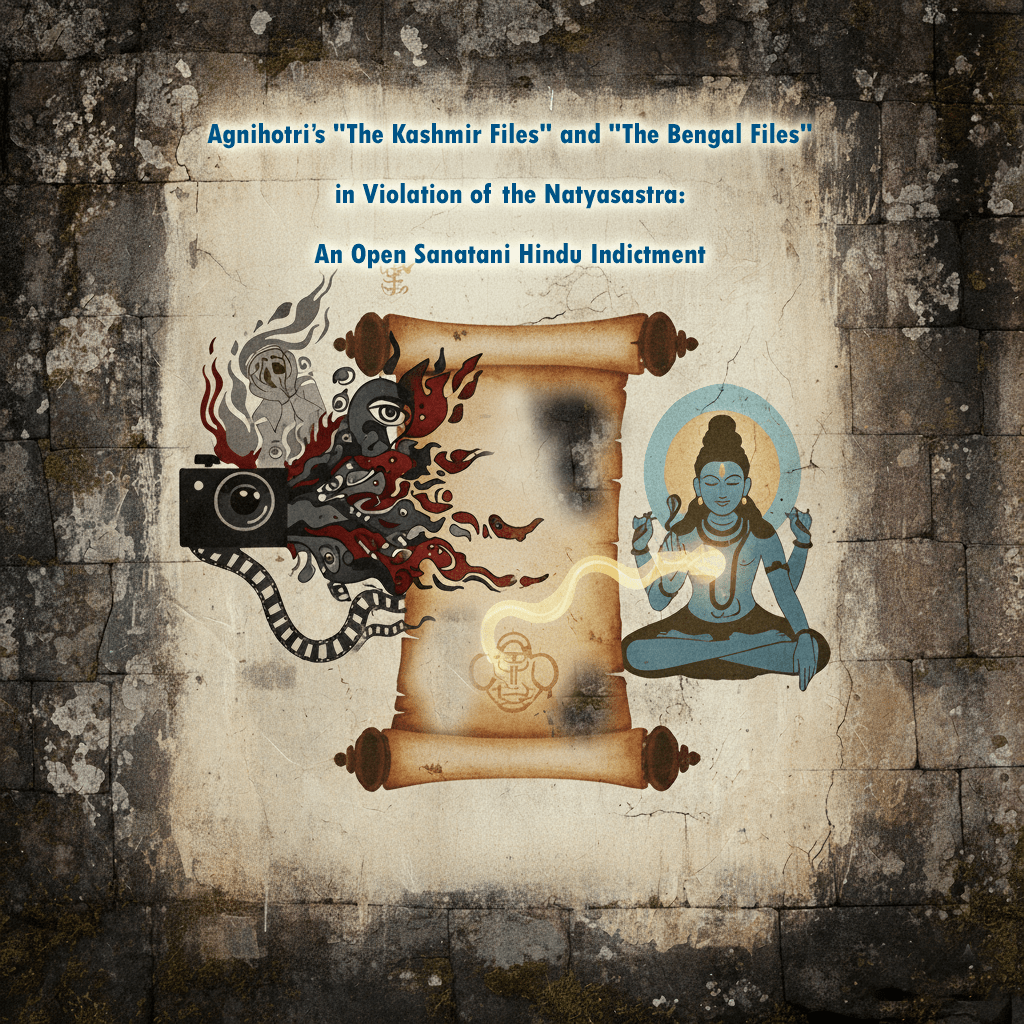
From the heart of Akhaṇḍ Hindutva, a Sanātanī Hindu United Family (HUF) indicts Vivek Agnihotri’s The Kashmir Files and The Bengal Files for brazenly violating Bharata Muni’s sacred Nāṭyaśāstra—turning Hindu grief into voyeuristic gore, rape imagery, and blood-spectacle. What claims to defend Sanātana Dharma abandons rasa, maryādā, and ahiṁsā, replacing ethical restraint with tāmasika exhibitionism and propaganda rage. True Hindutva demands dharma, not degeneration.
To
The Hon’ble Chairperson
Central Board of Film Certification (CBFC)
Mumbai
Through:
The Hon’ble Minister of Information & Broadcasting
Government of India
The Hon’ble Minister of Culture
Government of India
The Hon’ble Chief Executive Officer
Prasar Bharati (Doordarshan & AIR)
Copy to:
- Mr. Vivek Ranjan Agnihotri
- Mrs. Pallavi Joshi
- I Am Buddha Production House
Subject: Formal Condemnation of The Kashmir Files (2022) and The Bengal Files (2025) for Violating Sanātana Hindu Aesthetic-Ethical Traditions as Codified in Bharata Muni’s Nāṭyaśāstra, Despite Their Claim to Represent Hindutva
Respected Authorities,
We write this letter as a Sanātanī Hindu Undivided Family (HUF) that openly, unapologetically, and consistently identifies with Hindutva, Akhaṇḍ Hindutva, and a standardized, pasteurized, genealogical, monolithic conception of Hindu civilizational continuity. Our commitment to Hindutva is not performative, electoral, or cinematic—it is scriptural, civilizational, and ethical.
It is precisely from within Hindutva, and not from its margins, that we must register our strong condemnation of Mr. Vivek Agnihotri’s films The Kashmir Files (2022) and The Bengal Files (2025).
A Grave Civilizational Contradiction
Mr. Agnihotri presents himself—publicly and repeatedly—as a defender of Sanātana Dharma, Hindu civilization, and Hindutva politics. Yet the cinematic methods he deploys in the above films are in direct violation of the foundational Hindu aesthetic-ethical canon, namely Bharata Muni’s Nāṭyaśāstra—a text universally acknowledged as the bedrock of Indian performance theory.
Bharata Muni explicitly prohibits the on-stage depiction of violent catastrophes, actual violence in stage fights, and explicit erotic or intimate acts (including those involving sexual violence) in dramatic forms such as Nāṭaka (heroic plays) and Prakaraṇa (social plays). These prohibitions, rooted in the principles of nāṭya-dharma (dramatic convention), emphasize illusion (vyājika), restraint (maryādā), and the preservation of rasa (aesthetic sentiment/delight) to elevate the audience toward moral and spiritual insight, rather than indulging in shock or voyeurism.
In the context of Sanātana Dharma and Hindutva, which uphold civilizational continuity through ethical aesthetics, such rules prevent the degradation of sacred narratives into mere propagandist spectacle, ensuring that depictions of suffering foster śānta (peace) and dharma (righteousness) instead of rage or sadism. Violating these is not just artistic license; it undermines the very Hindu ethos of balance, decorum, and non-literal representation that Hindutva seeks to revive.
Key prohibitions from the sacred Nāṭyaśāstra include the following injunctions in particular:
Chapter 20, Verse 20
yuddhaṃ rājyabhraṃśo maraṇaṃ nagararopadhanaṃ caiva |
apratyakṣakṛtāni praveśakaiḥ saṃvidheyāni ||
Translation:
A battle, loss of a kingdom, death, and siege of a city not being presentable in an Act should be referred to by means of Introductory Scenes.
Context and Analysis:
Direct on-screen (or on-stage) depiction of battles, sieges, deaths, or catastrophic losses is forbidden due to staging impracticalities and to maintain narrative pace without disrupting the flow of rasa. In Nāṭaka or Prakaraṇa, such events must be narrated off-stage via prāveśaka (introductory scenes) to preserve illusion and ethical flow. Within Hindutva’s framework of Sanātana Dharma, this ensures that violence is not glorified as spectacle but reflected upon morally, preventing the audience from descending into vīra (heroic rage) without resolution toward higher sentiments like karuṇa (compassion) or śānta. Agnihotri’s films, by graphically showing massacres and lynchings, invert this, turning dharma into propaganda.
Chapter 20, Verse 21
aṅke praveśake vā prakaraṇamāśritya nāṭakaṃ vāpi |
na vadhaḥ kartavyaḥ syāt yastatra tu nāyakaḥ khyātaḥ ||
Translation:
In an Act or in an Introductory Scene of the Nāṭaka or the Prakaraṇa, there should be no killing of a person who is known as the Hero.
Context and Analysis:
The hero’s death cannot be shown directly, even in introductory narratives, to safeguard the play’s vitality and heroic rasa. This extends to any central figures embodying dharma, emphasizing indirect allusion to preserve audience decorum. In Hindutva’s civilizational lens, this protects the sanctity of Hindu narratives from tragic realism, fostering resilience over despair—yet these films revel, in one way or the other, in the graphic demise of Hindu protagonists or characters, betraying Sanātana ethics for emotional manipulation.
Chapter 23, Verse 221
moktavyaṃ nāyudhaṃ raṅge na cchedyaṃ na ca tāḍanam |
prādeśamātraṃ gṛhnīyāt saṃjñārthaṃ śastrameva hi ||
Translation:
No missile should be released on the stage, and no weapon should pierce or strike anyone. They should simply touch a spot, and the weapons are to be used only to make a gesture [of an attack].
Context and Analysis:
Actual violence in fights is banned; weapons must simulate through trained gestures to avoid injury and fatigue, aligning with nāṭya’s illusory nature. For Hindutva adherents, this reflects ahiṃsā (non-violence) in art, where violence is suggested poetically to evoke reflection, not horror. Agnihotri’s use of explicit stabbings, shootings (especially through what Foucault called the “spectacle of the scaffold“), and gore defies this, reducing sacred Hindu suffering to blood-soaked entertainment.
Chapter 24, Verses 292–293
yadā svapedārthavaśād ekākī sahito’pi vā |
cumbanāliṅganaṃ caiva tathā guhyaṃ ca yad bhavet || dantacchedyaṃ nakhakṣataṃ nīvīsraṃsanam eva ca |
stanādharavimardaṃ ca raṅgamadhye na kārayet ||
Translation:
“If out of any necessity anyone sleeps alone or with anyone, no kiss or embrace or any other private acts such as biting, scratching with nails, loosening the Nīvi, the pressing of breasts and lips, should be presented on the stage.”
Context and Analysis:
Explicit erotic or intimate acts, including those in sleep or privacy scenes, are prohibited to uphold decorum for family audiences, as per Verse 295’s rationale: plays are viewed by fathers, sons, mothers-in-law, and daughters-in-law together. In Sanātana Dharma, this maintains śṛṅgāra (erotic sentiment, self cultivation, self culturation, care of the self, epimeleia heautou) as subtle and elevating, not voyeuristic. Extending to sexual violence like r*pe, which involves forced intimacy, such depictions are antithetical, as they transform trauma into indecent spectacle. Hindutva’s ethical revival demands restraint here, yet Agnihotri’s films linger on r*pe or gang r*pe or implicates sexual violence, violating this core tenet.
What These Films Actually Do
Thematically speaking, both The Kashmir Files and The Bengal Files repeatedly indulge in:
- Graphic bloodshed and lynching sequences, including mass killings, burnings, and forced migrations framed as “genocide,” with blood-soaked montages that evoke horror rather than reflection.
- Lingering depictions and references to r*pe and sexual violence, such as a graphic r*pe scene shown twice in The Kashmir Files, and r*pe scenes lingered on for shock value in The Bengal Files, including implications of gang r*pe and disembowelment.
- Gore-heavy montages designed to shock rather than elevate, featuring severed limbs in slow-motion, torture, stabbings, slashings, beatings, explosions, and mobs wielding machetes or improvised weapons—rated as “severe” violence and gore in parental guides.
- An obsession with wounded Hindu bodies, including reenactments of Hindus being r*ped, tortured, and chopped on sawmills while alive, or women torched in temples, all presented as brutal, relentless “torture porn.”
This is not Hindu aesthetics.
This is spectacularized violence, indistinguishable from the very civilizational degeneration that Hindutva claims to oppose.
One must ask, plainly and without euphemism:
How can a filmmaker claiming allegiance to Sanātana Dharma violate Bharata Muni so brazenly?
Propaganda Is Not Dharma
We make this point with full clarity:
- Hindu grief is real. Hindus are in danger, yes.
- Hindu suffering deserves remembrance.
- Historical injustices must be acknowledged.
However, Hindu Dharma does not permit the transformation of grief into voyeuristic blood-spectacle—a profound philosophical betrayal that indulges both voyeurism and exhibitionism, trapping the soul deeper in māyā and saṁsāra.
Voyeurism here is the tamasic consumption of others’ suffering for sensory thrill or detached titillation, binding the viewer to rāga (attachment) and avidyā (ignorance), as warned in the Bhagavad Gītā (2.47; 3.6): unchecked indulgence in sense-objects perpetuates duḥkha rather than leading to equanimity and ātma-jñāna.
Exhibitionism, in turn, is the rajasic or tamasic display of sacred grief for ego, fame, or political gain—commodifying duḥkha under the guise of “truth,” reinforcing illusion and karma-bandha instead of fostering detachment and moksha.
Both violate ahiṁsā in art, maryādā in expression, and the Nāṭyaśāstra’s mandate for subtle, illusory representation that elevates toward śānta-rasa and dharma, not rage or sadism. True remembrance of suffering must awaken wisdom and compassion, not exploit it as spectacle that delays liberation.
By foregrounding gore, r*pe imagery, and punitive vengeance fantasies, these films abandon rasa for rage, śānta for sadism, and dharma for propaganda.
This is not Itihāsa.
This is not Smṛti.
This is not Saṁskāra.
It is political agitation dressed in saffron costume, and that too achieved by violating Hindu civilizational norms, not upholding them.
A Question to the State and Its Institutions
We therefore ask the Hon’ble decision-makers at CBFC, Prasar Bharati, and the Ministry of Culture:
- On what grounds were these films certified, promoted, and in some cases institutionally amplified?
- Why was Nāṭyaśāstra, the very spine of Hindu aesthetics, ignored?
- Why is Hindutva allowed to be represented only through blood, r*pe, and cinematic hysteria, rather than restraint, moral gravity, and civilizational depth?
If such films were made in the name of any other religious tradition, objections would have been immediate. Why is Sanātana Dharma treated as expendable, even by those claiming to defend it?
Our Position, Unambiguously
Let there be no misunderstanding:
- We are not secular liberals or Urban Naxals.
- We are not leftists.
- We are not anti-Hindu.
- We are not anti-Hindutva.
We are Sanātanī Hindus who believe that Hindutva without Dharma is merely majoritarian spectacle.
To weaponize Hindu pain while discarding Hindu ethics is not courage—it is civilizational illiteracy.
Our Demand
We formally demand:
- Public condemnation of the explicit depiction of gore, r*pe, and violence in these films as contrary to Hindu aesthetic tradition.
- A review of CBFC certification practices vis-à-vis films claiming to represent Hindu civilization.
- A clear statement from cultural authorities affirming that Sanātana Dharma is not compatible with such violence, even when politically convenient.
Conclusion
Bharata Muni did not write the Nāṭyaśāstra so that Hindu suffering could be converted into box-office spectacle and electoral affect.
Hindutva that forgets Bharata Muni, rasa, maryādā, and ethical restraint is not civilizational revival—it is degeneration.
We condemn these films not despite being Hindutvavādīs, but because we are.
Your Most Obedient Servant(s),
For and on behalf of
Once in a Blue Moon Academia
A Hindu Undivided Family (HUF)
Sanātanī | Hindutvavādī | Akhaṇḍ Hindutva-believing household
बहुजनहिताय बहुजनसुखाय च॥
(“For the happiness of the many, for the welfare of the many”)
Bibliography
- Bharata Muni. (1951–1967). The Nāṭyaśāstra: A treatise on ancient Indian dramaturgy and histrionics (M. Ghosh, Trans.; Vols. 1–2). Asiatic Society.
- Bharata Muni. (1982). Natyasastra (S. Bandyopadhyay & C. Chakrabarti, Trans.). Navapatra Prakashan.
- Bharata Muni. (n.d.). The Nāṭyaśāstra (M. Ghosh, Trans.). Wisdom Library. https://www.wisdomlib.org/hinduism/book/the-natyashastra (Original work published 1951)
- Vatsyayan, K. (1996). Bharata: The Nāṭyaśāstra. Sahitya Akademi.

 Once in a Blue Moon Academia